
Talks for Autumn 2026
Tuesdays 15:30–16:30, HERB.4.TR2 unless otherwise stated.
Details of Autumn 2026 talks will be added here.
Tuesday 6 October 2026
Speaker: Gregory Debruyne (Ghent University)
Tuesday 13 October 2026
Speaker: Ryan O’Loughlin (University of Reading)
Title:
Abstract:
Tuesday 20 October 2026
Tuesday 26 October 2026
Speaker: Takuya Takeishi (Kyoto Institute of Technology)
Title: TBA
Abstract: TBA
Tuesday 3 Novemer 2026 - no talk!
No talk – this is the enrichment week.
Tuesday 10 November 2026
Tuesday 17 November 2026
Tuesday 24 November 2026
Tuesday 1 December 2026
Tuesday 8 December 2026
Speaker: Lyonell Boulton (Heriot-Watt University)
Title: Completeness of trajectories in Hilbert spaces
Abstract: In this talk we will report on a framework to determine the linear completeness of families of non-linear trajectories in Hilbert spaces, which relies on an infinite analytic block Toeplitz operator formulation. By means of this approach, we show the linear completeness in Sobolev spaces of two families of classical functions. One is the moving family of dilated Weierstrass functions. The other is the family of eigenfunctions of the Gross-Pitaevskii equation with trapping potential in an infinite square well. Our results provide a new insight on the formulation of general methods to examine this intriguing concept, bridging classical non-linear analysis and linear approximation theory. The research has been conducted jointly with Connor Evans (Heriot-Watt University).
Tuesday 2026
Speaker: Xiao-Qi Lu (University of Glasgow)
Title: TBA
Abstract: TBA
Speaker: Jakub Curda (University of Oxford)
Title: TBA
Abstract: TBA
Speaker: Joshua Johansson (University of New South Wales)
Title: TBA
Abstract: TBA
Speaker: Stuart Hall (Newcastle University)
Title: TBA
Abstract: TBA
Previous Semesters
Spring 2026
Tuesday 3 February 2026
Speaker: Ujan Chakraborty (University of Glasgow)
Title: Ergodic Average Dominance for Unimodular Amenable Groups
Abstract: We show that the ergodic averages of the action of any unimodular amenable group along certain Følner sequences can be dominated by the Cesàro means of a suitably constructed Markov operator, that is, the ergodic averages of an integer action. Moreover, the restrictions on these Følner sequences are mild enough so that every two-sided Følner sequence has a subsequence satisfying these conditions. As a consequence of this inequality, we obtain the maximal and pointwise (individual) ergodic theorems for actions of unimodular amenable groups directly from the corresponding ergodic theorems for integer actions. One of the major difficulties in existing proofs of ergodic theorems for amenable groups is obtaining the appropriate maximal inequalities. This difficulty is circumvented by the new methods we develop, which further allow us to deal with the commutative and noncommutative ergodic theorems on an equal footing. This is joint work with R. Xia and J. Zacharias: https://arxiv.org/abs/2512.12894
Tuesday 10 February 2026 — two talks
Speaker 1: Are Austad (University of Oslo) — 2:00–3:00pm
Title: A new characterization of discrete groups yielding compact quantum metric spaces
Abstract: A compact quantum metric space (CQMS) is a non-commutative analogue of a compact metric space. We give an introduction to this concept, along with a novel approach on how to obtain CQMSs from discrete groups equipped with length functions. This will allow us to rephrase important results of Christ-Rieffel and Ozawa-Rieffel. Moreover, we will explain how the new approach relates to a problem concerning obtaining CQMSs from groups with rapid decay.
Speaker 2: Sanaz Pooya (University of Potsdam) — 3:30–4:30pm
Title: Higher Kazhdan projections and their K-theory
Abstract: Many important properties of groups can be detected by studying the algebraic structures naturally associated with them. A well-known example is Kazhdan’s property (T), which can be characterised by a special element called a Kazhdan projection. It lives in the universal group C*-algebra and is therefore of an operator algebraic nature.
In this talk, I will describe higher-dimensional analogues of this construction called higher Kazhdan projections. These capture topological information beyond the classical rigidity phenomena associated with property (T) groups and can exist even in groups that do not have property (T).
I will then explain how higher Kazhdan projections naturally give rise to K-theory classes and how numerical invariants can be extracted from them via trace pairings. This framework provides new tools for studying delocalised ℓ²-Betti numbers and leads to explicit computations for groups.
Tuesday 17 February 2026
Speaker: Shintaro Nishikawa (University of Southampton)
Title: On the Baum–Connes Conjecture with Finite Wreath Products
Abstract: The Baum–Connes conjecture (BC) is a central problem in noncommutative geometry, proposing a topological description of the K-theory of group C*-algebras, objects which are inherently analytic in nature. The Baum–Connes conjecture with coefficients (BCC) is a stronger form of this statement. However, the BCC remains open for higher-rank simple Lie groups, and even in the real rank one case, its status has been subtle.
In this talk, I will introduce the “Baum–Connes conjecture with finite wreath products.” Inspired by the Farrell–Jones conjecture with finite wreath products, I will explain its advantages and permanence properties. I will also discuss a new result relating this conjecture to the power functor in KK-theory. This is joint work with Nansen Petrosyan.
Tuesday 24 February 2026
Speaker: Safoura Zadeh (University of Bristol)
Title: Absolute dilation of Fourier multipliers
Abstract: Rota’s Alternierende Verfahren theorem in classical probability theory, which examines the convergence of iterates of measure preserving Markov operators, relies on a dilation technique. In the noncommutative setting of von Neumann algebras, this idea leads to the notion of absolute dilation.
In this talk, we explore when a Fourier multiplier on a group von Neumann algebra is absolutely dilatable. We discuss conditions that guarantee absolute dilatability and present an explicit counterexample — a Fourier multiplier that does not satisfy this property. This talk is based on a joint work with Christian Le Merdy.
Tuesday 3 March 2026 — two talks
Speaker 1: Alain Valette (University of Neuchâtel) — 2:00–3:00pm
Title: Reciprocal hyperbolic elements in PSL_2(\Z)
Abstract: An element A in PSL_2(\Z) is hyperbolic if |Tr(A)| > 2. The maximal virtually abelian subgroup of PSL_2(\Z) containing A is either infinite cyclic or infinite dihedral; say that A is reciprocal if the second case happens, so that A is conjugate to its inverse. We give a characterization of reciprocal hyperbolic elements in PSL_2(\Z) in terms of the continued fractions of their fixed points in P^1(\R), which are quadratic surds. Doing so we revisit results of P. Sarnak (2007), themselves rooted in classical work by Gauss and Fricke–Klein. This is joint work with C.-L. Simon (Rennes).
Speaker 2: Nóra Szakács (University of Manchester) — 3:30–4:40pm
Title: Singular functions in groupoid algebras
Abstract: Given a Hausdorff, locally compact, étale groupoid, its reduced C*-algebra is simple when the groupoid is minimal and effective, and in the amenable case this is an exact characterization. Minimality and effectiveness also characterizes the simplicity of the Steinberg algebra associated to the groupoid, which is a dense subalgebra of the groupoid C*-algebra studied in its own right. Without the Hausdorff condition, minimality and effectiveness are no longer sufficient to ensure simplicity in either setting: the first groupoid to showcase this behaviour was given by Nekrashevych, and arises from a self-similar group action. In this case, functions whose strict support contains no open set form maximal ideals in both the Steinberg algebra as well as the reduced C*-algebra, called the algebraic/C*-singular ideal. A natural problem that arises is to understand the relationship between the simplicity of the complex Steinberg algebra and the reduced C*-algebra: it is an open question whether algebraic simplicity implies C*-simplicity, or in other words, whether the C*-singular ideal can always be detected at the level of the Steinberg algebra. For several classes of groupoids, including for example those arising from contracting self-similar groups, the answer is known to be positive. A more general question is whether the algebraic singular ideal is always dense in the C*-singular one. In the talk, I will present a construction answering this negatively. This is joint work with Diego Martínez.
Tuesday 10 March 2026 — unusual room: AGRB.CSLT
Speaker: Greg Patchell (University of Oxford)
Title: Selfless Inclusions of C*-Algebras and Quantum Groups
Abstract: Recently, strong asymptotic freeness, or selflessness, in C*-algebras has emerged as a powerful technique to prove important regularity properties including simplicity, unique trace, stable rank 1, and strict comparison. In particular, in Fall 2024, Amrutam, Gao, Kunnwalkam Elayavalli, and I showed that the reduced group C*-algebras of all hyperbolic groups with trivial finite radical are selfless, which resolved the open problem of strict comparison for the reduced group C*-algebra of the free group on two generators. Since then, our result has been expanded to include a much larger class of groups. Work has also begun on isolating selflessness for C*-algebras not arising from groups, including the result of Hayes, Kunnawalkam Elayavalli, and Robert on selflessness of the reduced free product of a large class of C*-algebras. I will introduce the general notion of a selfless inclusion of C*-algebras, with which we will see the selflessness of the reduced unitary compact matrix quantum groups. This work is joint with Ben Hayes, Srivatsav Kunnawalkam Elayavalli, and Leonel Robert.
Tuesday 17 March 2026
Speaker: Joachim Zacharias (University of Glasgow)
Title: AF-Embeddings of Decomposition Rank 1 Algebras
Abstract: AF-embeddability, i.e. the question whether a given C*-algebra can be realised as a subalgebra of an AF-algebra, has been studied for a long time, with prominent early results by Pimsner and Voiculescu, who constructed such embeddings for irrational rotation algebras in 1978. Since then many AF-embeddings have been constructed for concrete examples, but also many non-constructive AF-embeddability results have been obtained for whole classes of algebras which typically assume the UCT to hold.
In this talk we consider a separable unital C*-algebra A of decomposition rank at most 1 and construct from a suitable system of 1-decomposable cpc-approximations an AF-algebra E, and an embedding of A into E, without assuming the UCT. As an application we can show AF-embeddability of quasidiagonal simple nuclear unique trace C*-algebras, more generally with only QD-traces, without assuming the UCT.
Tuesday 21 April 2026
Speaker: Michael Dritschel (Newcastle University)
Title: Hermitian indices and factorization of selfadjoint operators
Abstract: The hermitian indices of a selfadjoint operator C on a Kreǐn space H are defined as geometric measures of positivity and negativity of the operator. A different pair of indices arises in the Bognár-Krámli factorization of C, which writes C as a product AA* where A acts on a Kreǐn space K into H and has zero kernel; the new indices are the positive and negative indices of K. Such factorizations are far from unique. When H is separable, it is known that the two notions of indices always coincide. This has various applications, and is even of interest when the Kreǐn space is a Hilbert space. A new proof of the equality of indices that does not require separability is discussed.
This is joint work with Alejandra Maestripieri and Jim Rovnyak.
Wednesday 27 May 2026, 4:00–5:00pm in HERB.G LT1 — unusual time, date, and place
Speaker: Rachid El Harti (Hassan I University)
Title: On the crossed product Banach algebras associated with dynamical systems
Abstract: Starting from a locally compact group, a concrete Banach algebra, and an action of this group on the algebra, we construct an equally concrete algebra, called a Banach cross-product algebra, associated with a dynamical system. The study of this class of algebras plays a very important role in abstract harmonic analysis and representation theory. Furthermore, we investigate the conditions under which this class is Hermitian or amenable.
Autumn 2025
Tuesday 23 September 2025
Speaker: Christian Bönicke (Newcastle University)
Title: Nuclear dimension of groupoid C*-algebras
Abstract: Nuclear dimension is a noncommutative generalisation of Lebesgue covering dimension for compact Hausdorff spaces. Finiteness of this dimension plays an important role in the classification programme for simple nuclear C*-algebras. In this talk I give a brief introduction to this dimension theory and explain some results estimating the nuclear dimension for étale groupoid C*-algebras.
Tuesday 30 September 2025
Speaker: Niels Laustsen (Lancaster University)
Title: Equivalence after extension and Schur coupling for Fredholm operators on Banach spaces
Abstract: I shall report on joint work with Sanne ter Horst (North-West University, South Africa), in which we study two relations for bounded operators on Banach spaces: equivalence after extension (EAE) and Schur coupling (SC). They originate in the study of integral equations and have found numerous applications, often relying on a proof that they coincide in the case at hand.
More precisely, it has been known for 30 years that SC implies EAE, but only recently Ter Horst, Messerschmidt, Ran and Roelands disproved the converse by constructing a pair of Fredholm operators which are EAE, but not SC.
Motivated by this result, we investigate when EAE and SC coincide for Fredholm operators. Fredholm operators which are EAE have the same Fredholm index. Surprisingly, we find that for each integer n and every pair of Banach spaces (X,Y), either no pair of Fredholm operators of index n acting on X and Y, respectively, is SC, or every pair of this kind which is EAE is also SC.
Consequently, whether EAE and SC coincide for Fredholm operators of index n depends only on the geometry of the underlying Banach spaces X and Y, not on the properties of the operators themselves.
I intend to make the talk accessible to a broad audience of analysts; in particular, I shall not assume any prior knowledge of EAE and SC or specialist knowledge of Banach space theory.
Tuesday 7 October 2025
Speaker: Francesca Tripaldi (University of Leeds)
Title: Extracting subcomplexes in the subRiemannian setting
Abstract: On subRiemannian manifolds, the de Rham complex is not the ideal candidate to use to carry out geometric analysis. However, special subcomplexes have successfully been applied in very specific settings, such as Heisenberg groups and the Cartan group. I will give an overview of different techniques used to obtain such subcomplexes, as well as point out their limitations when used on arbitrary Carnot groups, and a possible way to overcome them.
Tuesday 14 October 2025
Speaker: Rhiannon Dougall (Durham University)
Title: From the thermodynamic formalism to convolution of probability in discrete groups
Abstract: This talk will involve analysis on a discrete countable group. The analysis we are interested in is to describe limiting quantities associated to self-convolution of a probability function. Quantities associated to random walks on the group. This is well-studied in the case where the probability is symmetric, whence one also benefits from self-adjointness of related operators. I’ll motivate the topic with how fundamental quantities associated to the group often appear in the limit. I’ll also explain a new result: a ratio limit theorem for amenable groups, and highlight the role and novelty of a thermodynamic mindset in this area.
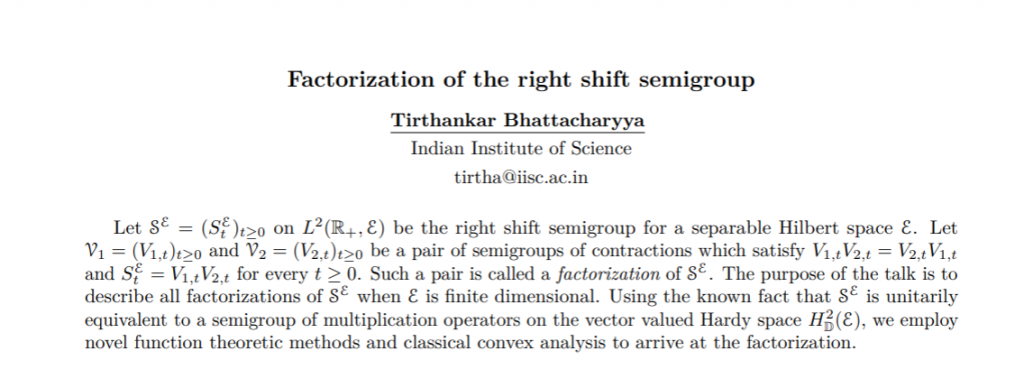
Wednesday 15 October 2025, 3:00–4:00pm, HERB.4.TR2
Speaker: Tirthankar Bhattacharyya (Indian Institute of Science, Bangalore)
Tuesday 21 October 2025
Speaker: Andrew S. Toms (University of Oxford and Purdue University)
Title: Homotopy groups of Cuntz classes in C*-algebras
Abstract: The Cuntz semigroup of a C*-algebra A consists of equivalence classes of positive elements, where equivalence means roughly that two positive elements have the same rank relative to A. It can be thought of as a generalization of the Murray von Neumann semigroup to positive elements and is an incredibly sensitive invariant. We give a brief introduction to this object and its relevance to the classification theory of separable nuclear C*-algebras. We then present a calculation of the homotopy groups of these Cuntz classes as topological subspaces of A when A is classifiable in the sense of Elliott.
Tuesday 28 October 2025
Speaker: Julian Gonzales (University of Glasgow)
Title: On dense subalgebras of the singular ideal in groupoid C*-algebras
Abstract: Groupoids provide a rich supply of C*-algebras, and there are many results describing the structure of these C*-algebras using properties of the underlying groupoid. For non-Hausdorff groupoids, less is known, largely due to the existence of “singular” functions in the reduced C*-algebra. This talk will discuss two approaches to studying ideals in non-Hausdorff groupoid C*-algebras. The first uses Timmermann’s Hausdorff cover to reduce certain problems to the setting of Hausdorff groupoids. The second will restrict to isotropy groups. For amenable second-countable étale groupoids, these techniques allow us to characterise when the ideal of singular functions has dense intersection with the underlying groupoid *-algebra. This is based on joint work with K. A. Brix, J. B. Hume, and X. Li, as well as upcoming work with J. B. Hume.
Tuesday 4 November 2025 — 3:00–4:00pm in HERB.4.TR4 — unusual time and room
Speaker: Ali Wehbe (Lebanese University)
Title: Geometric conditions for the stability of some singular transmission problems
Abstract: We study an elastic/viscoelastic transmission problem governed by coupled partial differential equations in a bounded domain. The stability of the system is strongly influenced by the regularity of the coupling coefficients at the interface and by the geometry of the damping region. By employing a frequency-domain approach combined with a novel multiplier technique, we derive a polynomial energy decay rate under significantly weakened geometric assumptions and without required smoothness of the interface coefficient.
Tuesday 11 November 2025
No talk this week.
Tuesday 18 November 2025
Speaker: Christian Voigt (University of Glasgow)
Title: Equivariant cyclic homology for ample groupoids
Abstract: In this talk I’ll first review how periodic cyclic homology, developed by Connes and Tsygan in the 1980s, can be viewed as an analogue of de Rham cohomology in the realm of noncommutative geometry. Then I’ll explain the construction of an equivariant version of periodic cyclic homology for actions of Hausdorff ample groupoids, and indicate why this theory should be a natural receptacle for an equivariant Chern character from groupoid equivariant bivariant KK-theory. Based on joint work with F. Pagliuca.
Tuesday 25 November 2025
Speaker: Connor Evans
Tuesday 2 December 2025
Speaker: Connor Gauntlett (Newcastle University)
Tuesday 9 December 2025
Speaker: Kasia Rejzner (University of York)
Title: Algebraic Structures in QFT in the Presence of a Quantum Reference Frame
Abstract: I will start with introducing the framework of algebraic quantum field theory, also on curved spacetimes, and explain how to understand measurement in this framework using the approach of Fewster and Verch. In particular, I will demonstrate that in the presence of symmetries one needs to use a quantum reference frame to be able distinguish between measurements related by symmetry transformations. This leads to interesting consequences regarding the type of relevant observable algebras, as observed by Chandrasekaran, Longo, Penington and Witten in the context of QFT on de Sitter. This talk will be mostly based on my joint paper with Fewster, Janssen, Loveridge and Waldron, “Quantum reference frames, measurement schemes and the type of local algebras in quantum field theory.”
Spring 2025
Tuesday 4 February 2025
Speaker: Kevin Aguyar Brix (University of Southern Denmark)
Title: A meditation on flow
Abstract: I will discuss the notion of flow equivalence for several examples of homeomorphisms on 0-dimensional compact Hausdorff spaces, e.g. shifts of finite type, and how it connects to flows on 1-dimensional spaces. It is an ongoing problem to extend this to higher dimensional dynamical systems, and I will explain one approach to this, joint with Elizabeth Gillaspy and David Pask.
Thursday 6 February 2025, 4:00–5:00pm, HERB.4.TR2 — unusual day and time
Speaker: Taro Sogabe (Kyoto University)
Title: Cuntz–Krieger algebras, their Toeplitz extensions and reciprocal algebras
Abstract: The Cuntz–Krieger algebras are typical examples of classifiable C*-algebras and have many interesting structures including the gauge action, computable K-theory and the associated Fock space.
In this talk, I would like to focus on so-called Toeplitz extensions of the Cuntz–Krieger algebras introduced by Fujii–Enomoto–Watatani and Evans, and will explain the strong K-theoretic duality discussed in the joint works with Ulrich Pennig, published, and Kengo Matsumoto, unpublished ongoing joint work.
If time permits, I will explain the reciprocal algebras and a construction of reciprocal algebras of the Cuntz–Krieger algebras.
Tuesday 11 February 2025
Speaker: Lucas Hataishi (University of Oxford)
Title: Discrete C*-algebraic inclusions as quantum symmetries
Abstract: Building on the philosophy started in the theory of subfactors, I will discuss how a class of C*-algebraic inclusions can be described in terms of representations of abstract algebraic and combinatorial objects, known as unitary tensor categories. A particular instance of that description encloses representations of groups, and also of quantum groups, motivating the terminology “quantum symmetries” in the general framework. We call the C*-algebraic inclusions fitting in this framework discrete, since structurally they are similar to crossed products by discrete groups. The main analytical tool used in the characterization of discrete inclusions is a collection of Pimsner-Popa inequalities, explored to construct faithful conditional expectations.
This talk will be based on joint work with Roberto Hernandez Palomares.
Monday 17 February 2025, 4:00–5:00pm, HERB.4.TR1 — unusual day, time, and room
Speaker: Alistair Miller (University of Southern Denmark)
Title: Homology and K-theory for self-similar group actions
Abstract: Self-similar groups are groups of automorphisms of infinite rooted trees obeying a simple but powerful rule. Under this rule, groups with exotic properties can be generated from very basic starting data, most famously the Grigorchuk group which was the first example of a group with intermediate growth.
Nekrashevych introduced a groupoid and a C*-algebra for a self-similar group action on a tree as models for some underlying noncommutative space for the system. Our goal is to compute the K-theory of the C*-algebra and the homology of the groupoid. Our main theorem provides long exact sequences which reduce the problems to group theory. I will demonstrate how to apply this theorem to fully compute homology and K-theory through the example of the Grigorchuk group.
This is joint work with Benjamin Steinberg.
Tuesday 18 February 2025
Speaker: Sihan Wei (University of Glasgow)
Title: Groupoid approach of Cuntz-Pimsner C*-algebras of subshifts and their nuclear dimension
Abstract: During the last decades, attempts to associate C*-algebras to arbitrary subshifts have been made to extend and generalize Cuntz-Krieger algebras associated to shifts of finite type. This finally gives the class of Cuntz-Pimsner algebras using C*-correspondence. Among many of its equivalent definitions, a groupoid approach was established by T. Carlsen, i.e. by associating a second countable étale groupoid to every subshift where the Cuntz-Pimsner algebra is isomorphic to the corresponding full groupoid C*-algebra.
In this talk, I will make an overall review of this groupoid approach. A description to the groupoid of a particular class of subshifts will also be given, which allows us to compute the nuclear dimension of their Cuntz-Pimsner algebras upon use of the dynamic asymptotic dimension. The talk is based on a joint work with Z. He, and the previous result of K. Brix.
Tuesday 25 February 2025 — moved to room KGVI.1.12
Speaker: David Kimsey (Newcastle University)
Title: Multivariate moment indeterminateness: separating functions and bounded point evaluations
Abstract: The discrete data encoded in the power moments of a positive measure fast decaying at infinity on Euclidean space is incomplete for recovery, leading to the concept of moment indeterminateness. On the other hand classical integral transforms, Fourier-Laplace, Fantappiè, Poisson, of such measures are complete, often invertible via an effective inverse operation. The gap between the two non-uniqueness/uniqueness phenomena is manifest in the dual picture when trying to extend the measure regarded as a positive linear functional from the polynomial algebra to the full space of continuous functions. This point of view was advocated by Marcel Riesz a century ago in the single real variable setting. Notable advances in functional analysis have root in Riesz’ celebrated four notes devoted to the moment problem. A key technical ingredient being there the monotone approximation by polynomials of kernels of integral transforms. With inherent new obstacles we reappraise in the context of several real variables M. Riesz’ variational principle. The result is an array of necessary and sufficient moment indeterminateness criteria, some raising real algebra questions, others involving intriguing analytic problems, all gravitating around the concept of moment separating function.
This talk is based on joint work with Mihai Putinar.
Friday 14 March 2025, 3:00–4:00pm, HERB.4.TR1 — unusual day, time, and room
Speaker: Sophie Emma Zegers (Delft University of Technology)
Title: On the classification of quantum lens spaces
Abstract: In the study of noncommutative geometry, various classical spaces have been given a quantum analogue. A class of examples are the quantum lens spaces described by Hong and Szymański as graph C*-algebras. The graph C*-algebraic description has made it possible to obtain important information about their structure and to work on classification. Moreover, every quantum lens space comes with a natural circle action, leading to an equivariant isomorphisms problem.
In this talk, I will give a brief introduction on how to classify quantum lens spaces and how to obtain a number theoretic invariant in low dimensions. Moreover, I will present my recent joint work with Søren Eilers on the existence and construction of equivariant isomorphisms of low dimensional quantum lens spaces.
Tuesday 29 April 2025
Speaker: Haluk Sengun (University of Sheffield)
Title: Unitary representations of groups and operator algebras
Abstract: The representation theory of locally compact groups and operator algebra theory had important interactions very early in their infant years but they began to move in separate directions afterwards. Recent years have seen efforts to bring the two theories back together in the fundamental case of reductive groups.
In this expository talk, we will touch upon some of these synergies: the interactions in the theory of unitary induction dating back to the 1970s and the recently discovered interactions in the theory of theta correspondence, also known as Howe duality. This is based on joint works with Bram Mesland (Leiden) and with Magnus Goffeng (Lund).
Tuesday 6 May 2025
Speaker: Jennifer Pi (University of Oxford)
Title: A Logical Classification Theorem for C*-Algebras
Abstract: I discuss a logical variant of the classification program for C*-algebras, proving that a particular kind of logical equivalence of the Elliott invariant implies equivalence of C*-algebras. This answers a question posed in the paper “Games on AF-Algebras”, by de Bondt, Vaccaro, Velickovic, and Vignati. The proof uses some descriptive set theory and a novel way of representing KK-equivalence of C*-algebras in terms of first-order model theory. In particular, the key is proving that the set of separable C*-algebras satisfying the UCT is an analytic set, in the sense of descriptive set theory. This is work-in-progress with Michał Szachniewicz and Mira Tartarotti.
Tuesday 22 July 2025
Speaker: Ilija Tolich (Victoria University of Wellington)
Title: Stably finite and purely infinite crossed products
Abstract: The C*-algebras associated to étale groupoids can be viewed as a crossed product: the inverse semigroup of bisections acting on the commutative continuous functions on the unit space. Using this as our model we can consider inverse semigroup crossed products of noncommutative C*-algebras.
For certain classes of groupoids there is a known dichotomy: the groupoid C*-algebra is either stably finite or purely infinite. This extends a dichotomy for classes of classifiable C*-algebras. The key construction in these proofs is a type semigroup arising from the dynamics on the underlying Hausdorff unit space.
In order to accommodate arbitrary C*-algebras we use the Cuntz semigroup as a noncommutative replacement for the unit space to build a type semigroup. We will outline the crossed product construction and present work towards the purely infinite–stably finite dichotomy.
Joint work with Becky Armstrong, Lisa Orloff Clark, Astrid an Huef and Diego Martínez.
Autumn 2024
Friday 27 September 2024
Speaker: Tirthankar Bhattacharyya (Indian Institute of Science, Bangalore)
Title: Herglotz and Caratheodory over the ages
Abstract: Herglotz’s representation of holomorphic functions with positive real part and Caratheodory’s theorem on approximation by inner functions are two well-known classical results in the theory of holomorphic functions on the unit disc. In this talk, we shall first see that they are equivalent. On a multi-connected domain Ω, a version of Herglotz’s representation is known. Caratheodory’s approximation was not known. This will be formulated. We then show that it is equivalent to the known form of Herglotz’s representation.
Additionally, it also enables us to prove a new Herglotz’s representation in the style of Koranyi and Pukanszky. Of particular interest is the fact that the scaling technique of the disc is replaced by Caratheodory’s approximation theorem while proving this new form of Herglotz’s representation. Caratheodory’s approximation theorem is also proved for matrix-valued functions on a multi-connected domain. The part of this talk which is new is joint work with Poornendu Kumar and Mainak Bhowmik.
Tuesday 1 October 2024
Speaker: Takuya Takeishi (Kyoto Institute of Technology)
Title: Groupoid homology and K-theory for algebraic actions from number theory
Abstract: By the work of Bruce and Li, the topological full group (TFG) of the groupoid associated to the ring C*-algebra for the ring of integers of a number field is known to be a complete invariant for number fields, but it is now clear how basic invariants of number fields are reflected in the TFG. For the first step to understand this TFG, we show that the extension degree over the rational field coincides with the smallest degree such that the group homology of the TFG does not vanish. We show it by the calculation of the groupoid homology. For another application of this computation, we give another proof of Li–Lück’s computation of the K-theory of the ring C*-algebras. We also compute the groupoid homology of Barlak–Omland–Stammeier groupoids and solve the conjecture for K-theory of their C*-algebras. This is a joint work with C. Bruce and Y. Kubota.
Tuesday 8 October 2024
Speaker: Zinaida Lykova (Newcastle University)
Tuesday 15 October 2024
Speaker: David Seifert (Newcastle University)
Title: A non-uniform stability result of Datko–Pazy type
Abstract: The Datko–Pazy theorem characterises uniform exponential stability of strongly continuous operator semigroups in terms of an integrability condition. It is a cornerstone of the classical stability theory of operator semigroups. More recent work, in some cases motivated by applications to evolution equations, has focussed on weaker quantitative notions of stability. After reviewing some background on the stability theory of operator semigroups I shall present a simple adaptation of the classical Datko–Pazy theorem for non-uniform polynomial stability of a bounded semigroup, and discuss some consequences of this result. The talk is based on joint work with Nicolas Vanspranghe and Lassi Paunonen.
Tuesday 22 October 2024
Speaker: Andrea Vaccaro (Universität Münster)
Title: Uniform property Gamma and the small boundary property
Abstract: Uniform property Gamma is an adaptation of the well-studied concept of property Gamma, from tracial von Neumann algebras, to the framework of tracial C*-algebras. In this talk I will give an overview of the role played by uniform property Gamma in the study of simple nuclear C*-algebras, particularly in relation to the Toms–Winter conjecture, and I will discuss the connections and relations that this property has with the notion of small boundary property for topological dynamical systems.
Tuesday 29 October 2024
Speaker: Ben Bouwen (University of Southern Denmark)
Title: A unified approach for classifying simple nuclear C*-algebras
Abstract: The classification program of C*-algebras aims to classify simple, separable, nuclear C*-algebras by their K-theory and traces, inspired by analogous results obtained for von Neumann algebras. A landmark result in this project was obtained in 2015, building upon the work of numerous researchers over the preceding 20 years. More recently, Carrión, Gabe, Schafhauser, Tikuisis and White developed a new, more abstract approach to classification, which connects more explicitly to the von Neumann algebraic classification results. In their paper, they carry out this approach in the stably finite setting, while for the purely infinite case, they refer to the original result obtained by Kirchberg and Phillips. In this talk, I provide an overview of how the new approach can be adapted to classify purely infinite C*-algebras, recovering the Kirchberg–Phillips classification by K-theory and obtaining Kirchberg’s absorption theorems as corollaries of classification rather than pivotal ingredients. This is joint work with Jamie Gabe.
Tuesday 12 November 2024 — two talks
Speaker 1: Malte Leimbach (Radboud University) — 2:00–3:00pm
Title: Spectral truncations and convergence of compact quantum metric spaces
Abstract: A fundamental principle of noncommutative geometry is to encode geometric information by spectral data, formalised in the notion of spectral triples. In physical practice there are, however, always obstructions on the availability of such data, and one might be led to considering truncated versions of spectral triples instead. In this talk we will take a closer look at this formalism and explore it within the framework of compact quantum metric spaces. In particular, we will discuss how one might appropriately approximate spectral triples by their truncated versions. As concrete examples we will consider spectral truncations of tori and Peter–Weyl truncations of compact quantum groups.
Speaker 2: Joan Bosa (Universidad de Zaragoza) — 3:30–4:30pm
Title: Almost Elementary Dynamical Systems
Abstract: Motivated by recent work on dynamical analogues of the Toms–Winter conjecture, we propose an extension of Kerr’s notion of almost finiteness for actions of discrete groups on compact metric spaces to actions on general C*-algebras by generalising the concept of castle. We call such actions almost elementary and study these dynamical systems in different frameworks. For instance, we show that they lead to Z-stable crossed products, if these are simple, and that for actions of the trivial group our condition is a weak form of being tracially AF or having tracial nuclear dimension 0.
Tuesday 19 November 2024 — cancelled
Speaker: Jeremy Hume (University of Glasgow) — Cancelled
Title: Dynamical Covers
Abstract: A method to understand a dynamical system is to study simpler and better behaved systems that factor onto it, which we will call “covers”. For instance, this method can be successfully employed to prove the existence of unique measures of maximal entropy and provide combinatorial classifications for symbolic dynamical systems known as sofic sub-shifts.
The talk is based on the pre-print https://arxiv.org/abs/2408.11917, joint work with Kevin Brix and Xin Li, where we construct covers that generalize the ones in symbolic dynamics responsible for the two mentioned successes. We will discuss the functorial and universal properties of the constructions which make the covers computable in practice. We will also describe some relationships between properties of the original systems and properties of their covers, and provide applications to C*-algebras of semi-étale groupoids.
Tuesday 26 November 2024
Speaker: Shanshan Hua (University of Oxford)
Title: Uniqueness theorems for maps into II1-factors and ultraproducts of matrices
Abstract: Over the past few decades, the classification results for C*-algebras have been built on those of morphisms. In the recent work of Carrión, Gabe, Schafhauser, Tikuisis and White, they recaptured the classification theorem for a large class of simple Z-stable C*-algebras by classifying maps into such C*-algebras. Following their abstract classification framework, we go beyond the range of currently existing classification results. For instance, as part of our results, uniqueness theorems for maps into II1-factors and ultraproducts of matrices are obtained, where codomain C*-algebras are either not known to admit Z-stability or are known to lack Z-stability.
Tuesday 3 December 2024
Speaker: Andrew Pritchard (Newcastle University)
Title: Semi-uniform stability of semigroups and their cogenerators
Abstract: Semi-uniform stability for a strongly continuous semigroup refers to the stability of classical solutions of a linear evolution equation. The cogenerator of a strongly continuous semigroup is a bounded linear operator defined as the Cayley transform of the generator. In this talk, I will present some results relating the quantified stability of strongly continuous semigroups with that of the discrete semigroup given by powers of the cogenerator. These results are obtained through two distinct approaches. The first approach is based on resolvent estimates and uses a quantified version of the Katznelson–Tzafriri theorem. The second approach is based on an integrability condition and the boundedness of a certain vector-valued integral transform.
This talk is based on joint work with David Seifert.
Tuesday 10 December 2024
Speaker: Apurva Seth (University of Oxford)