
As seen in the UN’s Sustainable Development Goals, sustainability is a major concern across all aspects of society due both to the far-reaching challenges of climate change and the impacts that modern life has on environment. Having said this, our attention can sometimes focus on certain aspects of society (such as the fossil fuel industry) more than others and one area where sustainability can be missed at times is healthcare (Sherman et al. 2020). So, to gain a better idea of the challenges and opportunities sustainability can bring to this critical service, I’ve spoken to a range of current students, societies, and academics involved with medicine at Newcastle University.

Why is sustainability important in medicine?
As Nuala Murray from the University’s Sustainable Medics Society points out, sustainability and medicine are very relevant to one another for a variety of reasons. Initially, the changing climate is creating a range of novel and dangerous challenges for healthcare practitioners globally, from spreading zones of regional diseases to dealing with the fallout of worsening extreme weather events (Abbasi et al., 2023). On the other hand, the provision of healthcare itself is a resource intensive process, with the NHS making up around 4% of the UK’s total emissions profile alone (NHS, 2020). This makes healthcare a centre of both adaptation and mitigation in the fight against climate change, underlining the importance of sustainability in healthcare provision. Positively, examples are appearing of key bodies in the sector recognising this reality. For instance, Newcastle NHS Trust were the first NHS trust to issue a Climate Emergency statement (in collaboration with Newcastle University), our NU Med Malaysian Campus has invested in a permanent Eco Lounge, and our own Medical School has a dedicated Sustainable Medicine Lead.
Challenges and opportunities
The medical training, practice, and research provided by our University is vital, but it needs a variety of specific resources to function properly and this can make improving medical sustainability a challenge. I spoke to Oak Taylor, one of our medical students, to get a better idea of how this looks in practice. She pointed out, for instance, that many items, including protective equipment and syringes, are single use by necessity to ensure quality standards and avoid spreading infection. Additionally, she noted that many of the anaesthetic gases that are critical for operations are also very polluting. Despite these challenges, however, there are still lots of opportunities to improve sustainability in medicine. So, while ambulances can’t be electric due to the need to refuel quickly, medicine delivery vans can be electrified, and while front-line protective equipment will need changing regularly, equipment used during training can often be reused. Additionally, many of these steps come with other, additional benefits, such as improvements to air quality from using electric vehicles or boosting patient satisfaction by greening hospital grounds.
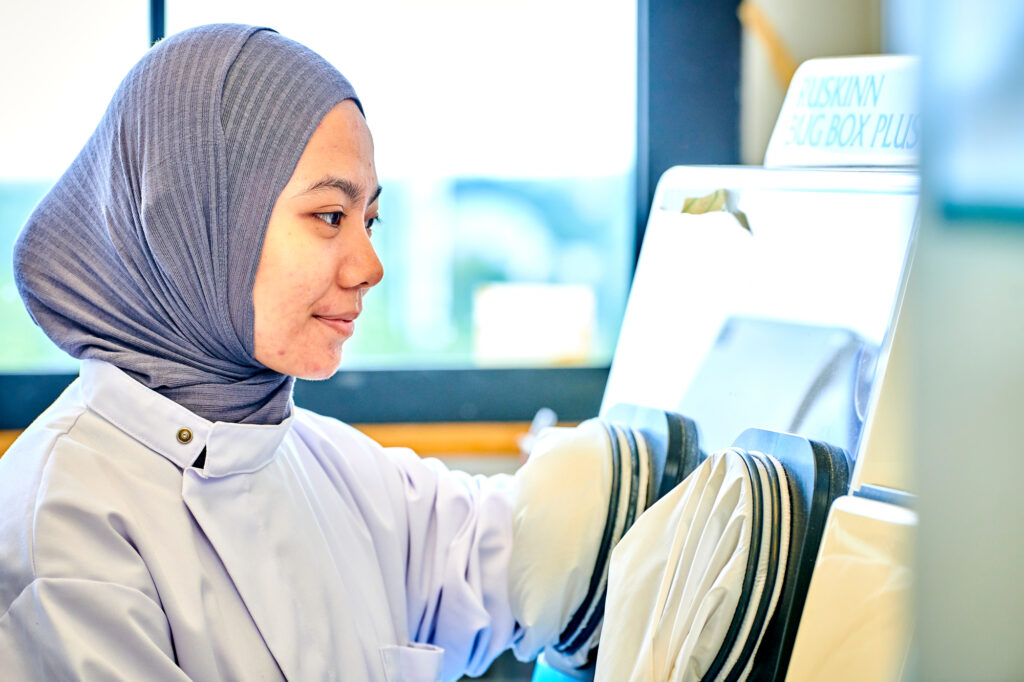
Here at Newcastle University’s medical, dental, and research facilities, a variety of projects are being carried out to implement more environmentally sound practice. For instance, our previously mentioned Sustainable Medicine Lead, Hugh Alberti, has been working throughout the School of Medicine to introduce sustainable healthcare teaching to the curriculum. This has led to a range of impressive initiatives, including all final year students completing sustainable quality improvement projects as part of their final GP placements – that’s 370 tailored sustainability projects being written for GP surgeries throughout Newcastle every year! Meanwhile, our Sustainable Medics Society run regular conferences on sustainable medicine and are currently working on a project to make lab sessions for clinical skills modules more sustainable by reducing plastic waste. Finally, lots of medical labs, including core labs used by a variety of different teams, have received Laboratory Efficiency Assessment Framework (LEAF) accreditation – with several operating at ‘Gold’, the highest level of the standard currently available!
What next?
This range of initiatives is having a tangible effect by both directly improving environmental outcomes and ensuring that sustainability is established as an important consideration in the minds of current and future medical practitioners. Our medical students, teachers, and researchers aren’t done yet, though! Ambitions for the future include further improving the University’s already impressive Planetary Health Report score, and further reducing the use of single use items in medical teaching.
Many thanks again to Nuala, Hugh, Oak, and everyone else who generously contributed their time for this piece. If you want even more information on sustainability in healthcare, have a look at the references and resources below. Additionally, if you’re looking for steps you can take yourself, get started by having a look at our recent Sustainability Newsletter for advice on how to sustainably dispose of medications!
References and further reading
Abbasi, K., Ali, P., Barbour, V., Benfield, T., Bibbins-Domingo, K., Hancocks, S., Horton, R., Laybourn-Langton, L., Mash, R., and Sahni, P., et al. (2023) ‘Time to treat the climate and nature crisis as on indivisible global health emergency’, British Medical Journal. 383. p. 2355.
Andrews, E., Pearson, D., Kelly, C., Stroud, L., and Rivas Perez, M. (2013) ‘Carbon footprint of patient journeys through primary care’, British Journal of General Practice. September.
Gillam, S., and Barna, S. (2011) ‘Sustainable general practice: another challenge for trainers’, Education for Primary Care. 22 (1). 7-10.
NHS England and NHS Improvement (2020) Delivering a ‘Net Zero’ National Health Service – July 2022 Update. Skipton House, London.
Pencheon, D., and Wight, J. (2020) ‘Making healthcare and health systems net zero’, British Medical Journal. 368.
Sherman, J. D., Thiel, C., MacNeill, A., Eckelman, M. J., Dubrow, R., Hopf, H., Lagasse, R., Bialowitz, J., Costello, A., Forbes, M., et al. (2020) ‘The Green Print: Advancement of Environmental Sustainability in Healthcare’, Resources, Conservation and Recycling. Volume 161.