Thursday 19th June 2025 marks Clean Air Day, the UK’s largest campaign dedicated to tackling air pollution. Coordinated by Global Action Plan, this day brings communities, schools, workplaces and decision-makers together to raise national awareness and advocate for clean, healthy air.
Why Air Pollution Matters
Air pollution is now recognised by both the UK Government and the World Health Organisation (WHO) as the “biggest environmental threat to public health in the UK.” Air pollution is linked to heart and lung diseases, low birth weight, stunted lung development in children, and even potential mental health impacts.
It’s estimated that air pollution contributes to up to 43,000 premature deaths every year in the UK alone. That’s why campaigns like Clean Air Day are so important – they shine a spotlight on the issue and push for solutions.
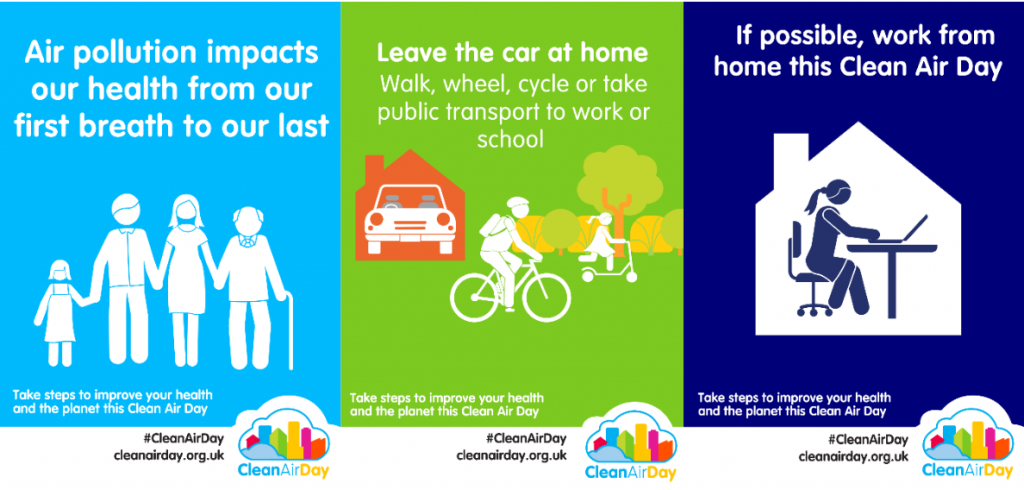
Image: Clean Air Day posters promoting actions like working from home and active travel alternatives. (Source: Global Action Plan, 2025).
The Pollution Problem
Transport is the single largest contributor of greenhouse gas emissions in the UK, with cars and vans being the primary sources. As we continue to rely heavily on petrol and diesel vehicles, we release harmful pollutants such as:
- Nitrogen Dioxide (NO₂) – a gas produced from fuel combustion in engines
- Particulate Matter (PM) – tiny airborne particles, often released from tyres and brakes, that can penetrate deep into our lungs
In densely populated urban areas, diesel vehicles alone can be responsible for up to 70% of air pollution (Living Streets, 2025). Reducing this dependence on polluting transport is critical for the health of our cities and our people.
Air Quality in the North East
In Newcastle, air pollution is monitored closely under the Environment Act 1995, with nine major pollutants assessed annually. The biggest concern locally remains Nitrogen Dioxide (NO₂), from road traffic. To monitor air quality and ensure compliance with national air quality standards, the city has established several automatic monitoring stations in four areas: Jesmond Road, St. Mary’s Place, Percy Street and Pilgrim Street.
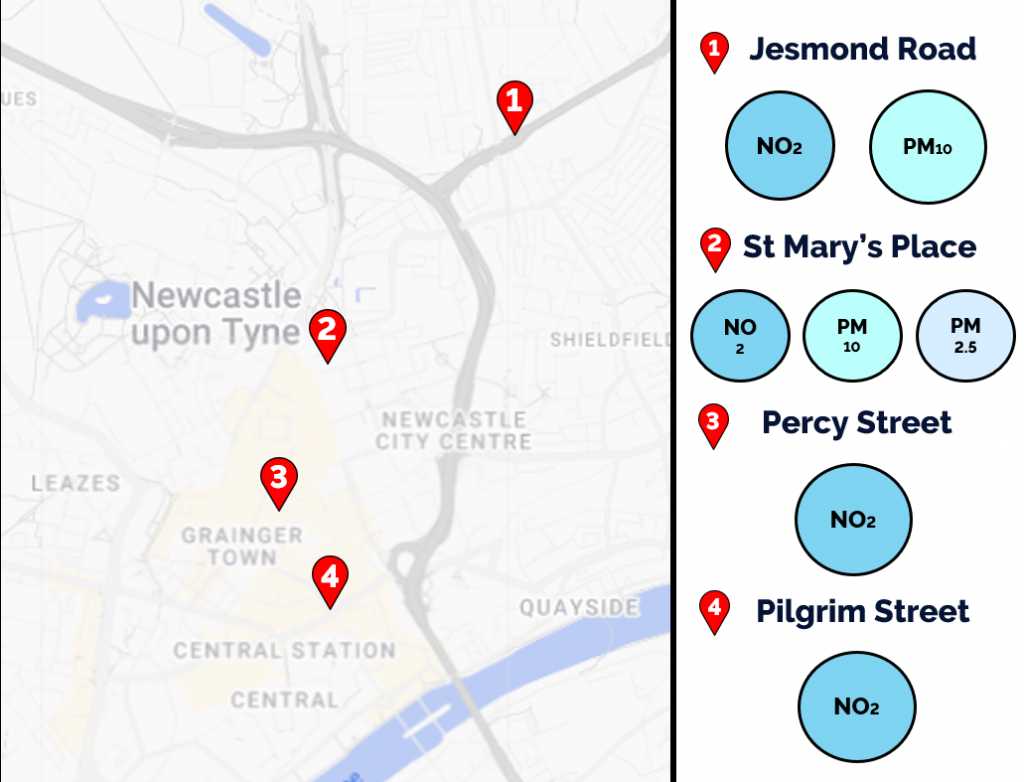
Image: Air quality monitoring sites in Newcastle showing where NO₂, PM₁₀, and PM₂.₅ are measured.
These monitoring stations provide valuable data to help Newcastle City Council take action where pollution levels risk exceeding safe limits, protecting residents and the environment alike.
What You Can Do
Everyone has a part to play in cleaning up the air we breathe. Here are a few impactful steps you can take:
- Write to your MP: Let them know you support investment in clean air and green transport.
- Use public transport: Buses and trains produce fewer emissions per person than cars.
- Walk or cycle when you can: It’s better for your health and the planet.
- Avoid idling your engine: Even a few minutes of idling contributes to unnecessary pollution.
- Talk about it: Share the campaign with friends, family and colleagues.
Final Thoughts
Clean Air Day is a great opportunity to celebrate the positive steps we can take toward cleaner, healthier air. Whether it’s changing how we travel or supporting local action, every effort helps build a healthier future for everyone.
\To find out more about the actions Newcastle University is taking to reduce carbon emissions and improve energy efficiency, check out our dedicated Carbon and Energy pages.
If you have any questions or want to get involved, please don’t hesitate to contact the Sustainable Campus team at sustainable-campus@newcastle.ac.uk