Yet another updated reading list on austerity and social geography

Once again, I’m updating my reading list for the Newcastle University Stage 2 module on Social Geographies (GEO2110) and am uploading the references and links here for ease of access, and so that others can use it too.

The usual disclaimer that I can’t cover everything here and I’m sure I’ve missed some great stuff. Please do let me know of things I can add. 

Previous versions of this list are accessible here: 2014, more 20142015 and 2016. I have repeated some of the references (for example, when a journal article has actually been published after being pre-publication previously, or when I’ve just forgotten I’ve already listed it 😉 ) but I have tended just to add newly-published material, so do look back over past versions to access publications that are just a couple of years old.

Note that some of the links for the policy reports in the previous posts are broken but all of the reports are still available – you can Google the report titles and find the updated links.

I have very much focused on publications which relate directly to the themes we cover in GEO2110 Social Geographies. There is much more excellent work which relates more closely to economic or political geography themes.

New (or updated) academic publications

Ballas, D., Dorling, D. and Hennig, B. (2017) Analysing the regional geography of poverty, austerity and inequality in Europe: a human cartographic perspective, Regional Studies, 51(1), 174-185.

Bragg, J., Burman, E., Greenstein, A., Hanley, T., Kalambouka, A., Lupton, R., McCoy, L., Sapin, K. and Winter, L. (2015) The Impacts of the Bedroom Tax on Children and Their Education: A Study in the City of Manchester.

Cooper, V. and Whyte, D. (2017) Government austerity demands that we die within our means, Open Democracy, 23.5.17.

Cooper, V. and Whyte, D. (eds.) (2017) The Violence of Austerity, Pluto – there’s a video here in which the authors talk about the book’s central argument.

Corcoran, M., Kettle, P.  and O’Callaghan, C. (2017) Green shoots in vacant plots? Urban agriculture and austerity in post-crash IrelandACME: An International Journal for Critical Geographies, 16(2), 305-331.

Edmiston, D., Patrick, R. and Garthwaite, K. (2017) Introduction: Austerity, Welfare and Social CitizenshipSocial Policy and Society, 16(2), 253-259. This is an introduction to a special section, and the editors have also produced a guide to “Some Useful Sources

Garthwaite, K. (2017) ‘I feel I’m Giving Something Back to Society’: Constructing the ‘Active Citizen’ and Responsibilising Foodbank UseSocial Policy and Society, 16(2), 283-292.

Garthwaite, K. and Bambra, C. (2017) “How the other half live”: Lay perspectives on health inequalities in an age of austeritySocial Science & Medicine, 187, 268-275.

Greenstein, A., Burman, E., Kalambouka, A. and Sapin, K. (2016). Construction and deconstruction of ‘family’ by the ‘bedroom tax’British Politics, 11(4), 508-525.

Greer Murphy, A. (2017) Austerity, women and health inequalities in the UK, Women Are Boring, 12.3.17.

Gill, R. and De Benedictis, S. (2016) Austerity Neoliberalism, Open Democracy. http://openaccess.city.ac.uk/15648/1/Austerity%2520Neoliberalism-1.pdf

Green, M., Dorling, D. and Minton, J. (2017) The geography of a rapid rise in elderly mortality in England and Wales, 2014-15Health & Place, 44, 77-85.

Hall, S. M. (2017) Personal, relational and intimate geographies of austerity: ethical and empirical considerationsArea, 49(3), 303-310.

Hitchen, E. (2016) Living and feeling the austereNew Formations, 87, 102-118.

Mattheys, K., Bambra, C., Warren, J., Kasim, A. and Akhter, N. (2016) Inequalities in mental health and well-being in a time of austerity: Baseline findings from the Stockton-On-Tees cohort studySSM-Population Health, 2, 350-359.

McDowell, L. (2017) Youth, children and families in austere times: change, politics and a new gender contractArea, 49(3), 311-316.

Moffatt, S., Lawson, S., Patterson, R., Holding, E., Dennison, A., Sowden, S. and Brown, J. (2016) A qualitative study of the impact of the UK ‘bedroom tax’, Journal of Public Health 38(2) 197-205

O’Brien, M. and Kyprianou, P. (2017) Just Managing? What it Means for the Families of Austerity Britain Open Book Publishers. https://www.openbookpublishers.com/reader/591#page/1/mode/2up

Patrick, R. (2016) Living with and responding to the ‘scrounger’ narrative in the UK: exploring everyday strategies of acceptance, resistance and deflection, Journal of Poverty and Social Justice, 24(3) 245-259

Pimlott‐Wilson, H. and Hall, S. M. (2017) Everyday experiences of economic change: repositioning geographies of children, youth and familiesArea. This is the introduction to a special issue with a number of related pieces.

Power, A. and Hall, E. (2017) Placing care in times of austeritySocial & Cultural Geography, 1-11 (from a forthcoming special issue on Placing Care in Times of Austerity).

Raynor, R. (2017) Dramatising austerity: holding a story together (and why it falls apart…)cultural geographies, 24(2), 193-212.

van Lanen, S. (2017) Living austerity urbanism: space–time expansion and deepening socio-spatial inequalities for disadvantaged urban youth in Ireland, Urban Geography.

Wilkinson, E. and Ortega-Alcázar, I. (2017) A home of one’s own? Housing welfare for ‘young adults’ in times of austerity, Critical Social Policy.

A special issue of Discover Society on families and relationships in crisis, with short articles by geographers including Sarah Hall and Helen Holmes, Iliana Ortega-Alcázar, Eleanor Wilkinson, and me (Alison Stenning)


Reports from thinktanks and charities

The School of Law at Warwick University collates and regularly updates a list of Reports on the Impact of Public Spending Cuts Across the UK. This includes reports on different parts of the UK and on different sectors.

Women’s Budget Group Gender Impact Assessment of Spring 2017 Budget

House of Commons Library Estimating the gender impact of tax and benefits changes, 13.12.2016


And a reminder to look at certain organisations, such as the Joseph Rowntree Foundation and Poverty and Social Exclusion, and key newspapers, such as The Guardian and The Financial Times, to explore their coverage of austerity and its impacts.


Austerity and Everyday Relationships in Low-to- Middle Income Families in the UK

This is a PDF of my recent presentation at the Nordic Geographers’ Meeting in Stockholm. I’m hoping to get this written up in the next few months, but in the meantime…

NGM Presentation

The paper’s abstract was as follows:

In the context of a research project which explores the experiences of austerity in a small number of ‘squeezed middle’, ‘just about managing’ (low-to-middle income) families in north east England, this paper focuses on the place of everyday relationships within and beyond the family in mediating austerity. It uses a psychosocial framing to foreground the importance, complexity and diversity of relationships in making sense of and negotiating changing socio-economic circumstances, attempting to think about and connect the psychic dynamics of families’ relationships and the social dynamics of austerity and recession, and to develop a psychosocial geography of everyday austerity. After setting out some ideas about the nature and value of relationships, the paper asks how and why relationships with family, friends, neighbours, acquaintances and wider communities have been invoked, used, challenged, remade, and imagined as families have navigated the transformations of austerity. As part of the ‘squeezed middle’, these are not families living in poverty, but they have all experienced real threats and losses in the context of austerity, redundancies, falling incomes, tightened budgets, and growing insecurities, for example. The paper explores the ways in which these shifts are connected, in families’ reflections and narrations, to the place of children and their futures in family dreams, the diverse support and demands of friends in crises, large and small, memories of earlier family lives, and everyday negotiations with partners, husbands and wives, and wider families. It seeks to map these shifting relationships, identifying the varying sites and spaces, within and beyond the family home, in which they are made and remade. In these ways, the paper connects to ongoing debates, political, popular and academic, about relationships, austerity, and neoliberalism more widely, to reflect on their diverse and complex articulations.

Thanks to Sarah Hall, John Horton and Helena Pimlott-Wilson for organising the session.

Street Play and Everyday Relationships

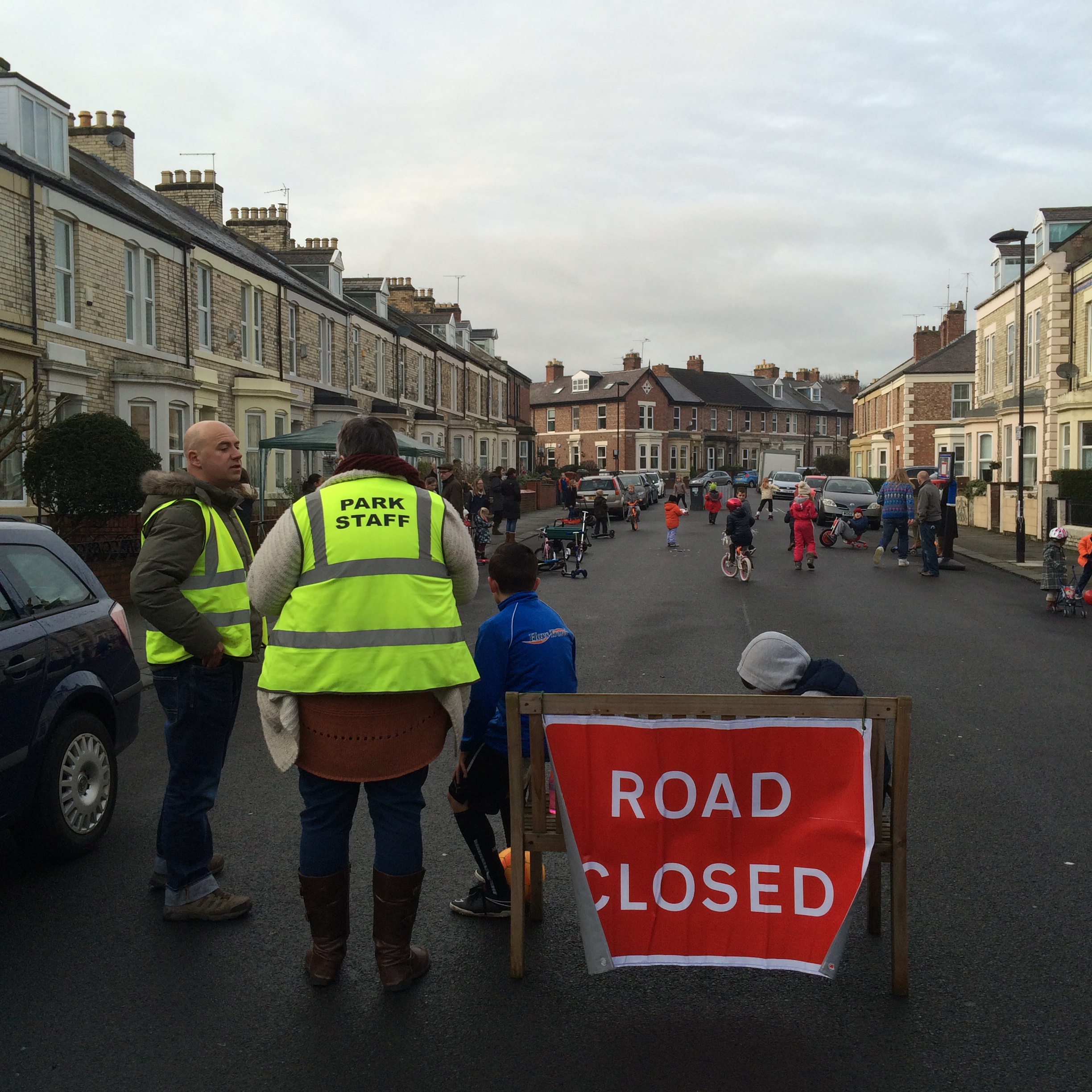
I spent yesterday at the play and playwork conference at Leeds Beckett University, my first play conference. I’ve been thinking more and more about play in the last year or so. Since December 2015, I’ve regularly coordinated with my neighbours to close my street for play about once a month, following the playing out model. In the last few months, I’ve started working with two other local street organisers to develop and promote opportunities for street play across North Tyneside. And in the last few weeks, I’ve realised that street play offers a fantastic opportunity to research the geographies of our everyday relationships, an idea that’s been central to my research and teaching for the last few years.

I love seeing kids play out in our street, I love the slightly subversive temporary displacement of cars, I love the chalk left on the street, often for days after we’ve been playing. But what I’m hoping to explore in my research is why adults plan street play, what they hope will happen, and what does happen, to them and their streets, as street play progresses.

From the very start of yesterday’s conference, the synergy between children playing and adult sociability was clear. Leeds’ Lord Mayor noted in her welcoming address that playing out is important not just for kids but for whole communities, as play builds relationships across diversity and difference, and as children’s presence in public space encourages – or even forces – adults to hang out outside too, watching their children, chatting with neighbours, and sometimes starting to play in their own ways too.

In the first workshop I attended, John McKendrick explored how we might make our cities and neighbourhoods play-friendly, and asked what it means for a place to be play-friendly, child-friendly or even family-friendly. What kinds of spaces do these different, if related, initiatives imagine?

The possibility of play is certainly at the heart of these visions, but so too is a broader idea of building relationships within communities, to draw people out into public spaces within their neighbourhoods, and to enable communities to develop shared identities and senses of belonging. The ‘play rhetorics‘ developed by Brian Sutton-Smith and cited by John might be augmented by an idea of play as relationships, as a catalyst for connection, friendship, recognition and community.

This is an idea at the heart of street play, and of my experiences of and hopes for playing out in my street and elsewhere. It is also one recognised by Helen Forman in her contribution to the conference’s street play workshop. Reflecting on the kinds of residential spaces that encourage and enable play, Helen reported that most research on the topic documents an improvement in adult ‘hanging out’ and sociability in places where children play outside.

Play is clearly at the heart of street play. This is a movement that is about kids playing out, but it is also about an idea of our streets and neighbourhoods as spaces that enable and reflect lively, hopeful, ordinary, everyday relationships. We can perhaps re-imagine play-friendly, child-friendly and family-friendly streets as relationship-friendly, streets that help us make and sustain connections which enable us to feel recognised, known, at home. It is these ideas that I’m hoping to explore, using ideas not only from literatures on play, children’s geographies, and communities, but also from theorisations of relationships, especially those which are part of and inspired by Donald Winnicott (for whom play itself was extraordinarily important) and the British object relations school. These thinkers imagine, in different ways, that our relationships, with intimate and imagined others, create the environment within which we find ways of going on being. This is the start of the idea that I hope to work with to explore and understand street play and everyday relationships.