Liam Archbold and I were invited to talk through the project, covering both the technical design and the backstory, particularly our motivation to show that useful lab automation can be built using low‑cost, open, and modifiable hardware rather than proprietary systems.
It’s been encouraging to see a very practical piece of open hardware work developed at School of Pharmacy Newcastle University reach a wider audience. I hope that it will prompt others to adapt, reuse, or rethink how lab tools are designed, shared, and validated.
A very special shoutout to Hayley Chan and Wing Man Lau for their contributions to Otto. Thank you EPSRC and Newcastle University for funding, and thanks to everyone who has supported us along the way to make the project a success.
Ng KW, Archbold L, Lau WM. Building Otto: An open-source Franz diffusion cell autosampler for automating in vitro skin permeation studies. HardwareX. 2026;25:e00735. doi: 10.1016/j.ohx.2025.e00735
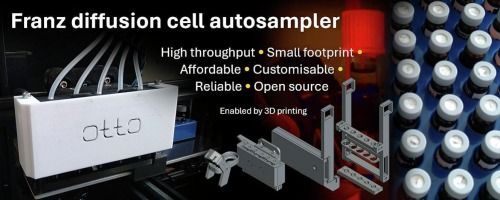
We have recently published a paper in HardwareX describing the design and construction of Otto, an open-source autosampler robot for Franz diffusion cell experiments. Otto is built using a desktop 3D printer as a gantry, a small number of custom 3D-printed parts, and commonly available laboratory consumables. It is designed to automate sampling and can collect up to 100 samples per run.
The system uses a Creality Ender 3 Pro 3D printer for motion control, with add-on components printed in-house on Prusa Research printers. The aim of the project was to develop a low-cost, accessible solution for automating repetitive sampling tasks in skin permeation studies, without reliance on proprietary hardware.
Otto has previously been validated. In a recent hydrogel study, Otto was used to collect every sample in a 72-hour skin permeation experiment, operating fully unattended throughout. The new HardwareX paper brings together the design rationale, build instructions and practical considerations needed for others to construct and use the system.
The paper, which is now available, provides a step-by-step guide to building Otto and is intended to support reproducibility and reuse by other laboratories. The 3D models and design files are openly available, and the models are also hosted on Printables.
Alongside the hardware, a companion application called OttoMate has been developed to generate the G-code used to control the system via a graphical user interface. The software is under active development and is available on GitHub.
A series of videos demonstrating different aspects of Otto’s operation, including assembly and sampling, is also available via a YouTube playlist.
This work was carried out by our team at Newcastle University, with contributions from Liam Archbold and Dr Wing Man Lau. Otto has been open-sourced in the hope that others will find it useful and adapt it for their own applications, and we are open to collaborations.
We would also like to acknowledge the EPSRC for funding this work.
We have open-sourced the design files for Otto, the Franz diffusion cell autosampler that we built to automate skin permeation studies. This means we’re sharing the 3D-printable models with the world, for free. Anyone may print, modify and share these files with others — with attribution. The files are released under the CC BY 4.0 licence.
I know, I don’t update this blog enough. When I do, I have too much to talk about. So, instead of a series of full-blown news articles, I’ll provide a summary of updates since my last post, with links to relevant twitter posts where available.
ULTRA technology
I have previously mentioned that we were developing a novel extended-release drug delivery platform (read it here , here and here). We call it Ultra-Long and Tunable Release of Actives (ULTRA). The patent for this technology was filed in October 2022. Meanwhile, development on the technology continues. Earlier this year, we had secured further funding from the Northern Accelerator to accelerate this effort. We are now seeking industrial partners to translate the technology to clinical applications. Interested parties please contact our Business Development Manager, Dr Tim Blackburn.
Litricity collaboration
We collaborate with Litricity, a German company specialising in liquid battery technology, in developing our microneedle biosensors. We were awarded a Wellcome Trust Translational Partnership grant to visit Litricity in Rosenheim, Germany, to perform some laboratory work. Rach and I flew out earlier this month to do just that. It’s been a really fruitful collaboration even at this early stage. We are really grateful to the Wellcome Trust and Litricity for their support.
We started a collaboration with the Polytechnic University of Hong Kong (PolyU) to develop 3D-printed microneedle patches for drug delivery and diagnostic applications. In December, Howard Chu and Dr Hin-Chung Lau from PolyU visited our labs in Newcastle to learn about our microneedle technology and perform experiments on the 3D-printed microneedles. As part of this collaboration, two undergraduate MPharm students (Jasmine and Liv) researched 3D-printed microneedles for their final year research project, working closely with the PolyU team. The project has already produced some interesting results. We are looking forward to visiting PolyU in 2023 for the second phase of the project. I am particularly pleased that we have been able to enrich the research experience for our MPharm students by providing an international, multidisciplinary and collaborative environment in which to thrive.
We have recently upgraded our texture analyser, which we rely on heavily to evaluate the mechanical properties of our microneedles. Prior to this upgrade, we already had the capability to record synchronous videos of the tests to help us pinpoint exactly when and how the microneedles reach the limit of their strength. The upgrade is a bespoke solution, designed by yours truly, that enables us to measure the strength of individual microneedles more reliably and more quickly. It uses 3D printing to create custom parts for the texture analyser to achieve this.
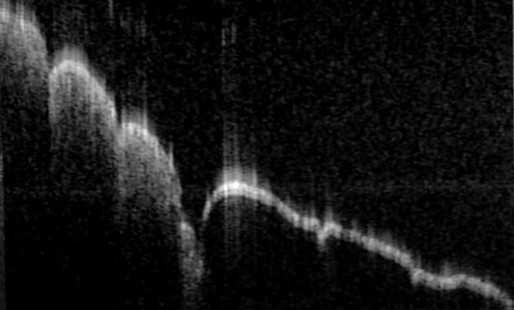
We have also recently acquired an optical coherence tomography (OCT) scanner, which can be used to rapidly assess gross internal structures in biological and non-biological samples. We will use this to analyse skin penetration of microneedles and other materials we use in our research.
An OCT image of my skin taken using our new OCT scanner.
Personnel changes
Daniel finished his MRes project and graduated with a distinction. Congratulations, Daniel!
Naeem has completed his experiments in our lab and returned to Pakistan to finalise the study.
It has been great working with both Daniel and Naeem. Both have now joined our list of distinguished alumni.
That’s it, folks!
We will be back in 2023. Have a lovely Christmas and happy new year!