Over the last two years, our lab has developed three pharmaceutical technologies. At first glance, they might seem unrelated. But they all share a rather unexpected origin.
In this video podcast, Keng speaks with Dr Manveer Sandhu about how it all began with a single research challenge: developing a long-acting microneedle formulation.
The work required laboratory equipment that wasn’t readily available, so we decided to build our own. That decision set in motion a series of developments that eventually led to the three technologies we have today.
Watch the conversation below to discover how one research challenge led to three different pharmaceutical technologies.
Many thanks to Manveer for inviting us to share our story on his Signal over Noise podcast series.
Want to learn more? Visit our Publications section to explore the scientific papers behind these technologies.
Liam Archbold and I were invited to talk through the project, covering both the technical design and the backstory, particularly our motivation to show that useful lab automation can be built using low‑cost, open, and modifiable hardware rather than proprietary systems.
It’s been encouraging to see a very practical piece of open hardware work developed at School of Pharmacy Newcastle University reach a wider audience. I hope that it will prompt others to adapt, reuse, or rethink how lab tools are designed, shared, and validated.
A very special shoutout to Hayley Chan and Wing Man Lau for their contributions to Otto. Thank you EPSRC and Newcastle University for funding, and thanks to everyone who has supported us along the way to make the project a success.
Ng KW, Archbold L, Lau WM. Building Otto: An open-source Franz diffusion cell autosampler for automating in vitro skin permeation studies. HardwareX. 2026;25:e00735. doi: 10.1016/j.ohx.2025.e00735
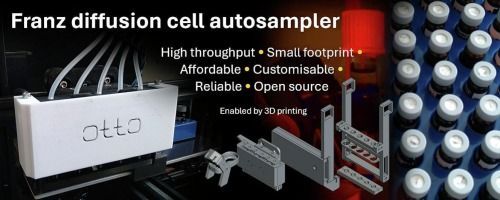
We have recently published a paper in HardwareX describing the design and construction of Otto, an open-source autosampler robot for Franz diffusion cell experiments. Otto is built using a desktop 3D printer as a gantry, a small number of custom 3D-printed parts, and commonly available laboratory consumables. It is designed to automate sampling and can collect up to 100 samples per run.
The system uses a Creality Ender 3 Pro 3D printer for motion control, with add-on components printed in-house on Prusa Research printers. The aim of the project was to develop a low-cost, accessible solution for automating repetitive sampling tasks in skin permeation studies, without reliance on proprietary hardware.
Otto has previously been validated. In a recent hydrogel study, Otto was used to collect every sample in a 72-hour skin permeation experiment, operating fully unattended throughout. The new HardwareX paper brings together the design rationale, build instructions and practical considerations needed for others to construct and use the system.
The paper, which is now available, provides a step-by-step guide to building Otto and is intended to support reproducibility and reuse by other laboratories. The 3D models and design files are openly available, and the models are also hosted on Printables.
Alongside the hardware, a companion application called OttoMate has been developed to generate the G-code used to control the system via a graphical user interface. The software is under active development and is available on GitHub.
A series of videos demonstrating different aspects of Otto’s operation, including assembly and sampling, is also available via a YouTube playlist.
This work was carried out by our team at Newcastle University, with contributions from Liam Archbold and Dr Wing Man Lau. Otto has been open-sourced in the hope that others will find it useful and adapt it for their own applications, and we are open to collaborations.
We would also like to acknowledge the EPSRC for funding this work.
We have open-sourced the design files for Otto, the Franz diffusion cell autosampler that we built to automate skin permeation studies. This means we’re sharing the 3D-printable models with the world, for free. Anyone may print, modify and share these files with others — with attribution. The files are released under the CC BY 4.0 licence.
Citation: Chan HKY, Archbold L, Lau WM, Ng KW. Validating Otto: a Franz diffusion cell autosampler to automate in vitro permeation studies, Journal of Pharmaceutical Sciences, 2025:103837. https://doi.org/10.1016/j.xphs.2025.103837
We have a new paper out. This one is close to my heart because I personally spent many hands-on hours developing Otto.
Who’s Otto?
Otto is a Franz diffusion cell (FDC) autosampler robot. It replaces manual sampling and refilling of FDCs in a skin (and cornea, mucosal membrane, etc.) permeation experiment. Those who have worked with FDCs before would know how fiddly, time-consuming and labour-intensive that is. It’s a job most suited for a robot.
But Otto is about more than us trying to avoid menial labour. It’s about the quality of the science, too.
Let me rephrase that — it’s primarily about the quality of the science.
For a long time, we have noted many skin drug absorption studies that include unusually large sampling gaps of ≥16 hours, presumably because the researchers were unable to collect samples outside normal working hours. This sampling gap could allow the drug to accumulate in the FDC receptor chamber and, consequently, underestimate drug absorption due to sink condition being violated. We have faced similar logistical challenges ourselves as local rules prevent some researchers from working out of normal working hours. A FDC autosampler would solve these challenges, but we have not been able to afford any of the few commercial FDC automation systems available. When COVID-19 hit, and lab access was further restricted, we finally found the impetus and time to build the FDC autosampler we had always needed, for less than £500, and retrofitted it to our existing FDCs.
Thus, Otto was born.
Otto is a Franz diffusion cell (FDC) autosampler robot, adapted from the Creality Ender 3 Pro 3D printer. This picture depicts an automated skin permeation experiment using FDCs, in which Otto handled FDC sampling and refilling fully unattended. See the full paper for details on the number labels. Image reproduced under the CC BY 4.0 licence.
We have spent the last 2 years validating Otto’s performance. In this paper, we demonstrate that the sampling gap indeed led to violation of sink condition and underestimation of drug absorption. We further show that Otto improved data quality by avoiding the sampling gap. We have benchmarked Otto’s precision and accuracy against a trained researcher. We are pleased to report that it outperforms the researcher on both counts.
Otto is better than the commercial offerings in many ways. It is built on open-source technologies, using inexpensive consumables and 3D-printed custom parts, and is therefore fully customisable. It has a small footprint of just 50 cm × 46 cm. It can be retrofitted to generic FDCs and can collect up to 100 samples per experiment, fully unattended. The samples are collected directly into high-performance liquid chromatography (HPLC) autosampler vials, so it integrates seamlessly with downstream analysis without any further liquid handling, nor modification to the FDCs or analytical equipment.
Logistical, human resource and financial constraints continue to grip many research organisations long after COVID-19 restrictions have ended. Otto should prove itself a valuable asset in many research labs seeking to retrofit an automation solution to their existing FDCs.
The build instructions for Otto are too extensive to include in this paper, so we will be publishing them separately.