
Download it here: IGM calendar
Download it here: IGM calendar
We are pleased to announce we’ll be hosting our popular Genetics Matters event again on the 27th of February 2016 as part of the International Rare Disease Day. Come meet the scientists, touch real specimens, chat about rare diseases and hear about the exciting state of the art research at Newcastle University.

“Genetics Matters” annual event serves to showcase genetic research and to give the patient and charity organisations a voice and a platform to interact with the members of general public. The theme of the Rare Disease Day in 2016 is “Patient Voice”, recognising the crucial role that patients play in research by voicing their needs and instigating change.
We would like patients or members of patient families to be present on the day and actively participate, sharing the presenting with our scientists. We believe that the patients’ voice is important in directing the course of scientific research and that it is important to remember that behind the tubes and microscope slides there is also a human story, and that we are all working towards a common goal.
This event is FREE to attend, but we have limited places available, so if you would like to attend, please book your place here:


We are teaching at the GNM8000/GNM8001 Introduction to genomics course, part of the prestigeous Genomic Medicine MSc, PGDip, PGCert course at the Institute of Genetic Medicine developed in coollaboraiton with Health Education England (HEE) and Genomics England Ltd (GeL). This course aims to train healthcare professionals in how to integrate genomic technology into patient care.

 and here’s the programme:


Abstract
Full text available from Journal website here
Or download a .pdf file here: review


Our “Genetics Matters” event has been recognised by the University and we have been invited by the Vice-Chancellor to attend the “Celebrating Success Event”!

TRIB1 (Tribbles Pseudokinase 1) is a protein containing a serine/threonine kinase-like domain which is expressed in skeletal muscle, thyroid, pancreas, peripheral blood leukocytes, and bone marrow. Trib1 is critical for the differentiation of tissue-resident macrophages and in musculoskeletal tissues it is highly expressed in the bone marrow of adult humans. However, its role in skeletal tissues is currently unknown.
In collaboration with Prof Drew Rowan at Newcastle University, we have been analysing a mouse model which overexpresses Trib1 in cartilage (under col2 promoter).

We have found that mice overexpressing Trib1 in cartilage (right) are much smaller than the wild type litter mates (left) and present with a pronounced hip dysplasia. The bones appear dense, shorter and broader and are very reminiscent of osteopetrosis (“the stone bone” disease).
 Jennifer Gerbracht, an Erasmus student in the lab, generated this bone density image (above) using bone mineral content quantification by Faxitron X-ray microradiography. The image was pseudocoloured, showing the densest material in red. The knee joint of a wild type mouse (left) is shown compared to a mutant mouse (right) with much higher bone density.
On the 15th of July the IGM are hosting our regular IGM Open Day for the lower 6th form students from local schools.
Final programme for the day:
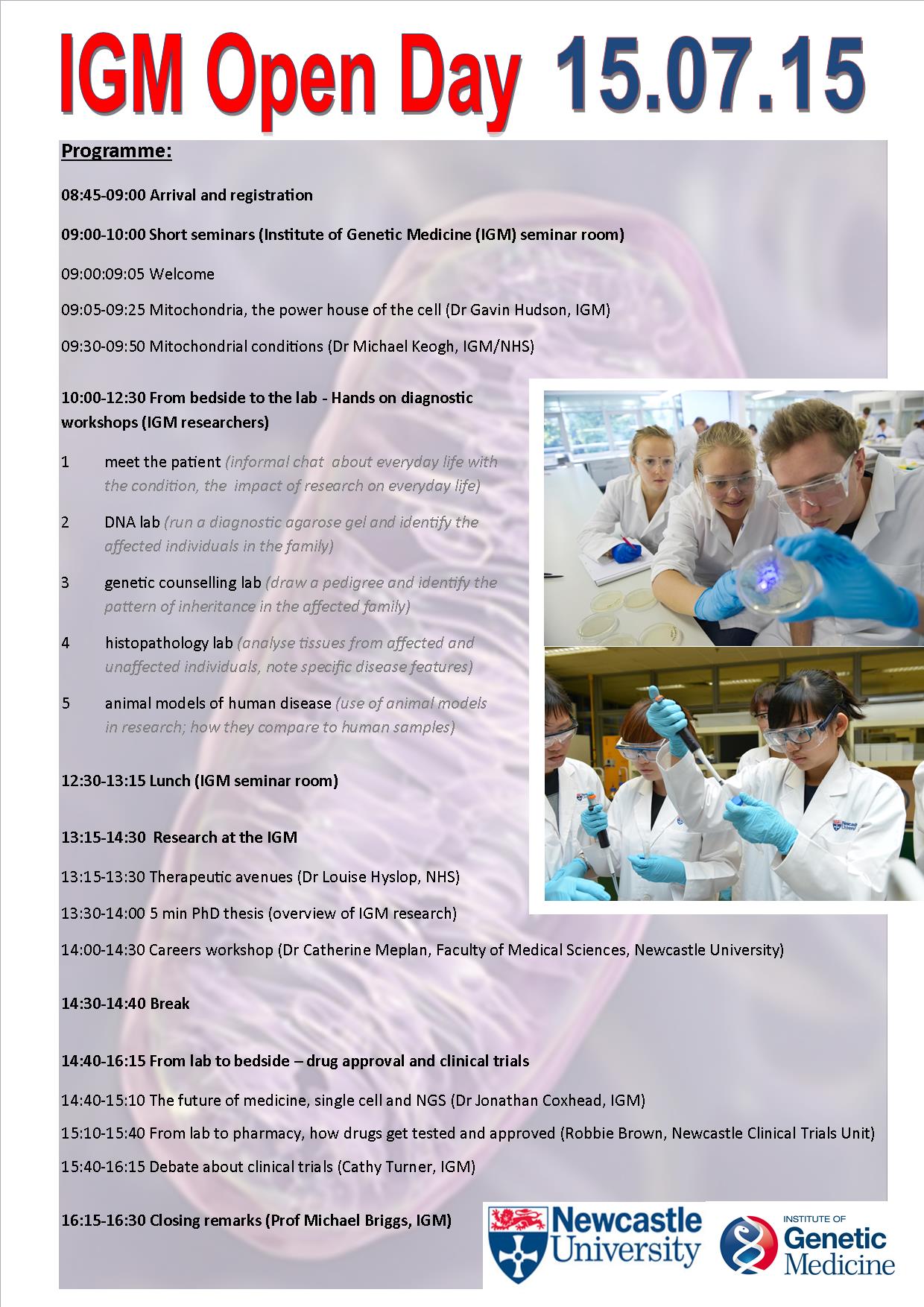
The event will include hands on experiments and a “bench to bedside” journey in mitochondrial genetics as well as a short presentation about studying at the University. Thank you very much to all participants and a big thank you to all the staff and students from IGM for taking time off to present their research and to the staff at the Centre for Life for their help with the practical sessions.
If you would like to participate in a similar event next year, please email IGMengagement@ncl.ac.uk