Pride in the Making: art, music and culture in the early days of Tyneside CHE

The Tyneside Campaign for Homosexual Equality (CHE) was formed in 1972 as a local branch of the national Campaign for Homosexual Equality. The Tyneside CHE Archive held in Special Collections and Archives at Newcastle University is one of the most complete records of CHE in the UK.

As Pride Month draws to a close, we reflect on the importance of art, music and culture in the early days of Tyneside CHE through extracts from the archive.

In the early days of the LGBTQ+ movement in the UK, criminalisation, discrimination, social exclusion and stigmatisation were widespread for its members.

Against this backdrop, art, music and culture, and the social bonds which both created and resulted from them, became powerful tools of resistance and self-expression for the LGBTQ+ community, forming the cultural backbone of a growing movement. Nationally, and internationally, artists, musicians and cultural spaces became lifelines for members of the LGBTQ+ community, and through the Tyneside CHE archive we can see the same unfolding at a local level.

In the early Tyneside CHE newsletters, regular committee business and political matters are interspersed with cultural gatherings and events throughout. In June 1976, plans included a trip to watch the York Mystery Plays and an outing to the Tyneside Cinema to see the film A Bigger Splash, a film significant for its treatment of gay themes.
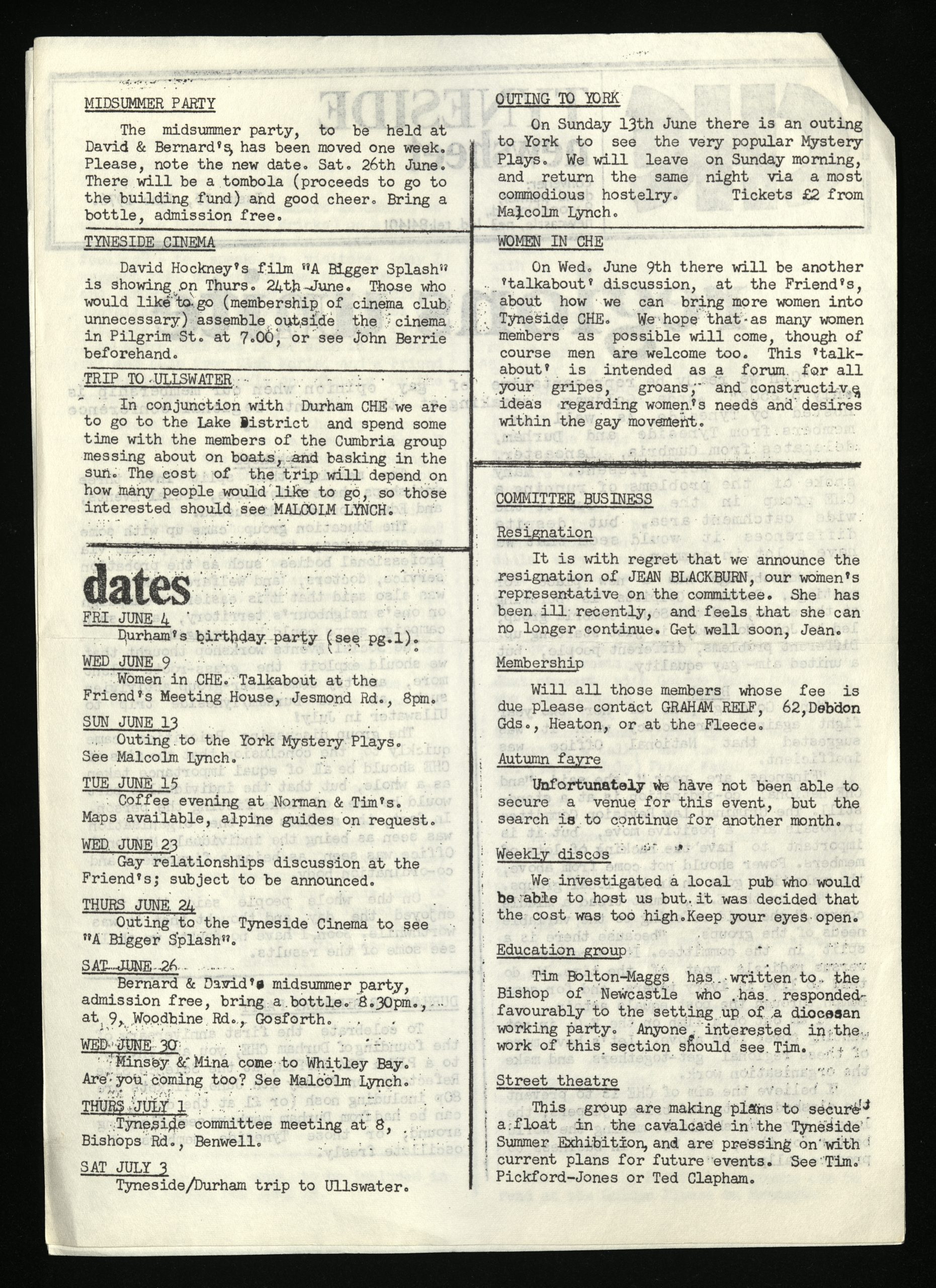
Page 2 of Tyneside CHE Newsletter, June 1976
Page 2 of Tyneside CHE Newsletter, June 1976 (CHE/01/05)

As well as organised trips, in-house events and productions formed a very significant part of Tyneside CHE’s activities too, from regular film nights and coffee mornings hosted in members’ own homes, to an organised street theatre group which made regular performances on Newcastle’s Northumberland Street. This production of Cinderfella in December 1980 was Tyneside CHE’s own take on a traditional festive pantomime.
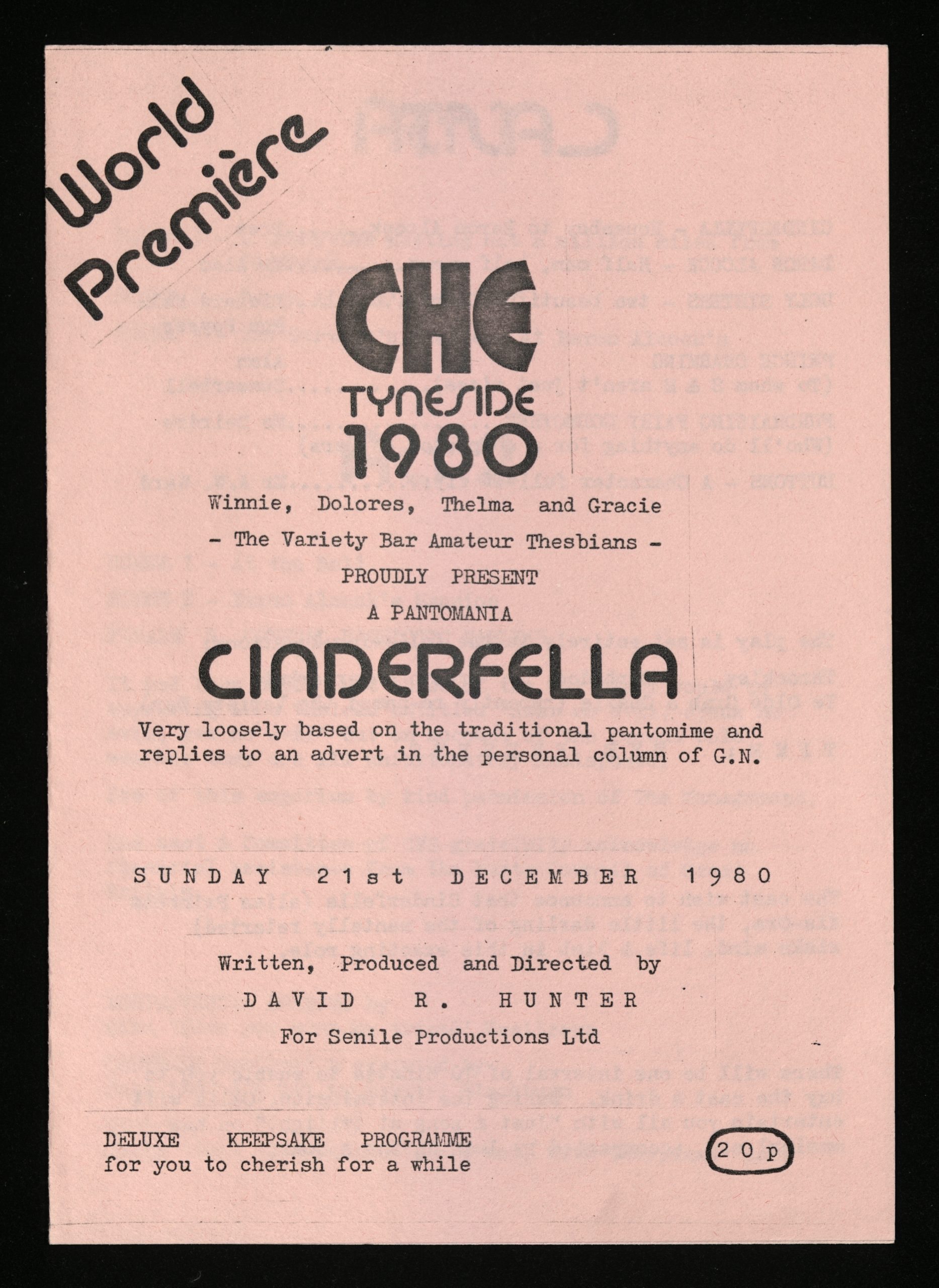
Programme for Cinderfella by Tyneside CHE, 21 December 1980
Programme for Cinderfella by Tyneside CHE, 21 December 1980 (CHE/01/05)

Theatrical performances and arenas provided a relatively safe and creative space for LGBTQ+ individuals to express their identities, desires, and experiences. Tyneside CHE supported and hosted several touring productions of Gay Sweatshop, a London-based theatre company and the first gay theatre company, which was formed to counteract prevailing misconceptions about homosexuals and promote awareness of sexual oppression experienced by the gay community.  This ticket relates to a performance of the play Indiscreet in Newcastle on 17 December 1976.
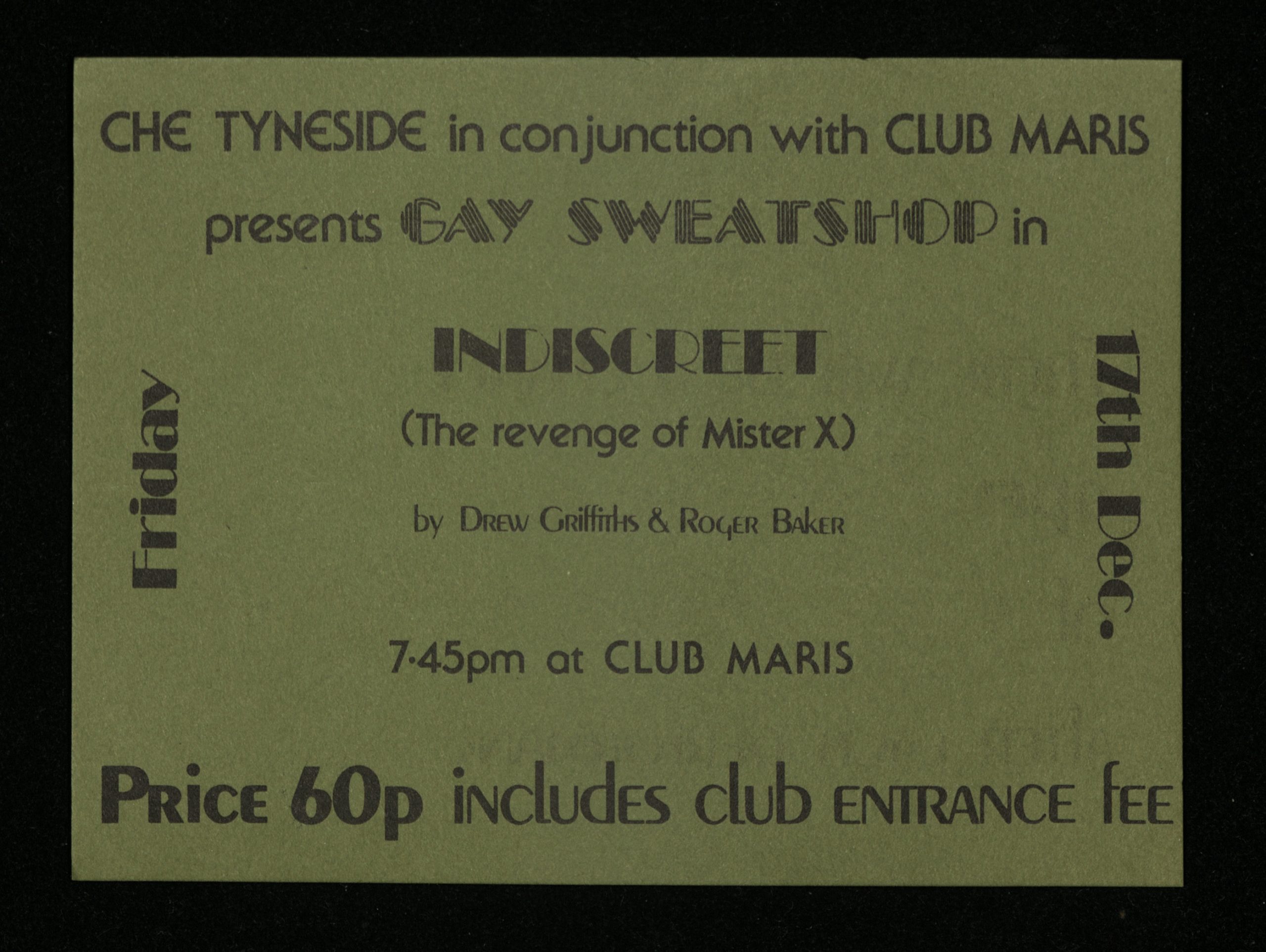
Ticket for performance of Indiscreet by Gay Sweatshop in Newcastle, 17 December 1976
Ticket for performance of Indiscreet by Gay Sweatshop in Newcastle, 17 December 1976 (CHE/01/05)

There were also touring productions of another gay theatre collective from London, Consenting Adults in Public, founded by the British playwright, performer, director, and activist Eric Presland.

Ticket proofs for performance of All our Yester-Gays by the Consenting Adults in Public theatre company in Newcastle, 12 August [1976?]
Ticket proofs for performance of All our Yester-Gays by the Consenting Adults in Public theatre company in Newcastle, 12 August [1976?] (CHE/01/05)

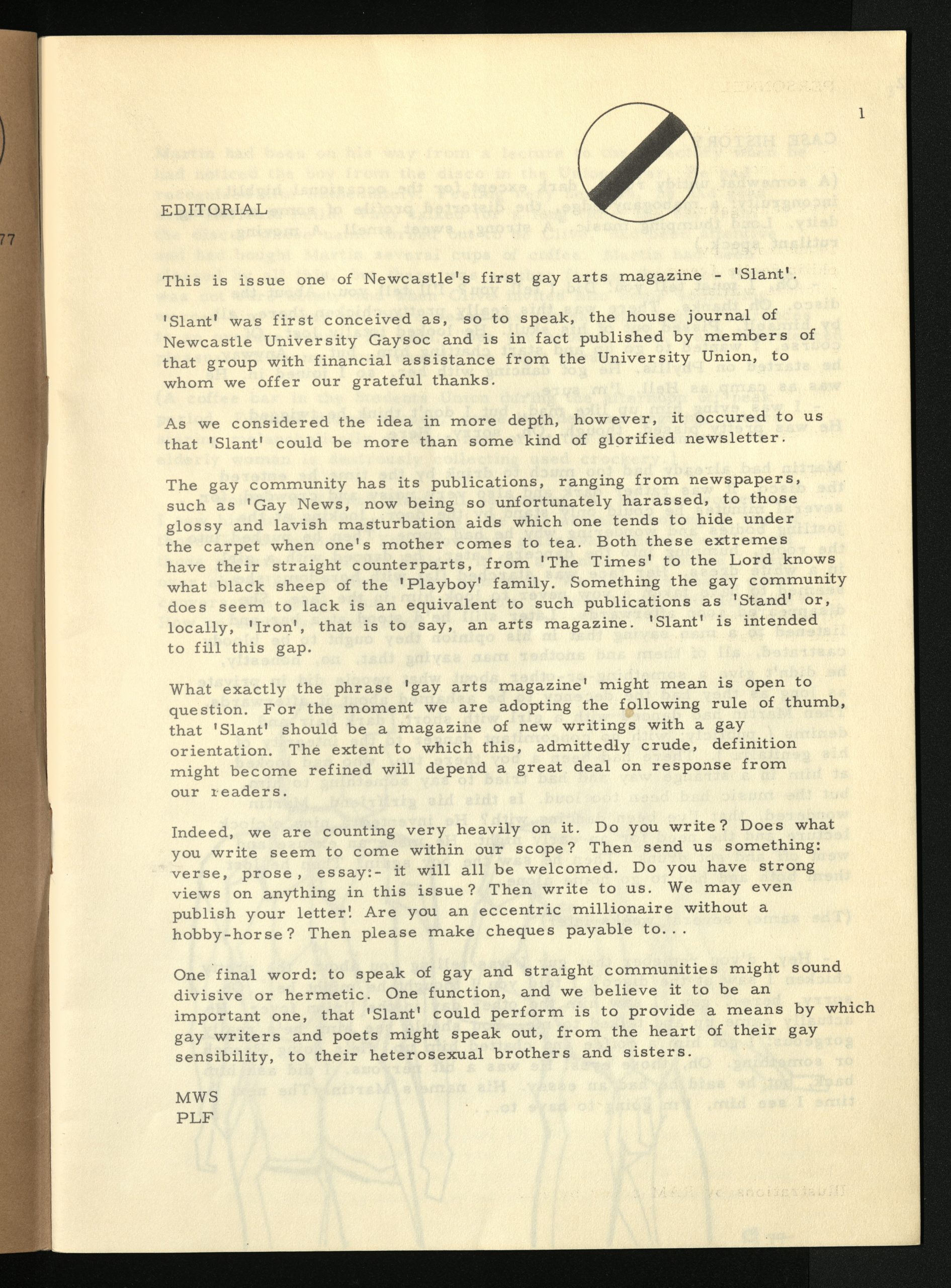
Arts magazines played a crucial role in the early LGBTQ+ movement, by providing a space for expression, visibility, and community when mainstream media marginalized or ignored LGBTQ+ voices.  Newcastle’s first gay arts magazine Slant was published in February 1977 by Newcastle University’s Gaysoc, with assistance from the Student’s Union. According to the Editorial in its first edition, it was formed “to be a magazine of new writings with a gay orientation” and “to provide a means by which gay writers and poets might speak out, from the heart of their gay sensibility to their heterosexual brothers and sisters”.
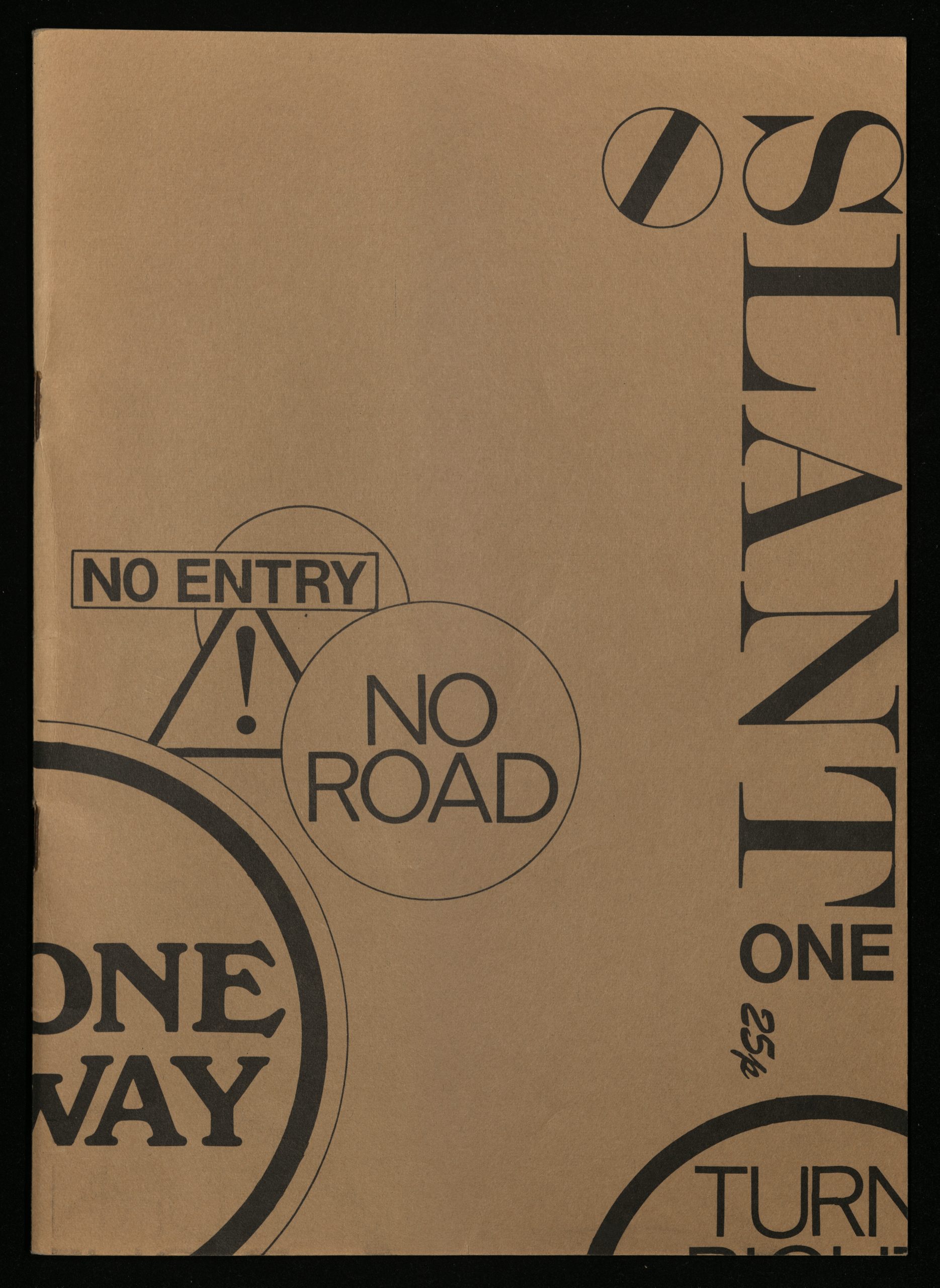
Front cover of Slant magazine, issue 1, February 1977
Front cover of Slant magazine, issue 1, February 1977 (CHE/05/02)
Editorial, Slant magazine, issue 1, February 1977
Editorial, Slant magazine, issue 1, February 1977 (CHE/05/02)

As Tyneside CHE arrived at its ten-year anniversary in 1982, celebrations included a barn dance featuring many traditional and well-known country dances and tunes, including Cumberland Square Eight, Lucky Seven, Winster Galop and the Blaydon Races, again demonstrating the continued importance of culture in unifying and strengthening the movement and its members, and of community gatherings that defied repression and laid the groundwork for LGBTQ+  visibility and activism.
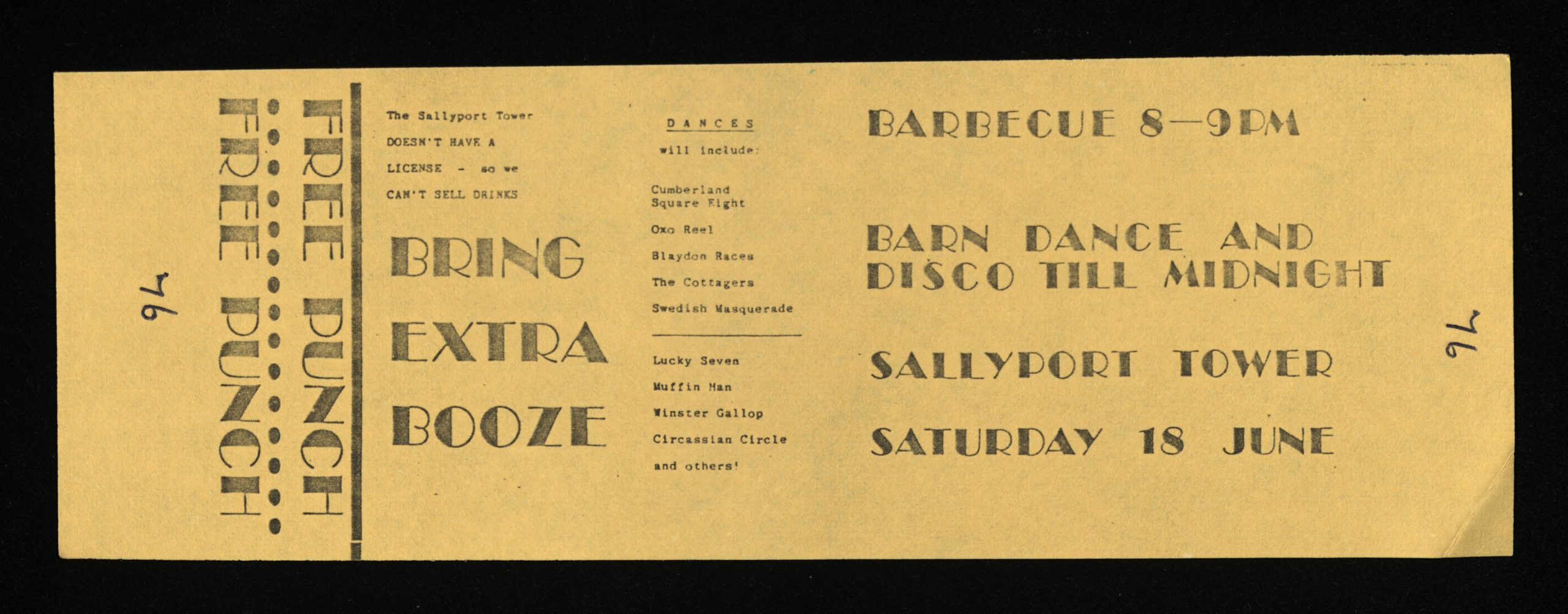
Ticket for Tyneside CHE barn dance and disco, 18June 1982
Ticket for Tyneside CHE barn dance and disco, 18June 1982 (CHE/01/05)

Browse and search the Tyneside Campaign for Homosexual Equality (Tyneside CHE) Archive

Read our blog post on celebrating 50 years of Pride

See our Finding their Voices exhibition which celebrates the many diverse voices present within our collections.

See our exhibition on The North’s Forgotten Female Reformers which examines the role of women in Tyneside CHE
Celebrating 50 Years of Pride

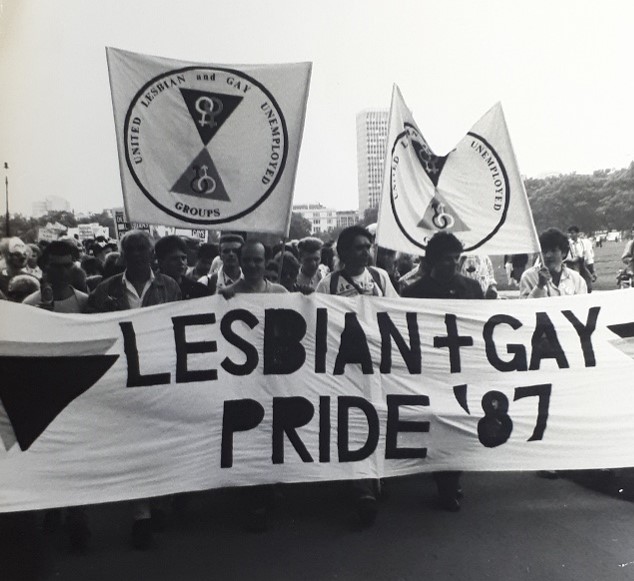
July 2022 marks the 50th anniversary of the UK’s first Pride march, held in London on 1st July 1972. The first Pride saw around 2,000 participants marching together. Over the past 50 years that number has grown considerably, with the 2019 London Pride seeing 1.5 million people taking part to celebrate LGBTQ+ rights.

Photograph of London Pride 1987 showing a group of people carrying a banner with 'LESBIAN + GAY PRIDE '87' written in bold letters on it.
Photograph of London Pride 1987 (Tyneside Campaign for Homosexual Equality (Tyneside CHE) Archive, CHE/03/02/01).

The official theme for this year’s march was #AllOurPride, uniting the collective past, present, and future of Pride for all members of the LGBTQ+ community. After a two-year hiatus due to the Covid-19 pandemic, this year’s London Pride Parade took place on Saturday 2nd July, beginning at Hyde Park, where the first Pride march in 1972 ended.

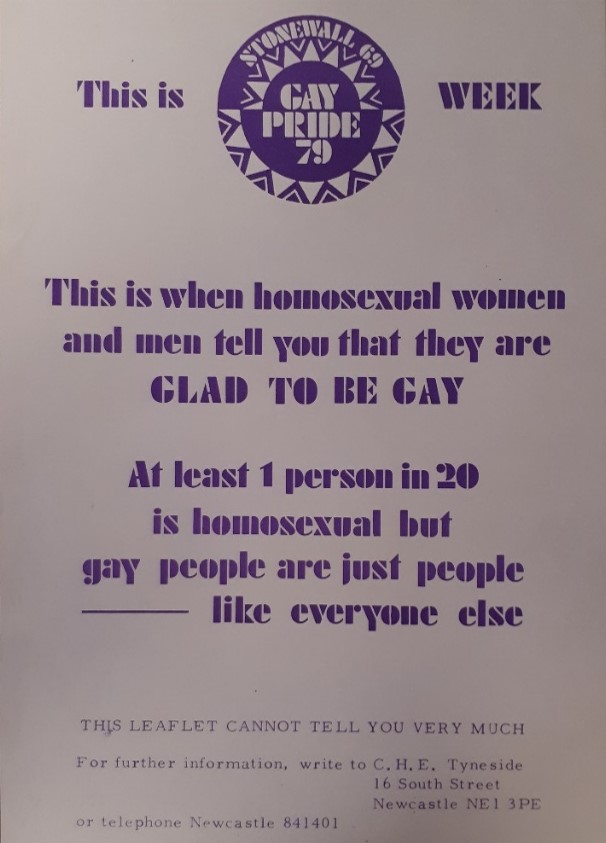
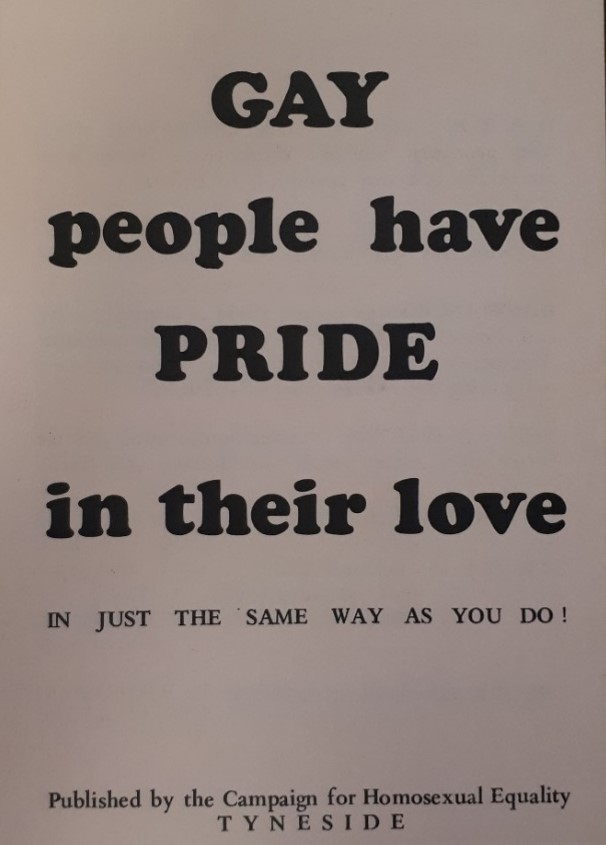
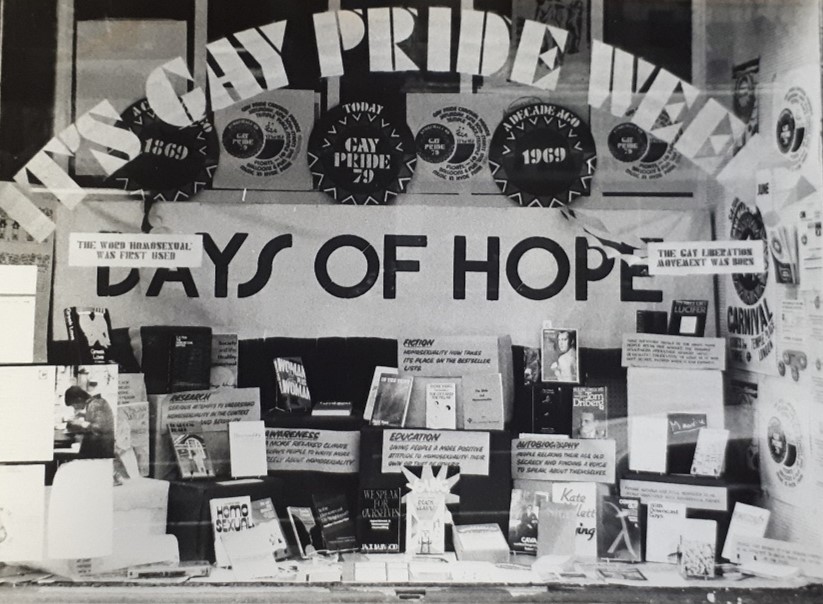
Photograph of a display celebrating Gay Pride Week 1979.
Photograph of a display celebrating Gay Pride Week 1979 (Tyneside Campaign for Homosexual Equality (Tyneside CHE) Archive, CHE/03/07/02).

2022 also marks the 50th anniversary of the Tyneside Campaign for Homosexual Equality, a branch of the Campaign for Homosexual Equality (CHE) which was established in Lancashire in 1964 and grew to have local groups throughout the country. The archive for the Tyneside CHE contains documents relating to the group’s many campaigns for equal rights. For example, the archive covers the fight for the age of consent for same-sex couples to match that of heterosexual couples, and campaigns against Margaret Thatcher’s 1988 Section 28 legislation banning local authorities from ‘promoting homosexuality’ by discussing LGBTQ+ issues in schools. As well as campaigning, CHE also provided a social and support network for gay men and lesbians.

Within the Tyneside CHE archive, it is possible to look back at Pride marches across the past five decades. The first Pride march in 1972 took place 5 years after the Sexual Offences Act 1967 which decriminalised sex between gay men over the age of 21 in England and Wales. At the time of the first Pride, however, the LGBTQ+ community still faced much discrimination – for example gay marriage was not legal, and gay and bisexual people were banned from joining the armed forces.

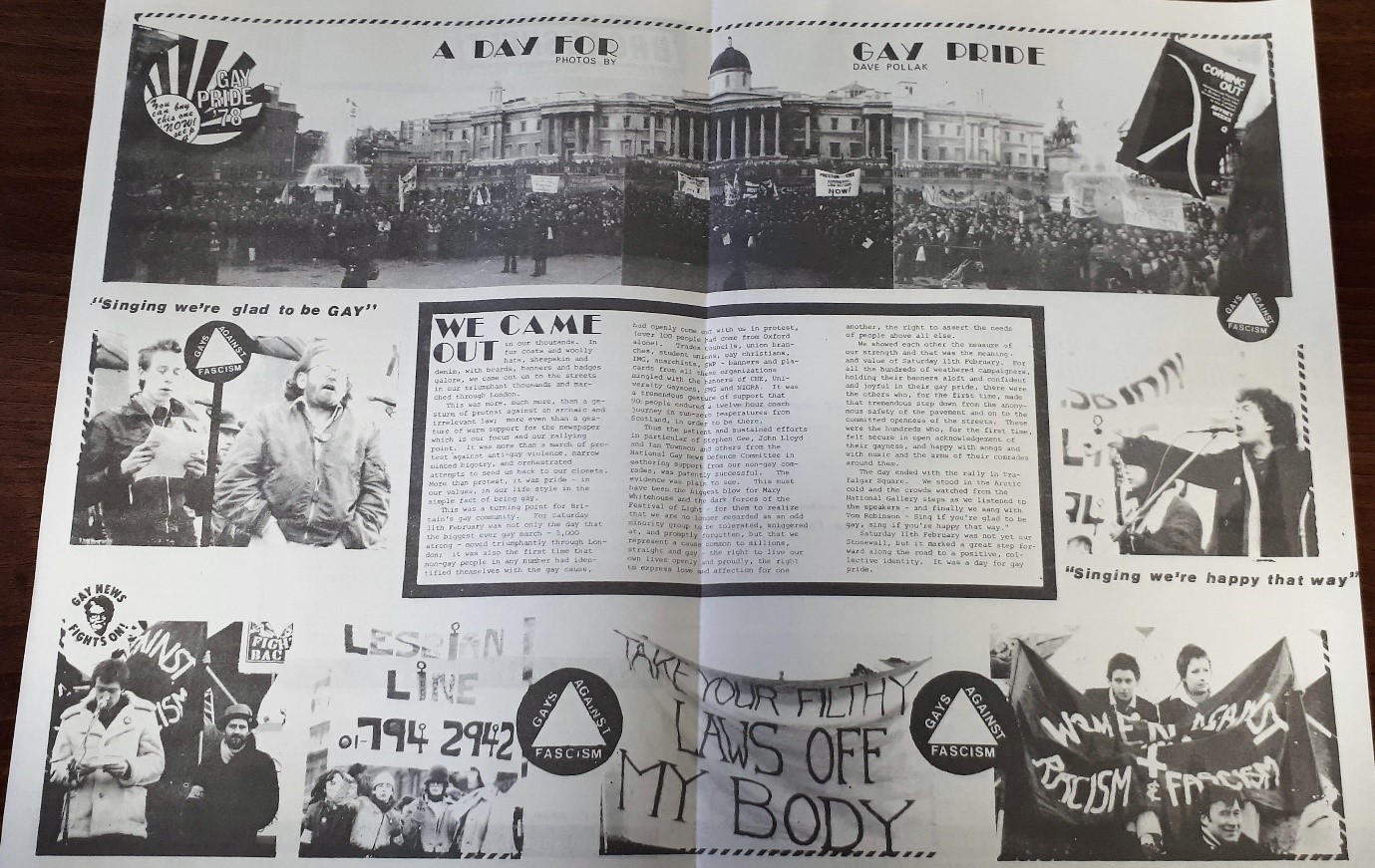
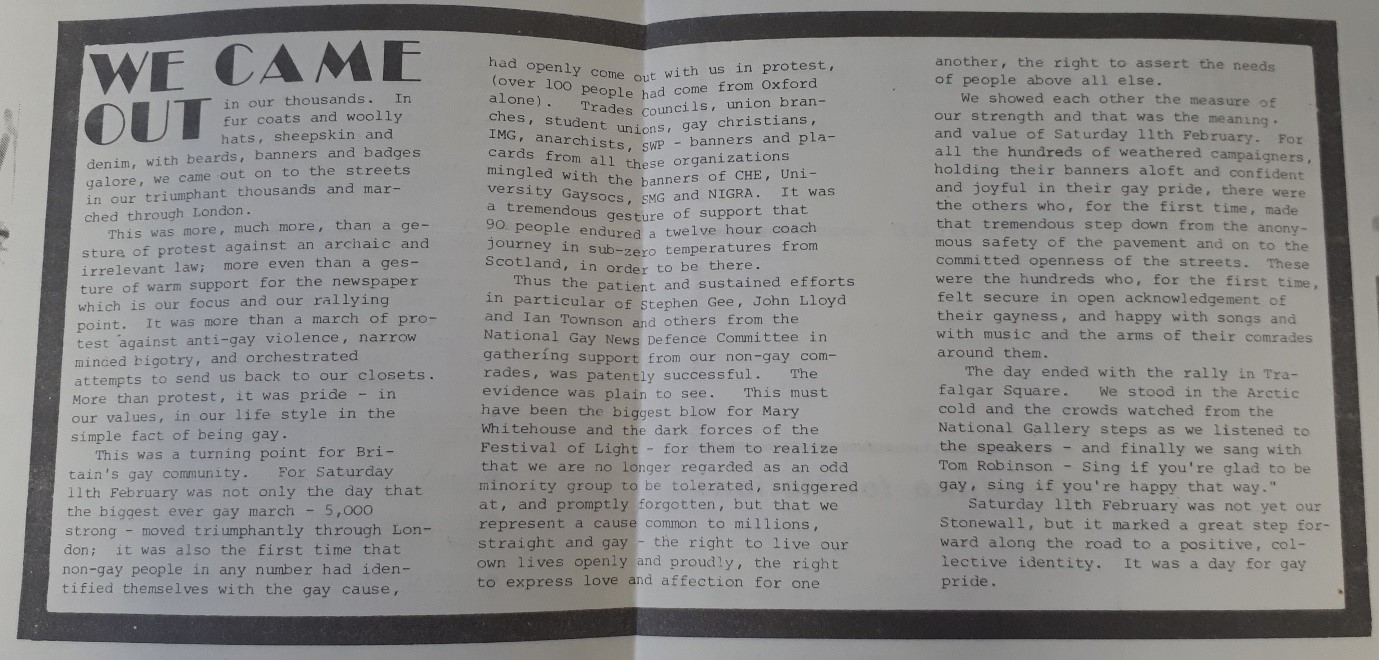
CHE Broadsheet, April 1978, article highlighting that this was the first year Pride saw support from allies in meaningful numbers
CHE Broadsheet, April 1978, article highlighting that this was the first year Pride saw support from allies in meaningful numbers (Tyneside Campaign for Homosexual Equality (Tyneside CHE) Archive, CHE/02/02).
Close-up of CHE Bulletin 1978 central article
Close-up of CHE Bulletin 1978 central article ( Tyneside Campaign for Homosexual Equality (Tyneside CHE) Archive, CHE/02/02).

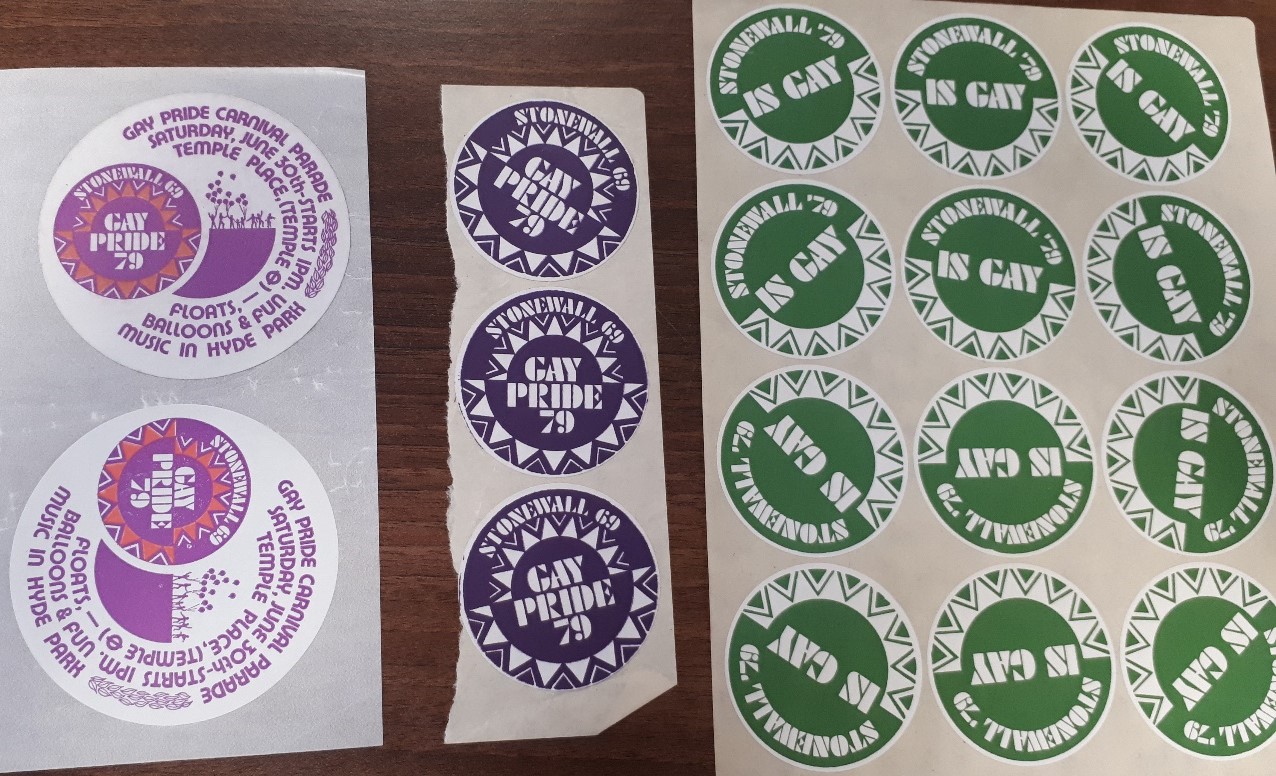
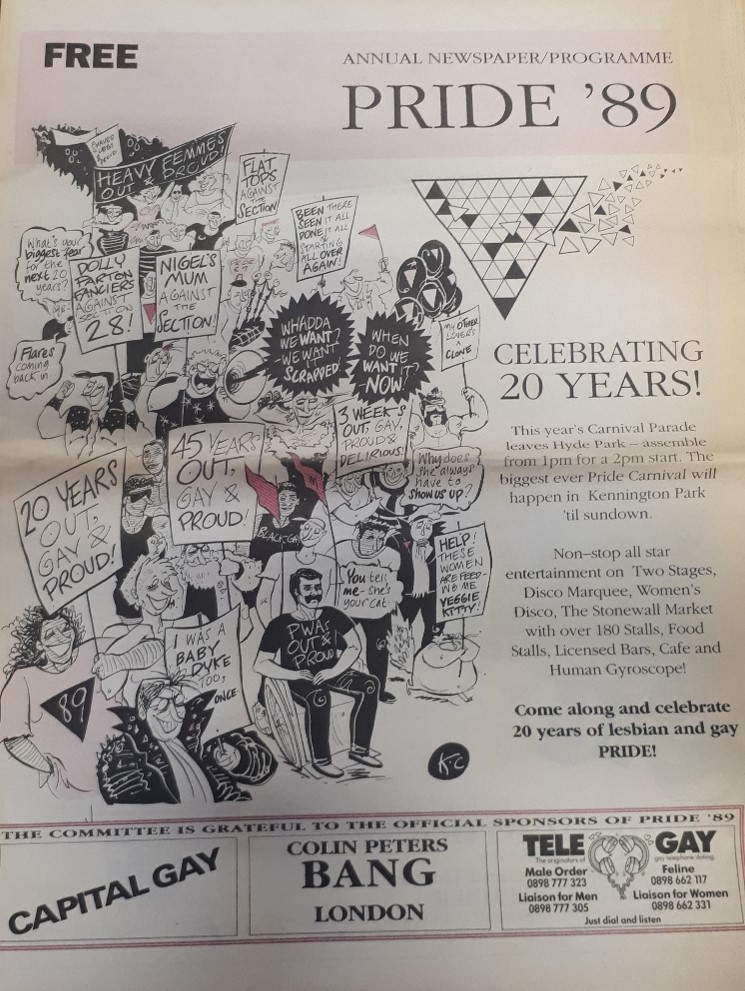
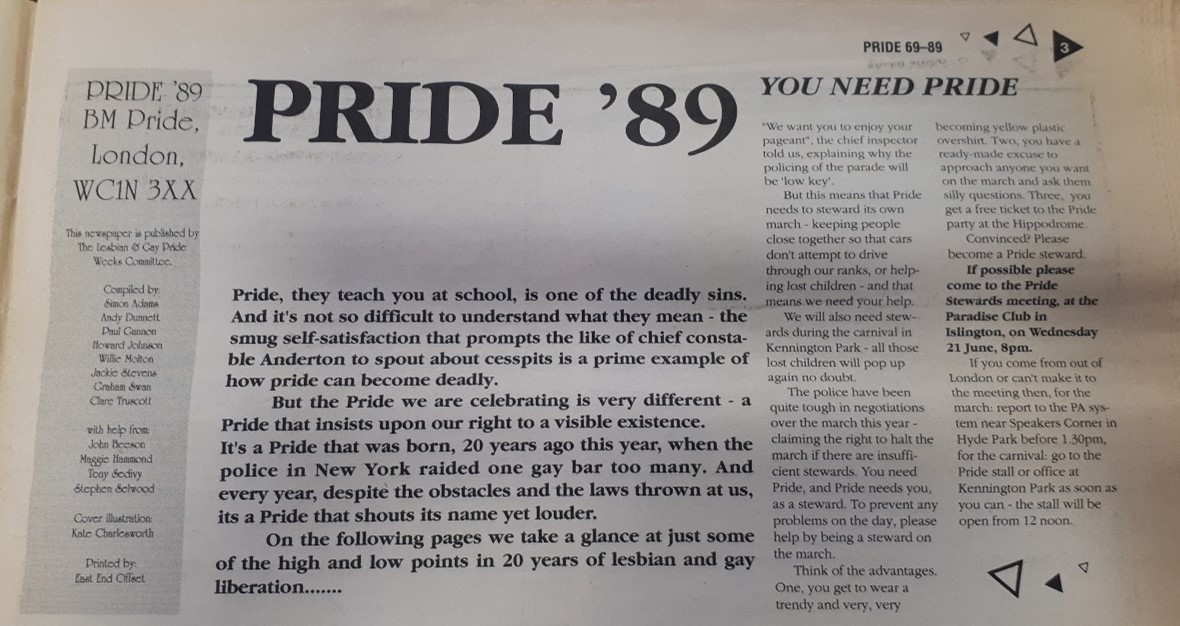
The Pride movement was influenced by the 1969 Stonewall riots in New York. The riots were a response to a violent police raid at the Stonewall Inn gay bar and were a catalyst for LGBTQ+ equality movements worldwide. The significance of Stonewall is reflected in the Tyneside CHE archive, as the marches of 1979 and 1989 commemorate the 10th and 20th anniversaries of this watershed moment in the LGBTQ+ liberation movement.

Stickers from Pride 1979 commemorating 10 years since Stonewall
Stickers from Pride 1979 commemorating 10 years since Stonewall (Tyneside Campaign for Homosexual Equality (Tyneside CHE) Archive, CHE/03/07/02).
Pride 1989 Annual Newspaper/Programme
Pride 1989 Annual Newspaper/Programme (Tyneside Campaign for Homosexual Equality (Tyneside CHE) Archive, CHE/03/07/02).
Pride 1989 Annual Newspaper/Programme
Pride 1989 Annual Newspaper/Programme (Tyneside Campaign for Homosexual Equality (Tyneside CHE) Archive, CHE/03/07/01).

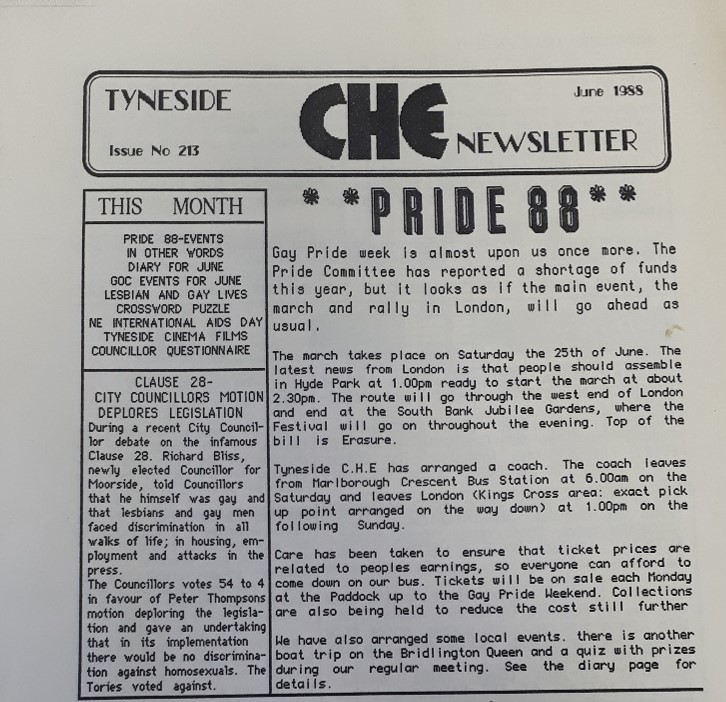
Throughout the years, Tyneside CHE organised annual trips to the London Pride marches. A coach was arranged, and ticket prices were ‘related to people’s earnings, so everyone can afford to come down on our bus’. Pricing tickets in this way promoted inclusivity and ensured LGBTQ+ people from across the socio-economic spectrum could participate in Pride.

Tyneside CHE Newsletter front page article advertising the organised trip to London Pride and the sale of coach tickets, June 1988, Issue 213
Tyneside CHE Newsletter front page article advertising the organised trip to London Pride and the sale of coach tickets, June 1988, Issue 213 (Tyneside Campaign for Homosexual Equality (Tyneside CHE) Archive, CHE/02/01).

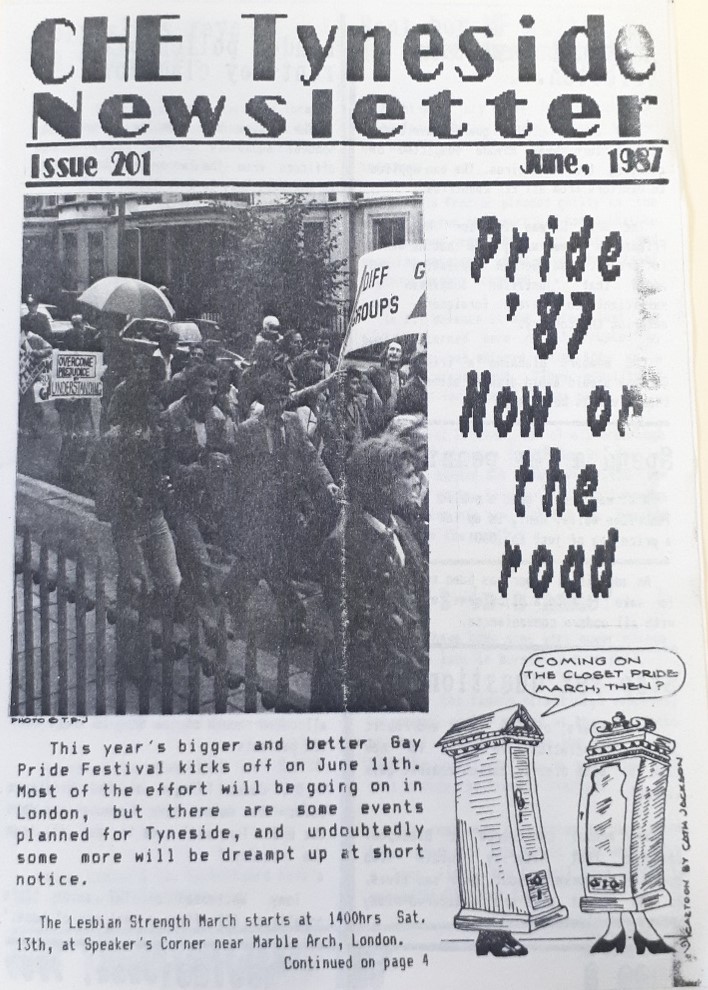
The London march was not the only way to celebrate Pride, however, with the CHE Tyneside newsletter from 1987 outlining that some events were planned in Tyneside itself.

CHE Tyneside Newsletter promoting Pride, June 1987, Issue 201
CHE Tyneside Newsletter promoting Pride, June 1987, Issue 201 ( Tyneside Campaign for Homosexual Equality (Tyneside CHE) Archive, CHE/02/01).

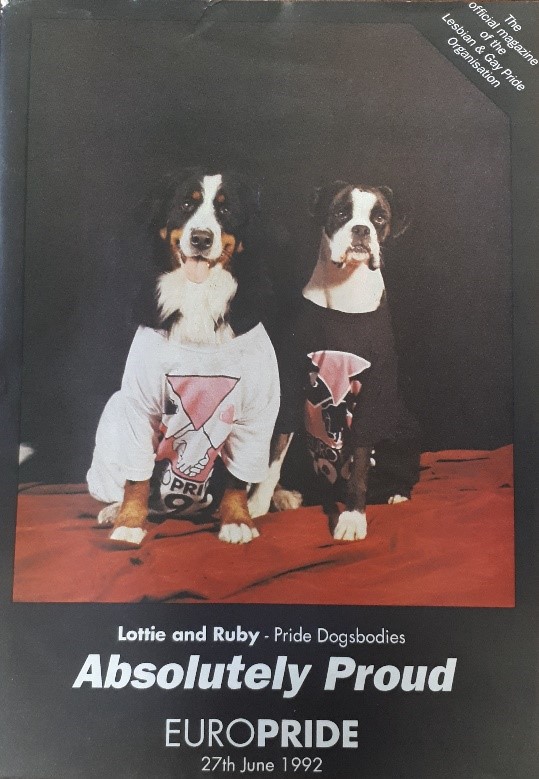
The Tyneside CHE archive also contains paraphernalia from Pride festivals across Europe, including from the very first EuroPride. EuroPride is a pan-European festival hosted by a different European city each year. The first EuroPride took place in London in 1992 and was attended by over 100,000 people. Not only does 2022 mark 50 years since the first Pride, but it also marks the 30 year anniversary of EuroPride.

Magazine from the first EuroPride, showing a photograph of 2 dogs wearing t-shirts
Magazine from the first EuroPride, London 1992, published by the Lesbian and Gay Pride Organisation (Tyneside Campaign for Homosexual Equality (Tyneside CHE) Archive, CHE/03/07/01).

Looking through the Tyneside CHE archive it is clear that a lot of progress has been made since the first Pride march 50 years ago. However, with 1 in 5 LGBTQ+ people in Britain experiencing a hate crime, and with conversion therapy still being legal in the UK, there is still a long way to go to achieving true equality.

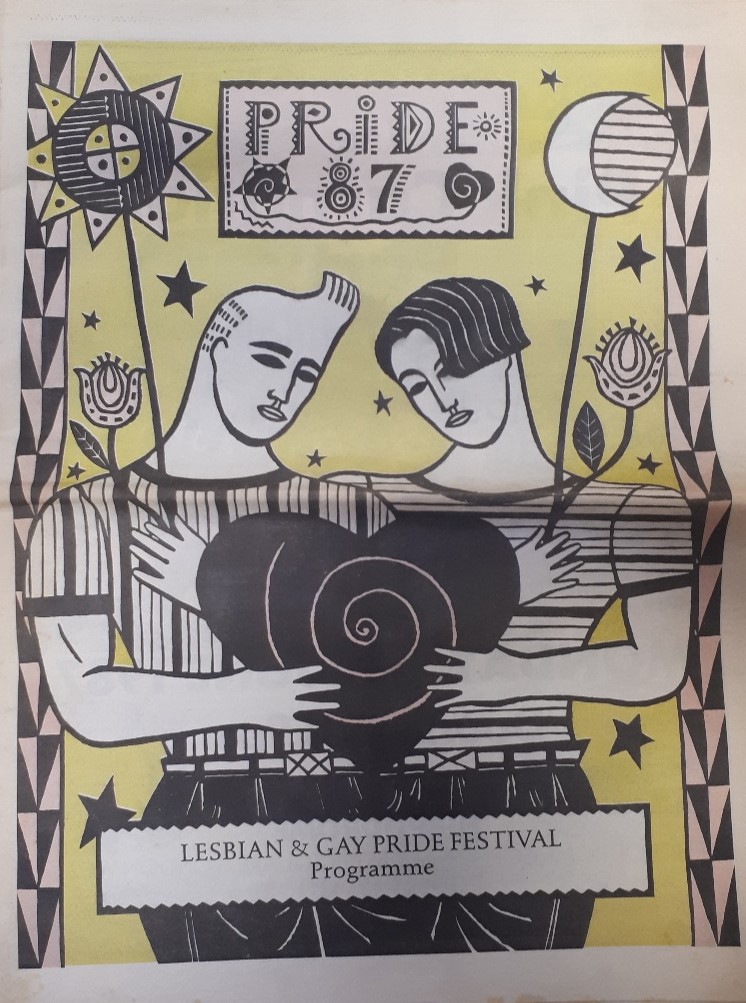
Pride 1987 Festival Programme, showing an illustration of 2 people holding a love heart
Pride 1987 Festival Programme (Tyneside Campaign for Homosexual Equality (Tyneside CHE) Archive, CHE/03/07/01).

CHE materials are used by kind permission of the Campaign for Homosexual Equality.

We have sought to ensure that the content of this blog post complies with UK copyright law. Please note however, that we have been unable to ascertain the rights holders of some of the images used. If you are concerned that there may have been a breach of your intellectual property rights, please contact us with the details of the image(s) concerned at libraryhelp@ncl.ac.uk and we will have the specified image(s) taken down from the blog post.

Jenny Lives with Eric and Martin – February 2021

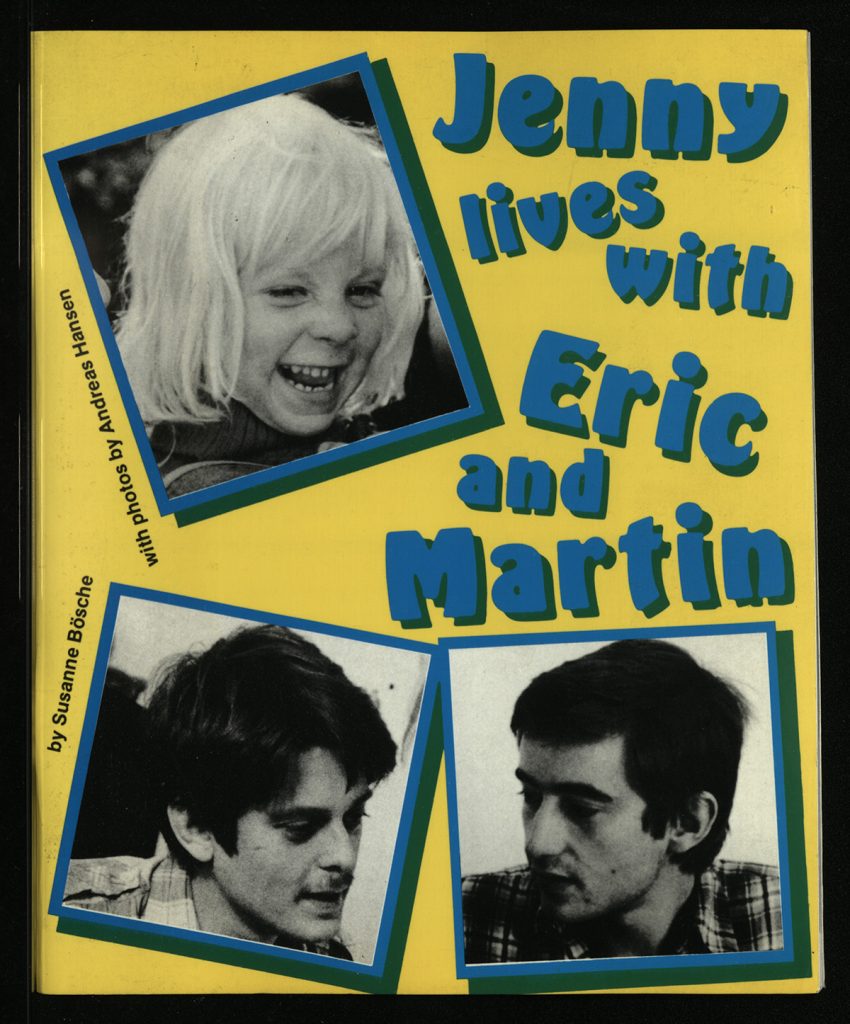
The book Jenny Lives with Eric and Martin was one of the first English-language children’s book to discuss male homosexuality and inadvertently played a significant role in one of the most difficult and controversial episodes in the history of the struggle for equality for LGBT people in the UK.

Written by Danish author Susanne Bösche and first published in Danish in 1981, the book was published in English in 1983 by Gay Men’s Press, intended to help reduce anti-gay prejudice and to be a resource to facilitate discussion with children about homosexuality.

Front cover of the Jenny Lives with Eric and Martin book.
Front cover of Jenny Lives With Eric and Martin (Gay Men’s Press, 1983). (Alderson (Brian) Collection, Alderson Collection BOS JEN)

Special Collections’ copy of Jenny Lives with Eric and Martin is held in the Alderson (Brian) Collection of children’s books, and demonstrates how a book may become politicised owing to its content and the context in which it is viewed, in this particular book’s case, having become a weapon in a war over the teaching of sexuality in schools.

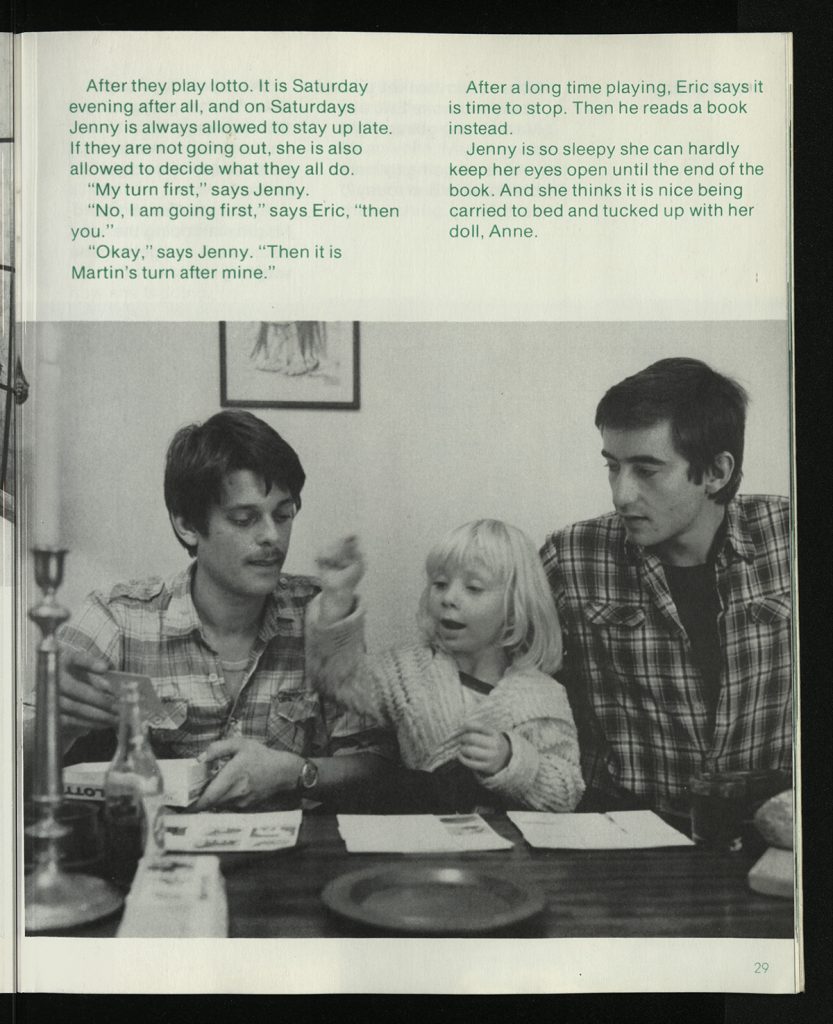
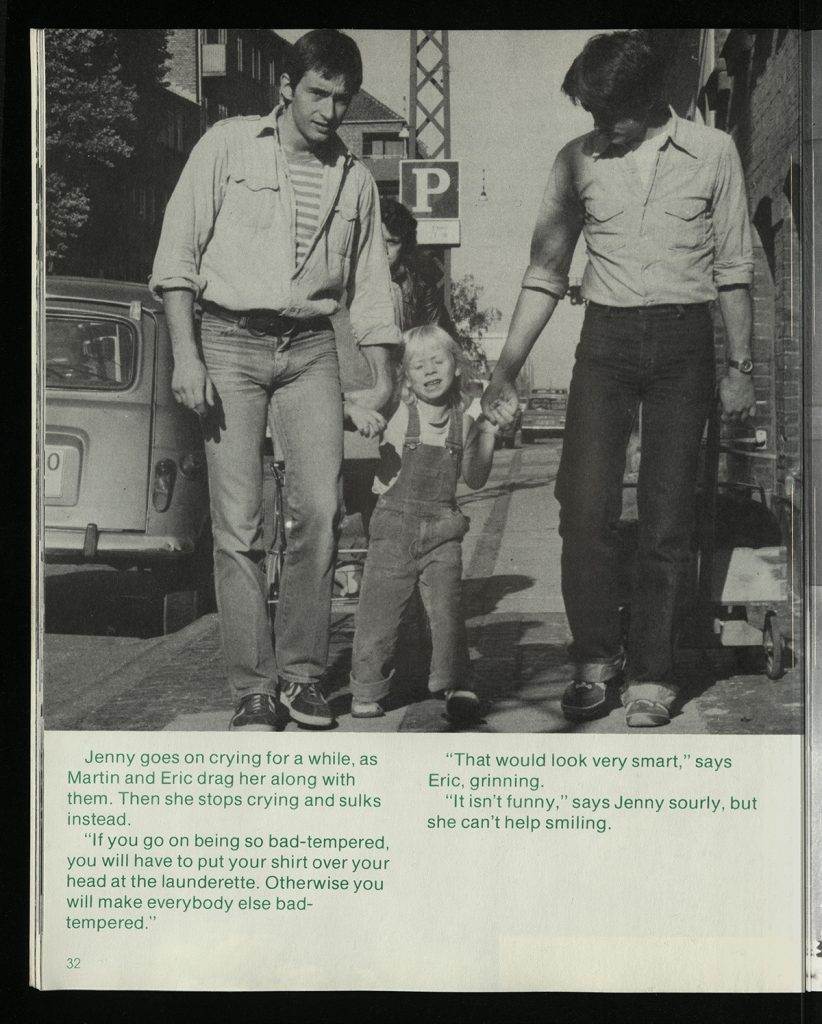
The story describes a few days in the life of five-year-old Jenny, her father, Martin, and his partner Eric who lives with them. Jenny’s mother Karen lives nearby and often visits. It covers their various day-to-day activities, including going to the laundrette together; playing a game of lotto; preparing a surprise birthday party for Eric; and Eric and Martin having a minor argument and making up. There is also a conversation with a passer-by who expresses homophobic disgust when meeting the family in the street, the subject of a later discussion between Eric and Jenny.

Page 29 of Jenny Lives With Eric and Martin containing text from the story and a photograph showing a young girl sat between two men at a table.
P.29 of Jenny Lives With Eric and Martin (Gay Men’s Press, 1983). (Alderson (Brian) Collection, Alderson Collection BOS JEN)

That the 1980s was a time of rising negative sentiments towards homosexuality in the UK is well-documented. In 1986 a copy of Jenny Lives With Eric and Martin was made available by the Inner London Education Authority in a teachers’ centre specifically for the use of teachers who wanted to know more about gay or lesbian parents. In response to this, various national newspapers inaccurately reported that the book was being made available in school libraries.

The ensuing controversy, including the condemnation of the book’s availability by the Secretary of State for Education, resulted in fear that the book was being used as “homosexual propaganda”, and made a major contribution towards the Conservative Government’s subsequent passing of the controversial Section 28 of the Local Government Act 1988, which forbade the promotion of homosexuality by local government and in schools in England, Wales and Scotland.

Attitudes towards sexuality and sexual minorities have shifted a great deal over the decades since the passing of Section 28, which was reviled by many far beyond the gay community itself. Now largely held to have been an unnecessary and unjust assault on civil rights, the legislation was repealed in 2003, and in 2009 the Conservative Prime Minister David Cameron apologised publicly for it.

Page 32 of Jenny Lives With Eric and Martin containing text and a large photograph of two men walking down a street with a young girl between them.
P.32 of Jenny Lives With Eric and Martin (Gay Men’s Press, 1983). (Alderson (Brian) Collection, Alderson Collection BOS JEN)

Bösche, Susanne. Jenny Lives with Eric and Martin (Gay Men’s Press, 1983)

Shelf mark: Alderson Collection BOS JEN