Academics and Researchers: September 2026

Welcome to the first digital newsletter from Newcastle University Library for the year. In this update we highlight what has been happening in the Library over the summer and essential updates to services for 2026-27, including updated opening hours, Reading Lists, updates to the Library website and space developments in the Philip Robinson Library.

Over the summer, the Library Liaison and Academic Services team has been renamed the Academic Engagement team. This reflects a broader shift within higher education librarianship from the term liaison to engagement – a more active expression of the relationship-building and partnership work we undertake.  

Importantly, this is a change in name only. Please be assured that we will continue to work closely with you, as we do now, to support both you and your students’ teaching, learning and research. Alongside our Academic Skills colleagues, your Librarians will continue to embed and deliver skills development within your programmes, and we look forward to collaborating with you as part of the curriculum transformation work planned for the coming year. Our commitment remains the same: to ensure you and your students have access to the library services, expertise, and support needed to succeed. 

Our email address has been updated, and you can contact your Faculty Engagement Librarians Aimee, Emily and Louise at libengagement@ncl.ac.uk.

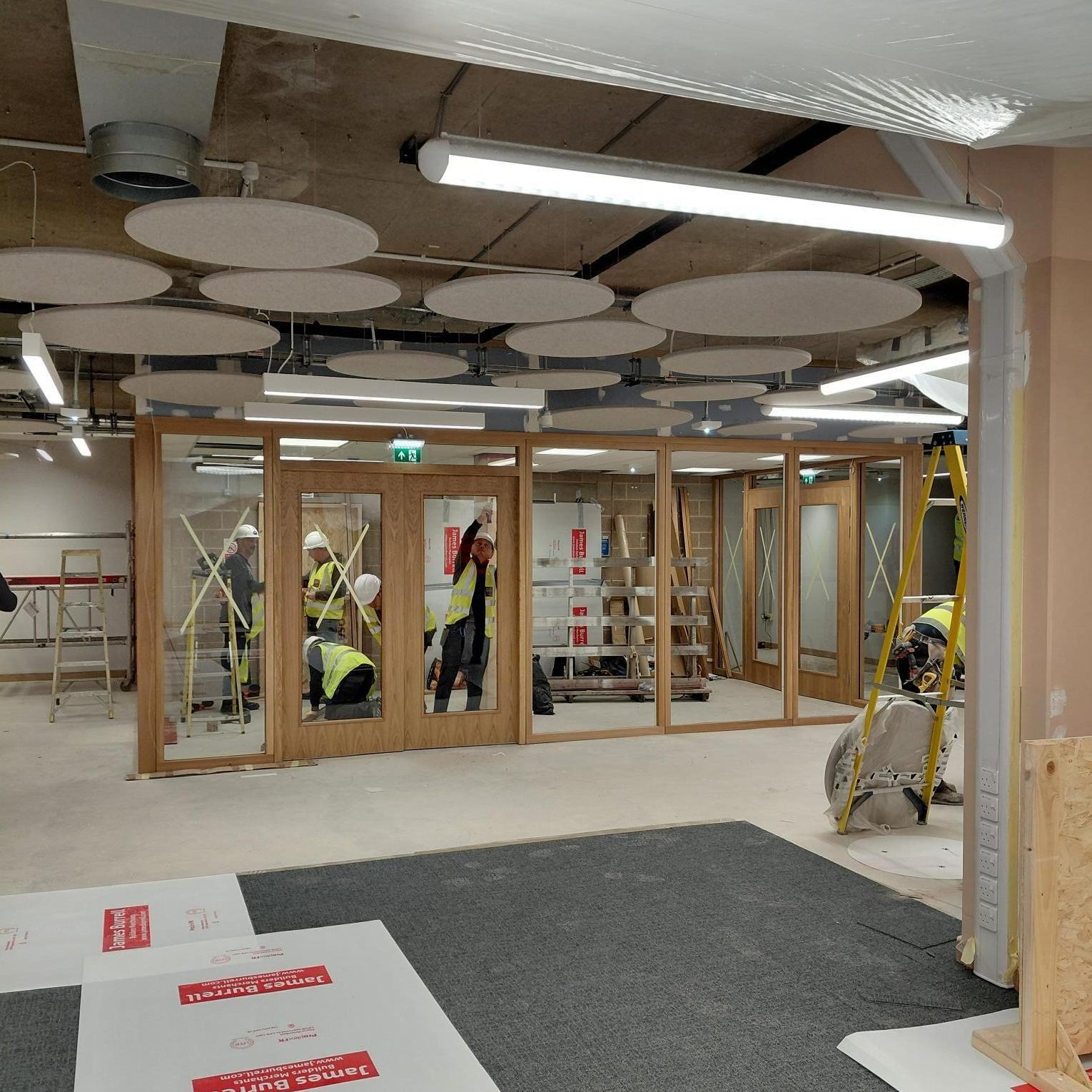
During the summer months, work has been undertaken to refurbish and re-zone Level 1 to provide fully accessible toilets, create a larger collaborative study space and combine existing cluster spaces to become a single, 48-person cluster. The work is in the final phase and is expected to complete by mid-October.

More information about the UX research that informed the space redevelopment is available on the Library website and more updates will be provided over the coming weeks.


Term-time service hours will resume on on 21 September 2026, with the three Library spaces open:

  • Philip Robinson Library: 24 hours 7 days a week.  
  • Walton Library: Monday to Friday 08.30 – 22.00; Saturday and Sunday 10.00 to 22.00.
  • Marjorie Robinson Library Rooms: Monday to Sunday 08.30 – 17.00; Saturday and Sunday 09.00 to 17.00.

The reading lists team are working on updating and acquiring materials to ensure we have resources ready for students. Please review, update and share any remaining reading list as soon as possible.

It is straightforward to add and edit your reading lists using our online reading lists. When a new resource is added our systems will automatically check we have the resource, if not it will seamlessly kickstart the acquisition process. For guidance on how to access, edit or send us your reading list, please visit our short guide of how you can manage your reading list.


New research webpages from the Special Collections and Archives team highlight how you can make use of our unique archival and rare book collections. The pages bring together research tools, guidance and opportunities for collaboration, helping you and your students discover new ways to engage with distinctive primary source material.
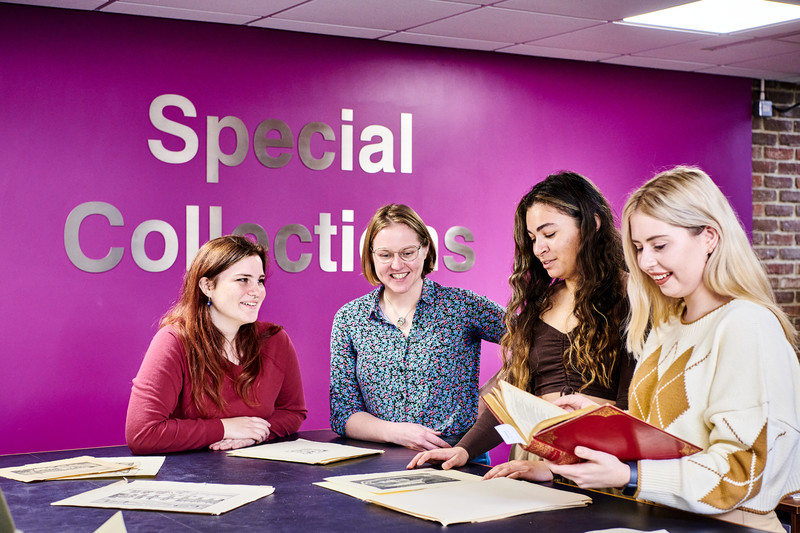
We welcome collaboration with academic and external researchers at all stages of the research lifecycle, from developing funding proposals and building collections to digitisation projects, exhibitions and digital scholarship. Early engagement can help shape projects and maximise the potential of our collections.

Find out more on our research webpages and contact the team to discuss potential collaborations.

Our Academic Engagement Team are finalising where we will be contributing to modules this year. We will be delivering a range of lectures, workshops and online materials through Canvas to help develop your students’ academic and information literacy skills.

If you’ve had support arranged previously and have not contacted us yet to confirm arrangements for 2026-27, now is the time to get in touch. Or perhaps you would like to explore how we could support your module/ programme in the future. You can find out more about how we can support your students and view example case studies on the Embedding Skills in your curriculum webpage.


The introduction of Academic Advising will give students ongoing support to help them reflect on their academic progress, skills development, goals and future plans. The Library can support this role by acting as a trusted referral point when students need additional help, providing specialist support with academic skills, study practices and learning development. In your role as an Adviser you can signpost students to Library services and the Academic Skills Kit, which offers a wide range of self-directed resources to help students build confidence, develop effective study strategies and succeed in their studies. In the initial meetings, the resources below may be particularly valuable.

Stepping up to university studies for the first time, in a new country or at a more advanced level of study, can be challenging for any student. Get Ready to Study is a collection of resources specifically tailored to supporting new undergraduate students with the transition to university. Developed in collaboration with students, these resources aim to build student knowledge, skills, confidence and independence. 


An Academic Skills Kit collection of resources and practical advice to help students studying in the UK for the first time understand academic expectations and prepare for their time at Newcastle University.


Contact the team: libengagement@ncl.ac.uk
Faculty of Humanities and Social Sciences:
Louise Masson
Faculty of Medical Sciences:
Aimee Watson-Cook
Faculty of Science, Agriculture and Engineering: Emily Dott

Finding empirical and methodological research articles

When it comes to research methods or research methodologies, there can be a lot of unfamiliar terms and concepts to get to grips with. One question we’re often asked by masters business students is how to find empirical and methodological research articles. It’s a good question as it can be quite tricky to locate articles on these topics, so here’s some advice on how you can go about searching for them in Library Search and the databases that we subscribe to.

Book shelves with hanging light bulbs
Photo by  Janko Ferlič on Unsplash

What is the difference between empirical and methodological research?

Let’s start by defining our key terms, so we know what to look out for:

Empirical research

Empirical research is based on observed and measured phenomena and derives knowledge from actual experience rather than from theory or belief.

How do you know if a study is empirical? Read the subheadings within the article, book, or report and look for a description of the research methodology. Ask yourself: Could I recreate this study and test these results?

Key characteristics to look for:

  • Specific research questions to be answered
  • Definition of the population, behaviour, or phenomena being studied
  • Description of the process used to study this population or phenomena, including selection criteria, controls, and testing instruments (such as surveys)

Another hint: some scholarly journals use a specific layout, called the “IMRaD” format, to communicate empirical research findings. Such articles typically have 4 components:

  • Introduction: sometimes called “literature review” — what is currently known about the topic — usually includes a theoretical framework and/or discussion of previous studies
  • Methodology: sometimes called “research design” — how to recreate the study — usually describes the population, research process, and analytical tools
  • Results: sometimes called “findings” — what was learned through the study — usually appears as statistical data or as substantial quotations from research participants
  • Discussion: sometimes called “conclusion” or “implications” — why the study is important — usually describes how the research results influence professional practices or future studies

Thank you to Penn State University for their description of empirical research: https://guides.libraries.psu.edu/emp

Methodological research / study

According to Mbaugbaw et al., a methodological study will:

“…evaluate the design, analysis or reporting of other research-related reports […] They help to highlight issues in the conduct of research with the aim of improving […] research methodology, and ultimately reducing research waste (2020, p.1).

In simple terms, it’s research on research!

Key characteristics to look for:

  • Will have the term ‘methodological research’ or ‘methodological study’ in the title or abstract.
  • Has more of a focus on the method(s) employed to do the research (e.g. interviews, questionnaires) rather than the findings of the research.
  • Evaluates how research was done and how the methodology could be improved.

How to find empirical and methodological research articles in Library Search and databases

Finding these research articles isn’t always easy, but it can be done! While they are indexed in most databases, it can sometimes be tricky to find them because of the wide variety of names used for these type of studies (methodological research can also be known as research-on-research, meta-research, meta-epidemiological studies etc.).

Here’s our top tips for finding empirical and methodological research articles:

Searching via journal titles

The easiest way to find these journal articles is to target journals that are focused on research methods, then search or browse within those titles.

Here’s some examples of such journal titles to help you find methodological studies:

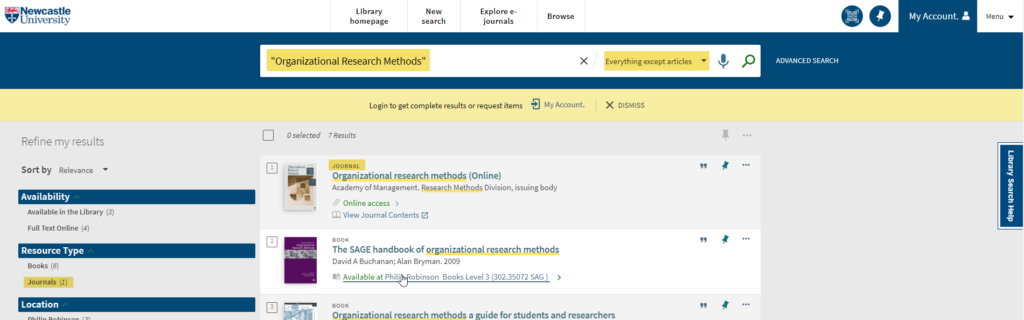
I recommend that you search for these titles in Library Search under ‘Everything except articles’ filter:

Screenshot of Library Search and searching for a particular Journal title.

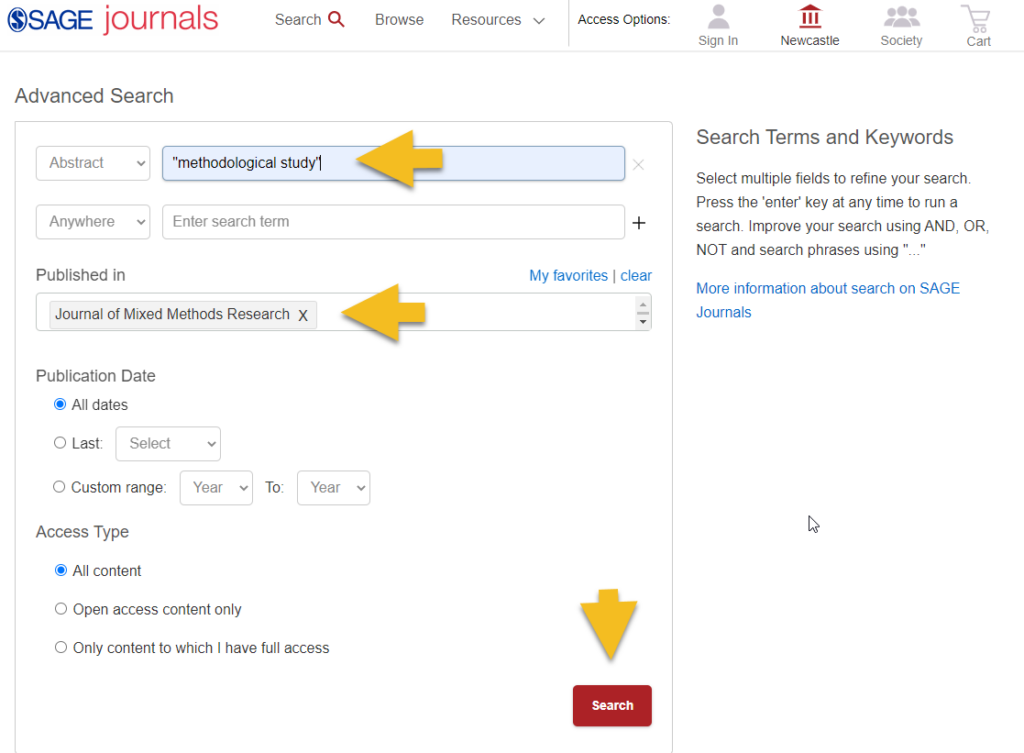
Within these titles I recommend searching for “methodological study” in the abstract:

Screen shot of searching within SAGE Journals for "methodological study"

To find empirical research articles, you would go to top, peer-reviewed, research journals in your field of study (the list is endless!) and search within these using relevant keywords.

Here are some key journal titles in the field of business:

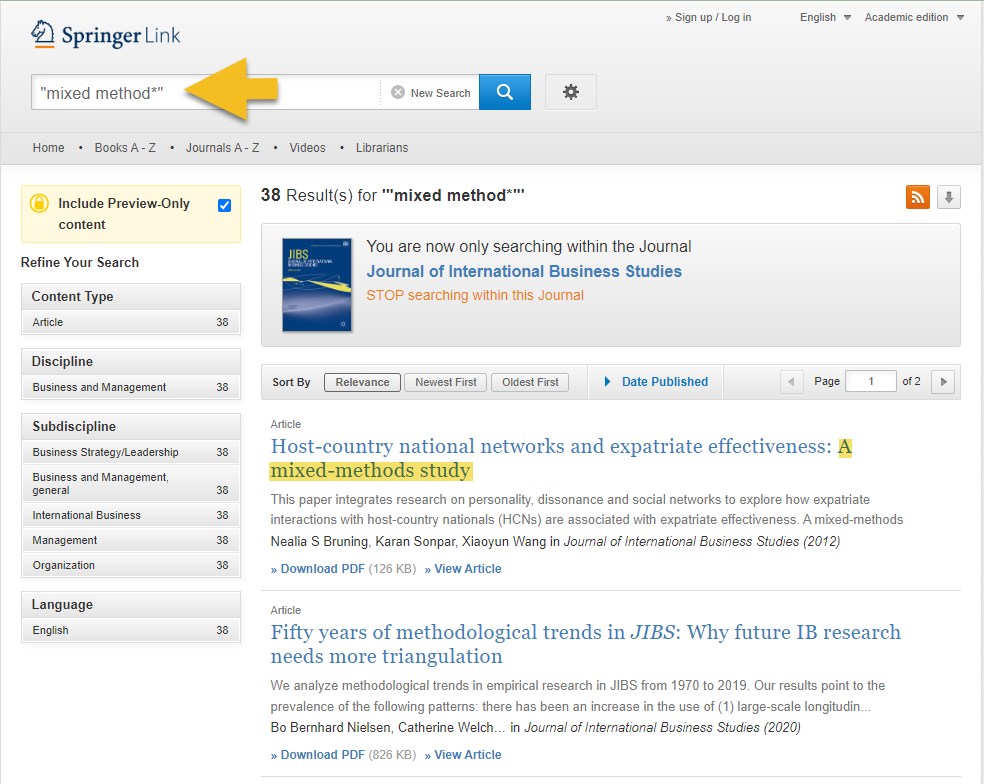
You then need to search within these journal titles, ideally within the abstract, for keywords relating to the research design / method ( i.e. how the researcher collected their empirical research) So you might search for terms such as interview*, survey*, questionnaire* or “focus group*” :

Screen shot of searching within a business journal for an empirical research method

Searching via keyword in Library Search and databases

If you aren’t finding enough when searching within journal titles, broaden your search by looking within Library Search and other suitable databases.

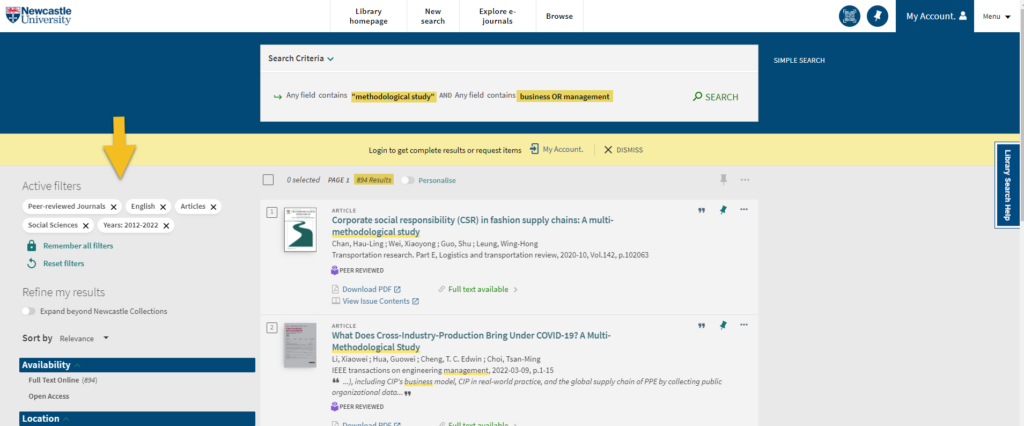
The Advanced Search within Library Search is a good place to start. Again, try to search for keywords such as “methodological study”, or by method, e.g., interview*, survey*, questionnaire* or “focus group*”, along with your subject topic. Remember to use the filters if you need to find research within a particular time frame, such as the last 10 years and to change the drop down to search “everything”.

Screenshot of Library Search search for "methodological study"

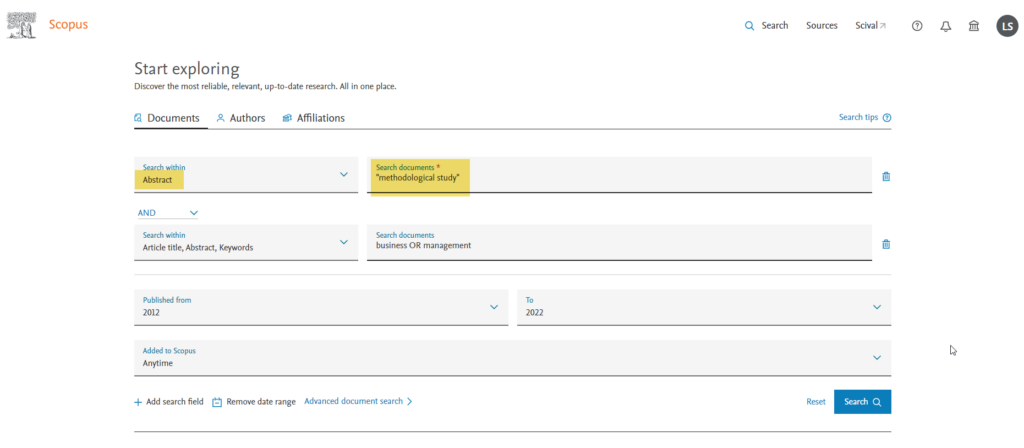
If you are looking within Scopus or subject specialist databases, such as Business Source Complete, the process is exactly the same. If your search isn’t working, try different keywords, but persevere as the research is there, it just might be hiding:

Screenshot of Scopus showing searching "methodological study" within the Abstract field.

Searching with controlled vocabulary / subject headings

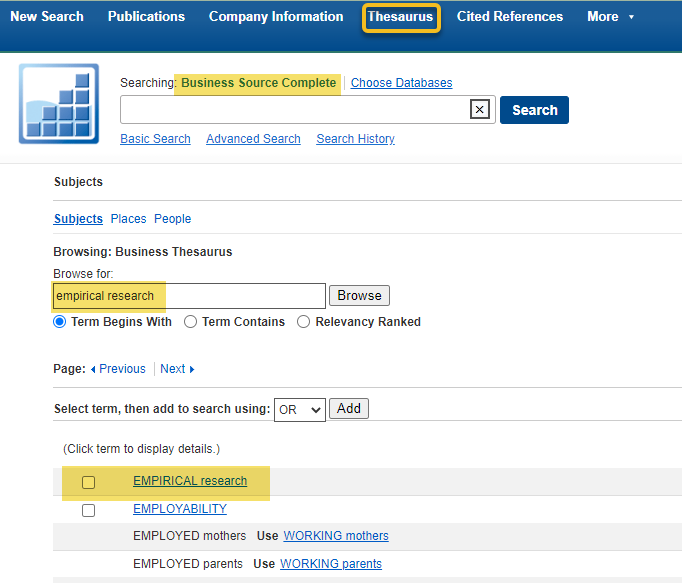
Some of our databases use controlled vocabulary (a thesaurus), this allows you to identify the preferred terms used in a particular database for your topic of interest, making it easier to find relevant articles. Here is a worked example using controlled vocabulary in Business Source Complete:

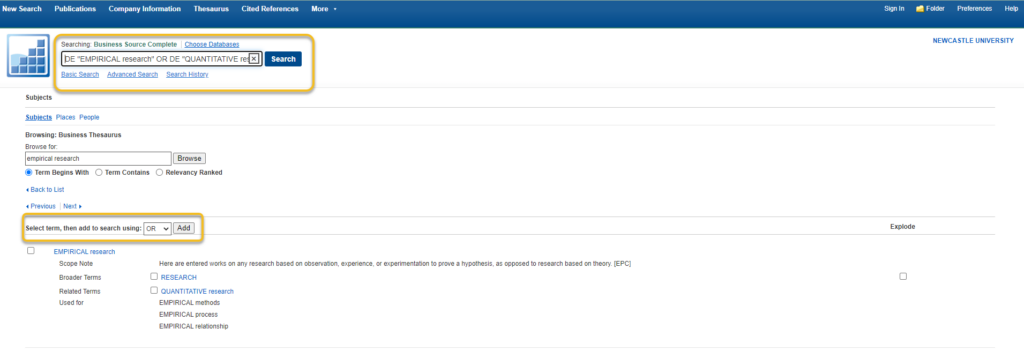
I tried a search for “empirical research”, and found it is a preferred term within this database:

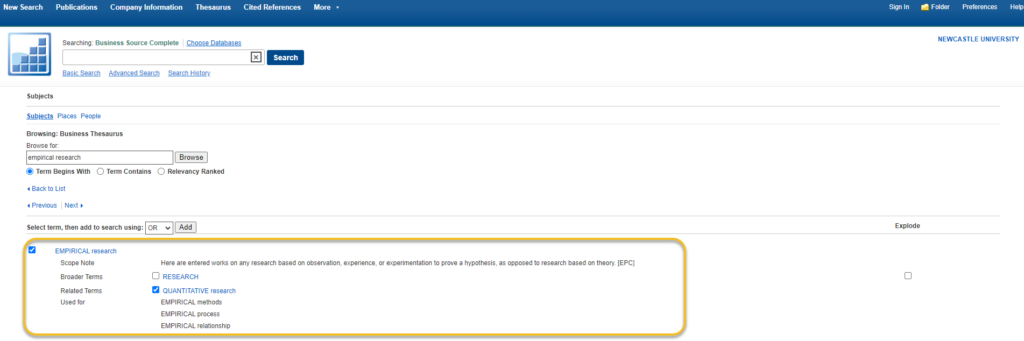
Clicking on this preferred term allows you to explore any related or narrower terms, which you can choose to add to your search to improve the quality of your results:

Screenshot of thesaurus in Business Source complete

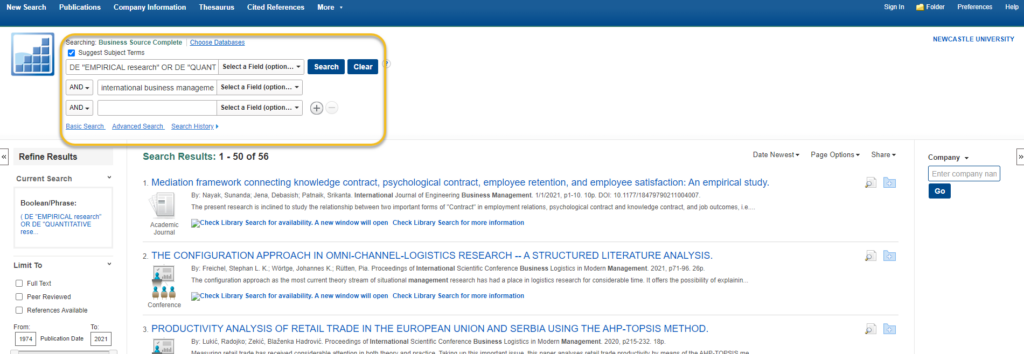
I decided to add Empirical research and the related term Quantitative research to my search, clicking add to include them in my search string:

I can then add subject related terms to my search:

Many of the social sciences databases have a thesaurus that you can search within.

SAGE Research Methods

For further help on topic of research methods and methodologies, check out SAGE Research Methods. This is a database containing thousands of resources, dedicated to the subject area of Research Methods. It supports all stages of the research process including: writing a research question, conducting a literature review, choosing the best research methods, analysing data, to writing up your results and thinking about publication. It contains information suited to all levels of researchers, from undergraduates starting your first project to research associates. Within the resource, you can access dictionary and encyclopaedia entries, book chapters, full books, journal articles, case studies, some datasets and video. There are many uses for the resources you will find in SAGE Research Methods:

  • get a quick explanation of a term or concept in a dictionary or encyclopaedia entry
  • access a full overview of a qualitative and quantitative methods, theory or approach in a specialist book
  • use an e-book chapter that covers a specific method in more detail for your methodology chapter or when choosing how to approach your research
  • access a journal article that illustrates the real world application of the methods in research

Access the SAGE Research Methods User Guide for an overview of the resource, and use the tabs below to access videos and training materials to get started. 

To access SAGE Research Methods, either:

I hope you have found this useful. I’m sorry there isn’t an easy way for finding such articles, however, a thorough and systematic search within journal titles, Library Search and databases will allow you to find some relevant and good quality articles that you can use in your research.

If you need further help with this topic or something similar, please make an appointment with your Liaison Librarian.

References

Mbuagbaw, L., Lawson, D. O., Puljak, L., Allison, D. B. and Thabane, L. (2020) ‘A tutorial on methodological studies: the what, when, how and why’, BMC Medical Research Methodology, 20(1). Available at: https://bmcmedresmethodol.biomedcentral.com/articles/10.1186/s12874-020-01107-7 (Accessed: 15 June 2022).

Women’s Magazine Archive

After a successful trial earlier in 2023, we are very pleased that the Library has been able to secure access to the Women’s Magazine Archive I-III.

Available in three separate collections, Women’s Magazine Archive provides access to the backfiles of the foremost titles of this type, including Good Housekeeping, Ladies’ Home Journal, and Woman’s Day, which serve as canonical records of evolving assumptions about gender roles and cultural mores. Other titles focus on narrower topics but deliver valuable source content for specific research areas. Parents, for example, is of particular relevance for research in the fields of children’s education, psychology, and health. Elsewhere, Seventeen, Cosmopolitan, and Essence disclose trends in and responses to the changing roles and experiences of teenage, young adult, and African-American women respectively.

In combination, the publications here cover topics such as family life, home economics, health, careers, fashion, culture, and many more; this material serves multiple research areas, from gender studies, social history, and the arts, through to education, politics and marketing/media history.

Issues are scanned from cover to cover in high-resolution colour, ensuring that the original print artefacts are faithfully reproduced and that valuable non-article items, such as advertisements, are included.

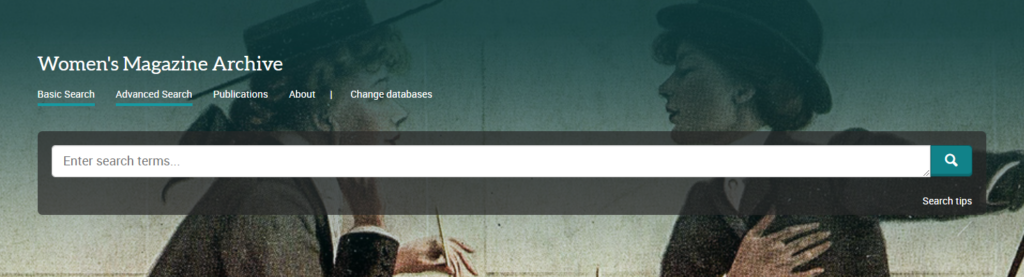
You can search the resource in different ways, including by Basic or Advanced Search:

Women’s Magazine Archive – Basic and Advanced Search options

For more support on using the Basic and Advanced Search, see the ProQuest Platform support guides.

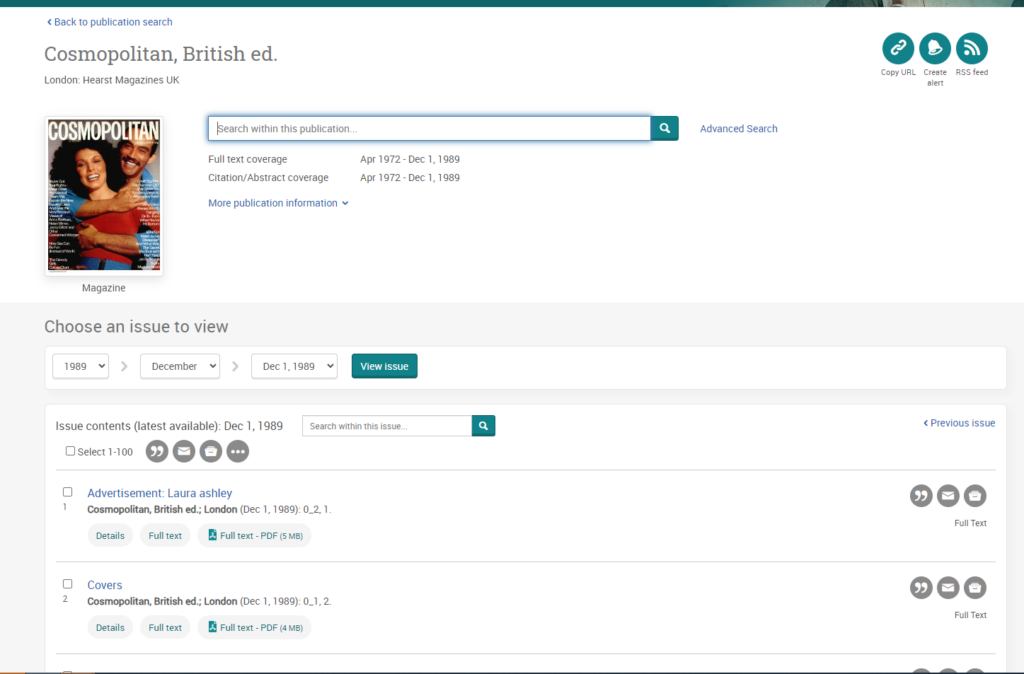
You can also search within a Publication, or for a specific issue of a publication:

Women’s Magazine Archive – publications search

Viewing individual pages is made easy, with options to download the PDF or browse the full issue:

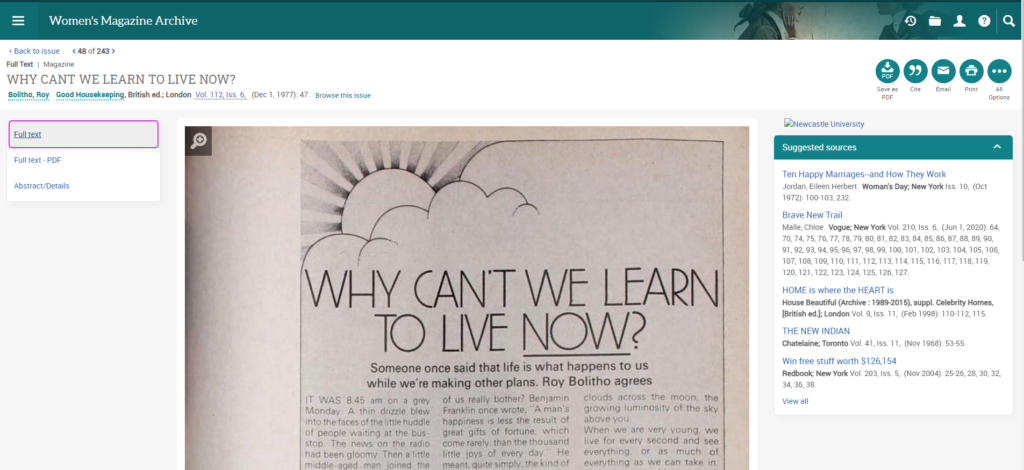
Women’s Magazine Archive – viewing the full text of an individual issue

Access the Women’s Magazine Archive using your Newcastle University credentials via the Library Search record here.

This resource will be useful for researchers in a number of subjects, including History, English, Media, and Sociology – we hope it is useful, and always, get in touch with the Liaison team should you need any further support in using the Women’s Magazine Archive I-III.