Tag Archives: Renewable energy

How Newcastle University’s CHP Plant is Driving Campus Decarbonisation 

In January 2024, a new Combined Heat and Power unit (CHP) was installed in the Merz Court Energy Centre, a powerful and efficient plant room tucked away in the building’s basement. Recognising its impressive potential, the University saw an opportunity to divert excess energy to the Stephenson Building. Since then, the CHP has become an integral component in our Net Zero strategy…
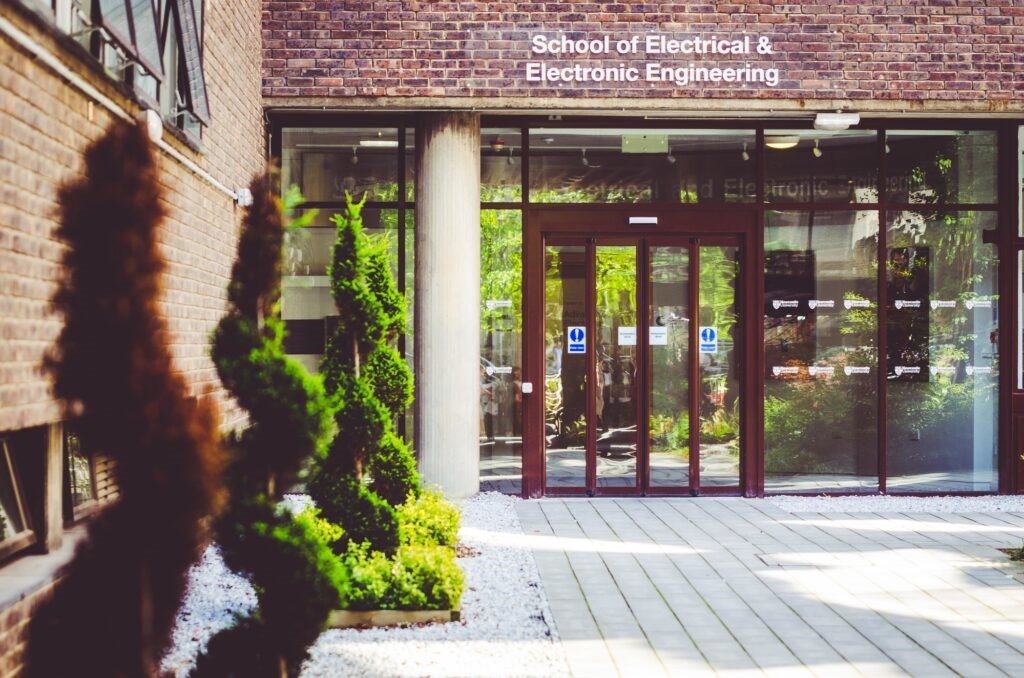
Image: Entrance of the Merz Court building, home to electrical and electronic engineering (and the CHP unit of course!)

CHP and the Stephenson Redevelopment 

To ensure sustainability was considered at every step of the Stephenson renovation, a Low and Zero Carbon Assessment (LZC) was carried out in the early planning stages. The assessment looked at a variety of scenarios, comparing a business-as-usual approach to an alternative scenario using renewable energy generation. Eventually, it was decided that, in line with our Climate Action Plan, Stephenson would primarily receive its heating from the CHP district network.  

CHP and Environmental Impact 

In its simplest terms, the CHP plant is a large engine that burns biofuel. The engine is connected to a generator which makes electricity to enter the University electricity distribution network. The heat created by this process is recovered and fed into the district heating network. 

Therefore, the CHP plant is more environmentally friendly than traditional systems in a few ways: 

  1. Natural gas power stations which supply the national grid generally do not recover heat, whereas the CHP plant preserves and recirculates produced heat 
  1. The biofuel is a certified renewable fuel resulting in significant reductions in our greenhouse gas emissions. The CHP generates and distributes electricity and heat to nearby buildings – reducing the transmission losses associated with a traditional ‘grid supplied’ distribution model.  

Image: The CHP unit located in the Merz Court Energy Centre. Inside the container is essentially a large engine, running off biofuel.

The District Heating Network 

Currently, the CHP is fully installed and undergoing final testing and commissioning. An array of underground pipes has connected the plant to the following buildings: 

  • Old Library Building 
  • Percy Building 
  • Henry Daysh Building 
  • Stephenson Building 
  • Cassie Building 

In recent months, the network has also been connected to the King’s Road Boiler House, extending the CHP heating network to five more buildings: 

  • Armstrong Building 
  • Bedson Building 
  • Boiler House Event Space 
  • Hadrian Building 
  • King George VI Building 

The CHP will become the lead heat source for these buildings, with natural gas boilers being used to ‘top-up’ the heat supplied by the CHP.  

Current Projections 

After tests have been completed, the CHP will generate 850 kW of electricity, which equates to approximately 10% of the University’s daytime load or around 25% of our overnight load. About 1000kW of heat is also produced – this heat is recovered and fed into the University’s district heating system. 

The Future of CHP 

As we enter the final commissioning stage, we expect CHP system to be fully operational in time for the next heating season.  

Recently, we applied for funding from the Green Heat Network Fund to extend our heat network to Kensington and Park Terrace student residences and the Drummond Building, with a decision expected this summer. If successful, this funding will enable the integration of an additional renewable energy source (Air Source Heat Pumps) to our network, further reducing the carbon intensity of our heating systems.  

The recently launched Estates Optimisation project will also play a vital role in supporting these developments through smarter use of space and infrastructure. This project also includes the development of the University’s Net Zero Strategy, shaping the business case for future heat network extensions and identifying specific ways to reduce energy use and deliver further increases in the generation of renewable energy across campus. 
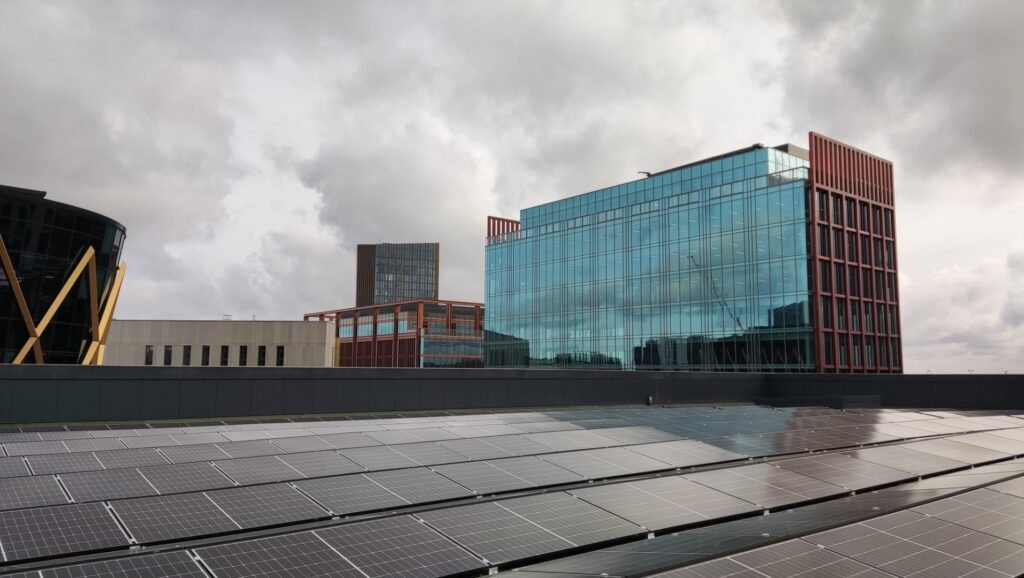
Solar power on campus: Harnessing renewable energy to power our university.

Why is renewable energy important?

As attested in UN Sustainable Development Goal 7, ensuring that our power is being generated renewably is a vital part of meeting climate goals, whether national, international, or across individual organisations (White, 2024). Here at Newcastle University, lighting accounts for around 20% of our energy use alone, but electricity is also used to power many building’s heating, cooling, and ventilation systems, our fleet of electric vehicles, our PCs, server banks, lab equipment, and more. With so much of the University drawing on electrical power, therefore, generating renewable energy on campus can have a huge impact on reducing the emissions of our facilities and operations. One technology that has proven invaluable in our efforts to increase local renewable energy production is solar power.

Image: A view of the Frederick Douglass Centre’s solar system with the Catalyst, Core, Lumen, and Spark buildings in the background. Credit: Author.

Image: A view of the Frederick Douglass Centre’s solar system with the Catalyst, Core, Lumen, and Spark buildings in the background. Credit: Author.

What’s happening at our university?

Solar Photovoltaics (PV) have been producing power since the 19th Century but have only really become commonplace in the last few decades as lowering costs and improving efficiencies have made the technology increasingly commercially viable (Mulvaney, 2019). One of the chief benefits of solar PV is its versatility. Solar arrays can produce power wherever there is good access to daylight (a full explanation of how solar PV works can be found in this blog) and can be deployed on building rooftops to easily integrate power production into dense urban environments (Hayat et al., 2019). This adaptability has allowed the University to install solar arrays on a wide variety of buildings across our city centre campus, and these systems generate power right where it’s needed most.

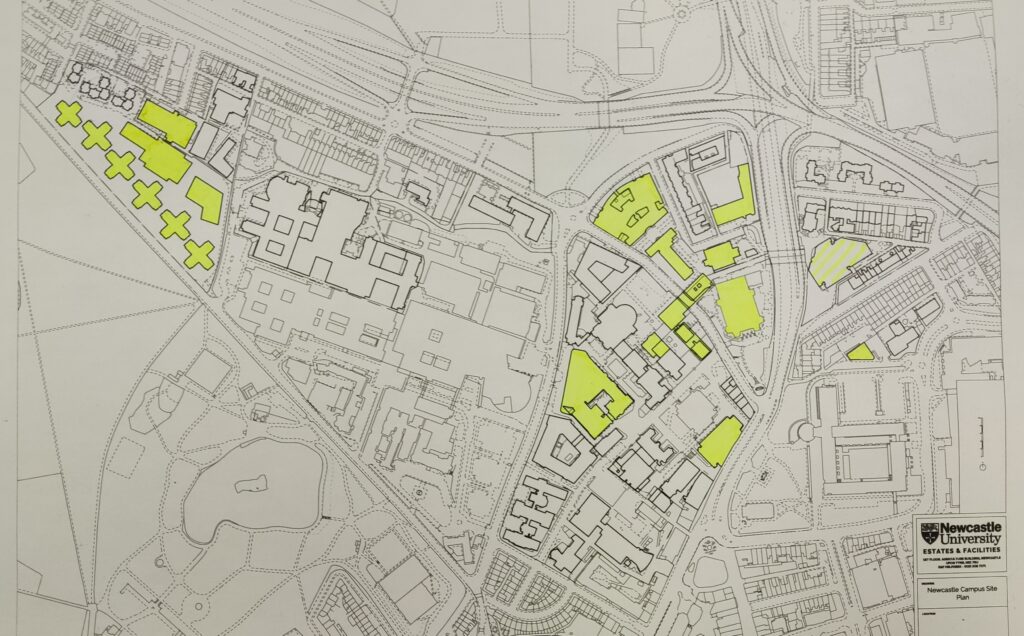
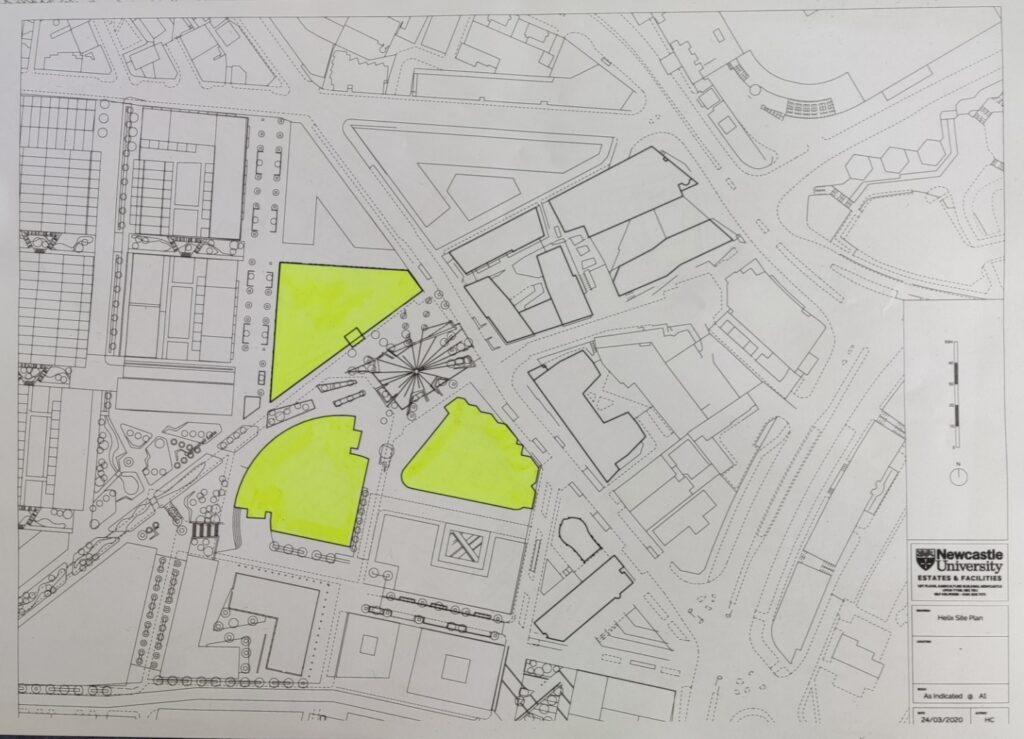
Image: Maps of the University’s city centre estates. University owned buildings have a thicker border around them, those highlighted in solid yellow have solar power systems installed, and those highlighted with yellow stripes have solar systems currently under construction. Credit: Author.

Image: Maps of the University’s city centre estates. University owned buildings have a thicker border around them, those highlighted in solid yellow have solar power systems installed, and those highlighted with yellow stripes have solar systems currently under construction. Credit: Author.

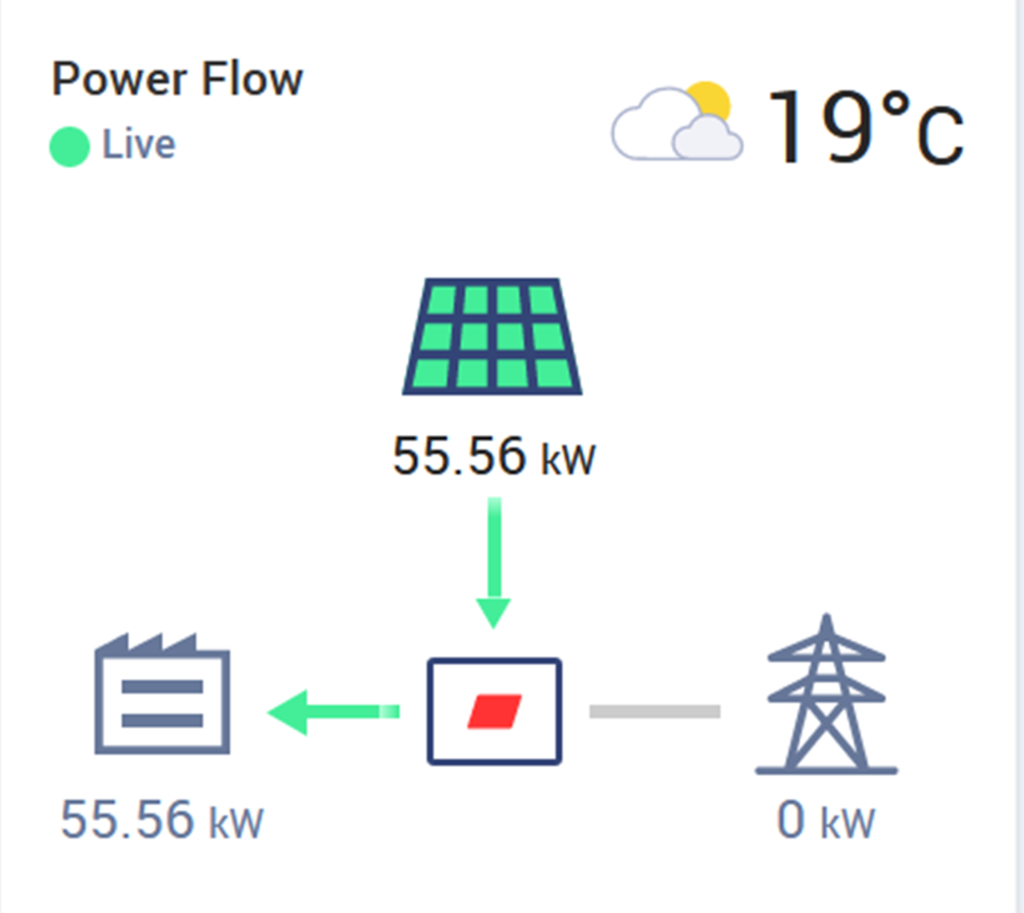
As the above maps show, solar arrays have been installed across campus including on buildings such as the Henry Daysh, Great North Museum Hancock, the Catalyst, and every block of the Park View Student Village. Our teams are also continually working to expand the amount of solar power we generate at the University and we’re currently constructing a new system on top of the Philip Robinson Library. Additionally, as we add new arrays, we’re constantly looking to expand their capacity and our recently finished Sports Centre system, now the largest at the University, generates as much power in under 2 days as an average UK household consumes in a year! Elsewhere, arrays have been designed to meet the entire daytime power demands of buildings – such as in our Frederick Douglass Centre, who’s generation data can be seen below.

Image: A graphic displaying the amount of energy at the University’s Frederick Douglass Centre that is being pulled from the grid vs from the building’s solar array in the early afternoon of 13.05.2024 (note: all values are estimates). Credit: Author.

Image: A graphic displaying the amount of energy at the University’s Frederick Douglass Centre that is being pulled from the grid vs from the building’s solar array in the early afternoon of 13.05.2024 (note: all values are estimates). Credit: Author.

A combined approach

The effects of the University’s solar power arrays are already being felt across our organisation. In addition to the savings on energy bills these systems are creating, the University is also saving tens of thousands of kilograms of CO2e across our facilities. Following these successes, we’ll continue to install new solar PV systems across our campus and beyond while working to complement these projects with other renewable and low carbon infrastructure initiatives. Examples of these complimentary improvements include:

  • Our low carbon factor combined heating and power engine in the Merz Court Energy Centre which utilises biofuel to provide electricity and hot water with a high degree of efficiency and a far lower comparative carbon footprint.
  • Projects to link the district heating networks we have across our city centre campus, improving efficiencies and reliability as systems help to pick up each other’s slack and can optimise over a wider area.
  • Our long-term campus-wide LED works to replace all indoor room lighting across our organisation with energy efficient LEDs. We’re now well over halfway through this decade long project!
  • The energy supply deal we’ve struck with The Energy Consortium to supply our buildings and facilities with zero carbon power from the grid.
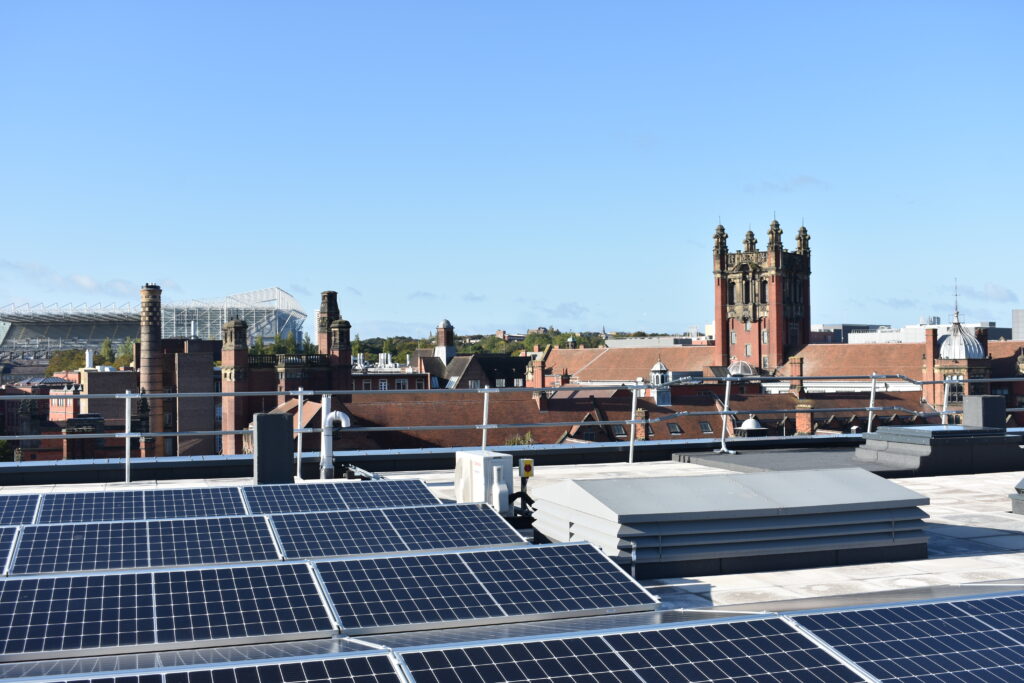
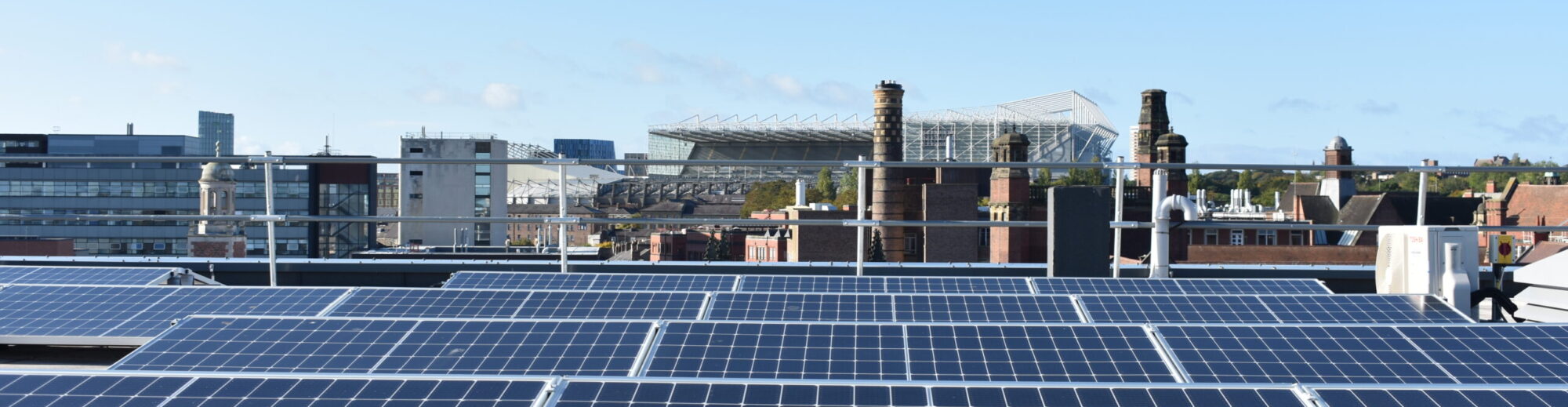
Image: Solar panels on top of the Henry Daysh Building with other University buildings, including the Bedson and Armstrong Buildings, as well as St James’s Park, visible in the background. Credit: Charlotte Robson.

Image: Solar panels on top of the Henry Daysh Building with other University buildings, including the Bedson and Armstrong Buildings, as well as St James’s Park, visible in the background. Credit: Charlotte Robson.

Many thanks to Irene Dumistrascu-Podogrocki and Luke Whittaker for helping with this blog and enormous thanks also to colleagues from the various teams, including projects and improvements, that are working hard alongside ourselves to bring renewable and low-carbon power to our campus. If you’re interested in finding out more, our website has further information on carbon and energy, we have blogs on our energy management system and wind power at the University, and the Sustainability Network gives regular updates on our projects and work across campus.

References

Hayat, M.B., Ali, D., Monyake, K.C., Alagha, L., Ahmed, N. (2019) ‘Solar energy – A look into power generation, challenges, and a solar-powered future’, International Journal of Energy Research. 43 (3). pp. 1049–1067.

Mulvaney, D. (2019) Solar Power: Innovation, Sustainability, and Environmental Justice. 1st ed. Oakland, California: University of California Press.

White, J.K. (2024) The Truth About Energy: Our Fossil-Fuel Addiction and the Transition to Renewables. Cambridge: Cambridge University Press.