 Straight into the second semester, a very interesting article (Twenge, J. M. (2009), Generational changes and their impact in the classroom: teaching Generation Me. Medical Education, 43: 398–405) was presented by Hamde Nazar, School of Pharmacy. This sparked discussion on the generational changes we may be seeing in our students and how this has perhaps led to a generation of students who have high expectations, not only from us but also increasingly of themselves.
To get us talking about feedback, Chris Eggett, School of Biomedical Sciences, presented ‘Pitt, E & Norton, L (2017), ‘Now that’s the feedback I want!’ Students’ reactions to feedback on graded work and what they do with it. Assessment & Evaluation in Higher Education, 42:4, 499-516.’ In the paper, the authors had stated that there could be de-motivational negative feedback but they did not acknowledge positive feedback that could be de-motivating! This got us discussing! I guess we could think a bit more about how we word positive-only feedback reports to allow students to maximise their potential in further assessments.
I would like to say that by March the warmer weather had kicked in but the trip down to the Ridley building was a cold, Siberian-like one. Nonetheless, there was an article that I was very much looking forward to discussing with the usual crowd (who showed up despite the heavy snow!). Richard Holmes, School of Dental Sciences, delivered to us ‘Chen, V, Foster Page, L, McMillan, J, Lyons, K & Gibson, B (2016) Measuring the attitudes of dental students towards social accountability following dental education – Qualitative findings, Medical Teacher, 38:6, 599-606.’ We explored the term ‘social accountability’ and discussed the comments from students documented in the paper. We concluded that it was very important in all disciplines to allow students to explore social accountability and it was discussed that this could be explored when we are interviewing prospective students for medicine and dentistry.
A big thank you to all our speakers of the Spring term. As always, these sessions are extremely informative and I am certain elements are captured by our Faculty teachers and used in their everyday practice. To kick off the summer term, Laura Woodhouse, School of Medical Education will be presenting on the 4th May. Title to follow.
Here’s to a well-deserved Easter!
Luisa Wakeling
All links to articles and up and coming speakers can be found at the Journal Club webpage

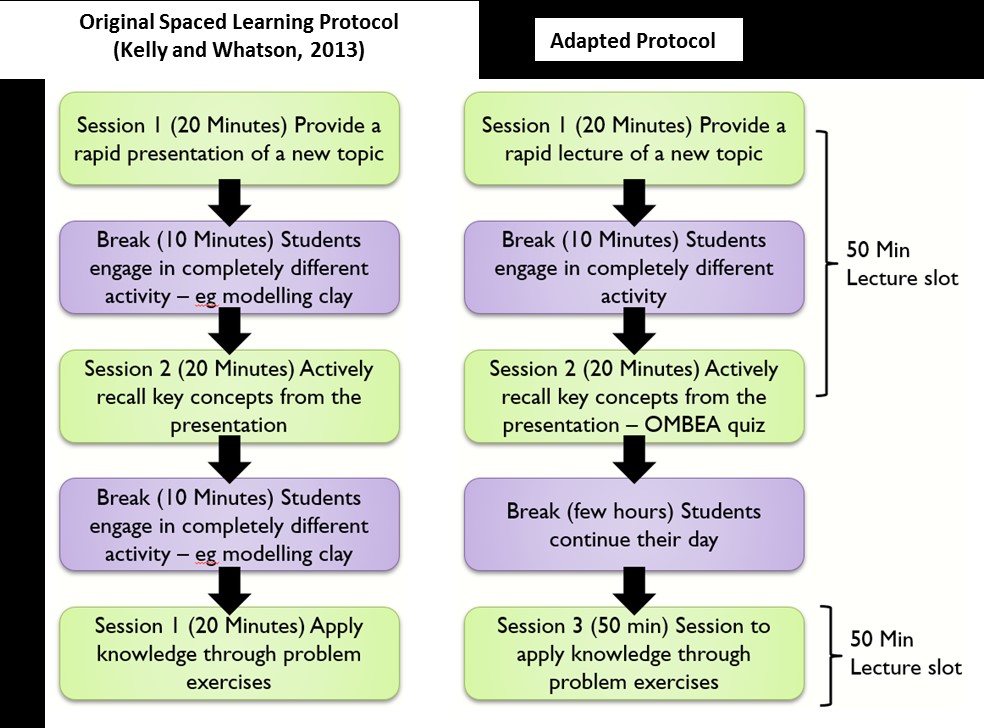 Most studies relating to neuroeducation techniques are trialled in a school environment but very rarely get trialled in higher education. It is therefore unknown whether such techniques can be adapted for use in higher education. I therefore aim to trial a form of spaced learning during the MBBS curriculum to see if there is scope for it to be used as an educational technique in higher education. The original study on spaced learning by Kelly and Whatson used a 90 minute teaching session that included three 20 minute teaching slots separated by two 10 minute breaks. This is outlined on the left side of the image. To work with the traditional 50 minute lecture based timetable it is proposed to run two 20 minute teaching sessions with a 10 minute break in between, followed by a second session later in the day (right side of the image). Feedback will be gained from students on their experience of this style of teaching with the view that a more extensive study may be developed in future.