
Engineering and in vitro evaluation of semi-dissolving, hydrogel-forming polymeric microneedles for sustained-release drug delivery


Abdelghany TM, Vo N, Vukajlovic D, Smith E, Wong JZ, Jackson E, Hilkens CMU, Lau WM, Ng KW, Novakovic K. Engineering and in vitro evaluation of semi-dissolving, hydrogel-forming polymeric microneedles for sustained-release drug delivery. Int J Pharm. 2025:125932. https://doi.org/10.1016/j.ijpharm.2025.125932


In our latest paper, we describe a microneedle formulation that utilises two polymeric domains: a soluble one and an insoluble one. The insoluble domain is chemically crosslinked and traps the soluble polymer, along with the drug, within it. This combination creates a microneedle array patch that can release a drug for over 2 months.

It can contain a significantly larger dose than microneedles where the drug is contained within the microneedle tips only (e.g., detachable microneedles). The drug reservoir in the backplate makes this possible to support extended release. It uses one-pot synthesis, a mild hydroalcoholic solvent system and mild temperatures to aid manufacturability and drug stability.

For the first time, we were able to see, on video, how the microneedles released the drug and swell as they hydrated. These videos are buried in the supplementary files for the paper, but I thought it worthy of sharing more widely here:

Videos from Abdelghany et al. (2025). Reused under a Creative Commons licence.

We would like to thanks everyone who’s contributed to this paper. Big thanks to the EPSRC and Innovate UK for funding this work.
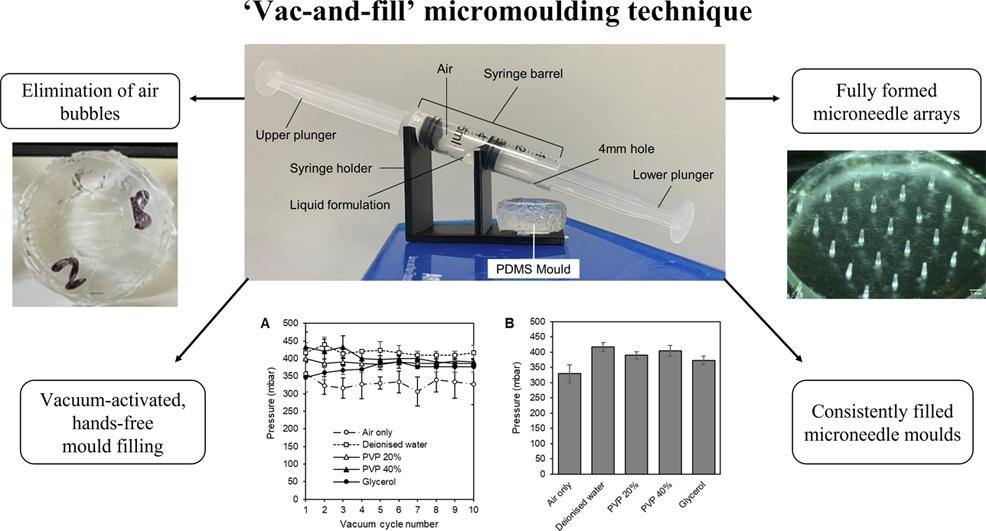
Micromoulding microneedle array patches under vacuum, hands-free!

Our hands-free, ‘vac-and-fill’ micromoulding technique prevented air entrapment and bubble formation in viscous formulations when degassed under vacuum. Image from Smith E, et al. Int J Pharm 2024;650:123706. Licence: CC BY 4.0 Deed.

Our latest paper, Vac-and-fill: A micromoulding technique for fabricating microneedle arrays with vacuum-activated, hands-free mould-filling, has been published in the International Journal of Pharmaceutics. It’s open access, so head over there to read the full-text article for free!

This paper reports the solution to a problem that took us several months to solve. We were trying to mould a microneedle array patch. There are basically two ways to do it: you fill the mould with the liquid formulation and either centrifuge it or degas it under vacuum. Both techniques are widely reported in the literature. They have been designed to force any air out of the microcavities in the mould, so that the formulation can enter them to form the microneedles. We didn’t have the right rotor to go with the centrifuge, so we opted for the vacuum degassing technique, fully expecting it to be a walk in the park. What a disappointment that turned out to be! We discovered that our formulation was too viscous to allow the air to escape. We ended up with a lot of air bubbles trapped in the liquid formulation.

We quickly realised that the vacuum degassing technique reported in the literature had used low polymer concentrations, which meant that their liquid formulations were not as viscous as ours. To micromould the microneedle array patch successfully from our viscous formulation, we had to remove the air first before filling the formulation into the mould. But how would one fill the mould under vacuum?

The answer: a modified syringe, a 3D-printed part, some painstaking calibration, and viola! The paper describes our solution in full, but here’s a peek of the contraption in action.

This is Emma’s first paper and our first together with Dr Katarina Novakovic‘s group. Congratulations, Emma, and thank you team for the hard work!

Review: Silica nanoparticles in transmucosal drug delivery

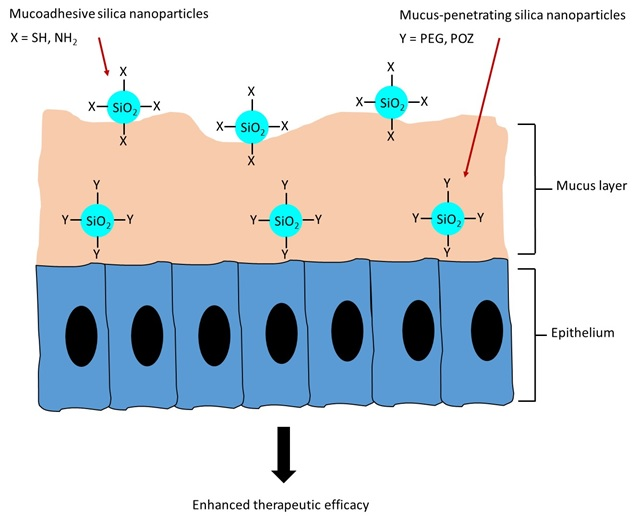
Graphical abstract

Our latest review in drug delivery is about silica nanoparticles, published this week in the open access journal, Pharmaceutics.

This is a collaborative paper with Professor Vitaliy Khutoryanskiy (University of Reading, UK), Dr Twana M. Ways (University of Sulaimani, Iraq), and our own Dr Wing Man Lau (Newcastle University, UK). In the paper, we examine the applications of silica nanoparticles in transmucosal drug delivery. We discuss different types of silica nanoparticles and their methods of preparation, including surface functionalisation strategies to facilitate interactions with mucosal surfaces.

The paper is published under the very permissive Creative Commons Attribution Licence (CC BY 4.0), which allows you to freely share and adapt the work as long as the source is appropriately cited. Please cite this work as:

M. Ways TM, Ng KW, Lau WM, Khutoryanskiy VV (2020) Silica nanoparticles in transmucosal drug delivery. Pharmaceutics 12(8):751. doi: 10.3390/pharmaceutics12080751