
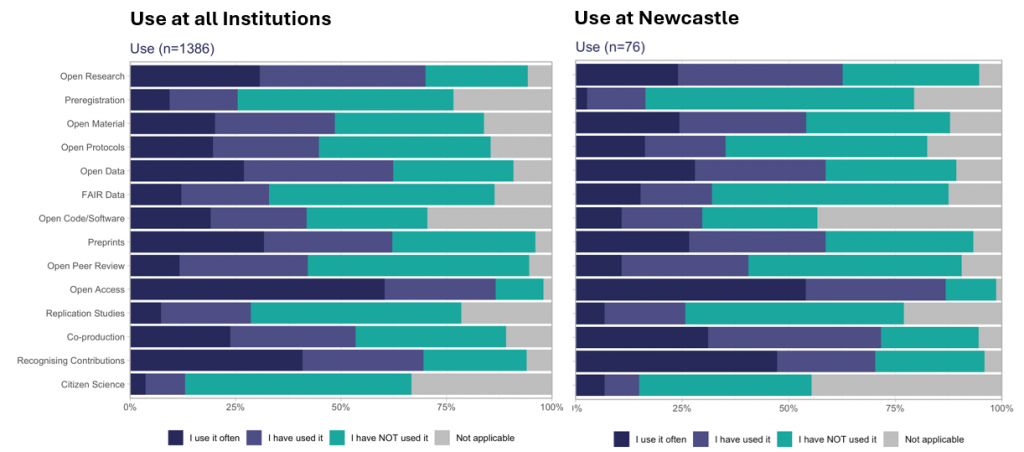
The UK Reproducibility Network (UKRN) has published the findings of its 2025 Open Research Programme (ORP) Survey, providing detailed insights into the prevalence open research practices such as data sharing, preregistration, open code, and open access publications, alongside attitudes and perceived barriers to open research adoption from across UK higher education, including Newcastle University.
This post presents a summary of findings from the aggregated national survey and reflections on our institutional results at Newcastle University.
Aggregated report
The UKRN survey report presents data from 1408 respondents across 19 partner institutions and is available at: https://doi.org/10.5281/zenodo.18711621
Key findings include:
- Awareness and Use: Awareness of OR practices is high overall, but uptake varies. Open access is near-universal (99% awareness, 86% use), while preregistration and citizen science awareness/use are lower (55%/25% and 66%/13%, respectively). Awareness of FAIR data is the lowest of any OR practice at 51%. Disparities between awareness and use are greatest for replication studies, citizen science, and open code/software, suggesting persistent barriers.
- Disciplinary and Career Differences: Quantitative and mixed-methods researchers report higher engagement than qualitative researchers, and uptake is generally greater in scientific disciplines than in arts and humanities. Senior researchers show higher awareness and use, though junior and mid-career researchers express strong motivation to engage more.
- Attitudes: Most respondents view OR as useful (80%), but only 42% feel their institution provides adequate training. Only 18% of respondents engaged with OR in hiring and promotion of staff.
- Facilitators: Practical enablers—guidance, infrastructure, time allocation—are prioritised over cultural drivers.
Results from Newcastle
Our survey was conducted between May and July 2025. We invited responses from a random sample of 10% of research colleagues and PGRs, stratified for representation across disciplines and career levels. It was sent to 503 recipients and 77 responses were received (15% response rate). Respondents represented 19 disciplines, with 31.2% primarily using quantitative research methods, 22.1% qualitative and 41.6% both. 36.4% declared their career stage as ‘junior’, 28.6% as ‘mid’ and 32.5% as ‘senior’.
Our results showed similar trends to those in the overall survey. Awareness of OR practices was relatively high overall. It was generally higher among those using quantitative methods compared to those using only qualitative methods, with the exception being co-production. Awareness was also generally higher in health and biological sciences and physical sciences disciplines than in arts and humanities and social sciences.
Use of open research practices largely mirrored awareness. Open access publication is used almost universally. Co-production, recognising contributions, preprints and open data are also widely used. Preregistration, replication studies and citizen science are less commonly used. Sharing of code/software is perhaps lower than expected given its broad potential applicability and relatively high levels of awareness.
Attitudes to open research were broadly positive with most respondents stating they feel it is useful and that they wished to engage more with open practices. However, we still have some work to ensure appropriate training, support and recognition across methodologies and disciplines before open research can become normalised.
We will use these findings to further improve our open research training and support and to target new interventions where they are needed to achieve that.
If you’d like to find out more you can download a PDF of our full institutional report.
