Since its introduction in 2022, the Newcastle University Research Publication and Copyright Policy, also known as our Rights Retention Policy (RRP), has enabled our authors to make their research journal articles and conference proceedings openly available, at no cost, with no embargo, under an open licence. The RRP ensures researchers can retain the rights to their work whilst meeting funder and REF open access policy requirements via dissemination in a repository while publishing in a journal of their choice.
Under the RRP, Newcastle University authors grant the University a non‑exclusive, irrevocable, worldwide licence to make their Author Accepted Manuscripts (AAMs) available under a Creative Commons Attribution (CC BY) licence. Authors self-archive their manuscripts, which are then made publicly available in the university repository on the date of first online publication.
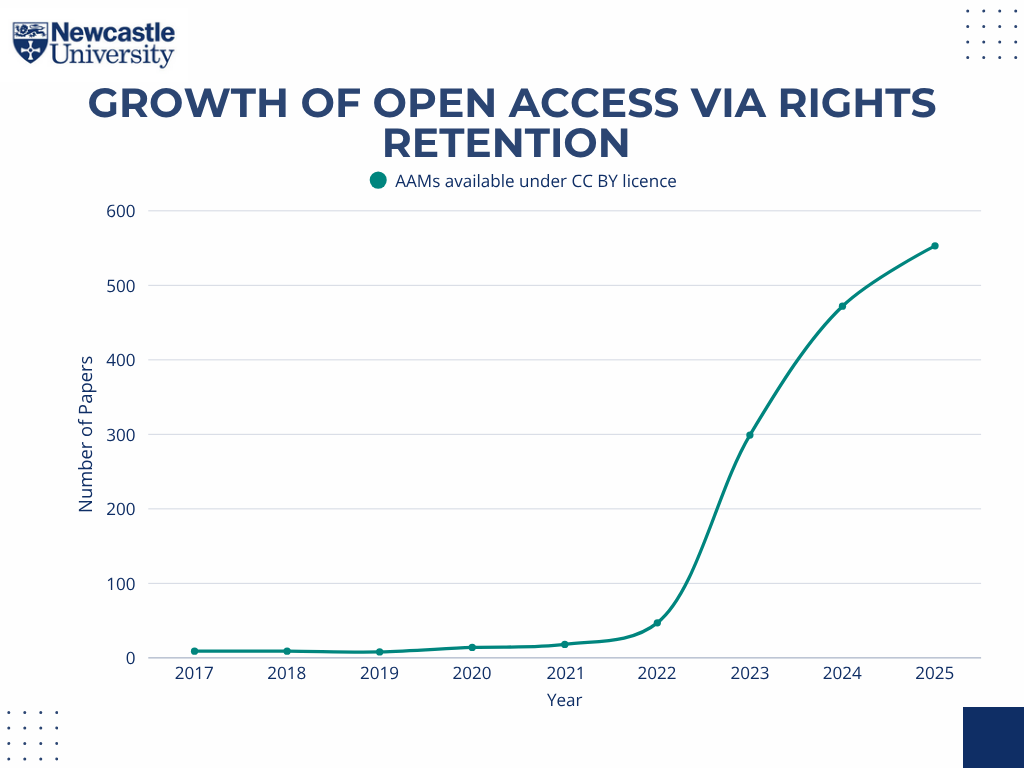
Through consistent monthly reporting, we are able to demonstrate the growth in the number of research outputs made openly accessible in our repository via the RRP, since the launch in 2022. This allows us to track how Rights Retention has supported an increased volume of article deposits over the past four years. The chart below highlights this progression, illustrating both the scale and the steady upward trajectory of openly available research articles produced through research connected to the University. Since the policy’s implementation, to date, we have been able to make 1,369 AAMs available under a CC BY licence. These numbers reflect the dedication of our research community, the effectiveness of our open‑access workflows, and the value of authors retaining the rights to share their work openly.
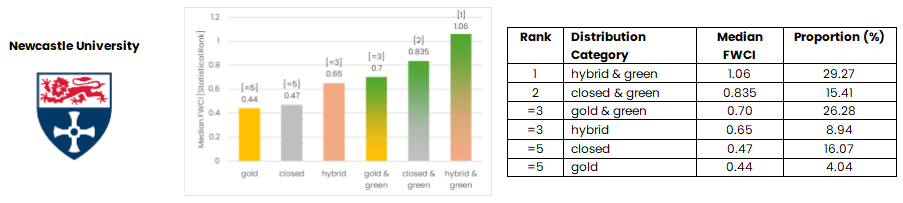
Research carried out by University of Liverpool explored the field weighted citation impact (FWCI) of journal articles, from 2021-2024, across the N8 Research Partnership, for different open access categories, including the impact of having a ‘green’ version of the paper available in a repository.
Across all eight N8 institutions, green (AAM) and hybrid/subscription open access papers consistently came out on top as the most highly cited. Articles that were published and had a green version available had more citations that those without a green version.
Credit: University of Liverpool
The analysis brings together data from several sources: Web of Science to identify corresponding authors, OpenAlex to check for repository versions, and Scopus to measure median FWCI.
The growing adoption of RRPs across the UK is helping to shift the landscape of scholarly publishing. Newcastle University’s position within the N8 Research Partnership has played an important role in our transition, with the N8 institutions simultaneously launching their individual RRP, and as other UK universities launch their own policies the momentum continues to grow. The sector’s collective stance contributes to our ability to assist authors with restrictions they may face when they choose to share their own work openly. While there is more work required to achieve open access to all content, positive change is happening as more of our research is made openly and freely accessible.
We remain committed to supporting all Newcastle University authors in understanding the advantages of depositing and sharing their AAMs, as they navigate this evolving publishing landscape. If you’re new to Rights Retention, unsure about depositing your manuscript, or simply want to learn more, please contact us at openaccess@ncl.ac.uk. We also host monthly drop‑in sessions, offering a friendly and informal space for researchers to ask questions, explore open access routes, and discover how Library Research Services can support at every stage of the publication process.
The OA policy applies to journal articles and conference proceedings with an ISSN that are published after 1 January 2021. It does not apply to any other research outputs, such as chapters, books, data, etc, although REF encourages researchers to move beyond the minimum requirements and apply open practices where possible to all outputs.
For inclusion in the REF OA submission, a version of the published article must be made open access, i.e. deposited, made accessible and discoverable, within the expected timeframes. The guidance for outputs published after 1 January 2026 has been updated, and the table below summarisies the key details.
Outputs made immediately open access on publication, provided they meet the deposit, access and licence criteria, will meet REF OA requirements. Note, there is no expectation that additional open access publication costs are required to meet REF 2029 OA policy requirements.
Newcastle University Guidance
We advise that Newcastle University authors continue to deposit their AAM in our institutional repository as soon as possible after acceptance. Following deposit, the open access team will review uploaded manuscripts and contact authors to discuss any issues in meeting the open access requirements for REF. In line with the University Research Publications & Copyright Policy, for any articles published after August 2023, the AAM will be made available open access in the University’s repository under a CC BY licence, on the article publication date, unless an embargo is required (see above for permitted embargo periods).
Detailed instructions of the policy requirements and how to make your paper REF eligible are available on our Open Access for REF page. Some exceptions to the policy are permitted for outputs that do not meet the OA requirements, details of how to apply for these are also shown on that page.
For more information or to arrange a discussion, please contact openaccess@ncl.ac.uk.
*The author accepted manuscript (AAM) is the version after peer review and containing all academically necessary changes, but before publisher copy-editing, proofing and typesetting of the peer-reviewed accepted manuscript.
Gabriel is an Open Research Champion for School of English Literature, Language and Linguistics. After attending an academic conference in Barcelona we provided some external funds to support a short extension to visit a colleague at Universitat Pompeu Fabra to discuss running an Open Access journal. Here’s what he learned…
In my visit to Barcelona, I integrated a conversation about Open Access and Open Research with Professor Louise McNally, Co-Editor-in-Chief of Semantics & Pragmatics, a leading Open Access journal for semantics and pragmatics research.
“Semantics and Pragmatics is a fully open access journal. All content is freely and immediately accessible to readers under a liberal CC-BY license. The journal is supported by the Linguistic Society of America, the Massachusetts Institute of Technology, and the University of Texas. Authors do not pay publication charges (APCs) nor submission charges. Authors retain full copyright and all rights of reuse.”
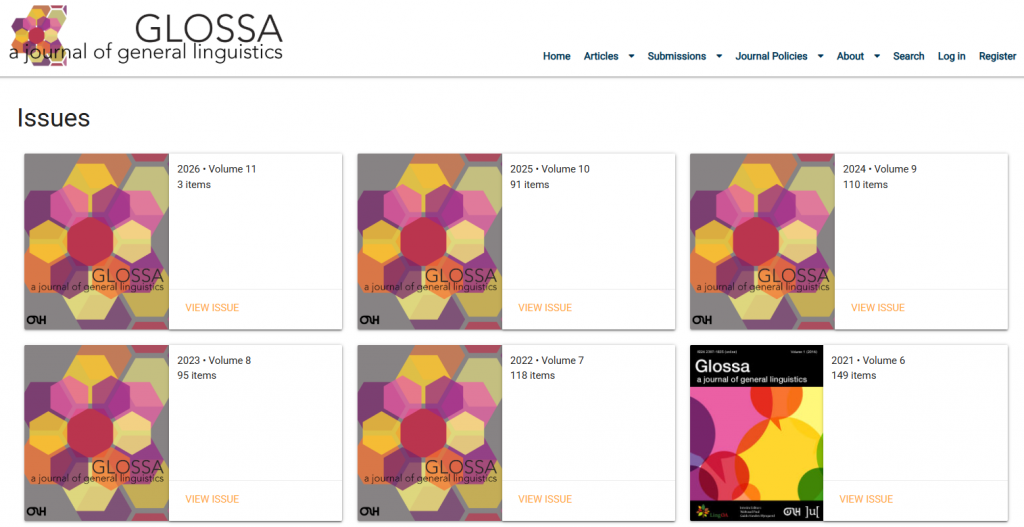
I wanted to hold a meeting with her as a fellow linguist to discuss their approach to open access, since in a couple of months I will become Co-Editor-in-Chief of Glossa: a journal of general linguistics, the leading journal in linguistics and a pioneering Open Access journal in the field. I wanted to benefit from her experience and expertise in this area. As a result of our conversation, I got some pieces of advice as to what areas are key when leading an Open Access journal.
The main component is sustainability in several respects (financial, production, administrative). In Louise’s opinion, it is fundamental to think ahead especially to editorial/management transitions, such as the ones I am currently involved in. In this regard, one has to make sure that there is time to familiarize new editors with how things have been done, so that any major policy decisions that are made can be discussed with them.
Further, it is very important to be proactive in that one should take advantage of whatever venues one has to explain to libraries, funding agencies, among others. Importantly, efforts should be made to get the home institutions of the editorial team to support the journal. In this sense, this is a joint effort to ensure that the journal survives in the medium to long term.
More generally, what this means is that the work that is done needs to be visible. Thus, it is key to further promote and support open access publishing models such as Diamond Open Access and Subscribe to Open.
Overall, these efforts constitute a very specific set of efforts to promote Open Research as related to Open Access journals, which, ultimately, shape the future of linguistics as a field where knowledge and ideas have the opportunity to flow freely—not being tied to paywalls. I will certainly integrate all these pieces of advice in my new role!
Are you looking for advice and information on open access or managing publications? Come to one of our monthly drop-in sessions and meet members of the Library Research Services team, who will be happy to answer questions on:
Copyright and licencing issues relating to your publications
Uploading your publications to our repository and REF
Whether you’re a seasoned researcher, student or simply keen to explore the possibilities within open access, this session offers a welcoming space to ask questions, gain insights and delve deeper into the realm of open access.
These are informal sessions, however, registration is required for you to receive the online teams link.
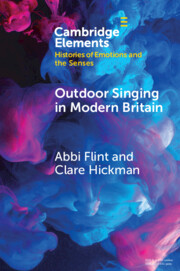
The work brings together historical sources and contemporary experiences to explore the interplay between singing, sociality, body, and meaning in the English landscape over the past century. It explores the connections between air and song and between singing and movement, through the context of the early twentieth century open-air recreation movement. This is supplemented by recent literature on singing and wellbeing, and the experiences of a contemporary walking choir captured via interviews in the field. The authors argue that outdoor singing has been part of co-constructed soundscapes of the modern English leisure landscape, and ask what this meant for those who participated in collective open-air singing and rambling. They explore how open-air singing connected with conceptions of the countryside, with a sense of fellow-feeling, and how this might have both reified and challenged normative ways of being in landscapes.
This is the fifth book published at Newcastle University as a result of the UKRI open access policy for long-form publications, with open access costs covered by UKRI funding.
Of the experience, Clare Hickman (co-author) had the following comment:
[T]he process was very straightforward and quick, and it is good to know that non-traditional monographs are included in the UKRI policy.
For further details of the previous books published through this funding scheme, follow the links to the published works and related blog posts:
The UKRI open access policy aims to ensure that findings from research funded by the public through UKRI can be freely accessed, used and built upon. The policy applies to peer-reviewed research articles and long-form outputs, namely book chapters, monographs and edited collections.
If you have any questions or concerns about the policy, and how this might affect any current or future publications, please contact openaccess@ncl.ac.uk.
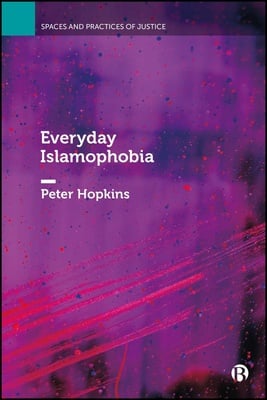
Everyday experiences of anti-Muslim racism include accounts of Islamophobia in public spaces, in the school playground, on social media and on public transport. This book explores the complex ways in which Islamophobia pervades the daily lives of Muslims and those perceived to be Muslim, drawing upon work by the author and leading researchers.
Everyday Islamophobia tends to be regarded as low level or trivial. This book considers the influence of organisations, agencies, and individuals on those who find themselves negotiating its significant harms in education, the community and online. It concludes by exploring strategies to challenge and resist Islamophobia.
This is the fourth book published at Newcastle University as a result of the UKRI open access policy for long-form publications, with open access costs covered by UKRI funding. The previous books published are:
The UKRI open access policy aims to ensure that findings from research funded by the public through UKRI can be freely accessed, used and built upon. The policy applies to peer-reviewed research articles and long-form outputs, namely book chapters, monographs and edited collections.
If you have any questions or concerns about the policy, and how this might affect any current or future publications, please contact openaccess@ncl.ac.uk.