The UKRI has recently published its new research data policy, which provides a high-level framework of good practice expectations applicable to most research contexts.
The policy applies to in-scope funding opportunities launched on or after 1 April 2027. For any funding opportunities launched before 1 April 2027 and awards arising from them, please follow current research data guidance and research council-specific policies.
In the meantime, colleagues in Library Research Services are working to update Newcastle University’s research data policy, our guidance and the support we provide, accordingly. If you are concerned about upcoming changes, or you have urgent questions, please do not hesitate to contact us at lrs@ncl.ac.uk.
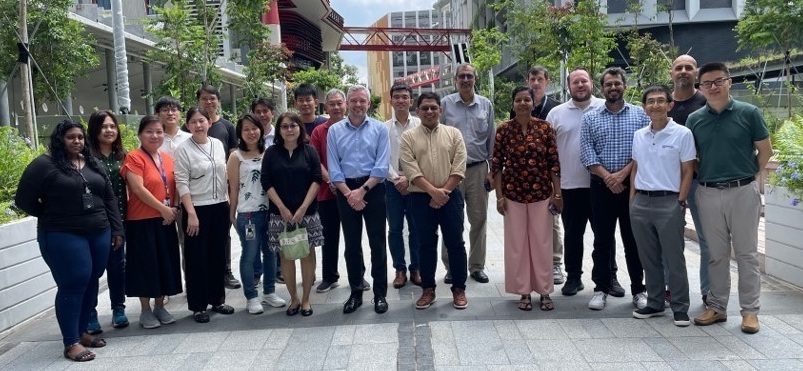
While attending the FORCE2026 conference, I had the opportunity to deliver an open research workshop at Newcastle University in Singapore (NUiS). It was a really rewarding experience that highlighted both the growing interest in open research across our global community and the enthusiasm of colleagues to explore how they can make their own research practices more open.
The workshop explored the principles of open research, practical approaches to sharing research processes and outputs, the benefits and challenges involved, and the role researchers can play in fostering a more open research culture. I was delighted by the excellent turnout and enthusiastic engagement of those who attended. Throughout the session, colleagues actively contributed by sharing their own experiences and challenges as we explored how they could implement open research in their own practice.
One particularly encouraging outcome emerged after the event. Inspired by the workshop and subsequent discussions, one participant (Kheng-Lim Goh) volunteered to become an Open Research Champion. This was especially pleasing as it reflects the wider goal of our advocacy for open research: not simply raising awareness, but empowering colleagues to champion good practice within their own communities.
I’d like to thank everyone who attended the workshop for the energy and enthusiasm they brought to this event. I’d especially like to thank Duncan Raynor, CEO of NUiS, for helping to organise the event and for making me feel so welcome during my visit to both the campus and Singapore.
This experience reinforced the value of engaging with colleagues across our international campuses, and I look forward to continuing these conversations in the future—although probably online rather than in person, sadly.
I recently joined around 200 librarians, developers, funders, publishers, and academics at Singapore Management University for FORCE2026, an international conference focused on the future of scholarly communication. The conference theme of “To Go Far, Go Together: Advancing Scholarly Communication Across Boundaries and Disruptions” emphasised the need for global cooperation in the face of increasing technological – and political – disruption.
The tone was set in an excellent opening keynote by SMU President Lily Kong, in which she challenged us to rethink how scholarly contributions are valued for their wider impact in academia and in society. She warned that the use of publication-based proxies for research quality and impact may be relatively easy, but used in isolation they can have a negative impact on research culture. She argued that institutions should recognise a much broader range of contributions, including methodological innovation and influence on policy, education, industry, and communities. However, she was also clear about the scale of the challenge in recognising that “reforming research assessment has proven far more difficult than simply articulating better principles” and that “No university can reform research culture alone” – i.e. we need work across boundaries.
Disruption from AI was the theme of the day 2 keynote by Ian Mulvany, Chief Technology Officer of BMJ Group. He described AI as a ‘jagged frontier’ in which while it may already exceed human capability in some domains that doesn’t mean it will in all. Scientific discovery is currently still mostly a human endeavour, but we are already seeing radical shifts in behaviour of academics with AI impacting on all aspects of scholarly workflows that we need to adapt to when considering how knowledge is created, communicated and trusted. He used the memorable metaphor of ‘dark factories’ in manufacturing to contemplate a future where autonomous AI generates a research question, designs experiments to test it, and writes up the results, all with minimal human involvement. Asking what this would mean for the traditional roles of researcher, publisher and librarian?
In the closing keynote from Professor Ginny Barbour, Co-Chair of the Declaration on Research Assessment (DORA) discussed the state of publishing and “…how we got into such trouble and how we get out of it?” She reflected on ‘disturbed times’ with shifting attitudes towards openness and academia, and how AI risks breaking established scholarly processes, reinforcing biases, and undermining research integrity. However, she also presented ways in which institutions and individuals might help rebuild a better system by championing openness and integrity, by telling uncomfortable truths despite pressure not to, and by educating our communities against emerging threats. She concluded with a positive message about the necessity of disruption based on a gift card that offered the wisdom “If the seas were always calm, we would never build a better boat.”
Beyond the keynotes there was an excellent range of sessions on topics including FAIR data, open access publishing, open research infrastructure, and of course, AI. Across all these sessions I found it refreshing to hear so many different perspectives from around the world and to recognise that we share many of the same challenges with scholarly communication. So my strongest takeaway from FORCE2026 was that addressing these challenges will, as the conference theme suggested, depend on our ability to work across disciplinary, institutional, and national boundaries.
If you’d like to find out more about the conference you can view recordings of the keynotes and slides from other sessions at: https://ink.library.smu.edu.sg/force2026/
(P.S. While away I also managed to run an open research workshop for our colleagues at Newcastle University in Singapore, but that’s for another post…)
The UK Reproducibility Network (UKRN) has published the findings of its 2025 Open Research Programme (ORP) Survey, providing detailed insights into the prevalence open research practices such as data sharing, preregistration, open code, and open access publications, alongside attitudes and perceived barriers to open research adoption from across UK higher education, including Newcastle University.
This post presents a summary of findings from the aggregated national survey and reflections on our institutional results at Newcastle University.
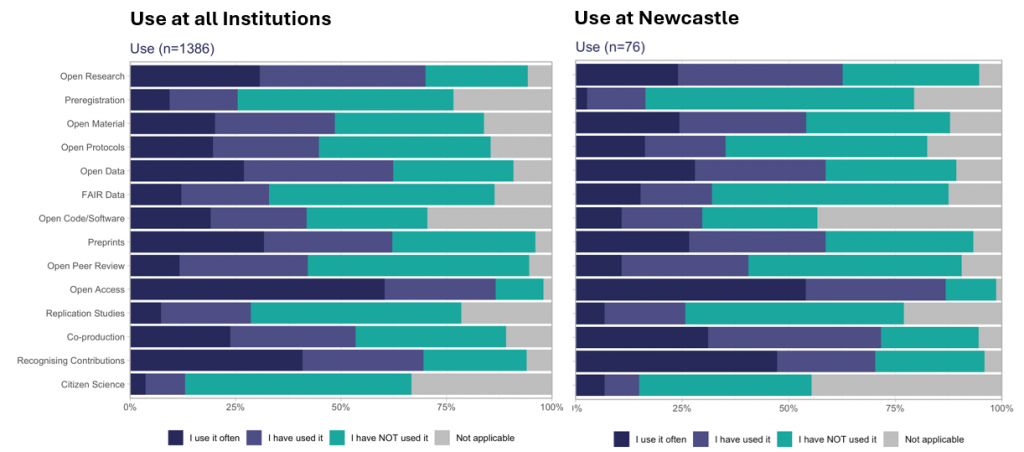
Awareness and Use: Awareness of OR practices is high overall, but uptake varies. Open access is near-universal (99% awareness, 86% use), while preregistration and citizen science awareness/use are lower (55%/25% and 66%/13%, respectively). Awareness of FAIR data is the lowest of any OR practice at 51%. Disparities between awareness and use are greatest for replication studies, citizen science, and open code/software, suggesting persistent barriers.
Disciplinary and Career Differences: Quantitative and mixed-methods researchers report higher engagement than qualitative researchers, and uptake is generally greater in scientific disciplines than in arts and humanities. Senior researchers show higher awareness and use, though junior and mid-career researchers express strong motivation to engage more.
Attitudes: Most respondents view OR as useful (80%), but only 42% feel their institution provides adequate training. Only 18% of respondents engaged with OR in hiring and promotion of staff.
Facilitators: Practical enablers—guidance, infrastructure, time allocation—are prioritised over cultural drivers.
Results from Newcastle
Our survey was conducted between May and July 2025. We invited responses from a random sample of 10% of research colleagues and PGRs, stratified for representation across disciplines and career levels. It was sent to 503 recipients and 77 responses were received (15% response rate). Respondents represented 19 disciplines, with 31.2% primarily using quantitative research methods, 22.1% qualitative and 41.6% both. 36.4% declared their career stage as ‘junior’, 28.6% as ‘mid’ and 32.5% as ‘senior’.
Our results showed similar trends to those in the overall survey. Awareness of OR practices was relatively high overall. It was generally higher among those using quantitative methods compared to those using only qualitative methods, with the exception being co-production. Awareness was also generally higher in health and biological sciences and physical sciences disciplines than in arts and humanities and social sciences.
Use of open research practices largely mirrored awareness. Open access publication is used almost universally. Co-production, recognising contributions, preprints and open data are also widely used. Preregistration, replication studies and citizen science are less commonly used. Sharing of code/software is perhaps lower than expected given its broad potential applicability and relatively high levels of awareness.
Attitudes to open research were broadly positive with most respondents stating they feel it is useful and that they wished to engage more with open practices. However, we still have some work to ensure appropriate training, support and recognition across methodologies and disciplines before open research can become normalised.
We will use these findings to further improve our open research training and support and to target new interventions where they are needed to achieve that.
If you’d like to find out more you can download a PDF of our full institutional report.
If you are involved in research, even to a small extent, you may benefit from attending training offered by the Library Research Services team.
On the 12th February 2026, between 11:00 and 13:00, there will be an online, practical training workshop for research data management. Attended by over 60 researchers in the last year, ‘Introduction to Writing a Data Management Plan’ is suitable for colleagues new to research (in various roles) and for those of you who may wish to refresh their memory and renew their day-to-day data practices.
Suitable for all disciplines, this session encourages you to think about what underpins, helps others understand, or validates your research claims and publications. It will include a live demonstration of DMPonline, a web-based tool designed to help you write, or update, your data management plan and you will have the opportunity to start outlining your own plan. We will provide considerations for the individual sections of a data management plan (DMP):
Outlining and detailing your data.
Data collection methods, consistency and quality assurance.
Metadata and documentation. How will you ensure your continuous understanding of your own work. How will others be able to make sense of it?
Ethical and legal considerations.
Short-term, active project storage.
Long-term storage, sharing and preservation. This will include information about the university’s repository, finding alternative repositories and staying compliant with funder requirements.
These training sessions are run a few times each academic year and we try to provide a mix of in-person and online training. For more information about the support we provide, please visit our website.
Coincidentally, this training session will take place during everyone’s favourite celebration, Love Data Week. So, what better time is there to think about your research data?
Library Research Services is excited to announce a series of informal Pop-up Sessions across campus in November and December. These sessions are designed to showcase the wide range of services we offer. We warmly invite academics and researchers to join us with any questions they may have about open access publishing, data management, or any specific open research queries. Below, you will find a full list of our locations and dates.
Tuesday, 5th November, 12pm-2pm: Medical School Foyer
Tuesday, 12th November, 12pm-2pm: Henry Daysh Café Space
Wednesday, 11th December, 12pm-2pm: The Atrium, Urban Sciences Building
Don’t worry if you miss us this time—you’ll have the opportunity to speak to us again in the new year. You can also contact us anytime at lrs@ncl.ac.uk
Since the launch of this addition of the open access policy, LRS have been on hand to answer queries about publishing monographs, edited collections and chapters open access, in particular relating to UKRI funded works, advising on publishing routes and how to comply with policy, where appropriate.
Throughout the first half of the 2024, we have visited three schools, hosted five drop-in support sessions, and presented an in-depth webinar to share the UKRI policy and the support we offer. We will continue to share details of our services in future workshops and presentations, and we are always available for 1-2-1 sessions for anyone who would like to know further details.
Following the policy update, we have received numerous queries about publishing books open access, from across all the faculties. They have covered a range of book types and publishers, including Bloomsbury, Boydell and Brewer, Bristol University Press, IWA Publishing, Manchester University Press, and Routledge. Where appropriate, we have advised on the different open access options available, such as publishing the final output open access or self-archiving the accepted manuscript.
Of the six applications received that acknowledge UKRI funding, are within the scope of the policy, and require funding to cover a book processing charge, all have been awarded funding from UKRI to cover the open access publishing costs. The funding is reserved until the books are published, at which time UKRI release the funds and complete the process.
We expect the first of the UKRI funded outputs to be published by September 2024, details of which will follow once available.
If you have any questions or concerns about the policy, and how this might affect any current or future publications, please contact openaccess@ncl.ac.uk.
The updated guidance around the UKRI open access policy for long-form publications is now available, and the Library Research Services team are here to provide support with the policy and publishing open access.
As detailed in our previous post, the UKRI policy update applies to monographs, book chapters and edited collections that acknowledge UKRI funding, and are published on or after 1 January 2024, where:
The final Version of Record or Author’s Accepted Manuscript must be free to view and download via an online publication platform, publisher’s website, or institutional or subject repository within a maximum of 12 months of publication.
Images, illustrations, tables and other supporting content should be included in the open access version, where possible.
The open access version of the publication must have a Creative Commons licence, with a Creative Commons Attribution (CC BY) licence preferred. An Open Government Licence is also permitted. (This requirement does not apply to third party materials included in the publication).
UKRI expects publications acknowledging their funding to be made open access, although they do allow some exemptions, which we are happy to discuss.
UKRI have a dedicated fund to support open access costs for long-form publications within scope of the policy, where publication via a green, free, route to open access is not an eligible option for authors. Applications for this fund are made via the library.
Our UKRI Policy for long-form publications page includes a summary of the policy, how grant holders can comply, details of exemptions and what funds are available to support open access publication. The page also has a link to the form we require to submit an application to UKRI on your behalf or if you want to discuss your options.
Library Research Services will be attending some faculty meetings, throughout March to May, to discuss what the policy means for authors, and how the library and UKRI will be supporting this. Alongside this, we will be holding a couple of webinars focused on the policy, along with general Open Access Support sessions for any open access queries. We are also available for 1-2-1 sessions as required.
If you have any questions or concerns about the policy, and how this might affect any current or future publications, please contact openaccess@ncl.ac.uk.
Since beginning implementation of Newcastle University’s Research Publications and Copyright Policy in January 2023, the open research landscape has continued to transform. Library Research Services have been integrating our RPCP policy into open research publishing practices across the university. We have been doing this by supporting researchers and professional services staff while monitoring the uptake using our research support systems. Before we dive into the progress made over the past 9 months, we would first like to extend a thank you to our staff and students for recognising the benefits of the new policy and embracing change, and retaining their rights to publish their work where they see fit.
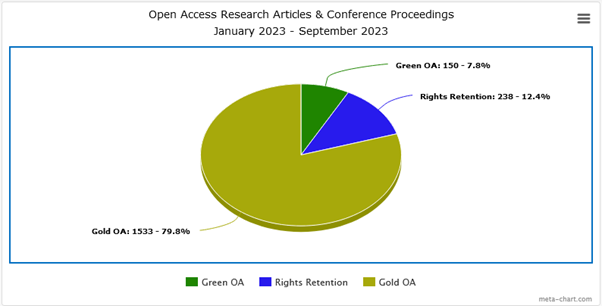
We have made 1,533* articles open access via the gold (paid) route and 388* available using the green (free) route. 238* of the publications made available through green open access were because of our policy with more research articles being accepted for publication containing the statement.
Implementing the policy required extensive planning and coordination. We developed a communications plan outlining the various media and methods we could use including channels, time frames and promotional material to convey the policy clearly and effectively. We added a web page within Library Research Services detailing the policy, a step-by-step guide for researchers and professional services staff and a list of FAQs to pre-empt and answer any questions or concerns they may have.
We are grateful to be part of the N8 Research Partnership which has allowed us to work together while launching similar policies around rights retention. The partnership enabled us to anticipate and tackle the issues we faced as a collective while allowing us to benchmark our progress with other research-intensive universities across the North of England. We liaised with our colleagues in Research, Strategy and Development to discuss how our policy aligned with our Ownership, Protection and Exploitation of Intellectual Property for Employees and the Open Access Policy Statement.
The first practical steps we took towards implementation was to contact over 150 publishers informing them of our policy. The publishers were based on a list from Edinburgh University and adapted to include those our researchers publish with. Once we were in possession of our letter, written and signed by Legal Services and N8 Rights Retention statement, we began contacting publishers as a courtesy.
The next stage involved informing our authors, we contacted each school asking to come along and present the policy to interested parties and we received a very welcoming response. The information was then fed through to various teams within the university by Professional Services staff. By speaking to staff directly, we were able to field questions and concerns to make incorporating the new policy as seamless as possible in the attempt to minimise the impact this would have on our academic’s workload. We set up Open Access Zoom Drop-In sessions to give the opportunity for researchers and members of staff to ask questions surrounding the policy, ask general open access queries and offer advice on good research practice.
As we develop and support open research while continuing to advocate for our research publications policy, the N8 have proposed a webinar for 23rd October 2023 at 10.15am (BST) to give the opportunity for those universities who launched their policies to present on their experience, the barriers they faced and offering advice to other institutions wishing to embark on their own rights retention journey. Details of how to sign up are posted in our Library Calendar.
*Figures taken from CRIS (MyImpact) (Jan 2023-Sep 2023)