Rendezvous – Plays and Poems in loving memory of Poet and Playwright Julia Darling.

Rendezvous was a Live Theatre production from 28th of May to the 6th of June 2015 which marked the 10th anniversary of the death of poet and playwright Julia Darling.

Julia started her writing career in the 1980s in Newcastle before forming with a performance poetry group called The Poetry Virgins with four other female writers: Ellen Phethean, Charlie Hardwick, Kay Hepplewhite and Fiona MacPherson. The group would go on to publish poetry collections such as Sauce and Modern Goddess and perform their poems live.

Julia and Ellen would then go on to co-found Diamond Twig Press in 1992, a small publishing press for publishing works of female authors in the north of England that closed in 2018.

Julia published her first novel, Crocodile Soup in 1998 followed by The Taxi Driver’s Daughter in 2003. She was a writer in residence at the Live Theatre from 2001 to 2003 where she wrote five works: Attachments, The Last Post, Sudden Collapses in Public Places, Venetia Love goes Netting and Personal Belongings. She sadly passed away on the 13th of April 2005 due to breast cancer at the age of 48.
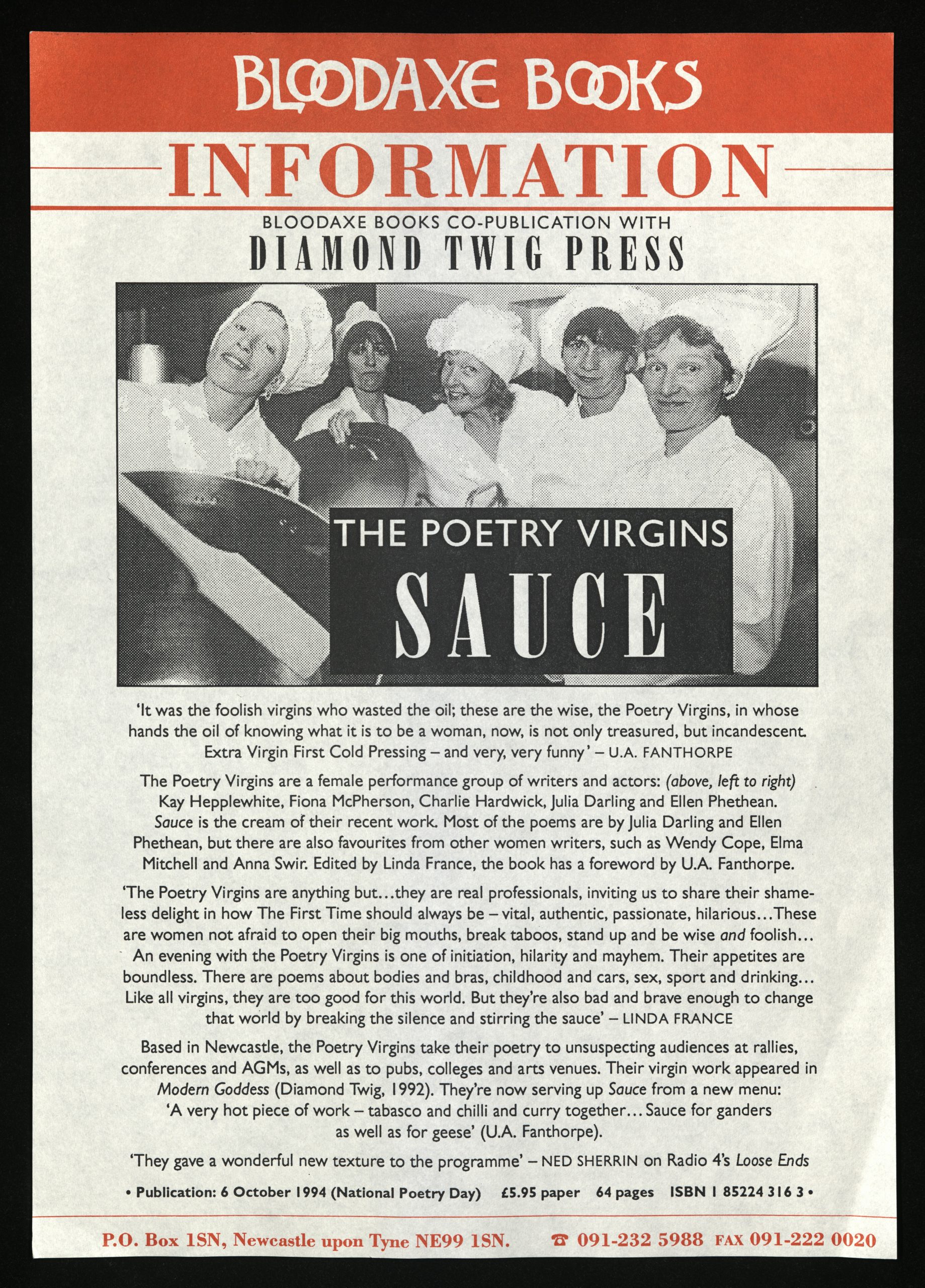
Advertising poster for The Poetry Virgins live performance of 'Sauce' (DT/9)
Advertising poster for The Poetry Virgins live performance of ‘Sauce’ (DT/9)

The production had five plays and many events in which many former colleagues, friends and associates participated including performances from The Poetry Virgins and Diamond Twig. Many performed poems written for the event, previous poems authored by Julia or popular poems that had been played on stage previously. For example, The Poetry Virgins poetry performances of the Stages of Drunkenness and at the Rendezvous Cabaret Nights where they performed their poems as solos, duos or all together. Notes on the running order of Cabaret Nights reveal hidden details of their performance with each performer drinking wine with ‘the poem mapping out Julia’s life through her refreshments’.

We also see after Julia’s death personal letters and poems being written by close colleagues of Julia reflecting on how much she meant to them.
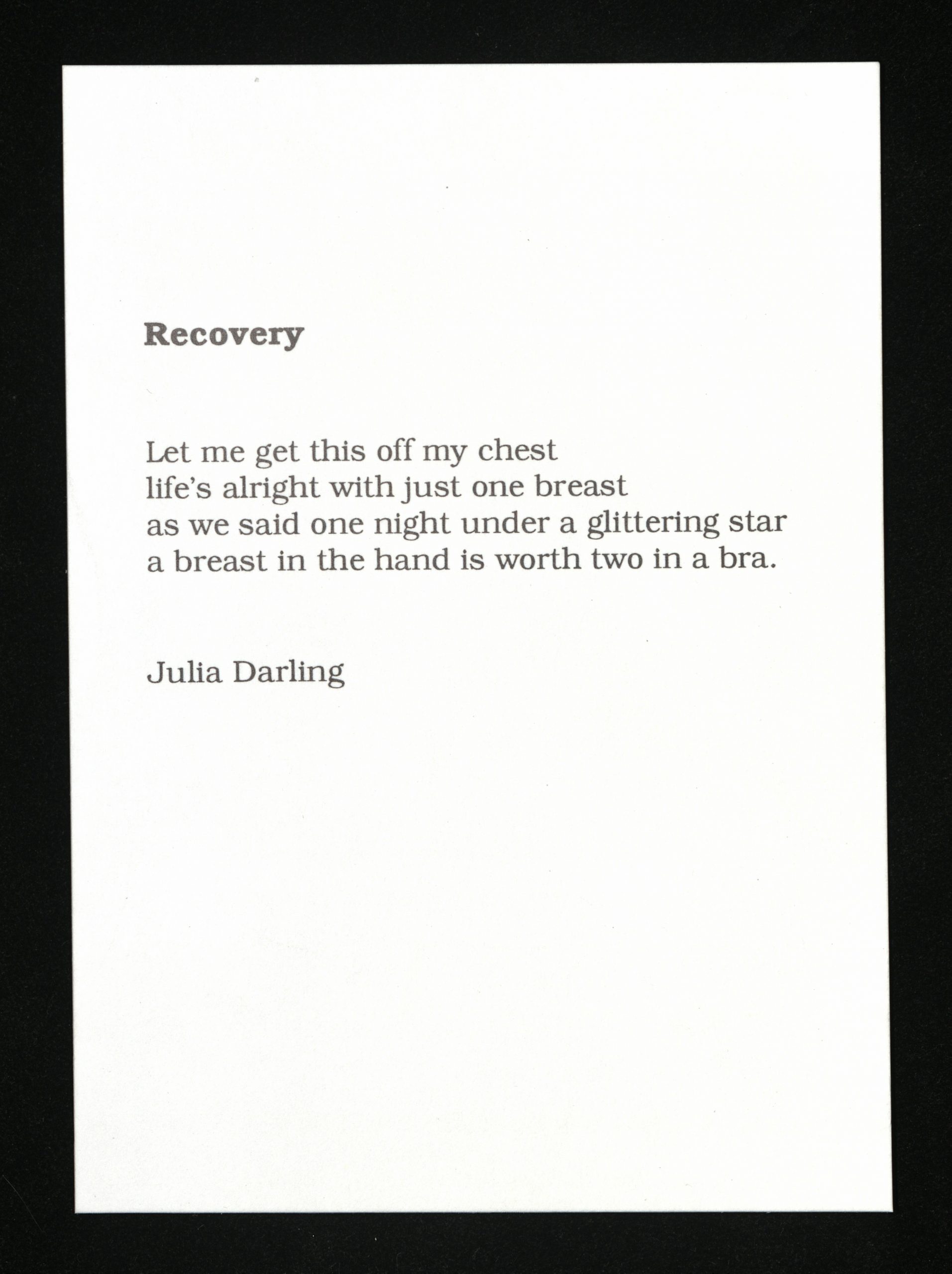
Back of a postcard with the poem 'Recovery' by Julia Darling on the back (DT/11).
Back of a postcard with the poem ‘Recovery’ by Julia Darling on the back (DT/11).
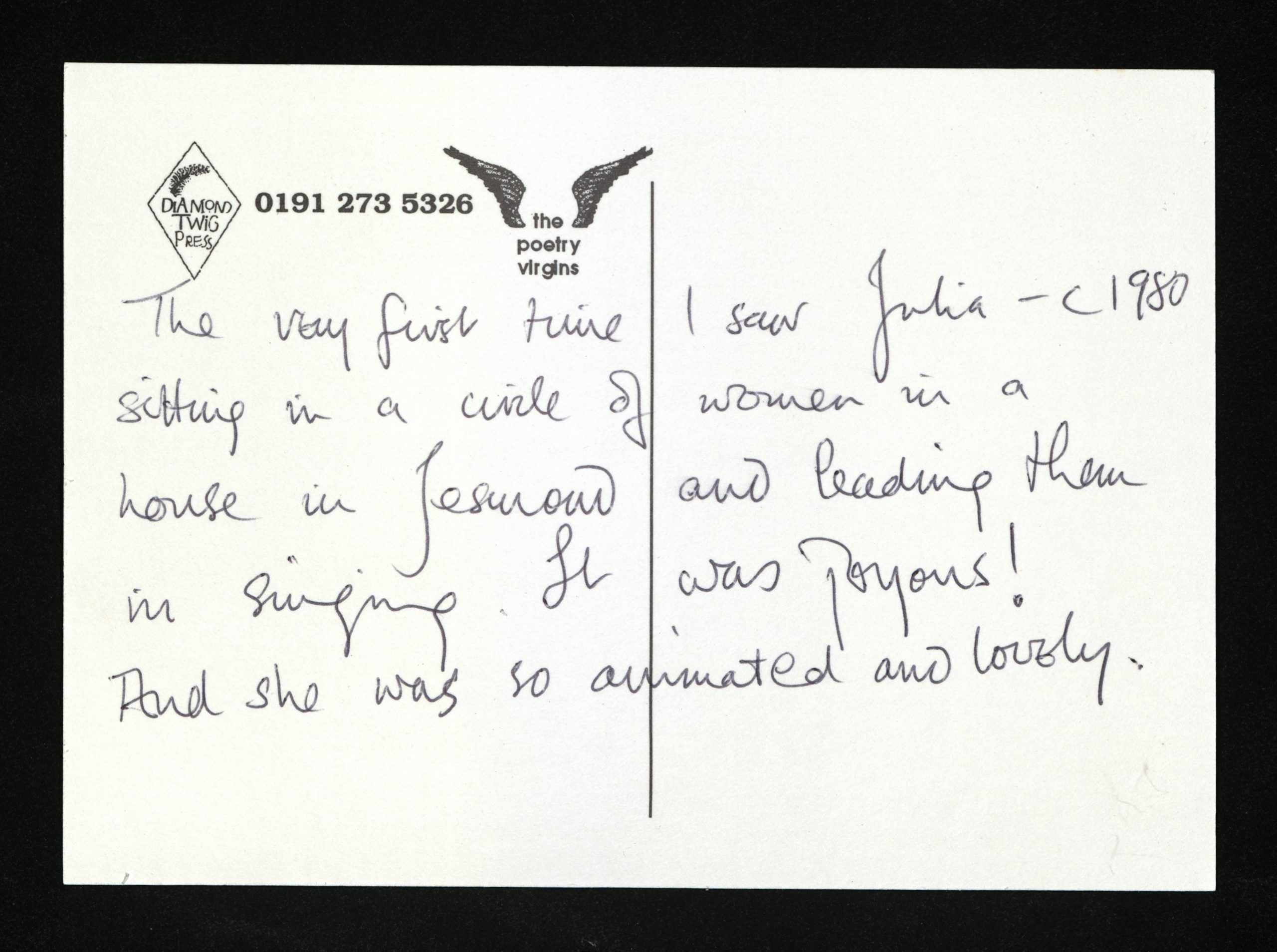
Postcard describing the first time a colleague first saw Julia in Jesmond (DT/11).
Postcard describing the first time Julia and Ellen first saw Julia in Jesmond (DT/11).

In these letters we learn more about Julia’s personality as a leader, a lovely individual, a teacher/mentor, a friend and a brilliant writer. She is described in the postcard as ‘so energetic and sweet’. We see her important contributions to cultivating creative writing in women around the north of England through her dedication of teaching many creative writing courses and classes for women.

June Portlock first met Julia on one of these writing courses. In a letter reflecting on their first meeting, June stated that ‘Julia ran the session so orderly that it felt everyone was having fun with words, but we also accomplished a lot’. In the same letter she attached a poem named ‘After Billy Elliot’ which, Portlock stated, ‘without Julia’s course would not have existed’.

Sylvia Forrest also first met Julia through her courses. In a letter to Ellen Phethean, she talks about her re-read of Julia’s poem ‘Disrespectful to Lakes’ saying ‘I adore the poem from the beginning stanza and her illustrations in the poem’ which allow her to enjoy ‘being in a world with Julia’s purposeful and stinging remarks’. She also, like many, was positively impacted and inspired from Julia’s creative writing classes. Like June, she also attached a poem to her letter to Ellen titled ‘Remembering Julia’ in which she recounts when she first met Julia through a screen-printing class which she partook in.

All these letters reveal both Julia’s brilliant personality and the massive impact she had on female writers in the north of England, many of whom she inspired through her classes.

These classes by Julia would help inspire and cultivate new talents in female writing as seen with June Portlock and Sylvia Forrest. From these courses June and Sylvia would become a part of Diamond Twig’s ‘Branch Lines’ series and both become published authors in 1997 with their publications of Broken Biscuits and Waltzing off from Hand-Me Downs both published by Diamond Twig Press respectively.
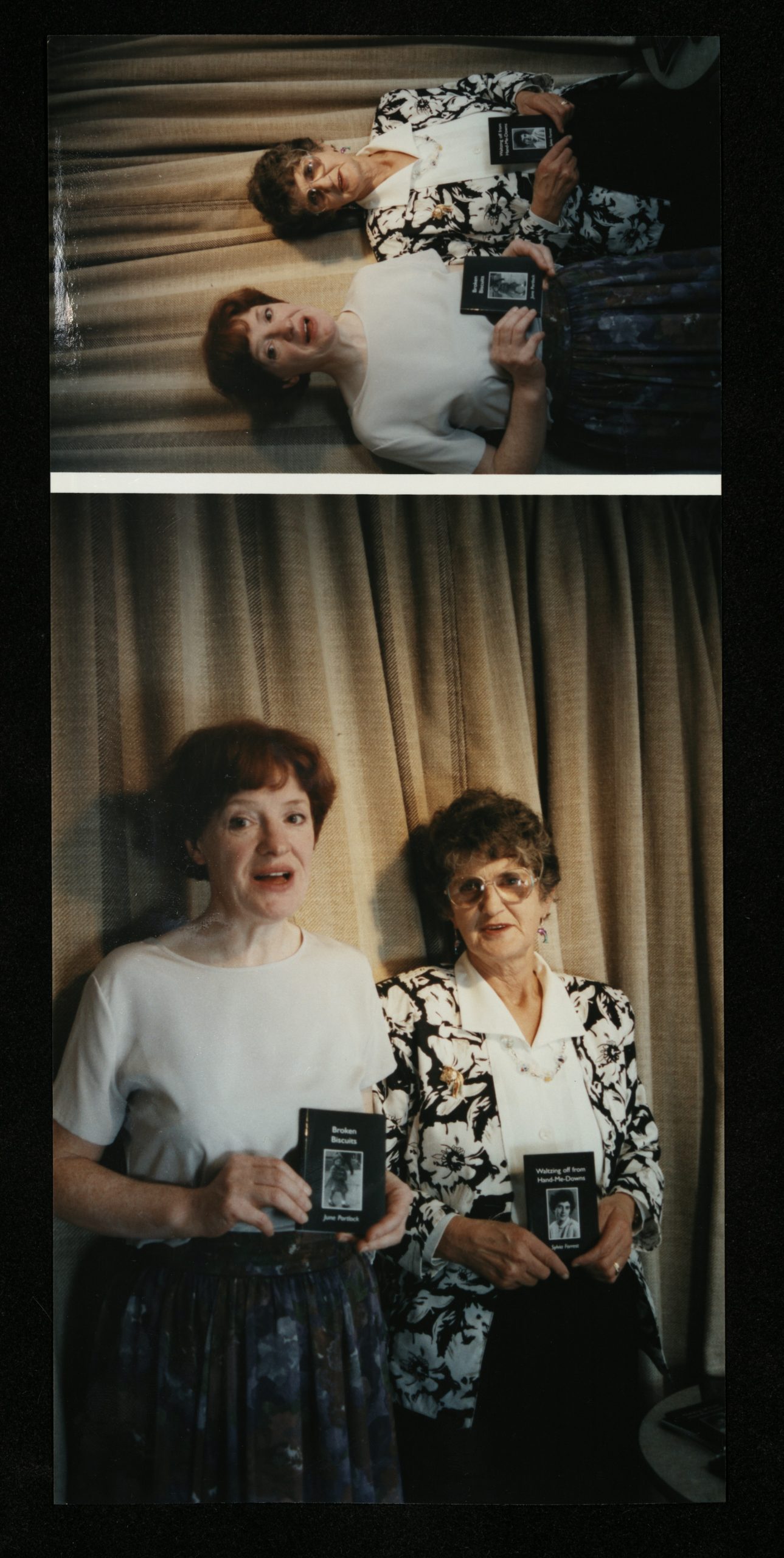
June Portlock and Sylvia Forrest both holding their respective published works of Broken Biscuits and Waltzing off from Hand-Me Downs. (DT/13)

The images included in this blog are part of the Diamond Twig archive which was donated to the library by Ellen Phethean.
Michael Chaplin – Newcastle United

If you have lived, worked, or visited the city of Newcastle Upon Tyne during match days, you may have seen the sea of fans, all wearing the iconic black and white shirts. You may have heard the roar of the fans emanating throughout the city whenever a goal is scored, or the fans disagreeing with a decision from the referee. Newcastle is a city proud of its football team. The stadium, affectionally known as the ‘church,’ is central to the culture of this part of the Northeast. As a one team city, the love and at times distain for the club runs deep through Geordie blood. For those new to Newcastle, it is easy to get caught up in the excitement and become an adoring fan. Newcastle United, for those not native to the city, can give a sense of belonging. Michael Chaplin, whose archive is located in Newcastle University Special Collections and Archives, is an example of just that…

Michael Chaplin, born in County Durham, moved to Jesmond in Newcastle as a young boy after his family moved back to the Northeast from Essex, where his father (Sid Chaplin) had been working as a writer. Although he attended schools in the area, his accent was different to those around him made, and often made it hard for him to feel like he belonged. But, whilst playing outside with a friend one day, he heard the Geordie roar from the stadium and became intrigued by what could cause such a sound that reached over a mile away. This was the beginning of his life-long love for Newcastle United and in the future would be the inspiration for some of his works in local live theatre, literature and tv dramas.

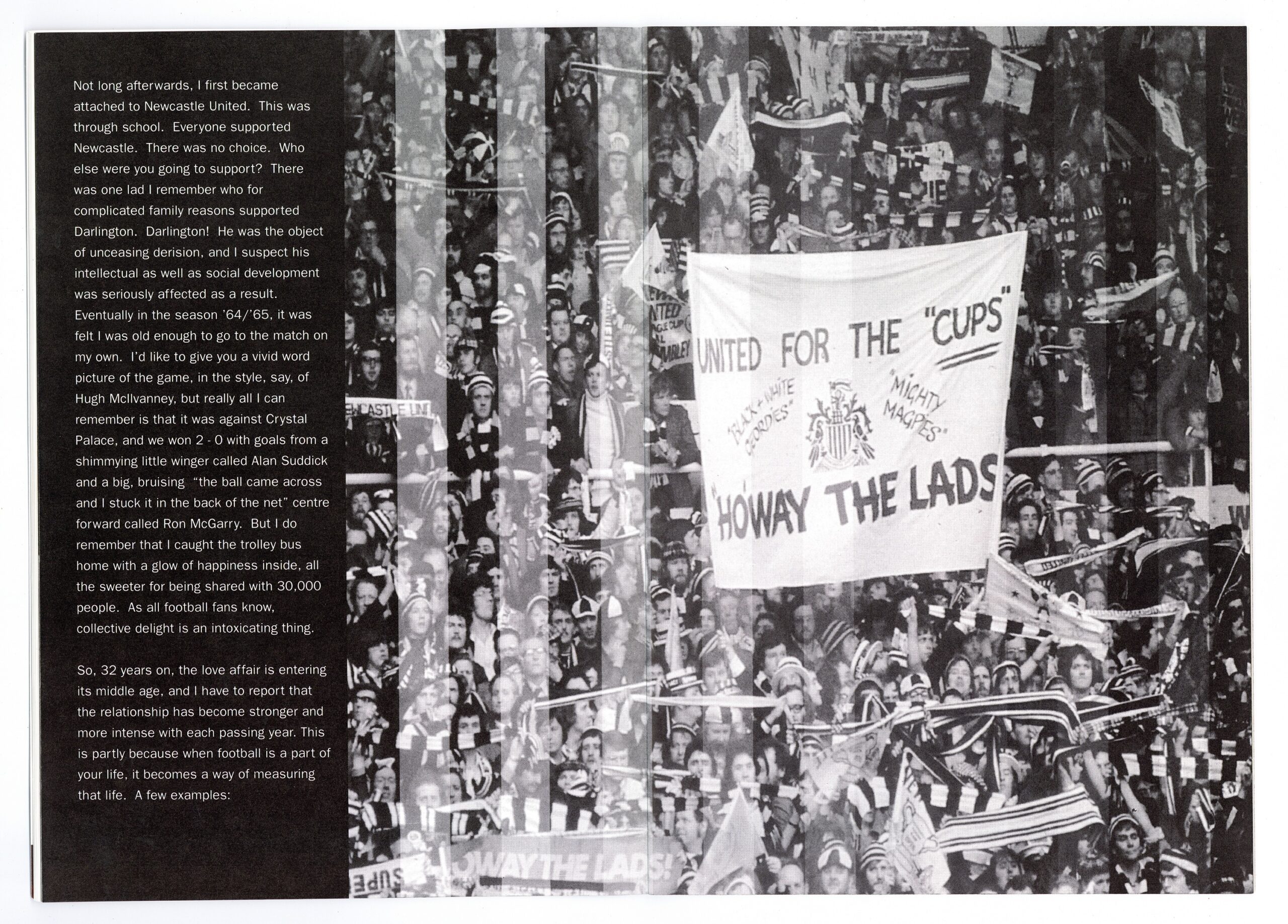
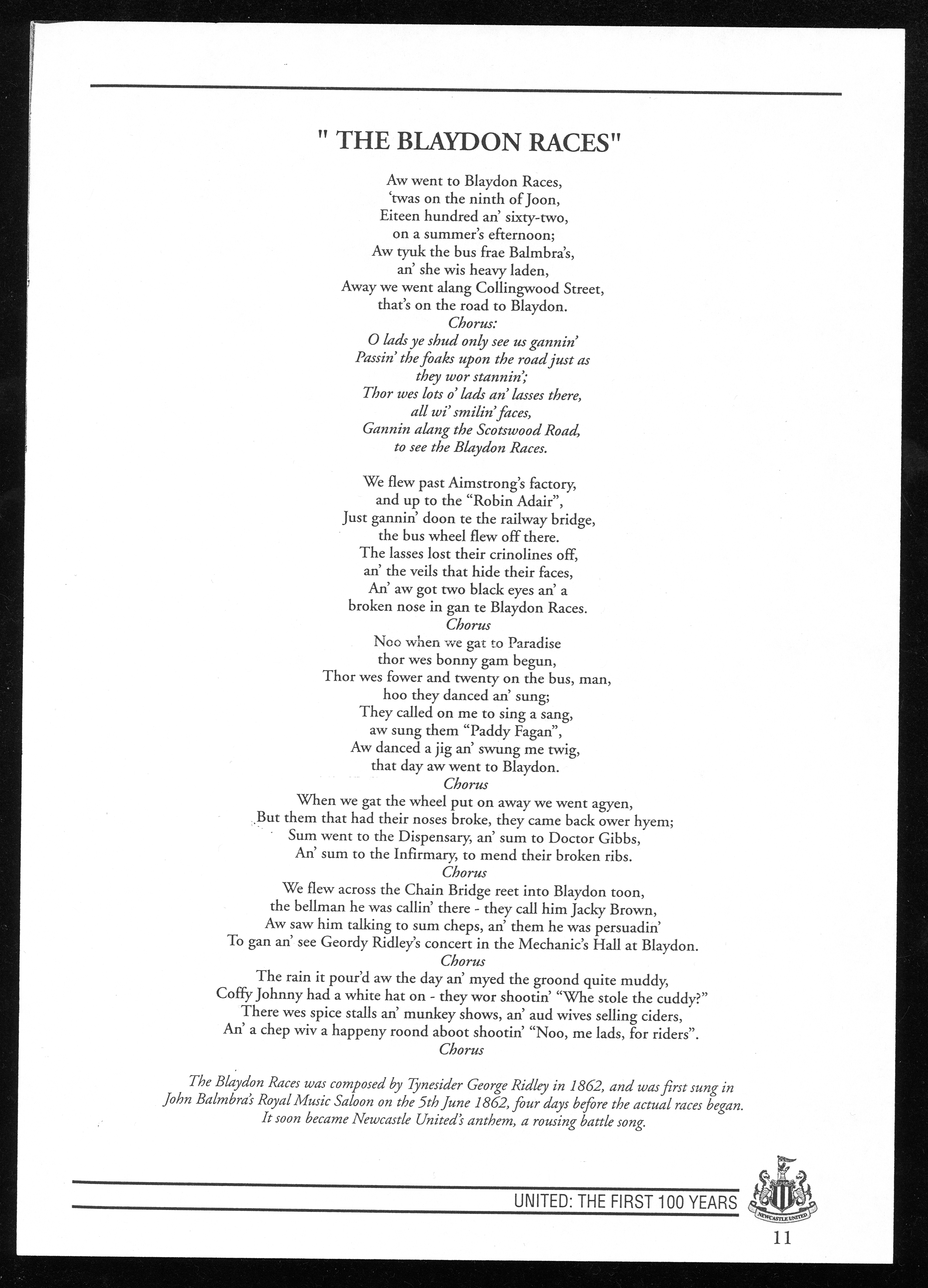
Fans of Newcastle United will be familiar with some of the famous chants, such as The Blaydon Races pictured below (part of the Michael Chaplin Archive and used as research material for the theatre production Beautiful Game: The Newcastle United Story). These chants fill the stadium grounds whilst the players are on the pitch. They fill the local pubs while the matches are shown on the tv, and they fill public transport across the country and worldwide when the black and white fans are travelling to support their team. They are vital to the club, urging the team to do well, cementing the love of the team between fans, and showing their rivals that they are serious.

‘The Blaydon Races,’ from United: The first 100 years (Michael Chaplin archive, MC/4/1/4/2)

In 1996, Chaplin’s live theatre production Beautiful Game: The Newcastle United Story, was performed at the Theatre Royal in Newcastle. The production told the story of his much-loved club through the eyes of three generations of the Purvis family and includes the trials and triumphs the team faced in the past through to present through affection, humour, and song. The period before had been a hugely successful year at the theatre. It became Newcastle’s first arts institution to receive a substantial National Lottery Award, and after a post-match pint between Robson Green and Max Roberts about Michael’s ideas for the new production, the history of the Newcastle United production was born.

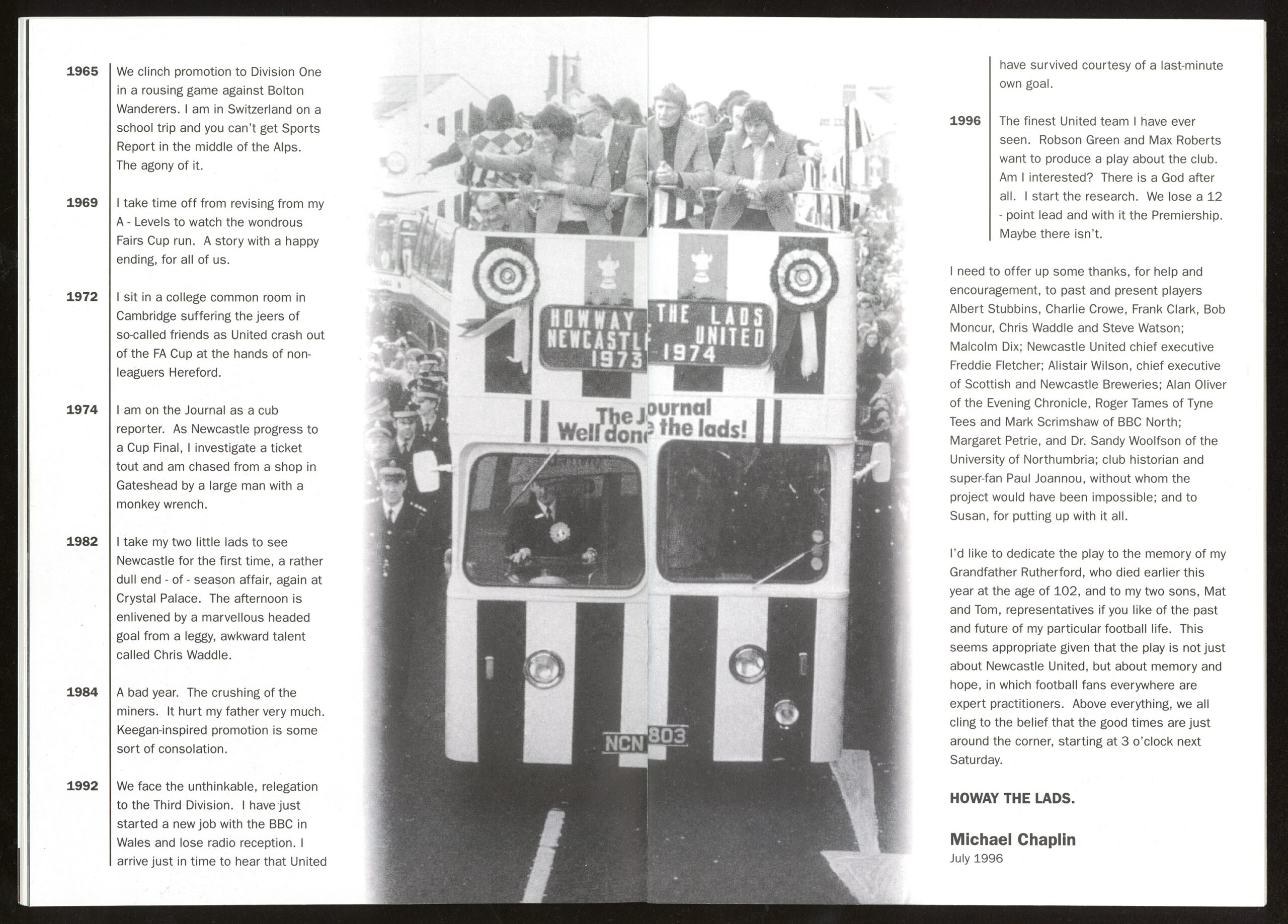
The programme that was produced for Beautiful Game: The Newcastle United Story described how Michael’s love of Newcastle United evolved, with key images and special event dates included (see the images below). This biographical information was later developed into a book called Newcastle United stole my heart. It tells of the growing sense of belonging that was gained from hearing the crowds and attending matches. It tells the story of his own changing life and career. This book is currently on display within the Sid Chaplin and Michael Chaplin Archives exhibition case, near to the exhibition area on Level 2 of the Philip Robinson Library.

The theatre production of Beautiful Game: The Newcastle United Story, was a tremendous success and enticed those that would normally be at a football match, to come to the theatre and enjoy the ‘game’ in a format different to the usual venue.

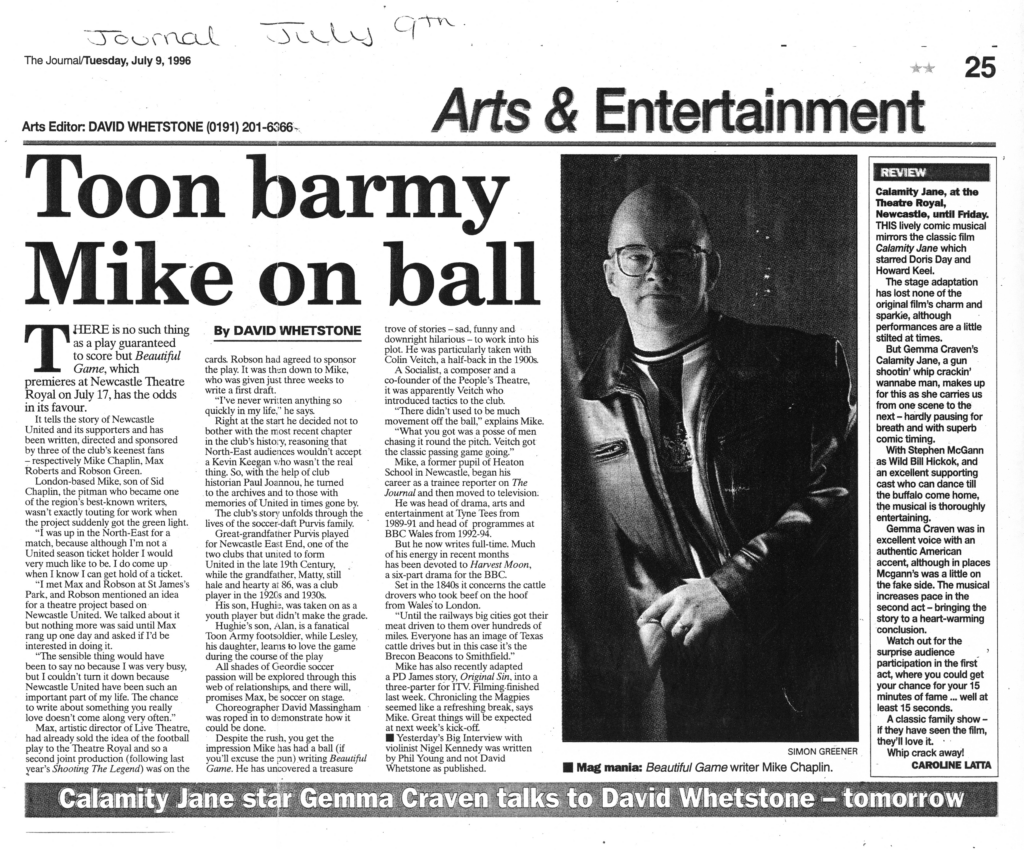
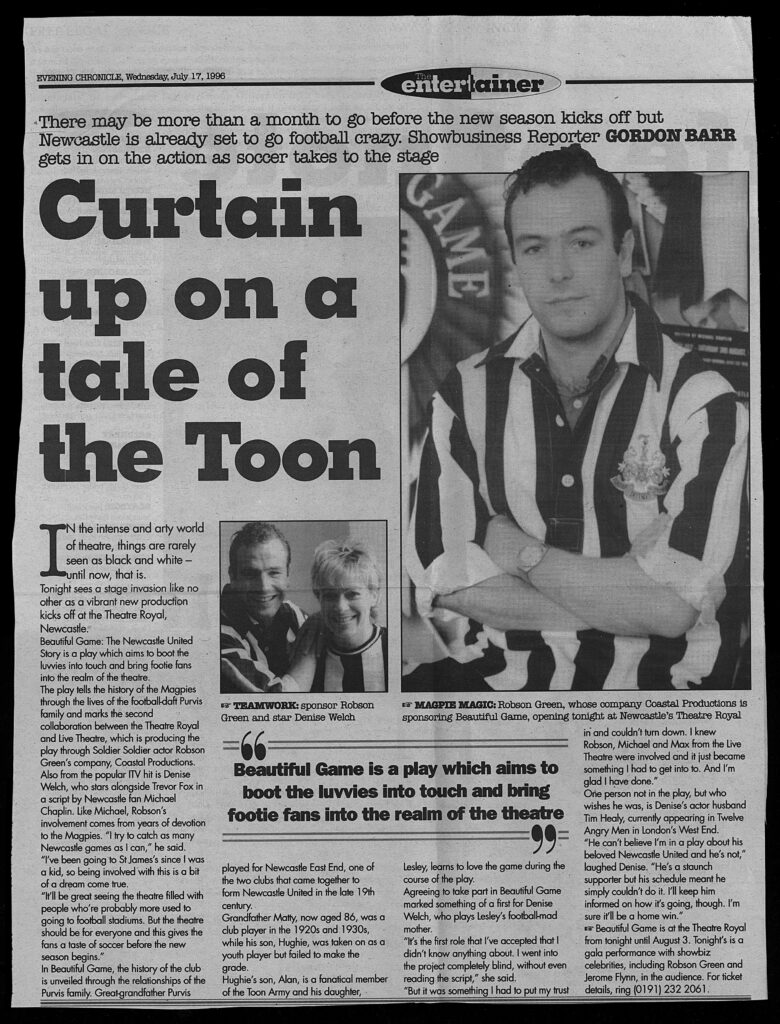
Local newspapers wrote of the enjoyment of the production and reviewing Chaplin, Roberts and Green highly. These cuttings are a few of many which we hold in the archives. Many of them sing the praises of the trio and tell the individual stories that brought them together for this production.

Page from The Journal – Toon Barmy Mike on the Ball’ (Michael Chaplin Archive, MC/4/1/4/3/6)
Page from Evening Standard – ‘Curtain up on a tale of the Toon’ (Michael Chaplin Archive, MC/4/1/4/1/1)

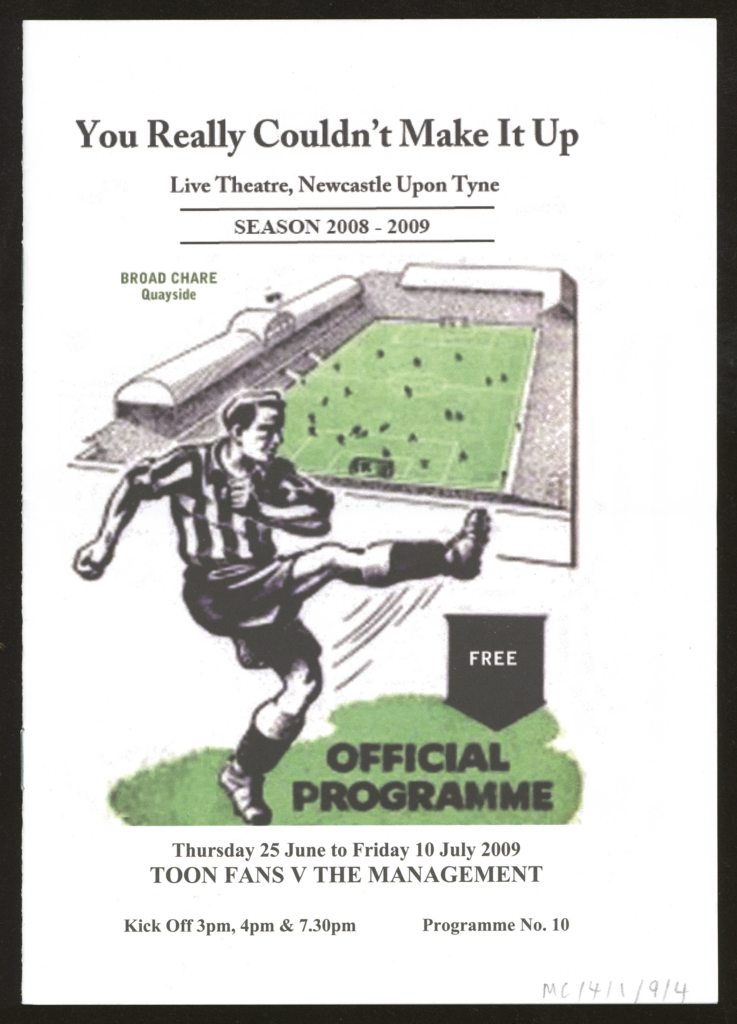
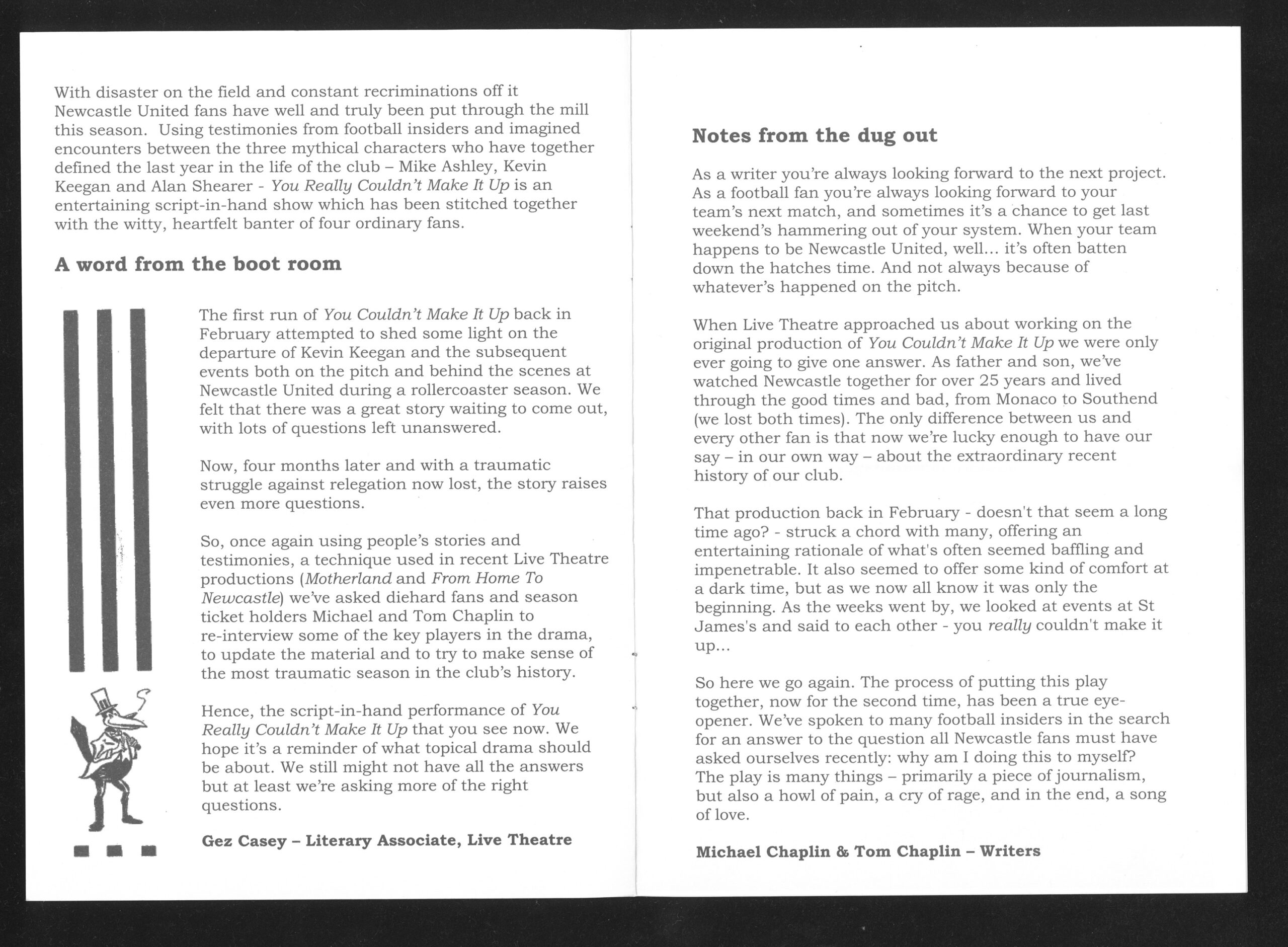
Years later in 2009, a new play was written by Michael Chaplin and his son Tom, titled, You Couldn’t Make It Up. The production told of the story of the current turbulent events of the team they both loved. This ‘script in hand’ style of play was created in line with the theatres theme of real-life stories, with other plays such as From Home to Newcastle being an enormous success. This new production centred around key members of Newcastle United and included the characters of Mike Ashley, Kevin Keegan, and Alan Shearer. Key goals from across the seasons were shown on video during the interval. Unlike the previous Beautiful Game production, which was written as a ‘love letter’ to Newcastle United’s history, this new performance was written and performed in a manner to describe the most recent turmoil the club was facing and expressed how much the fans yearned for change. The programme sold during the performance (images below) was designed with the iconic black and white strips and the magpie (the Northeast icon for the nickname of the Geordie team), with the headline ‘Toon fans Vs the Management.’

'You just couldn’t make it up’ programme, themed in the style of a Newcastle United match day programme with the traditional black and white strips and and iconic magpie (Michael Chaplin Archive, MC/411/8/4)
‘You just couldn’t make it up’ programme, themed in the style of a Newcastle United match day programme with the traditional black and white strips and and iconic magpie (Michael Chaplin Archive, MC/411/8/4)
‘You just couldn’t make it up’ programme, short paragraphs describing the back story to the play (Michael Chaplin Archive, MC/411/8/4)

The Michael Chaplin Archive holds scripts, correspondence and some key research material used in the planning process of Chaplin’s journey writing the live theatre plays Beautiful Game and You Just Couldn’t Make It Up, alongside his other successful pieces of work.

Still on the theme of football, but with an entertaining story about a canine, we also hold the archival material for the wonderful drama of Pickles the dog (written by Chaplin and shown on ITV). The story is about the canine that found the stolen World cup in 1966. More information on this can be found here: Pickles – The Dog Who Won the World Cup – Newcastle University Special Collections and Archives (ncl.ac.uk)

If you are interested in Newcastle, football, theatre, television, literature, community and culture, the Michael Chaplin Archive is highly recommended. You can find more information and links below:

In Blackberry Time – June 2020

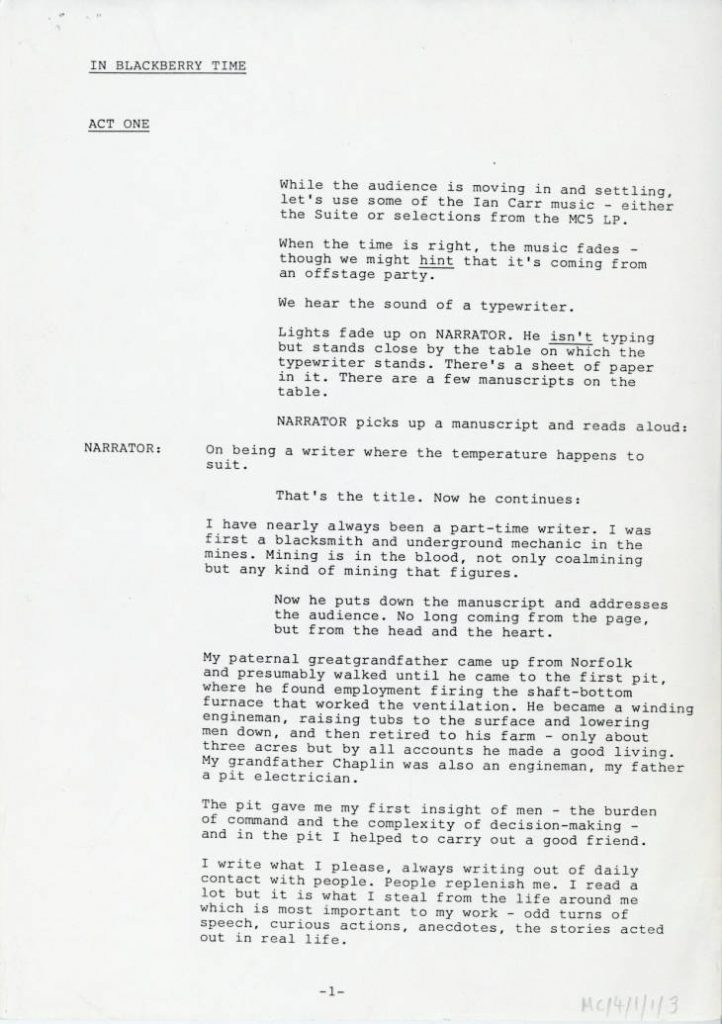
Page from annotated typescript for theatre production 'In Blackberry Time'
Page from annotated typescript for theatre production ‘In Blackberry Time, 1985 (Chaplin (Michael) Archive, MC/4/1/1/3/1)

In Blackberry Time was produced collaboratively by Alan Plater and Michael Chaplin.  The play is based on Sid Chaplin’s book of short stories that go by the same name.  Sid started to write the autobiographical book before his death in January 1986.  His son, Michael Chaplin, and wife, Rene Chaplin, edited and published the book on his behalf posthumously with Bloodaxe Books in 1987.

As we can see from this first page draft of the play, the narrator establishes himself as a son of a coal miner who ‘writes what I please, always writing out of daily contact with people’. Sid was highly regarded for his depictions of North East mining and working-class communities drawing upon his experiences growing up in the coal mining community of County Durham and of work in the pit. Sid began working in the mines from the age of sixteen before moving away to be a writer for the National Coal Board’s publication Coal.

With his vivid portrayals of life in region Sid was an inspiration to many North East writers.  In the 1960s he became a mentor figure to the playwright Alan Plater.  When Plater was approached by Max Roberts, the Creative Director of Live Theatre, to write a North-East play, Plater was drawn to Sid’s work. In a meeting with Michael it was decided that they would together adapt the latest of Sid’s work into a play. This extract from a typescript of In Blackberry Time was written in 1987, the same year that Sid’s final and posthumous book was published.  

The play was staged at Live Theatre in 1987 and starred actors Val MacLane and David Whitaker.

In these audio interviews you can hear Michael Chaplin’s account of his collaboration with Alan Plater.  In the interview Michael claims that In Blackberry Time began his career as a writer. He has written some 30 plays for Radio 4 including the series ‘Two Pipe Problems’ and ‘The Ferryhill Philosophers’ and various single plays like ‘The Song Thief’. His work for television includes the series ‘Grafters’, ‘Dalziel and Pascoe’ and ‘Monarch of the Glen’ and films like ‘Just Henry’.

The production of In Blackberry Time was also the beginning of a long relationship with Live Theatre.  Michael wrote another two plays for the theatre, ‘You Couldn’t Make It Up’ (with Tom Chaplin) about the travails of being a Newcastle United fan, and ‘A Walk-On Part’, based on the diaries of ex-Labour MP Chris Mullin.

You can find the Archives of Michael Chaplin and Sid Chaplin here at Newcastle University Special Collections and Archives. You can also find material in our Live Theatre Archive including Max Robert’s copies of draft script for In Blackberry Time and production photographs.