The Tyneside Campaign for Homosexual Equality (CHE) was formed in 1972 as a local branch of the national Campaign for Homosexual Equality. The Tyneside CHE Archive held in Special Collections and Archives at Newcastle University is one of the most complete records of CHE in the UK.
As Pride Month draws to a close, we reflect on the importance of art, music and culture in the early days of Tyneside CHE through extracts from the archive.
In the early days of the LGBTQ+ movement in the UK, criminalisation, discrimination, social exclusion and stigmatisation were widespread for its members.
Against this backdrop, art, music and culture, and the social bonds which both created and resulted from them, became powerful tools of resistance and self-expression for the LGBTQ+ community, forming the cultural backbone of a growing movement. Nationally, and internationally, artists, musicians and cultural spaces became lifelines for members of the LGBTQ+ community, and through the Tyneside CHE archive we can see the same unfolding at a local level.
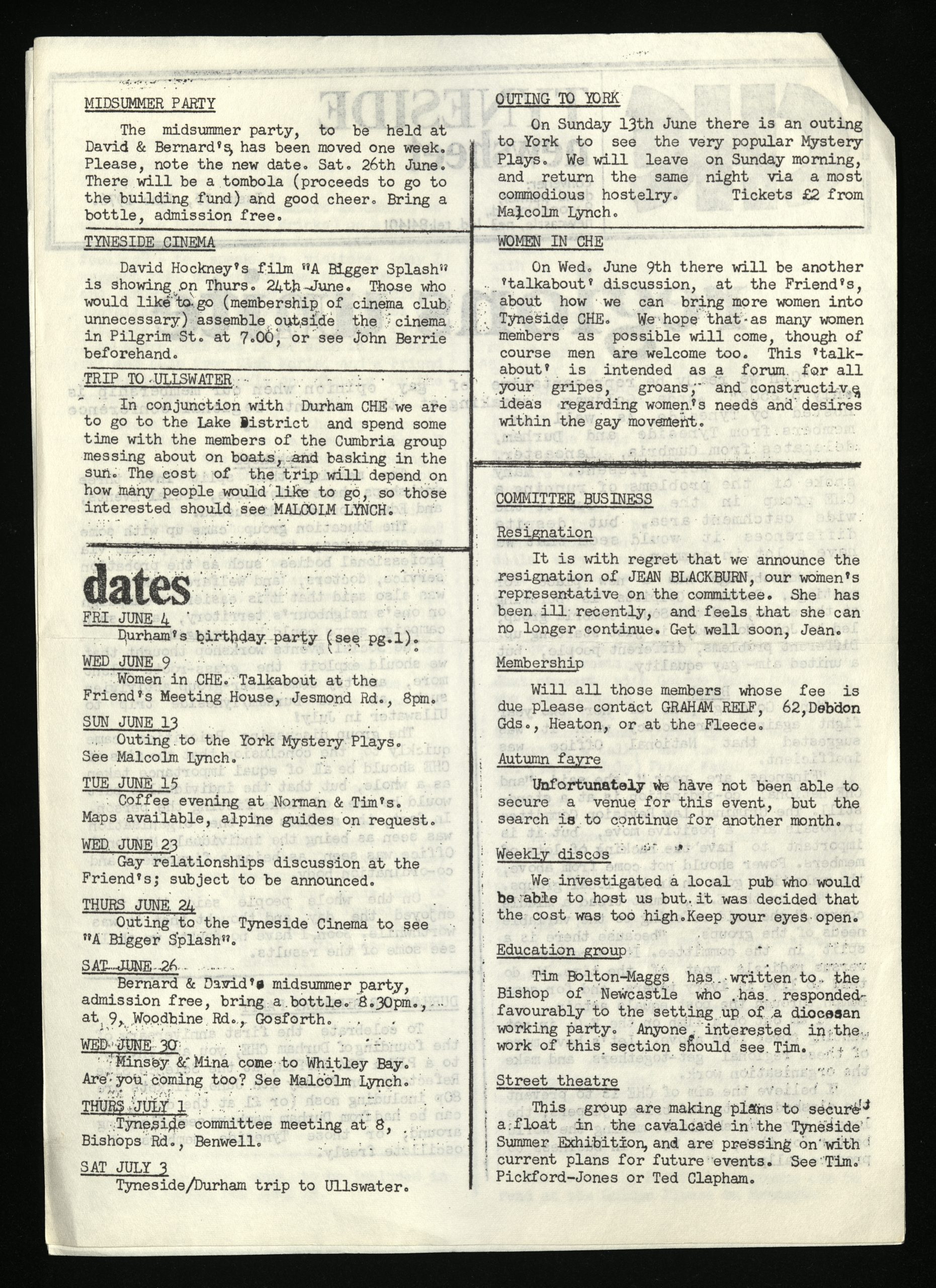
In the early Tyneside CHE newsletters, regular committee business and political matters are interspersed with cultural gatherings and events throughout. In June 1976, plans included a trip to watch the York Mystery Plays and an outing to the Tyneside Cinema to see the film A Bigger Splash, a film significant for its treatment of gay themes.
Page 2 of Tyneside CHE Newsletter, June 1976 (CHE/01/05)
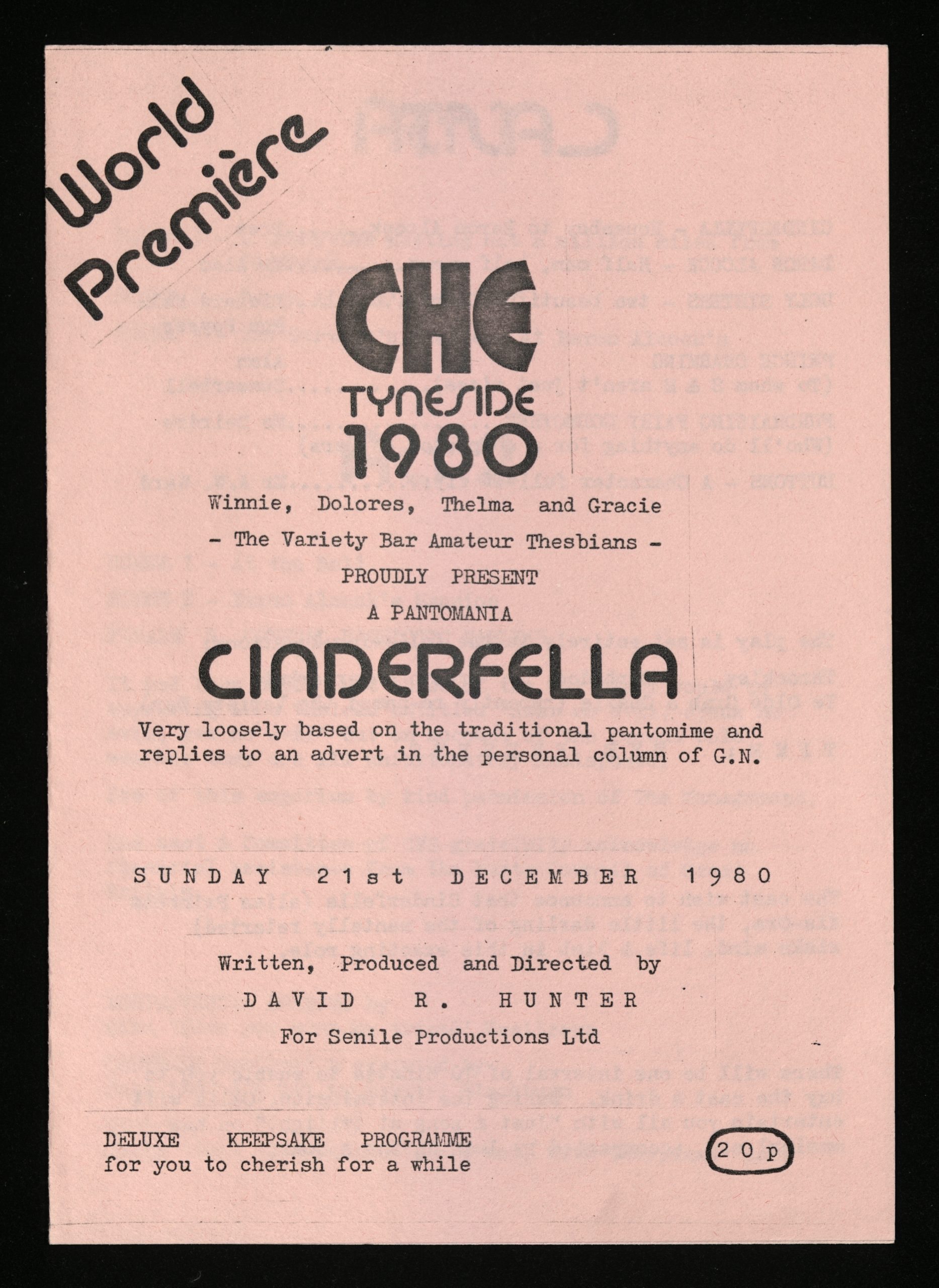
As well as organised trips, in-house events and productions formed a very significant part of Tyneside CHE’s activities too, from regular film nights and coffee mornings hosted in members’ own homes, to an organised street theatre group which made regular performances on Newcastle’s Northumberland Street. This production of Cinderfella in December 1980 was Tyneside CHE’s own take on a traditional festive pantomime.
Programme for Cinderfella by Tyneside CHE, 21 December 1980 (CHE/01/05)
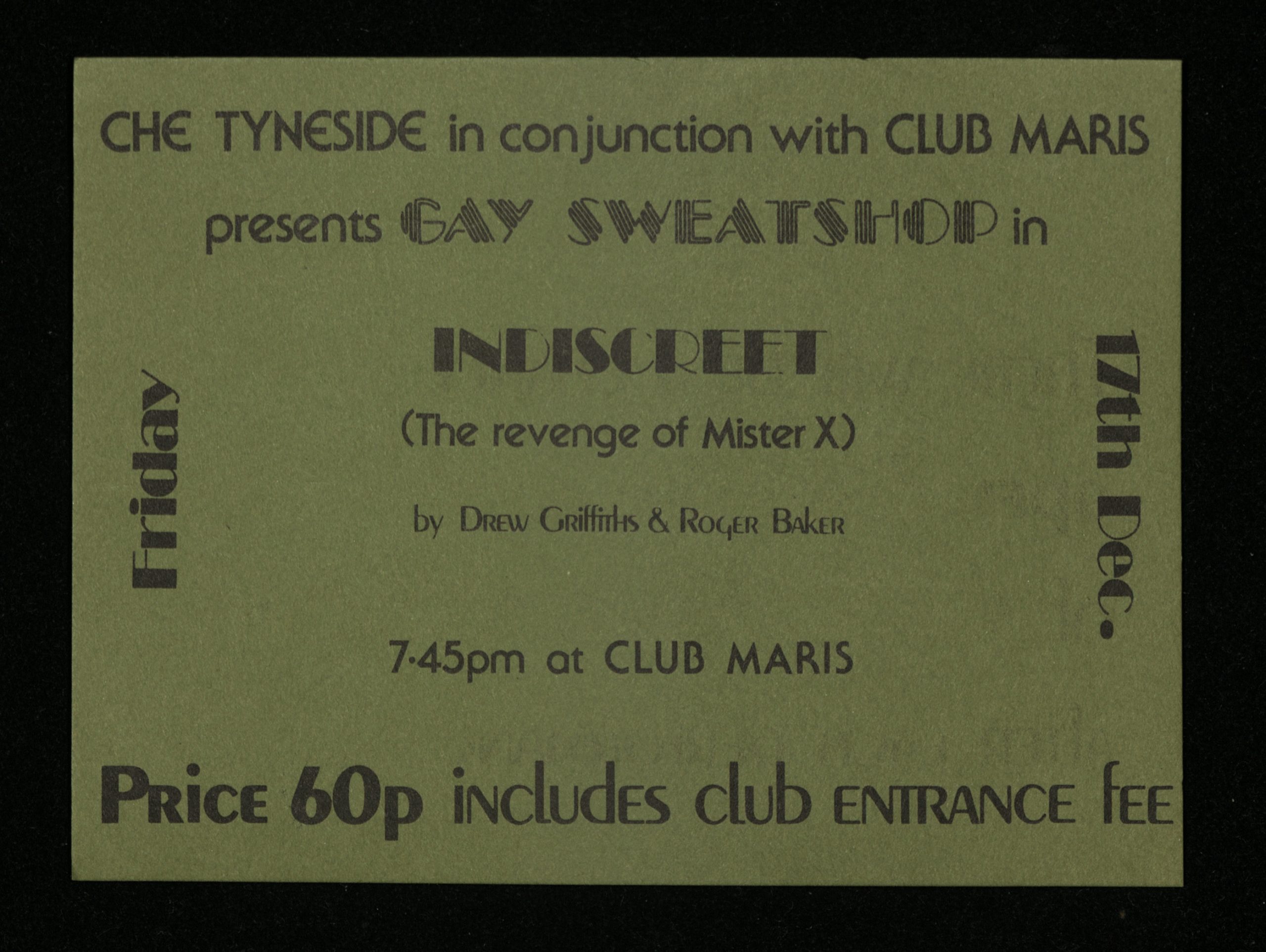
Theatrical performances and arenas provided a relatively safe and creative space for LGBTQ+ individuals to express their identities, desires, and experiences. Tyneside CHE supported and hosted several touring productions of Gay Sweatshop, a London-based theatre company and the first gay theatre company, which was formed to counteract prevailing misconceptions about homosexuals and promote awareness of sexual oppression experienced by the gay community. This ticket relates to a performance of the play Indiscreet in Newcastle on 17 December 1976.
Ticket for performance of Indiscreet by Gay Sweatshop in Newcastle, 17 December 1976 (CHE/01/05)
Ticket proofs for performance of All our Yester-Gays by the Consenting Adults in Public theatre company in Newcastle, 12 August [1976?] (CHE/01/05)
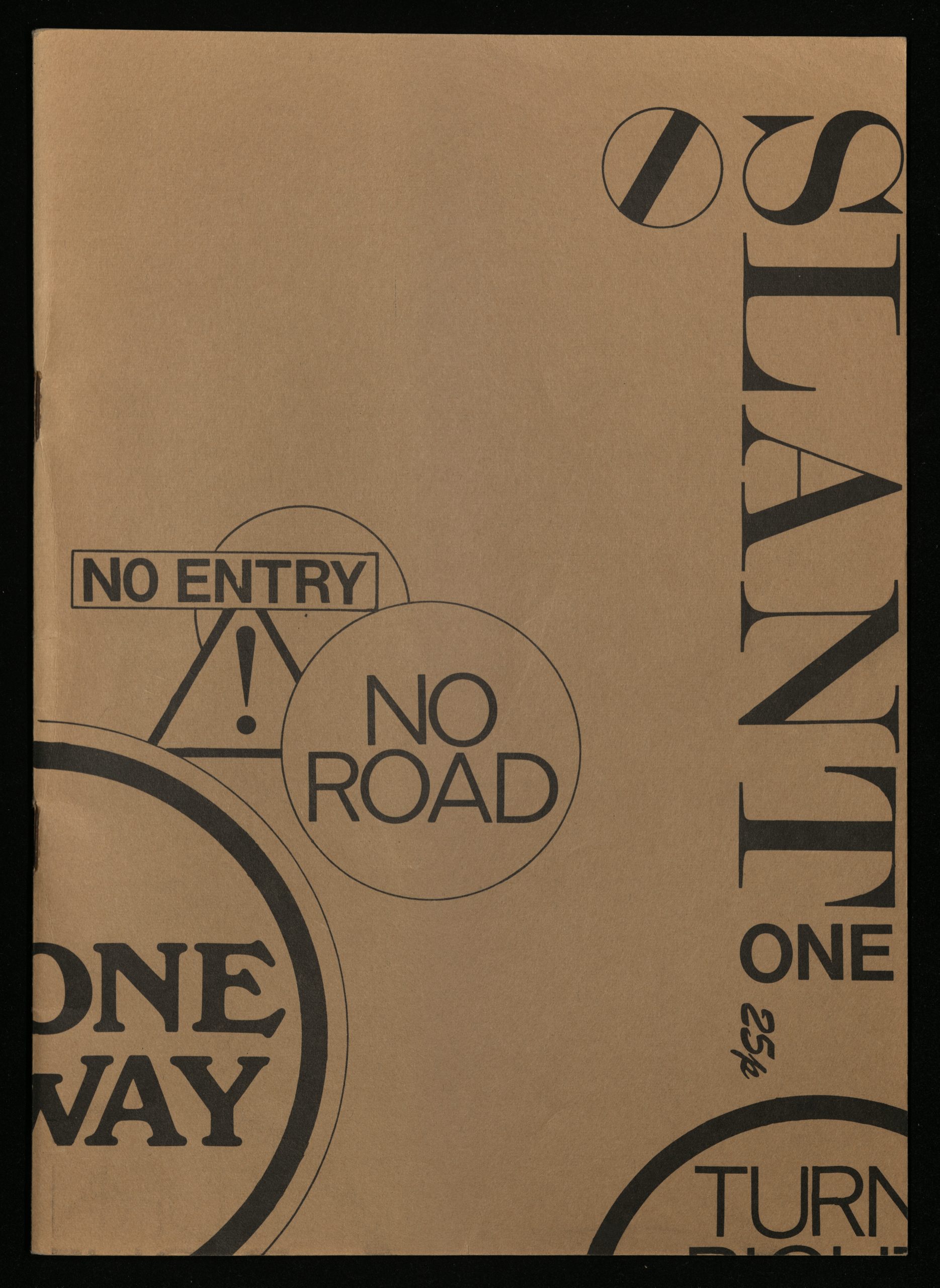
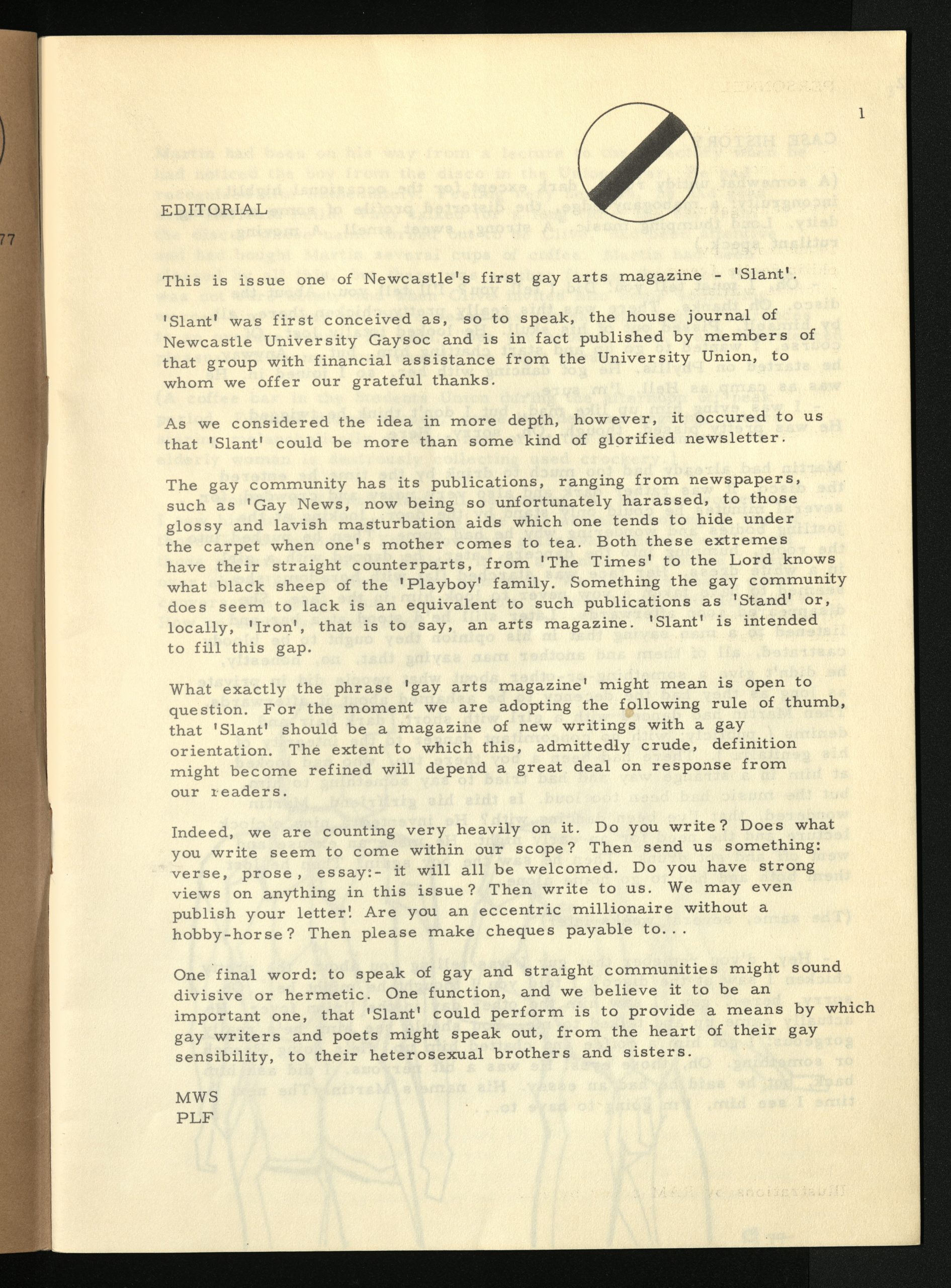
Arts magazines played a crucial role in the early LGBTQ+ movement, by providing a space for expression, visibility, and community when mainstream media marginalized or ignored LGBTQ+ voices. Newcastle’s first gay arts magazine Slant was published in February 1977 by Newcastle University’s Gaysoc, with assistance from the Student’s Union. According to the Editorial in its first edition, it was formed “to be a magazine of new writings with a gay orientation” and “to provide a means by which gay writers and poets might speak out, from the heart of their gay sensibility to their heterosexual brothers and sisters”.
Front cover of Slant magazine, issue 1, February 1977 (CHE/05/02)
Editorial, Slant magazine, issue 1, February 1977 (CHE/05/02)
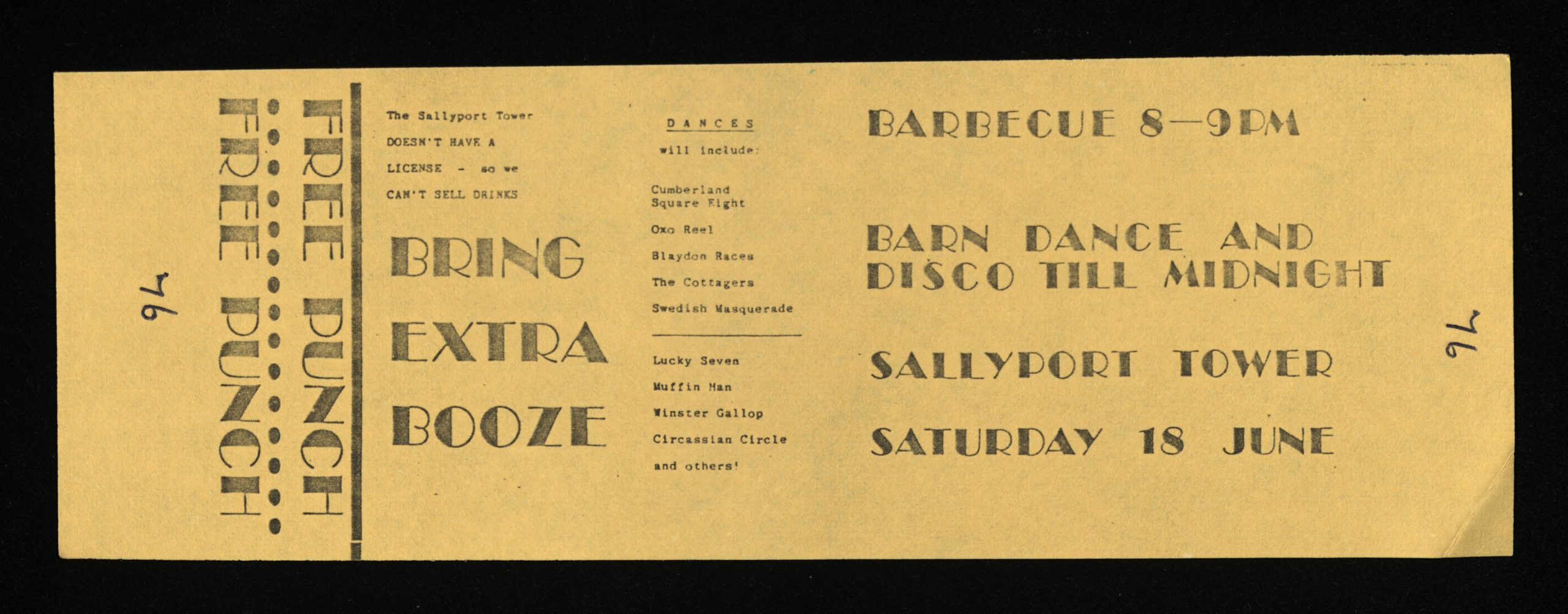
As Tyneside CHE arrived at its ten-year anniversary in 1982, celebrations included a barn dance featuring many traditional and well-known country dances and tunes, including Cumberland Square Eight, Lucky Seven, Winster Galop and the Blaydon Races, again demonstrating the continued importance of culture in unifying and strengthening the movement and its members, and of community gatherings that defied repression and laid the groundwork for LGBTQ+ visibility and activism.
Ticket for Tyneside CHE barn dance and disco, 18June 1982 (CHE/01/05)
As part of the Special for Everyone project to address equality, diversity and inclusion in Special Collections & Archives, Finding their Voicesis an exhibition celebrating the many diverse voices present within our collections.
Many of the voices within Special Collection & Archives have long been visible and heard, yet those from marginalised groups in society have often been obscured. Our Special for Everyone project is actively working to diversify the voices included in our collections and to illuminate the hidden or lesser-heard voices they contain. We are doing this by taking a fresh look at the sources and, where necessary, reading between the lines to uncover those which are harder to find.
Finding their Voices is a celebration of some of the people we have encountered through this work. It features people who found and made their own voices heard despite their often-marginalised position, and those whose voices have been more difficult to hear. We are amplifying them here to enable a new generation of researchers to discover them.
The exhibition contains items from across Special Collections & Archives. Below are some of the exhibition highlights:
Working-Class Mining Communities
The lives of people from working-class communities in the past can often be difficult to discern within the official record. However, closer examination and interrogation of sources can help to uncover their history and voices.
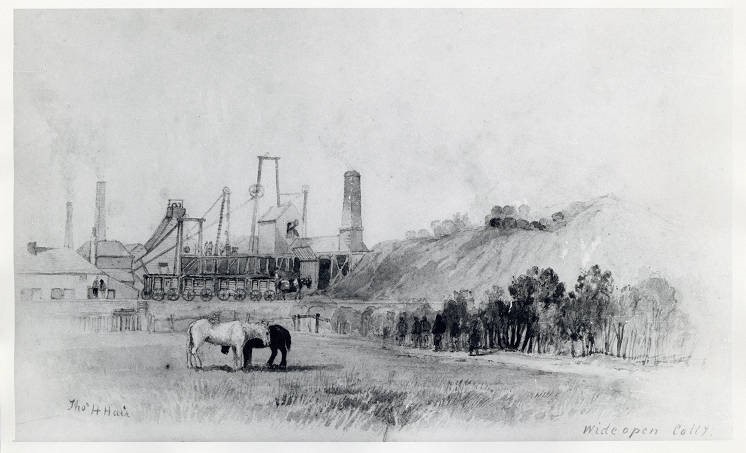
Thomas Hair (c.1810-1875) was a local artist whose illustrations depict the North East’s coal mining industry in the 19th century. His work captures the everyday workings of the industry, with many of the illustrations focussing on collieries, machinery, and river trade. Hair’s work provides visual evidence of the coal mining landscape and reveals the industry’s impact on the built environment. These images can tell us much about the lived experience of miners in this period, giving a ‘voice’ to their lives and the hard-working conditions they faced.
Poet David Bateman had a severe stutter as a child and teenager. He had successful speech therapy in 1980, aged 23. Since then, he still has a slight stutter in ordinary life but performs his poetry widely and has won many poetry slams and competitions. He writes poems, stories, scripts and articles. His book Shtum is a frank and personal account of what it is to have a stutter, the process of seeking the right help, and of finding your voice.
The poems in Shtum were mostly written between 2009 and 2015, but some have their origins in work from as early as 1980. David Bateman had never really considered writing about his stutter until he was prompted to think about how it was woven into his work when asked to participate in a radio documentary about stuttering in 2009. The project led him to return to some previously unpublished work made up of incomplete poems, unrealised ideas and prose diary entries. He felt ready to rework these early pieces and develop many new poems. The result is Shtum: the stutter poems.
The Pride Movement
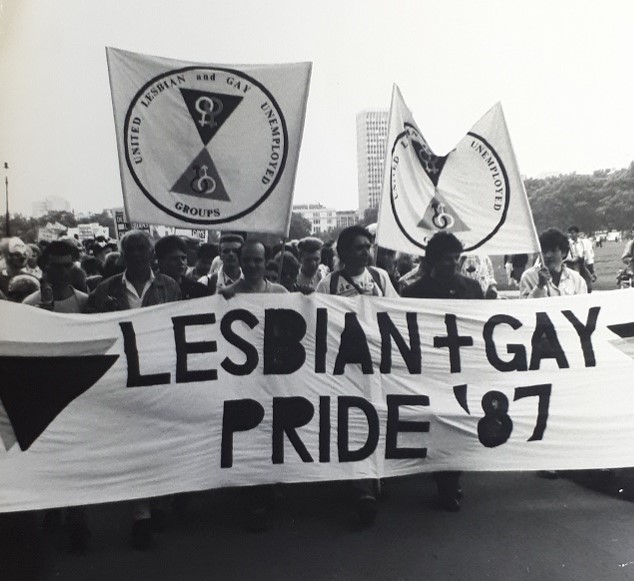
The UK’s first Pride march took place in London on 1st July 1972 with around 2,000 participants. Over 50 years later, London Pride now sees over 1.5 million people marching together to celebrate LGBTQ+ rights. The Campaign for Homosexual Equality (CHE) was established in Lancashire in 1964. Special Collections & Archives holds the archive for CHE’s Tyneside branch, including documents which illuminate the story of the Pride movement since that first march over five decades ago.
Within the Tyneside CHE Archive, it is possible to look back at Pride marches from across the past five decades. The first Pride march in 1972 took place 5 years after the Sexual Offences Act 1967 was passed, which decriminalised sex between gay men over the age of 21 in England and Wales. However, at the time of the first Pride march, the LGBTQ+ community still faced much discrimination. For example, gay marriage was not legal, and gay and bisexual people were banned from joining the armed forces. As well as campaigning, CHE also provided a social and support network for gay men and lesbians, providing a space for members of the LGBTQ+ community to make their voices heard.
Photograph of London Pride (1987), Tyneside Campaign for Homosexual Equality (Tyneside CHE) Archive, CHE/03/02/01
Female Friendships
The everyday lives and voices of women are often not well-documented. Through personal belongings such as books and correspondence, however, it is possible to gain glimpses into the ordinary day-to-day lives of women. We can see the importance of friendship amongst women, and the bonds and relationships they made through their social networks. In historical periods women found themselves in charge of running the household whilst their husbands were away at work. The exhibition highlights items which are testimony to the importance of companionship and mutual support between women and reflect how we can uncover their voices through what they left behind.
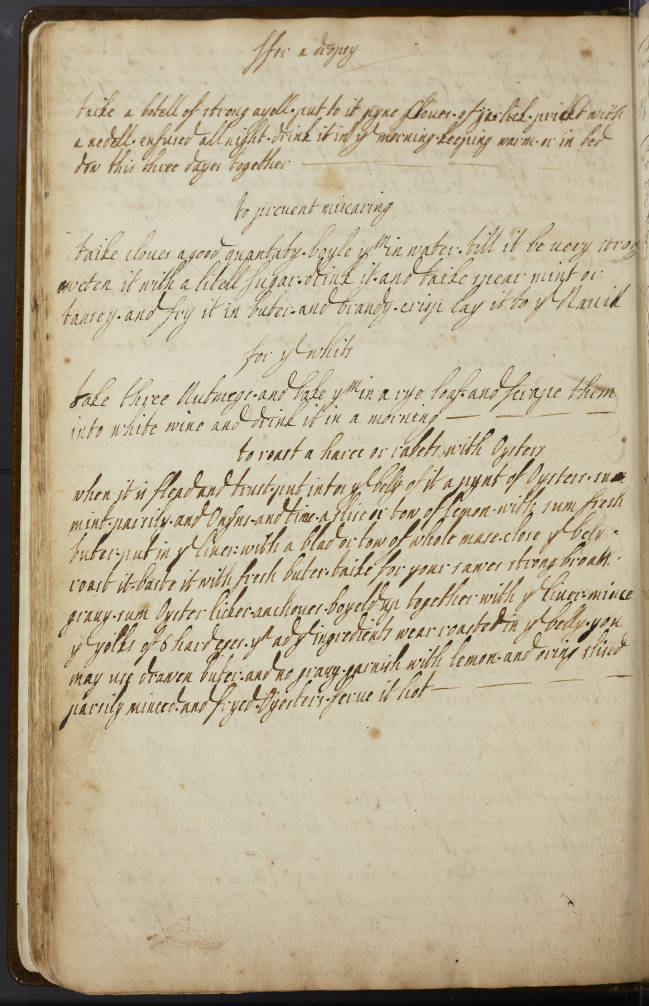
Jane Loraine’s recipe book from the 17th century contains a recipe ‘good for conception’, one ‘to prevent miscaring [miscarrying]’ and one ‘to make teeth white’. These recipes highlight the shared experiences of women and their attempts to help one another, not only with culinary recipes but also with fertility and more general health concerns. Different handwriting styles and recipes are attributed to different women. This indicates that the manuscript had multiple female contributors. Recipes were also often passed between class boundaries, highlighting the communal and collaborative nature of domestic knowledge in the early modern period.
The classic image of women from the past is one of confinement, lack of agency, and a life of drudgery, domestic boredom or excess. In reality, whilst this might have been true for some, there have always been women who defied the expectations of their gender and exploited their talents to support themselves financially. Many gained a degree of respect in their chosen field and enjoyed popular success. Finding their Voices showcase items written and illustrated by women with talents and expertise in areas as diverse as science, art, storytelling, philosophy and pedagogy. Through their writings and illustrations their voices have a lasting impact.
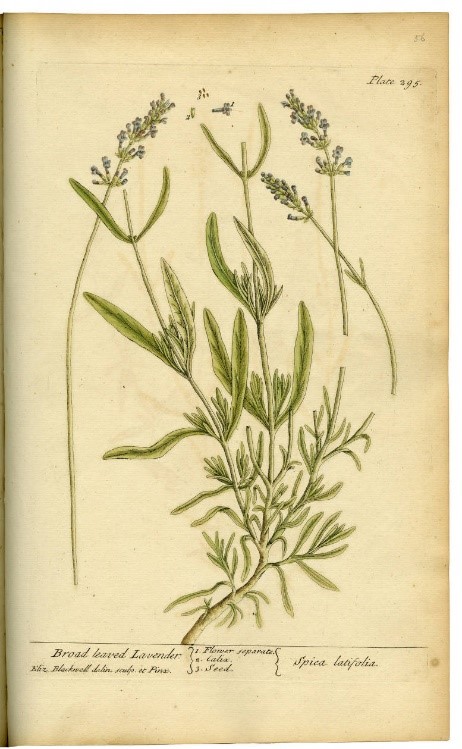
Elizabeth Blackwell (1707-1758) is one of the women highlighted within the Finding their Voices exhibition. She was the first woman known to have produced a book of botanical work in Britain. Despite having a wealthy background, she was forced to use her skill of botanical drawing to raise money to support herself and release her husband from debtor’s prison. Even more unusually, Elizabeth Blackwell undertook all stages of the illustrative process herself rather than employing specialist engravers and painters. She completed two volumes consisting of about 500 illustrations with accompanying commentary in under two years. The book was intended as a reference work for doctors who needed a thorough knowledge of medicinal plants.
Page from A Curious Herbal, by Elizabeth Blackwell (1737), Rare Books, RB 633.88 BLA
Kamau Brathwaite and the Caribbean Voice
Barbadian poet, literary critic and historian Kamau Brathwaite (1930–2020) is a significant figure in the Caribbean literary canon, and one of its major voices. His work is noted for its rich and complex examination of the African and indigenous roots of Caribbean culture. He sought to create a distinctively Caribbean form of poetry which would celebrate Caribbean voices and language.
Kamau Brathwaite was born in Bridgetown, Barbados. Originally named Edward Lawson Brathwaite, he received the name Kamau from the grandmother of the Kenyan writer and academic Ngũgĩ wa Thiong’o, when on a fellowship at the University of Nairobi in 1971.
Kamau Brathwaite co-founded the Caribbean Artists Movement, a collaboration of artists which celebrated a new sense of shared Caribbean ‘nationhood’, in 1966. Caribbean identity and culture are central to Kamau Brathwaite’s academic writing as well as his poetry. Brathwaite felt that the traditional meter of the English iambic pentameter (where every line is composed of ten syllables and has five stresses) could not express the breadth and depth of that experience. He instead used African and Caribbean folk and jazz rhythms in his poetry. He combined that with the use of Caribbean dialect and patterns of speech to create a distinctively Caribbean form of poetry, which was written to be performed out loud and heard.
These items can be found alongside many others within the Finding their Voices exhibition on Level 2 of the Philip Robinson Library from Monday 10th April – June 2023.
Written by Daisy-Alys Vaughan, student working on the Special for Everyone project.
![Ticket proofs for performance of All our Yester-Gays by the Consenting Adults in Public theatre company in Newcastle, 12 August [1976?]](https://blogs.ncl.ac.uk/speccoll/files/2025/06/CHE-01-05-3-crop-scaled.jpg)