Category Archives: All Blogs

Environment Awards 2023

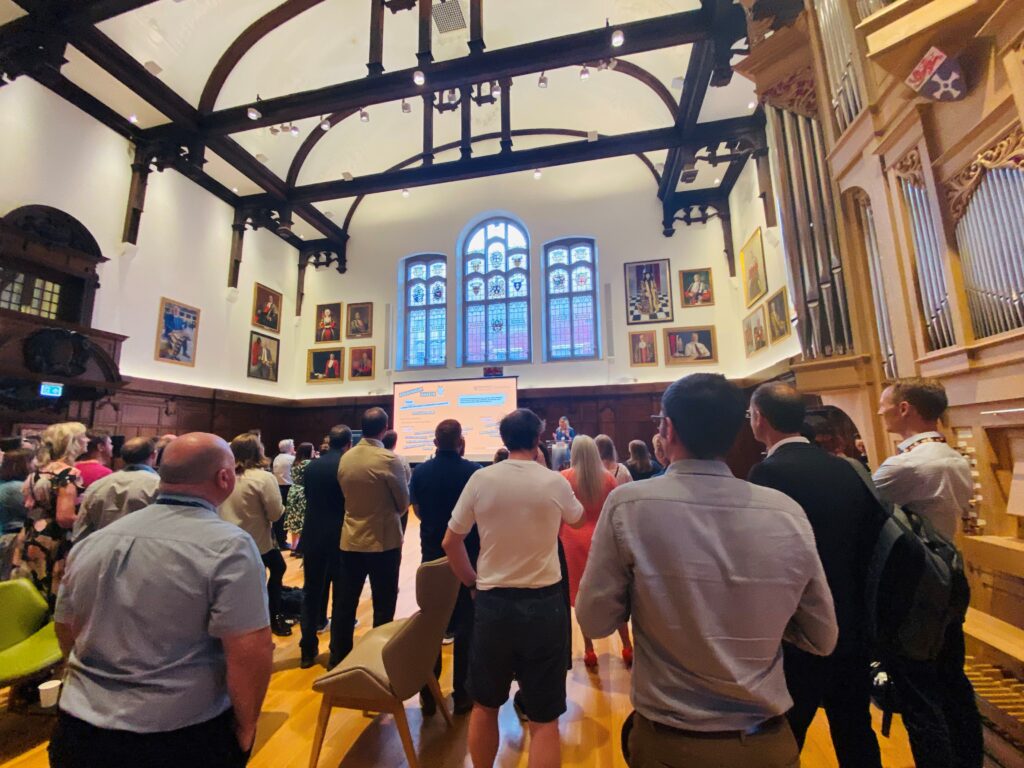
On the 29th of June the Sustainability Team joined staff, students and members from Newcastle University’s Executive Board in King’s Hall to celebrate achievements and displays of sustainable excellence. 

Recipients of the award were from various departments across the university, including teaching, research and Estates and Facilities. We hope this demonstrates how sustainable changes and innovation can be made across any department and be recognised. 

Recipients:

  • LEAF (Laboratory Efficiency Assessment Framework) members 

LEAF lab groups who have achieved a Gold, Silver, or Bronze award at the University this academic year were all acknowledged for their achievements in increasing the sustainability of their labs. 

LEAF is a framework that helps to guide lab users through different actions that they can take to make their labs more sustainable across areas like waste, water, travel and energy. 

This year, 4 labs at Newcastle University achieved Gold efficiency, 2 labs achieved Silver, and 7 labs started their journey with LEAF and achieved Bronze. 

Running on Bronze accreditation and efficiency, a lab can save 7 tonnes of carbon dioxide equivalent a year, compared to not completing and running on Bronze criteria.  

If you would like to learn more about LEAF at Newcastle University, please take a look at our LEAF information on the Sustainable Campus website

  • The Grounds Team for their work on enhancing biodiversity 

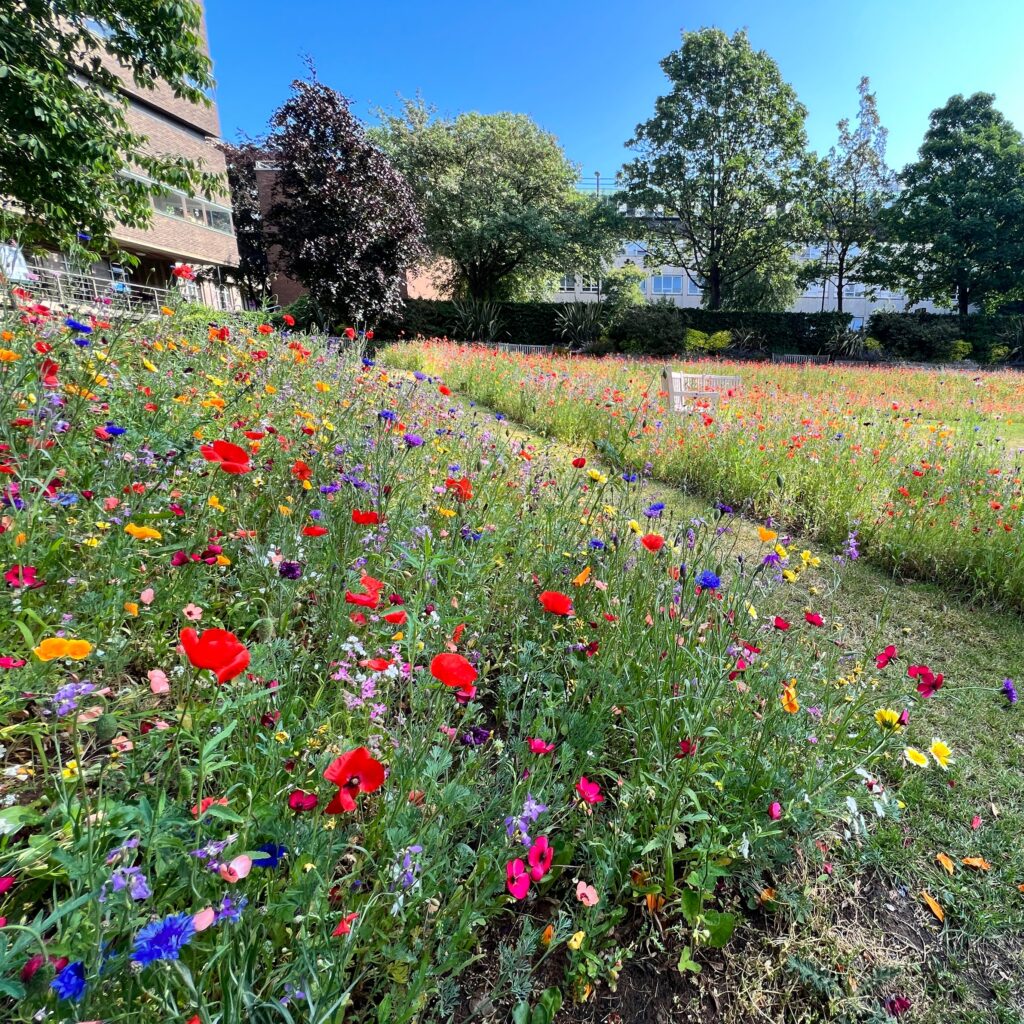
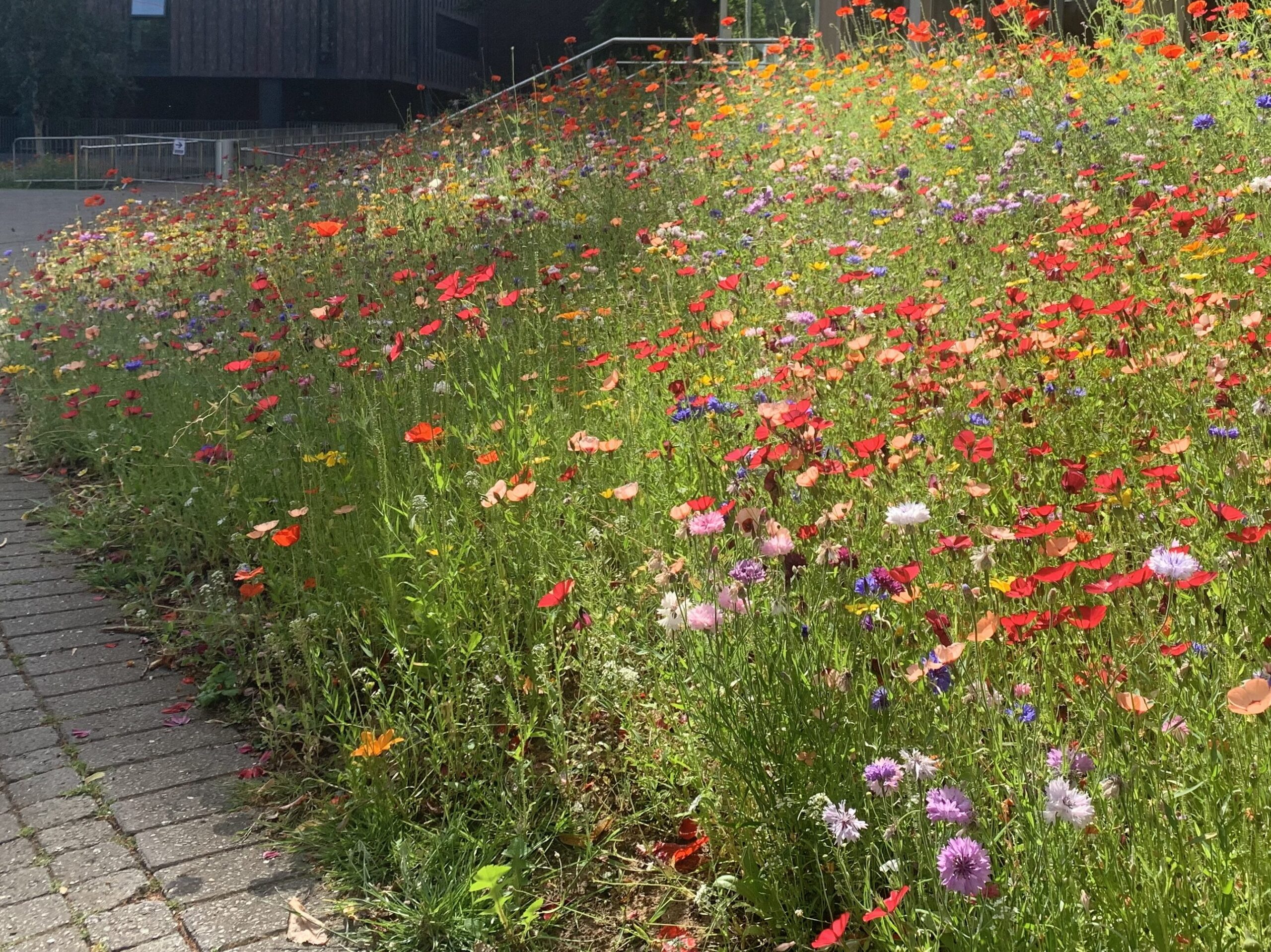
The 29-person Grounds Team were recognised for the work they do to enhance and protect biodiversity on our city-centre campus. They plant a wonderful array of flowers, trees and bushes to benefit insects, and keep our campus litter-free, which keeps hazards out of the way of any animals that pass through. 

The Grounds Team prepped/planted more than 1200 m2 of wildflower beds last year, and they’ve added another 500 m2 this year. 

Wildflower planting has many benefits which include: 

  • Boosting biodiversity as it attracts pollinators such as: bees, birds and butterflies. 
  • Wildflower areas on campus bring flowers into the everyday which can encourage people to get outdoors, enjoy walks, take photos and observe wildlife. 
  • Wildflower areas also help us with our aim to be more sustainable, as wildflower areas instead of lawns means that we reduce our cutting frequency, which prevents wear on machines, and reduces fuel use and emissions. This also saves money in the Grounds Team’s budget and frees up time for the team to focus on the detail of their ground’s maintenance tasks and other types of planting. 

The wildflowers have been in bloom all month across campus and receive non-stop compliments on social media. 

Please let us know what you think of wildflower areas on campus in the comments.  

What are environmental and energy management systems?

An Environmental Management System (EMS) assists businesses and organisations in improving their environmental performance and their operations that have an environmental impact.

It is worth noting that an EMS can be implemented within any business or organisation, it is not dependant on the size or activity of the organisation/ business.

An implemented EMS would be applicable to a wide variety of areas within an organisation such as a university or hospital, this is due to the extensive range of daily activities that are conducted at these institutions, most of which are likely to have an environmental impact in one way or another.

An example of some prominent areas that are assessed through an EMS include:

  • Carbon usage
  • Water usage
  • Biodiversity gains and loses
  • Waste generation and disposal.

Once an EMS has been successfully implemented within an organisation, that organisation can become certified. Newcastle University’s EMS is certified to ISO 14001.

We have recently had an external audit on our environmental and energy management systems in June 2023 and we are pleased to say that we have been recommended to be re-certified for both our systems.

How is the environmental management system different to the energy management system?

An Energy Management System (EnMS) is similar in nature to an Environmental Management System however, it has a primary focus on helping the organisation improve energy performance and identify energy inefficiencies.

An implemented EnMS will assess an organisation or businesses daily activity, of which areas that impact environmental performance will be identified and addressed within the system.   

In addition to an Environmental Management System, Newcastle University has also implemented an Energy Management System (certified to ISO 50001) and the two have become an integrated system.

Some questions answered by our EnMS manager, Luke Whittaker

Do you have a favourite procedure/ element of the EnMS?

“For a data nerd like me, the Energy review and baseline is my favourite element. It is where we consolidate the entire University’s energy consumption into a single document. This means that we can rank buildings based on their size and type. We can also compare usage year on year, which is really useful for identifying where energy saving projects have been effective (or where there is some abnormal high usage).”

What areas of the University do the EMS and EnMS apply to? 

“It would easier to say where it doesn’t apply! Officially it applies to “provision of education and research, and the management of buildings, laboratories and land at the University’s UK sites”, so essentially the EMS and EnMS covers the entirety of the University. This includes our functional farms, marine sites and sports ground. Everyone has a part to play in making sure our EMS and EnMS work as best as they can”.

What is my part to play with the management systems?

Staff and Students: Our Environmental and sustainability policy and Energy policy that are in place at the university apply to the whole university, this includes both staff and students.

Students: The Student Environment and Sustainability Committee (SESC) is a student-led and focused committee who look at areas relating to sustainability at the University. For more information, please look at the student action part of our Sustainable Campus website.

Staff who work in laboratories: Labs are areas where there is a higher environmental impact, LEAF (Laboratory Efficiency Assessment Framework) aims to improve the sustainability of labs. The online platform has actions for lab users to complete that relate to areas such as waste, travel, energy and water. If you work in a lab at the university and would like to join LEAF, please register.

If you have any questions about the environmental and energy management systems in place at the University, please send us an email at: sustainable-campus@newcastle.ac.uk.

World Environment Day 2023

World Environment Day is an annual event that takes place on the 5th of June, this day was implemented by the United Nations Environment Programme (UNEP) to raise awareness of global environmental problems.

Each year a different theme is selected, and this year’s theme is #BeatPlasticPollution

Plastic pollution is a global crisis that stems from the overuse and over production of plastic.

 “Of the seven billion tonnes of plastic generated globally so far, less than 10% has been recycled”.

(UNEP)

Plastic has many uses, unfortunately many of the common products made from plastic over the years are made for single use only. Some examples of common single use items made from plastic include:

  • Shampoo/ body wash bottles
  • Plastic cutlery, plates, and straws
  • Plastic drink bottles
  • Laundry detergent bottles or containers
  • Plastic bags
  • Food packaging

It is with the rise of these single use items that plastic has become a material commonly found in our environment in areas such as rivers, the sea, and forests in addition to the everyday environment.

Problems with plastic pollution

Causing harm to marine life

The various impacts of plastic and microplastics on marine life has been outlined by the UNEP “impacts to marine life range from physical or chemical harm to individual animals, to wider effects on biodiversity and ecosystem functioning”.

Many marine animals have been trapped in plastic, they have digested plastic and marine animals that have digested plastic that has contained toxins are based down through food chains extending toxicity to multiple animals.

Marine ecosystems as a whole are also being damaged by plastic as the material sinks to the bottom of seabeds and smothers coral reefs which prevents them from thriving due to a change in conditions.

Causing harm to humans

New studies are being conducted that research the impact of plastic and microplastic on humans. Some studies suggest that microplastics are making their way into humans through a plethora of ways, such as inhaling or digesting. Research is being conducted to understand the physical implications of this on the human body. This research is the first step in developing an understanding of how microplastics will affect humans, however it does indicate that a precautionary approach should be implemented before extensive harmful effects occur.

The harm of plastic pollution on humans is also visible through the social, economic, and political effects. Developing countries and governments unfortunately do not have the monetary means for highly efficient waste disposal methods. They also do not produce as much plastic waste as developed countries, but often other countries waste ends up in other regions. Developing countries often rely on the marine environment for water and food, therefore if the marine life is infiltrated by plastic pollution this then filters through to the community relying on it.

Causing harm to the climate

Plastic is produced from a fossil fuel (oil) which is a resource that needs to be used less worldwide if we are to prevent further climate change. The UNEP highlights that “plastic products create greenhouse gas emissions across their entire lifecycle” outlining the need to reduce plastic production to reduce climate change.

While plastic is harming marine life and marine ecosystems with its physical presence, plastic production is also harming the ocean through the warming and chemical change that is a result of being a large carbon sink. The world currently has a large amount of carbon within its atmosphere (a proportion of which is from plastic production) therefore the ocean is working overtime to absorb carbon from the atmosphere which is having a detrimental effect.

Resources for World Environment Day 2023

World Environment Day 2023 is about learning how to live in a society that relies on a resource that is causing extensive damage and cannot be ignored any longer. #BeatPlasticPollution will contain resources, guidance and information relating to the elimination of the plastic in today’s society.

The official campaign webpage for World Environment Day 2023 is: World Environment Day.

If you would like to learn how to reduce the use of plastic within your home, please read our previous posts about reduction of plastic in your kitchen and bathroom.

Event coming up:

Second hand market

Pop down and have a browse of the stalls selling items such as: books, clothes and other household items which will all sold by students. The sustainability team will also be at the event if you have any questions on how to best dispose of items that you no longer need.

  • Event date: Wednesday 7th June 2023Event time: 11am-3pm
  • Event time: 11am-3pm
  • Event location: Newcastle University Students Union, outside on the Luther’s Terrace

Actions Newcastle University takes to protect and enhance biodiversity

Biodiversity loss is advancing at a rapid rate, the Living Planet Report (2020) outlines five prominent threats to biodiversity:

  1. Changes in land and sea use
  2. Species overexploitation
  3. Invasive species and disease
  4. Pollution
  5. Climate change

Newcastle University undertakes multiple actions to protect and enhance biodiversity on campus as part of its commitment to environmental sustainability. If you would like to learn more about Newcastle University’s commitment to biodiversity you can read our Biodiversity Policy.

Here are some of the actions that Newcastle University takes to enhance and protect biodiversity on campus:

The use of bat barns and huts

Multiple types of bats are currently listed by the International Union for the Conservation of Nature (IUCN) as Threatened with Imminent extinction or Near Threatened on the Red List.

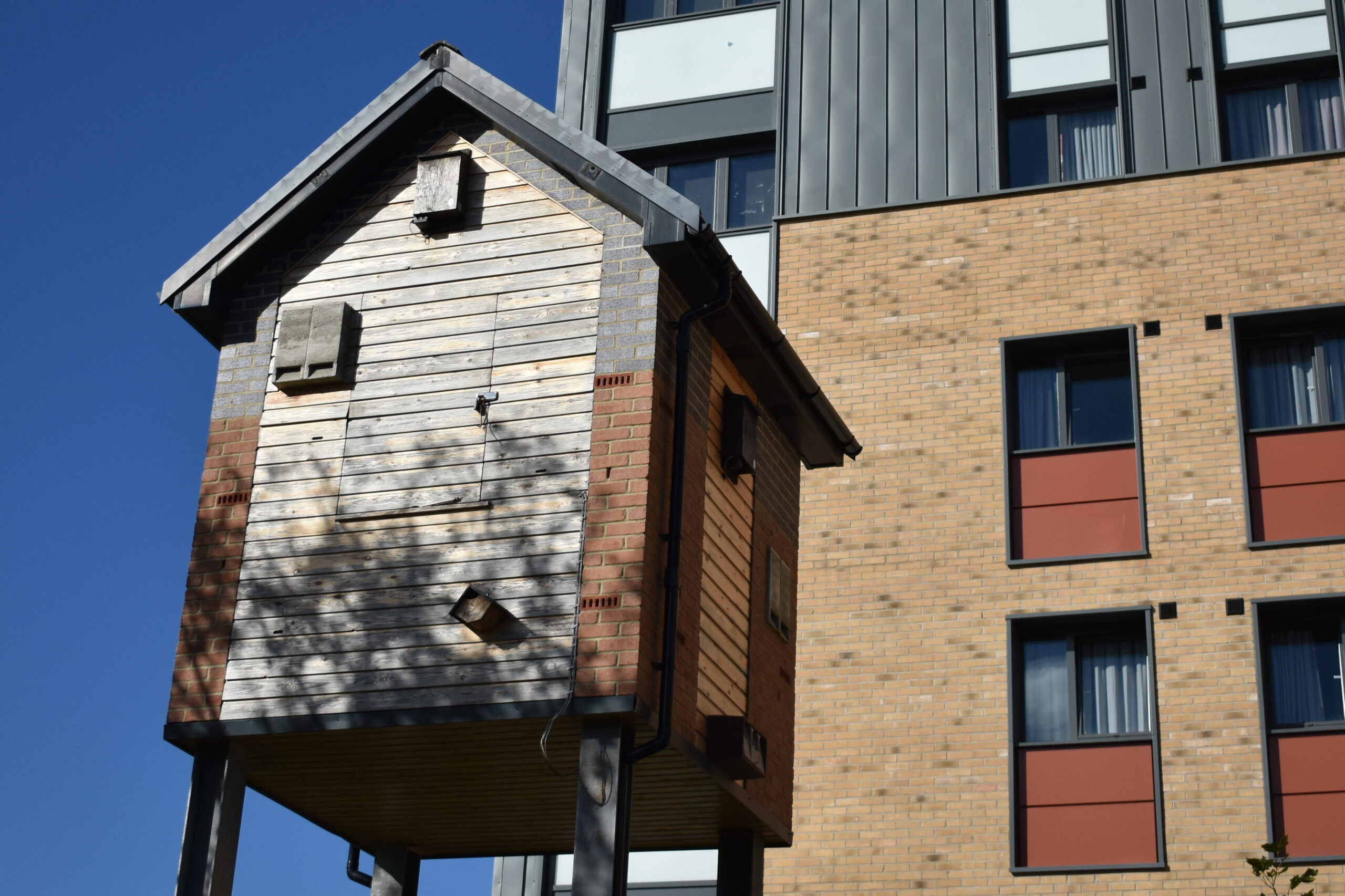
Newcastle University currently has 2 bat barns and 39 bat boxes on campus. These are implemented as bats don’t mind built-up areas, if they have safe spaces for roosting. As our campus is a built-up area and is in the middle of Newcastle city centre, we have installed roosting spaces for local pipistrelle bats.

An image of one of our bat boxes over by Park View Student Village accommodation.

Wildflower planting

The national bee population is declining, and not only do these animals have intrinsic value in nature, but we need them as pollinators for our food.

We have planted up several unused areas of our estate as ‘pollinator gardens’, to provide sources of nectar and pollen as well as suitable nesting habitats. These spaces contain plants and flowers chosen by our own experts as pollinator friendly. We have a range of flowers with differing petal shapes (attracting a range of insects) and a succession of flowering times so insects have a nectar resource throughout the year.

An example of Newcastle University’s wildflower planting

Hedgehogs on campus

Unfortunately, hedgehogs were recently listed as a species ‘vulnerable to extinction’ on the International Union for the Conservation of Nature’s Red List for British Mammals.

Newcastle University is attempting to make life on campus more hedgehog friendly

Hedgehog surveying

In the last week of April, we carried out a hedgehog survey on campus. The surveying was important for understanding more about the biodiversity on and around campus, including finding out if we have hedgehogs on campus. The process included:

  • A group of student volunteers went through survey training in March
  • This group of volunteers deployed the tunnels on campus across our randomised locations.
  • They also checked them every morning for footprints, along with a couple of members of the Sustainability Team

Sadly, we did not find any hedgehog footprints however we did find prints from squirrels, rodents and one cat.

To learn more about how to protect hedgehogs in your local area, have a read of our Hedgehog Friendly Campus post.

Green Careers: Why You Should Choose a Career in Sustainability

Over the past few years, there has been an increased awareness for the state of the planet and the need to take action to avoid further environmental crisis. Sustainability is becoming central to the way we live and, as a consequence, the number of jobs in the industry has rapidly grown. This blog post will address why working in sustainability is a good idea, why the industry is not just for environmental science graduates and how Newcastle University Careers Service can help you break into the industry. 

Why a career in Sustainability? 

Having a career in sustainability can be an incredibly rewarding. It offers the opportunity to make a positive impact and help create solutions towards a better future. If you’re passionate about making a difference and contributing towards a better world, working in sustainability can offer you a sense of purpose and fulfilment which you may not find in other professions.  

Sustainability work is also a growing area with a wide range of career opportunities. From the government to the private sector, there is plenty of work within the industry. These roles can be varied from policy development to marketing to analytics roles, there is something for every skill set. 

It is exciting to be able to make changes to an organisation that will decrease its negative impacts on the world, and increase its positive impacts. In addition to the work that you put in in your organisation for sustainability, other sustainability professionals that you talk to and collaborate with are a really supportive bunch of people – I love that us in the sector all help each other out with our work because we go through the same challenges and there’s no reason not to share solutions and best practice – we all want each other to be the most sustainable we can be. 

KatY, sUSTAINABILITY oFFICER AT nEWCASTLE uNIVERSITY

But I didn’t do an Environmental Science degree? 

No problem! While environmental science is an important part of the industry, it is not the only discipline relevant to the field. Sustainability is highly interdisciplinary and professionals from many different industries can work within the field. For example, someone with a marketing background could be a sustainability communications officer or someone with a law background could work within environmental law.  

Prospects provides a great list of some environmental career profiles but this is not an extensive list and there are more opportunities than listed here. Newcastle University also have a page for sustainability careers and development which has a useful list of professional associations, funding opportunities, upcoming events and job sites to find jobs in sustainability. 

Although I am still at the early stages of my Sustainability Career, I love feeling as if I am making a positive impact each day. I am able to use my unique background in humanities subjects (Combined Honours in Geography and Spanish) to help bring a new perspective to current environmental issues and help create interdisciplinary solution.  It is really satisfying to see the positive difference I can make, and I am excited to continue to develop my skills as I move up in the field!  

How Newcastle Careers Service can help 

Newcastle University Careers Service can be a great place to find support and guidance about entering the Sustainability sector. They offer a range of resources including career information and guidance, CV and LinkedIn checks and preparation for interviews. You can book an appointment with the career’s service on MyCareer and speak to one of the University’s advisors. 

All current Newcastle Students and recent graduates of up to 3 years can make appointments with the service. 

You can also visit the career’s service dedicated environment page for further advice on gaining work experience and finding jobs in the sector. 

A Look Inside the SESC: How Newcastle University Students are Making a Difference

The Student Environment & Sustainability Committee (SESC) is a student-led group which looks to improve sustainability at the University. The group aims to gather feedback and understand student priorities regarding sustainability. The SESC is chaired by the Ethics and Environment Rep and is attended by Environment & Sustainability (E&S) Reps from many academic schools. Any student can sign up to be an E&S rep, just ask about the position at your school at the start of each academic year! 

The History 

The SESC was created in 2020 following student Emilie Coutin’s year as Ethics and Environment Officer. During her time in this role, Emilie set up numerous activities, including regular Ethics and Environment Discussion Groups and a Student-Staff Summit, where students were able to put their ideas to members of Executive Board. When Emilie left the post, she put plans in place to create a Student Environment and Sustainability Committee, to feed into the [Staff] Environment and Sustainability Committee. This became the SESC we have today. 

Watch our video to learn more about Student Action at Newcastle University!

Who is in the SESC? 

Attendance at SESC meetings is notexclusive to E&S reps; any interested students are welcome to attend and contribute. Just get in contact with your school’s E&S Rep, or NUSU’s Ethics and Environment Rep to ask to join a meeting.   Meeting outcomes  are  taken to the University’s Environment and Sustainability Committee (ESC). The [Staff] ESC   is mostly made up of colleagues but is also attended by one or more Students’ Union Sabbatical Officers, the Ethics and Environment Rep & a postgraduate officer. 

We have representatives on the SESC from schools across campus including: Architecture, GPS (Geography, Politics and Sociology), Psychology, Combined Honours, SNES (Natural and Environmental Sciences), Computing, English, Planning and Business. 

Read on to find out what being a SESC rep is like from the reps themselves. 

Why did you choose to become an Environment and Sustainability Rep? 

Being an Environmental and Sustainability Rep provides me with lots of opportunities to get involved in increasing climate issue awareness, campus development and other activities. I also get the great experience of working alongside the people who are striving for the better future and care about making our University environmentally friendly. – Vladislava 

While in year 11/6th form, I decided to become a member of the eco committee when I became more aware of our impact on the environment. After stage 1 at university, I wanted to become more involved in the university in some way, so I volunteered to be on the Student Staff Committee for my degree as a stage rep. There was an open position for the E&S rep, and I thought this would line up well with my role from the past. – Sham 

What does your role involve? 

A lot of teamwork and doing your own research. I usually go through some ‘hot topics’ related to the climate change, sustainability, local development etc. and try to brainstorm some ideas of how to apply it at our University. During the meeting we discuss all possible solutions to current issues and Reps can present their thoughts.  – Vladislava 

Away from the SESC meetings, I have worked with staff in my school towards reducing our impact on the environment as a degree specifically. This is ongoing and I can gather feedback from others on my degree/ in my school on things to bring up at SSC meetings, where I can either take it to SESC meetings to discuss or meet with staff to seek improvements. In the SESC meetings I provide feedback on any ongoing campaigns and play a role in helping organise any future events. I also gather information which is to be brought back to the SSC meetings to be distributed to students around the school/ degree. -Sham 

What would you say to somebody who is thinking about taking up this role next year? 

Our future begins here and now, and you can change it! Be brave, curious and use your potential as much as you can!  – Vladislava 

There doesn’t have to be a lot of work involved to make a difference and if it is something that you are passionate about then it won’t be any work at all. It feels great to be able to make an instant difference to what is happening around you when making changes within your sphere or around the university/ planning events. – Sham 

Rubbish Revelations

Reduce, reuse, and recycle are three strategies that can help us protect the environment. The ‘Three R’s’ were first publicised in the 1970s around the same time the universal logo for recycling was created, but do you know what they really mean?

The ‘Three Rs’ are actually listed in order of importance.

Reduce

Reduce is the most effective of the three because it involves decreasing the amount of waste we generate in the first place. By reducing our consumption of goods and resources, we can minimize the amount of waste that needs to be managed or disposed of, which avoids all the emissions and pollution that are produced form recycling or disposing of the waste. However, we also avoid producing the emissions and pollution associated with the manufacturing and production of the items in the first place.

If you would like to learn more about waste reduction you can read our post about International Day of Zero Waste.

Reuse

Reuse is the next best option because it involves finding new ways to use items that would otherwise be thrown away.  Reusing or preparing items for reuse involves assessing the condition of items, and determining if they can be restored to a usable condition. This may include repairing damaged items, cleaning them, or upgrading them. Once the items have been restored, they can be sold or donated to others for use. At the University, we do this through our IT contractor and furniture reuse partners who take items for refurbishment or reuse. We also have a dedicated mailing list for furniture reuse available to all colleagues – it currently has over 600 members! Small amounts of furniture that need a new home can be listed for another member to claim to reduce the need for purchasing new furniture or equipment, and to prevent it going to waste.

Recycling

Recycling is the last of the ‘Three Rs’ but it’s still incredibly important. Recycling helps conserve natural resources, reduce landfill waste, save energy, reduce greenhouse gas emissions, and create jobs and economic benefits.

Putting the correct things in the recycling bin can be complex, as each country, each council in the UK and even each organisation may have a different list of what you can put in a recycling bin. To make it EVEN MORE complicated, just because an item has the recyclable symbol on it, doesn’t really mean you can recycle it!

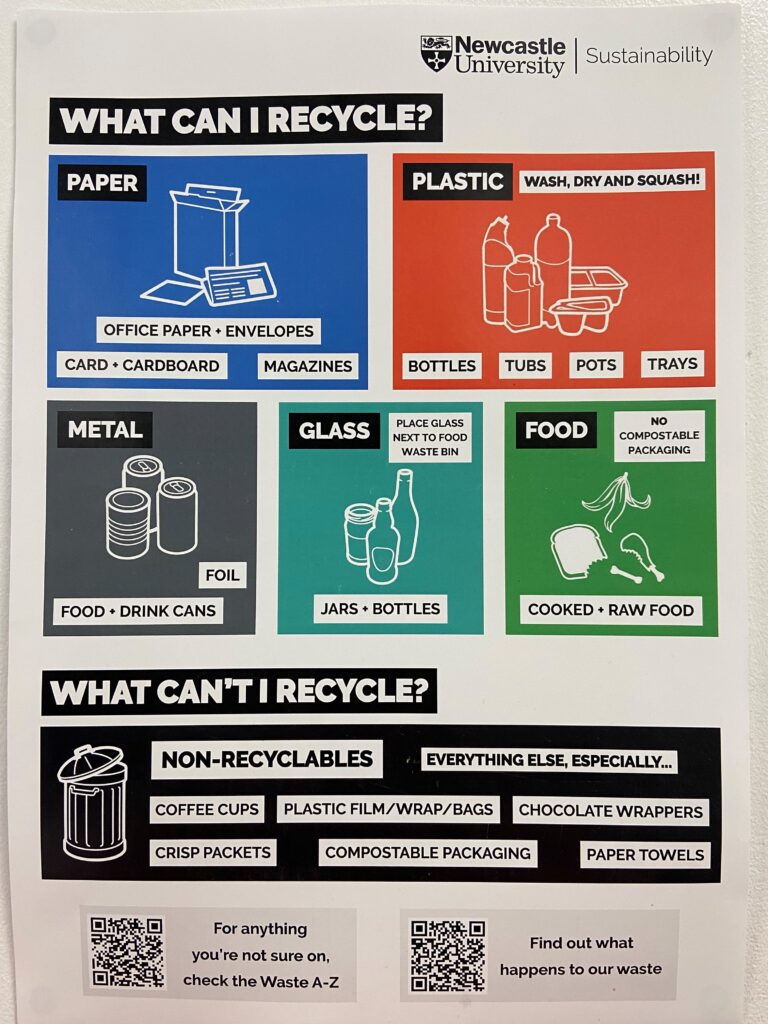
Our new recycling posters provide guidance on what can go in our recycling bins and if in doubt, scan the QR code on the poster to check our Waste A-Z. If you’re STILL in doubt, then pop your waste into the general waste bin as this is better than potentially contaminating the recycling bins.

It is very important that the recyclables placed within the bins are clean and are not contaminated by food or non-recyclables as this could result in all the waste being sent to an incinerator rather than being recycled.

Keep an eye out for our posters around campus.

Where does Newcastle University’s waste go?

Our non-recyclables (the black bins) are taken to Wallsend and then loaded onto a trailer to go to the Energy from Waste plant at Ferry Bridge in West Yorkshire.  The plant burns the waste at high temperatures in a controlled environment to generate energy. The heat produced by the combustion is used to generate steam, which in turn drives turbines to produce electricity. The electricity generated by the plant is then sent to the National Grid to be distributed to homes and businesses. The Plant has advanced pollution control measures in place to minimize emissions and meet strict environmental regulations.

Our recycling waste is taken to a Material Recovery Facility (MRF). At the MRF the recycling materials that have been placed into the recycling bins are sorted and graded into different categories. They are then bailed and passed on to processing plants to be turned into new materials. For example, the PET (primarily plastic bottles) we produce is currently processed at the Biffa Polymers facility in Seaham, where it is turned from baled raw materials back into high-purity plastic pellets that is then sold to drinks makers and other manufacturers for a range of purposes, from food packaging to clothing. This is currently one of the most advanced PET recycling facilities in the world.

Our food waste is taken by a contractor to an anaerobic digestion facility. Here, billions of bacteria ‘feed’ on the food waste and produce a methane rich ‘biogas’ which is then used to generate electricity. 

What are the Sustainable Development Goals and why are they important to Newcastle University?

The Sustainable Development Goals (SDGs) are a group of 17 interlinked targets created by the United Nations which aim to create a better and more sustainable global future. They address  challenges such as poverty, inequality and climate change. The goals recognise that in order to end poverty and other hardships, we must work towards improving health and education, reduce inequality and increase economic growth – all while working to preserve our natural landscape and combat climate change.   

Most of the SDGs have an end target of 2030, however some have no end date. 

The SDGs are: 

  1. No Poverty – End poverty in all its forms everywhere. 
  1. Zero Hunger – End hunger, achieve food security and improved nutrition and promote sustainable agriculture. 
  1. Good Health and Wellbeing – Ensure healthy lives and promote wellbeing for all. 
  1. Quality Education – Ensure inclusive and equitable quality education for all. 
  1. Gender Equality – Achieve gender equality and empower all girls and women. 
  1. Clean Water and Sanitation – Ensure availability and sustainable management of water for all. 
  1. Affordable and Clean Energy – Ensure access to affordable, reliable, sustainable energy for all. 
  1. Decent work and Economic Growth – Promote sustained, inclusive and sustainable economic growth, full and productive employment and decent work for all. 
  1. Industry, Innovation, and Infrastructure – Build resilient infrastructure, promote inclusive and sustainable industrialization and foster innovation. 
  1. Reduced Inequalities – Reduce inequality within and among countries. 
  1. Sustainable Cities and Communities – Make cities and settlements inclusive, safe, resilient and sustainable. 
  1. Responsible Consumption and Production – Ensure sustainable consumption and production patterns. 
  1. Climate Action – Take urgent action to combat climate change and its impacts. 
  1. Life Below Water – Conserve and sustainably use the oceans, seas and marine resources for sustainable development. 
  1. Life on Land – Protect, restore and promote sustainable use of terrestrial ecosystems, sustainably manage forests, combat desertification, and halt and reverse land degradation and halt biodiversity loss. 
  1. Peace, Justice and Strong Institutions – Promote peaceful and inclusive societies for sustainable development, provide access to justice for all and build effective, accountable and inclusive institutions at all levels. 
  1. Partnerships for the Goals – Strengthen the means of implementation and revitalize the Global Partnership for Sustainable Development 

Newcastle University 

Newcastle University is part of the University Global Coalition: a group of universities committed to supporting the UN with the Sustainable Development Goals. Each year, the group celebrates SDG Action and Awareness Week, raising awareness of the SDGs to colleagues and students and inspiring them to get involved. 

UNSDG Action and Awareness week (6-10th March 2023) was a great opportunity to present the work we do to try to embed our core value of Social and Environmental Justice into everything we do. The University is committed to tackling critical environmental issues while helping create a more just and fairer society. Visit Newcastle’s dedicated SDG page to see the work we are doing towards each of these goals. 

Newcastle University was recognised with a Times Higher Education Impact Ranking, which placed us first in the UK and eighth in the world in 2022. 

How can I be involved? 

  • Try to incorporate the SDGs into your research. You will often find that your work has links to multiple goals with little effort! 
  • Contact your school/faculty to see if any ongoing research is happening towards the SDGs.  
  •  Join the Sustainability Network if you are staff or a student. This is a great way to find out about more events relating to the SDGs. 
  • Continue reading our blog posts and implementing the advice within them! Our posts have plenty of useful information about the SDGs and ways you can help make positive change. 

Are you incorporating the SDGs into your research? Let us know in the comments below! 

International Day of Zero Waste

The International Day of Zero Waste aims to promote zero-waste initiatives and approaches that will contribute toward the progression of the 17 Sustainable Development Goals. A move toward a zero-waste society is a necessary process due to overconsumption and excessive production across a large portion of the world. To reduce the amount of waste that is being produced globally, new waste management initiatives are required to influence change at every level across society.

The United Nations Environment Program organised #ZeroWasteDay to raise global awareness to facts that demonstrate the environmental impact of waste.

“Every minute, the equivalent of one garbage truck of plastic is dumped into the ocean”

“Resource extraction is responsible for half of the world’s carbon emissions”

The United Nations Environment Programme

What is ‘zero waste’?

The zero-waste approach refers to a move away from mass consumption and waste disposal towards a reduction in waste with the development of a circular economy. The concept of a circular economy aims to redesign products so they are durable, repairable and recyclable to ensure less materials and resources require extraction and energy to produce new products.

@UNEP / Duncan Moore

How is Newcastle University addressing waste?

Circular Economy

A movement towards a circular economy would go a very long way when attempting to tackle waste pollution. The concept of a circular economy uses the core principles of the Waste Hierarchy such as reducing production and re-using our existing materials, which the University is attempting to embed within our waste management processes. Embedding a circular economy approach will contribute to reducing the scope 3 carbon emissions from treatment of waste in addition to emissions related to purchased goods and services at the University. To learn more about this you can read the Circular economy section in our Climate Action Plan.

A diagram of the waste hierarchy of most to least preferred waste
management actions from our Climate Action Plan.

Introducing labs at the University to the Laboratory Efficiency Assessment Framework

LEAF was made and is managed by University College London (UCL), and is a framework designed to improve the efficiency and sustainability of laboratories. LEAF provides a standard for labs to work on decreasing their carbon emissions and environmental impacts. Newcastle University has been using the Laboratory Efficiency Assessment Framework (LEAF) for the last year, and there are labs making huge strides to improve their sustainability.

The online platform has actions for lab users to complete relating to waste, travel, energy, water and more. Lab users create Lab Groups and work through Bronze, Silver and Gold criteria.

We currently have 20 labs on the LEAF platform, and 14 awards have been given for labs completing the criteria!

If you work in a laboratory at the University, register with LEAF to reduce the carbon impact of your laboratory work.

Furniture Reuse

There is a dedicated mailing list for furniture reuse available to all Newcastle University colleagues, which currently has over 600 members! Small amounts of furniture that needs a new home can be listed for another member to claim to reduce the need for purchasing new furniture or equipment, and to prevent it going to waste.

By sharing equipment and furniture that is no longer required saves money, resources and energy, and contributes towards embedding the circular economy principles into university practice.

If you would like to join the mailing list, just send an email to sustainable-campus@newcastle.ac.uk with the subject ‘Join Furniture Reuse’.

We share ideas and resources related to waste management across multiple channels

This blog

Our blog, Sustainability includes posts that introduce subjects that are related to sustainability and social & environmental justice in an approachable and digestible way.  Our blog is a great resource if you would like to explore topics such as reducing waste in everyday life through small sustainable swaps for your bathroom and kitchen alongside an introduction to the problem of food waste.

Twitter

Over on Twitter, we share our own information and resources amongst outlining our progress in achieving targets. You will also find that we retweet resources shared by other universities, environmental charities and organisations such as the United Nations that introduce new ideas, tips and tricks for individuals and other organisation to use to begin their journey to zero waste.

Sustainability Network

Our Sustainability Network is a newsletter to keep you updated on all things sustainability at Newcastle University. We also share relevant opportunities and events that are happening on campus and in the city that colleagues and students alike can get involved with.

If you would like to join the Sustainability Network, you can sign up here.

What is solar energy?

There are many ways that energy is created across the world, and these are grouped into renewable and non-renewable energy sources. Non-renewable energy refers to natural sources that take thousands of years to form and produce harmful greenhouse gases when they are burned for energy. The most used non-renewable energy sources are coal, oil, and gas, also known as fossil fuels.

When fossil fuels are burned, they produce greenhouse gas emissions which trap in the world’s heat and raise the global temperature. The world is currently experiencing a climate crisis due to increased global temperature. There are numerous negative impacts that are being felt internationally due to the climate crisis, such as increased natural disasters and accelerated loss of species.

Renewable energy refers to various natural sources that replenish themselves rapidly, unlike non-renewable energy sources. Sources of renewable energy include solar, wind, wave, geothermal, tidal, and hydro-electric.

Within this post we will be outlining what solar energy is, how solar energy works, and we will explore solar energy’s presence on Newcastle University’s estate.

What is solar energy?

Solar energy is initially generated by the sun in a constant and renewable process of nuclear fusion. This energy is what lights and warms our planet during the day.

How is solar energy turned into usable power?

Solar energy can be harnessed using multiple methods, the most common method uses photovoltaic systems. Photovoltaics are used in solar cells and panels which form what is known as arrays when they are placed together in groups. Photovoltaics use semiconductors such as silicone to absorb sunlight and generate electricity in the form of a direct current. When the energy has been generated, it is then converted into an alternating current so that it can power objects within a building, which is completed by an inverter.

Why is Newcastle University investing in solar energy?

Newcastle University has invested in solar energy for a plethora of reasons. The installation of solar panels on our current infrastructure such as roof tops is relatively simple, whereas the installation of small-scale wind energy infrastructure is difficult on our campus due to the vast amount of space required. Solar energy is also scalable, the number of panels required depends on the amount of energy required by the University, as this ensures that we can generate this energy on campus instead of buying it. Solar energy is also incredibly efficient and has a medium cost level to high efficiency and production ratio, meaning it is a desirable form of energy to produce for Newcastle University’s needs.

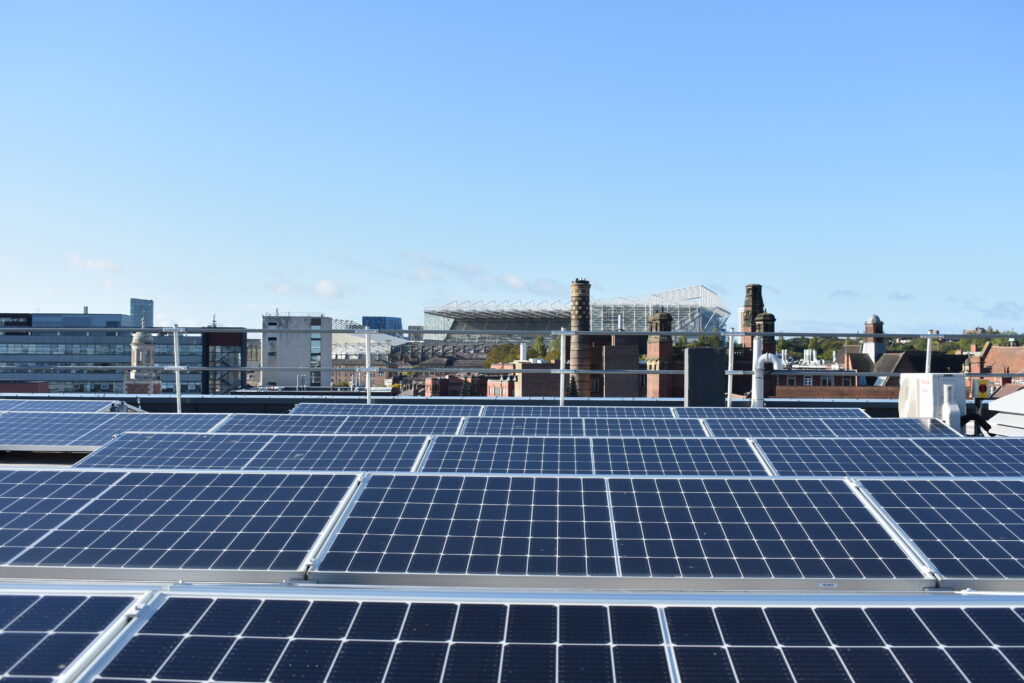
Close up of a solar panel

Current use of solar energy on Newcastle University’s estate

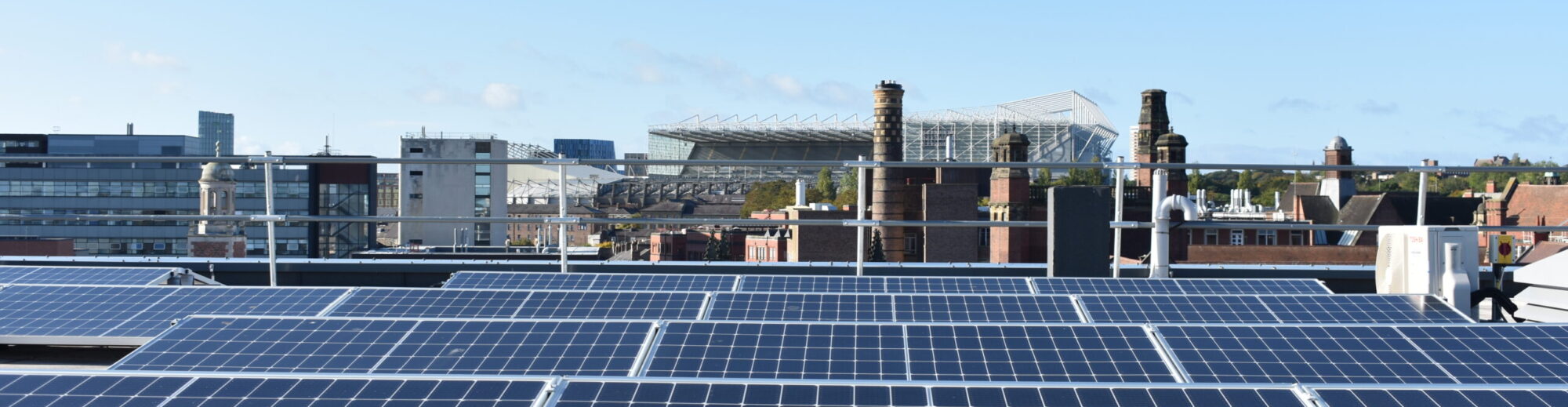
Newcastle University currently has 13 solar arrays in a variety of sizes. The energy created by these solar arrays contributes towards the energy usage of the University. Some of the arrays on campus are made up of a few panels on smaller buildings, but we also have a number of larger arrays on buildings like King’s Gate, Henry Daysh, and the Frederick Douglass Centre.

We use a software called Solar Edge to monitor the amount of electricity being created across the arrays. The system also recognises if one of the panels becomes damaged and informs us.

Thank you for reading this post, if you have any questions please email us at sustainable-campus@newcastle.ac.uk