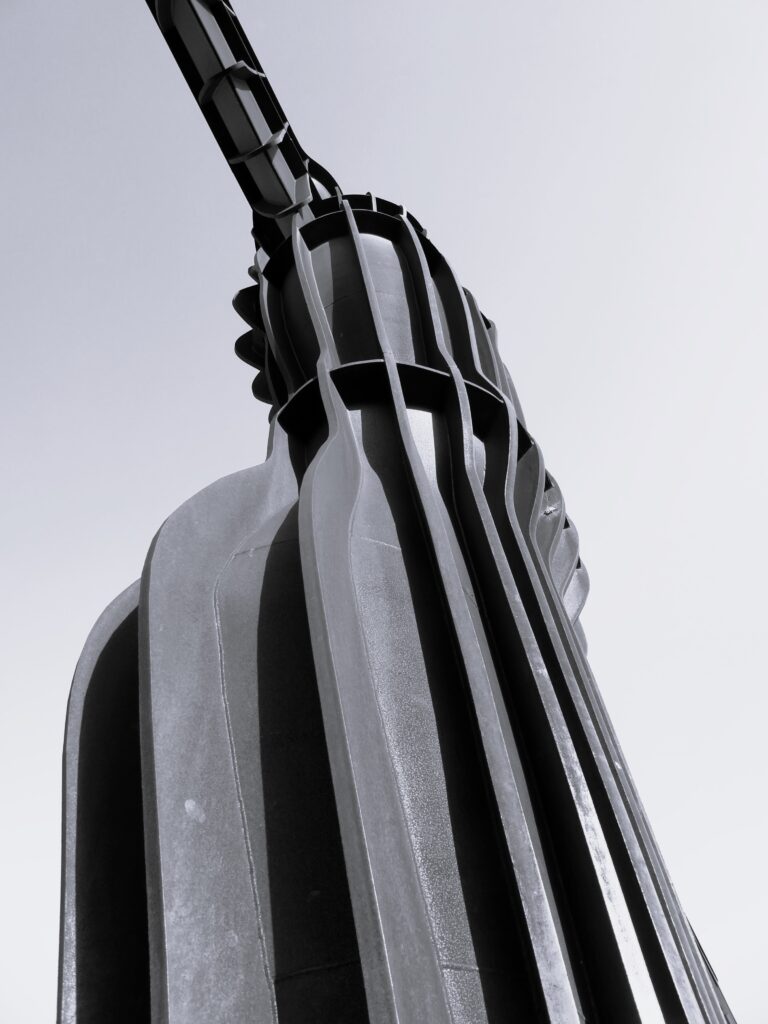
Yesterday I received an email from Liz Shaw, who had heard the Radio 4 broadcast about our project on the Today programme. Elizabeth is a member of the Watford Writers’ Group and had been set the task to write a piece that was inspired by an artwork. Based on my interview, Liz wrote a beautiful piece which constitutes its own eloquent and moving response to The Angel.
Liz has kindly given me permission to include her writing on the blog, and you can read it below. I hope you enjoy it as much as I did.
Angel of the North
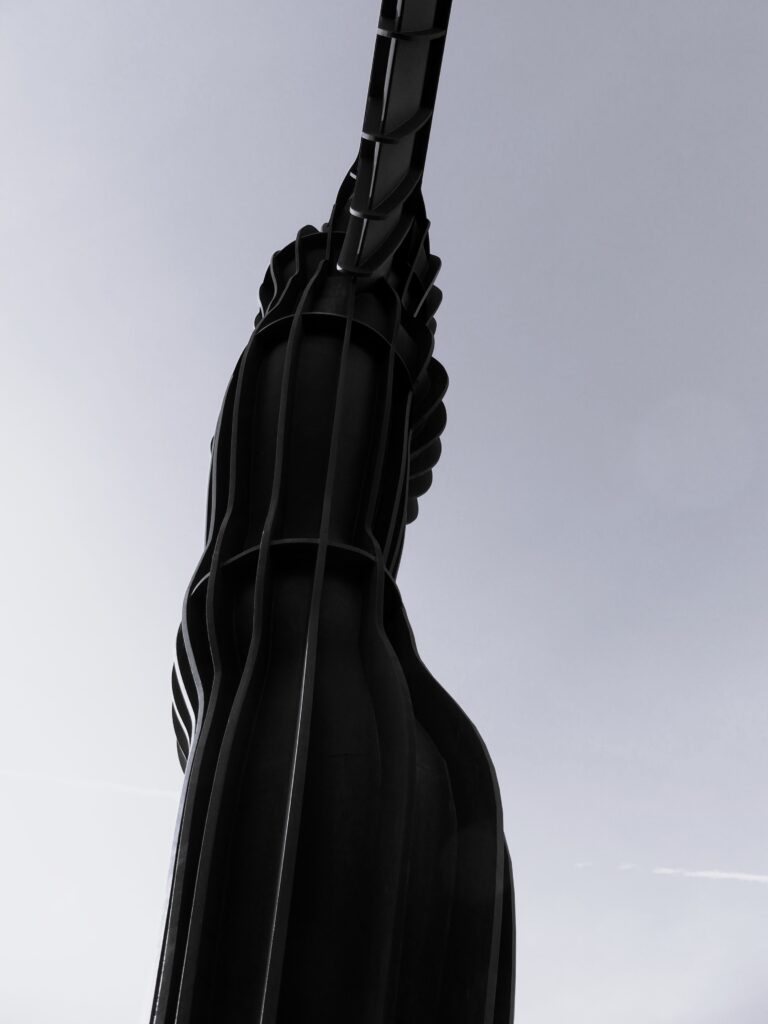
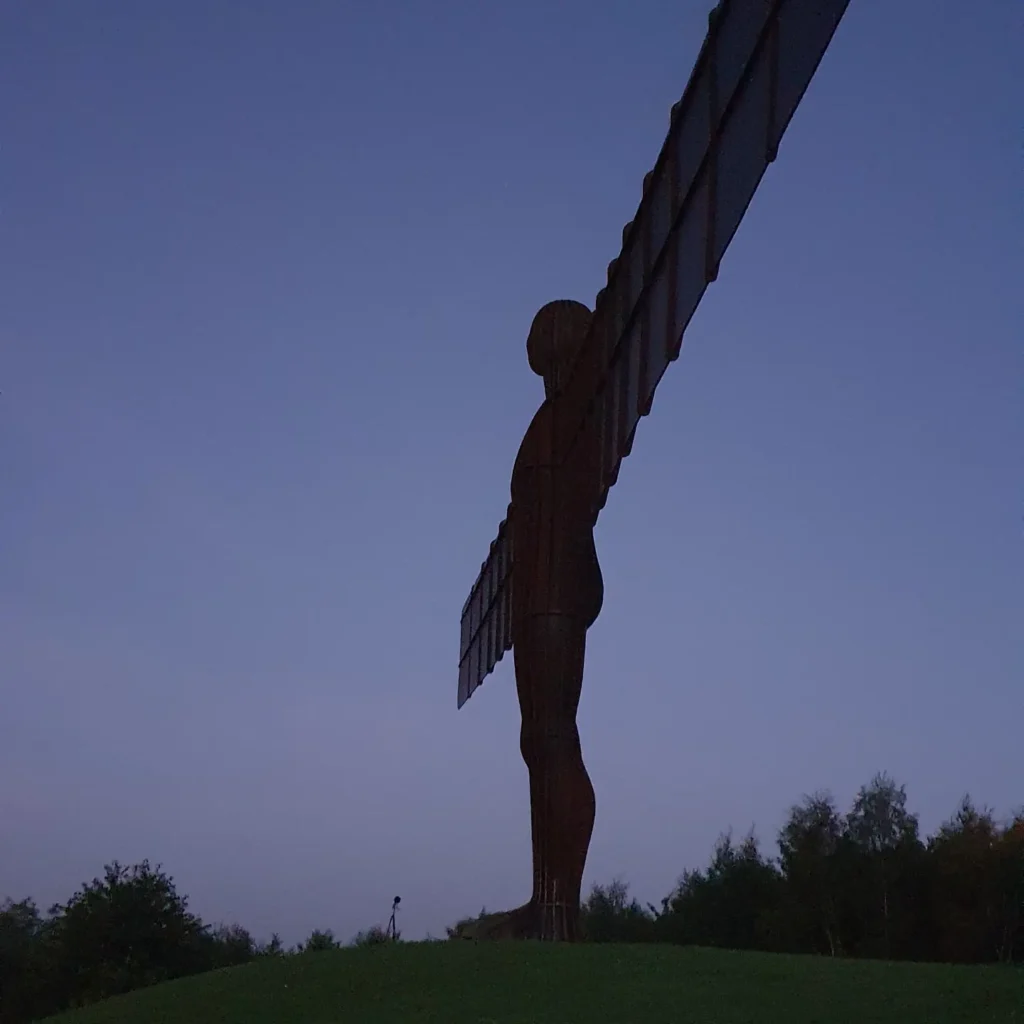
My arms are not raised up high in anger or in defiance. They do not bend and curve to cherish and protect. Nor do they hang in despair or in defeat. They stretch out wide, wider than I am tall, parallel to the earth. My arms are winged and spread to catch the wind. I am genderless and ageless. My face is emotionless and featureless. I was created blind to your existence, deaf to your voices. I watch unheeding as your traffic and trains stream below me.
Born in a blast furnace, forged in steel, I am municipal, magnificent, agnostic, secular, classless.
And yet. And yet. You leave your hopes, fears and prayers at my feet. Slips of paper sealed and curled within my iron ribs. Nearby trees hang heavy with your memorials, charms, ribbons and fairy lights. I have become a road-side shrine, an altar, a minaret, a bridge of sighs, a wailing wall.
You conceived me, you built me, you know this. So why do you believe that I have power over your fate? Do you hope to see me spark to life and stride the fields like a modern-day Prometheus, take flight to intercede with the Gods on your behalf?
My feet are planted in a landscape once blighted by industry. I feel the souls of the colliers who mined the seams beneath me. I feel their heaving lungs and their black coal-ingrained scars. Your messages seep into me with their raw emotions of hope, grief, love and hate.
And now the sounds of my structure will be added to your voices. Your memories and stories will be forever entwined with the rush of the wind as it wails around me. The eerie groans of my metal body expanding and contracting with the summer heat and the winter ice will be added to birdsong and the sound of children playing at my feet. The gentle rustle of the leaves will blend with the tinkle of your votive offerings. A soundscape will be created of what I have come to mean to you.
Are you hoping to wear away at my cold rusting heart? If your wishes came true, if you were wealthy, loved, cured, avenged, then what? The deep scars of your life will fade in time as will your life itself. I cannot bring them back, the people who you mourn and grieve. They will not return from death.
Better to stand tall and strong with arms wide open to accept your future, to feel your feet firmly planted in history, to gaze ahead to the distant twinkling northern city lights.
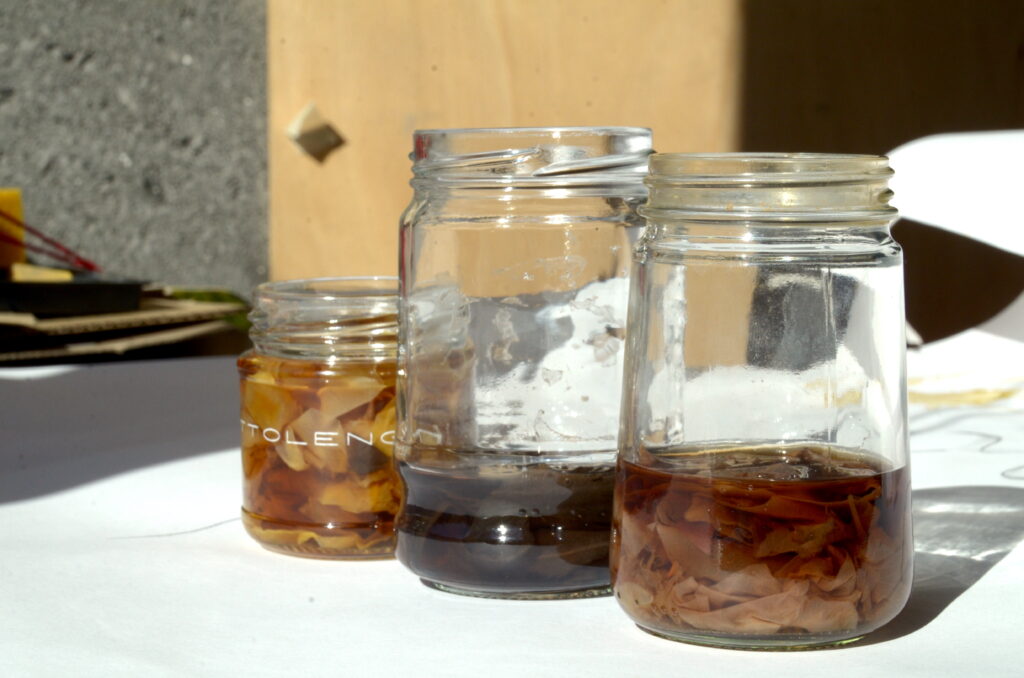
Making inks was at the core of the film that we co-created with parents who had experienced the loss of one twin from a multiple pregnancy. Workshop sessions were structured around the three stages of the ink-making process, as outlined by Jason Logan in Make Ink: (1) find ink (gathering the materials); (2) make ink (creating and bottling the inks); and (3) test ink (drawing and writing with the inks). The natural materials collected either on the walks or in other meaningful places – bilberries, buttercups, rose petals, an empty crab shell – were distilled into inks, which were in turn transformed into drawings and film animations. The memories of the lost babies permeated these activities, and ink making became its own ritual of commemoration.
The parents spoke often during the making of the film about the bottling up or repression of a grief that could not easily be articulated, because it is not well understood. Outside the family, the loss often went unspoken and even within the family it was hard to share, particularly across the generations. The inks gave a new and different resonance to what it meant to bottle up feelings associated with the loss. One parent observed: ‘having those gorgeous little bottles – bottled up feelings and emotions and places – it’s a really nice thing to have at the end of the project. The bottles are sitting on the shelf so we know that any time we want to we can go back and use those again and we know that if we see other things that we like we can make more inks. Even for anniversaries or things like that we know we can do that.’ The ‘bottling up’ of the feelings and places associated with the walks as inks created new memories, and grief was experienced not as internal, but as an object on the shelf that could be picked up and put down, used and remade.
The parents talked about the beneficial process of gathering materials on the walks, which gave dedicated time as a family to remember, and provided them with an activity on which to focus: ‘I think as an actual process, it’s a wonderful therapy tool – I’m not sure if that’s the right phrase – just to be able to spend some time somewhere that you like thinking about the loss and then having something practical to do. We are going somewhere that we enjoy being and we want to collect these materials and we are going to turn them into something completely different. It might have started out as buttercups or crab shells, but it ends up being this beautiful film.’ The transformation of the materials into something different – and something beautiful – is key to the project’s meaning for the parents.
Kate made inks in her studio from the materials gathered on the walks, and she also gave kits and instructions to the parents so that they could make their own inks, either between sessions or once the sessions had ended. One parent commented of this aspect of the project: ‘It was easy to make the inks and we did our own from the instructions and equipment that Kate gave us. I think this was something that could be given to all sorts of families and not just families that have lost a child but anybody who has lost anyone.’ While the families appreciated the creativity of what could be done with the inks – the drawing and writing that they enabled – the ink making itself seemed to be particularly helpful for navigating grief as a family, and the bottled ink was treasured in and of itself.
Babs Behan, founder of Botanical Inks, has written of ink making from natural materials:
There is something simple and beautiful about walking out onto the land and picking up fallen leaves, harvesting flowers and berries, and digging up muddy roots and then soaking them in water to extract their colour. I have seen people falling in love over and over again with these old-new ways of creating something – they love the fact that bringing more beauty into the world needn’t be harmful to the environment or to their own personal health. (p. 10)
In the context of our project, making inks transformed the bottling up of feelings about a difficult form of grief into a positive meaning and activity, and provided beautiful objects that the parents could keep once the project had finished. Like Behan, we also watched the parents fall in love with the techniques and processes of ink making that Kate introduced to them in the workshop sessions.
Sarah Gensburger’s Memory On My Doorstep (2019) chronicles the spontaneous memorial that commemorated those who lost their lives either in the terrorist attack on the offices of French satirical newspaper Charlie Hebdo, in January 2015, or in the shooting at the Bataclan Café, 50 Boulevard Voltaire, in November 2015. Both incidents took place in the same neighbourhood of Paris, which is where Gensburger lives. She documented the memorial and its visitors over the course of a year, from 2015 to 2016, drawing on her position as a resident to consider the ordinary dynamics that characterise living beside events such as the shootings on an everyday level. The places which families, including her own, inhabited daily became ‘the stage for memorialization, for tributes and homages to the victims’ (p. 17), and Gensburger decides ‘to pay attention to the social relationships people build with their environment, and to the role that environment plays in memory dynamics’ (p. 17).
The spontaneous memorial with which Gensburger is concerned is different from the memorial at The Angel, in that it has emerged at the site of one terrorist event and in proximity to another. There are nevertheless correspondences between my own project and Gensburger’s. We are both interested in chronicling a public space of remembrance, as a means of enabling ‘the expression of multiple narratives’ (19). Both projects record a local memorial, which is regularly observed and that forms a backdrop to our daily lives and activities. We are also both concerned with how spontaneous memorial activity adds new meanings to the environment in which it takes place – in the case of The Angel, I am interested in the ways in which the objects and tokens left at the site re-create Gormley’s sculpture as a place of collective remembrance.
Gensburger’s perspective as a resident who passes the memorial daily means that she has a heightened awareness of the objects that are placed there. The objects are subject to theft as well as to the elements, so that many ‘ultimately become invisible for history’ (p. 180). Gensburger distinguishes between those visitors who leave laminated messages, and thereby ‘plan for posterity’, and those who leave more fragile tokens (p. 180). In my last post, I thought about the ribbons and fabric items that are placed in the trees at The Angel, and the ways in which synthetic materials do not disintegrate like traditional cloth. Other objects at The Angel demonstrate the same divide that Gensburger points out, some of which are protected while others are exposed to the elements. Gensburger notes that, as she observes the memorial, it develops ‘a kind of autonomous existence’, so that new messages respond to those that are already there (p. 98). At The Angel, too, objects and messages respond both to The Angel and to each other, so that they form a kind of loose collective, as well as representing individual memories and tributes.
I am particularly struck by a passage in Gensburger’s book in which she discusses a key challenge of observing a memorial closely over time. On November 25, 2015, Gensburger took a photograph of a bright pink child’s wand taped to a pole, together with a branch which she took to be an olive. She interpreted the object as ‘one of optimism’, and the branch as a symbol of peace (p. 42). Returning to the photograph on January 4, 2016, Gensburger is no longer sure what she is looking at. She reflects:
Today, with hindsight, I cannot ignore the possibility that this magic wand was simply lost by a child in the street and stuck to the pole by a well-meaning passerby. Just like the lost gloves or scarves we often see draped over the railings of the park in winter, in the hope their former owners retrace their steps to find them. (p. 43)
To what extent, Gensburger asks, is she seeing all objects in the neighbourhood as memorials, when they might have other significances? ‘When this photograph was taken’, she writes, ‘I was so accustomed to encountering homages and tributes in the neighbourhood, that this encouraged me to interpret every unexpected object through this analytic frame’ (p. 43)
On recent visits to The Angel, I have experienced the same doubt as to whether some of the objects I see are deliberately placed as memorials, or if they do not hold such commemorative significance. A pile of stones recently appeared near the entrance to the group of trees at The Angel; these were still in place on my visit today, although I felt less confident than I first was about whether they are tokens of remembrance. Other stones have been placed under trees, or are painted or inscribed, but these rocks are unmarked and are ambiguously positioned on the perimeter of the site. Am I, too, seeing everything at The Angel through a single lens because I am so accustomed to encountering memorial objects in, or near, the group of trees?
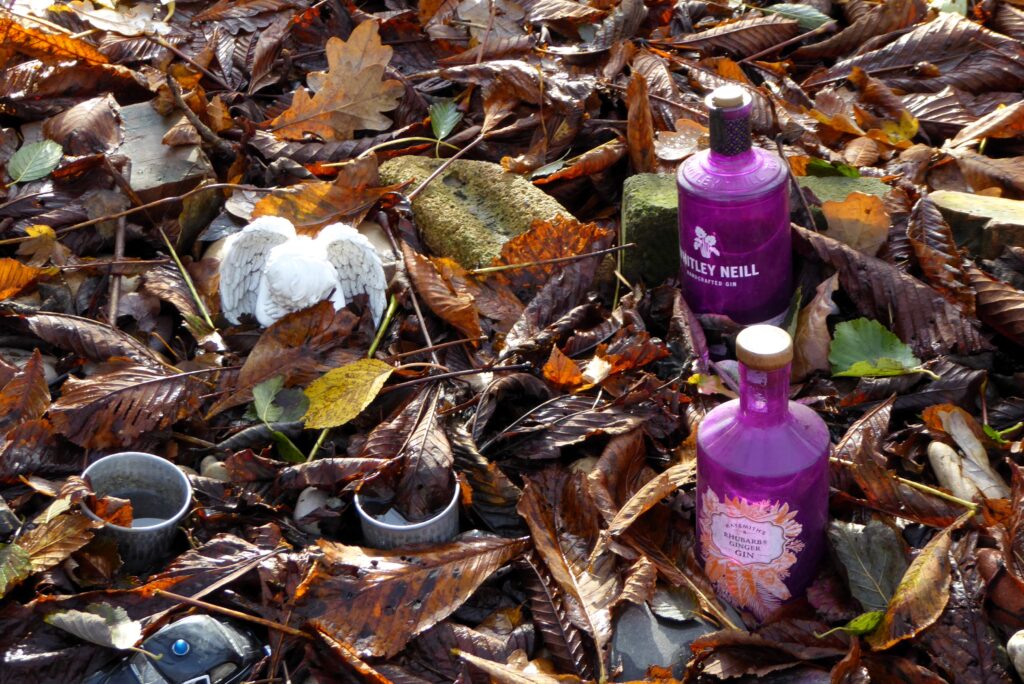
At the other side of the copse, where a fence separates the trees from the nearby A1, two bottles have been placed as objects of remembrance. The decorative nature of the bottles and their location beside other memorial tokens make their significance clear. Less evident, though, is the meaning of a nearby empty bottle of Newcastle Brown Ale, which today lies in the leaves on the far side of the fence, having blown down from the fence rail where it stood when I last visited. The bottle has been here for some time, always in the same area but occupying different positions; I cannot ignore the possibility that, even though it has appeared in the memorial site, it may not hold the same significance as the twinned bottles nearby. Several objects that have been placed near the fence have local reference points, so I had originally thought that the bottle of Newcastle Brown might have been left alongside them as part of a commemorative ensemble, but I am increasingly doubtful of my own interpretation.
I might never know whether the bottle of Newcastle Brown, or the pile of stones, represent memorial tributes or have different stories to tell. Both objects are located on the edge of the trees, where it is difficult to read their significance. In the absence of other information, all I – like Gensburger – can do is ‘consider the limits of my initial interpretation’ (p. 43). The meaning of objects and traces left at The Angel is not self-evident; if we are not able to recover their stories from the people who left them, their significance lies largely in the way they are perceived and interpreted.
References:
Sarah Gensburger, Memory On My Doorstep: Chronicles of the Bataclan Neighbourhood, Paris: 2016-2016, Leuven: Leuven University Press, 2019.
Following the article in The Guardian about the memorial objects at The Angel of the North, a number of people kindly emailed me about clootie or rag trees, wondering whether there might be a connection with the memorial activity at The Angel. Clootie means cloth in Scots and the trees, usually hawthorn or ash, are located close to sacred wells or springs. A rag or cloth would be dipped into the holy water and tied to the tree in order to cure a sickness or ailment. The cloth would often be from a garment associated with the body part affected by the illness, and it was believed that the sickness would fade even as the material disintegrated over time. Holy wells were visited by people from across the area on special days, such as Beltane, the May Day festival marking the beginning of summer.
The Dictionary of English Folklore records that rag trees had become rare by the nineteenth century, although a few remained in Yorkshire, Lancashire, and Cornwall. In 2003, it records three active wells in England: two in Yorkshire (St. Helen’s Well at Walton and St. Helen’s Well at Eshton) as well as an unnamed well at Madron in Cornwall. As the name clootie suggests, a number of trees in Scotland are also associated with this ritual: the best known and still much visited are the Munlochy Clootie Well on the Black Isle peninsula, and St. Mary’s Well in the woods near the battlefield of Culloden. Scotland passed an Act of Parliament in 1581 banishing pilgrimages to holy wells and those which lasted became associated with Christian saints: the well at Munlochy is dedicated to Saint Boniface Curitan. The ritual of the clootie tree nevertheless remained popular in Scotland, and Alexander Crow has observed:
The Clootie Well is mentioned by several historical writers and collectors of folklore and tradition. Writing in his 1869 Book of Days, Robert Chambers mentioned a well to the east of the current Munlochy site, called Craigach Well, in Avoch. He describes the scene on the first Sunday of May as ‘like a fair’, with English, Scots and Gaelic all spoken as the pilgrims made their offerings, also noting that each person drank from the well. Thomas Pennant made two famous journeys around Scotland and in 1769 recorded that he saw many such places ‘tapestried with rags’.
Poignantly, Crow records that the well in Culloden Woods was decorated with coloured ribbons and rags when the 51st Highland Division was lost during the Dunkirk evacuations in 1940. He observes that this revival demonstrates ‘how an ancient practice still had meaning in recent times’. This example also suggests that the traditional association with hanging ribbons on the clootie tree has merged more recently with the memorialisation of the dead.
There are many holy wells scattered across Northern Ireland and the Republic of Ireland: 187 are recorded by the Northern Ireland Sites and Monuments Record, while 2,996 have been officially recorded in the Republic of Ireland. Many more have not been documented because they are small, unnamed springs of local significance, and in 2021 a research project at Queens University Belfast, Hidden Heritage of Holy Wells, set out to map these sites county by county. Examples of rag trees in Ireland include St. Brigid’s Well in Kildare, the Well of St. Lasair in Roscommon, the Holy Well at Tobernalt, and St. Feichin’s Well in Westmeath.
Photo credit: Anne Whitehead
The clootie tree at Munlochy has recently brought into focus some of the sensitivities around these sites. Traditionally, the cloths tied to the trees were scraps of cotton or woven wool that would disintegrate over time. With man-made and synthetic fibres now more commonly used in clothing, some of the cloths that are left do not deteriorate, meaning that the sites can become crowded. Forestry and Land Scotland, who manage the Munlochy well, have teamed up with local community groups to clean up the site periodically, leaving in place those items which are biodegradable and environmentally friendly, and removing only plastics, polyesters and other items that won’t disintegrate. A major clean-up in 2019 responded to the concerns of locals about the deteriorating condition of the area. In 2022, there was community concern when a visitor decided to clean the site without permission from Forestry and Land Scotland, following a build-up of offerings during the Covid-19 pandemic and tree damage by Storm Arwen.
There are undoubtedly correspondences between the clootie or rag trees and the memorial at The Angel, most obviously the tying of ribbons and pieces of cloth around the branches of trees, or hanging items of clothing from the branches. Some of the emails I received speculated about whether The Angel served a similar function to the holy wells, prompting a feeling that the nearby copse of trees was a place of spiritual significance or power. Unlike at the holy wells, however, the ribbons and cloths tied to the trees seem to be items of remembrance rather than placed there in the hope of healing. This prompts the question of whether the rag tree tradition is adapting and merging with grassroots memorialisation, as the example of the tree in Culloden Woods would suggest. It also raises the question of whether cloth tied to a tree as a memorial would be more likely to be made of fibres that will last, so that the memory is preserved. Or would the disintegration of the cloth over time be experienced as the lost person gradually merging into the surrounding landscape? To what extent, too, does the healing function of the rag tree carry over to the memorial at The Angel, so that tying a cloth or ribbon to the branches not only commemorates a person who has died but also represents a healing ritual for those who have been left behind?
Photo credit: Anne Whitehead
The mapping of the holy wells in Ireland and Northern Ireland raises a further question about the delicate balance to be observed between recording and preserving a site and interfering with it. The same sensitivities about removing objects are felt at The Angel and the holy wells, and when I visit the memorial I am careful to disturb the site as little as possible. Like the memorial at The Angel, the holy wells are important to local communities, and the offerings are private and personal to those who leave them. At the same time, it is precisely this grassroots and localised memorial activity that is often overlooked and undocumented; it represents what Professor Keith Lilley from the Hidden Heritage of Holy Wells research team has called ‘small heritage’. By recording the site through sound, our hope is that this project can document the memorial at The Angel of the North, and capture what it means to those who leave objects and tokens there, whilst also respecting the site and the sensitivity of what is being remembered.
It’s been a busy week as we have focused on trying to reach as many people as we can who have left objects, messages or tokens at the memorial site near The Angel.
David and I went to out to The Angel on a blustery day to meet the university photographer for a press release. You can read the piece here.
I spoke to local journalist Tony Henderson, who could help us reach out to people who live nearby, and who either visit the memorial or might know more about its origins and history. This interview was covered by the Newcastle Journal as well as by The Chronicle. I also had the pleasure of being in conversation at the Angel with Gilly Hope for Radio Newcastle, and Gilly hopes to follow the progress of the project as we develop the sound piece.
We were delighted that there was interest in this story beyond the region, that might help us reach a wider audience. I spoke about the project in the last few minutes of Radio 4’s Today programme as well as on Radio 5 Live. The Guardian covered the story today.
We’d love you to get in touch if you have left memorial objects, messages or tokens at The Angel of the North, at any time. We’d like to record a short conversation with you, the content of which would be defined by you, and we are particularly interested to know what The Angel means to you and the significance to you of what you have placed at the site. All contributions can be anonymous.
We are seeking to create a record of the memorial through a sound work, which will combine extracts from recorded conversations with the sounds of the site, including the resonance of The Angel itself. The piece will be played as part of the Sound Project in the Arches of Newcastle University, and Antony Gormley’s sculpture ‘Clasp’ – which represents two people embracing – is nearby, so anyone listening to the work will be able to see it. Everyone who is recorded for the project will be invited to a launch event in July 2024.
We’d also love to hear from anyone who knows more about the origin and history of the memorial site, so that we can understand it more fully.
In a recent visit to Middlesbrough’s Institute of Modern Art, I encountered sound artist Nell Catchpole’s ‘Teesmouth’, a video installation included in the exhibition People Powered: Stories of the River Tees. The original sound piece was commissioned by BBC Radio 3, and it responds to the ecological crisis currently affecting the marine waters around Teesside. The mass die-off of species, including crab and lobster, has been attributed to various causes, including the effects of an algae and the deep dredging of the river Tees.
The landscape that Catchpole explores is the Tees estuary, a place of shifting tides and mudflats that is an important feeding ground for wading birds as well as for the resident colony of harbour seals. The constant ebb and flow of the sea, as well as the site’s proximity to the heavy shipping of an industrial port, makes Teesmouth, in Catchpole’s description, a place of ‘constant change and flux and exchange’.
Catchpole’s work begins with the sound of the tide washing on the shore, and her reflections on what it means to listen. Listening ‘intimately’, she observes, gives her a sense of ‘connection and solidarity’ with the place. Structured as a walk, the piece brings Catchpole’s own soundmaking and reflections into conversation with others she meets on the way, interlocutors who have a long intimacy with this landscape, and who have witnessed recent changes there. Field recording is described as a way of listening differently, of ‘breaking the habits of filtered listening’ that attend our everyday lives, and of being more ‘expansive’. For Catchpole, this brings into focus a sense of ‘entanglement’ with our surroundings, a feeling of ‘being with’. To enhance this sense of intimacy with the estuary that she documents, Catchpole engages in a playful practice of making sounds with what she finds there – sticks, stones, shells, sand, and grasses. This fosters a process of imaginative engagement, that helps to disrupt her habitual patterns of listening.
Like David, Catchpole uses hydrophones – underwater microphones – to capture the hidden sounds of the tiny creatures that live beneath the mud, revealing the mudflats themselves to be vibrant and noisy environments. These ‘quiet species’ are important to listen to, because they form a vital presence in this landscape, their sounds the noise of creatures that work to repair the damage that has been caused by the toxic waste from former industries. David uses the same microphones in his work to record the species that live in ponds and harbours, and the noisier the recording, the healthier the water is. For our project, contact microphones will capture the resonances of The Angel, and the same principle is at work. In the words of Catchpole, ‘It is important to listen to the quiet, often ignored, hidden sounds of a place.’
The sound of the water is replaced by noises made by Catchpole with sticks, sand and shells, and, like her, we attune ourselves to listening differently. We also hear the noises of the tiny creatures working slowly and minutely in the mud, which counterpoint the human voices that speak of more visible change. Conversations with local residents open up different perspectives on the estuary. A fisherman reports on the death of crabs since the previous September. A walker mimics the singing of the seals which can be heard there on a calm day, but not on that day because it was too windy. A birdwatcher lists the migrants that can be seen out on the mudflats – wheatears, waxwings – and speaks of seeing the thousands of dead crabs that had washed ashore at Teesmouth, reminding us of the intimate entanglement of species. A chorus of human voices are recorded from a protest march, chanting the refrain, ‘Save Our Seas’. The piece closes by returning to the natural sounds of the estuary: the call of a wading bird flying overhead, the wind in the grasses.
Catchpole’s practice of sound making with the materials that are at hand reminds me of David knocking on the panels of The Angel on our first visit. David is also keen to record The Angel in heavy rain, testing with his microphones how the sound of the rainfall would resonate through the sculpture. I am intrigued to find out how these possibilities for producing sound at the site change our imaginative engagement with it. Catchpole’s mingling of human voices with sounds from her field recordings chimes with our hope to combine recordings from our conversations about the memorial with field recordings from, and of, The Angel.
The podcast series Conversations about Arts, Humanities and Health, hosted by Dieter DeClercq and Ian Sabroe, is well loved by many who work in the medical and health humanities. The series, supported by the Winston Churchill Memorial Trust, develops meaningful dialogue and connection between the humanities and medicine. The conversations take place online, and scholars, health professionals and the public discuss how the arts and humanities can inform healthcare. The recording of the conversation is then published as a podcast, together with a reflective summary by Dieter and Ian.
Having enjoyed listening to many episodes, I was honoured to be invited as a guest on the third season of the podcast. I had already had the pleasure of working with Ian, who was a contributor to the Edinburgh Companion to the Critical Medical Humanities, and the care and thoughtfulness with which the conversation was conducted therefore came as no surprise. I met Ian, Dieter, and Jennifer Pien for a preliminary online chat about what areas Jenn and I would like to cover in the conversation, and about topics of common interest, and we agreed a loose series of questions, which would still allow space for the conversation to take its own direction on the day.
It was a pleasure to talk with Jenn about her work with medical professionals as well as her own creative practice. Our conversation focused on the role of writing and personal stories in the medical and health humanities. We explored the relation between the personal and the critical, and we thought about how bringing the personal perspective into academic work does not mean losing a critical voice. More broadly, we thought about the value of lived experience, the meaning of creativity, and the varied craft of writing.
Thank you to Dieter, Ian and Jenn for such a generous, and generative, conversation.
You can listen to the podcast, which is episode 23 of Ian and Dieter’s series, here.
My second visit to The Angel with David took place on a very windy day. As I arrived, David emerged from the memorial in the trees, having made a short recording of the wind in the leaves. I entered the trees and took a few minutes to listen to the dry rustle as their branches waved above me, a sound that I strongly associate with this place. String had been threaded between two alder trees and packages filled with inscribed hearts were pegged to it, which spun and twisted in the air as the wind caught them.
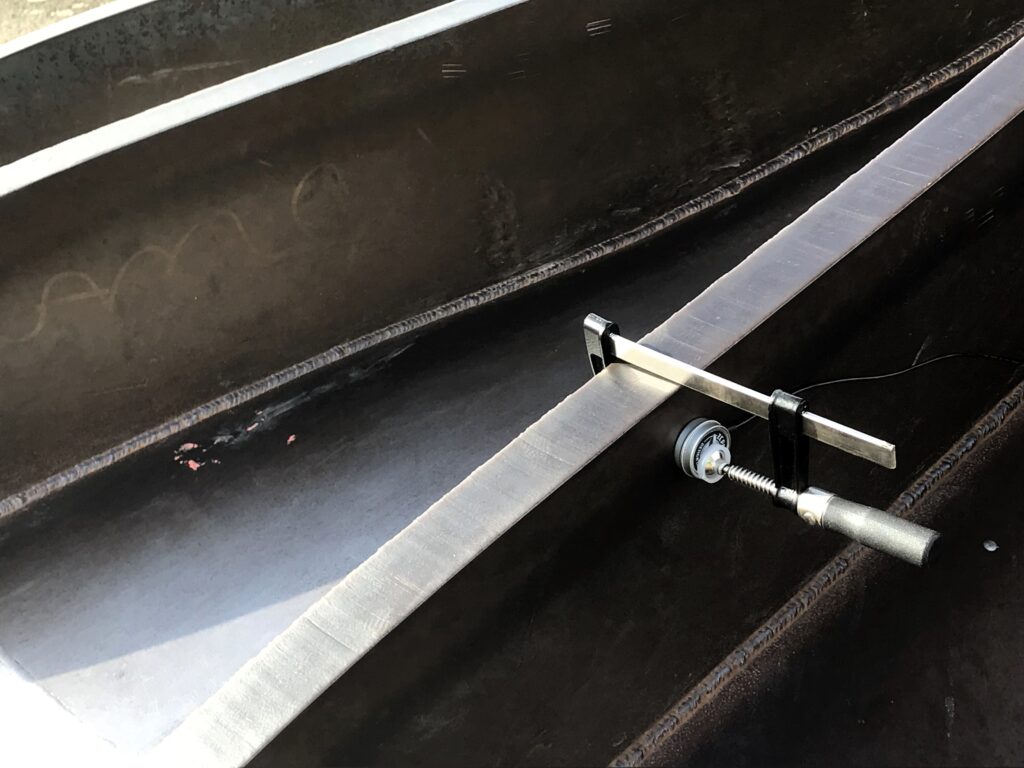
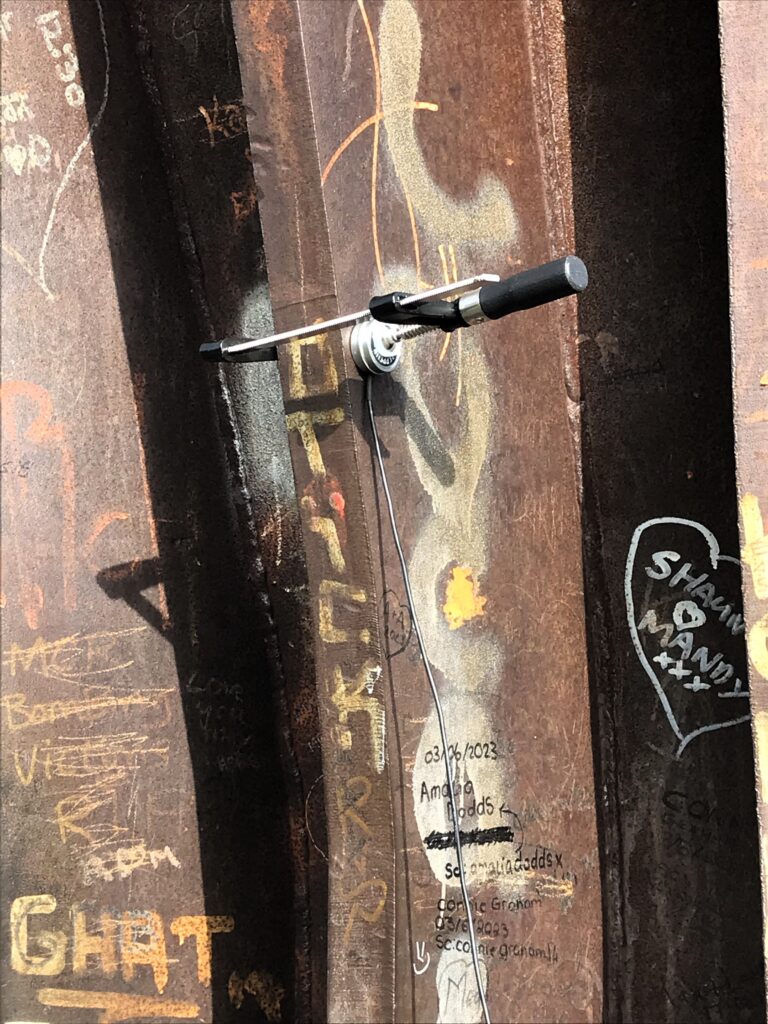
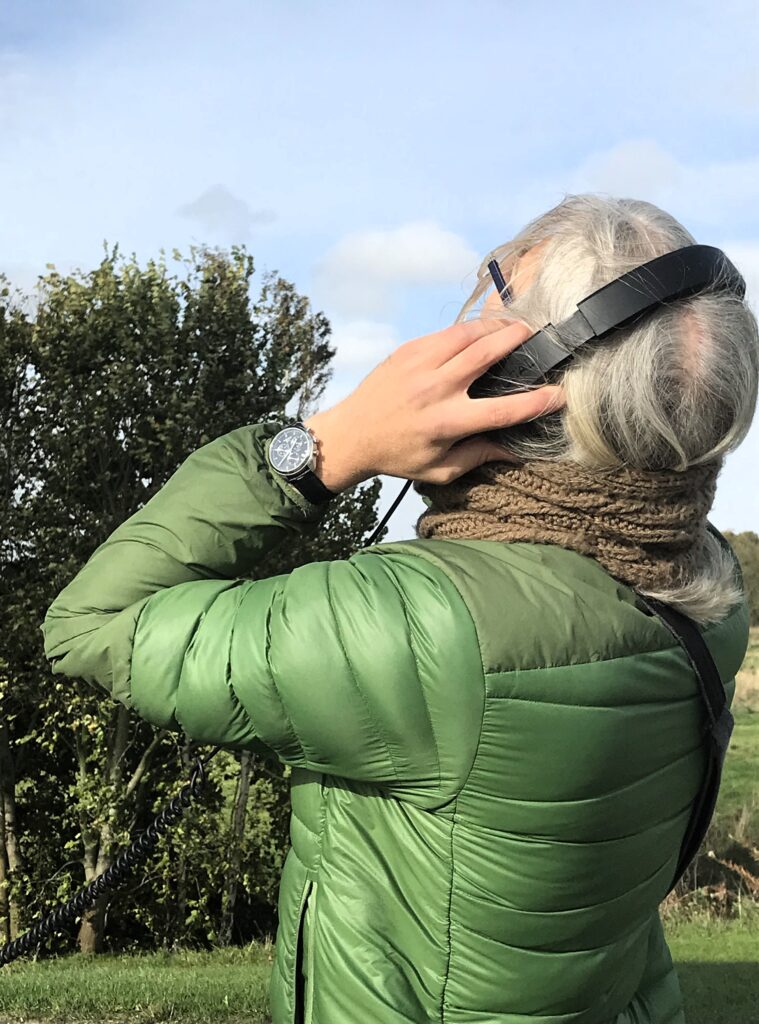
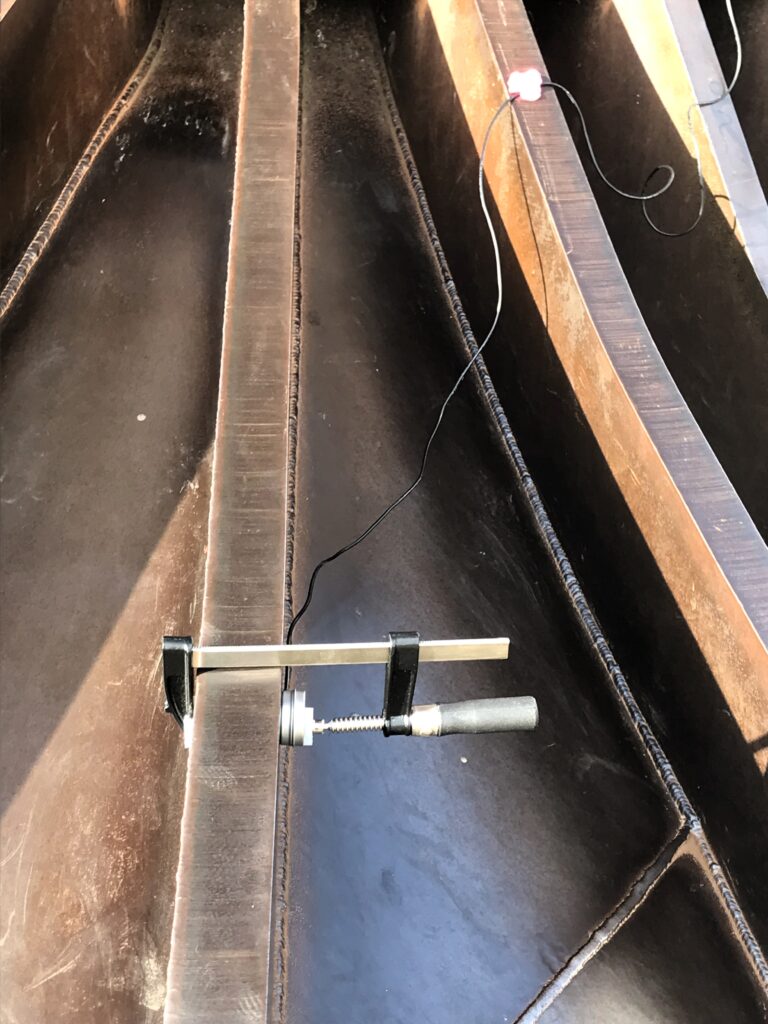
Once we reached The Angel, David took out his new contact microphone, which he was able to clamp onto the ribs of the sculpture, rather than holding it in place as he did on our previous visit. This meant that there was less disturbance to the sound, as interference is caused by slight movements of the hand and the resulting changes in pressure of the microphone on the surface.
We tested the microphone on the west side of The Angel, having climbed the mound after leaving the shelter of the trees. The sound through the headphones was the same low pitch as on the previous recordings, but higher and clearer in tone. As gusts of wind buffeted the wings of The Angel, they resonated down into the sculpture and were clearly audible. David also set up a standing microphone to record the atmospheric conditions on site, so that these sounds could be in conversation with the recordings of the Angel’s interior vibrations.
Photo credit: Anne Whitehead
David wanted to record at the same points on the Angel in different conditions, so we devised a rudimentary map of the sculpture. Walking round The Angel, I counted twenty ribs and we divided these into four groups of five. We mapped these onto the points of the compass, so that we were recording the west, north, east, and south faces of the sculpture.
Counting five ribs round, David clamped the microphone to the back of The Angel, as high as he could reach. The recording here was different in tone, having an eerie quality like the soundtrack of a horror film. The wind’s gusts were still audible, but less dominant than on The Angel’s western side.
Photo credit: Anne Whitehead
Five more ribs counted, and we listened to the sound on The Angel’s east face, again placing the microphone as high on the sculpture as we could reach. As on the western side, the wind once more became the prominent feature. David recorded for five minutes in each location, and he explained that, once these files were placed in sequence, the distinctions between them would become more evident.
The final five ribs took us round to the south of the Angel and David fixed the microphone to the front of its feet. Here, the sound was softer and quieter, and the wind was muted. It felt as though The Angel was sheltering the sound, and us, from the force of the wind.
Photo credit: Anne Whitehead
David had recorded at the site once more between our first and second visits, rising on a misty dawn to capture the site without the constant rumble of traffic. Even at this time on a Sunday morning, the flow of cars had been unceasing, however, and David had noted that his recordings of the Angel picked up the vibrations of passing vehicles. On this visit, we were unable to hear the resonances of the traffic, and it seemed that the vibrations to the structure caused by the buffeting of the wind were more audible, with the traffic noise receding to a supporting note.
As on our last visit to The Angel, there were several visitors to the site when we were recording. It was notable that this time they did not approach us to ask what we were doing. I wondered whether this was because of the shift in the recording equipment that we were using. On our first visit, David had held the microphone to the body of the Angel and looked like a doctor with a stethoscope. The new method of clamping the microphone to the sculpture involved less direct contact with The Angel, and David looked more like a structural engineer visiting the site to make tests. Even though we were involved in the same activity, it seemed that a minor change in the recording technique – namely, how David attached the contact microphone to The Angel – had changed the appearance of what we were doing, to make it look more technical and more scientific.
In her poignant and powerful collection of poems, A Fine Yellow Dust, written in the year following her daughter’s suicide, Laura Apol includes the poem ‘Patient Stone’. The poem is based in an Iranian tradition that when your pain is overwhelming, you go in search of your ‘patient stone’. Once you have found it, you sit alone with it and tell it your story. As you unburden yourself, your pain will lessen and once you reach the end of your story, the stone will break into pieces.
Apol’s poem records an afternoon of searching for her own ‘patient stone’, so that it can hold something of her overwhelming grief. She accords agency to the stone, believing not that she will find it but that ‘it will find me’. But what stone would be the right one for the task? She asks, ‘How large is a stone / that can manage this work?’ Should she carry it home with her when she has found it? Once it has broken into pieces, should she visit it? She concludes by reflecting that she will need to find ‘the right stone’, because, whole or broken, ‘it will be mine for life’.
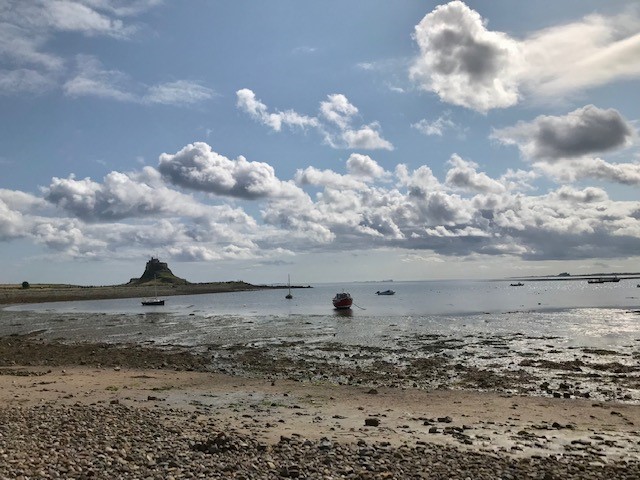
A few days before the last anniversary of my sister’s death, I was on Lindisfarne, a tidal island just off the Northumberland coast. I had wanted to find a stone on the beach here that would mark this anniversary, and I wandered along the strand looking at the pebbles. I was drawn to the smooth, oval-shaped stones, coloured like the sand, that were piled there. Picking them up, they sat well in my hand, and they had a pleasing weight and heft to them. Turning over one of the stones, I saw that it had been inscribed in pen with a name and date, and I liked the idea that this stone had already been picked up and held by someone else. I put the stone in my bag and continued my walk around the perimeter of the island to the causeway, accompanied by the sound of seals singing on a sandbar just offshore.
It was only when I examined the stone more closely at home that I realised the date that had been marked in pen on its surface was 28 August 2021. Not only had this stone already been picked out by someone else, but it had been inscribed on the anniversary of my sister’s death. It felt that this was the ‘right stone’, and that, even as I had been looking for it, it had found me.
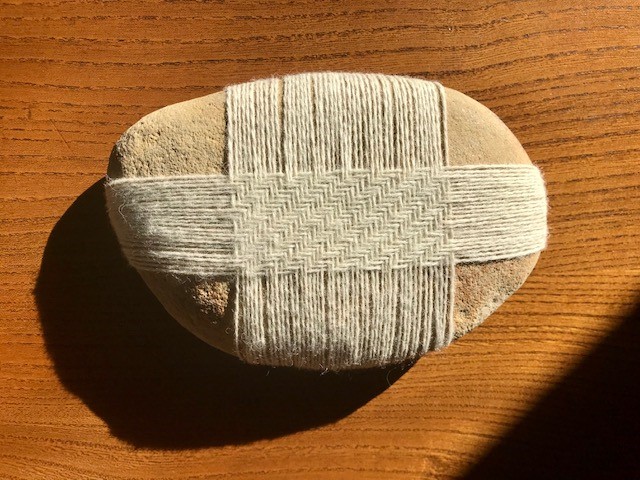
I had recently attended an online weaving course run by Sarah Ward of Lark and Bower. Sarah teaches off-loom weaving, which uses left over yarn to stitch basic weave structures, such as twill and herringbone, around everyday found objects. Instead of writing or drawing on the stone, I decided to make a weaving around it, a practice reminiscent of the Japanese art of wrapping stones. Choosing a plain, natural thread that toned with the sand-hued pebble, I wrapped the warp threads carefully around the stone, working from left to right. I then stitched the weft threads through the warp in a two-twill pattern, working across the width of the pebble from bottom to top. The weaving was a slow and meditative process, taking several days to complete.
I sat with this stone, not to tell it the story of my grief, but to weave around it a thread that, as I was winding and stitching, held memories of my sister. The process of weaving was slow and patient work. The yarn covered over, without erasing, the pen inscription that had already been made on the stone, so that the finished work took on a palimpsestic quality. The stone currently sits on a bookshelf in my study, and I often pick it up and hold it for a minute or so, feeling its weight and texture in my hand.
In her workshops, Sarah encourages participants to place their woven objects back where they found them. For her, it is a cathartic process to return these objects to their original surroundings, enhanced by the weaving. The thread used is a natural yarn, which will degrade naturally over time. I wonder what this stone would look like back on the beach at Lindisfarne, taking its place amongst the other oval pebbles. Would the weaving gradually disappear, eroded by the action of weather and the tides, to uncover the writing once more? Would another person encounter this stone and imbue it with their own meaning and significance, adding another layer to the palimpsest? Would it feel cathartic to return it to the beach on Holy Island, or would it feel as if I am leaving something precious behind?
I have long intended to walk across the causeway to Holy Island, as many pilgrims do each year. Perhaps I could carry the stone with me as I do so, and end the walk by returning it to the strand. This gesture would honour the spirit of Sarah’s workshop by giving the stone back to the island and to the sea.
Picture Credit: Anne Whitehead
References
Laura Apol, A Fine Yellow Dust (East Lancing, Michigan: Michigan University Press, 2021).
I was delighted to be in conversation recently with Rebecca Helman about the Relating Suicide book. Rebecca is part of the Suicide Cultures team at Edinburgh University, a five-year project funded by a Wellcome Trust Investigator Award. The project focuses on the social and cultural contexts of suicide in Scotland, and it has a deep commitment to working with lived experiences of suicide and suicidality.
My conversation with Rebecca began by reflecting on the trajectory of my work and how I came to write a book on suicide. We reflected on the writing of the book during the Covid-19 pandemic, and what impression this left on the work. We then moved on to think about what creativity means in relation to the book and the ways in which its form bridges the critical and the creative. We considered the importance of capturing feeling as well as facts in relation to suicide, which formed an important link between the book and the Suicide Cultures project.
We then focused on the book more specifically. We talked about the structuring of the chapters around a series of questions, and the limits of what we can know in relation to suicide. We thought about the emphasis that I put on the importance of place in connection to suicide-related grief, and about the language of living beside suicide.
Our conversation closed by thinking about the archive, reflecting on the ways in which my book disrupts institutional archives relating to suicide and is suggestive of more creative archiving practices. Rebecca shared the project’s making of a photographic archive, based on images contributed by those affected by suicide. We ended by registering the importance of listening as well as speaking in the context of suicide narratives.