
By Katie Dooley Cawley, NIHR Pre-Doctoral Fellow February 2025 – January 2026 in Speech and Language sciences (Prof Helen Stringer-mentor) and Population and Health Sciences Institute (Dr Simon Hackett-mentor); SLT Hub Lead for SLT services in the Community across Gateshead and Sunderland; Cumbria, Northumberland, Tyne and Wear NHS Foundation Trust. With the Makaton Evidence Review Group
Early career Speech and Language Therapists from Gateshead, Newcastle, and Sunderland Adult Learning Disability teams.
Why We Started This Journey
Makaton signing is a well-established tool in supporting communication with people with learning disabilities. Many of us use it in our daily practice, drawing on tradition, patient feedback, and peer recommendations. But how strong is the actual evidence supporting its use?
In early 2023, a group of early career speech and language therapists came together to find out. Our aim was to conduct a critical review of the literature on Makaton signing, looking not only at the outcomes but also at how it’s implemented and experienced in practice.
What We Discovered
We reviewed 11 studies published between 1983 and 2022. The findings were eye-opening:
- Mixed quality: Most studies were small and methodologically limited. Only one met higher quality thresholds, but even it failed on critical screening.
- Positive perceptions: Makaton was consistently valued for improving communication, boosting user confidence, and supporting social connection.
- Behaviour change techniques: The most effective strategies involved:
- Monitoring how often signs were used
- Demonstrating signs during interactions
- Rehearsing signs in structured practice
- Challenges: While users gained skills, generalising them outside training environments remained a key hurdle. Communication partners also expressed a need for more training.
Our Experience as a Research Group
Over 18 months, we met 15 times to complete this review. While none of us were research experts at the start, we all brought curiosity, motivation, and clinical insight to the table.
Key reflections from the group:
- A strong sense of achievement – seeing the project through from beginning to end was hugely rewarding.
- Value in teamwork – working together helped us build confidence, challenge assumptions, and stay motivated.
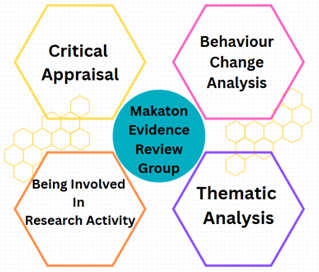
- Growth in research skills – from critical appraisal to thematic analysis, we now feel more prepared to engage in evidence-informed practice.
- Time and capacity challenges – fitting research into busy clinical roles was not easy and highlights the need for organisational support.
Tips for Future Projects
- Plan clearly and early – timelines and goals help maintain momentum.
- Provide training upfront – especially for clinicians new to research.
- Support participation – build research activities into appraisals and job plans.
- Meet in person when possible – it really helped our engagement and collaboration.
Final Thoughts
This project showed us how valuable and necessary it is to question our assumptions and strengthen the evidence behind what we do. We hope our findings will contribute to more informed use of Makaton and inspire others to build bridges between clinical practice and research.