A ‘classic revival’ of bilingualism and suspected speech and language disorders

In 1984 I published a book ‘Bilingualism and Language Disability’. This book has recently been reissued by Psychology Press in their Classic Revivals series http://www.guilfordpress.co.uk/books/details/9781848722408/. It’s strange to think of oneself as a classic revival, I might be expected to get up on stage and start singing Flanagan and Allen’s ‘Underneath the arches’ or Gertie Gitana’s smash hit ‘Old mill by the steam’! The Classic Revivals series consists of works from ‘some of the most influential scholars of the last 120 years’, of works which made a great impact at the time. It sounds flattering, but in today’s world a cynic might condense such statements down to that some publisher has noticed they have a stack of old manuscripts on their shelves and they’re not making any money there, what selling point could we find to persuade people to buy them again. Anyway, whatever you might think about the publishing industry, I thought it might be worth a few lines of reflection on how the book came about in the first place, and some other random thoughts vaguely in the same direction.

It all started when I was a student on placement with a rather overwhelming, loud clinician. The epithet of ancient tree-felling war weapon springs to mind (think Hyacinth Bucket, Keeping up Appearances, and then some). The therapist had arranged for me a morning of children with what were called speech problems (I don’t think phonology had been invented then, or not when she had trained anyway). The plan was that I would observe for the first child; by that time I would have learned all there is about how to treat speech disorders and so would be able to take the rest of the morning (checking notes beforehand to look at assessments and what previous therapy had been conducted? Preparation? Session plans? Totally unjustifiable and unnecessary – we’re talking here of the sink or swim approach to student training prevalent at the time).

In the opening session I was treated to a demonstration of a therapy method I hadn’t encountered previously, but which I suspected was not part of established speech/ phonology intervention, when she took the poor wee mite over her knee to give her a good hit on the bottom for not trying hard enough (see below for more on that…). I was allowed to show my skills (or not, given the stage in my training, and again, the fact that phonology had not been invented) with the next child, who was barely intelligible. After the session I remarked on how severely she was affected and that I hadn’t met anyone like that before. ‘Just you wait till you hear the next one!’ was the reply I received as she waltzed out into the waiting room, promptly reappearing with a rather reluctant, anxious looking wee child in tow.

We sat down at the table and Jan started to speak with liberal doses of retroflex affricates, palatal and velar fricatives, word initial sound combinations like /dv, /ʃr/, ʃtʃ/, various nasal vowels, a stress pattern rule which emphasized penultimate syllables in multisyllable words, and that just for starters. Mrs X nodded knowingly across the room at me, expressing a definite ‘see what did I tell you, could you ever get worse than that’ look. An expression not as priceless, though, as the one that crossed her scandalised face, when I too started babbling in this bizarre jargon, the one she had been trying to eradicate by foul means or fair for the last however many months. For Jan was speaking nothing more bizarre than perfectly well-formed, appropriate, fluent Polish.

I’ll omit the transcript of the post session discussion; you can imagine what it might have sounded like. The ancient tree-felling war weapon’s defence was that she had noticed on the referral that Jan had a foreign name but she had had been assured by the mum (who spoke barley any English) that they only ever spoke English at home and ipso facto this must most certainly be a developmental speech disorder. Observing the interaction between my supervisor and mum paralleled exactly the type of conversation that was had with the poor wee girl in the first session. She hadn’t taken the mum across her knee and commanded her to speak only English, but she battered her in every other way. Of course there is a further,  unnamed culprit in this chain of events, the person who referred Jan in the first place with an alleged speech problem.

When I got back to college I reported everything to the placement organiser, thinking that this would be the prelude to getting advice/assistance on taking up the matter with the therapist’s superior, if not going straight to the disciplinary board at the College of Speech Therapists. Not so. My concern about the bottom hitting incident was dismissed with the suggestion that I was creating a fuss over nothing, ‘a lot of people do that, I’m sure, it’s common’, ‘so long as she didn’t hurt the child’, ‘she’s a first rate therapist, you’re lucky to have a placement there’. The kerfuffle over Jan was brushed aside with the retort of ‘well, what should she have done, you can’t expect her to know every language can you? And she had checked with the mother that he was talking English’.

I was absolutely incensed at this. I let the staff member know what a bunch of irresponsible and ignorant iijits (I might have been a smidgen more diplomatic) I thought she and the rest of the staff were. This wasn’t such a shock for her. They were already used to me giving off in this manner (they provided plenty of opportunity for it) and so the dismissive end of the conversation was ‘well if you think it’s so important you can give us a lecture on it’. So, even though that’s not what the illocutionary force of the offer had been, that’s what I did.

I didn’t know a great deal on bottom smacking, but I reckoned I could assemble some facts and figures on bilingualism. And feeling this should not be just for the class of ‘77 I decided to write it up and submit to the British Journal of Disorders of Communication (the grandparent of the Int J Lang and Comm Dis) http://informahealthcare.com/doi/abs/10.3109/13682827809011322

After I graduated the incensedness persisted. I channelled it into getting the Health Authority I worked for to set up a policy on management of bilingual or non-English speaking clients, probably the first speech therapy service in the country to have one. I set up a special interest group (they weren’t called that then) for speech therapy and educational psychology clinicians working with bilingual clients. I gave various talks around the place emphasizing the message. Somehow word of all this must have spread because a while later I got an invitation from a publisher, Croom Helm in GB, who were paired up with College Hill in USA, to write a book about bilingualism and speech therapy. Which I accepted, and that’s how the book came about in the first place, thanks to Jan and a clinical ill-advisor.

By the time the invitation for the book arrived I was long since moved back to Ireland. The impetus for all the work where I was employed in England had been around the large influx of people from south Asia and east Africa at the time, from numerous countries and with numerous languages.  Bilingualism was a big issue in Ireland then too, but on a completely different stage. So my activity in bilingual directions was of a quite different nature for many years (though in work I was ostracised by a section of my colleagues for a while for having in the acknowledgements preface of the book signed off as having written it in Béal Feirste rather than Belfast, which gives a minor indication some of the attitudes to even indigenous languages that people wishing to use Irish were up against).

The book received rave reviews, so it must have been fulfilling some need; and it went to further printings, so folk must have been finding it useful. Certainly in the 1980s concern over management of bilingual clients in SLT took off as a topic of training and research. I can’t claim that the book was solely responsible for that. It was more likely the needs of the time pressuring SLTs into realising something had to be done, but then the book did provide the background and templates and methods and hypotheses to test out to advance the field from the point of view of practice and research. It was a long time before other works overtook it, and even some of today’s publications don’t move much beyond it in many aspects (I did spot the 1978 article mentioned in the 2007 RCSLT document of good practice for working with clients from linguistic minorities). The big area of advance compared to 1984 has been in our knowledge of bilingual language acquisition and usage, the development of some well validated testing materials and techniques and methods for working with bilingual children – and of course the awareness that all this is a vital part of the knowledge and practice base for SLTs.

In the late 1990s the RCSLT together with the SIG Bilingualism had prepared a document of good practice around training in bilingual issues in SLT. The model adopted was one where there weren’t specific courses on bilingualism. The aim was to have bilingualism integrated into, permeating the whole curriculum. So, when language or sound acquisition was tackled bilingual acquisition would be part of this. When models of word production were discussed this would cover the lexicon and output of bi- and multilingual speakers. Aphasia recovery would encompass patterns of recovery not just in monolingual speakers.

The SLT course in Newcastle was actually held up as a model example at the time that had these characteristics (and coincidentally did have dedicated specialist courses on bilingualism too). There were big (300-400 delegate) conferences on bilingualism organised from the department (the profits paid for a new photocopier on one occasion!). Myself and a great bilingual colleague at the time, Li Wei, launched the International Journal of Bilingualism http://ijb.sagepub.com/ which is still going strong.

How fragile things are though. Countless reorganisations and curriculum development ‘advances’ later and it is doubtful the same course would be held up as a beacon example. There certainly are pockets of excellent input on bilingualism and some top class dissertations have emerged around the topic.

The big hole that still seems to persist, at least in student training at Newcastle and many other SLT institutions in GB, concerns management of people with acquired communication disorders who are bilingual. The same applies to RCSLT guidelines which are heavily weighted to child cases. There are some services with model practice out there; there is ample research in the field to support practice; there are assessment materials – most notably the Bilingual Aphasia Test, which for all its imperfections has been a great stimulator to work and progress – take a look, you’ll find assessments in most languages you are likely to want to use: http://www.mcgill.ca/linguistics/research/bat/.

Communicating Quality 3 and other guidelines make it clear: ‘’With regard to assessment and differential diagnosis, bilinguals are vulnerable to misdiagnosis if linguistically and/or culturally inappropriate tools are used…An incomplete picture of their skills will emerge if only one language is assessed’ (p270). Still too often, despite this one can observe clients who have been assessed on only half or less of their languages, in English only, or the clinician has felt that asking the family about whether the person sounds disordered in their other language(s) and what is difficult or not for them suffices for an assessment. Too close to ancient tree-felling war weapon and Jan for my liking!

So, if you’re out there and that’s what you see – time to get incensed again!

Nicholas Miller

Statistics never lie

It’s good to count stuff. We can count how frequently someone makes a grammatical error. Or how many speech sounds they find difficult. Or how many times they point to the wrong picture in a comprehension test. Once we’ve done our sums we can get out or look-up table and find out if someone is language-typical or language-impaired. We can find out if an intervention programme is working. We can demonstrate that speech and language therapy works. There’s no need for messy subjective judgments. We can let the data do the speaking. We might even run a few statistical tests which will enable us to quantify our degree of certainty. And we can even count that certainty (using p-values).

There’s no escaping that Speech and Language Therapy needs to embrace quantitative methods. Yet at the same time we risk making the wrong conclusions if we cannot think “beyond” the numbers. One particular pitfall is understanding the difference between causation and correlation. People who live in large houses are more likely to vote Conservative, but this doesn’t mean that the size of one’s house actually determines one’s voting habits. Fortunately, SLT students with their advanced statistical training are able to spot such dodgy claims a mile off. And tear them apart with savage gusto.

But let’s not be too smug. There are plenty of research areas where vigorous debates thrive on the causation versus correlation dilemma. One example is the field of Verbal Working Memory (VWM). VWM tasks involve retaining and recalling linguistic items while simultaneously doing some kind of additional processing task. A classic example is “listening span” where you have to say if sentences are true (the processing task), and then recall the final words from the last few sentences (the recall task). Because performance on VWM is strongly associated with language skill (e.g. comprehension of complex sentences), many have argued that VWM determines language skill. But as every SLT student will know, correlation does not equal causation. An alternative, and I think, far more convincing explanation, is that performance on both language and VWM tasks are influenced by the same underlying factor, which is… err… language. Viewed from this perspective, the idea that VWM determines language skill simply vanishes in a puff of smoke.

To be fair, proponents of VWM accounts have countered these criticisms with some rather sophisticated methods (e.g. structural equation models). No one has yet struck a killer blow and the debate rages on. But stepping back one or two paces, there is a larger lesson to be learned. Running stats is just the starting point. The crucial thing is how we interpret the stats. At the end of the day, though we do lots of complex stuff with numbers, it’s all about the fine art of crafting a convincing and persuasive argument. And in that sense, perhaps we have more in common with the humanities than we’d like to think…

Nick Riches

Comparing apples with broccoli: stepping out on the path to national outcome measures

Ever since I first qualified as a speech and language therapist we have been discussing the need to measure the outcome of our interventions. Almost twenty years ago when I was a service manager in Newcastle we knew that we would need to provide data about our outcomes to our managers and commissioners. In an attempt to get ahead of the game and be well prepared for when the request came, we invited Pam Enderby up to Newcastle to talk to us about her newly developing Therapy Outcome Measures (TOMs). Based on the principles of the newly emerging WHO ICF (since redeveloped and modified) TOMs was, as far as I know, the first outcome measurement tool that considered multiple aspects of the client and did so in a holistic way (Enderby & John, 1999).  At that time we really collected data for our own edification and amusement as no one ever asked us for it.  

We live in a different world now and the need to demonstrate the effectiveness of our interventions has become pressing, as the structure and drivers behind commissioning have changed. However, we have no set of outcome measures that are acceptable to all and the danger we have now is that services will develop outcome measures independently that are not comparable. Commissioners will not be able to accurately or appropriately compare services with each other or evaluate their outcomes and the consequence will have a negative impact on the quality of client care. As a profession we need to be able to rise above our fierce independence as autonomous practitioners and  devise a system for measuring outcomes that enables us to compare like with like.

The Royal College of Speech and Language Therapists (RCSLT) has picked up the baton and is leading an initiative to develop national outcome measures by consensus through engaging as many SLTs in England as possible. On October 10th 2013 RCSLT held a Summit meeting in Birmingham to start the process. Although I am no longer working at the service delivery sharp end, I have been involved in the outcome measure work with RCSLT because it links into a research project that I am involved with in collaboration with RCSLT and Newcastle University Culture Lab (http://www.ncl.ac.uk/culturelab/). Consequently, at the Summit, I sat with the dysfluency group although I have no expertise and limited knowledge in that area. A Theory of Change (http://www.theoryofchange.org/what-is-theory-of-change/#6) process was used to develop some preliminary ideas at this meeting which we took forward with the North East Regional Dysfluency Clinical Excellence Network (NERDCEN) a fortnight later.

Theory of Change provided a framework for us to consider the outcomes of intervention for children, young people and adults with dysfluent speech. Theory of Change takes us from the ultimate outcomes of our intervention to consider the intermediate outcomes that contribute to them and then to the activities that we need to undertake in order to achieve the goals. The combined outstanding brain power in the room took remarkably little time to come to a consensus in each of these areas. I think this was partly down to the fact that they had been talking about outcome measures for several years and had a fairly good idea where they were heading and partly down to the structure provided by Theory of Change. Another contributing and helpful factor on the day was the presence of Dominique Lowenthal, Professional Development Services Manager at RCSLT, who has a lot of experience using Theory of Change in different RCSLT projects. Dominique guided us through each stage so that the relevant points were considered and everyone’s views were taken into account. The result is not yet an outcome measure (or two) but a path on the way and a consensus of the experts in this region. This work will continue with input from NERDCEN and RCSLT over the next few months. The aim is to have a set of outcome measures that are agreed across all SLTs that can be used in the RCSLT/Culture Lab/Speech & Language Sciences project. We are on our way to being able to compare apples with apples (even if some are red and some are green) rather than continuing to have apples in one hand and broccoli in the other while we vainly search for similarities.

 Thanks to: @domlowenthal and all the NERDCEN SLTs.

 Helen Stringer

 References

Enderby, Pam ;  John, Alex; (1999). Therapy outcome measures in speech and language therapy: comparing performance between different providers. International Journal of Language & Communication Disorders, 34(4), 417-429. doi: doi:10.1080/136828299247360

Praise for Professor Howard!

Professor David Howard, researcher and lecturer for the Speech and Language Sciences department at Newcastle University has been awarded the 2013 Robin Tavistock award, presented by The Tavistock Trust for Aphasia. This award, named after Robin Tavistock, the 14th Duke of Bedford who founded The Tavistock Trust for Aphasia, is presented annually to a person, or group, who has made a significant contribution in the field of aphasia.

Professor Howard is a trained speech and language therapist and neuropsychologist and a large majority of his research has focused around aphasia. With over 100 publications to his name David is a towering figure in aphasia research. He was one of the first to bring the insights of cognitive neuropsychology to the field of aphasiology, and particularly to the domain of therapy. As a result he has hugely added to our understanding of the nature of aphasic impairments and how to treat them. His more recent research has used advances in brain imaging to illuminate the neural representation of language. In addition to theoretical rigour David’s research has a strong focus on the clinical needs of people with aphasia. With colleagues at Newcastle University and elsewhere he has generated a legacy of therapy and assessment materials that are widely used by therapists both in the UK and beyond.

Professor Howard’s contribution to the setting up in 1999 of The North East (since renamed as The Tavistock) Aphasia Centre at Newcastle University has alos been recognised by The Robin Tavistock Award.  Now acknowledged internationally as a pinnacle of excellence, the centre offers intensive therapy to people with aphasia, provides cutting edge clinical education for SLT students and is leading research into the assessment and treatment of aphasic impairments. Most recently, the centre has supported the development of the North East Trust for Aphasia, known as NETA. This charity, run largely by people with aphasia, has become an independent, award winning self-help group that is inspiring others across the country.

When asked how he felt about being presented with the award, David said the following: “I’m delighted and honoured to be receiving this award. Much of the credit belongs to my friends and collaborators both in Newcastle and elsewhere. In particular, the success of the Tavistock Aphasia Centre North East and the North East Trust for Aphasia (NETA; a charity run by and for people with aphasia), both of which are based at Newcastle University, was a key contributor to the award. I’m hugely grateful to my colleagues at Newcastle University and many people with aphasia  for making these so successful”.

Congratulations Professor David Howard on behalf of staff and students in the Speech and Language Sciences department, Newcastle University.

Out of the dark ages…

Speech and Language Sciences at Newcastle University has spent a lot of time over the past few weeks finding its way out of the dark ages and catching up with the modern world! For those of you who aren’t yet aware, we have relaunched our Speech and language Sciences at Newcastle Univeristy Facebook page which has now gained over 300 likes and attracts daily interest from therapists and students from all over the world. As a department we are pleased to be able to share resources and information from our staff and from all over the speech world to our followers and friends. For those of you who haven’t liked us yet, our page can be found at https://www.facebook.com/slsncl

Sls@ncl has also appeared on…. Twitter! Yes, conversations with staff about “twitting(?)” have been refined and now we are “tweeting” daily, again sharing resources and engaging in professional discussions with the speech world. You can find the link to our Twitter page at https://twitter.com/SLSncl

Finally, we have produced a LinkedIn page and discussion area for past students, professionals and SLTs to join together, keep in contact with ex-classmates and colleagues and engage in inter-professional discussions. Although a bit slow to start with, we are confident that this can become a useful hub for people to use. http://www.linkedin.com/groups/Speech-Language-Sciences-Newcastle-University-5110447?home&gid=5110447&trk=anet_ug_hm

 Happy social media-ing everyone!


Professor Nick’s Parkinson’s Podcast

http://hcp.gsk.co.uk/therapy-areas/neurology/gsk-scinapse-promotional-webcasts-and-videos/helping-people-wit-parkinsons.html

Professor Nick Miller, researcher and well known lecturer at Newcastle University has produced a series of Podcasts to outline the various speech, language and communication changes that can occur in people with motor speech and progressive neurological disorders.

This first podcast offers an overview of the types and extent of changes in communication associated with Parkinson’s and outlines some issues and practices in intervention to support people with Parkinson’s who experience such changes.

Professor Dorothy Bishop honoured at Newcastle University

Dorothy Bishop, Professor of Developmental Neuropsychology, has been awarded an honorary doctorate by Newcastle University, in recognition for her internationally renowned work on specific language impairment in a degree ceremony on July 10th. She was nominated by the Speech and Language Sciences section, where Professor Bishop worked in the early 1980’s, and by the School of Psychology.

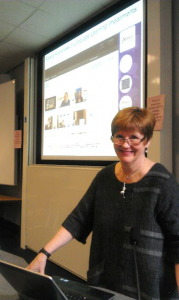
Spending the day at the University, she visited the Speech and Language Sciences Section giving an open lecture on the subject of “Why do some children find it hard to learn to talk?” Seen here, at the talk, in front of her slide about the campaign “Raising Awareness of Language Learning Impairments”, she spoke to an audience that included representatives from across the University, local speech and language therapists, parents and young people. She then went on to visit the University’s Institute of Neurology. In her speech to congregation Professor Vicki Bruce, Head of the School of Psychology, spoke of Professor Bishop’s contribution not only to the academic world but also for her support for women in science, for her blog and other forms of social media taking on all-comers in the field, for her Orwellian Prize for Journalistic Misrepresentation and, finally, for her authorship of three novels featuring the Freemantle based detective intrepid sixty-something amateur sleuth, Rose Absalom.

Newcastle University expert wins BEST award

http://www.ncl.ac.uk/press.office/press.release/item/best-way-to-overcome-language-problems-wins-innovation-award

Praise is to be given to Dr. Cristina McKean who has won a prestigious award for her work in developing a technique called BEST (Building Early Sentence Production) with Drs Sean Pert and Carol Stow of Pennine Care NHS Foundation Trust. The Sternberg Prize for clinical Innovation was awarded to the trio from the Royal College of Speech and Language Therapists in November 2012.

In the autumn of this year, Cristina is launching a product based on the BEST technique she has worked so hard to develop. Piloting and service evaluation work has shown that children who receive BEST make significant progress; learning the rules about how to combine words into a range of different sentences. Published items will include a manual and therapy resources and training sessions will be delivered at Newcastle University. Dr. Cristina McKean is publishing these items and organising the training involved on a not for profit basis.

More information about the product will be released over the next few months. Follow our pages on Facebook, LinkedIn and Twitter to find out more.

https://www.facebook.com/SpeechandLanguageSciencesatNewcastleUniversityUK

http://www.linkedin.com/groups/Speech-Language-Sciences-Newcastle-University-5110447?home&gid=5110447&trk=anet_ug_hm

https://twitter.com/SLSncl

A new blog?! I’m speechless!

Hello everyone and welcome to the blog set up for the Speech and Language Sciences staff, students and followers! (Yes, that did say staff!)

Firstly, congratulations on finding your way here and not getting lost amongst all the links and “click here, click there, click everywhere!”. This is a new adventure for the Speech and Language Sciences department at Newcastle University and has been set up to help share all the wonderful hard work that the department has been doing. Modestly is not tolerated on this blog – if we have done something good then we want you to know about it!

The format of the blog will be taking shape over the next few weeks so keep checking back to read up on what the staff and students have been up to.

Bye for now!