Rendezvous was a Live Theatre production from 28th of May to the 6th of June 2015 which marked the 10th anniversary of the death of poet and playwright Julia Darling.
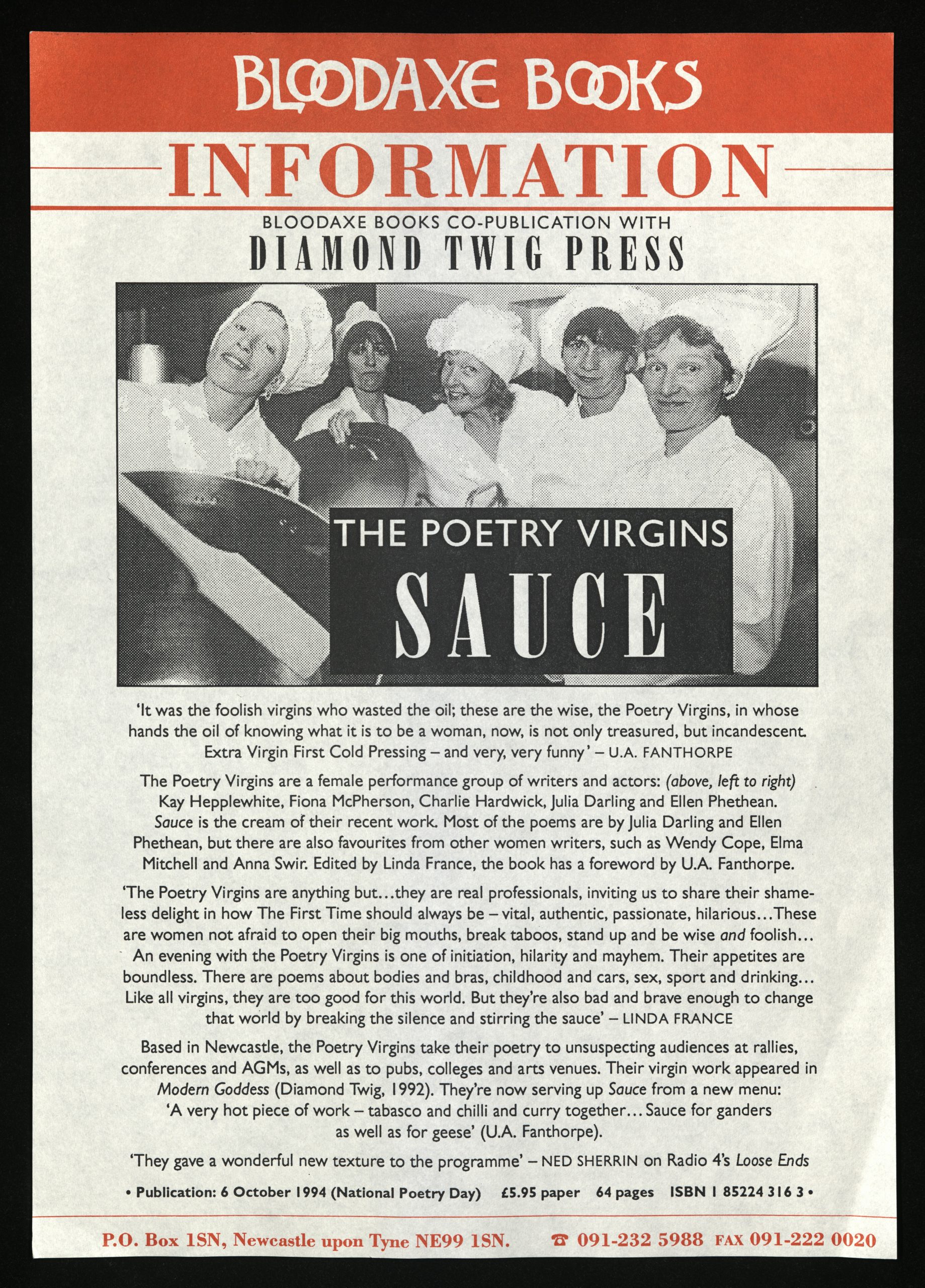
Julia started her writing career in the 1980s in Newcastle before forming with a performance poetry group called The Poetry Virgins with four other female writers: Ellen Phethean, Charlie Hardwick, Kay Hepplewhite and Fiona MacPherson. The group would go on to publish poetry collections such as Sauce and Modern Goddess and perform their poems live.
Julia and Ellen would then go on to co-found Diamond Twig Press in 1992, a small publishing press for publishing works of female authors in the north of England that closed in 2018.
Julia published her first novel, Crocodile Soup in 1998 followed by The Taxi Driver’s Daughter in 2003. She was a writer in residence at the Live Theatre from 2001 to 2003 where she wrote five works: Attachments, The Last Post, Sudden Collapses in Public Places, Venetia Love goes Netting and Personal Belongings. She sadly passed away on the 13th of April 2005 due to breast cancer at the age of 48.
Advertising poster for The Poetry Virgins live performance of ‘Sauce’ (DT/9)
The production had five plays and many events in which many former colleagues, friends and associates participated including performances from The Poetry Virgins and Diamond Twig. Many performed poems written for the event, previous poems authored by Julia or popular poems that had been played on stage previously. For example, The Poetry Virgins poetry performances of the Stages of Drunkenness and at the Rendezvous Cabaret Nights where they performed their poems as solos, duos or all together. Notes on the running order of Cabaret Nights reveal hidden details of their performance with each performer drinking wine with ‘the poem mapping out Julia’s life through her refreshments’.
We also see after Julia’s death personal letters and poems being written by close colleagues of Julia reflecting on how much she meant to them.
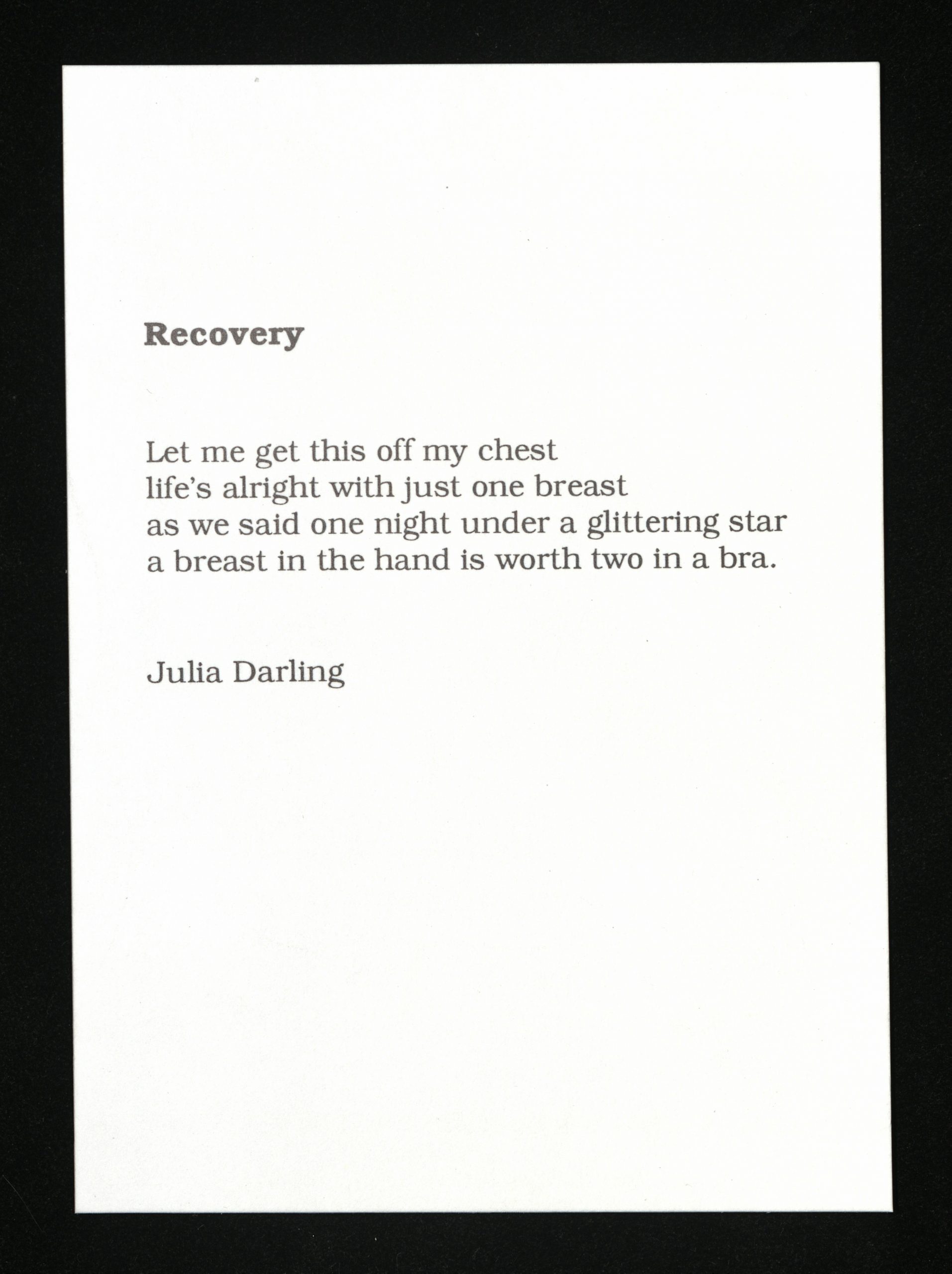
Back of a postcard with the poem ‘Recovery’ by Julia Darling on the back (DT/11).
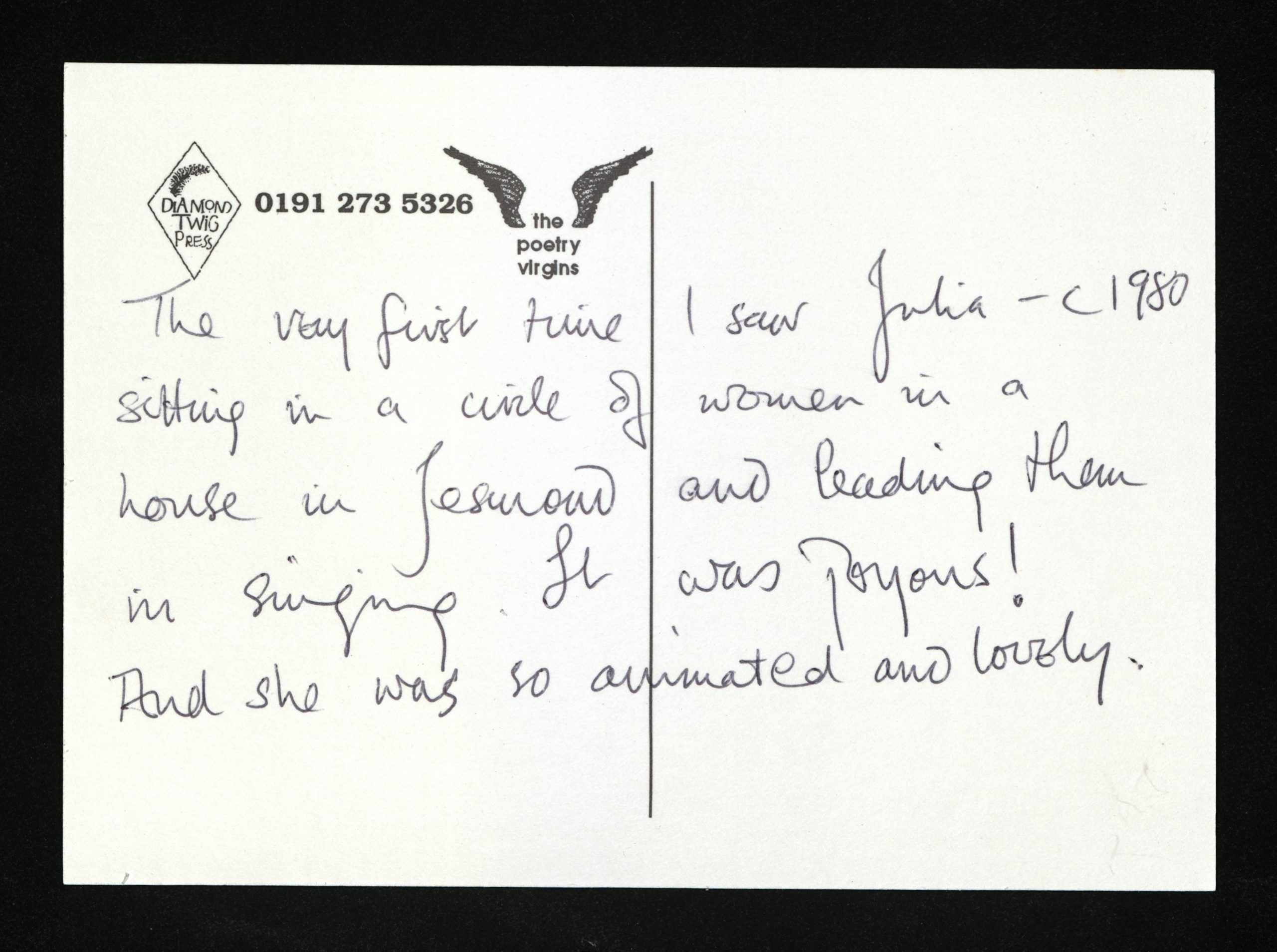
Postcard describing the first time Julia and Ellen first saw Julia in Jesmond (DT/11).
In these letters we learn more about Julia’s personality as a leader, a lovely individual, a teacher/mentor, a friend and a brilliant writer. She is described in the postcard as ‘so energetic and sweet’. We see her important contributions to cultivating creative writing in women around the north of England through her dedication of teaching many creative writing courses and classes for women.
June Portlock first met Julia on one of these writing courses. In a letter reflecting on their first meeting, June stated that ‘Julia ran the session so orderly that it felt everyone was having fun with words, but we also accomplished a lot’. In the same letter she attached a poem named ‘After Billy Elliot’ which, Portlock stated, ‘without Julia’s course would not have existed’.
Sylvia Forrest also first met Julia through her courses. In a letter to Ellen Phethean, she talks about her re-read of Julia’s poem ‘Disrespectful to Lakes’ saying ‘I adore the poem from the beginning stanza and her illustrations in the poem’ which allow her to enjoy ‘being in a world with Julia’s purposeful and stinging remarks’. She also, like many, was positively impacted and inspired from Julia’s creative writing classes. Like June, she also attached a poem to her letter to Ellen titled ‘Remembering Julia’ in which she recounts when she first met Julia through a screen-printing class which she partook in.
All these letters reveal both Julia’s brilliant personality and the massive impact she had on female writers in the north of England, many of whom she inspired through her classes.
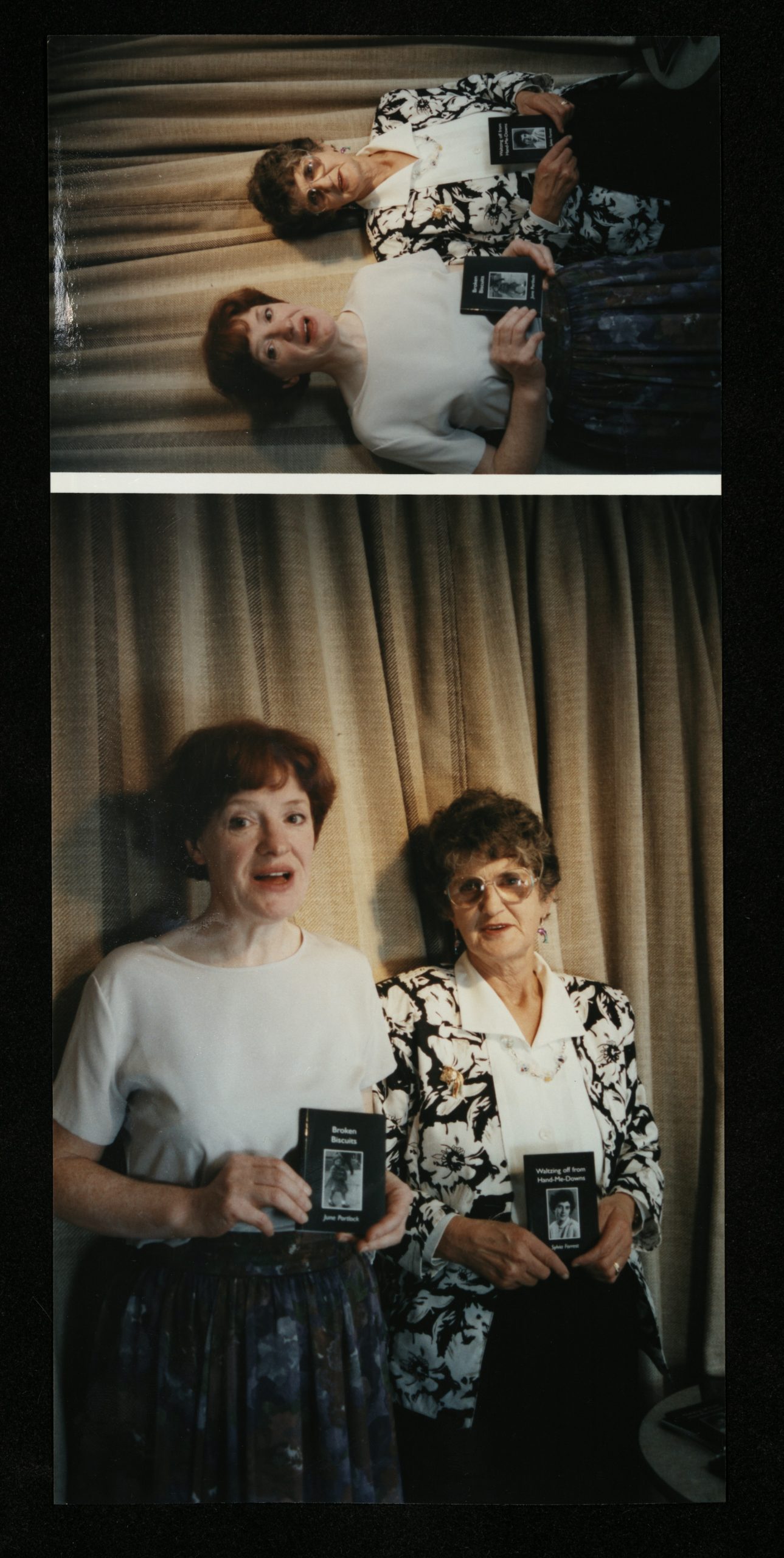
These classes by Julia would help inspire and cultivate new talents in female writing as seen with June Portlock and Sylvia Forrest. From these courses June and Sylvia would become a part of Diamond Twig’s ‘Branch Lines’ series and both become published authors in 1997 with their publications of Broken Biscuits and Waltzing off from Hand-Me Downs both published by Diamond Twig Press respectively.
June Portlock and Sylvia Forrest both holding their respective published works of Broken Biscuits and Waltzing off from Hand-Me Downs. (DT/13)
The images included in this blog are part of the Diamond Twig archive which was donated to the library by Ellen Phethean.
The primary purpose of book bindings is to protect the text block, but bindings can also transform books into beautiful objects that tell us about social status, changing fashions, and craftsmanship. In the Fifteenth Century, bookbinders commonly covered books in leather, usually calf because it is durable, smooth, lightweight and has a surface that lends itself to decoration. The leather could be dampened and decorated by directly applying heated brass tools. Those tools embossed the leather with a design and this process is described as blind tooling. (Gold tooling was introduced to Europe in the Fifteenth Century but really took off in the Sixteenth Century. This is the process whereby the tools are applied through gold leaf.)
Bookbinding was a professional book trade activity. Although we can rarely identify the person or workshop that bound the books, the comparison of bindings has enabled scholars to sometimes recognise the repeated use of particular stamps and other tools, such as metal rolls which have continuous designs engraved around a wheel to quickly create repeated friezes.
The ‘Demon Binder’
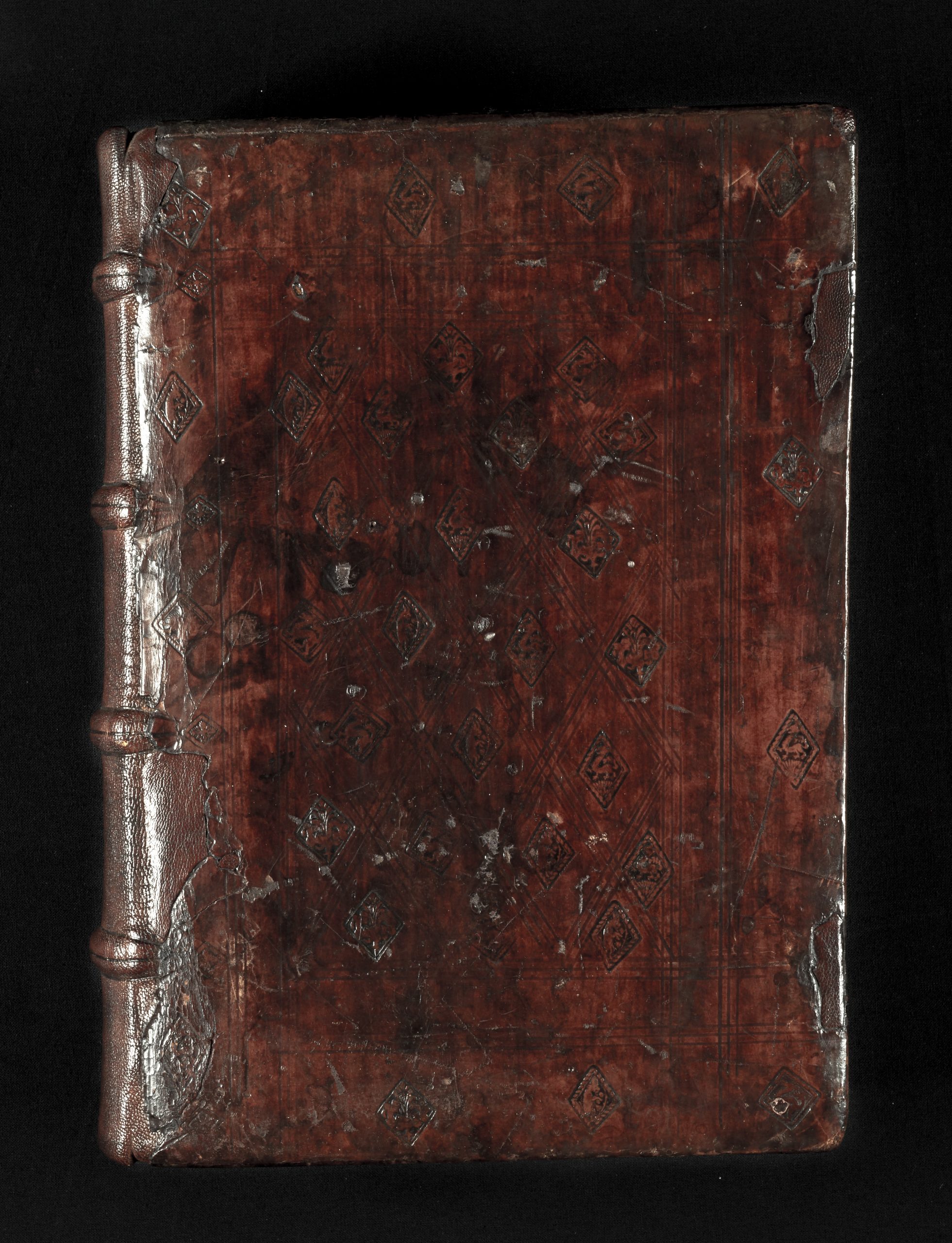
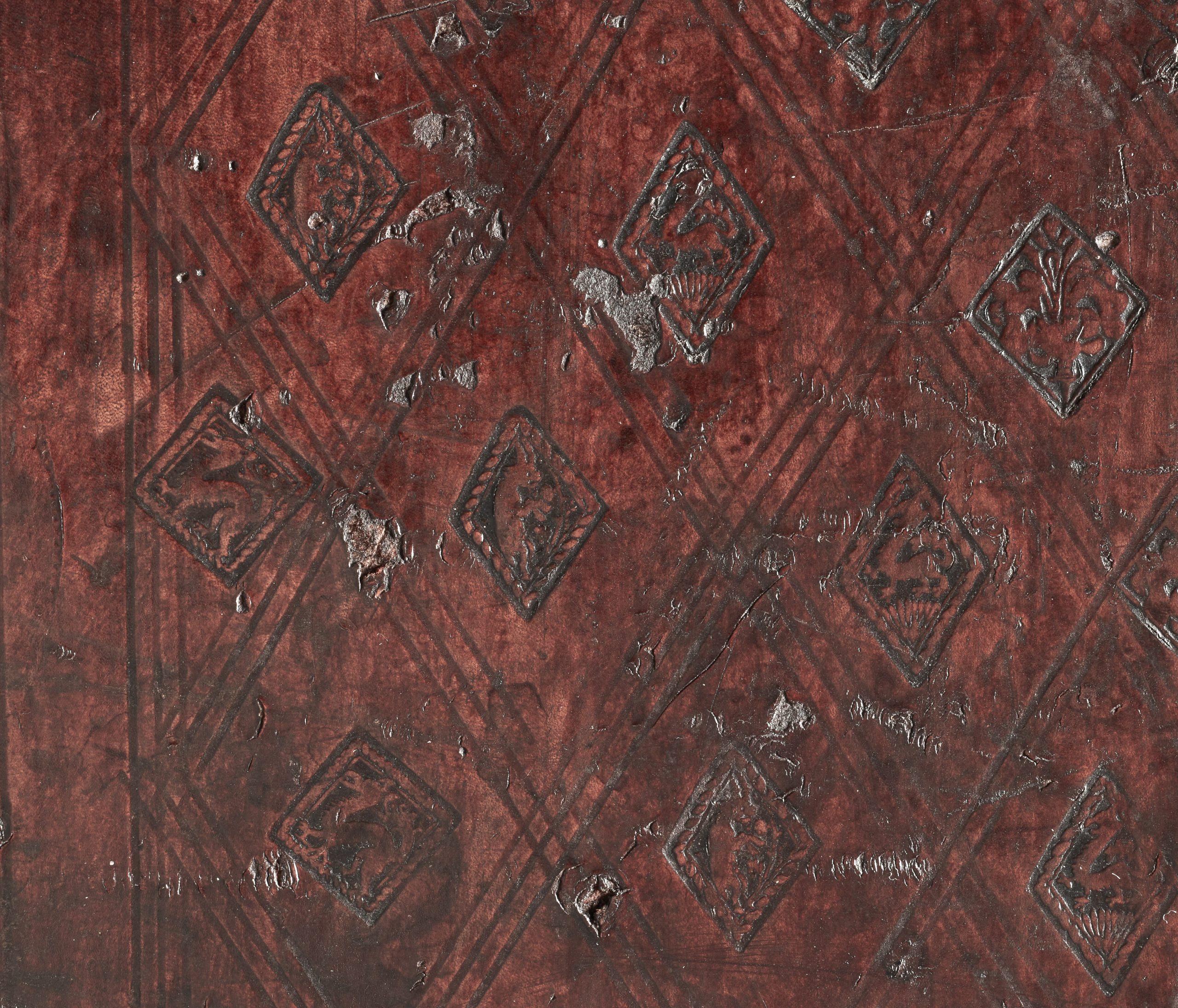
The ‘Demon Binder’ is so called after use of a binding tool that resembles a horned devil within a lozenge. We can see an example of the Demon Binder’s work on a copy of Reporta Parisiensia (reports or transcriptions of lectures given by the Scottish Catholic priest John Duns Scotus in Paris) that was printed in 1478 and is bound with manuscript printer’s waste and a work by the Italian theologian Peter Lombard (c.1096-1160). The book has wooden (oak) boards that have been covered in mid-brown calf and blind-tooled. A tool called a fillet has been used to create a border of triple lines and the same triple lines divide a central panel into lozenges. There is evidence of the book once having two clasps to hold the book shut; now absent.
Front cover of: Duns Scotus, John. Reportata Parisiensia: liber I (Bononiae Italy: Johann Schreiber for Johannes de Annunciata de Augusta, 1478) Bainbrigg Library, BAI 1478 DUN Quarto
Each lozenge features a stamp, including one that can be said to look like a devil.
Detail showing the horned devil stamp.
On this occasion, we think we know who the binder was: the ‘Demon Binder’ has been identified as Gerard Wake, based in Cambridge. During the hand-press era (roughly 1450-1850), Cambridge, alongside Oxford and London, was a major centre for bookbinding with the university creating demand for books. Indeed, the Demon Binder’s work can be found on registers at Pembroke College.
It is reasonable to assume that the first owner of this book also lived in Cambridge. There are copious Latin annotations in an unknown Fifteenth Century hand. Later, it was owned by Reginald Bainbrigg (1545-1606) who was born in Westmoreland (now Cumbria) but was an undergraduate student at Peterhouse, Cambridge University. He graduated in 1577 and went on to become Headmaster at Appleby Grammar School, Cumbria. The historic library of Appleby Grammar School was deposited with Newcastle University Library in 1966, and this book is found within the Bainbrigg Library/Appleby Grammar School Collection.
The ‘Dragon Binder’
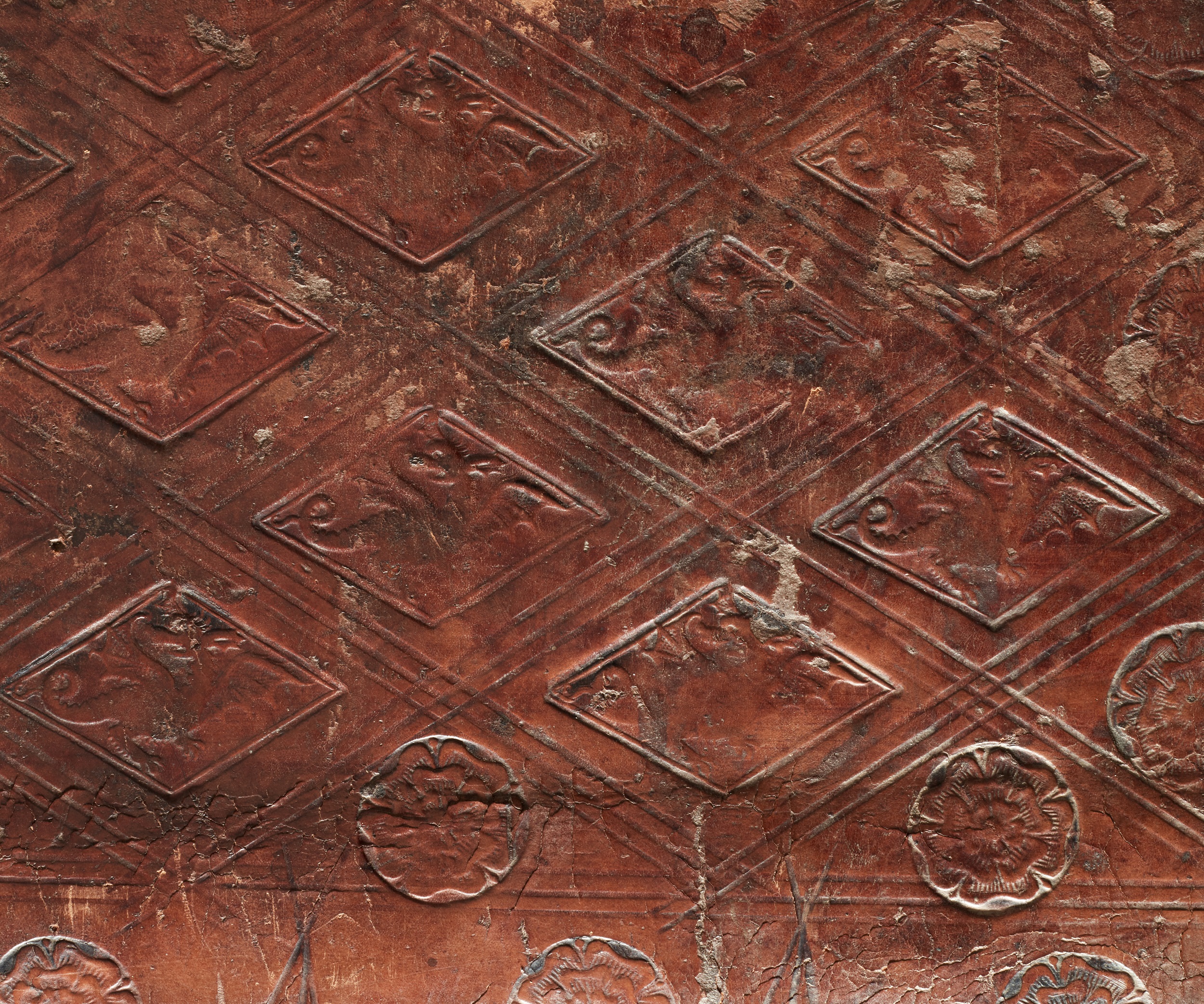
Also working in the Fifteenth Century was the ‘Dragon Binder’, thought to have been Thomas Bedford (fl. 1486-1506). Bedford was a book binder at Magdalen College, Oxford and then stationer at the university. We can see an example of the Dragon Binder’s work on a copy of Summa Angelica . . . (a work of moral theology and guide on matters of conscience by Antonio Carletti)that was printed in 1498. The binding was repaired at the Bodleian Library in 1952: the front, or upper, board has been re-covered, resulting in total loss of the original covering material but the back, or lower, board retains the original blind-tooled calf. According to J. Basil Oldham in English Blind-stamped Bindings (1952), the dragon tool was damaged in 1504/1505 but its use continued, albeit with a nick under the dragon’s tail (p.5).
Back cover of: Carletti, Angelo. Summa Angelica de casibus conscientie cum additionib[us] nouiter additis (Nurenberge: Impressa per Antonium Koberger, 1498) Sandes Library, Sandes 259
The Dragon Binder’s two distinctive stamps, a dragon inside a lozenge and a Tudor rose within a circle, are visible.
Detail showing the dragon and Tudor rose stamps, placed sideways on the binding.
We don’t know anything about the book’s history before the Seventeenth Century, when a wealthy wool merchant, Thomas Sandes (1606-1681) of Kendal in Cumbria donated books to the school he founded. The Sandes Library of Kendal Grammar School was donated to Newcastle University in the 1960s.
Other Fifteenth Century bookbinders
There are several other early binders that have been assigned nicknames. Oldham references the Lattice Binder (named after his use of a lattice stamp); the Unicorn Binder who used a small lozenge stamp depicting a unicorn looking over its shoulder; the Fruit and Flower Binder; the Monster Binder, named for his strange beast with a head at the end of its tail; the Greyhound Binder who used a triangular greyhound stamp; the Fishtail Binder, named after a stamp depicting a creature whose only recognisable feature is its fish-tail and several more.
Ascribing book bindings to specific binders based on the use of consistent tools comes with the caveat that binding workshops might have had multiple staff so we can’t be certain that it was always the same individual that created the bindings. It is also possible that tools passed to other book binders.
The Tyneside Campaign for Homosexual Equality (CHE) was formed in 1972 as a local branch of the national Campaign for Homosexual Equality. The Tyneside CHE Archive held in Special Collections and Archives at Newcastle University is one of the most complete records of CHE in the UK.
As Pride Month draws to a close, we reflect on the importance of art, music and culture in the early days of Tyneside CHE through extracts from the archive.
In the early days of the LGBTQ+ movement in the UK, criminalisation, discrimination, social exclusion and stigmatisation were widespread for its members.
Against this backdrop, art, music and culture, and the social bonds which both created and resulted from them, became powerful tools of resistance and self-expression for the LGBTQ+ community, forming the cultural backbone of a growing movement. Nationally, and internationally, artists, musicians and cultural spaces became lifelines for members of the LGBTQ+ community, and through the Tyneside CHE archive we can see the same unfolding at a local level.
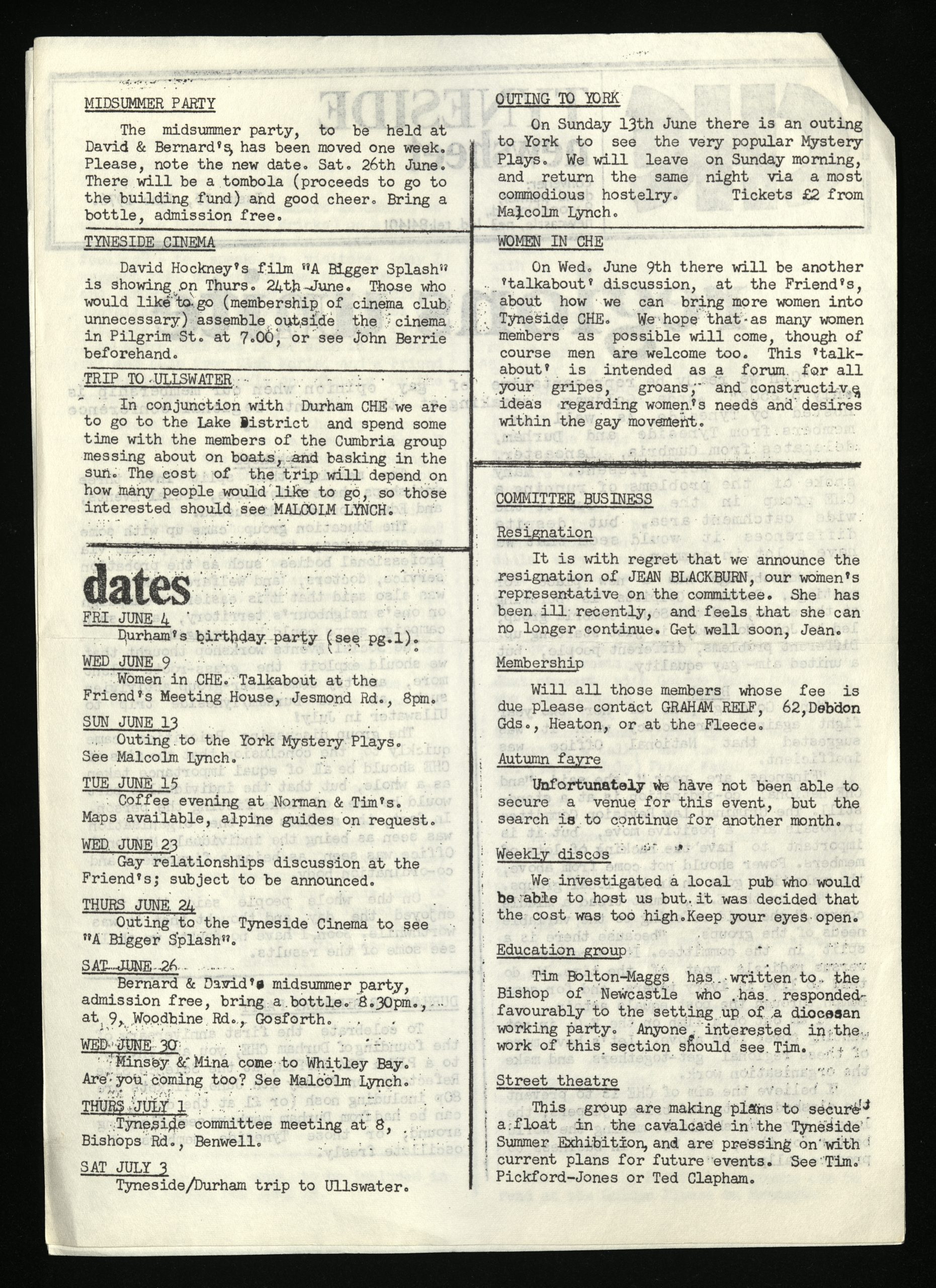
In the early Tyneside CHE newsletters, regular committee business and political matters are interspersed with cultural gatherings and events throughout. In June 1976, plans included a trip to watch the York Mystery Plays and an outing to the Tyneside Cinema to see the film A Bigger Splash, a film significant for its treatment of gay themes.
Page 2 of Tyneside CHE Newsletter, June 1976 (CHE/01/05)
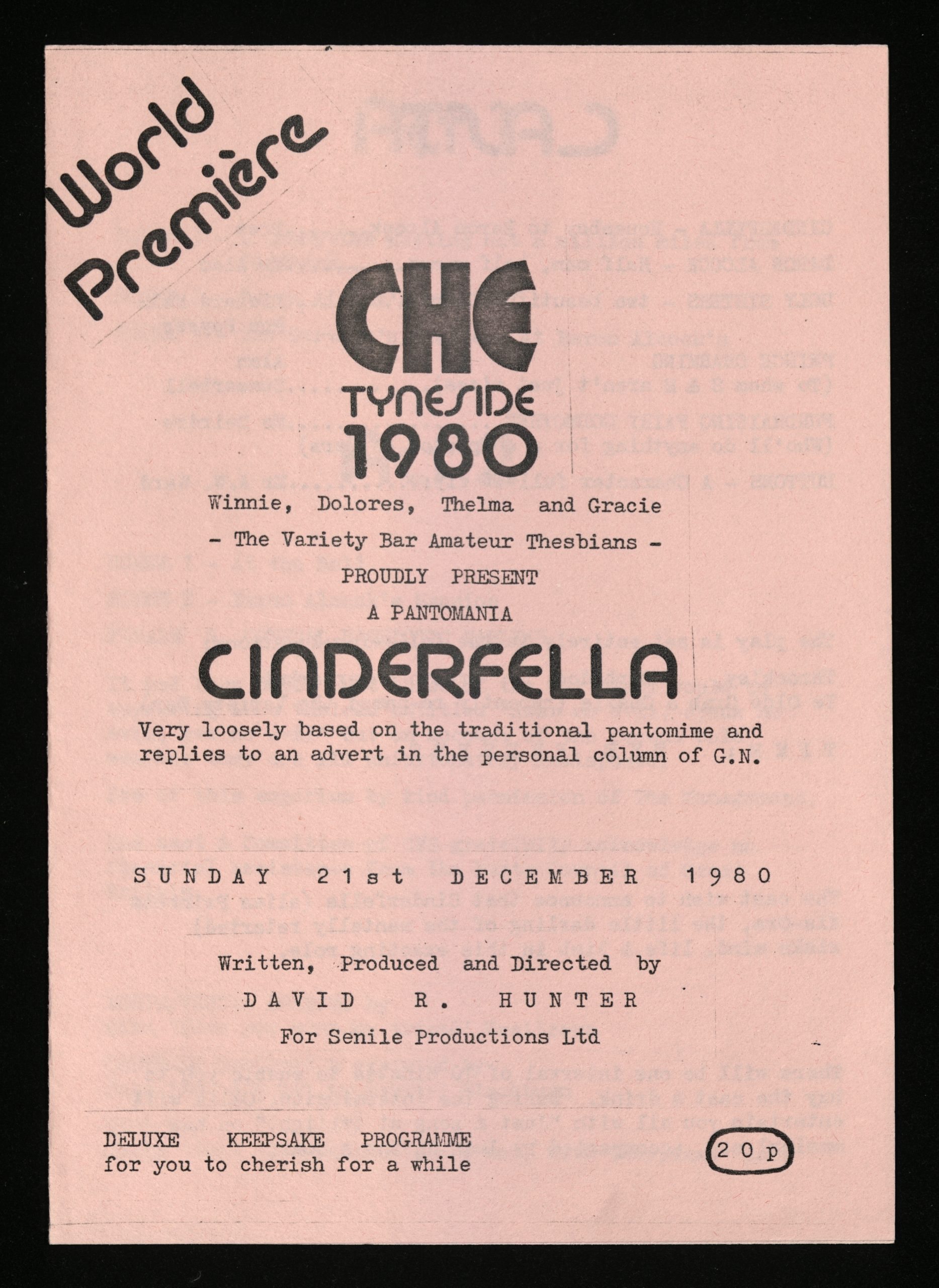
As well as organised trips, in-house events and productions formed a very significant part of Tyneside CHE’s activities too, from regular film nights and coffee mornings hosted in members’ own homes, to an organised street theatre group which made regular performances on Newcastle’s Northumberland Street. This production of Cinderfella in December 1980 was Tyneside CHE’s own take on a traditional festive pantomime.
Programme for Cinderfella by Tyneside CHE, 21 December 1980 (CHE/01/05)
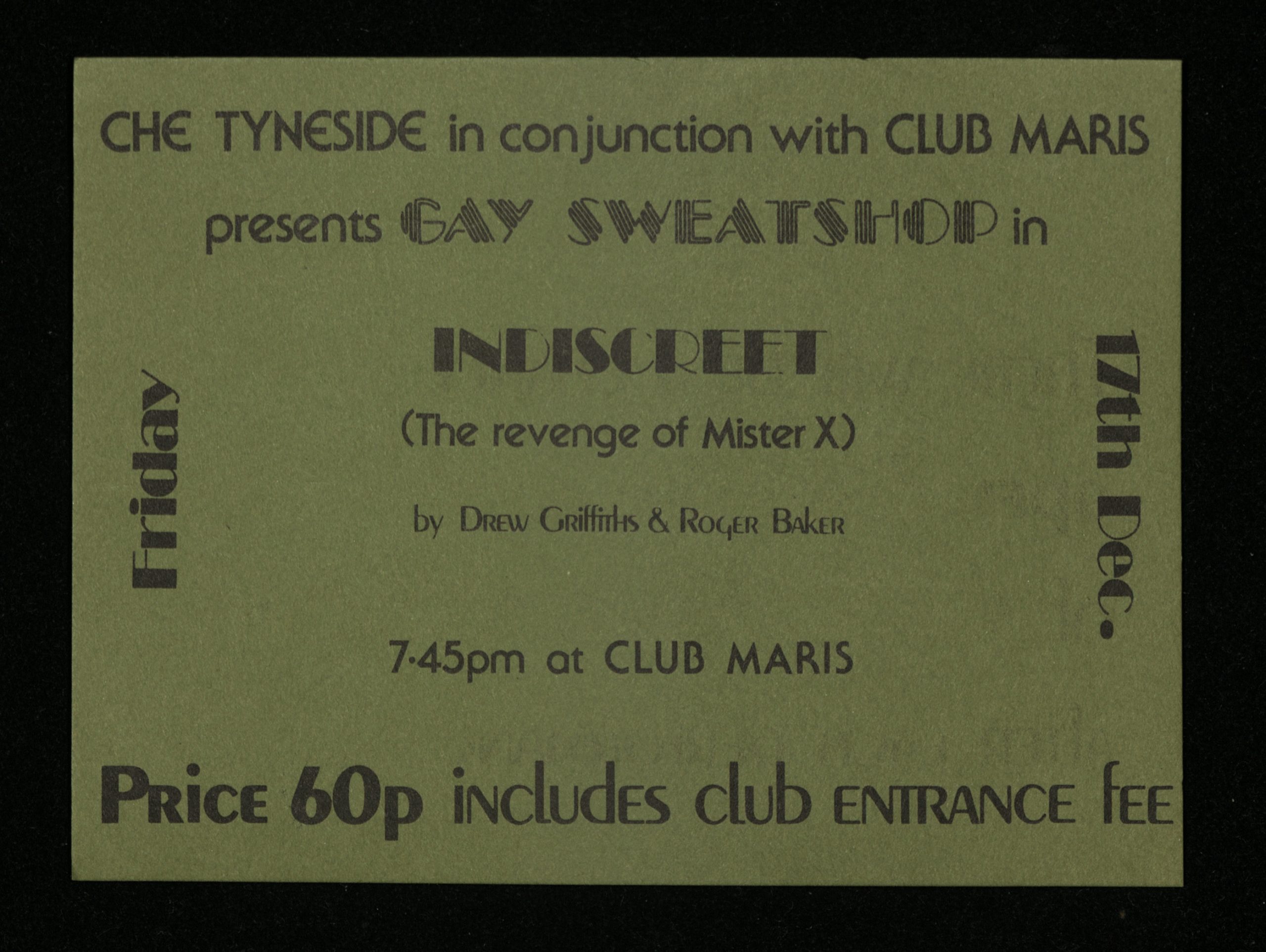
Theatrical performances and arenas provided a relatively safe and creative space for LGBTQ+ individuals to express their identities, desires, and experiences. Tyneside CHE supported and hosted several touring productions of Gay Sweatshop, a London-based theatre company and the first gay theatre company, which was formed to counteract prevailing misconceptions about homosexuals and promote awareness of sexual oppression experienced by the gay community. This ticket relates to a performance of the play Indiscreet in Newcastle on 17 December 1976.
Ticket for performance of Indiscreet by Gay Sweatshop in Newcastle, 17 December 1976 (CHE/01/05)
Ticket proofs for performance of All our Yester-Gays by the Consenting Adults in Public theatre company in Newcastle, 12 August [1976?] (CHE/01/05)
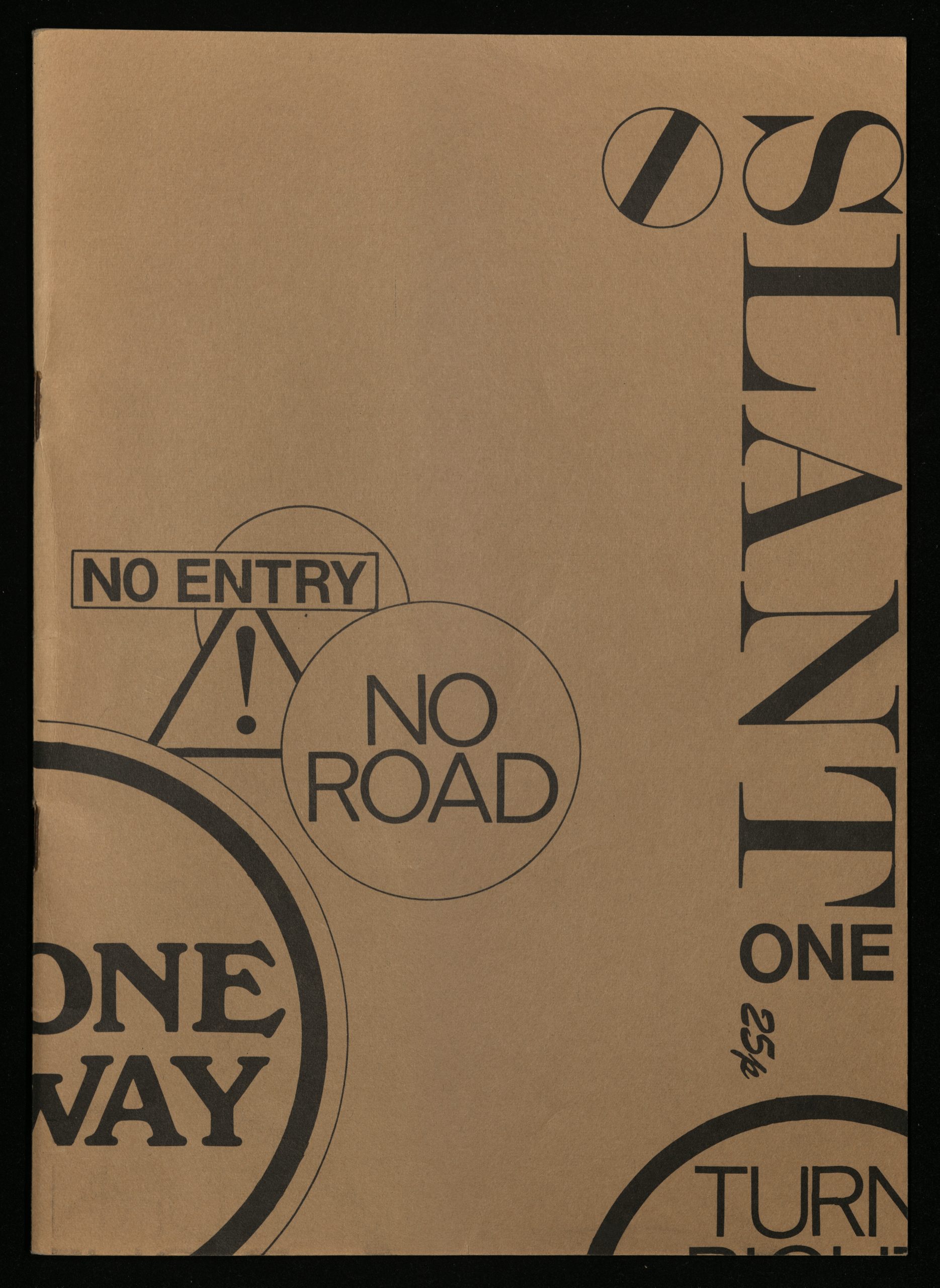
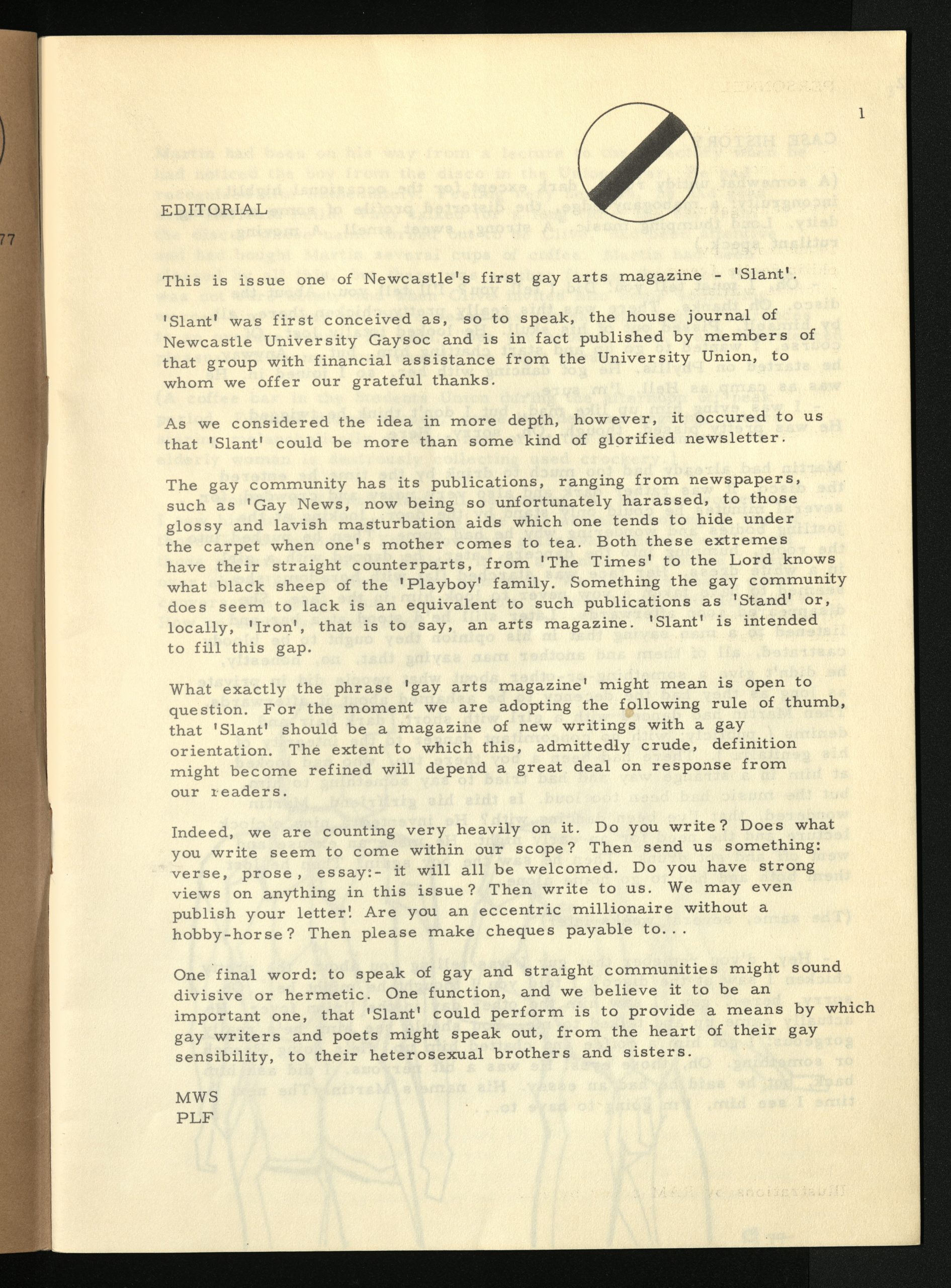
Arts magazines played a crucial role in the early LGBTQ+ movement, by providing a space for expression, visibility, and community when mainstream media marginalized or ignored LGBTQ+ voices. Newcastle’s first gay arts magazine Slant was published in February 1977 by Newcastle University’s Gaysoc, with assistance from the Student’s Union. According to the Editorial in its first edition, it was formed “to be a magazine of new writings with a gay orientation” and “to provide a means by which gay writers and poets might speak out, from the heart of their gay sensibility to their heterosexual brothers and sisters”.
Front cover of Slant magazine, issue 1, February 1977 (CHE/05/02)
Editorial, Slant magazine, issue 1, February 1977 (CHE/05/02)
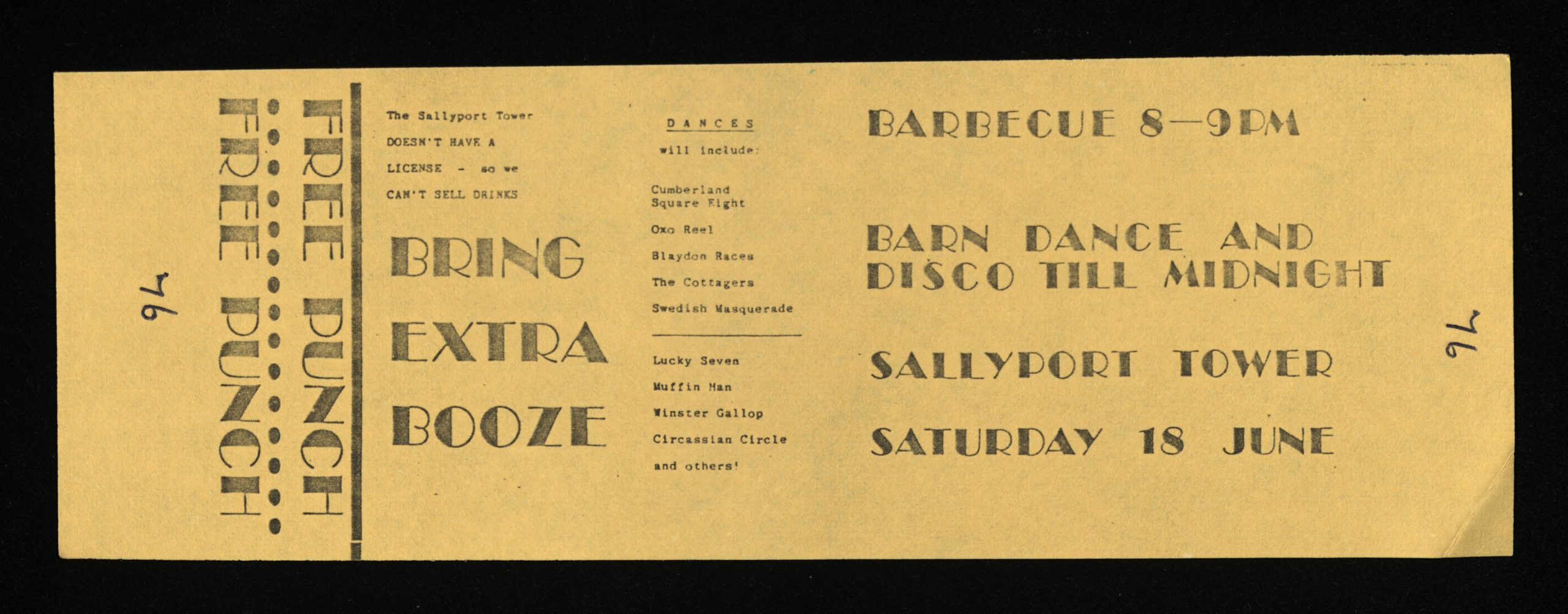
As Tyneside CHE arrived at its ten-year anniversary in 1982, celebrations included a barn dance featuring many traditional and well-known country dances and tunes, including Cumberland Square Eight, Lucky Seven, Winster Galop and the Blaydon Races, again demonstrating the continued importance of culture in unifying and strengthening the movement and its members, and of community gatherings that defied repression and laid the groundwork for LGBTQ+ visibility and activism.
Ticket for Tyneside CHE barn dance and disco, 18June 1982 (CHE/01/05)
Conduct literature is a little-known genre nowadays; it has been absorbed mostly into magazine culture and advice you get from your grandma. But in the 18th and 19th centuries it was a genre of literature that shaped, and was shaped by, popular culture. Conduct literature is texts that give advice on how to behave in polite society and how to run a successful household; in other words, on a person’s conduct. This advice ranged from the practical; how much credit it was acceptable to run up with household vendors; to the philosophical; how best to educate children to make them into functional citizens. The vast majority of these texts were aimed at women: in their capacity as mothers, as wives and as daughters. These manuals formed an influential industry in the late 18th and early 19th century as the French Revolution and Napoleonic Wars raged and the British propaganda machine cultivated the idea of the French as immoral and dissolute compared to Britain’s steadfast morality. This deep-seated aspiration for ethical superiority is seen in the conduct literature of the age, conduct literature found in the 18th century collection at Newcastle University. As part of this collection the University holds books by Hannah More and Mary Wollstonecraft (among others), authors who, despite their varied political viewpoints, used their writing as a way of giving women more power.
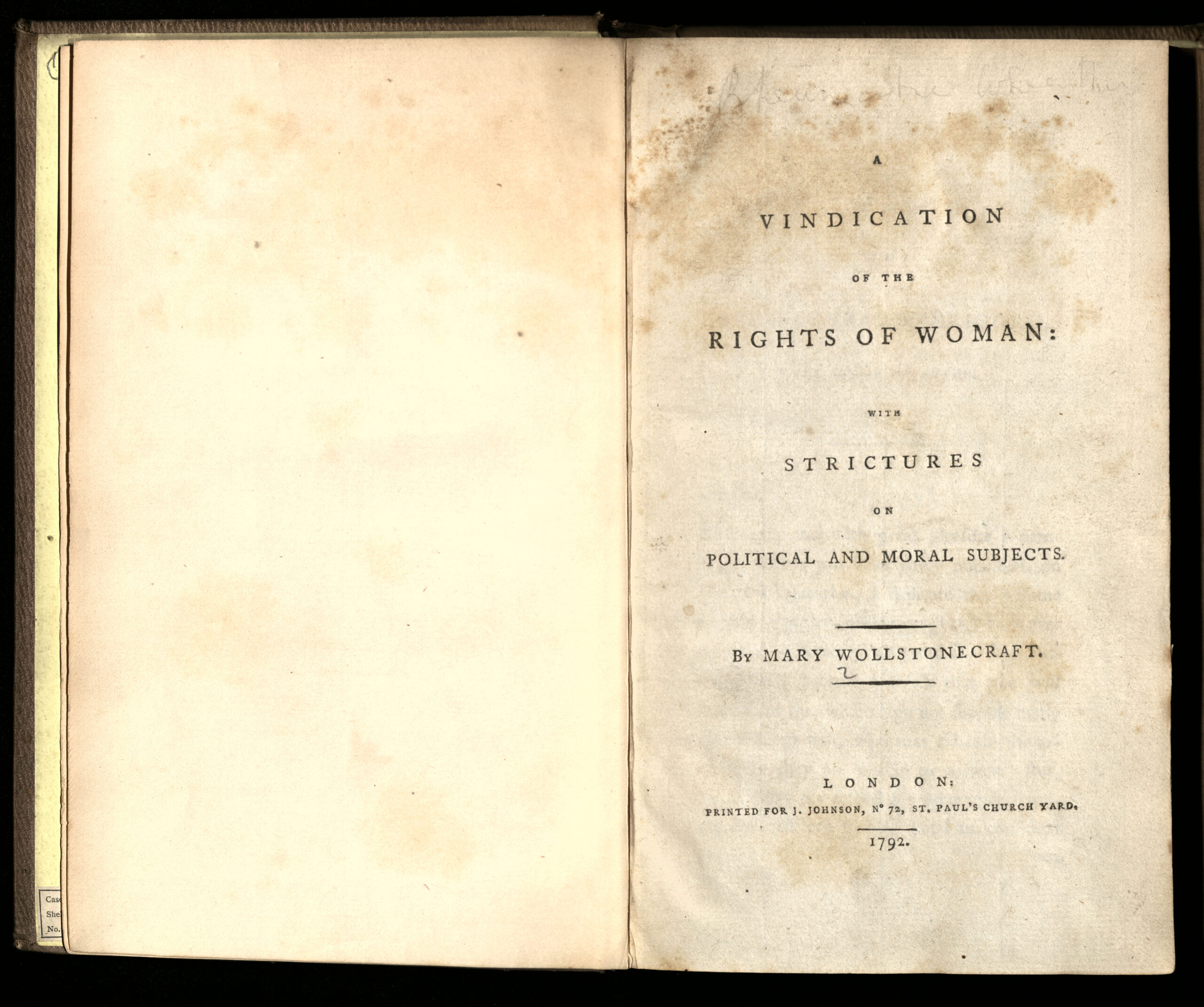
Title page from Wollstonecraft’s A Vindication of the Rights of Woman (18th Century Coll, 18th C. Coll 396 WOL)
Mary Wollstonecraft wrote A Vindication of the Rights of Woman (1792), widely regarded to be one of the first works of feminist philosophy and the precursor to the organised feminist movement. A first edition of this is held in the 18th Century Collection in the Phillip Robinson Library, previously owned by Joseph Cowen, revolutionary Member of Parliament for Newcastle Upon Tyne. This manifesto for female education was a well-known, radical example of the conduct literature genre. Wollstonecraft famously wrote in her introduction to the volume: “My own sex, I hope, will excuse me, if I treat them like rational creatures, instead of flattering their fascinating graces, and viewing them as if they were in a state of perpetual childhood, unable to stand alone.” (6, emphasis original). This sentence is a decisive judgement on both women and the men who interact with them. Wollstonecraft invokes rationality to justify the language of her doctrine; a characteristic that was considered the defining trait of humanity in the 18th century. She also implies that women were treated as being in a ‘state of perpetual childhood’ by men in this era, something that can be seen in the conduct literature written by men in the 18th century. For instance, in Fordyce’s Sermons for Young Women he states, “The Almighty has thrown you upon the protection of our sex. To yours we are indebted on many accounts. He that abuses you dishonours his mother. Virtuous women are the sweeteners, the charm of human life.” (9). Not only does Fordyce imply women to be incapable of functioning without male protection in this statement, but he also designates them as ‘the charm of human life’ thus suggesting them not to be human at all. This is where the different political viewpoints of the female conduct literature writers held in Special Collections at Newcastle are united. Although they differ in how it should be expressed and used, each author acknowledges the female capacity for rationality.
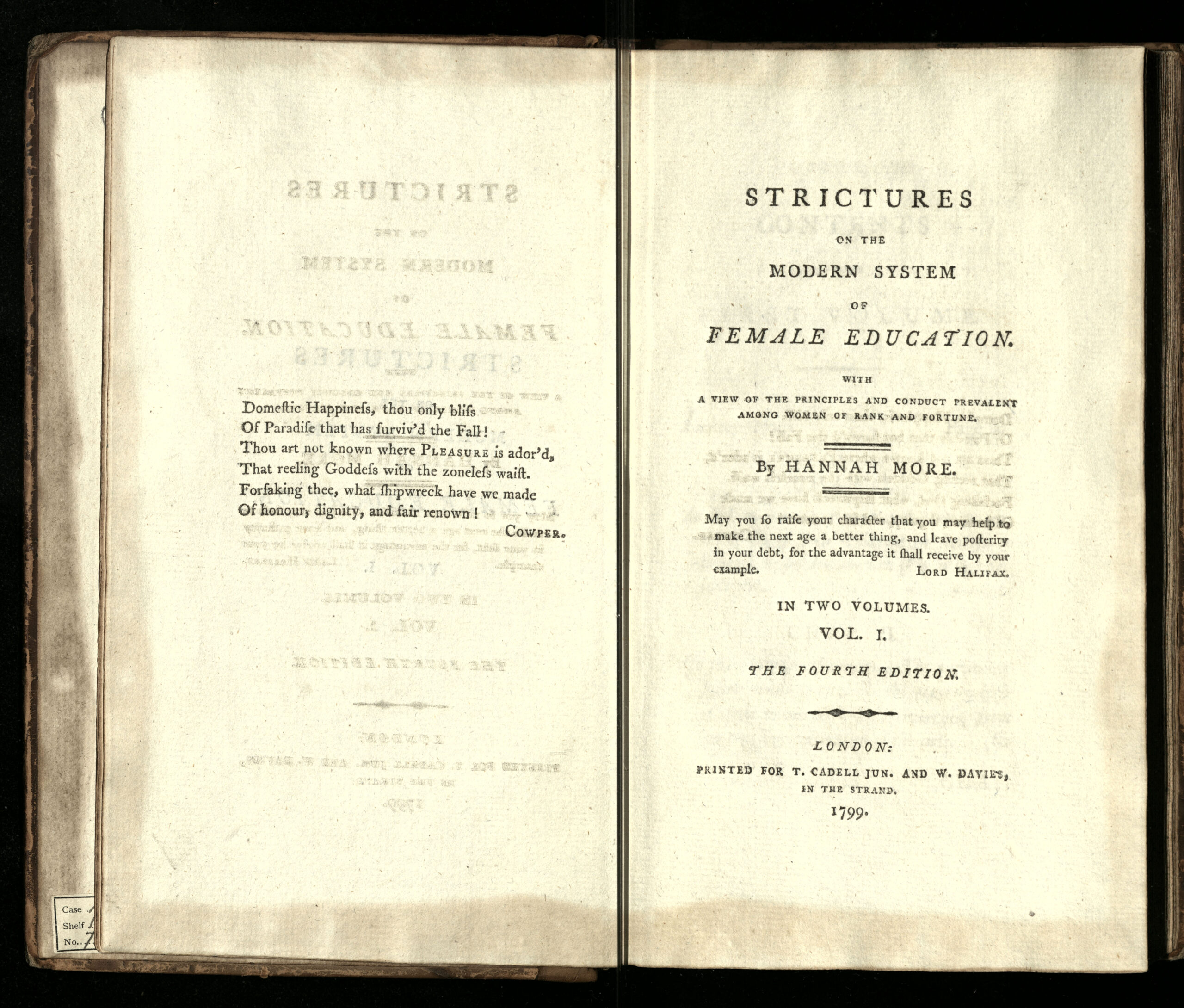
Title page from More’s strictures (18th Century Collection, 18th C. Coll 828.69 MOR)
Another deeply influential text that is held in the 18th Century Collection at Newcastle is conservative moralist Hannah More’s Strictures on the Modern System of Female Education (1799). This is one of many texts by Hannah More that is held by the university, but Strictures is her best well-known work. The text discusses both the practicalities and the moralities of raising children, especially young women. More grounds her philosophy in the importance of the family in raising future citizens and in shaping society. On the title page of the fourth edition copy held in the Newcastle University archives (shown above) she places a quote from Lord Halifax which states, “May you so raise your character that you may help to make the next age a better thing, and leave posterity in your debt, for the advantage it shall receive by your example.” This statement embodies More’s attitude to female morality and education; in Strictures she passes judgement on aristocratic women and their perceived indolence. More, like Wollstonecraft, values the emerging middle-class and their work ethic, manifesting in women through their cultivation of useful employment such as mending, rather than the frivolous, impractical embroidery typically undertaken by the aristocracy. When quoting Lord Halifax, More also invokes the concept of debt to a nation; she perceives women as being as much the cause of Britain’s intellectual superiority as men and as owing their full potential to their country.
The idea that citizens owe their nation morality stems from the conflict with France mentioned earlier; the prevailing opinion in Britain was that the French were immoral and prone to excess, and therefore one way in which Britain was superior to them was through their morality. This created an anxiety around female morality that both informed and was informed by the conduct literature genre, including those held by Newcastle University. Hannah More and Mary Wollstonecraft are two of the most well-known conduct literature authors from the 18th century and occupy opposite ends of the political spectrum. Nevertheless, they are united in their anxiety about female morality during this period and how any degradation of that would affect the nation at large. This collective anxiety eventually led to a societal idolisation of the middle class, whose ideology and ethics would come to set the standard for British society. Mary Wollstonecraft and Hannah More, therefore, form part of a genre that shaped British culture and therefore its history.
Written by bequest student Charlotte Davison, Postgraduate student from the School of English Literature, Language and Linguistics.
Gertrude Bell (1868-1926) was a writer, archaeologist, and colonial diplomat who played a significant role in the creation of the Kingdom of Iraq in 1921. Although Bell spent the latter years of her life living in Baghdad, her archive and book collection were donated to our library by her family following her death in 1926. Bell’s archive remains one of our most heavily used collections and has recently been made available on our dedicated Gertrude Bell website after being digitised and catalogued to current archival standards. Bell’s book collection, which comprises her working and personal library, complements the archive by contextualising her activities and providing an insight into the way she worked and learned throughout her life.
Although Bell’s own output is impressive (the archive contains over 12,000 unique items), her book collection reflects her diverse interests and shows us the ways in which the work of others supported and inspired her travels. Additionally, Bell’s books are often annotated with notes which document the learning process whilst also serving as reminders of key information she regarded as important. The selection of books in her library and the copy specific information they contain can be interpreted by researchers looking to further understand the work and methods of this unique historical figure.
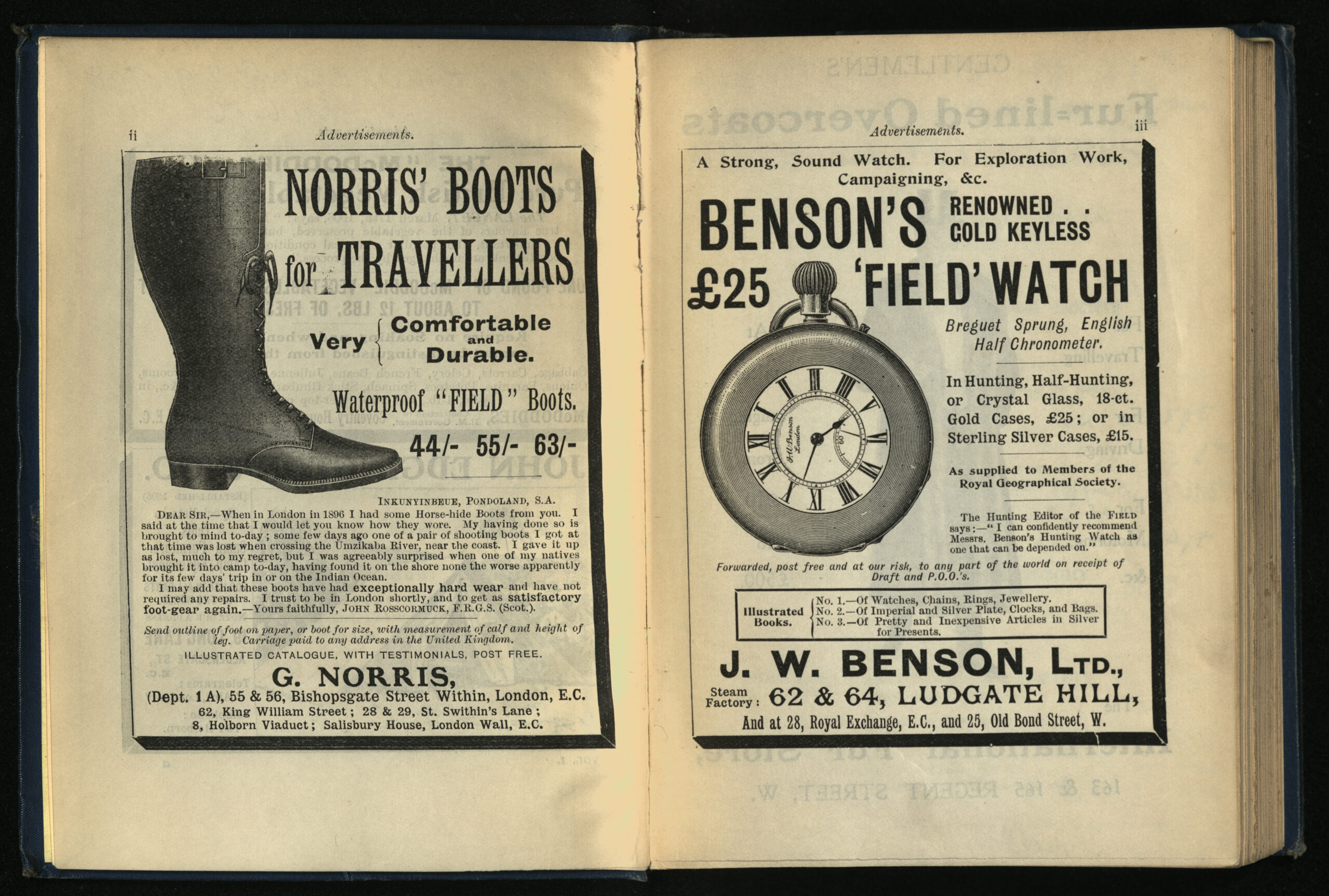
One item within Bell’s book collection which illustrates the way she used and interacted with her books is her copy of Hints to Travellers: Scientific and General (B910.2 REE) published in 1906 by the Royal Geographical Society. Hints to Travellers was originally created by the Society for,
“a person who, proposing to explore a wild country, asks what astronomical and other scientific outfit he ought to take with him, and what observations he may attempt with a prospect of obtaining accurate results”.
The guide included sections on a wide variety of topics including climate, geography, anthropology, and astronomical observations as well as comprehensive lists of pieces of equipment a traveller would need to take with them on their journey.
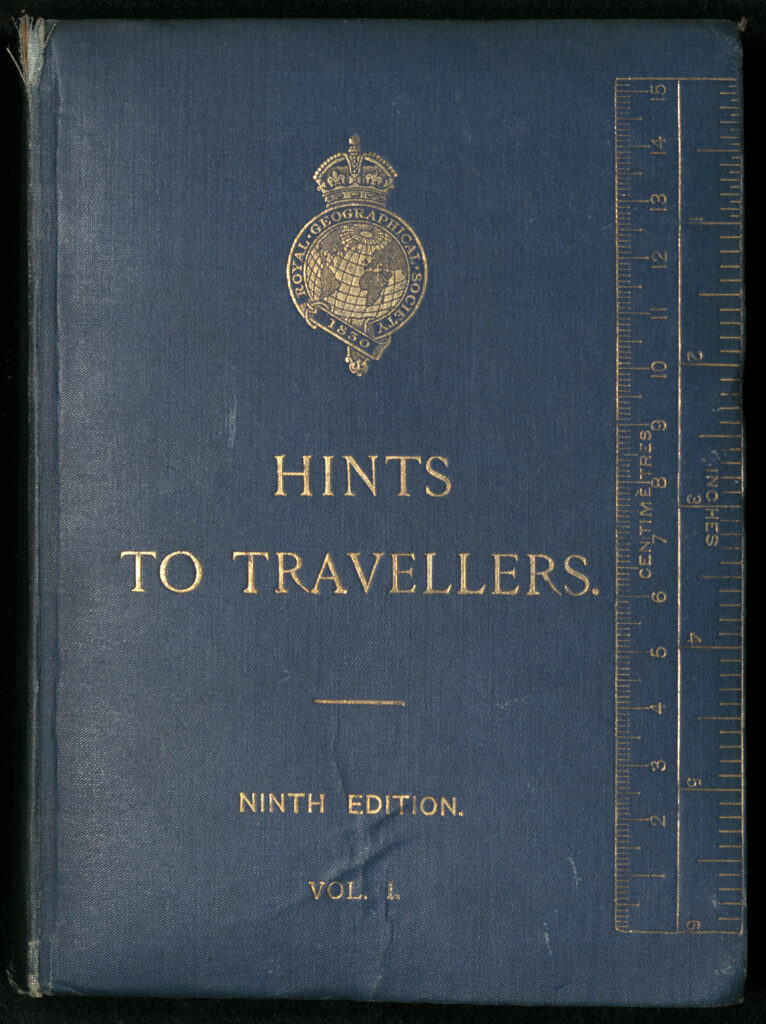
Bell’s copy of the ninth edition of Hints to Travellers: Scientific and General (Vol. 1) [Gertrude Bell Collection, B910.2 REE]
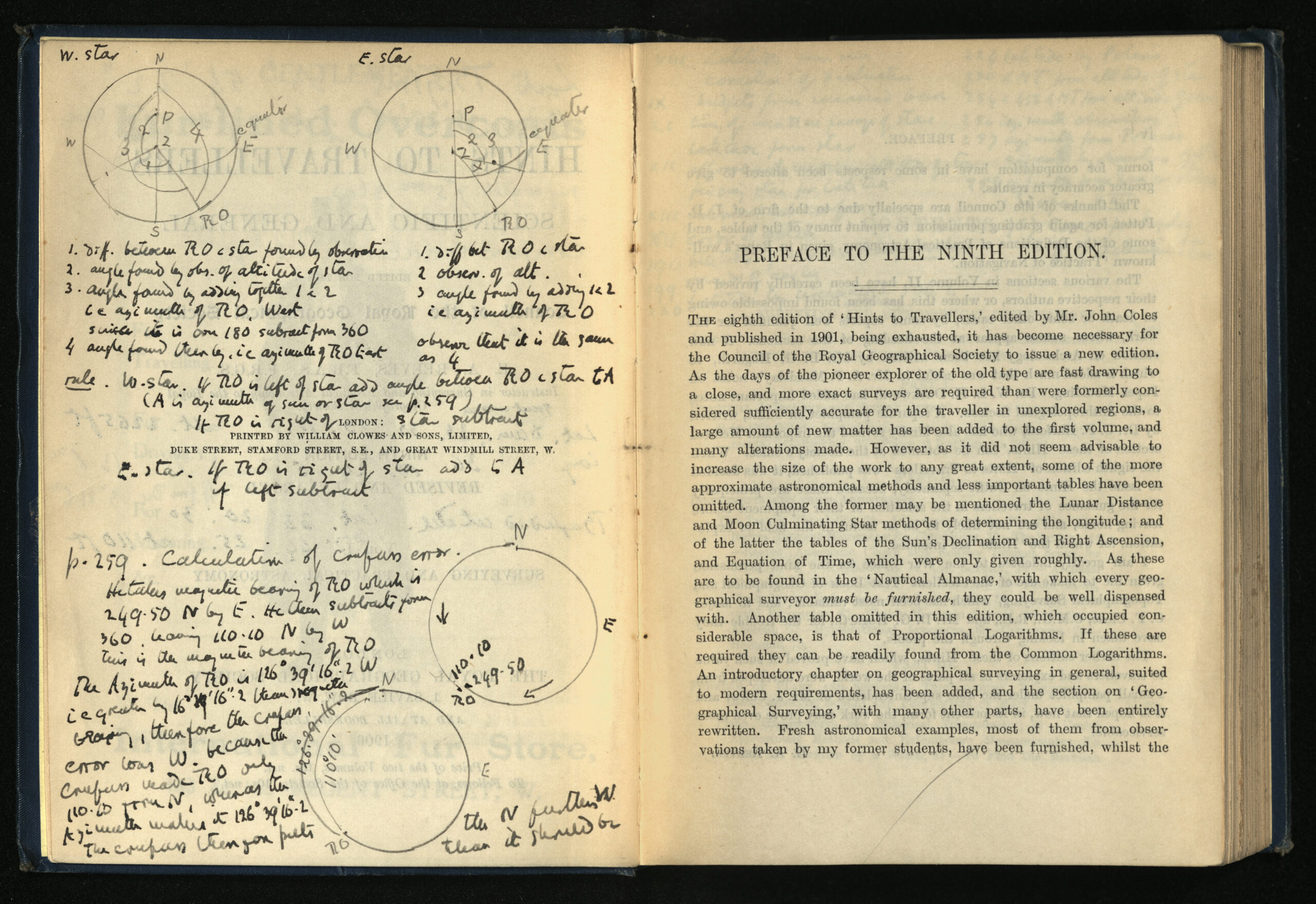
Bell owned a copy of the ninth edition of the Guide (above), which was published in 1906 and split into two volumes. The first volume, which focused on “Surveying and practical astronomy”, is particularly special as Bell has filled many of the pages with handwritten notes and diagrams. These notes document both her learning process and her use of the methods explained within the book.
Pages from Hints to Travellers: Scientific and General (Vol. 1) showing much of the blank space in the first section of the book filled with Bell’s handwritten notes and diagrams [Gertrude Bell Collection, B910.2 REE]
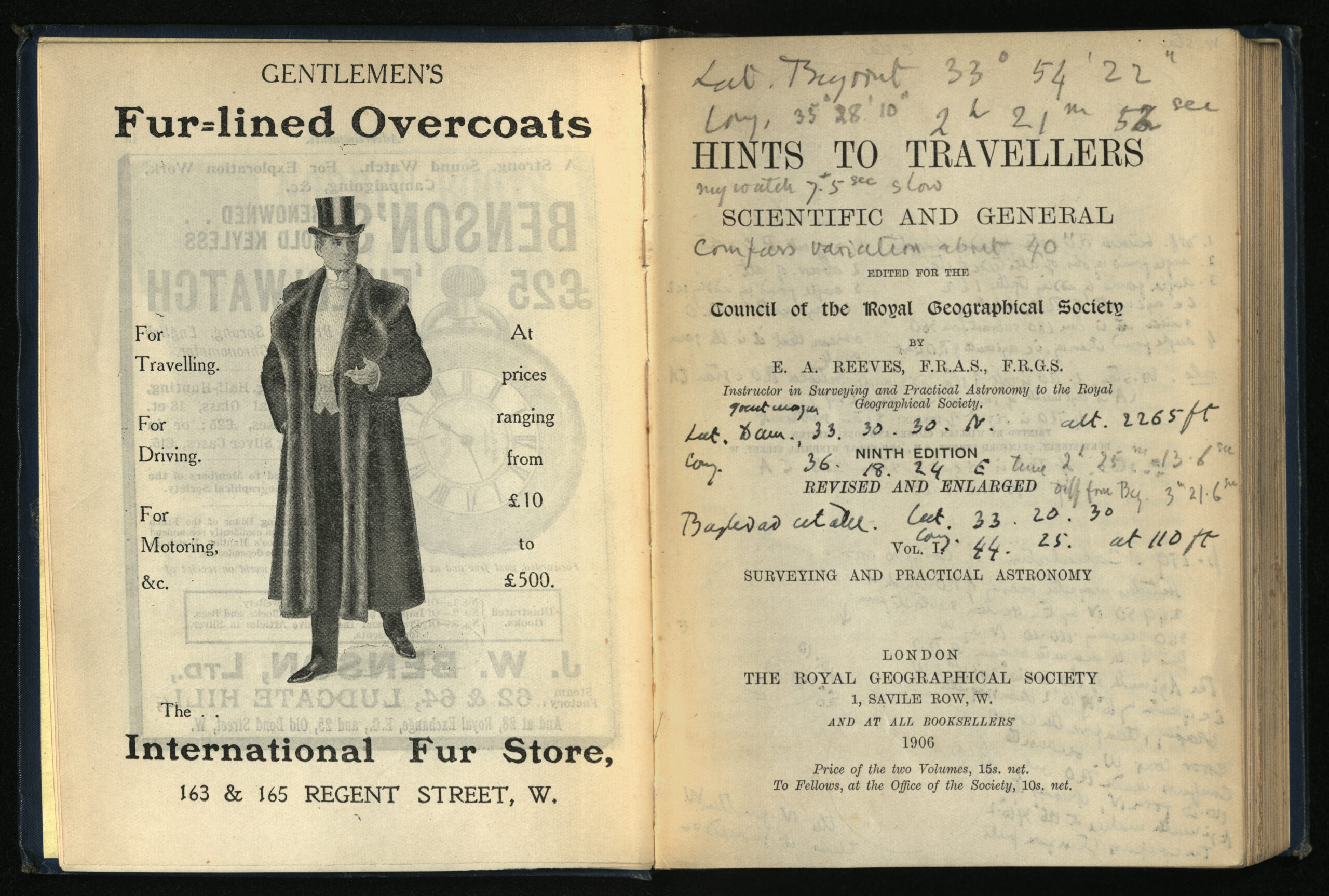
Bell has also included the latitude and longitude of locations in Lebanon (“Beirut”) and Iraq (“Baghdad Citadel”), which she has presumably been able to calculate using the guide.
Pages from Hints to Travellers: Scientific and General (Vol. 1) [Gertrude Bell Collection, B910.2 REE]
Many of the books within Bell’s library, such as language and grammar books as well as works focusing on history and culture within the Middle East, provide a unique insight into the ways in which Bell prepared herself for her travels across the region. They also indicate the voracious appetite she had for reading and learning, and the wide variety of subjects in which she took an interest.
Pages from Hints to Travellers: Scientific and General (Vol. 1) [Gertrude Bell Collection, B910.2 REE]
Bell’s copy of Hints to Travellers: Scientific and General can be requested here.
Photograph of Benjamin Zephaniah (BXB/1/1ZEP/1/5, Bloodaxe Books Archive)
In honour of the life and works of Dr. Benjamin Zephaniah (1958-2023), March 2024’s Treasure of the Month is his work from the Bloodaxe Books Archive. Benjamin Zephaniah was a dub poet born in Handsworth in Birmingham who rose to become Britain’s third favourite poet, according to a BBC poll in 2009. He was known for his hard-hitting performance poetry about race, class and injustice in modern Britain as well as his portrayal of preacher ‘Jeremiah Jesus’ in Peaky Blinders.
Benjamin Zephaniah reading his poem Money in Newcastle City Centre in 1991
Zephaniah also famously rejected an OBE (Officer of the British Empire) in 2003, his response was a decisive, honest commentary focused on his relationship with empire:
“Me? I thought, OBE me? Up yours, I thought. I get angry when I hear that word “empire”; it reminds me of slavery, it reminds of thousands of years of brutality, it reminds me of how my foremothers were raped and my forefathers brutalized. It is because of this concept of empire that my British education led me to believe that the history of black people started with slavery and we were born slaves, and that we were born slaves, and should therefore be grateful that we were given freedom by our caring white masters. It is because of this idea of empire that black people like myself don’t even know our true names or our true historical culture. I am not one of those who are obsessed with their roots, and I’m certainly not suffering from a crisis of identity; my obsession is about the future and the political rights of all people. Benjamin Zephaniah OBE – no way Mr Blair, no way Mrs Queen. I am profoundly anti-empire.”
Benjamin Zephaniah, Gaurdian (2003)
The self-proclaimed anarchist’s commitment to his views extended to work that was consistently radical. Zephaniah used the controversy he inspired to fuel his work and draw attention to injustice. Of the artifacts kept in the Bloodaxe Archive, one such document is the information sheet for his 1992 collection City Psalms. In this Zephaniah actively acknowledges the racist prejudices levelled on him by tabloids such as The Sun, which is quoted directly.
City Psalms Information Sheet (BXB/1/1ZEP/1/4, Bloodaxe Books Archive)
The archival material on Benjamin Zephaniah at Newcastle University contains proofs of Zephaniah’s collections: City Psalms; Propa Propaganda; Too Black, Too Strong and To Do Wid Me. These collections were published by Bloodaxe Books and as such the material held also includes internal documents from within the publishing house concerning edits and forewords. These artifacts give both an insight into Bloodaxe Books’ workings and attitude to a radical poet such as Zephaniah.
Zephaniah’s social commentary covers key political conflicts over his lifetime; he was involved in Nelson Mandela’s campaign against apartheid, commented on the Israeli-Palestinian conflict and the 1990 poll tax riots, among others. His work covers all formats, printed, spoken word and digital, allowing for an accessible form of poetry that does not adhere to the traditional British literary cannon. Zephaniah commented on the need for accessibility in his poem “Dis Poetry” which he performed at Live Theatre in Newcastle in 2009.
Benjamin Zephaniah reading Dis Poetry at Live Theatre in Newcastle in 2009.
One of the collections held in the Bloodaxe archives is Too Black, Too Strong, published in 2001. This collection was born of a residency at Tooks Barristers’ Chambers funded by The Poetry Society and as such contains poetry that comments on legal systems and notable cases that occurred during Zephaniah’s residency there. One such poem is called What Stephen Lawrence has taught us, a poem commissioned by Independent Television News for Channel 4 News which discusses the well-publicized murder of 18 year old Stephen Lawrence whilst he waited for a bus in April 1993. This attack initiated a public enquiry, resulting in the Macpherson report, which deemed the Metropolitan Police Service institutionally racist and incompetent. Zephaniah’s poem talks about the state of Great Britain after Stephen Lawrence’s murder and declares that institutional racism “is now an open secret”. Despite this damming conclusion the poem has a thread of hope running through it, Zephaniah states,
“The death of Stephen Lawrence / Has taught us to love each other” and the final stanza of the poem contains a plea to the Metropolitan Police Commissioner, Sir Paul Condon asking him to “Pop out of Teletubby land, / And visit reality”.
The vibrant life of Benjamin Zephaniah will leave an imprint on Britain’s art and literary scene for generations to come, his infectious passion for the work that mattered, for the future of the British people and for the potential they have, will, I hope, never be forgotten.
The artifacts surrounding Benjamin Zephaniah’s work are accessible via the Special Collections Reading Room at Newcastle University, and his spoken word poetry is available through Bloodaxe Books’ YouTube channel or Zephaniah’s own website.
Written by Charlotte Davison, PGR student at Newcastle University English Literature, Language and Linguistics.
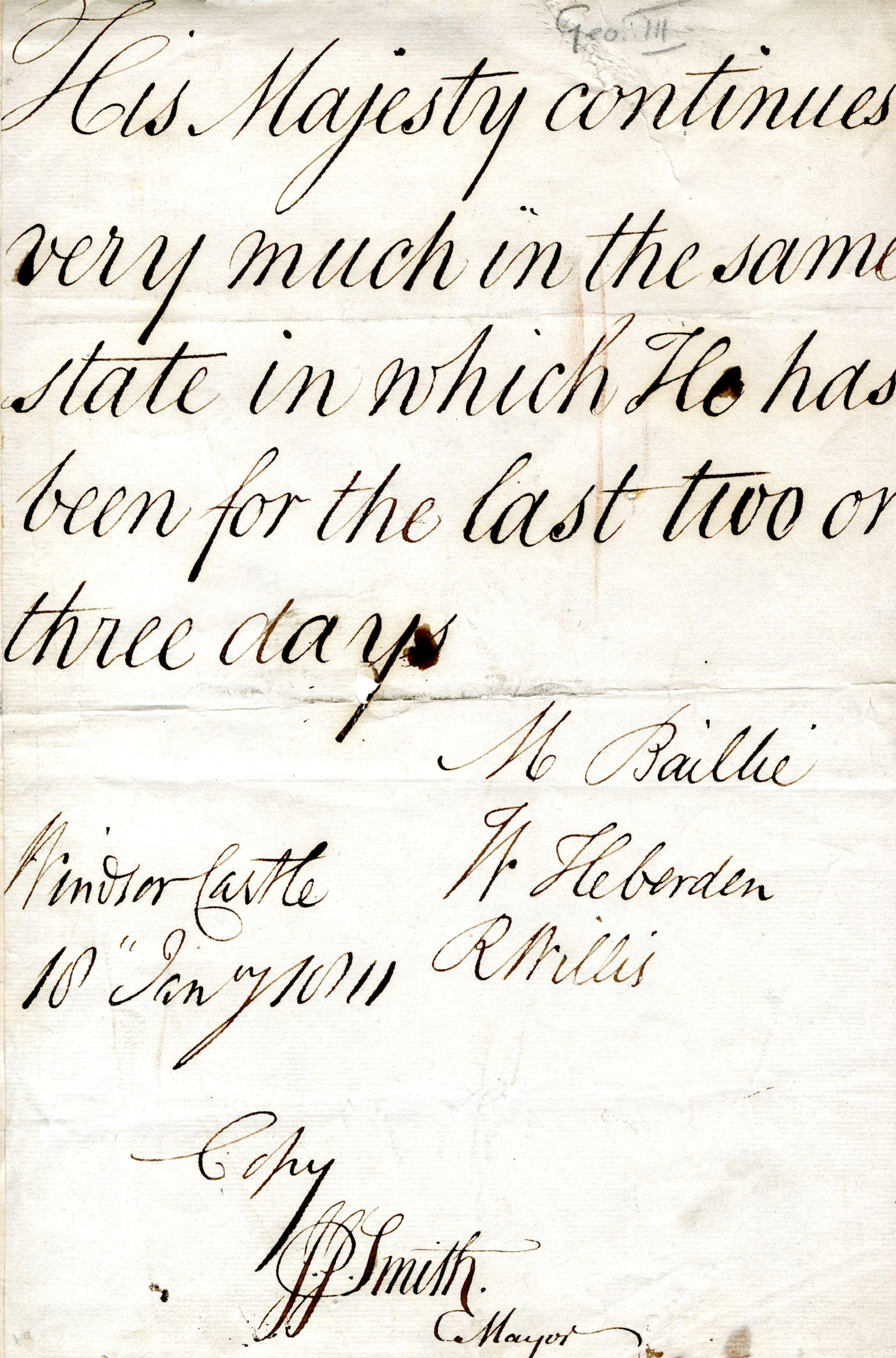
The story of King George III’s illness, the repeated bouts of mental instability and derangement from which he suffered from 1788 until the end of his reign, known variously as “the Royal Malady” or “the madness of King George”, is a familiar one.
This bulletin, carrying the latest news on the status of George III’s illness, was issued from Windsor Castle by his doctors and physicians on 18th January 1811, during his final and longest bout of illness and just a few months after his final public appearance at a reception at Windsor.
Bulletin on the health of King George III, 18th Jan 1811 (Pybus (Charles Frederick) Archive, FP/2/7/10)
Bulletins on the king’s health were issued throughout his illness and were intended for public consumption as well as for the eyes of the queen and her council. At this stage the bulletins were being issued daily and deliberately lacked any real or valid detail about the king’s health, being designed to allay alarm rather than to record medical facts and to protect the dignity of the king as well as the feelings of the queen and the royal family. This bulletin, therefore, is a typical example of its type.
It is signed by Matthew Baillie, physician-extraordinary to the king, William Heberden the younger, the king’s physician-in-ordinary, and Robert Willis, who specialised in the treatment of mental disorders. Although the bulletin carries the signatures of all three men, it is known that, by this stage, the royal physicians had been ordered by the queen’s council to leave the daily management of the king’s illness to specialist “mad-doctors” and that to this task the council had appointed John and Robert Willis, sons of the reverend Francis Willis who owned a private asylum and who had been credited with bringing about the king’s recovery from his first bout of illness in 1789.
The Willises favoured the use of repressive and coercive forms of treatment such as the use of the strait-jacket and restraining chair, both of which the king was subjected to, as well as enforced confinement and a strict medical regime to bring down his “fever” and “turbulent spirits”, including vomits, purges, bleeding, blistering, the application of leeches and regular doses of medicine. During the king’s last illness both Baillie and Heberden sounded strong objections to the methods of treatment handed out to him by the Willis brothers, but were ignored.
At the time this bulletin was issued, the king had relapsed midway through the previous month and had been very ill over Christmas and New Year. The following month, he would be declared mentally unfit to rule and his eldest son, the future George IV, would be appointed Prince Regent to rule in his place. Thereafter the king would spend the last ten years of his life in a twilight world, deprived of visitors, conversation and outings under the Willises’ regime, losing his sight and growing increasingly deaf, until his death at Windsor on 29th January 1820.
Although George III’s symptoms were identified as insanity by contemporary doctors, it is now widely held that he was in fact suffering from the rare hereditary blood disorder porphyria. A classic physical symptom of porphyria is deep red or purple coloured urine, and this was found to be evident throughout the notes and observations contained in the journals and correspondence of the king’s physicians when they were re-examined in the 1960s. Furthermore, in its acute form, porphyria is known to produce neurological damage and mental instability. Further research in 2005 concluded that the king’s porphyria attacks were quite possibly brought on by a build-up of arsenic in his system (tests on a sample of his hair showed it to contain over 200 times the toxic level), thought to have been caused by one of his medicines, James’ Powder. The Powder, which, tragically, was administered to him several times daily, was made from antimony which in turn contains significant amounts of arsenic.
The bulletin is contained in a collection of medical manuscripts donated to the library by Professor Pybus (1883-1975) who donated his private collection on the history of medicine, including books, manuscripts, engravings, portraits, busts, bleeding bowls and research notes, to the University Library in 1965.
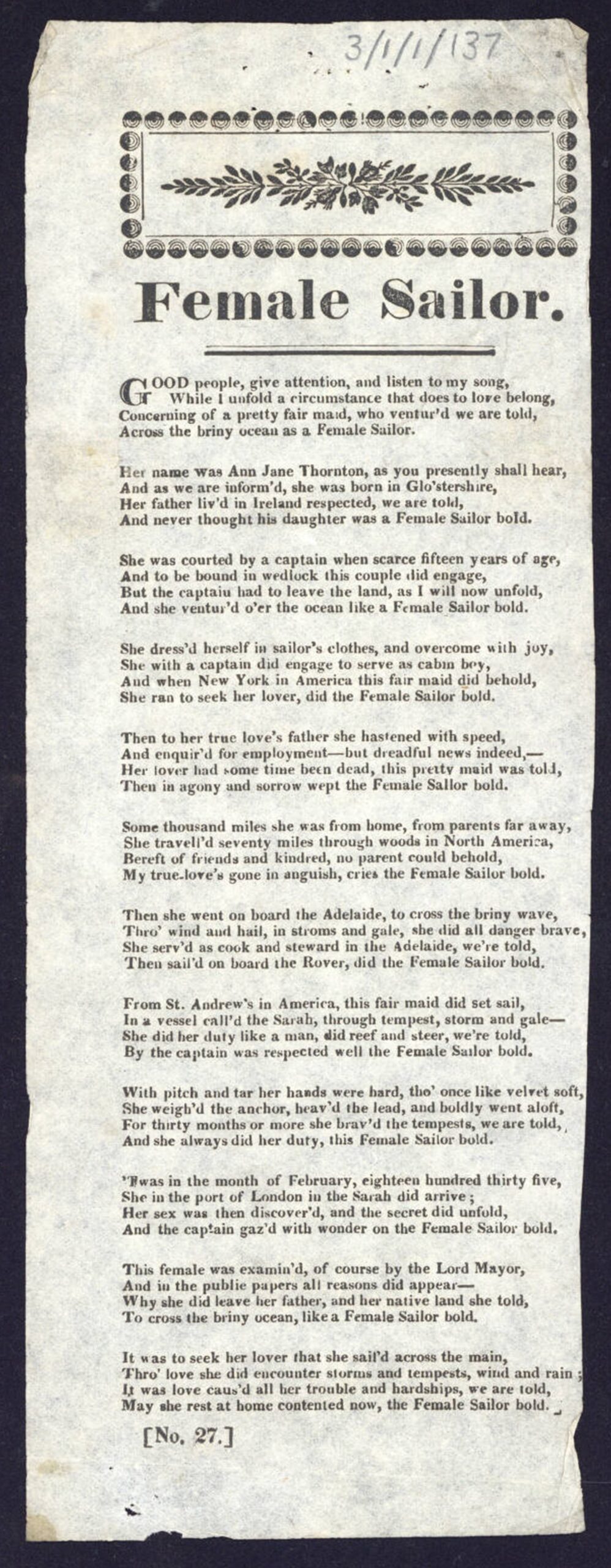
The life and adventures of Ann (also spelled ‘Anne’) Jane Thornton, a woman who defied the prescribed gender roles of the nineteenth century, are commemorated in the popular broadside ballad The Female Sailor.
Ann Jane Thornton resisted society’s gender restrictions by dressing in male clothing and going to sea as a sailor. She was born in 1817 in Gloucestershire and was the daughter of a shopkeeper. When Ann was just 6 years old her mother died, and her father moved the family to Donegal, Ireland.
TheFemale Sailor ballad captures Ann’s meeting and falling in love with an American Captain named Alexander Burke when she was just 15 years old. The two got engaged, but shortly afterwards, the Captain returned to New York to visit his father. Not wanting to be left behind, Ann needed a way to finance her travels to follow her beloved, and so she took the unconventional decision to become a female sailor, leaving her life in Ireland behind.
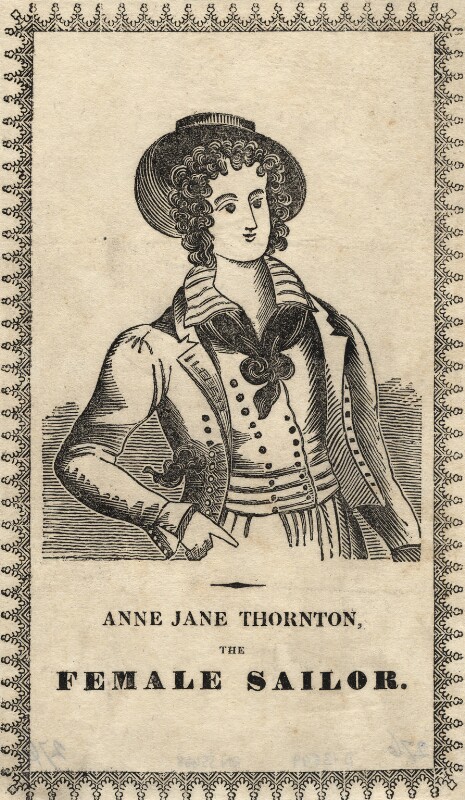
Anne Jane Thornton by Unknown artist, woodcut, published 1835 (National Portrait Gallery, Reference Collection, NPG D13549). Used by permission of The National Portrait Gallery under the terms of a Creative Commons Licence: http://creativecommons.org/licenses/by-nc-nd/3.0/
In the nineteenth century, sailing was a male-dominated activity and women were banned from seafaring professions as many believed that having women onboard was bad luck. Women were also thought to be at risk of sexual harassment and violence from the male crew if permitted on board. As a result, the only way for Ann to pursue her goal of following her fiancé was to disguise herself as a man.
Ann proceeded to obtain male clothing and journeyed to England, where she then boarded a ship to New York as a cabin boy. Once in New York, Ann sought out her beloved fiancé but received the devastating news that he had died.
Whilst abroad, Ann needed an income to support herself, and so she took a job as a cook and steward onboard the Adelaide, earning nine dollars a month. TheFemale Sailor ballad stresses how Ann took part in every task the same as her male colleagues, doing her duty ‘like a man’, and convincingly taking on her new identity. As well as working on the Adelaide, Ann also worked aboard the Rover and the Belfast, before eventually heading back to London as a ship’s cook onboard the Sarah.
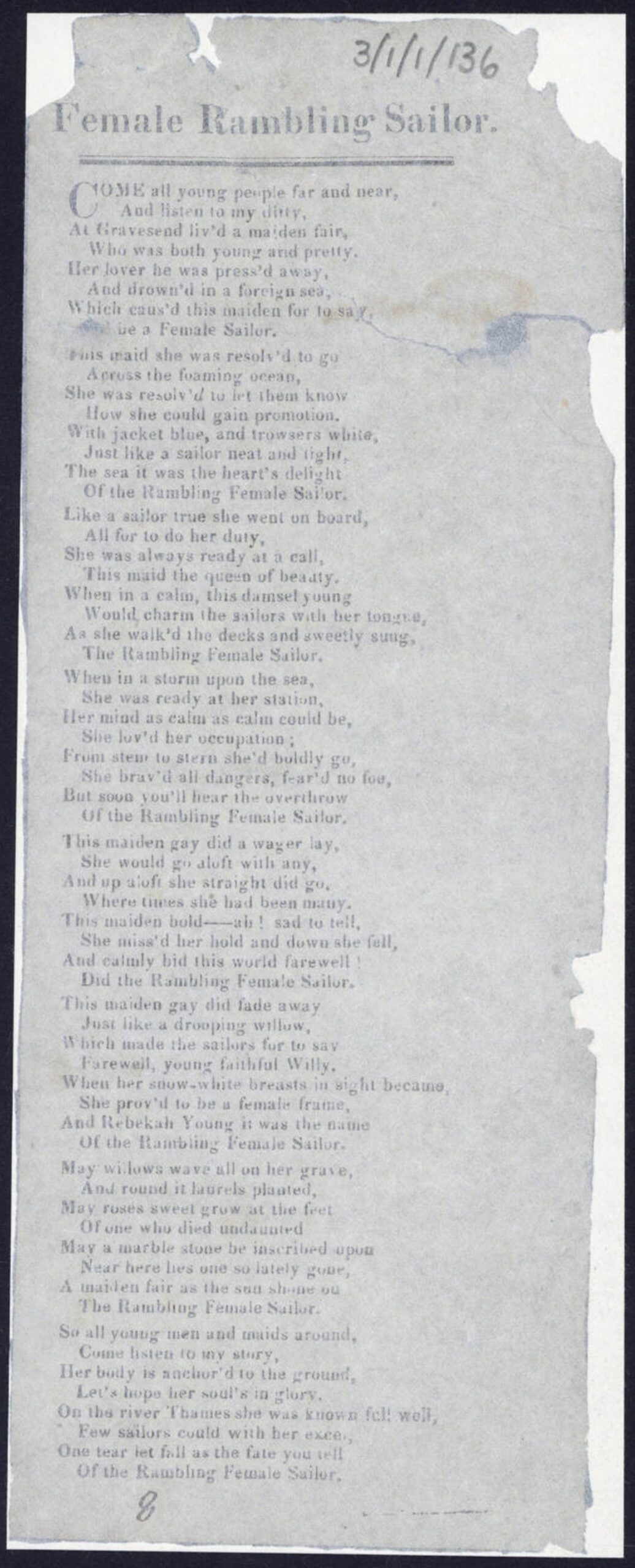
Ann Jane Thornton was far from the only woman to don male clothing and become a sailor. Another broadside ballad within Special Collections and Archives, called the Female Rambling Sailor, tells the story of Rebekah Young, who went by the name Billy Bridle. Whilst at sea, she died by falling from the top of the mast. This ballad perhaps served as a warning to any other women considering disguising their sex to become a sailor.
Ann lived in her new identity as a man for the whole three years she was away from home, going by the name Jim Thornton from Donegal. Conflicting accounts exist of whether it was upon her return to London, or whilst docked in Lisbon, Portugal, that Ann’s sex was revealed, but either way her identity was outed and her life as a sailor came to an end. The revelation happened as a result of a male colleague on board the Sarah catching sight of Ann’s breasts while she was washing. He threatened to disclose her identity to the ship’s Captain unless she had sex with him. Refusing to submit to the sexual harassment, Ann’s identity was revealed to the Captain. Describing the event later, the Captain claimed he was the last to know and could barely believe it.
It is difficult to determine how much of these accounts are true, with many contrasting versions of the ballad existing. However, the very fact of so many iterations surviving demonstrates the extent to which Ann’s story captured the imagination of the British public. Her story was widely reported in newspapers as well as being popularised in The Female Sailor ballad. After reading the newspaper reports, the Lord Mayor of London allegedly sent a city police inspector to investigate her story. The mayor scolded Ann for leaving her father, but also praised her courage, offering to support her financially until she could return home to Ireland.
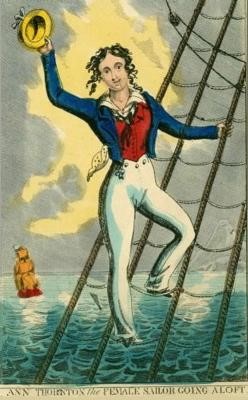
c.1835 Engraving of Ann Thornton, the Female Sailor Going Aloft, by unknown artist. Image available via Wikimedia Commons
Ann’s story was told many times by other people. However, the autobiographical chapbook – Interesting Life and Wonderful Adventures of that Extraordinary Woman, Anne Jane Thornton, the Female Sailor, disclosing important secrets, unknown to the public, written by herself – offers a rare insight into the personal experiences of Ann’s life as a female sailor. The publication of this book ultimately provided Ann with the opportunity to reclaim her adventures and recall them in her own voice.
This Treasure of the Month feature was researched and written by Special for Everyone placement student Daisy Alys-Vaughan of the School of History, Classics and Archaeology. our Special for Everyone project.
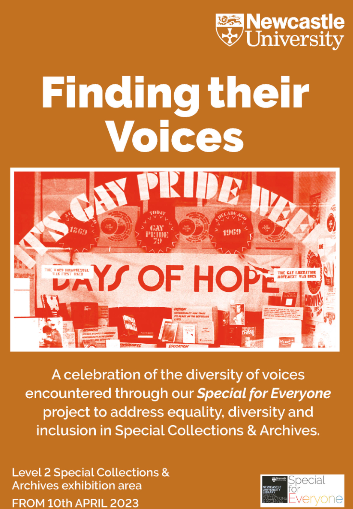
As part of the Special for Everyone project to address equality, diversity and inclusion in Special Collections & Archives, Finding their Voicesis an exhibition celebrating the many diverse voices present within our collections.
Many of the voices within Special Collection & Archives have long been visible and heard, yet those from marginalised groups in society have often been obscured. Our Special for Everyone project is actively working to diversify the voices included in our collections and to illuminate the hidden or lesser-heard voices they contain. We are doing this by taking a fresh look at the sources and, where necessary, reading between the lines to uncover those which are harder to find.
Finding their Voices is a celebration of some of the people we have encountered through this work. It features people who found and made their own voices heard despite their often-marginalised position, and those whose voices have been more difficult to hear. We are amplifying them here to enable a new generation of researchers to discover them.
The exhibition contains items from across Special Collections & Archives. Below are some of the exhibition highlights:
Working-Class Mining Communities
The lives of people from working-class communities in the past can often be difficult to discern within the official record. However, closer examination and interrogation of sources can help to uncover their history and voices.
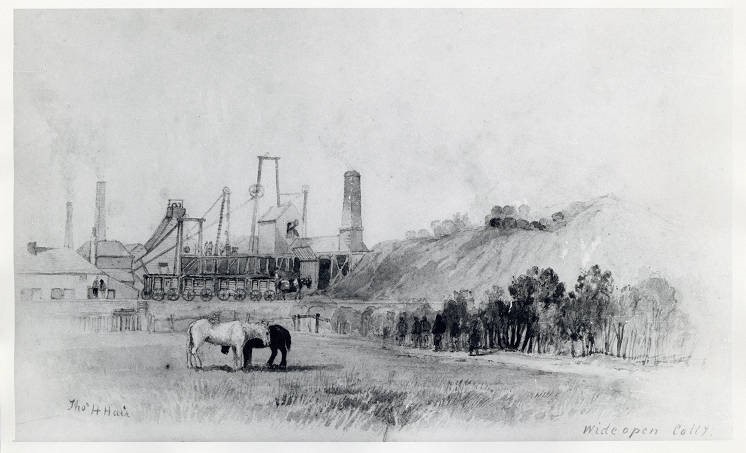
Thomas Hair (c.1810-1875) was a local artist whose illustrations depict the North East’s coal mining industry in the 19th century. His work captures the everyday workings of the industry, with many of the illustrations focussing on collieries, machinery, and river trade. Hair’s work provides visual evidence of the coal mining landscape and reveals the industry’s impact on the built environment. These images can tell us much about the lived experience of miners in this period, giving a ‘voice’ to their lives and the hard-working conditions they faced.
Poet David Bateman had a severe stutter as a child and teenager. He had successful speech therapy in 1980, aged 23. Since then, he still has a slight stutter in ordinary life but performs his poetry widely and has won many poetry slams and competitions. He writes poems, stories, scripts and articles. His book Shtum is a frank and personal account of what it is to have a stutter, the process of seeking the right help, and of finding your voice.
The poems in Shtum were mostly written between 2009 and 2015, but some have their origins in work from as early as 1980. David Bateman had never really considered writing about his stutter until he was prompted to think about how it was woven into his work when asked to participate in a radio documentary about stuttering in 2009. The project led him to return to some previously unpublished work made up of incomplete poems, unrealised ideas and prose diary entries. He felt ready to rework these early pieces and develop many new poems. The result is Shtum: the stutter poems.
The Pride Movement
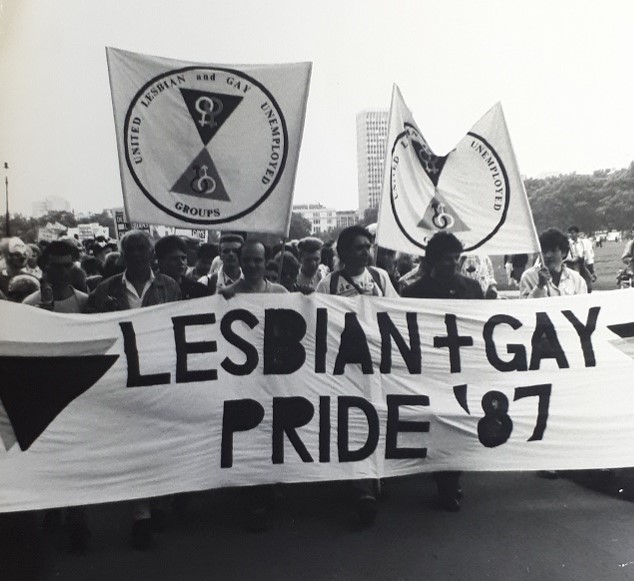
The UK’s first Pride march took place in London on 1st July 1972 with around 2,000 participants. Over 50 years later, London Pride now sees over 1.5 million people marching together to celebrate LGBTQ+ rights. The Campaign for Homosexual Equality (CHE) was established in Lancashire in 1964. Special Collections & Archives holds the archive for CHE’s Tyneside branch, including documents which illuminate the story of the Pride movement since that first march over five decades ago.
Within the Tyneside CHE Archive, it is possible to look back at Pride marches from across the past five decades. The first Pride march in 1972 took place 5 years after the Sexual Offences Act 1967 was passed, which decriminalised sex between gay men over the age of 21 in England and Wales. However, at the time of the first Pride march, the LGBTQ+ community still faced much discrimination. For example, gay marriage was not legal, and gay and bisexual people were banned from joining the armed forces. As well as campaigning, CHE also provided a social and support network for gay men and lesbians, providing a space for members of the LGBTQ+ community to make their voices heard.
Photograph of London Pride (1987), Tyneside Campaign for Homosexual Equality (Tyneside CHE) Archive, CHE/03/02/01
Female Friendships
The everyday lives and voices of women are often not well-documented. Through personal belongings such as books and correspondence, however, it is possible to gain glimpses into the ordinary day-to-day lives of women. We can see the importance of friendship amongst women, and the bonds and relationships they made through their social networks. In historical periods women found themselves in charge of running the household whilst their husbands were away at work. The exhibition highlights items which are testimony to the importance of companionship and mutual support between women and reflect how we can uncover their voices through what they left behind.
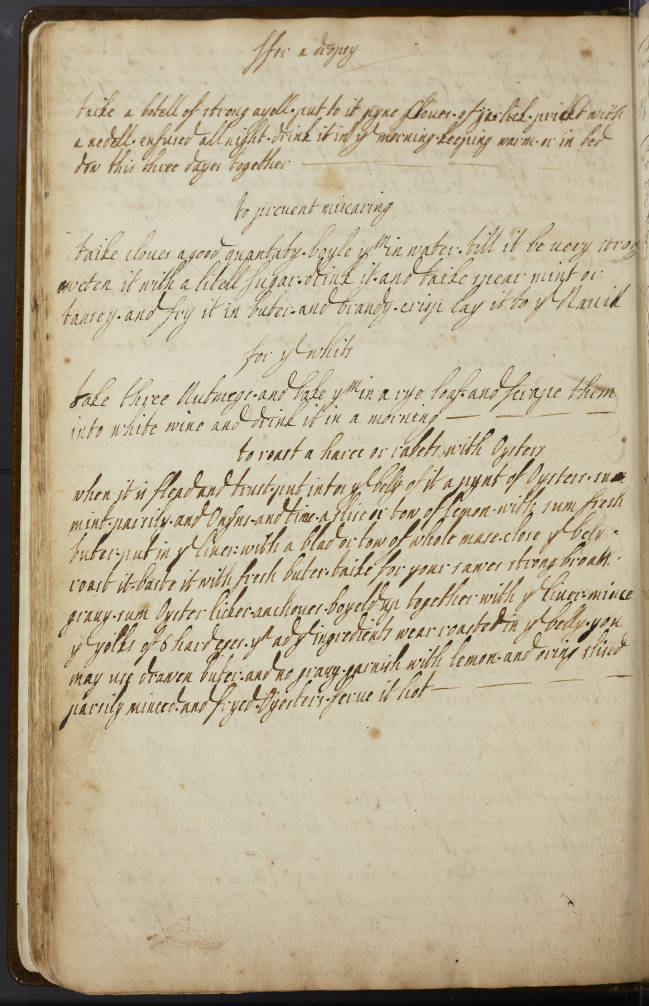
Jane Loraine’s recipe book from the 17th century contains a recipe ‘good for conception’, one ‘to prevent miscaring [miscarrying]’ and one ‘to make teeth white’. These recipes highlight the shared experiences of women and their attempts to help one another, not only with culinary recipes but also with fertility and more general health concerns. Different handwriting styles and recipes are attributed to different women. This indicates that the manuscript had multiple female contributors. Recipes were also often passed between class boundaries, highlighting the communal and collaborative nature of domestic knowledge in the early modern period.
The classic image of women from the past is one of confinement, lack of agency, and a life of drudgery, domestic boredom or excess. In reality, whilst this might have been true for some, there have always been women who defied the expectations of their gender and exploited their talents to support themselves financially. Many gained a degree of respect in their chosen field and enjoyed popular success. Finding their Voices showcase items written and illustrated by women with talents and expertise in areas as diverse as science, art, storytelling, philosophy and pedagogy. Through their writings and illustrations their voices have a lasting impact.
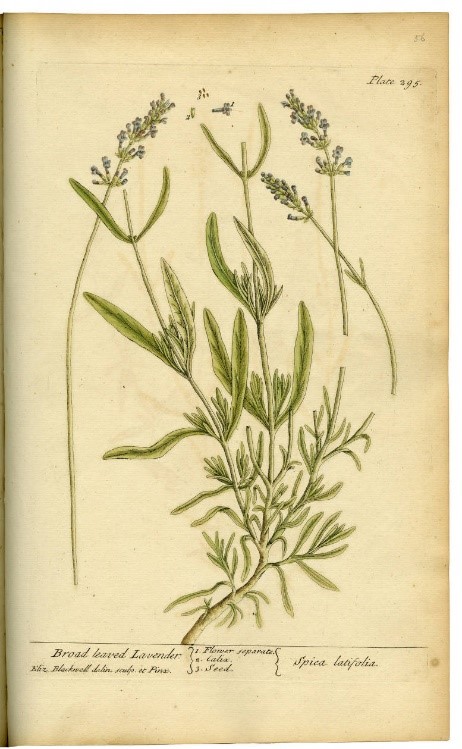
Elizabeth Blackwell (1707-1758) is one of the women highlighted within the Finding their Voices exhibition. She was the first woman known to have produced a book of botanical work in Britain. Despite having a wealthy background, she was forced to use her skill of botanical drawing to raise money to support herself and release her husband from debtor’s prison. Even more unusually, Elizabeth Blackwell undertook all stages of the illustrative process herself rather than employing specialist engravers and painters. She completed two volumes consisting of about 500 illustrations with accompanying commentary in under two years. The book was intended as a reference work for doctors who needed a thorough knowledge of medicinal plants.
Page from A Curious Herbal, by Elizabeth Blackwell (1737), Rare Books, RB 633.88 BLA
Kamau Brathwaite and the Caribbean Voice
Barbadian poet, literary critic and historian Kamau Brathwaite (1930–2020) is a significant figure in the Caribbean literary canon, and one of its major voices. His work is noted for its rich and complex examination of the African and indigenous roots of Caribbean culture. He sought to create a distinctively Caribbean form of poetry which would celebrate Caribbean voices and language.
Kamau Brathwaite was born in Bridgetown, Barbados. Originally named Edward Lawson Brathwaite, he received the name Kamau from the grandmother of the Kenyan writer and academic Ngũgĩ wa Thiong’o, when on a fellowship at the University of Nairobi in 1971.
Kamau Brathwaite co-founded the Caribbean Artists Movement, a collaboration of artists which celebrated a new sense of shared Caribbean ‘nationhood’, in 1966. Caribbean identity and culture are central to Kamau Brathwaite’s academic writing as well as his poetry. Brathwaite felt that the traditional meter of the English iambic pentameter (where every line is composed of ten syllables and has five stresses) could not express the breadth and depth of that experience. He instead used African and Caribbean folk and jazz rhythms in his poetry. He combined that with the use of Caribbean dialect and patterns of speech to create a distinctively Caribbean form of poetry, which was written to be performed out loud and heard.
These items can be found alongside many others within the Finding their Voices exhibition on Level 2 of the Philip Robinson Library from Monday 10th April – June 2023.
Written by Daisy-Alys Vaughan, student working on the Special for Everyone project.
Jane Marcet was an unusual woman. She believed that girls as well as boys should be educated in science and economics and that scientific knowledge should not be hidden behind a requirement for proficiency in Latin and Greek. She loved to learn and was keen to share her enjoyment of learning with others. When she was unable to find books that satisfied her own curiosity, she wrote them herself.
Jane Marcet the hostess
Born in 1769, Jane was educated alongside her brothers under the guidance of her father Francis Haldimand, a rich Swiss merchant established in London. The household was a lively one, often gathering groups of friends and intellectuals. After her mother’s death, Jane took on the role of hostess and relished the stimulating and intelligent company of her father’s friends. In 1799 Jane married medical doctor and chemist Alexander Marcet. Jane’s father lived with the couple and their growing family, and the culture of gathering for conversation and learning continued.
Jane Marcet the student
It is clear that Jane was a sponge for knowledge. At around this time in London one of the entertainments available to the fashionable elite was attending lectures and demonstrations on scientific subjects. Some of the best, which Jane and Alexander attended together, were given by Humphry Davy at the Royal Institution. Jane was somewhat frustrated not to understand everything she heard and saw, but after each lecture she discussed the topic with her husband and their guests, seeking clarification and deepening her understanding. She described her experiences, writing about herself in the third person, in the preface to her first published work.
“On attending for the first time experimental lectures, the author found it almost impossible to derive any clear or satisfactory information from the rapid demonstrations which are usually, and perhaps necessarily, crowded into popular courses of this kind. But frequent opportunities having afterwards occurred of conversing with a friend on the subject of chemistry, and of repeating a variety of experiments, she became better acquainted with the principles of that science, and began to feel highly interested in its pursuit.” 1
She invited Humphrey Davy and wife to dine and so drew them into her social circle.
Jane Marcet the educator
In response to her own increased enjoyment of scientific lectures, once she had acquired some background knowledge, Jane was motivated to share her joy of learning. Her first book Conversations on Natural Philosophy, written in 1805, was not initially published, but her second, Conversations on Chemistry was published anonymously in 1806. Although anonymous, she made it clear in her preface that she was a woman. Her books were aimed at young women in their teens. In Conversations on Chemistry, she dismissed concerns that science was not suitable for girls simply by stating that public opinion was changing and therefore she considered it suitable.
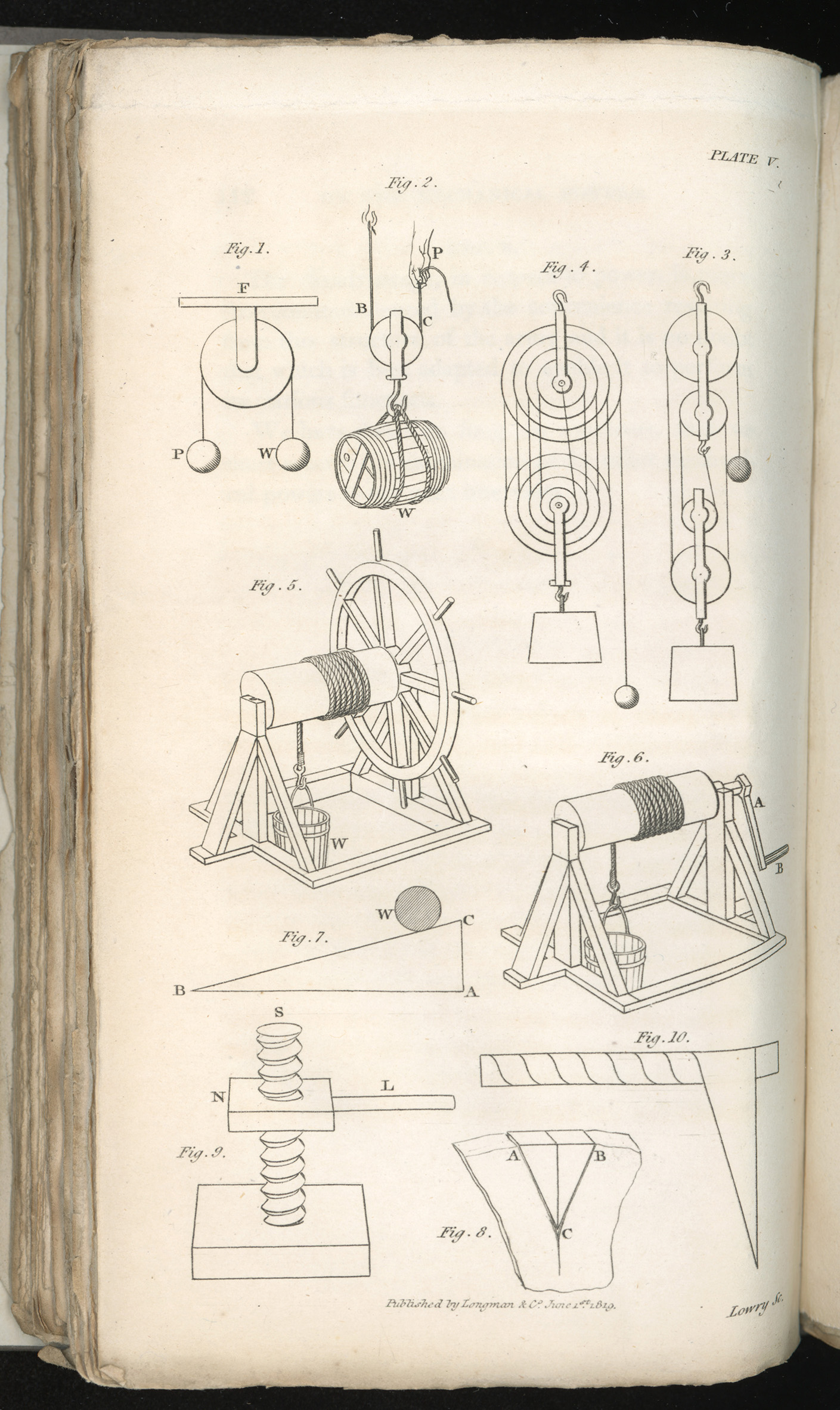
Pulleys, wheels, the inclined plane, wedge and screw, drawn by Jane Marcet for Conversations on Natural Philosophy: in which the elements of that science are familiarly explained and adapted to the comprehension of young pupils (Wallis (Peter) Collection, Wallis 910 MAR)
Jane wrote textbooks intended for the non-expert at a time when this sort of simplified text was largely unknown. Simplification did not lead to stagnation, however. Her work was based on the latest ideas and she worked hard in subsequent editions to keep her books up to date, substantially revising them by adding the latest thinking and new discoveries and removing anything out of date.
After chemistry she tackled economics, publishing Conversations on Political Economy in 1816. Conversations on Natural Philosophy was eventually published in 1819. She followed these with Conversations onVegetable Physiology in 1829 as well as stories for younger readers. She put her name to her work in the 12th edition of Conversations on Chemistry in 1832.
Since “conversing with a friend” – probably primarily her husband – had been such an important means of her own learning, she emulated this, adopting a conversational style within her writing. Each of her textbooks is a conversation between a teacher, Mrs Bryan and two pupils, Caroline and Emily. These were not confined to the stilted question and answer style of many contemporary schoolbooks but instead were an approximation of normal lively conversation between a dedicated teacher and curious pupils. That this was a well-considered pedagogical technique was acknowledged by her contemporaries: “For Marcet, the dialogue is a teaching method, a means of conveying established knowledge as well as of helping young people to reorganize their own thoughts and experiences.” 2
The conversations frequently centre around experiments. The reader is able to experience and witness these vicariously through the questions, reactions and increased understanding of Caroline and Emily. This use of experimentation as a teaching method was innovative and, like the use of conversation, reflected her own learning experience.
To say that her books were a success is something of an understatement. Conversations on Chemistry ran to 16 English editions, Conversations on Natural Philosophy 14, Conversations on Political Economy 14 and Conversations on Vegetable Physiology 3. They were translated into Dutch, German, Spanish and French and there were many American editions where her work was widely plagiarised due to lack of international copyright laws.
Throughout her works she makes no claims to original thought but presents the ideas of others in innovative and clear ways. She is not afraid of tackling controversial subjects or the latest theories. The books had a mixed reception with critics, being praised by some and dismissed as unsophisticated by others, however they were widely read and provided a useful introduction to each subject for adult readers as well as the schoolgirl audience for whom they were intended.
After the death of her husband, Jane continued to be influenced by the diverse intellectual circle of friends that she nurtured around her. Conversations on Political Economy was based on what she had learned in conversation with thinkers in her social circle such as Thomas Malthus and, most significantly, David Ricardo. Her publication predates Ricardo’s own work Principles of Political Economy. A friendship with naturalist Augustin Pyramus de Candolle inspired Conversations on Vegetable Physiology.
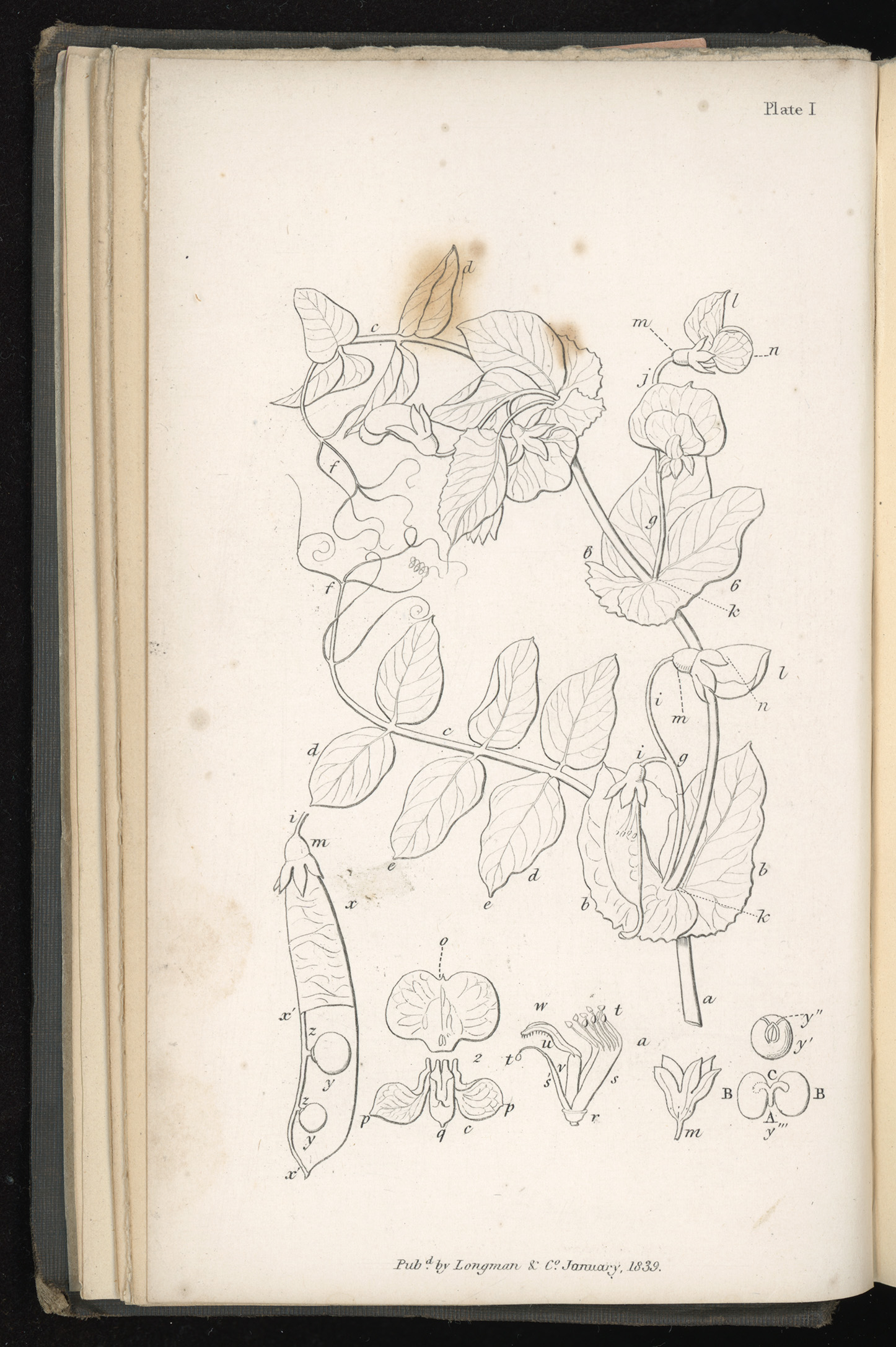
The Common Pea, Pisum vulgaris, drawn by Jane Marcet for Conversations on Vegetable Physiology: comprehending the elements of botany, with their application to agriculture (Alderson (Brian) Collection, MAR CON)
Jane also published books on grammar and stories for young children including, in 1835, Mary’s Grammar which became a classic text and was still widely used until the early 1900s.
Jane Marcet the influencer
One of the early readers of Conversations on Chemistry was an apprentice book binder called Michael Faraday. He was inspired to attend Humphry Davy’s lectures himself. His insight and understanding made a favourable impression on Davy who later employed him as his assistant. He then rose to prominence in his own right. Jane befriended him and from 1833 incorporated his new discoveries into later editions.
Another member of Jane’s intellectual circle was Harriet Martineau. Martineau was inspired by reading Conversations on Political Economy to include the ideas in her own work. The two became friends although they did not always see eye to eye politically.
Jane Marcet the polymath
In her youth, Jane had travelled to Italy with her father and became interested in painting. She studied with Joshua Reynolds and Thomas Lawrence, nurturing a talent that resulted in her illustrating her own work with simple clear and stylish diagrams. She read both English and French fluently.
Despite having become proficient enough in science and economics to have written successful textbooks, she remained modest. Her friends wrote of her propensity for listening rather than talking. Having listened, it is her ability to communicate in a direct and engaging manner in her writing that is her legacy.
Her originality lay in both considering science and economics suitable subjects for girls, and in her pedagogical style, using dialogue and experimentation to help learners to organise and re-evaluate their thinking based on her own learning experiences. Emphasis is placed on understanding rather than rote learning or memorisation. The pupils in her conversations are expected to be active participants in their own learning, to think for themselves and to ask and answer questions. Marcet, through the voice of Mrs Bryant, guides the students and uses examples with which they will already be familiar from other disciplines as well as from everyday life. Commentators have suggested that Marcet was influenced by writers such as Mary Wollstonecraft, Maria Edgeworth and Richard Lovell Edgeworth, and while this is certainly possible, it is likely that her style drew its most significant influence from her own desire for knowledge and understanding, experience of wanting to learn, and achieving success through “conversing with a friend”. 3
Jane Marcet in Special Collections
There are many of Jane Marcet’s publications, in numerous editions, held across our collections, including in the Wallis (Peter) Collection; the Alderson (Brian) Collection; the Butler (Joan) Collection; the Bell (Maurice) Collection; the Medical Collection; 19th Century Collection; and the Blavatnik Honresfield Library.
This Treasure of the Month is brought to you through our Special for Everyone project to celebrate and highlight diversity across our collections.
Notes
1. Marcet, J. (1813) Conversations on Chemistry: in which the elements of that science are familiarly explained and illustrated by experiments. 4th / rev., cor. and considerably enl.. edn. London: Longman, Hurst, Rees, Orme and Brown.
2. Letter from Michael Faraday to Auguste de la Rive quoted in Henderson, W. (1994) ‘Jane Marcet’s Conversations on Political Economy: a new interpretation’, History of Education, 23(4)
3. Letter from Michael Faraday to Auguste de la Rive quoted in Henderson, W. (1994) ‘Jane Marcet’s Conversations on Political Economy: a new interpretation’, History of Education, 23(4)

![Back cover of: Carletti, Angelo. Summa Angelica de casibus conscientie cum additionib[us] nouiter additis (Nurenberge: Impressa per Antonium Koberger, 1498)](https://blogs.ncl.ac.uk/speccoll/files/2025/07/Sandes-259-Back2-scaled.jpg)
![Ticket proofs for performance of All our Yester-Gays by the Consenting Adults in Public theatre company in Newcastle, 12 August [1976?]](https://blogs.ncl.ac.uk/speccoll/files/2025/06/CHE-01-05-3-crop-scaled.jpg)