In the UK, it’s estimated that 4.4 million tonnes of edible food is thrown away each year. This equates to £17.5 billion worth of food being wasted, and 16 million tonnes of greenhouse gases being created by food waste, harming the environment as well as our pockets.
It is therefore essential we avoid food waste where we can, and that where food waste can’t be avoided, we process it in the best way possible.
Food waste at Newcastle University
In March 2025, the Simpler Recycling legislation came into force, meaning that all UK businesses with 10 or more employees must have food waste segregation and collections in place. While Newcastle University has had food waste caddies and collections for several years on campus, this was expanded to all University-owned accommodation in January 2025.
All food waste is taken by Biffa to a local anaerobic digestion (AD) facility. Here, food waste is processed into fertiliser, as well as a methane-rich ‘biogas’ which is fed back into the national grid.
Newcastle University is highly aware of the issues surrounding food waste and has also implemented several initiatives to combat them, such as:
- Giving excess food to local food banks and to our new Student Pantry.
- Catered events are advised to order an amount of food which is less than the amount of people visiting so there is less waste.
- Ingredients which are left over are used to make other meals if possible.
- If one food outlet closes earlier than another, the food is transported to another that is open later.
How to reduce food waste
Want to save some money and produce less food waste? Check out these top tips from Love Food Hate Waste…
- Think before you shop
Take a few moments to consider what you need before you hit the shop. Check what you actually need in your fridge, freezer, and cupboards, and plan to use up anything that’s going to expire soon. And don’t forget to take your shopping list with you to keep you on track!
- Plan your meals
Create a realistic flexible meal plan, and leave space for a ‘use up fridge food’ meal. Planning for what you’ll eat during the week reduces buying any ‘just in case’ food, saving you money and reducing the possibility of wasting food.
- Don’t throw your leftovers
If you have food leftover from a meal, put it in the fridge or freezer. This means you can eat it at a later date, and it doesn’t get wasted!
Top tip: Make sure to label your food with a date so you know how long it has been there to ensure its safe to eat.
- Store your food right
Putting your food away in the right places will help keep it fresher for longer. This guide created by Love Food Hate Waste has some great tips about how to best store different food items, and the visual guide below shows what should go where in the fridge.
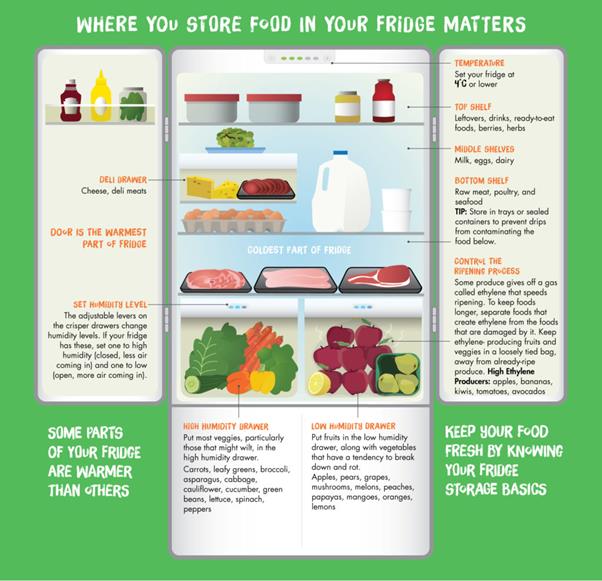
A guide how to organise your fridge by Love Food Hate Waste
- Eat every edible morsel of food
Get more value and nourishment from your food by eating and using all the edible parts and reduce what goes in the bin. One example would be to save yourself some time by not peeling carrots or potatoes – less food waste and time saved is surely a win-win situation!
- Try a food waste app
If you know you won’t use your item and it is still within its use-by date, list it on a food waste app like Olio. This way, you can get rid of items you won’t use and somebody in your community can benefit from a free food donation!
For more good food habits, recipe information and more, visit Love Food Hate Waste.
It is impressive to see the university’s proactive steps in managing food waste to support environmental sustainability. Regards Telkom University Jakarta