Inks from donated flowers

Photo credit: Anne Whitehead

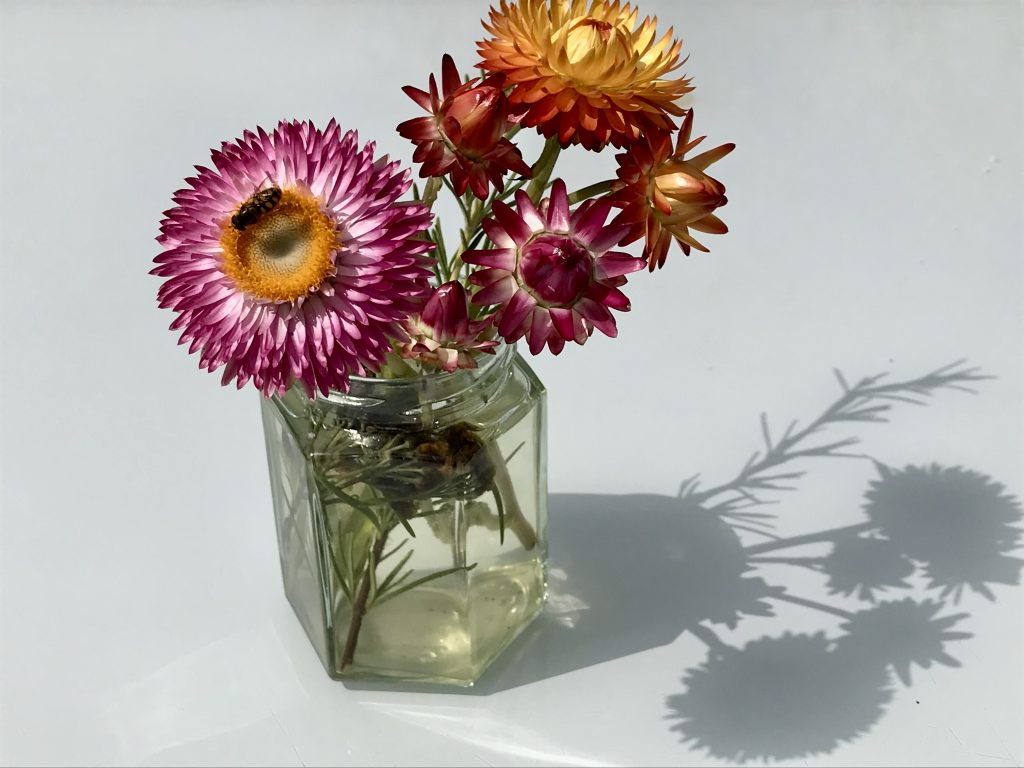
At the Spontaneous Memorials conference at Manchester University a week ago, I was intrigued to hear of an art project that used inks made from the donated flowers that had been left at a spontaneous memorial. Our project used inks made from materials that the parents had gathered from places that were meaningful to them in the context of their grief, and the project that I learned about shared a similar ethos of imbuing the very materials from which the images were made with affective and emotional meaning.

The paper that I listened to was presented by Shannon Blamyres, Curator of Manuscripts at the Alexander Turnbull Library (National Library of New Zealand Te Puna Matauranga o Aotearoa) and Stephanie Gibson, Curator of New Zealand Histories and Cultures at the Museum of New Zealand Te Papa Tongarewa, Wellington, New Zealand. The paper was titled, ‘Beyond the First Wave: Understanding the Ebb and Flow of Trauma Collection’.

On 15 March 2019, a man carrying semi-automatic weapons entered the Masjid Al-Noor Mosque and the Linwood Islamic Centre in Christchurch, New Zealand. The gunman killed 51 people and injured another 40. In an instant outpouring of grief, shock and anger spontaneous memorials formed near the sites of the attacks and throughout the rest of the country.  Thousands of people visited these sites and left behind artworks, flowers, candles, toys, cards, placards and banners.

Gibson and Blaymires have already written of the work of their two Wellington-based institutions to sensitively document and archive this physical and digital outpouring of national grief, as evidence of what they called the nation’s ‘first wave’ response to the attacks. More specifically, the Alexander Turnbull Library and the Museum of New Zealand (Te Papa) were also invited by Muslim leaders to acquire the hundreds of community tributes that had been left outside the Kilburnie Mosque in the Wellington Islamic Centre.

In the weeks and months following the attacks, staff documented the cityscape in unobtrusive ways, photographing public tributes and vigils and collecting online material in the public domain. No intervention was initially made with the public tributes around the city beyond this recording activity. These collecting activities captured the immediate response and much of what was recorded has either been removed or is no longer visible.

With the Kilburnie Mosque tributes, an early decision was made by Te Papa and the Alexander Turnbull Library to acquire the tributes in their totality to maintain archival integrity. Deselection of items was seen to work against the life force (mauri) of the collection, as well as risking arbitrariness and implying a hierarchy of grief. The approach taken was community driven and curatorially responsible and preserved the representation of voices, faith, community, and forms in response to the event.

In their paper at the conference, Gibson and Blaymires observed that while a growing body of work exists on the immediate collection of materials from spontaneous memorials, there is a significant gap of knowledge relating to the life of these collections after they have been gathered. What does ongoing community engagement with trauma material look like? What roles do the materials play in commemoration, education and healing? And how do institutions ensure that these materials remain active for future generations? What, in other words, does a ‘second wave’ of archiving spontaneous memorials look like?

Of particular interest in the context of the ink-making at the heart of our ‘Losing a Twin at Birth’ project was the Darkness Into Light initiative at the Turanga Christchurch City Libraries, led by community artist Janneth Gil. Under the umbrella of Darkness Into Light, Gil ran the ‘Raising Sakinah: Finding Peace’ initiative, working with women who had lost loved ones in the attacks. ‘Sakinah’ is an Arabic word meaning spirituality, or the peace and consolation of the divine presence, and participants in the workshops responded to this prompt to explore where, or in what, they had found sakinah. Workshops guided them through photography and printmaking techniques, so that the women could produce their own artworks.  

Many of the women used photographs of the loved ones they had lost, trees, or the Quran, to express what gave them peace. From these, they made linocut prints using inks made by Gil from the cremated ashes of the floral tributes that had been left at the spontaneous memorials at the Christchurch Botanic Gardens and outside Al Noor Mosque. The idea of making this ink came to Gil when she saw the scale of the flowers that had been left, and Rebecca Parnham, who helped to run the workshops and provided a safe and supportive space for the women, collected the floral tributes for the artist. The ash from the burned flowers provided black, the burned wrapping paper made grey, and the copper florist’s wire provided an intense blue green. Charcoal was also made by burning organic materials donated after the attacks in temperatures above 400C in an oxygen starved environment. Through the use of these hand-made materials, the artworks mixed the women’s grief with the outpouring of community feeling and love.

Alongside the exhibition of the works at the Turanga Christchurch City Library, which coincided with the fourth anniversary of the attacks, Gil also led a Finding Peace badge-making workshop. Here, members of the public wrote messages of peace and made them into a badge, using paper from the thousands of origami cranes left as tributes to the victims of the mosque attacks.  Here, too, donated items were repurposed in meaningful ways, to be given back to the community who had donated them in order to amplify and reinforce their message.

Speaking after the paper to the conference organiser, Kostas Arvanitis, he observed that the artistic transformation or repurposing of donated tributes is common to a ‘second wave’ of memorialisation, where there is often uncertainty as to what to do with some of the objects in the longer term and an understandable reluctance to discard them.  Kostas cited the example of the Manchester bombings archive, which is held by Manchester Art Gallery; there, candles that had been left as tributes were melted down and reworked by an artist into new memorial candles, which were then given to the families of those who had lost loved ones in the attacks.

The paper highlighted to me the ways in which archiving spontaneous memorials can, with the support of a community artist, offer ongoing support for those who have lost loved ones through the sensitive and creative repurposing of appropriate materials. It also focused my attention once again on the powerful memorial function of hand-making inks from materials with strong affective resonance, such that the colour, texture, and saturation of the inks become as vital as the image, to the meaning of the artwork that is created from them.

Further reading:

Stephanie Gibson and Shannon Blaymires, ‘First Wave Collecting – Christchurch Terror Attacks, 15 March 2019’, The Curator: The Museum Journal 66.2 (2023), pp. 233-55. DOI: 10.111/cura.12451    

Previous Tūranga Exhibitions | Christchurch City Libraries Ngā Kete Wānanga o Ōtautahi
Light in the Darkness: Transforming tragedy through creativity | Christchurch City Libraries Ngā Kete Wānanga o Ōtautahi    
Women who lost loved ones in mosque attacks create art exhibition to help journey through grief | Stuff

The Panel: Raising Sakinah, Finding Peace exhibition | RNZ

Groynes

Photo credit: Anne Whitehead

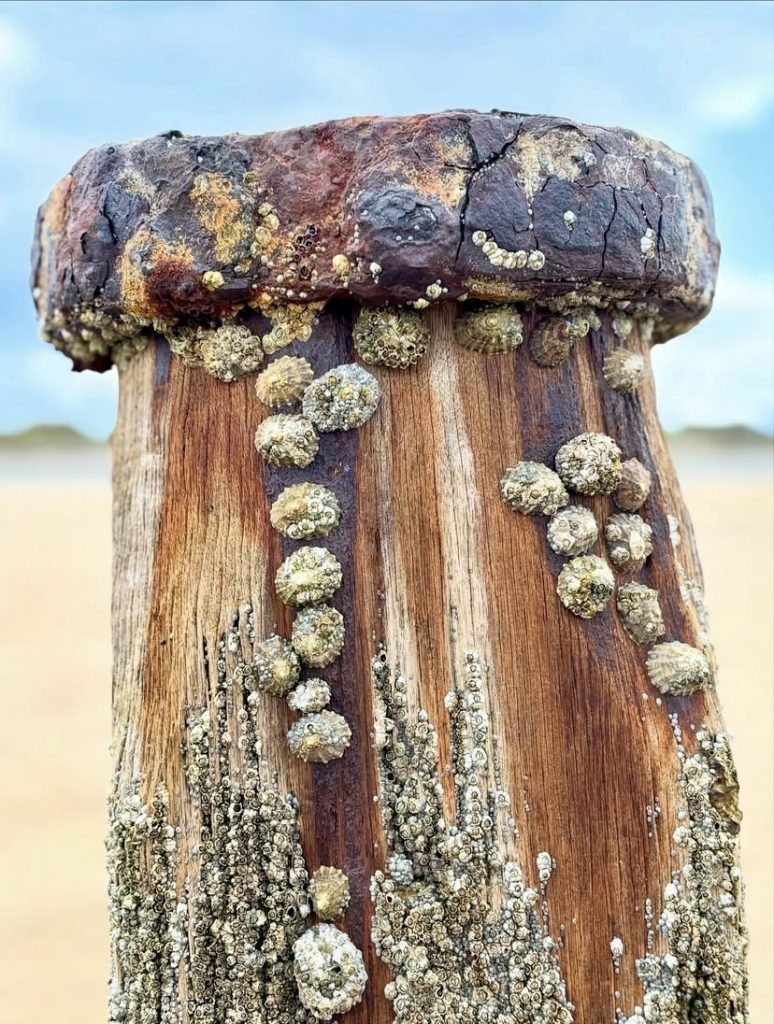
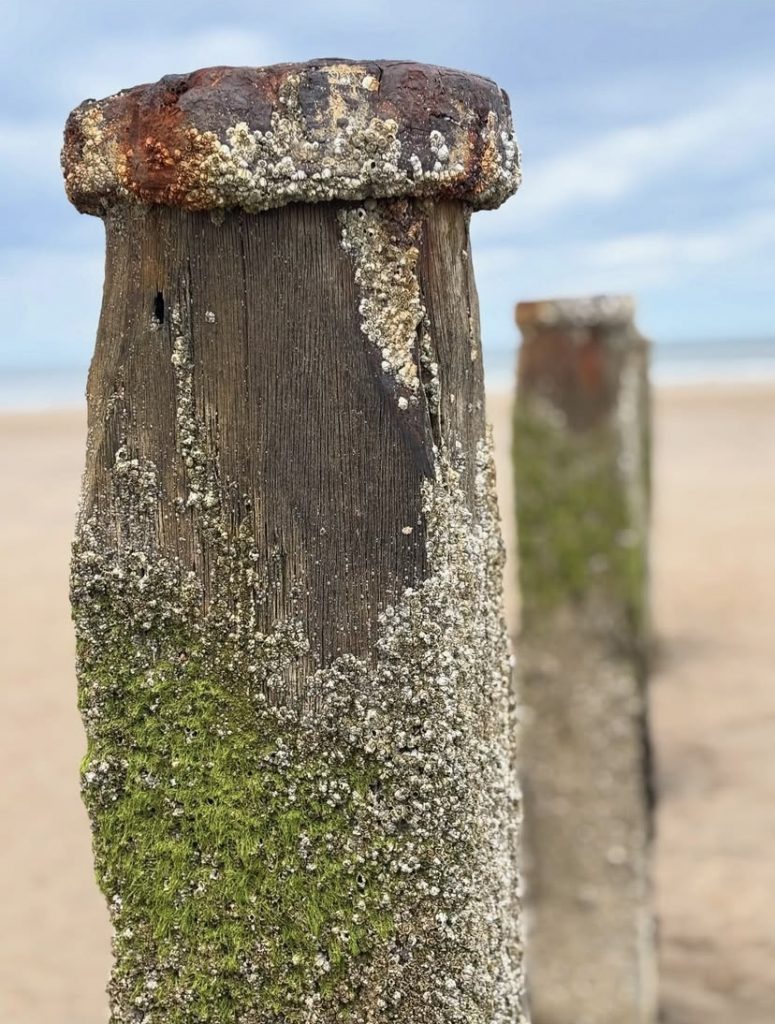
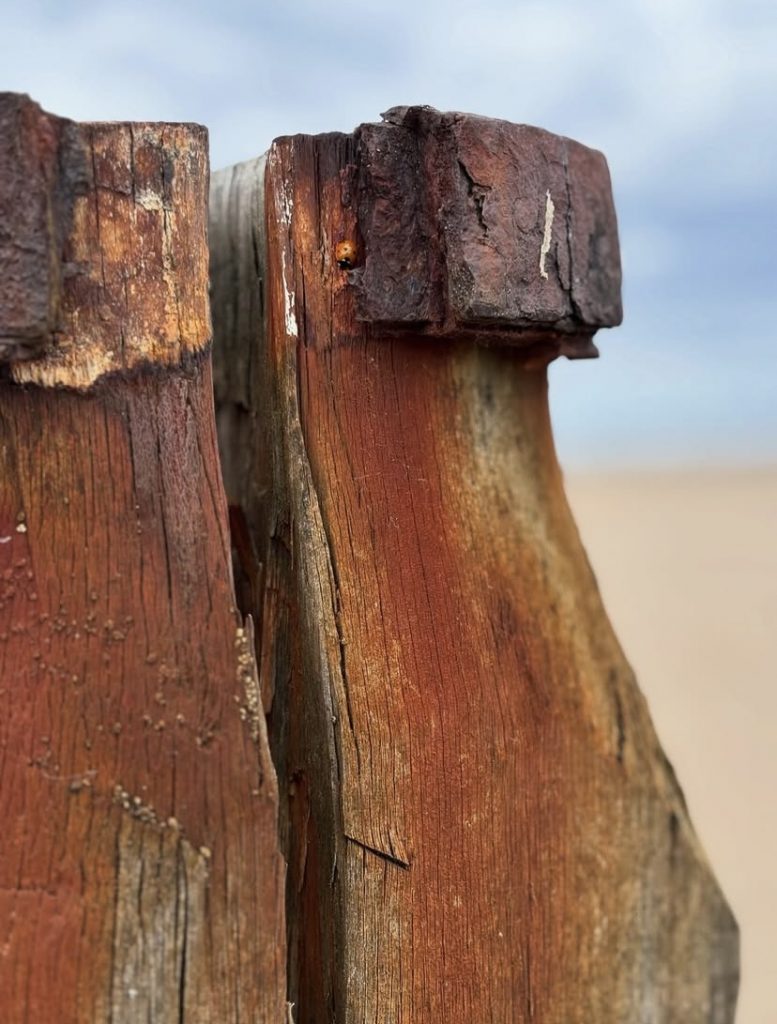
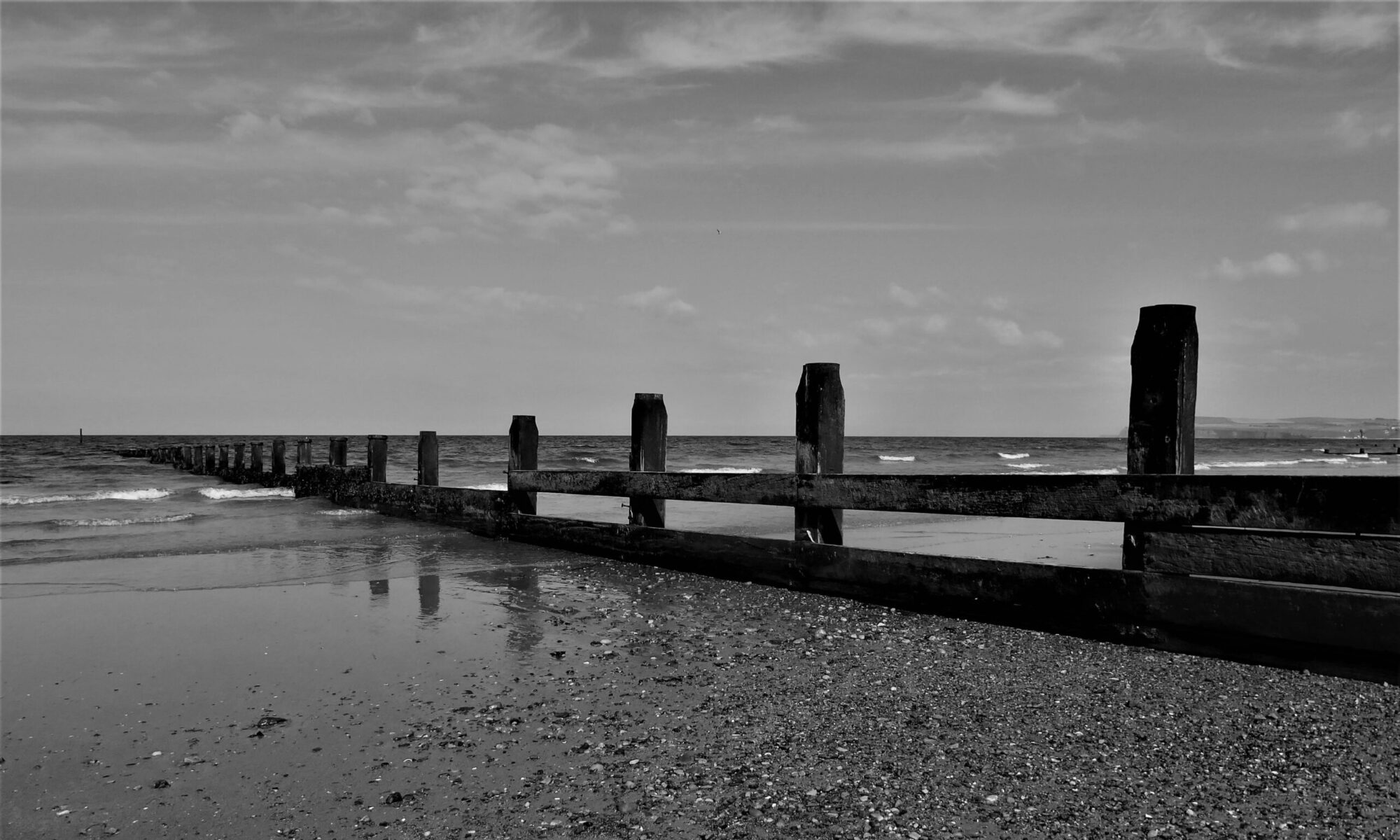
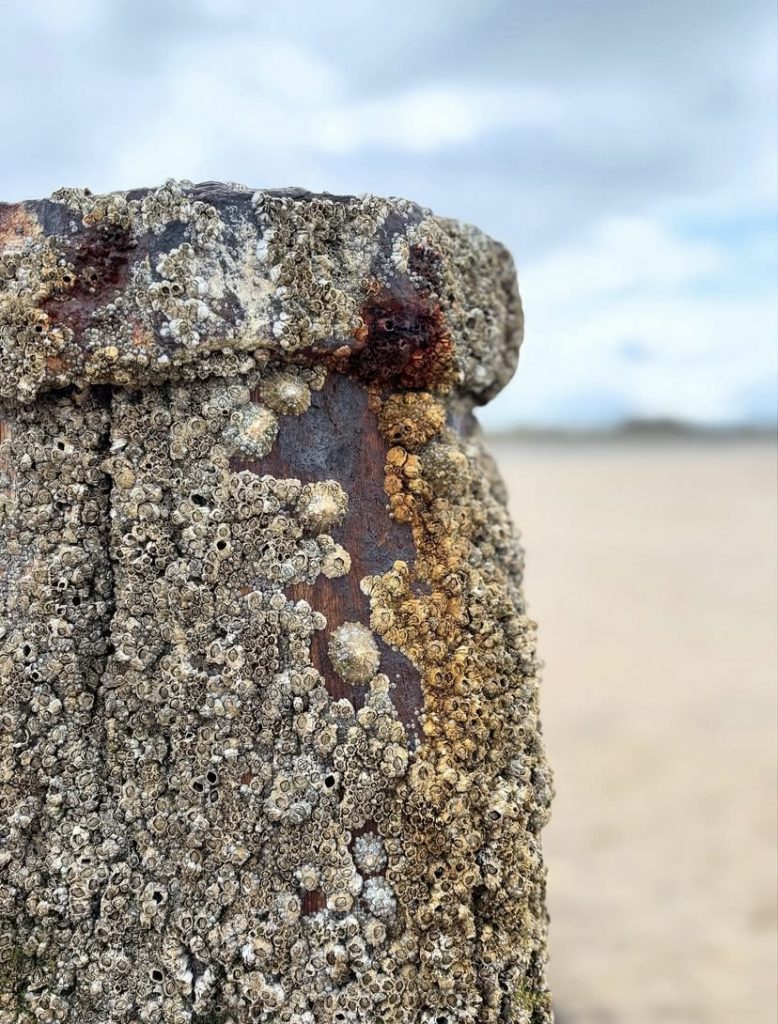
At the weekend I visited The Stray near Redcar, the beach where my sister died. Even on a day when the Redcar Kite Festival was taking place at neighbouring Coatham Beach, this section of sand was quiet, with only a few dogwalkers and runners passing by. The tide was a long way out, further than on many previous visits, so I had a chance to see fully the wooden groynes that stretch along the sands here, and which had been uncovered by the sea.

Photo credit: Anne Whitehead

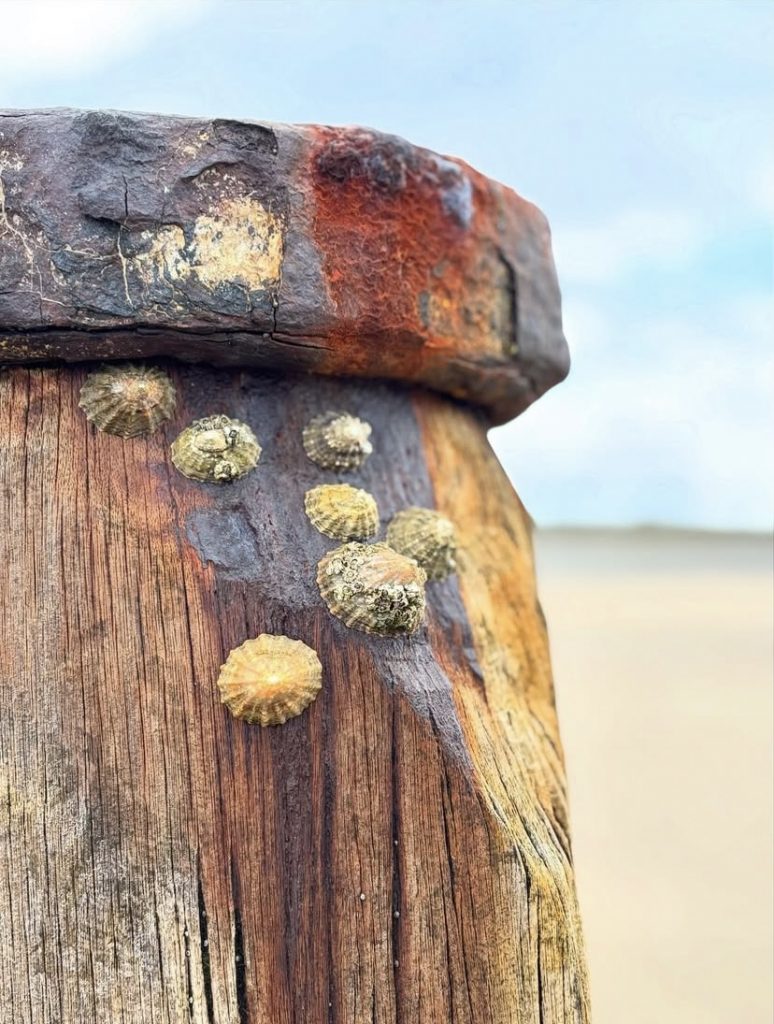
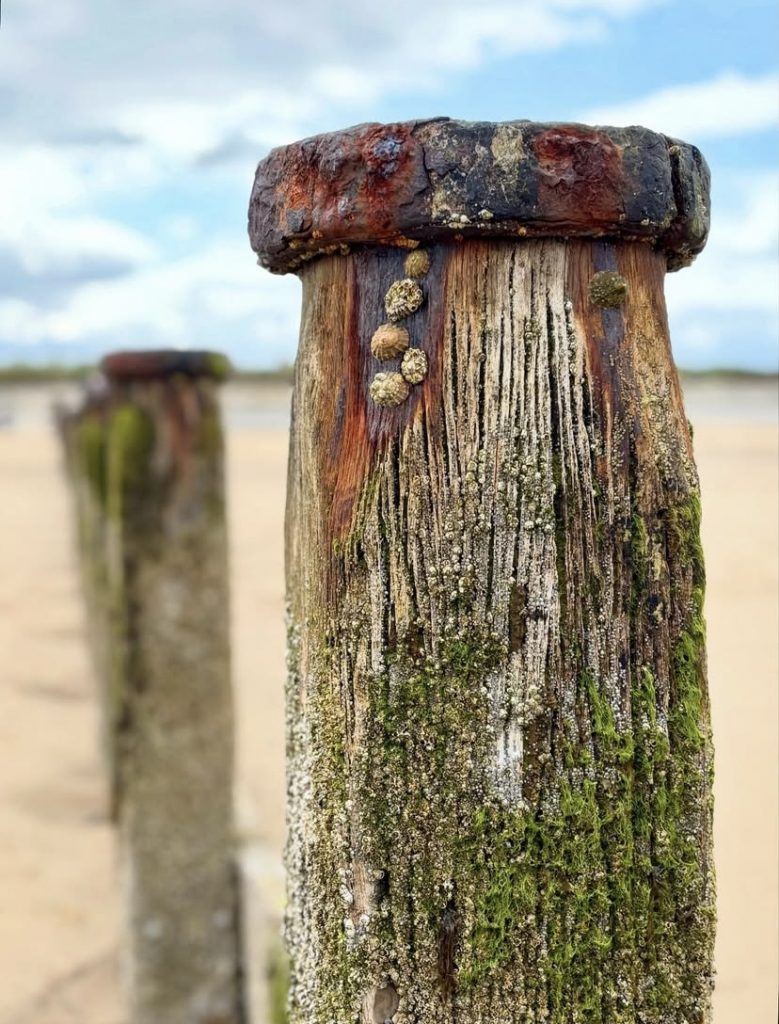
The iron red staining of the wood, combined with the barnacles attached to the groynes, reminded me of Antony Gormley’s Another Place on Crosby Sands, near Liverpool. There, too, the perpetual advance and retreat of the tide over the rows of sculpted men means that the figures are increasingly covered by barnacles from the sea and affected by corrosion from the elements.

Photo credit: Anne Whitehead

I have written in Relating Suicide about my close association between The Stray and Another Place and the ways in which Antony Gormley’s installation has helped me to navigate my own grief. This, in turn, provided the basis for the ‘Sounding the Angel’ project, as I wanted to understand more fully how Gormley’s Angel of the North sculpture was helping others to deal with loss through the tributes to loved ones that they were leaving there. As at Crosby, so my experience of visiting The Stray differs according to the tide, and I spent some time wandering among the groynes, examining closely the different ways in which they had weathered, as well as the various life forms that had found shelter there.

Photo credit: Anne Whitehead

I have noted in a previous post David’s observation that the memorial tributes at The Angel of the North have both arisen from and around the sculpture, and become a vibrant and integral part of its meaning, in a way that is reminiscent of the barnacles that now encrust the sculpted men at Crosby. The shifting nature of tidal patterns, living creatures, and the memorial tributes animates the static structures of groynes and sculptures, and thereby renders them into lively and dynamic organisms.

Spontaneous Memorials

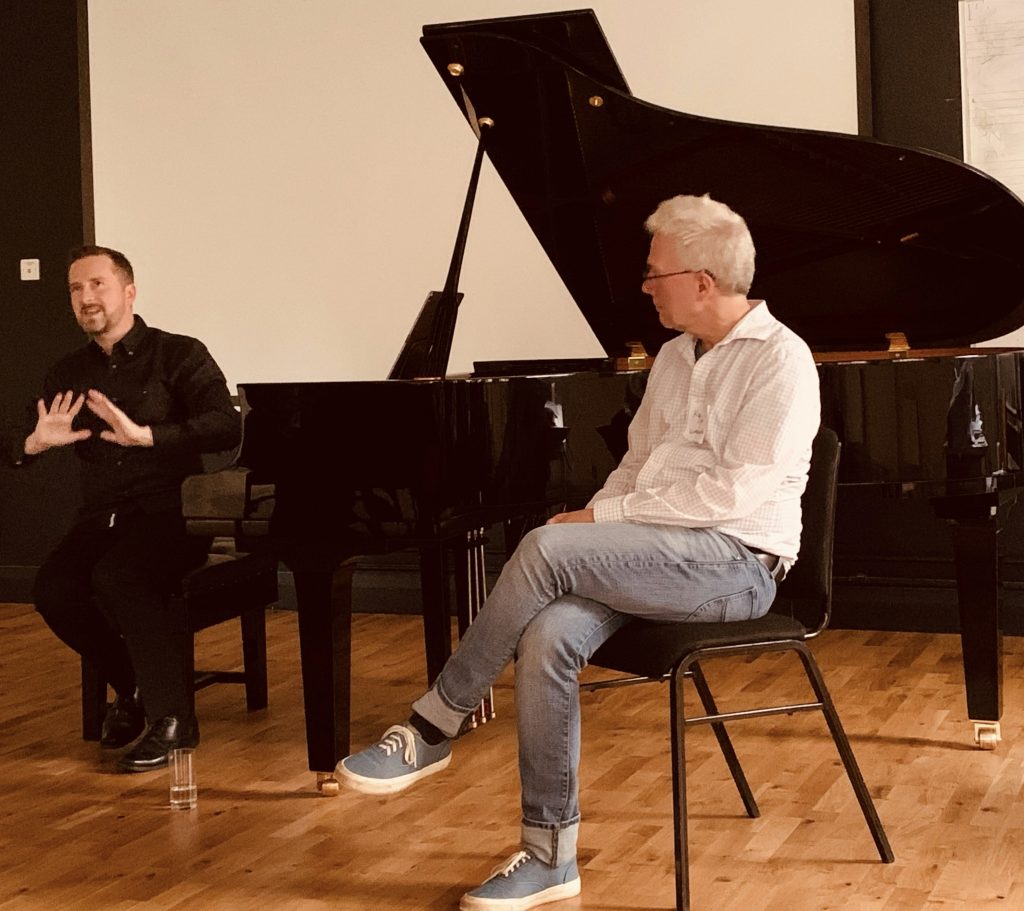
Adam Swayne and Kevin Malone, discussion and live performance of ‘Sudden Memorials’

Last week I was delighted to attend the AHRC-funded ‘Spontaneous Memorials’ conference, organised by Kostas Arvanitis at the University of Manchester. The conference focused on how we research, curate and analyse spontaneous memorials and the impacts that they have on individuals, communities, organisations and societies. I was delighted to be presenting a paper on the ‘Sounding the Angel’ project alongside other scholars and practitioners who were engaged with questions of sound, affect and memorialisation.

The first speaker on the panel, Katelyn Hearfield, brought our attention to our location in Manchester with her paper on the role of song in affective processing after the Manchester Arena Bombing in 2017. The attack, which happened as concertgoers were exiting the Arena after an Ariana Grande concert, killed twenty-three people, including the perpetrator, and injured hundreds more, and a spontaneous memorial was assembled outside the Arena just hours after the attack, which was later moved to St Ann’s Square. Katelyn spoke of the many tributes, now held in the Manchester Together Archive at Manchester Art Gallery, which were music related, referring to Grande and also local musicians and songs. The paper then discussed the moment after the national minute’s silence was held at St Ann’s Square when a member of the crowd began to sing the Manchester classic ‘Don’t Look Back in Anger’ by Oasis, which was then taken up by the crowd of 400 people assembled there. Katelyn read this as an example of collective processing through music, while also discussing a distinction that emerged between how the lyrics were interpreted by some people in the local community and those who witnessed the moment online.

Also engaging with song, Heather Sparling from Cape Breton University addressed the memorialising role of songs in the aftermath of the Novia Scotia mass shooting of April 18 and 19, 2020, in which the perpetrator killed 22 people and injured 3 others, before being shot down by the police. Grief at the deadliest mass murder in Canadian history was compounded by the beginning of lockdown in Canada, meaning that people dealt with their grief in relative isolation. Lockdown also made intangible memorials, such as songs, particularly significant in the response to the shootings. Arguing that songs and music offered a means of processing, expressing and sharing grief, Heather played and discussed the YouTube video of Nova Scotian fiddler Natalie McMaster playing alongside the youngest victim of the shooting, Emily Tuck, using a home video made shortly before she died. Heather pointed to the importance of song as an intangible memorial both in the context of the Covid-19 lockdown and in not being tethered to a specific physical location – significant for the Nova Scotia shooting which had taken place over a wide geographical spread.

Following the panel, we were treated to a performance and discussion of Kevin Malone’s piano composition ‘Sudden Memorials’, which responded to the site in Shanksville, Pennsylvania, where the passengers of Airlines Flight 93 crashed their aircraft to thwart hijackers on 9/11. In 2006, Kevin had taken a photograph of the makeshift memorial at the site: a wire fence onto which visitors could attach items and tokens of remembrance. For the 30 minute piece, Kevin focused closely on 20 diverse objects and composed a response to each object. These pieces were then stitched together into a mosaic composition which reflected the non-linear and impromptu experience of a visitor to the memorial. Concert pianist Adam Swayne had first performed the piece in lockdown conditions in London, Oxford, New York, Brighton and Manchester, and the piece incorporated a series of theatrical gestures, through which Adam discovered ‘objects’ in, on and around the piano while playing. In the closing section, Adam spontaneously improvises while looking at the objects on the photograph, enabling the composition to be responsive to the audience in the room. Many of the participants at the conference found the piece profoundly moving, observing that their research on spontaneous memorials requires them to keep their emotions in check, whereas listening to the piano piece led them in the opposite direction and helped them to release their feelings through tears. One participant spoke of looking at the photograph and imagining which object was the focus of each ‘piece’ of the music. Initially worrying that she had got the wrong object, she then realised as she was listening that the meaning she was attaching to it was its true significance.

In subsequent 9/11 works, Kevin incorporated documentary techniques, using recordings of air traffic controllers, his own recorded site-specific sounds, and interviews with witnesses and first responders. This takes these works closer to the ‘Sounding the Angel’ project, which immersed the listener in a soundscape comprised of interviews, site-specific recordings, and the vibrations from within the Angel of the North. Kevin titled his session ‘Fence, photograph, pandemic, piano: The Makeshift Music of Sudden Memorials‘. I found his phrase, ‘makeshift music’, both poetic and beautiful, and it closely described my experience of listening through David’s headphones to the eerie drones and thumps resonating through the Angel sculpture.

All of the papers I heard at the ‘Spontaneous Memorials’ conference manifested a deep care in relation to archiving and researching memorials, thinking through how to do so both ethically and in conjunction with the community. The same level of care had been shown by Kostas in curating the conference itself, and I feel honoured to have been a part of the event, as well as humbled by the important work that so many participants were doing.