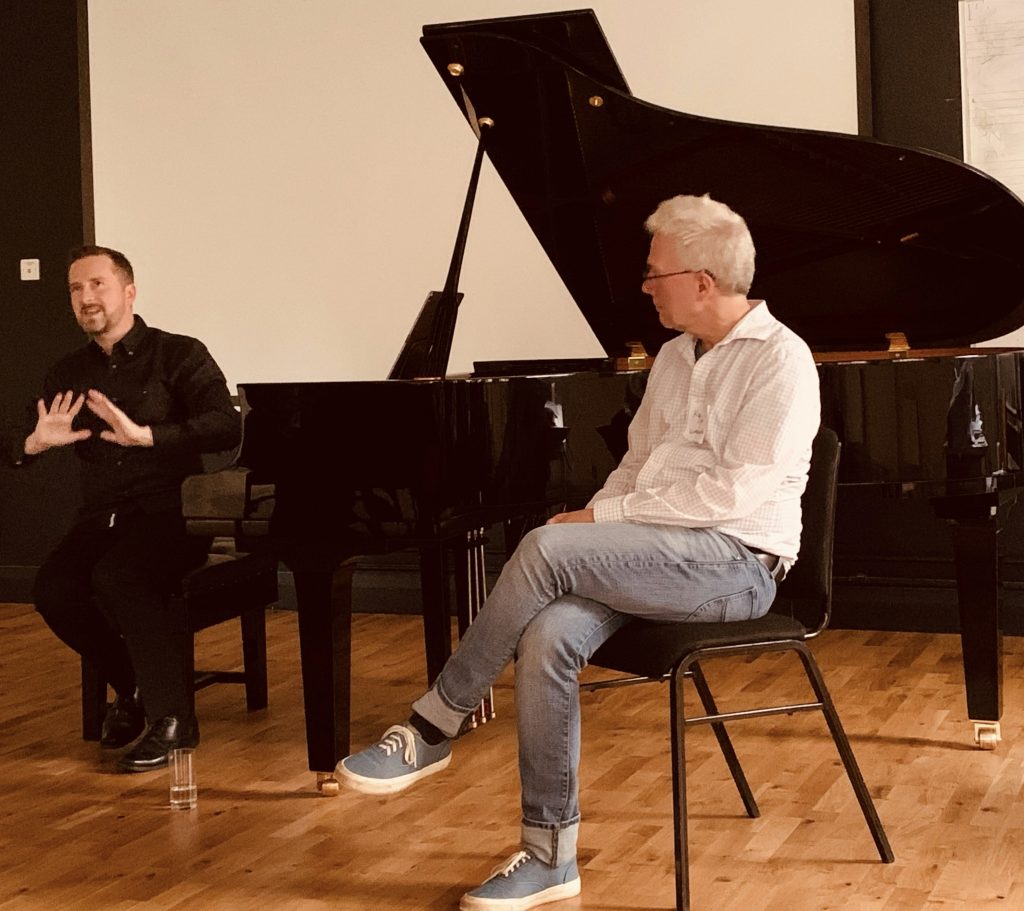
Adam Swayne and Kevin Malone, discussion and live performance of ‘Sudden Memorials’
Last week I was delighted to attend the AHRC-funded ‘Spontaneous Memorials’ conference, organised by Kostas Arvanitis at the University of Manchester. The conference focused on how we research, curate and analyse spontaneous memorials and the impacts that they have on individuals, communities, organisations and societies. I was delighted to be presenting a paper on the ‘Sounding the Angel’ project alongside other scholars and practitioners who were engaged with questions of sound, affect and memorialisation.
The first speaker on the panel, Katelyn Hearfield, brought our attention to our location in Manchester with her paper on the role of song in affective processing after the Manchester Arena Bombing in 2017. The attack, which happened as concertgoers were exiting the Arena after an Ariana Grande concert, killed twenty-three people, including the perpetrator, and injured hundreds more, and a spontaneous memorial was assembled outside the Arena just hours after the attack, which was later moved to St Ann’s Square. Katelyn spoke of the many tributes, now held in the Manchester Together Archive at Manchester Art Gallery, which were music related, referring to Grande and also local musicians and songs. The paper then discussed the moment after the national minute’s silence was held at St Ann’s Square when a member of the crowd began to sing the Manchester classic ‘Don’t Look Back in Anger’ by Oasis, which was then taken up by the crowd of 400 people assembled there. Katelyn read this as an example of collective processing through music, while also discussing a distinction that emerged between how the lyrics were interpreted by some people in the local community and those who witnessed the moment online.
Also engaging with song, Heather Sparling from Cape Breton University addressed the memorialising role of songs in the aftermath of the Novia Scotia mass shooting of April 18 and 19, 2020, in which the perpetrator killed 22 people and injured 3 others, before being shot down by the police. Grief at the deadliest mass murder in Canadian history was compounded by the beginning of lockdown in Canada, meaning that people dealt with their grief in relative isolation. Lockdown also made intangible memorials, such as songs, particularly significant in the response to the shootings. Arguing that songs and music offered a means of processing, expressing and sharing grief, Heather played and discussed the YouTube video of Nova Scotian fiddler Natalie McMaster playing alongside the youngest victim of the shooting, Emily Tuck, using a home video made shortly before she died. Heather pointed to the importance of song as an intangible memorial both in the context of the Covid-19 lockdown and in not being tethered to a specific physical location – significant for the Nova Scotia shooting which had taken place over a wide geographical spread.
Following the panel, we were treated to a performance and discussion of Kevin Malone’s piano composition ‘Sudden Memorials’, which responded to the site in Shanksville, Pennsylvania, where the passengers of Airlines Flight 93 crashed their aircraft to thwart hijackers on 9/11. In 2006, Kevin had taken a photograph of the makeshift memorial at the site: a wire fence onto which visitors could attach items and tokens of remembrance. For the 30 minute piece, Kevin focused closely on 20 diverse objects and composed a response to each object. These pieces were then stitched together into a mosaic composition which reflected the non-linear and impromptu experience of a visitor to the memorial. Concert pianist Adam Swayne had first performed the piece in lockdown conditions in London, Oxford, New York, Brighton and Manchester, and the piece incorporated a series of theatrical gestures, through which Adam discovered ‘objects’ in, on and around the piano while playing. In the closing section, Adam spontaneously improvises while looking at the objects on the photograph, enabling the composition to be responsive to the audience in the room. Many of the participants at the conference found the piece profoundly moving, observing that their research on spontaneous memorials requires them to keep their emotions in check, whereas listening to the piano piece led them in the opposite direction and helped them to release their feelings through tears. One participant spoke of looking at the photograph and imagining which object was the focus of each ‘piece’ of the music. Initially worrying that she had got the wrong object, she then realised as she was listening that the meaning she was attaching to it was its true significance.
In subsequent 9/11 works, Kevin incorporated documentary techniques, using recordings of air traffic controllers, his own recorded site-specific sounds, and interviews with witnesses and first responders. This takes these works closer to the ‘Sounding the Angel’ project, which immersed the listener in a soundscape comprised of interviews, site-specific recordings, and the vibrations from within the Angel of the North. Kevin titled his session ‘Fence, photograph, pandemic, piano: The Makeshift Music of Sudden Memorials‘. I found his phrase, ‘makeshift music’, both poetic and beautiful, and it closely described my experience of listening through David’s headphones to the eerie drones and thumps resonating through the Angel sculpture.
All of the papers I heard at the ‘Spontaneous Memorials’ conference manifested a deep care in relation to archiving and researching memorials, thinking through how to do so both ethically and in conjunction with the community. The same level of care had been shown by Kostas in curating the conference itself, and I feel honoured to have been a part of the event, as well as humbled by the important work that so many participants were doing.