Memory Studies

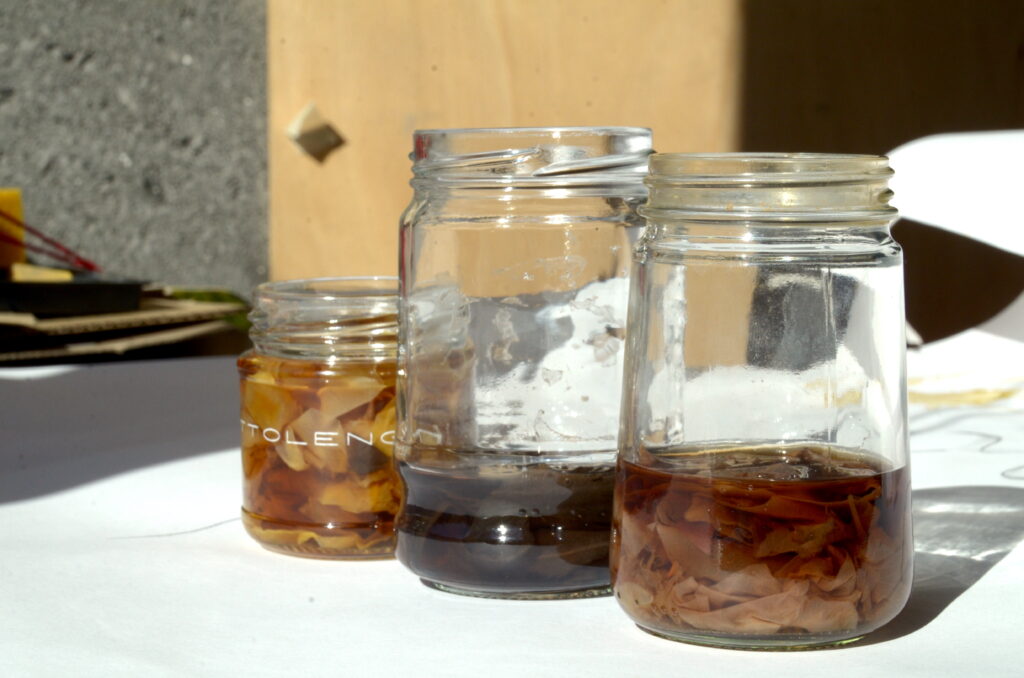
Rose petals in water in three jam jars
Photo credit: Kate Sweeney, 2022.

In a previous post, I have written about the inclusion of Where We Will Go in the ‘Communities and Change’ exhibition, hosted by Newcastle Contemporary Art as part of the 2023 Memory Studies Association conference. The Memory Studies journal has recently published a special issue related to the conference and, in one of the articles, organisers Catherine Gilbert and Alison Atkinson-Phillips reflect on the various works that were displayed in the exhibition.

Catherine and Alison note that, in curating the exhibition, there was a strong desire to embed the conference in place and to connect with local communities. They observe that there was a particular poignancy to the inclusion of the Amber Collective in the exhibition, because the Side Gallery – their permanent exhibition space in Newcastle – had recently closed due to a lack of funds. Special screenings of two Amber films documented the long history of industrial loss on Tyneside and its impact on local communities. The short film from our project was connected to place through the activity of walking, and it was positioned in the gallery so that it was in conversation with Henna Asikainen’s ecological installation Delicate Shuttle. Asikainen had walked with people who had experienced migration and displacement, and they had gathered white poplar leaves which were dispersed across a large white wall of the gallery space. Similarly, Kate had invited the parents participating in our project to walk in a place that was meaningful to them, and gather materials that could be used as the basis for the inks. The act of gathering materials and transforming them into another form is a powerful one, and the white poplar leaves reminded me of the rose petals that the parents brought into the workshop, so carefully assembled and preserved. These materials are fragile, even when they have been preserved, and as Catherine and Alison note, they can speak as much of the dispersal of memory as of its conservation in the archive.

Leaves and petals connect human memories with the more-than-human, reminding us that acts of memory are as much expressions of ecological as cultural community. The question of community was at the heart of the exhibition and many of the installations considered different scales of community. Kate’s film was one of the most intimate communities represented in the exhibition, working as it did at the scale of the family. I have documented in previous posts our encounter, in the course of the project, with the ways in which the loss of a twin at birth resonates across multiple generations of a family as well as rippling out to affect friendship networks. This experience of complex grief is difficult to speak about, and, like the other artworks displayed, Kate’s short film demonstrated that words are not the only way to convey grief. The gathering of materials and making of the inks formed an important act of memorialisation in itself, and the drawings that the parents and the siblings made with the inks provided a further testament to their loss.

One of the key questions raised by the staging of the exhibition was the place of creative-critical works within a discipline such as memory studies, which has predominantly focused on the traditional academic outputs of the article and the monograph. Catherine and Alison open their article by reflecting on exactly this question:

These are important questions for the field to address. How can memory studies become more inclusive of creative practice, when it is premised on particular forms and modes of publication and dissemination? What does it mean to value process as well as ‘output’? Which aspects of memory might most effectively be opened up through creative practice? It is becoming more common to see creative exhibitions or performances staged alongside academic conferences and this is a welcome development. At the same time, such creative responses are often not fully integrated into the conference programme, featuring instead as a venue for mingling over lunch or at a wine reception, and/or as a space to visit for reflection between sessions. A final question, then, might be: How could the conference format, as a key expression of the academic community of a field, evolve to become more inclusive of creative-critical practice contributions?

With many thanks to Catherine and Alison for curating the exhibition and writing an article that enabled creative-critical practice to feature in the special issue of Memory Studies.

References

Alison Atkinson-Phillips and Catherine Gilbert, ‘Creatively imagining communities: The Communities and Change exhibition’, Memory Studies 18.2 (2025), pp. 354-62. You can access the article here.

National Archives

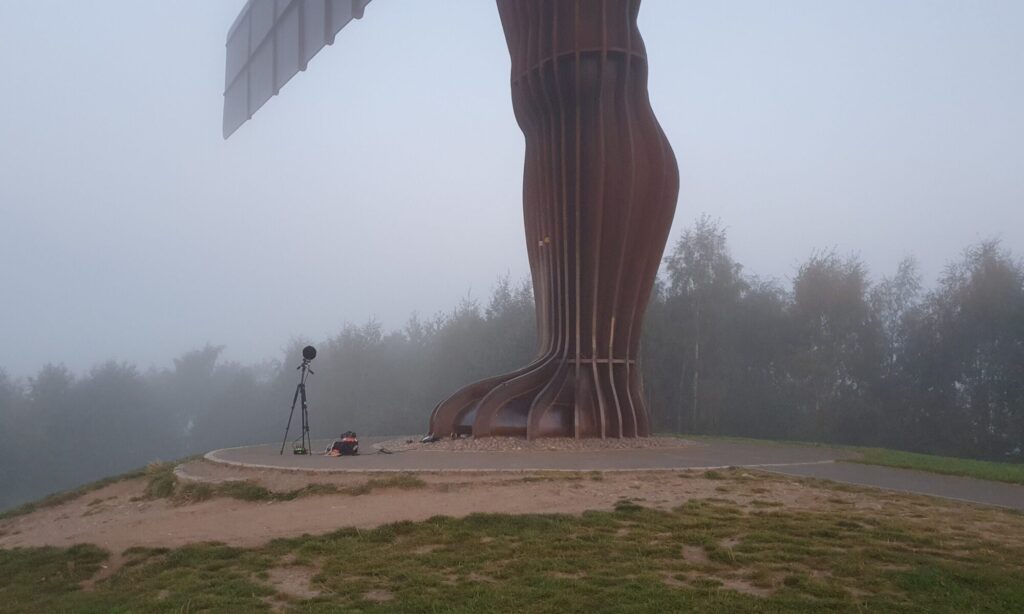
Microphone next to The Angel of the North
Photo Credit: David de la Haye

I wrote in a recent post about presenting a paper on the ‘Sounding the Angel’ project at the Spontaneous Memorials conference at Manchester University, which was organised by Kostas Arvanitis. Here, I reflected on the importance of sound in relation to spontaneous memorialisation, which was evident both in the other papers for the panel and in the piano recital that followed.

In this post, my focus is on a panel that I was invited to chair, which included a presentation from a team at the National Archives. Hannah Jones, Mike Rogers, and David Morris from the National Archives UK gave a paper entitled ‘Rapid Response Collecting: developing practical guidance for the archives sector’. They explained that the National Archives hold an advisory and leadership function for archives in England, offering a wide range of support and guidance through their Archives Sector Leadership department. The department is responsive to needs in the sector, and it became apparent that there was an emerging gap of knowledge in relation to collecting, documenting and archiving spontaneous memorials. In 2024, the department therefore commissioned a piece of guidance on best practice in this area, drawing on the advice of archivists and curators who had already been involved in archiving spontaneous memorials. The conference paper spoke about the approach that was taken in commissioning the guidance, and provided practical examples and suggestions.

One of the leading principles adopted in developing the guidance was not to be proscriptive but rather to present a range of different approaches. Drawn from examples around the world, the guidance aimed to offer potential approaches in often sensitive and emotive situations, with high levels of media interest. The guidance covered first response, and short and medium-term actions and strategies. Seeking to be flexible and inclusive in their definition of spontaneous memorials, the team did not restrict their examples to attacks and disasters, but also featured case studies from other scenarios, including the 2001 Foot and Mouth outbreak, the Covid-19 pandemic, and documenting student protests.

Speaking with the National Archives team after the panel, I was delighted to hear that they were interested in including the ‘Sounding the Angel’ project as an additional case study to accompany the guidance. The team explained that the project was very different from other examples they had encountered. On the one hand, this was related to the nature of the memorial itself, which commemorates many separate, unconnected people and events, and has arisen in relation to a work of public art. On the other hand, our documenting of the memorial through sound, rather than by the collection and storage of objects, also offered a novel approach to archival practice. Using a template of questions and prompts from the National Archives team, I developed the learning from the project into a case study, and it was fascinating to think about the work from the point of view of what other teams might find most useful in practice.

The case study is now on the National Archives website and you can read it here. Many thanks to Mike, Hannah, and David for their generous invitation to include the project as part of such a valuable and carefully considered resource.

The Circle

‘I’m riddled with appreciation of the ordinary.’ (Richard Farrington)

Photo Credit: Anne Whitehead

In Relating Suicide, I wrote about Hunt Cliff, which rises above the former fishing village of Saltburn in North Yorkshire, as a location where suicide is a discernible presence in the landscape. I noted that, in addition to the sign at the peak of the cliff, the National Trust had also erected a suicide-prevention sign at the foot of the cliff, in a bid to reduce the number of suicides at the site. I also reflected on the recent closure of the Teesside steelworks nearby, and the ways in which a lack of employment opportunities and economic deprivation can contribute to a geography of despair. In such a prevailing climate, Middlesbrough had emerged as one of the ‘suicide capitals’ of the UK.

In addition to the official signage at Hunt Cliff, my research for the book had also alerted me to a couple of grassroots suicide-prevention initiatives. Former coastguard, Paul Waugh, had placed hand-painted signs along the cliff edge, with messages written on pieces of slate as warnings of the dangers, and as hopeful reminders that a current state of crisis does not last forever. Inspired by Paul’s example, local schoolgirl Emily Armitage collected stones and painted them with messages and colourful designs. Emily had lost classmates to suicide and accidents on the cliff, and she wanted to do something to help. The UV paint that Emily used to decorate the stones meant that they would be easily seen by anyone walking on the cliff edge. Although I did not include these two examples in the book, they are reminders of the communities of care that arise in relation to suicide, and that, as I discussed, are often represented by local, small-scale actions.

Photo credit: Anne Whitehead

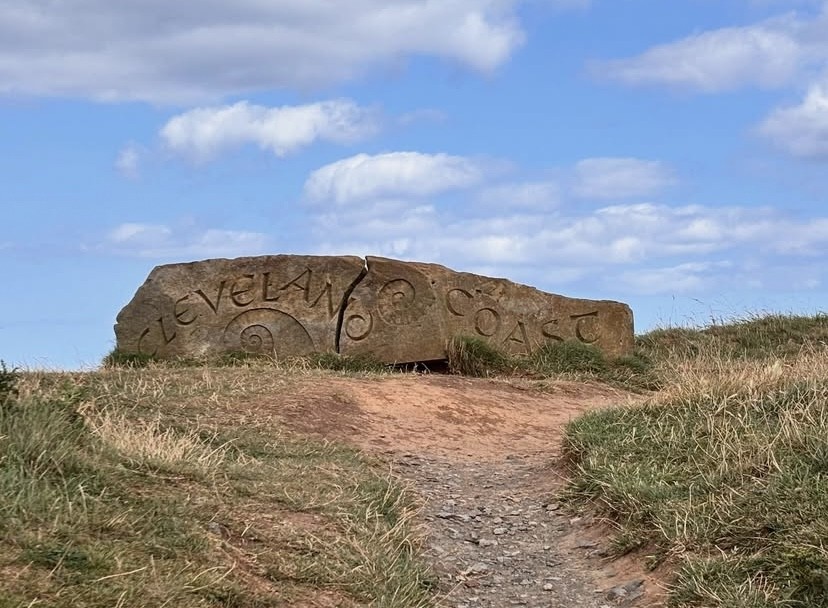
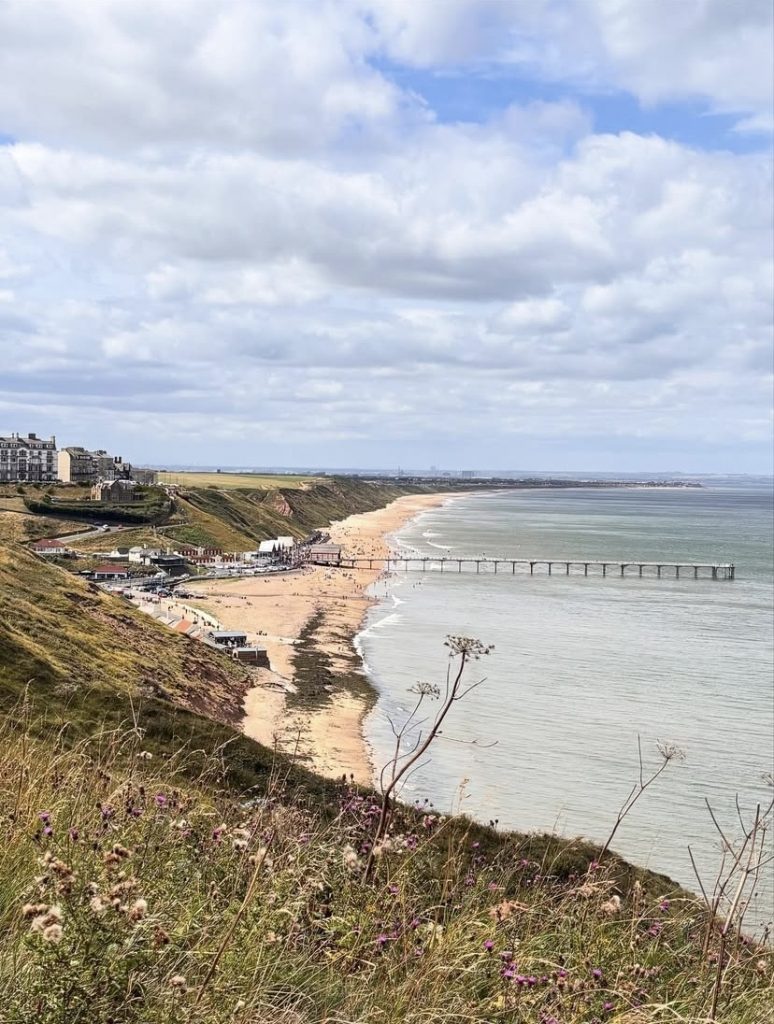
Even though I have often visited Saltburn, I have never walked on Hunt Cliff, and I decided last week to walk along the cliffs to a sculpture by Richard Farrington called ‘The Circle’; an artwork which is also known locally as the ‘Charm Bracelet’. The walk forms part of the Cleveland Way, and is the first part of the stretch that runs south from Saltburn to Staithes. Walking past the Ship Inn, and circling the Old Mortuary, where bodies washed ashore at the base of the cliffs were housed before burial from the late 1800s to 1960, I climbed the set of steps cut into the cliff, noting the suicide-prevention sign at their base. At the top of the steps, a large, carved marker stone offered a welcome rest, and the expansive view looking back along the coast took in Saltburn, Marske, Redcar, and Middlesbrough.

Photo Credit: Anne Whitehead

Walking along the cliff, hand-written slate discs were clearly visible from the path, placed carefully at intervals, their messages offering expressions of community and hope, as well as providing the phone number for the Samaritans helpline. Even though there was no sign of Emily’s painted stones, it was heartening to see that Paul’s initiative had lasted, and that the grassroots commitment to suicide prevention was continuing.

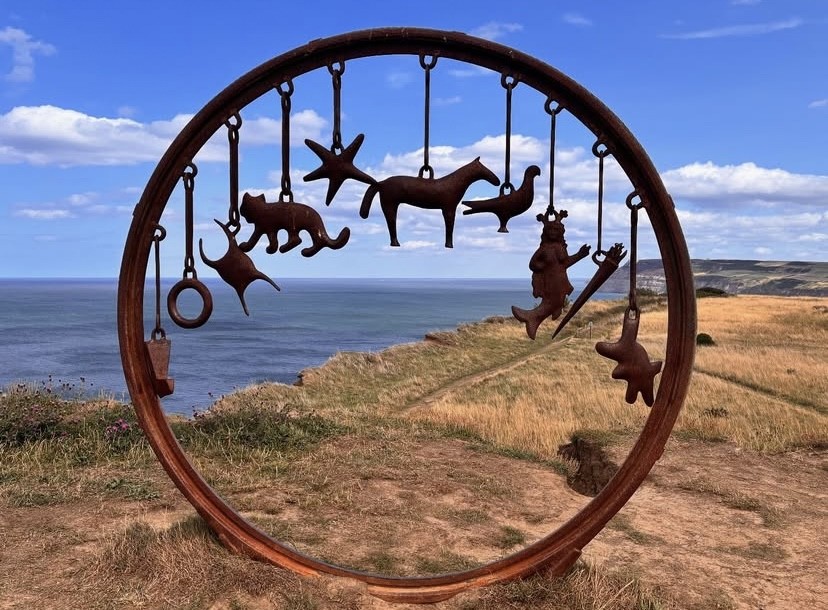
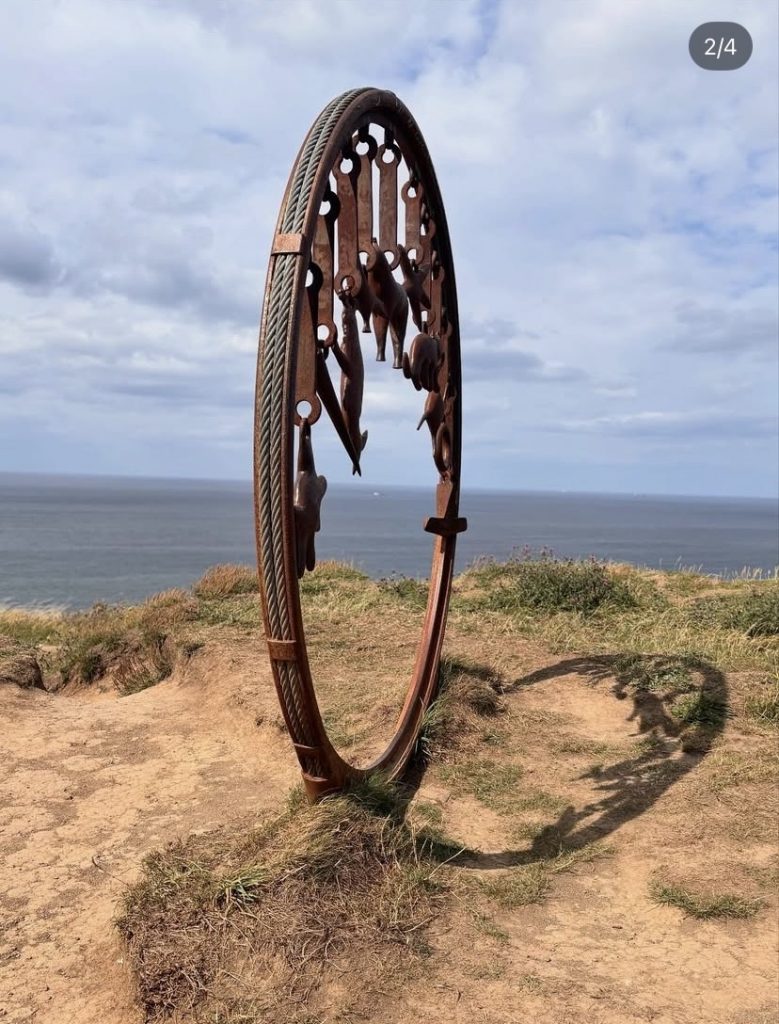
Farrington’s sculpture is located midway between Saltburn and the fishing village of Skinningrove. The path follows a disused railway line that originally carried ore from an ironstone mine established at Skinningrove in 1848, which eventually closed in 1958. The sculpture is situated close to the cliff edge, and it was constructed at the British Steel plant in Skinningrove from local materials. The inner section of the circle was made from an old mine shaft mast and the outer part from materials used to reinforce the hulls of trawlers. As well as referencing the industrial heritage of the area, Farrington recycled, in the making of the sculpture, the detritus that the former industrial works had left behind.

Photo Credit: Anne Whitehead

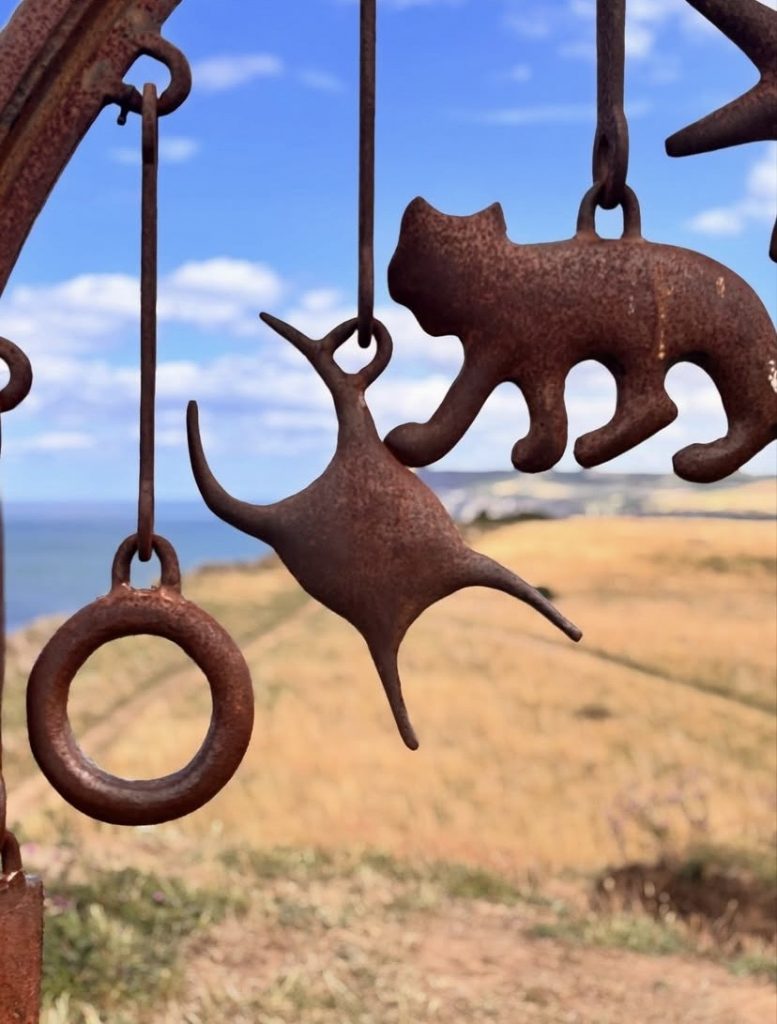
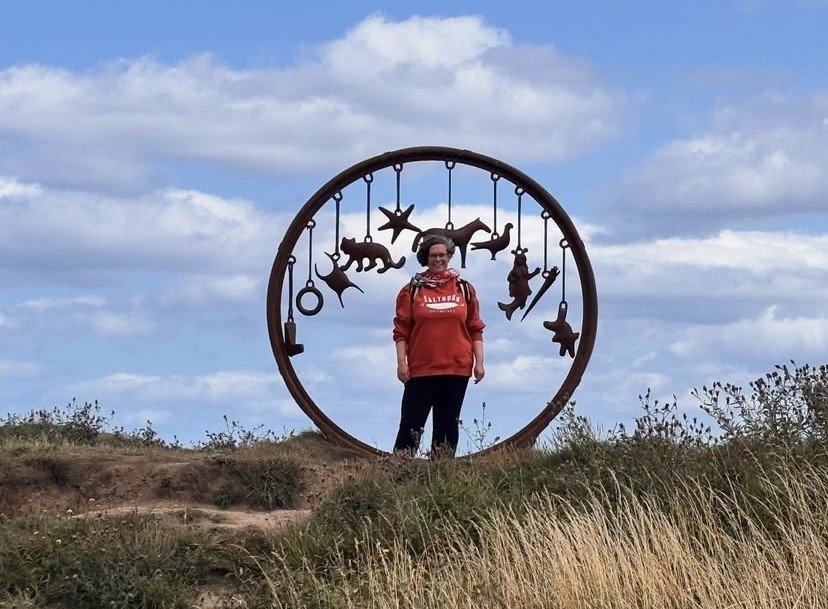
I found the sculpture an affecting site. The ‘charms’ of the bracelet each represent a story about local culture, folklore or tradition, and they include a belemnite, a mermaid, a cat, a mermaid’s purse, a bird, a ring, and a horse. Farrington has deliberately not provided details of the traditions or stories to which he refers, which means that the associations of these figures remain loose and speculative. The effect is similar to that of encountering an ancient monument, the significance of which can be intuited, but not fully known. In the strong wind, the ‘charms’ struck one another with an irregular rhythm, so that the circle also became a musical instrument, sounding out strange but oddly comforting notes.

Photo Credit: Anne Whitehead

In my book, I described The Stray, the beach where my sister died, as a ‘thin place’. By this, I meant that, for me, the beach is a place where the boundary between the living and the dead feels slight and almost indiscernible, like the sea frets that regularly descend on this stretch of coast in any season. Although there was no sign of mist at Hunt Cliff on the day of my walk, the site of the sculpture evoked the same feeling in me as the nearby sands. It felt as if the sculpture, located on the cliff edge and playing its strange music, was an emanation, or a manifestation, of the site as a ‘thin place’. On approaching the sculpture, I noticed a growing cairn of stones, which indicated that I was not alone in experiencing this sensation. Indeed, Farrington has been pleased by the recent evolution of the sculpture into a secular sacred place: a venue for midsummer gatherings, weddings, and memorials.

I reflected in my book on hopeful signs that Teesside might be starting to regenerate. These have continued since, with a range of initiatives designed to reinvigorate places that have fallen into dereliction and decay. That said, there are still pockets of deep poverty, and the effects of austerity continue to cast a long shadow across the region. My walk along the cliffs had nevertheless reinforced for me the importance of local communities of care in relation to suicide, and the tangible difference that small, grassroots initiatives can make. Resonating with my Angel of the North memorial project, Farrington’s sculpture also reminded me of the power and potential of public art. At its most effective, public sculpture can act as a prompt or a conduit for feelings that are hard to articulate, and they can provoke echoing responses from visitors in the form of tributes that are left in their vicinity.

Photo Credit: Angie Scott

Further Reading

World Suicide Prevention Day: The little sign that could make a big difference in Saltburn – Teesside Live

Ex-coastguard hopes cliff signs will save lives. – Free Online Library

These colourful stones placed on Huntcliff by Emily could help save lives – Teesside Live

Circle (Charm Bracelet), Pillar and Trawl Door (Huntcliff, Richard Farrington, 1990) – North East Statues

Inks from donated flowers

Photo credit: Anne Whitehead

At the Spontaneous Memorials conference at Manchester University a week ago, I was intrigued to hear of an art project that used inks made from the donated flowers that had been left at a spontaneous memorial. Our project used inks made from materials that the parents had gathered from places that were meaningful to them in the context of their grief, and the project that I learned about shared a similar ethos of imbuing the very materials from which the images were made with affective and emotional meaning.

The paper that I listened to was presented by Shannon Blamyres, Curator of Manuscripts at the Alexander Turnbull Library (National Library of New Zealand Te Puna Matauranga o Aotearoa) and Stephanie Gibson, Curator of New Zealand Histories and Cultures at the Museum of New Zealand Te Papa Tongarewa, Wellington, New Zealand. The paper was titled, ‘Beyond the First Wave: Understanding the Ebb and Flow of Trauma Collection’.

On 15 March 2019, a man carrying semi-automatic weapons entered the Masjid Al-Noor Mosque and the Linwood Islamic Centre in Christchurch, New Zealand. The gunman killed 51 people and injured another 40. In an instant outpouring of grief, shock and anger spontaneous memorials formed near the sites of the attacks and throughout the rest of the country.  Thousands of people visited these sites and left behind artworks, flowers, candles, toys, cards, placards and banners.

Gibson and Blaymires have already written of the work of their two Wellington-based institutions to sensitively document and archive this physical and digital outpouring of national grief, as evidence of what they called the nation’s ‘first wave’ response to the attacks. More specifically, the Alexander Turnbull Library and the Museum of New Zealand (Te Papa) were also invited by Muslim leaders to acquire the hundreds of community tributes that had been left outside the Kilburnie Mosque in the Wellington Islamic Centre.

In the weeks and months following the attacks, staff documented the cityscape in unobtrusive ways, photographing public tributes and vigils and collecting online material in the public domain. No intervention was initially made with the public tributes around the city beyond this recording activity. These collecting activities captured the immediate response and much of what was recorded has either been removed or is no longer visible.

With the Kilburnie Mosque tributes, an early decision was made by Te Papa and the Alexander Turnbull Library to acquire the tributes in their totality to maintain archival integrity. Deselection of items was seen to work against the life force (mauri) of the collection, as well as risking arbitrariness and implying a hierarchy of grief. The approach taken was community driven and curatorially responsible and preserved the representation of voices, faith, community, and forms in response to the event.

In their paper at the conference, Gibson and Blaymires observed that while a growing body of work exists on the immediate collection of materials from spontaneous memorials, there is a significant gap of knowledge relating to the life of these collections after they have been gathered. What does ongoing community engagement with trauma material look like? What roles do the materials play in commemoration, education and healing? And how do institutions ensure that these materials remain active for future generations? What, in other words, does a ‘second wave’ of archiving spontaneous memorials look like?

Of particular interest in the context of the ink-making at the heart of our ‘Losing a Twin at Birth’ project was the Darkness Into Light initiative at the Turanga Christchurch City Libraries, led by community artist Janneth Gil. Under the umbrella of Darkness Into Light, Gil ran the ‘Raising Sakinah: Finding Peace’ initiative, working with women who had lost loved ones in the attacks. ‘Sakinah’ is an Arabic word meaning spirituality, or the peace and consolation of the divine presence, and participants in the workshops responded to this prompt to explore where, or in what, they had found sakinah. Workshops guided them through photography and printmaking techniques, so that the women could produce their own artworks.  

Many of the women used photographs of the loved ones they had lost, trees, or the Quran, to express what gave them peace. From these, they made linocut prints using inks made by Gil from the cremated ashes of the floral tributes that had been left at the spontaneous memorials at the Christchurch Botanic Gardens and outside Al Noor Mosque. The idea of making this ink came to Gil when she saw the scale of the flowers that had been left, and Rebecca Parnham, who helped to run the workshops and provided a safe and supportive space for the women, collected the floral tributes for the artist. The ash from the burned flowers provided black, the burned wrapping paper made grey, and the copper florist’s wire provided an intense blue green. Charcoal was also made by burning organic materials donated after the attacks in temperatures above 400C in an oxygen starved environment. Through the use of these hand-made materials, the artworks mixed the women’s grief with the outpouring of community feeling and love.

Alongside the exhibition of the works at the Turanga Christchurch City Library, which coincided with the fourth anniversary of the attacks, Gil also led a Finding Peace badge-making workshop. Here, members of the public wrote messages of peace and made them into a badge, using paper from the thousands of origami cranes left as tributes to the victims of the mosque attacks.  Here, too, donated items were repurposed in meaningful ways, to be given back to the community who had donated them in order to amplify and reinforce their message.

Speaking after the paper to the conference organiser, Kostas Arvanitis, he observed that the artistic transformation or repurposing of donated tributes is common to a ‘second wave’ of memorialisation, where there is often uncertainty as to what to do with some of the objects in the longer term and an understandable reluctance to discard them.  Kostas cited the example of the Manchester bombings archive, which is held by Manchester Art Gallery; there, candles that had been left as tributes were melted down and reworked by an artist into new memorial candles, which were then given to the families of those who had lost loved ones in the attacks.

The paper highlighted to me the ways in which archiving spontaneous memorials can, with the support of a community artist, offer ongoing support for those who have lost loved ones through the sensitive and creative repurposing of appropriate materials. It also focused my attention once again on the powerful memorial function of hand-making inks from materials with strong affective resonance, such that the colour, texture, and saturation of the inks become as vital as the image, to the meaning of the artwork that is created from them.

Further reading:

Stephanie Gibson and Shannon Blaymires, ‘First Wave Collecting – Christchurch Terror Attacks, 15 March 2019’, The Curator: The Museum Journal 66.2 (2023), pp. 233-55. DOI: 10.111/cura.12451    

Previous Tūranga Exhibitions | Christchurch City Libraries Ngā Kete Wānanga o Ōtautahi

Light in the Darkness: Transforming tragedy through creativity | Christchurch City Libraries Ngā Kete Wānanga o Ōtautahi    

Women who lost loved ones in mosque attacks create art exhibition to help journey through grief | Stuff

The Panel: Raising Sakinah, Finding Peace exhibition | RNZ

Groynes

Photo credit: Anne Whitehead

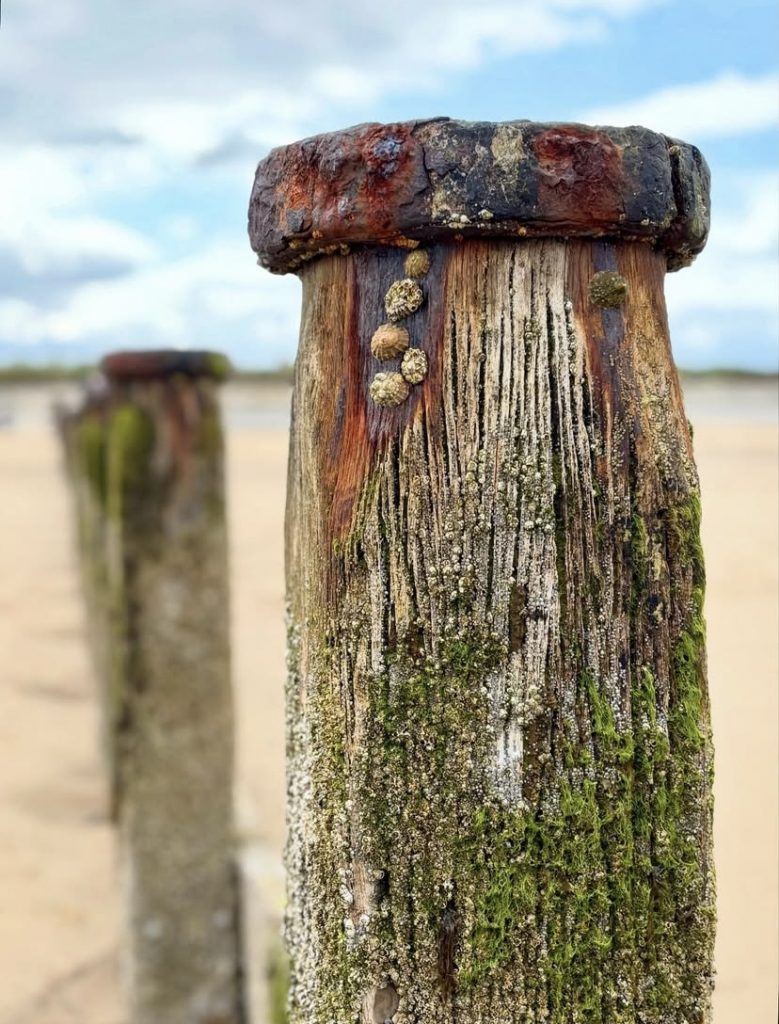
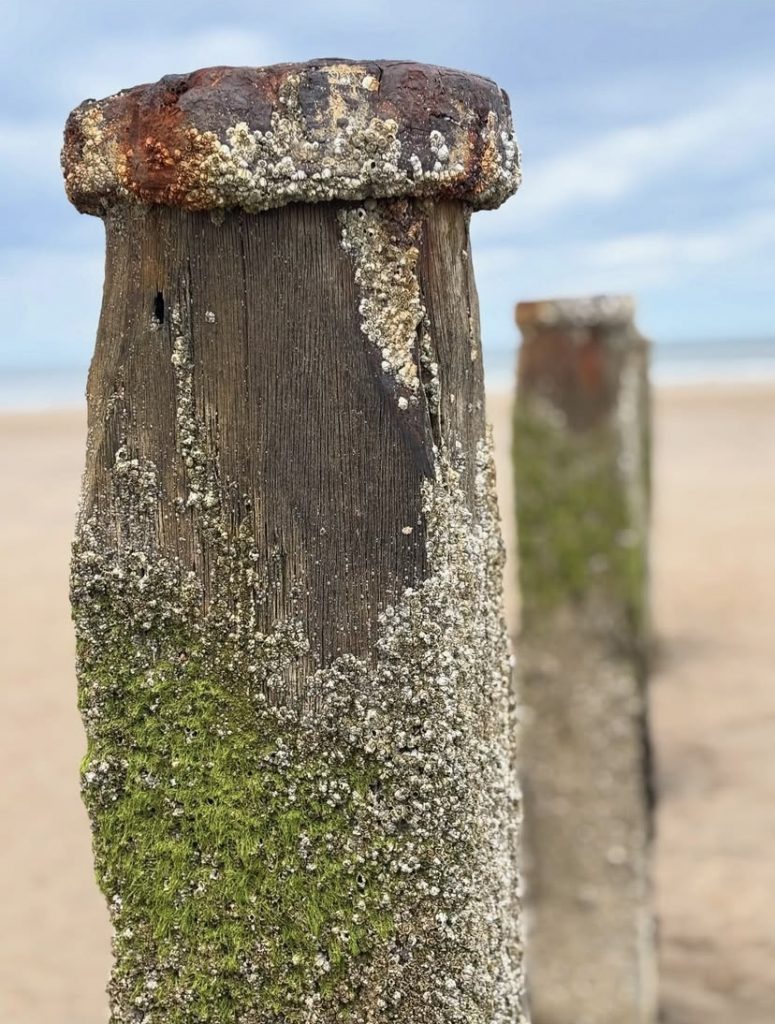
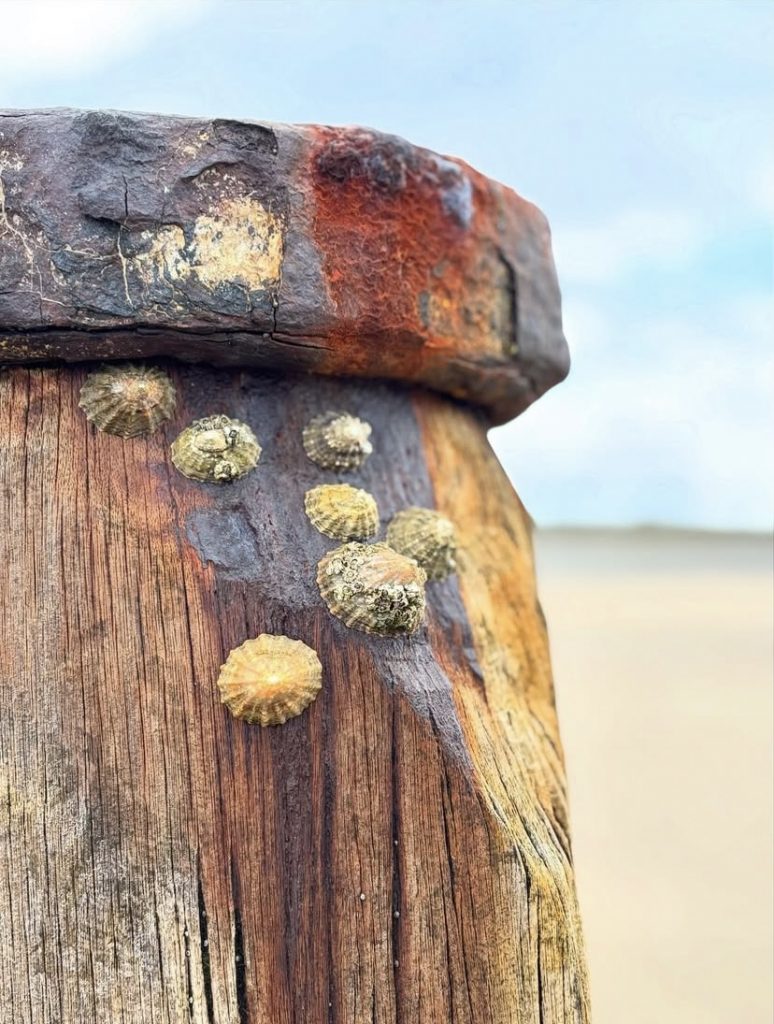
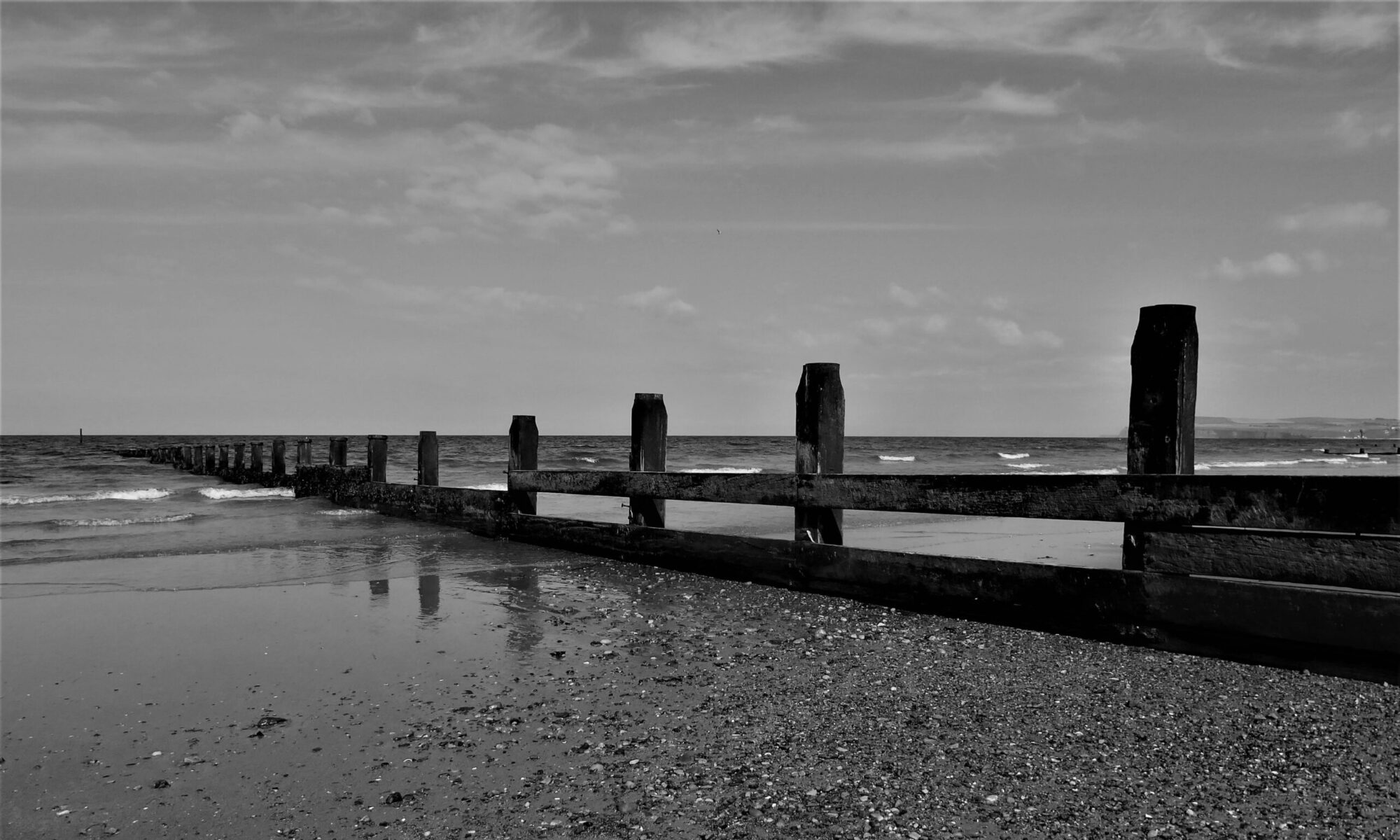
At the weekend I visited The Stray near Redcar, the beach where my sister died. Even on a day when the Redcar Kite Festival was taking place at neighbouring Coatham Beach, this section of sand was quiet, with only a few dogwalkers and runners passing by. The tide was a long way out, further than on many previous visits, so I had a chance to see fully the wooden groynes that stretch along the sands here, and which had been uncovered by the sea.

Photo credit: Anne Whitehead

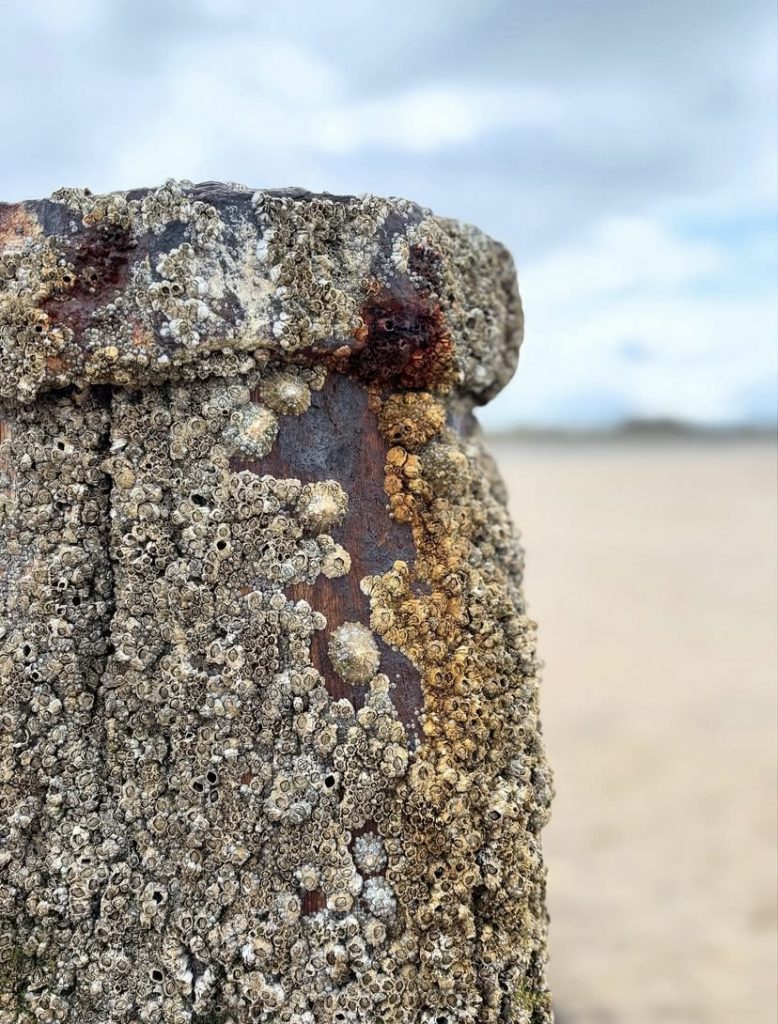
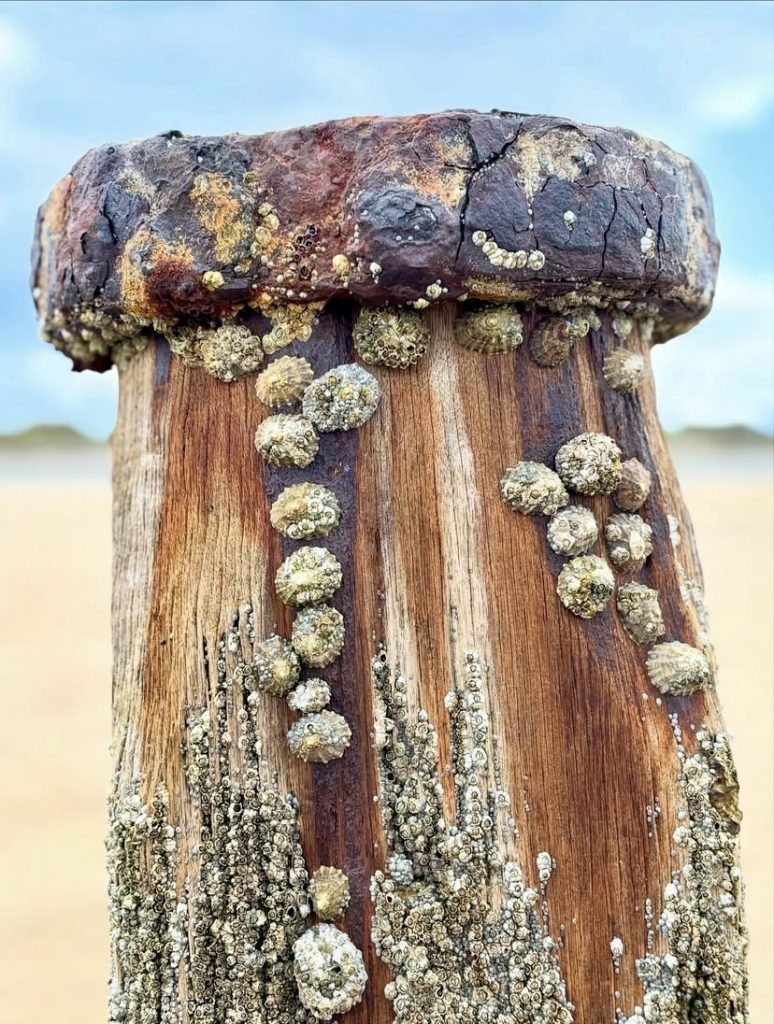
The iron red staining of the wood, combined with the barnacles attached to the groynes, reminded me of Antony Gormley’s Another Place on Crosby Sands, near Liverpool. There, too, the perpetual advance and retreat of the tide over the rows of sculpted men means that the figures are increasingly covered by barnacles from the sea and affected by corrosion from the elements.

Photo credit: Anne Whitehead

I have written in Relating Suicide about my close association between The Stray and Another Place and the ways in which Antony Gormley’s installation has helped me to navigate my own grief. This, in turn, provided the basis for the ‘Sounding the Angel’ project, as I wanted to understand more fully how Gormley’s Angel of the North sculpture was helping others to deal with loss through the tributes to loved ones that they were leaving there. As at Crosby, so my experience of visiting The Stray differs according to the tide, and I spent some time wandering among the groynes, examining closely the different ways in which they had weathered, as well as the various life forms that had found shelter there.

Photo credit: Anne Whitehead

I have noted in a previous post David’s observation that the memorial tributes at The Angel of the North have both arisen from and around the sculpture, and become a vibrant and integral part of its meaning, in a way that is reminiscent of the barnacles that now encrust the sculpted men at Crosby. The shifting nature of tidal patterns, living creatures, and the memorial tributes animates the static structures of groynes and sculptures, and thereby renders them into lively and dynamic organisms.

Spontaneous Memorials

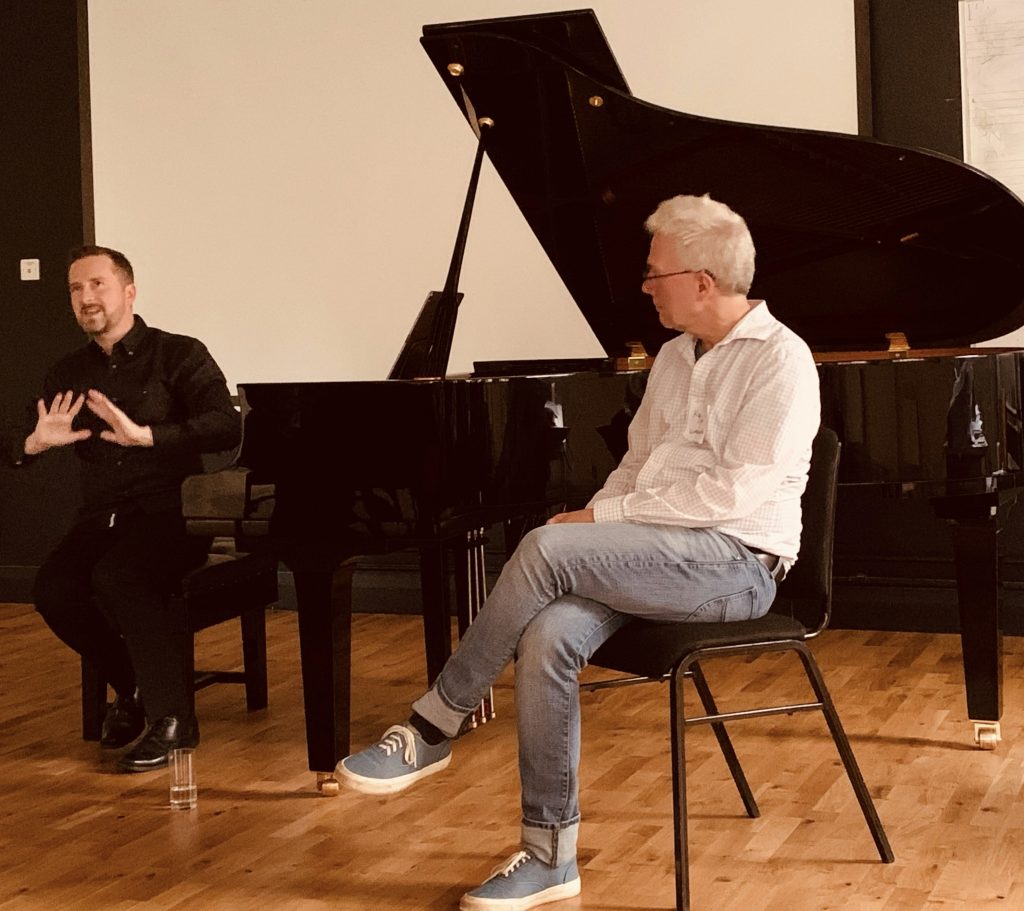
Adam Swayne and Kevin Malone, discussion and live performance of ‘Sudden Memorials’

Last week I was delighted to attend the AHRC-funded ‘Spontaneous Memorials’ conference, organised by Kostas Arvanitis at the University of Manchester. The conference focused on how we research, curate and analyse spontaneous memorials and the impacts that they have on individuals, communities, organisations and societies. I was delighted to be presenting a paper on the ‘Sounding the Angel’ project alongside other scholars and practitioners who were engaged with questions of sound, affect and memorialisation.

The first speaker on the panel, Katelyn Hearfield, brought our attention to our location in Manchester with her paper on the role of song in affective processing after the Manchester Arena Bombing in 2017. The attack, which happened as concertgoers were exiting the Arena after an Ariana Grande concert, killed twenty-three people, including the perpetrator, and injured hundreds more, and a spontaneous memorial was assembled outside the Arena just hours after the attack, which was later moved to St Ann’s Square. Katelyn spoke of the many tributes, now held in the Manchester Together Archive at Manchester Art Gallery, which were music related, referring to Grande and also local musicians and songs. The paper then discussed the moment after the national minute’s silence was held at St Ann’s Square when a member of the crowd began to sing the Manchester classic ‘Don’t Look Back in Anger’ by Oasis, which was then taken up by the crowd of 400 people assembled there. Katelyn read this as an example of collective processing through music, while also discussing a distinction that emerged between how the lyrics were interpreted by some people in the local community and those who witnessed the moment online.

Also engaging with song, Heather Sparling from Cape Breton University addressed the memorialising role of songs in the aftermath of the Novia Scotia mass shooting of April 18 and 19, 2020, in which the perpetrator killed 22 people and injured 3 others, before being shot down by the police. Grief at the deadliest mass murder in Canadian history was compounded by the beginning of lockdown in Canada, meaning that people dealt with their grief in relative isolation. Lockdown also made intangible memorials, such as songs, particularly significant in the response to the shootings. Arguing that songs and music offered a means of processing, expressing and sharing grief, Heather played and discussed the YouTube video of Nova Scotian fiddler Natalie McMaster playing alongside the youngest victim of the shooting, Emily Tuck, using a home video made shortly before she died. Heather pointed to the importance of song as an intangible memorial both in the context of the Covid-19 lockdown and in not being tethered to a specific physical location – significant for the Nova Scotia shooting which had taken place over a wide geographical spread.

Following the panel, we were treated to a performance and discussion of Kevin Malone’s piano composition ‘Sudden Memorials’, which responded to the site in Shanksville, Pennsylvania, where the passengers of Airlines Flight 93 crashed their aircraft to thwart hijackers on 9/11. In 2006, Kevin had taken a photograph of the makeshift memorial at the site: a wire fence onto which visitors could attach items and tokens of remembrance. For the 30 minute piece, Kevin focused closely on 20 diverse objects and composed a response to each object. These pieces were then stitched together into a mosaic composition which reflected the non-linear and impromptu experience of a visitor to the memorial. Concert pianist Adam Swayne had first performed the piece in lockdown conditions in London, Oxford, New York, Brighton and Manchester, and the piece incorporated a series of theatrical gestures, through which Adam discovered ‘objects’ in, on and around the piano while playing. In the closing section, Adam spontaneously improvises while looking at the objects on the photograph, enabling the composition to be responsive to the audience in the room. Many of the participants at the conference found the piece profoundly moving, observing that their research on spontaneous memorials requires them to keep their emotions in check, whereas listening to the piano piece led them in the opposite direction and helped them to release their feelings through tears. One participant spoke of looking at the photograph and imagining which object was the focus of each ‘piece’ of the music. Initially worrying that she had got the wrong object, she then realised as she was listening that the meaning she was attaching to it was its true significance.

In subsequent 9/11 works, Kevin incorporated documentary techniques, using recordings of air traffic controllers, his own recorded site-specific sounds, and interviews with witnesses and first responders. This takes these works closer to the ‘Sounding the Angel’ project, which immersed the listener in a soundscape comprised of interviews, site-specific recordings, and the vibrations from within the Angel of the North. Kevin titled his session ‘Fence, photograph, pandemic, piano: The Makeshift Music of Sudden Memorials‘. I found his phrase, ‘makeshift music’, both poetic and beautiful, and it closely described my experience of listening through David’s headphones to the eerie drones and thumps resonating through the Angel sculpture.

All of the papers I heard at the ‘Spontaneous Memorials’ conference manifested a deep care in relation to archiving and researching memorials, thinking through how to do so both ethically and in conjunction with the community. The same level of care had been shown by Kostas in curating the conference itself, and I feel honoured to have been a part of the event, as well as humbled by the important work that so many participants were doing.

Insights Public Lecture

Photo credit: Anne Whitehead

In December 2024, David and I marked the end of the Sounding the Angel project by contributing a public lecture to Newcastle University’s Insights lecture series. The sound recording from the project was reinstalled in the Arches Sound Project to coincide with the lecture, so that people had the chance to hear it in full before and after the lecture.

David and I presented the lecture together, in recognition that it had been a collaboration between us at every step of the way. We began by describing our own encounter with the memorial at the Angel, which opened out into a broader description of the project and its aims. We then focused on David’s recording of the sounds of the site across the seasons of the year, before letting the voices of our participants lead the conversation with their reflections on what it had meant to them to leave memorial tokens at the Angel. We closed by pulling the different strands together into a reflection on what it means to use sound as a means of recording a spontaneous memorial.

We had some fantastic responses from those who attended the lecture and it was great to see so much interest in the project. Some of those who came had heard about the project from the early radio broadcasts and followed its progress in this blog, while others had encountered it for the first time through the lecture.

We gave the last word to the Angel, playing David’s recording of its metal structure contracting at the end of a hot summer’s day in our last visit to the site together. Amplified through the audio system of the lecture theatre, the sound reverberated through the floor, even as it had radiated out from the base of the Angel on the day that we recorded. It felt like a fitting close to a project called Sounding the Angel!

You can watch the lecture here.

World Health Day 2025

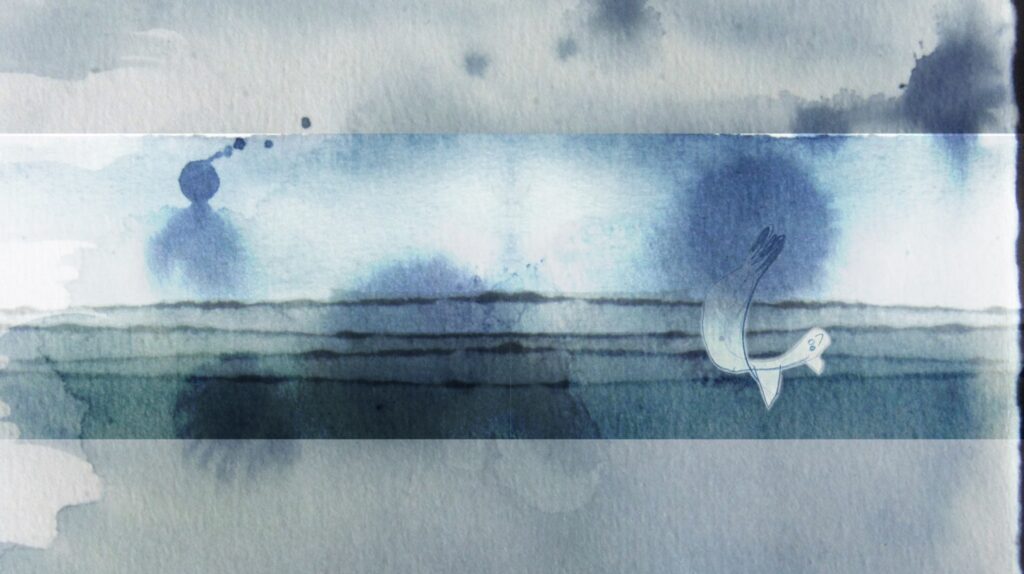
child's drawing of dolphin in sea
Film still, Where We Will Go (2023) by Kate Sweeney

Yesterday marked World Health Day, which this year marks the start of a global campaign focused on improving maternal and newborn health. To mark this initiative, Newcastle University published a blog that profiled the leading research in this area that is being carried out at Newcastle.

It was a privilege to see Where Will We Go featured in the blog alongside medical research advances, and to see Judith Rankin’s wider research in this area recognised and celebrated. Our project sought to create a supportive resource for parents who lose a twin at birth, so that they could hear the voices and experiences of the families we worked with. It was very special to hear from the parents who participated in the project that they would use the film to speak with their children about their lost siblings when the time was right to do so.

You can read the blog post about the work in newborn and maternal health at Newcastle University here.

July

Photo credit: Anne Whitehead

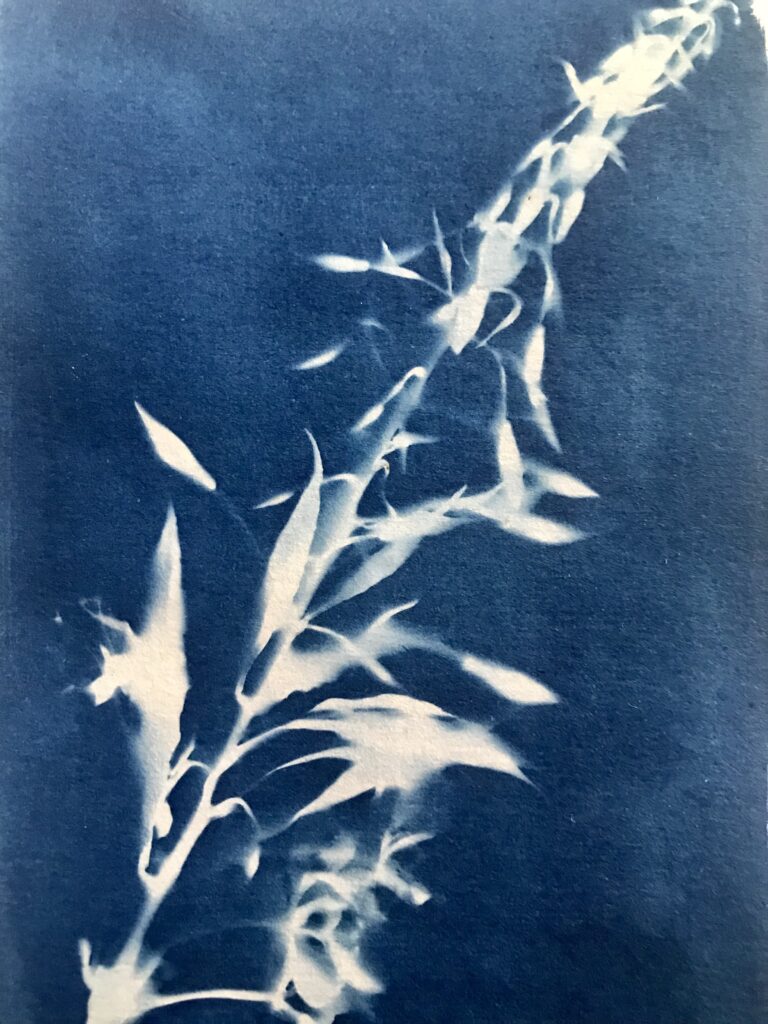
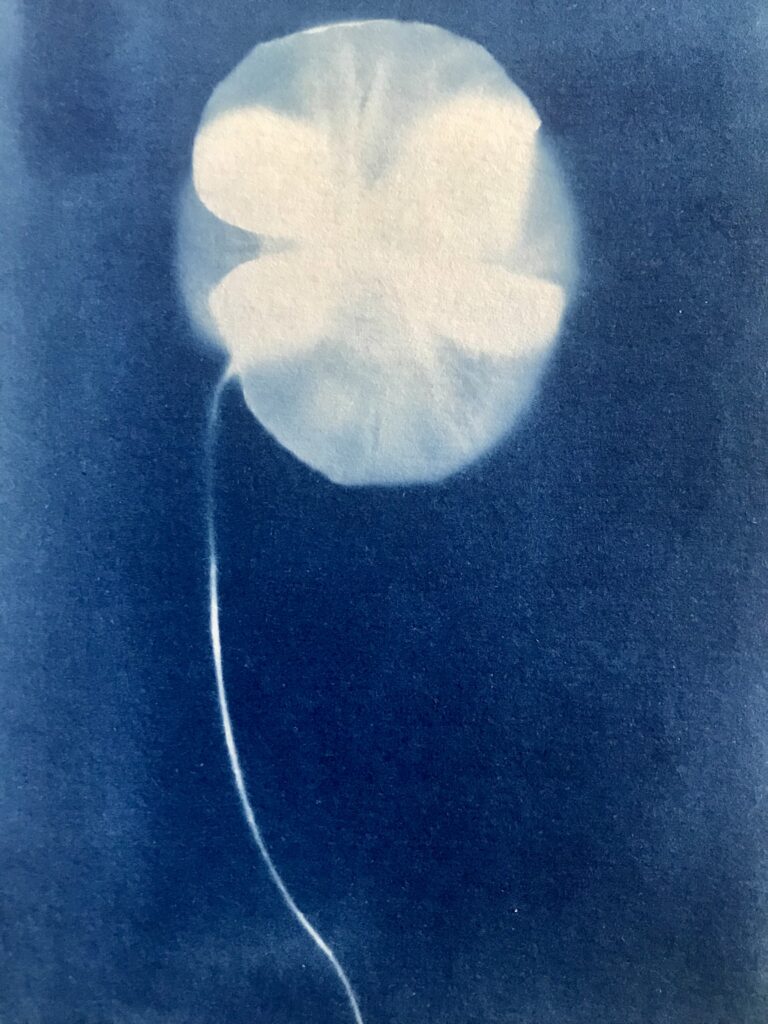
This post forms part of a monthly series that documents the plants growing at The Angel of the North through a series of cyanotypes.

July sees two flowers in bloom at the Angel site that have commemorative significance relating to the two World Wars. The pink spires of the rosebay willowherb wave in the breeze, and this plant is closely associated with the bombed-out sites of World War Two, when it proliferated on the fire-scorched ground. Poppies are also in flower, and this plant has become synonymous with the national commemorations of the First World War.

Rosebay willowherb, otherwise known as fireweed, thrives on waste ground, and particularly on burned-over land, because fire and other disturbances cause its seeds to germinate. Considered a rare species in Britain in the eighteenth century, it took hold here during the Industrial Revolution, particularly along the railway lines, where the associated soil disturbance, combined with the wind dispersal of the seeds by passing trains, created the ideal conditions for it to flourish. Even today, the rosebay willowherb’s purplish-pink flowers are a ubiquitous sight from train windows, spreading along the route of the track.

The bombing campaigns of the Second World War, and especially the widespread fire damage, caused the rapid spread of rosebay willowherb across bomb-damaged sites, earning it the nickname of bombweed. The children’s novel Fireweed is set during the Blitz, and centres on the bomb sites where the plant grew profusely, while Cicely M. Barker’s 1948 book Flower Fairies of the Wayside includes the following verse for the Rosebay Willowherb Fairy:

In 2002, the rosebay willowherb was chosen as the county flower of London, to mark its role in clothing in magnificent purple the bomb-scarred areas of the City, as it slowly recovered from the derelictions and deprivations of war.

The cyanotype of the rosebay willowherb above cannot capture its distinctive colour, but it does highlight the sculptural form of its tall spire. The site of the Angel of the North has not been fire damaged, but it is highly disturbed ground that has been landscaped from the waste land left behind by the former coal mine. The presence of the plant registers the industrial history of the site, and its reclamation from brownfield land.

Photo credit: Anne Whitehead

This cyanotype of a poppy growing at the Angel enhances its ghostly fragility, as the thin outer petals allow the light to pass through, creating a semi-opaque halo effect. The image seems appropriate to the flower’s status as an icon of remembrance.

Poppies have long symbolised sleep and death: sleep because of the somnolent effects of the opium that can be extracted from them, and death because of the blood red of the flower. In ancient Greek and Roman culture, images of poppies inscribed on graves represented eternal sleep and poppies were commonly used as offerings to the dead. The common poppy became a symbol of remembrance for the First World War in Britain and the Commonwealth nations, because it thrived in the disturbed land of the European battlefields. The connection of the poppy with remembrance was reinforced by the famous poem ‘In Flanders Fields’ by the Canadian soldier and surgeon John McCrae, and artificial poppies were adopted to commemorate those who had died in war in the UK, Canada, Australia, South Africa and New Zealand. The ritual of wearing the poppy centres on Remembrance Day on November 11, and in New Zealand and Australia, soldiers are also commemorated on ANZAC Day, which falls on April 25.

The poppy as a token of remembrance resonates with the memorial site at the Angel, as well as with the memorial aspect of the sculpture itself, which commemorates those who lost their lives in the mining industry. Like the rosebay willowherb, the poppy flourishes on disturbed ground and it is this feature of the plants that has made them so closely associated with the bomb sites and battlegrounds of the twentieth century. Looking at the soil in which these plants grow, as well as at the flowers themselves, their presence at the Angel site acts as a marker, not of the catastrophic events of war, but rather of the long industrial and post-industrial usage of this land. It is plants such as these, which are tolerant of disruption and low fertility, that are able to proliferate in the conditions created by such activity.

Summer

Photo credit: Anne Whitehead

Sounding the Angel can now be accessed in full here. In a series of four blog posts, I introduce each of the four sections of the sound work. Today’s post discusses the final part of the work, ‘Summer’. You can listen to this section here. This section of the sound work invites the participants to reflect on the memorial site and the act of leaving memorial tributes there. It is more expansive in tone than previous sections, as the participants describe their changing responses.

Our first participant asks what constitutes litter. In one sense, he suggests, what is at the memorial in the trees can be seen as litter – it is material that has been left behind – but at the same time it is clearly meaningful and precious to those who have placed it there. He sees an irresolvable contradiction between his work as a volunteer litter picker and his scattering of his wife’s ashes at The Angel – although one that is mitigated to some degree by the rapid dispersal of the tribute in the wind. Nevertheless, a tension remains for him between a memorial act that he can now ‘understand’ but of which he does not fully ‘approve’, commenting: ‘That’s the difficult part. I see it from all sides now. But I still don’t have a nice, neat answer from either side.’

For our second participant, too, there was a troubling aspect to leaving memorial tributes in the trees, and she turns to the ecological debates that have arisen around the clootie tree sites as her reference point. For a time, she explains, she was ‘a bit grumpy’ about the plastics and other non-biodegradable materials that people were leaving at the site. However, she reflected that it was not her place to judge others’ acts of commemoration, saying: ‘It’s so personal and whatever that little thing is, a little card or a plastic angel, or whatever they want to have there, it’s theirs to hang or leave. I used to mind terribly but now I don’t mind at all’. For both participants, leaving their own memorial tributes brings greater understanding of, and empathy for, what it means to others to do so.

The sound piece closes with the participants evoking the memorial site in sensory terms. Speaking of the positive effect of The Angel on the perception of public art, our first participant described a memorial that had been put up in his village to commemorate the mining industry. Designed in the shape of a miner’s lamp and illuminated by solar panels, the memorial signified that out of darkness came light. The theme of light is echoed by our second participant’s description of those trees that have lights strung around them, to shine out through the dark. She also evokes the sounds of the memorial – the wind chimes, the rustling of the cellophane that wraps the flowers. Her final description is of what she hears when she sits in the grass at The Angel, a combination of the noise of the traffic and the sounds of nature: ‘if you zone out a little bit you can hear the trees and then you hear the cars and it almost becomes one noise. So, it doesn’t become the mechanical noise from the car and then the natural noise from the trees, it’s just sort of a white noise in the end.’

Our conversations with the participants were reflective about the ecological questions that are posed by the site, while understanding the emotional weight that it holds for those who leave memorial tributes there, Feelings about the memorial were fluid and fluctuating. Both participants were attentive to the sensory qualities of the site, and there was an association for them both with a light shining out of the darkness as a beacon of hope.

This section of the sound work integrates the recordings from our last field recording session at The Angel. You can hear the rustling of leaves and grasses, a bird calling from the treetops in the memorial site, and the airier tone of the vibrations moving through The Angel that was recorded by the geophone.