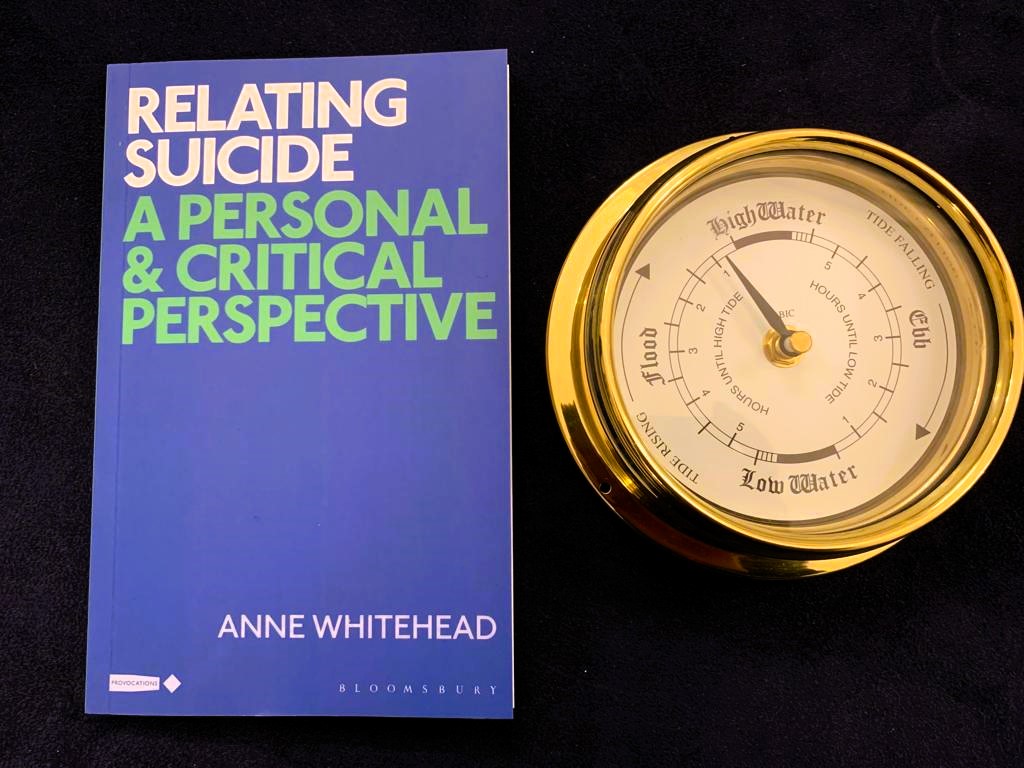
In February 2023, a book launch for Relating Suicide: A Personal and Critical Perspective was hosted by the Institute for Medical Humanities at Durham University. It took place in the Birley Room at Hatfield College, and I was both moved and delighted to see the venue filled with so many dear friends and colleagues.
The evening was launched by Professor Angela Woods, Director of the Institute.
Newcastle University Emeritus Professor Linda Anderson then reflected on the book’s combining of creative and critical writing.
My conversation with Durham University Emeritus Professor Patricia Waugh deepened the discussion of creative and critical approaches in the book. We ranged across other topics, including the integration of the personal into academic writing, the value of reticence, the question of form, and the influence of Virginia Woolf.
I closed the launch by reading a short extract from the third chapter of the book, in which I reflect on the tide clock that hangs on the wall of my kitchen.
Thank you to the Durham Institute for organising and hosting the event.
The image I have chosen for the page that introduces the Relating Suicide project is of a cyanotype. One of the earliest forms of photography, the cyanotype process does not need a camera. Instead, the object that is ‘photographed’ is placed directly onto a surface that has been coated with chemicals. Glass is laid over the object to flatten it onto the surface and it is then placed in direct sunlight. The coating on the paper gradually changes colour, the speed at which this happens being dependent on the strength of the sun. This represents the exposure of the image. To develop the image, the glass and object are removed from the surface, and the object appears in negative. Once immersed in water, the chemicals deepen to the dark cyan blue that characterises the cyanotype, and the object appears in white against this ground. The surface that is treated is usually paper, although fabric and other materials can also form the basis of a cyanotype.
I started to experiment with cyanotypes at the beginning of lockdown. Even though it was early in the year, the start of lockdown was marked by sunny days. I made my first cyanotype on fabric in my garden, using one of the plants that was growing there, and I was immediately hooked. Through successive lockdowns, I cyanotyped the different plants that grew in my garden or that I encountered on my walks. Developed onto fabric, the images enabled me to stitch in added detail. Gathering these cyanotypes together, I realised that I had created an archive of my lockdown experience. I stitched the cyanotypes into two albums, bound between fabric covers recycled from tops I no longer wore. I wrote about my lockdown cyanotypes for my good friend Kate Davies’ blog, and you can read the post here.
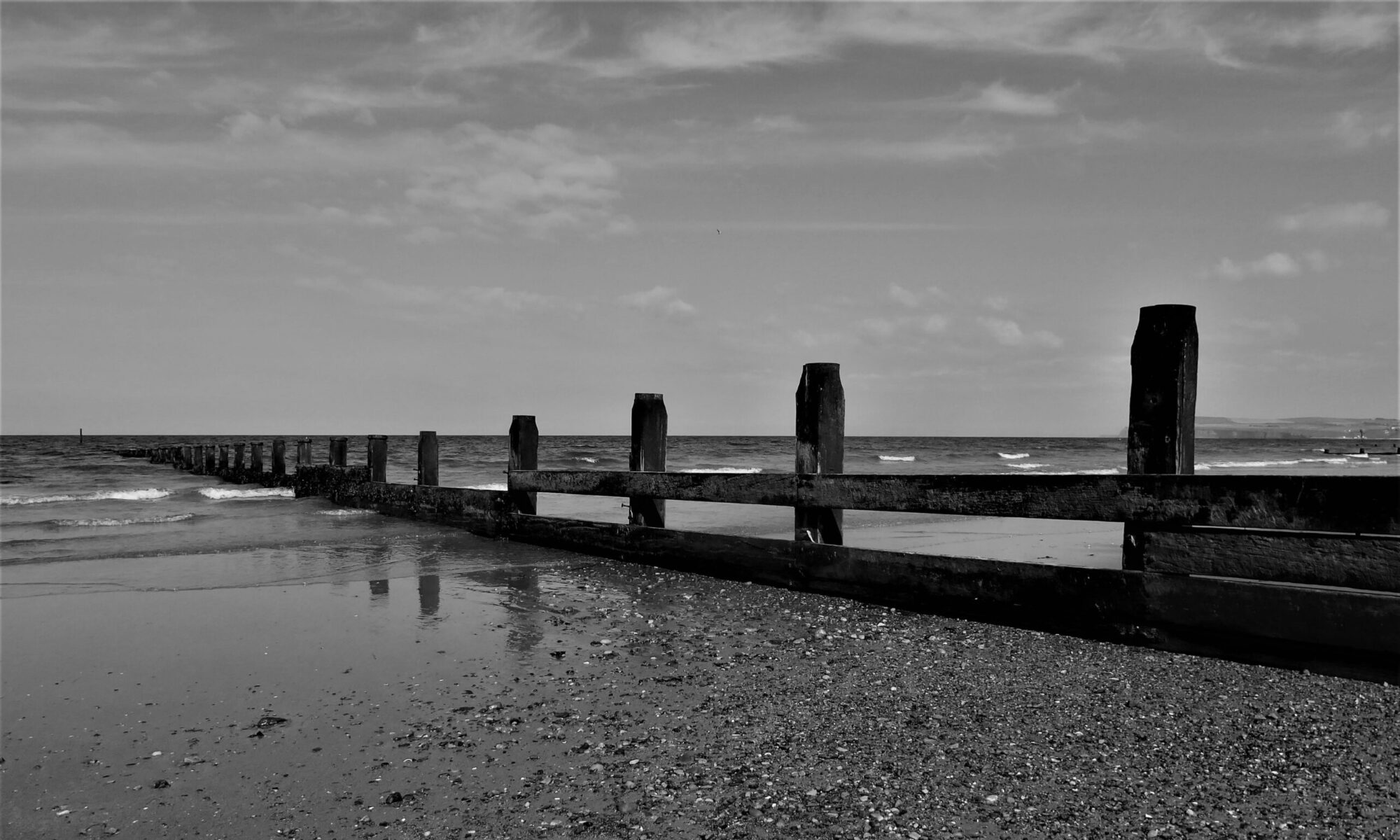
More recently, I have experimented with cyanotypes of plants and objects gathered on the beach at Redcar where my sister died. I like to walk there, and I often pick up small treasures along the way – a pebble, a feather, a strand of seaweed. The lockdown cyanotypes were created using the process described above, which is known as dry cyanotype because the chemicals have been allowed to dry on the treated surface before the object is placed on them. For the beach cyanotypes, I have mostly used the technique of wet cyanotype, so called because the object is placed on the surface when the chemicals are still wet. This allows the addition of other materials into the chemical mix, including dilute vinegar, sea salt or turmeric powder. The result is more unpredictable than with the dry method but it can be beautiful. I have written about the beach cyanotypes in a blog post for Bloomsbury Press, which you can read here.
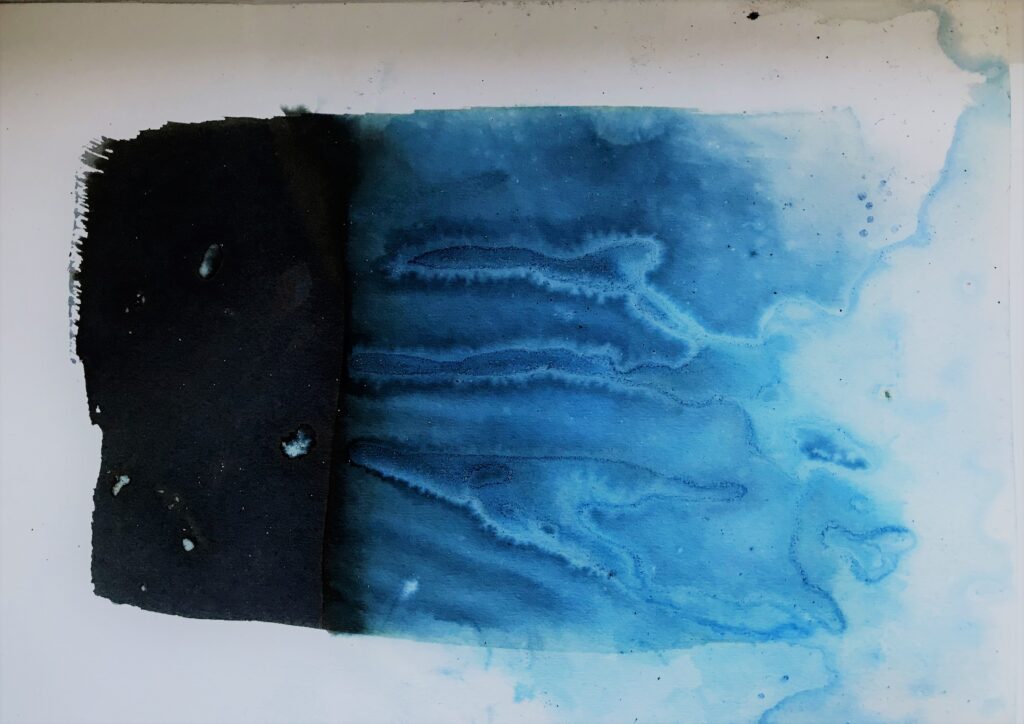
The cyanotype pictured on this page takes the sea as its object. Unlike many of the beach cyanotypes, it uses pre-treated paper because it was impractical to coat the paper when I was at the beach. But as a dry cyanotype, it collapses the distinction between the exposure and the developing stages. With the sea as its object, the cyanotype is exposed by dipping the paper into the edge of the tide and letting the receding pull of the water create the negative image. This already merges into the submersion of the paper into water for the developing stage, meaning that the image captures a part of the cyanotype process – the washing away of the chemicals – that is normally invisible.
This experimental cyanotype of the sea’s edge feels resonant to me with the subject of relating suicide. It is made in the place where my sister died and, on the anniversary of her death, it records a unique moment in time as the tide washes over the paper. I have written in my book about grief’s disturbance of time, and I used the tide clock that hangs in my kitchen to represent the rhythmic ebb and flow of time that commonly characterises grief. This image records both a washing away and a staining, which also speaks to me of what it means to visit this beach to remember my sister’s death.