
Memory Studies

Rose petals in water in three jam jars
Photo credit: Kate Sweeney, 2022.

In a previous post, I have written about the inclusion of Where We Will Go in the ‘Communities and Change’ exhibition, hosted by Newcastle Contemporary Art as part of the 2023 Memory Studies Association conference. The Memory Studies journal has recently published a special issue related to the conference and, in one of the articles, organisers Catherine Gilbert and Alison Atkinson-Phillips reflect on the various works that were displayed in the exhibition.

Catherine and Alison note that, in curating the exhibition, there was a strong desire to embed the conference in place and to connect with local communities. They observe that there was a particular poignancy to the inclusion of the Amber Collective in the exhibition, because the Side Gallery – their permanent exhibition space in Newcastle – had recently closed due to a lack of funds. Special screenings of two Amber films documented the long history of industrial loss on Tyneside and its impact on local communities. The short film from our project was connected to place through the activity of walking, and it was positioned in the gallery so that it was in conversation with Henna Asikainen’s ecological installation Delicate Shuttle. Asikainen had walked with people who had experienced migration and displacement, and they had gathered white poplar leaves which were dispersed across a large white wall of the gallery space. Similarly, Kate had invited the parents participating in our project to walk in a place that was meaningful to them, and gather materials that could be used as the basis for the inks. The act of gathering materials and transforming them into another form is a powerful one, and the white poplar leaves reminded me of the rose petals that the parents brought into the workshop, so carefully assembled and preserved. These materials are fragile, even when they have been preserved, and as Catherine and Alison note, they can speak as much of the dispersal of memory as of its conservation in the archive.

Leaves and petals connect human memories with the more-than-human, reminding us that acts of memory are as much expressions of ecological as cultural community. The question of community was at the heart of the exhibition and many of the installations considered different scales of community. Kate’s film was one of the most intimate communities represented in the exhibition, working as it did at the scale of the family. I have documented in previous posts our encounter, in the course of the project, with the ways in which the loss of a twin at birth resonates across multiple generations of a family as well as rippling out to affect friendship networks. This experience of complex grief is difficult to speak about, and, like the other artworks displayed, Kate’s short film demonstrated that words are not the only way to convey grief. The gathering of materials and making of the inks formed an important act of memorialisation in itself, and the drawings that the parents and the siblings made with the inks provided a further testament to their loss.

One of the key questions raised by the staging of the exhibition was the place of creative-critical works within a discipline such as memory studies, which has predominantly focused on the traditional academic outputs of the article and the monograph. Catherine and Alison open their article by reflecting on exactly this question:

These are important questions for the field to address. How can memory studies become more inclusive of creative practice, when it is premised on particular forms and modes of publication and dissemination? What does it mean to value process as well as ‘output’? Which aspects of memory might most effectively be opened up through creative practice? It is becoming more common to see creative exhibitions or performances staged alongside academic conferences and this is a welcome development. At the same time, such creative responses are often not fully integrated into the conference programme, featuring instead as a venue for mingling over lunch or at a wine reception, and/or as a space to visit for reflection between sessions. A final question, then, might be: How could the conference format, as a key expression of the academic community of a field, evolve to become more inclusive of creative-critical practice contributions?

With many thanks to Catherine and Alison for curating the exhibition and writing an article that enabled creative-critical practice to feature in the special issue of Memory Studies.

References

Alison Atkinson-Phillips and Catherine Gilbert, ‘Creatively imagining communities: The Communities and Change exhibition’, Memory Studies 18.2 (2025), pp. 354-62. You can access the article here.
Easington Colliery

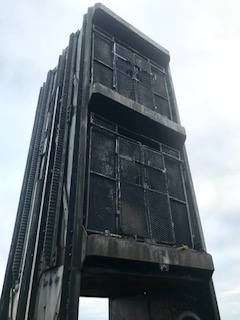
Reconstructed pit cage at Easington Colliery
Photo credit: Anne Whitehead

When I first spoke to David about the Sounding the Angel project, he told me about a recording he had recently made at Easington Colliery in County Durham. He had been recording the wildlife in the ponds with underwater microphones, and had walked up to the reconstructed pit cage nearby, which marks where the miners would have descended into the mine for their underground shift. Using his contact microphones, David tested to see what noise this large metal structure might make. The sound that he heard through his headphones is similar to the vibrations that reverberate through the hollow form of The Angel, and David integrated them into the larger sound piece that he was making. You can hear ‘There Is Power In These Titans Yet’, David’s recording of the pit cage memorial, here.

Listening to David’s piece through headphones, the deep rumblings, surgings and flexings caused by the structure’s amplification of the wind are similar to the sounds that the contact microphones pick up at The Angel. David’s evocative title invites us to read the piece as a sonic statement of the energies and potential that still reside in former mining areas. As with his recordings of the aquatic life in ponds, David’s sounding of the pit cage shows us that community extends beyond the human, and his work gives us insights into a larger ecology that mostly goes unwitnessed. The recordings make visible that which lies below the surface, whether that is the unseen wildlife under the water, or sounds that travel through the earth. Each of these elements of David’s work resonate with the Sounding the Angel project, given the siting of Antony Gormley’s sculpture on the former pithead baths of Ravensworth Ann Colliery, also known as the Ann Pit.

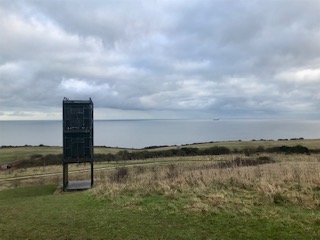
Last weekend, I visited Easington Colliery to gain a better sense of the inter-relationship between the reconstructed pit cage and The Angel. To what extent can one be transposed onto another, and what distinguishes them apart? Approaching the pit cage from a pathway that leads from the road, way markers give visitors key facts about the history of the mine. Although the pit cage now stands in isolation, an extensive mine works had once surrounded it. The sculpture is only fully visible after climbing to the crest of the hill, framing a view of the sea beyond. From beneath the pit cage, I looked out over extensive views north to the Sunderland coastline, and south to Teesside. Although there were some other visitors, the sculpture did not have the same constant flow of people as The Angel.

Metal pit cage with backdrop of the sea
Photo credit: Anne Whitehead

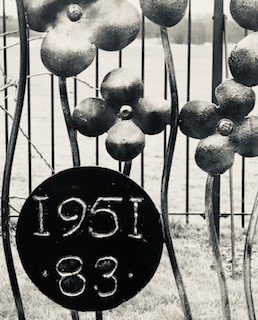
The most significant difference from The Angel became apparent when I followed a muddy track past a children’s playground to the Easington Colliery Disaster Memorial. Here, a horizontal pithead wheel is enclosed in a circular wooden cage, and the spaces between the spokes of the wheel have been filled with coal. The memorial commemorates a significant mining accident that took place on 29 May 1951, when an explosion in the mine resulted in the deaths of 83 men, two of whom were rescue workers. The death toll was so high because the explosion occurred at the change of shift, which renders the pit cage memorial even more poignant. The ornamental metalwork that surrounds the Disaster Memorial inscribes the year of the explosion and the total number of men that were lost.

Metal flowers with inscribed plaque
Photo credit: Anne Whitehead

I have previously differentiated the grassroots memorial in the trees from roadside memorials, noting that the memorial at The Angel does not mark the site of a death. Comparison with the memorials at Easington Colliery offers a sharpened perspective on this statement. Paired with the Disaster Memorial nearby, the pit cage at Easington marks the site where the explosion occurred in 1951; the sculpture commemorates the 83 lives that were lost there. The form of the pit cage is also specific to the event of the explosion, commemorating the change of shift that had entangled so many men at a single site.

If I turn to the entry for the Ravensworth Ann Colliery on the website of the Durham Mining Museum, the single listing under ‘Disasters (5 or more killed)’ is an explosion that took 16 lives on 10th June 1757. This accident, although claiming over the 10 lives that qualify an event as a mining disaster, is on a smaller scale than at Easington and it is far outside of living memory. Under ‘Names of those killed at this colliery’, 80 men are listed, including the 16 men who died in the explosion. The remaining 64 men died as a result of individual accidents, most often killed by a fall of stone or being struck by a truck. These deaths have different causes and, while they lend weight and specificity to Antony Gormley’s intention to commemorate on the site those who died as a result of the mining industry, The Angel is not specific either to these men or to the Ravensworth Ann colliery. The form of The Angel does not explicitly reference the mine, and the sculpture’s title gestures to the broader demise of heavy industry across the region.

Reading the pit cage at Easington Colliery in relation to The Angel calls attention to the importance of history in understanding the resonance of the site as a memorial space. The pit cage memorial at Easington marks the site where the explosion occurred in 1951, and it commemorates the 83 lives that were lost. The Angel stands on a site that still carries the emotional weight of the 80 deaths listed by the Mining Museum as having occurred over the timeframe that the colliery was in operation. Nevertheless, Gormley’s sculpture does not commemorate either a single event or particular lives. The lack of specificity of The Angel lends itself to adoption as a grassroots memorial in a way that the Easington pit cage memorial does not – the sculpture marks the site out as a place of memorial significance, but it evokes a range of associations, meaning that visitors can more readily connect it to their own particular lives and losses.

References

‘Ravensworth Ann Colliery’, Durham Mining Museum, https://www.dmm.org/colliery/-003.htm