ESRI UK User Conference Tuesday 17 May

This year’s ESRI Annual Conference took place once more in the QEII Conference Centre in the heart of Westminster.  It was good to meet up with several Newcastle graduates, each making their mark on the GI industry.  The major ‘take-away message’ from this year’s conference was the increasing ease by which the traditionally ‘clunky’ ArcGIS desktop can be left behind in favour of developing using ArcGIS Pro and ArcGIS Online, products with regular and frequent update cycles and increasingly comprehensive functionality.

From the perspective of ESRI, David Rix (1976 graduate) and Dominic Stubbins (1995) were amongst the welcoming corporate hosts, contributing to an efficiently-run and informative event, well worth the trip from the north!  Nathan Ward (1993) was manning the Leica stall, one of several associated partners exhibiting in the building.  Laura Hanson (2003 graduate), now with Arup, and Rachel Oldroyd (2011 graduate), now with the University of Leeds, were ex-staff members spotted, along with Meredith Williams (staff 2000-2010).

Joining Dominic from the 1995 cohort was Ian Moodie, whilst from even further even back, Rob Knight and Helen Durham (both 1985) are both thriving.  Clive Surman-Wells (1988) and Andy Hopkins (1996) made their presence known also, along with some 21st century graduates – Bruce Ford (2009), Claire Watkins (2009), Victoria Short and Matt Bowerbank (2010), Matthew Bierton (2014) and Jonathan Hallam (2015).

Next week, the re-unions will continue in London at the GeoBusiness event.  There is a formal Newcastle alumni meeting on Tuesday 24 May at 15:00 hrs.  Come along to the Business Design Centre in Islington, if you are in town …

GIS students present research projects Friday 13 May

This week saw the annual ‘Final Year Conference’, the showcase for the Stage 3 Geomatics students to present their dissertation research in a formal venue to their fellow students and to the staff and postgraduates in the School.  A total of 31 Newcastle Geomatics students delivered talks in two parallel tracks with themed session titles including ‘Built Environment’, Spatial Analysis’ and ‘Geovisualisation’.  The 12 final-year Geographic Information Science students’ topics were as follows:

Nada Alabdulwahed used an impressive range of satellite remote sensing imagery from the past 20 years to track the urban development of the city of Al Khobar in eastern Saudi Arabia.  Standard image analysis and classification techniques along with ground truthing and integration with other data on population and land reclamation allowed for accurate quantification of urban growth.

Ed Drummond-Hay researched house price changes across England and Wales, using millions of records from Land Registry, ONS and commercial sources.  His hypothesis was that house price increases in London ‘rippled’ out from the capital to affect the rest of the country after a time lag.  The dynamic and animated representation of such patterns was an important part of the output from Ed’s research.

Emmanuel Egunyu aimed to create an online website resource to promote tourism in his native Uganda.  Using OpenStreetMap data and open source technologies with PostGIS and Geoserver, he reported on the creation of a map-based information portal for those planning to visit national parks and view wildlife in this country.

Alexia Fenn’s study concentrated on the validity and reliability of observations from GPS receivers worn by athletes.  A variation of sport/athletics course shapes, course distances, and exercise/movement intensities were examined.  Walking, jogging, and sprinting over various distances and in a variety of course configurations were examined, with GPS accuracies determined for each exercise regime.

Will Franklin developed a system to estimate the safety of junctions on the road network in Newcastle.  By calculating a Junction Risk Factor, based on a number of parameters related to road conditions and traffic volumes, he was able to develop a predictive model to determine the optimum location for investment in road network improvements.

Jo Gallagher’s interest in spatially-enabled Twitter data led to a study of the geolocation of football clubs’ fan base.  He found that the ‘bigger’ the club, the more dispersed the distribution of fans – backing up the popular theory that the mean location of a Manchester United fan is some distance from Old Trafford.

Patryck Janicki’s research aimed to develop a geodatabase schema able to hold both CityGML data at Level of Detail 1 and main Industry Foundation Classes (IFC) classes.  The ability of the schema to abide by standards, allow for SQL queries, hold geometry effectively, was to be supplemented by an effective visualisation flowline through export to QGIS.  The outcomes of this project have impact on the integration of BIM with GIS.

This was also the focus of the research of Anthony Morley, who examined current technologies for importing a BIM model into a geospatial environment and assessing interoperability.  This involved using a range of software and data formats, including ArcMap, ArcScene, ESRI City Engine, REVIT, AutoCAD and FME.  The geometric and semantic integrity of the model, and the needs of users were considered.

Amber Kaye-Kenyon chose the analytical capabilities of ArcMap, ArcScene and City Engine (including Buffer, Viewshed and Line of Sight (LOS)) to look at the modelling of an urban sensor network.  In the context of the instrumented city concepts being developed in Newcastle upon Tyne, particularly around the university’s new Science Central campus, ease of use, visualisation and effective monitoring of the sensor network were derived.

Ben Nicholls undertook a very detailed study of some of the rich cartographic generalisation tools in ArcGIS.  Applying these to different types of feature (railways, contours, buildings etc. as represented on large scale Ordnance Survey data), and in different locations (e.g. central urban zones, rural regions), Ben presented an impressive assessment of the data pre-processing, algorithm effectiveness and presentation quality of such procedures.

Josh Watson’s theme was a big data set dealing with cardiac arrests outside hospital.  The spatial and temporal distribution of these events was determined, as a precursor to understanding the nature of the phenomenon and to try to raise low survival rates in the North East.  Clusters of cases were apparent and these were linked to population distribution, to ambulance stations and response times, and to times of day, season and year.

Imogen Weight made a comparative study of several web mapping APIs, assessing data needs, scope of functionality, usability, and final appearance of maps created in Leaflet, Mapbox, and the dedicated Javascript APIs for Google Maps and for ArcGIS.

The remaining students (Surveying and Mapping Science students) pursued research topics in a wide range of other spatial themes, many of which have a GIS ‘flavour’.  Environmental monitoring of coasts, glaciers, urban heat, and floods used GIS tools, as did further investigations of BIM, and further social investigations of education from a GI perspective.

New paper: Reducing the impact of extreme weather on infrastructure networks

Last week our latest paper was published entitled ‘Assessing urban strategies for reducing the impacts of extreme weather on infrastructure networks’ in the Royal Socities Open Science journal. Alistair Ford, Craig Robson and Stuart Barr all contributed to the artical alongside colleagues from civil engineering, Maria Pregnolato (lead authour), Vassilis Glenis and Richard Dawson. A summary is given below.

“A framework for assessing the disruption from flood events to transport systems is presented that couples a high-resolution urban flood model with transport modelling and network analytics to assess the impacts of extreme rainfall events, and to quantify the resilience value of different adaptation options. A case study in Newcastle upon Tyne in the UK is presented and shows that both green roof infrastructure and traditional engineering interventions such as culverts or flood walls can reduce transport disruption from flooding.The magnitude of these benefits depends on the flood event and adaptation strategy, but for the scenarios considered here 3–22% improvements in city-wide travel times are achieved.

Both options should form part of an urban flood risk management strategy, but this method can be used to optimize investment and target limited resources at critical locations, enabling green infrastructure strategies to be gradually implemented over the longer term to provide city-wide benefits. This framework provides a means of prioritizing limited financial resources to improve resilience. By capturing the value to the transport network from flood management interventions, it is possible to create new business models that provide benefits to, and enhance the resilience of, both transport and flood risk management infrastructures.”

Championship Away Fans

The volume of a teams away following is often used as measure for the “size” of a club and is heavily debated amongst football fans. But their are many factors that influence this, not least their proximity to other clubs.

13096253_10156800676615123_3874620268719268683_n
Hartlepool Away Fans making 400-mile trip to Plymouth away to watch their side lose 5-0

With the Football league last week releasing statistics showing the average away attendance for each team playing in the championship (shown below), I looked at whether this was effected by the clubs accessibility to other clubs and how long fans were spending travelling.

Team Away Attendance
Leeds 2807
Middlesbrough 2515
Sheffield Wednesday 2510
Derby 2125
Burnley 1911
Birmingham 1779
Brighton 1658
Preston 1506
Wolves 1470
Nottingham Forest 1443
Hull 1393
Ipswich 1383
Bristol City 1263
QPR 1204
Huddersfield 1128
Blackburn 1106
Brentford 1073
Rotherham 1041
Reading 1040
Fulham 988
Bolton 911
Cardiff 748
Charlton 637
MK Dons 636

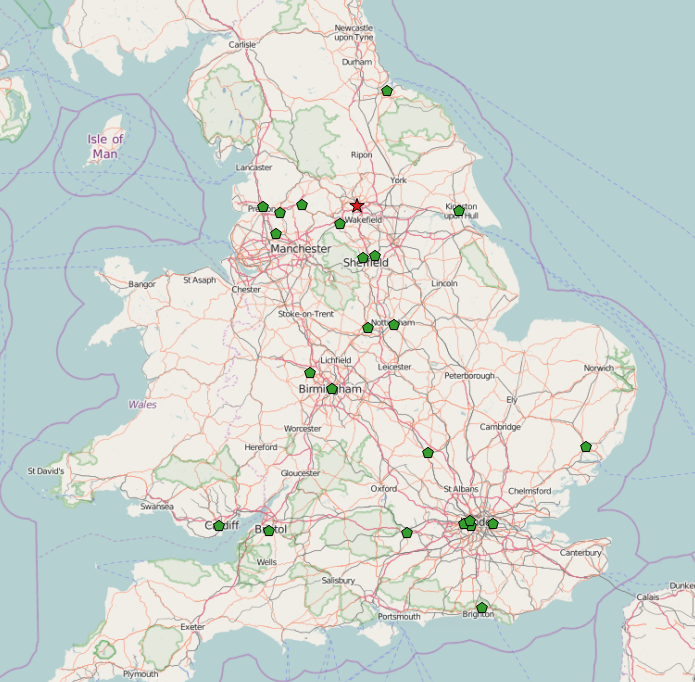
With Leeds being located in within fairly close proximity to a number of the northern teams, and Leeds railway station being well connected I wanted to look at the whether this contributed to their loyal away following.

Screenshot_2016-05-16_09-56-56

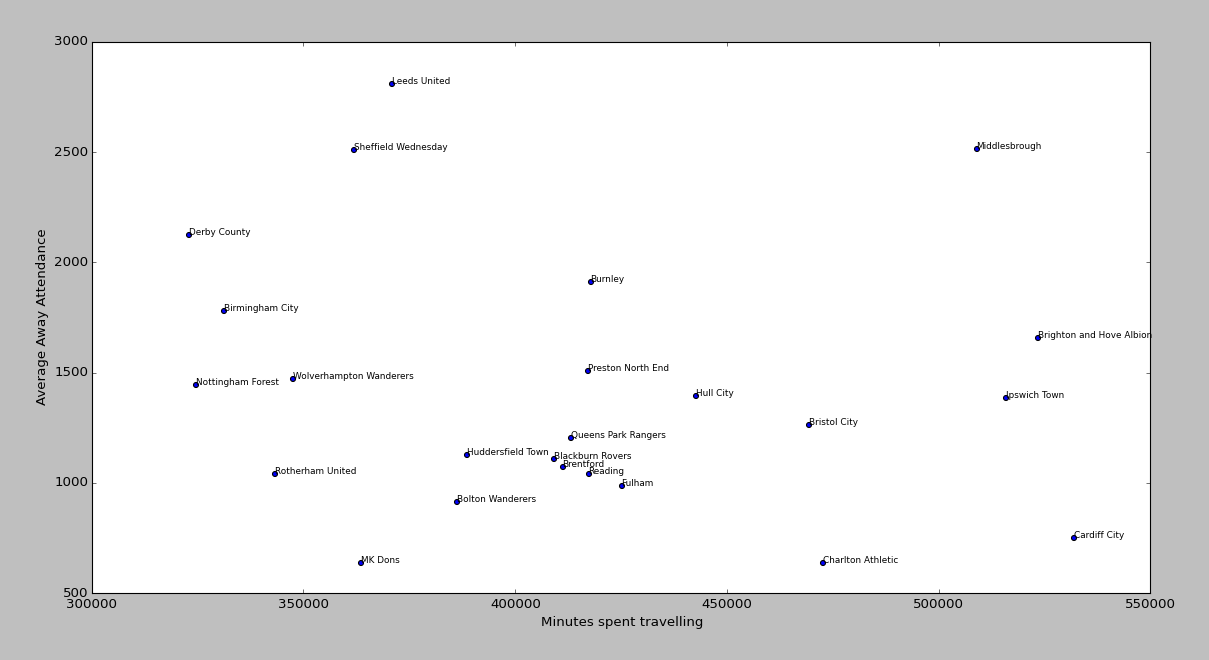
So I used the Google Travel API to look at the total time a football fan would spend travelling if they went on public transport to every away game. The results are below.

Team Time Spent Travelling
Cardiff City 6 Days 3 Hours 44 Minutes 14 Seconds
Brighton and Hove Albion 6 Days 1 Hours 23 Minutes 36 Seconds
Ipswich Town 5 Days 23 Hours 17 Minutes 34 Seconds
Middlesbrough 5 Days 21 Hours 25 Minutes 26 Seconds
Charlton Athletic 5 Days 11 Hours 18 Minutes 10 Seconds
Bristol City 5 Days 10 Hours 22 Minutes 50 Seconds
Hull City 5 Days 2 Hours 57 Minutes 20 Seconds
Fulham 4 Days 22 Hours 6 Minutes 38 Seconds
Burnley 4 Days 20 Hours 5 Minutes 32 Seconds
Reading 4 Days 19 Hours 58 Minutes 32 Seconds
Preston North End 4 Days 19 Hours 52 Minutes 22 Seconds
Queens Park Rangers 4 Days 18 Hours 44 Minutes 38 Seconds
Brentford 4 Days 18 Hours 13 Minutes 12 Seconds
Blackburn Rovers 4 Days 17 Hours 38 Minutes 16 Seconds
Huddersfield Town 4 Days 11 Hours 55 Minutes 58 Seconds
Bolton Wanderers 4 Days 11 Hours 17 Minutes 36 Seconds
Leeds United 4 Days 7 Hours 2 Minutes 12 Seconds
MK Dons 4 Days 5 Hours 1 Minutes 4 Seconds
Sheffield Wednesday 4 Days 4 Hours 30 Minutes 54 Seconds
Wolverhampton Wanderers 4 Days 0 Hours 30 Minutes 48 Seconds
Rotherham United 3 Days 23 Hours 23 Minutes 6 Seconds
Birmingham City 3 Days 19 Hours 59 Minutes 4 Seconds
Nottingham Forest 3 Days 18 Hours 12 Minutes 6 Seconds
Derby County 3 Days 17 Hours 41 Minutes 6 Seconds

Screenshot_2016-05-16_09-46-08

From this it appears that there is very little correlation between the average away attendance and time spent travelling especially with Middlesbrough’s travel time and attendance being so high.

As a final thought I looked at using the travel times for ranking the teams be the number of “fan hours” spent travelling.

Team Fan Hours
Middlesbrough 40 Years 31 Weeks 3 Days 1 Hours 4 Minutes 50 Seconds
Leeds United 33 Years 0 Weeks 5 Days 23 Hours 55 Minutes 24 Seconds
Sheffield Wednesday 28 Years 41 Weeks 5 Days 4 Hours 39 Minutes 0 Seconds
Brighton and Hove Albion 27 Years 27 Weeks 0 Days 6 Hours 8 Minutes 48 Seconds
Burnley 25 Years 16 Weeks 6 Days 20 Hours 14 Minutes 12 Seconds
Ipswich Town 22 Years 32 Weeks 3 Days 5 Hours 54 Minutes 42 Seconds
Derby County 21 Years 39 Weeks 2 Days 20 Hours 37 Minutes 30 Seconds
Preston North End 19 Years 48 Weeks 0 Days 0 Hours 24 Minutes 12 Seconds
Hull City 19 Years 28 Weeks 5 Days 13 Hours 5 Minutes 20 Seconds
Bristol City 18 Years 41 Weeks 4 Days 6 Hours 38 Minutes 30 Seconds
Birmingham City 18 Years 35 Weeks 3 Days 8 Hours 19 Minutes 36 Seconds
Wolverhampton Wanderers 16 Years 10 Weeks 1 Days 10 Hours 36 Minutes 0 Seconds
Queens Park Rangers 15 Years 40 Weeks 1 Days 7 Hours 38 Minutes 32 Seconds
Nottingham Forest 14 Years 44 Weeks 5 Days 9 Hours 0 Minutes 18 Seconds
Blackburn Rovers 14 Years 18 Weeks 0 Days 19 Hours 22 Minutes 56 Seconds
Brentford 13 Years 51 Weeks 4 Days 14 Hours 3 Minutes 36 Seconds
Huddersfield Town 13 Years 46 Weeks 5 Days 20 Hours 10 Minutes 24 Seconds
Reading 13 Years 40 Weeks 0 Days 14 Hours 34 Minutes 40 Seconds
Fulham 13 Years 16 Weeks 5 Days 5 Hours 13 Minutes 44 Seconds
Cardiff City 12 Years 32 Weeks 0 Days 11 Hours 26 Minutes 32 Seconds
Rotherham United 11 Years 17 Weeks 3 Days 7 Hours 47 Minutes 6 Seconds
Bolton Wanderers 11 Years 8 Weeks 1 Days 16 Hours 13 Minutes 36 Seconds
Charlton Athletic 9 Years 28 Weeks 3 Days 23 Hours 52 Minutes 10 Seconds
MK Dons 7 Years 17 Weeks 2 Days 23 Hours 18 Minutes 24 Seconds

Where is Newcastle?

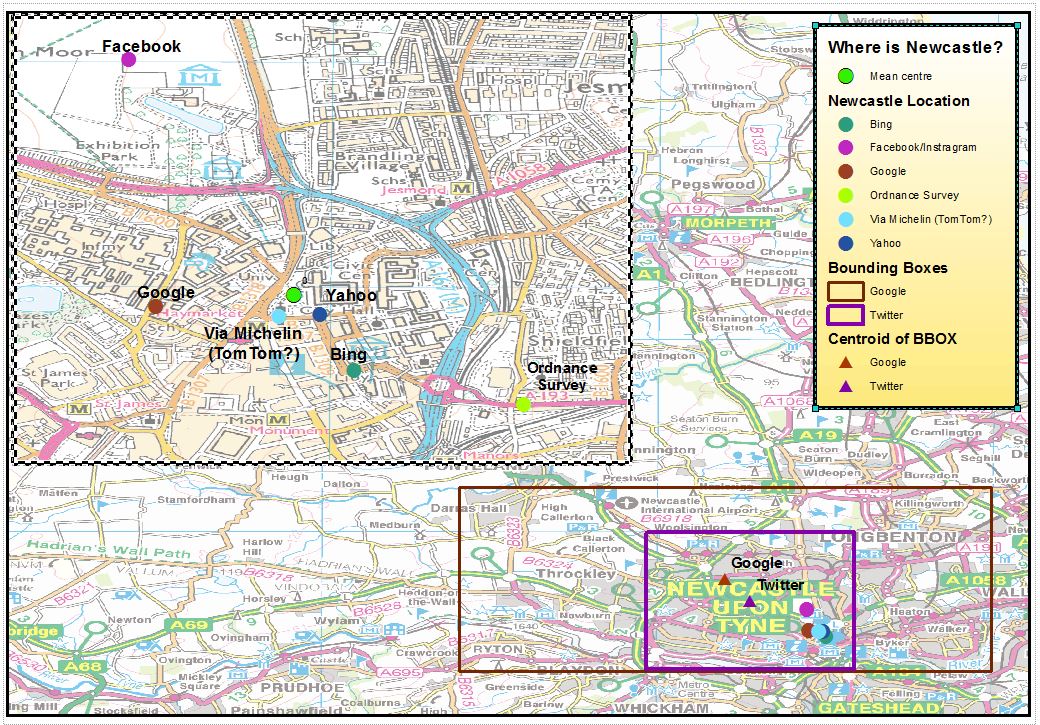
Following on from an early email exchange about how Google defined “Newcastle” it got me thinking about other providers and how they define the city. Twitter for instance provides a bounding box the centre of which is the middle of Nun’s Moor (as does Google but the point location is not the centroid of it). As you can see from the image there is wide variation. Note that a couple (Yahoo/Michelin) place the point location at the point roughly where the centre of the text “Newcastle upon Tyne” appears on certain map products.

The mean centre of the point locations excluding the centroids is shown as well.

Newcastle maps

So I visited a pile of map sites and extracted their default location (and/or bounding box) and plotted them on the map. For twitter I sent a tweet from “Newcastle upon Tyne” and captured the coordinates using the API. Just to be rigorous I installed TOR browser which obfuscates the IP address to ensure that location was not being picked up from the browser and tried different browsers as well. The OS point for Newcastle upon Tyne was collected from the Gazetteer service provided through Digimap.

The vaguely serious point here is that we now routinely use APIs to get data from and its location yet those locations provide spurious precision!