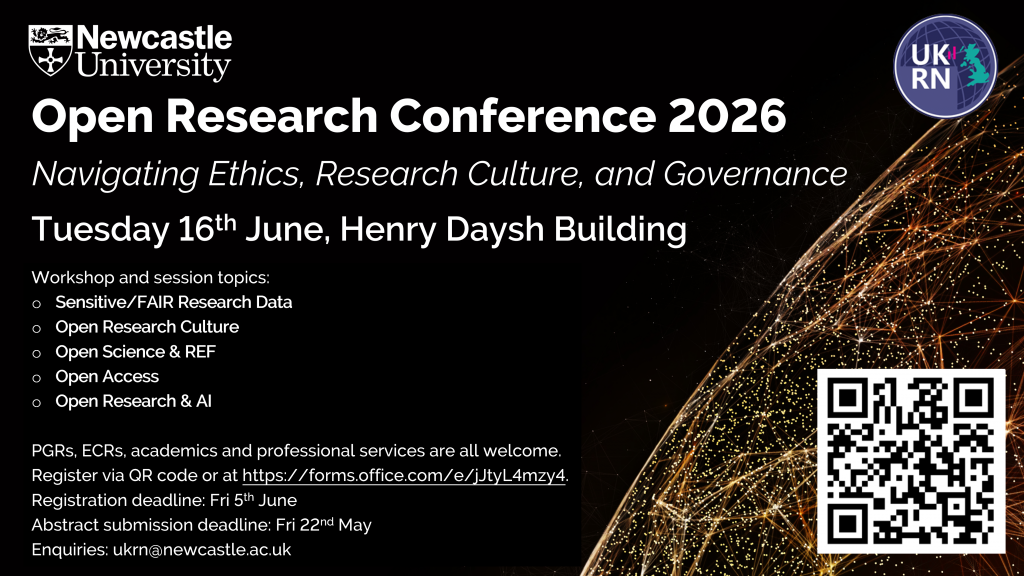

If you missed the Open Research Conference held at Newcastle in June, see our blog post for details of the day, the sessions and links to some of the presentations.
Check out the library calendar for further courses and dates happening in 2026.
Are you looking for advice and information on open access or managing publications? Do you have questions about copyright or how to comply with REF? Come to one of our monthly drop-in sessions and meet members of the Library Research Services team, who will be happy to answer questions on:
Copyright and licencing issues relating to your publications
Uploading your publications to our repository and REF
and more!
Whether you’re a seasoned researcher, student or simply keen to explore the possibilities within open access, the session offers a welcoming space to ask questions, gain insights and delve deeper into the realm of open access.
These are informal sessions, however, registration is required for you to receive the online teams link.
The OA policy applies to journal articles and conference proceedings with an ISSN that are published after 1 January 2021. It does not apply to any other research outputs, such as chapters, books, data, etc, although REF encourages researchers to move beyond the minimum requirements and apply open practices where possible to all outputs.
For inclusion in the REF OA submission, a version of the published article must be made open access, i.e. deposited, made accessible and discoverable, within the expected timeframes. The guidance for outputs published after 1 January 2026 has been updated, and the table below summarisies the key details.
Outputs made immediately open access on publication, provided they meet the deposit, access and licence criteria, will meet REF OA requirements. Note, there is no expectation that additional open access publication costs are required to meet REF 2029 OA policy requirements.
Newcastle University Guidance
We advise that Newcastle University authors continue to deposit their AAM in our institutional repository as soon as possible after acceptance. Following deposit, the open access team will review uploaded manuscripts and contact authors to discuss any issues in meeting the open access requirements for REF. In line with the University Research Publications & Copyright Policy, for any articles published after August 2023, the AAM will be made available open access in the University’s repository under a CC BY licence, on the article publication date, unless an embargo is required (see above for permitted embargo periods).
Detailed instructions of the policy requirements and how to make your paper REF eligible are available on our Open Access for REF page. Some exceptions to the policy are permitted for outputs that do not meet the OA requirements, details of how to apply for these are also shown on that page.
For more information or to arrange a discussion, please contact openaccess@ncl.ac.uk.
*The author accepted manuscript (AAM) is the version after peer review and containing all academically necessary changes, but before publisher copy-editing, proofing and typesetting of the peer-reviewed accepted manuscript.
Are you looking for advice and information on open access or managing publications? Come to one of our monthly drop-in sessions and meet members of the Library Research Services team, who will be happy to answer questions on:
Copyright and licencing issues relating to your publications
Uploading your publications to our repository and REF
Whether you’re a seasoned researcher, student or simply keen to explore the possibilities within open access, this session offers a welcoming space to ask questions, gain insights and delve deeper into the realm of open access.
These are informal sessions, however, registration is required for you to receive the online teams link.
The work brings together historical sources and contemporary experiences to explore the interplay between singing, sociality, body, and meaning in the English landscape over the past century. It explores the connections between air and song and between singing and movement, through the context of the early twentieth century open-air recreation movement. This is supplemented by recent literature on singing and wellbeing, and the experiences of a contemporary walking choir captured via interviews in the field. The authors argue that outdoor singing has been part of co-constructed soundscapes of the modern English leisure landscape, and ask what this meant for those who participated in collective open-air singing and rambling. They explore how open-air singing connected with conceptions of the countryside, with a sense of fellow-feeling, and how this might have both reified and challenged normative ways of being in landscapes.
This is the fifth book published at Newcastle University as a result of the UKRI open access policy for long-form publications, with open access costs covered by UKRI funding.
Of the experience, Clare Hickman (co-author) had the following comment:
[T]he process was very straightforward and quick, and it is good to know that non-traditional monographs are included in the UKRI policy.
For further details of the previous books published through this funding scheme, follow the links to the published works and related blog posts:
The UKRI open access policy aims to ensure that findings from research funded by the public through UKRI can be freely accessed, used and built upon. The policy applies to peer-reviewed research articles and long-form outputs, namely book chapters, monographs and edited collections.
If you have any questions or concerns about the policy, and how this might affect any current or future publications, please contact openaccess@ncl.ac.uk.