Shakespeare at the old Theatre Royal – May 2016

Shakespeare performed by Children

May 2016 marks the 400th anniversary of Shakespeare’s death. Newcastle has played host to the bard’s plays ever since – in more recent times, the Royal Shakespeare Company performed almost annually at the Theatre Royal by the Royal Shakespeare Company from 1977. Unfortunately, they will not be returning in 2016.

Our Theatre Royal Playbills (RB 792 (4282) – NEW) feature many notices for performances of Shakespeare at the old Theatre Royal on Mosley Street between 1770 and 1820, including this one by a Georgian/Victorian theatre sensation and her two sisters.
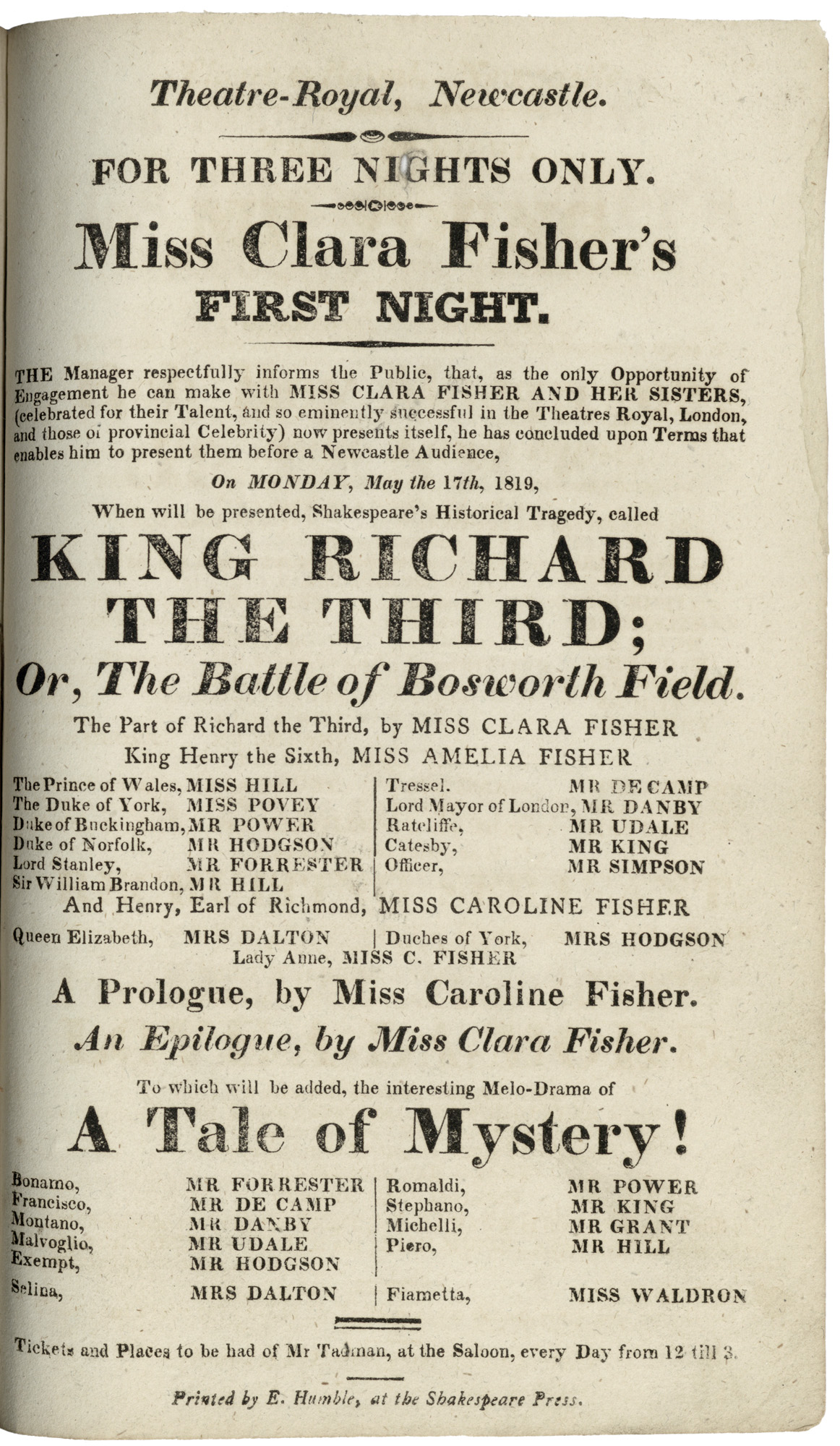
King Richard The Third playbilll (RB 792 (4282)–NEW).

King Richard The Third playbilll (RB 792 (4282)–NEW).

Clara Fisher (b.14 July 1811, London, died 12 November 1898, Jersey, U.S.) was an Anglo-American actress who inspired an enormous following in the United States. She made her stage debut in 1817, at the age of six, in a children’s adaptation of David Garrick’s Lilliput at the Drury Lane Theatre in London. Her performance in that and in excerpts from Richard III captivated the audience. She then began a 10-year period of touring up and down Great Britain, winning popular acclaim in a variety of child’s and adult’s roles.

By the time she and her sisters Amelia and Caroline started their three-night engagement at the Newcastle Theatre Royal on 17 May 1819, Clara would have been only seven years old. On the opening night, she played the leading role in  ‘Shakespeare’s Historical Tragedy, called KING RICHARD THE THIRD; Or, The Battle of Bosworth Field. Clara was known for her ‘breeches parts’ (men’s roles), including Hamlet on at least one occasion. At the Theatre Royal, her sister Amelia was Henry VI, and Henry, Earl of Richmond, was played by Caroline Fisher.

On the second night, she played Shylock in The Merchant of Venice, and then, on a lighter note, performed ‘A COMIC SONG. (IN CHARACTER)’.

The third, and supposedly final, night was Shakespeare-free.

Such was the success of the Fisher girls’ engagement that they were held over for an extra performance on Friday 21 May, 1819, performing ‘some of the best scenes from the most popular Plays . . .’. This included acts four and five of King Richard the Third, with the sisters reprising their ‘breeches parts’ of the previous Monday.

Fisher went to the United States in 1827 and made her debut in New York City that same year. She was a sensation – her name was given to babies, racehorses, stagecoaches, and steamboats – and she was regarded as America’s leading stage actress. Her last performance was in Baltimore, Maryland, in 1889.

This performance, and about 240 others, is promoted by notices in one volume of our Theatre Royal Playbills collection, a bound collection of ‘posters’ for the ‘old’ Newcastle Theatre Royal in Mosley Street. The bills were printed in 1819 and 1820, and are typical of the early nineteenth century –  i.e. very small compared to the modern-day concept of ‘posters’ –  and utilising revolutionary display typefaces which had begun to be manufactured in about 1810 for advertising.

Fittingly, the bill was printed by Edward Humble, at the Shakespeare Press. Humble was a respected local printer, and a proprietor of the County Durham Advertiser.

If you are interested in coming into the reading room to see playbill and others from the collection…

# This item is held within a volume of our Theatre Royal Playbills (Ref Code RB792(4282) NEW.

# You can place your order by linking to our request form. The reference code and title will be RB 792 (4282) – NEW – Theatre Royal Playbills.’
Research our Children’s Literature Collections for your PhD

Newcastle University are offering over £1million in PhD funding through the Research Excellence Academy scheme for students to start a full-time PhD in autumn 2016. The University’s Children’s Literature Unit would particularly welcome applications for this funding to study our children’s literature collections.

Newcastle University’s Research Excellence Academy PhD Studentships

Each studentship covers tuition fees and living expenses for the three years of your PhD studies. There are two schemes available:

Arts, Humanities and Social Sciences: This scheme covers a number of academic subjects, including English Literature. This funding would particularly suit cross-disciplinary research proposals. The deadline for applications is 30th April 2016. See: http://www.ncl.ac.uk/postgraduate/funding/sources/allstudents/hrea16.html

School of English Literature, Language and Linguistics: There are a number of studentships available and your main supervisor will be based within the School of English. The department are also offering extra support to international applicants. The deadline for applications is 5pm on 16th May 2016. See: http://www.ncl.ac.uk/elll/study/postgraduate/funding/reastudentshipslitandcw.htm

Our Children’s Literature Collections

Our children’s literature collections hold great potential for academic research. As well as the Booktrust collection of contemporary children’s books, we hold a number of Special Collections children’s literature.

Britnell Collection A collection of late 19th and early 20th Century children’s literature, focusing on literacy, language, and moral instruction.

Burnett Collection A collection of children’s books and annuals published in the early to mid-20th century. Includes Timothy’s Quest (1900) and Girl’s Fun Annual (1952).

burnett-professor-mark-collection

Butler Collection Includes 18th century pamphlets, books by the likes of Daniel Defoe and J.M. Barrie and titles illustrated by Randolph Caldecott.

butler-joan-collection

Davin Collection Contemporary editions of popular children’s literature largely from the early 20th Century. Also includes catalogues and critical responses to children’s literature.

Chorley Collection Children’s literature chiefly from the 19th century. Includes Kate Greenaway’s Almanack for 1884, R. M. Ballantyne’s The Coral Island and the work of Randolph Caldecott.

chorley-sarah-collection

Meade Collection Around 180 books by L.T. Meade which were published between 1878 and 2003. Titles include: The Autocrat of the Nursery, Kitty O’Donovan and The Scamp Family.

meade-l-t

If you are considering applying for either of Newcastle University’s Research Excellence Academy studentship opportunities in children’s literature, please contact Dr. Lucy Pearson, lucy.pearson@newcastle.ac.uk / +44 (0) 191 208 3894.

To find out more about our holdings please refer to the Collections Guide. To discover how you can consult materials see Using our collections.

Dissertations and Projects – Tips from the Special Collections Team!

Fancy using some primary source items in your dissertation or project?  An original edition print or records from the archives?  Here are some tips to get you started.


Research Tip # 1: Primary → Secondary → Primary

OK so this is slightly against normal advice, which is to start with your secondary sources before you move to your primary sources, but I promise I have a reason!  You don’t have an unlimited amount of time to complete this dissertation … there is some danger in deciding on a very specific topic and trying to find evidence to prove a specific point: you may draw conclusions that are not supported by the sources, or miss more important or interesting information, and perhaps most importantly waste a lot of time looking for something very specific which simply does not exist, or which does exist but which can only be accessed in person in Australia, not that convenient…

So:

  • Then step away, and go to your secondary sources and start reading around your subject: books, journal articles, trusted websites, your lecture notes! This is going to give you the background knowledge you need in order to get the best out of your research.  You will acquire a general knowledge of your topic, you will develop a sense of the areas that have been thoroughly covered and those aspects that need further study, you will begin to formulate the questions and ideas that will provide the focus for your work and you will also pick up the names, places, events and dates which will be essential for providing the access points to the primary source material you consult.  Importantly you will also be able to see what primary sources published authors have used in their own research.
  • Then return to our archival and rare book collections and start to find and choose the primary sources which you will use.

Research Tip # 2: Finding Rare Books

Our rare book collections here at Newcastle University have been entered onto the library catalogue, so that can often be the best way to start your topic search.  Subject search terms work as they would for modern books, and then refining your search using ‘date of publication’ or ‘location’ (“Special Collections”) will get you to those rare and unique, old or limited print run titles. To locate rare books beyond the Newcastle region, the best place to start is the Copac website, where you can search the rare book catalogues of 90 specialist research libraries in the UK.

Research Tip # 3 Finding Archives

Archives are business records, diaries, letters, email threads, photographs, research notes, government publications, annual reports, web pages…  They are not published books and they are not stored and catalogued in the same way that books are.  All those great tricks for finding books, which you have got really good at over the last few years, will not necessarily help you to find archive records.  Don’t panic!  You just need to learn some new tricks.

Subject searches sometimes work, but not always.  Why?  Imagine someone’s diaries. They might have written about your topic once, on the 3rd of April, a long and fascinating account perhaps, but it is unlikely that anyone has subject indexed every single page of every single diary.  So how will you find this precious page?

Well what do you know?  Imagine you are interested in an event held in Newcastle and you are interested in the public response and reaction.

  • You know the date of your event, so that’s the first useful piece of information.
  • You know the location of the event, so that’s the second useful piece of information.
  • You know you are interested in the public reaction, not the official record. So what type of archive will contain this?  Well newspapers might, someone’s diary might, a letter might.  You’re nearly there, but not quite!
  • Who will have created these things? Individuals will have produced letters and diaries, whose names you do not know, so you are probably at the end of this line of enquiry.  You could therefore try to find a letter or diary collection, using ‘diary’ as a search term and making sure that you include your specific date range.  For newspapers you can go a little further.  Do you know the names of newspapers for your time period?  Is there an archive for that newspaper title?  Who holds it?

So that’s the general idea, don’t rely on search terms, think things like:

  • What type of archive am a looking for (letters, a government document, a political pamphlet, company minutes or annual reports, scientific research notes …)?
  • Who, or what type of person or type of company, produced this type of record?
  • What sort of archive or museum or library holds records for that type of person or company?
  • What is my date range?
  • Do I have a geographical limit?

And if you are new to this type of search process, remember that the staff in Special Collections are happy to give advice.

Good luck and here are some collections held here at Newcastle University to get you thinking.

Ideas For Your Dissertation! #1

Ideas For Your Dissertation! #2

Ideas For Your Dissertation! #3

Ideas For Your Dissertation! #4

Ideas For Your Dissertation! #5

Ideas For Your Dissertation! #6

Ideas For Your Dissertation! #7

Ideas For Your Dissertation! #8

Ideas For Your Dissertation #9

Ideas For Your Dissertation! #10

Ideas For Your Dissertation! #11

Ideas For Your Dissertation! #12

Ideas For Your Dissertation! #13

Ideas For Your Dissertation! #14

Ideas For Your Dissertation! #15

The Turbina Steamship and a mystery in the archives … – March 2016

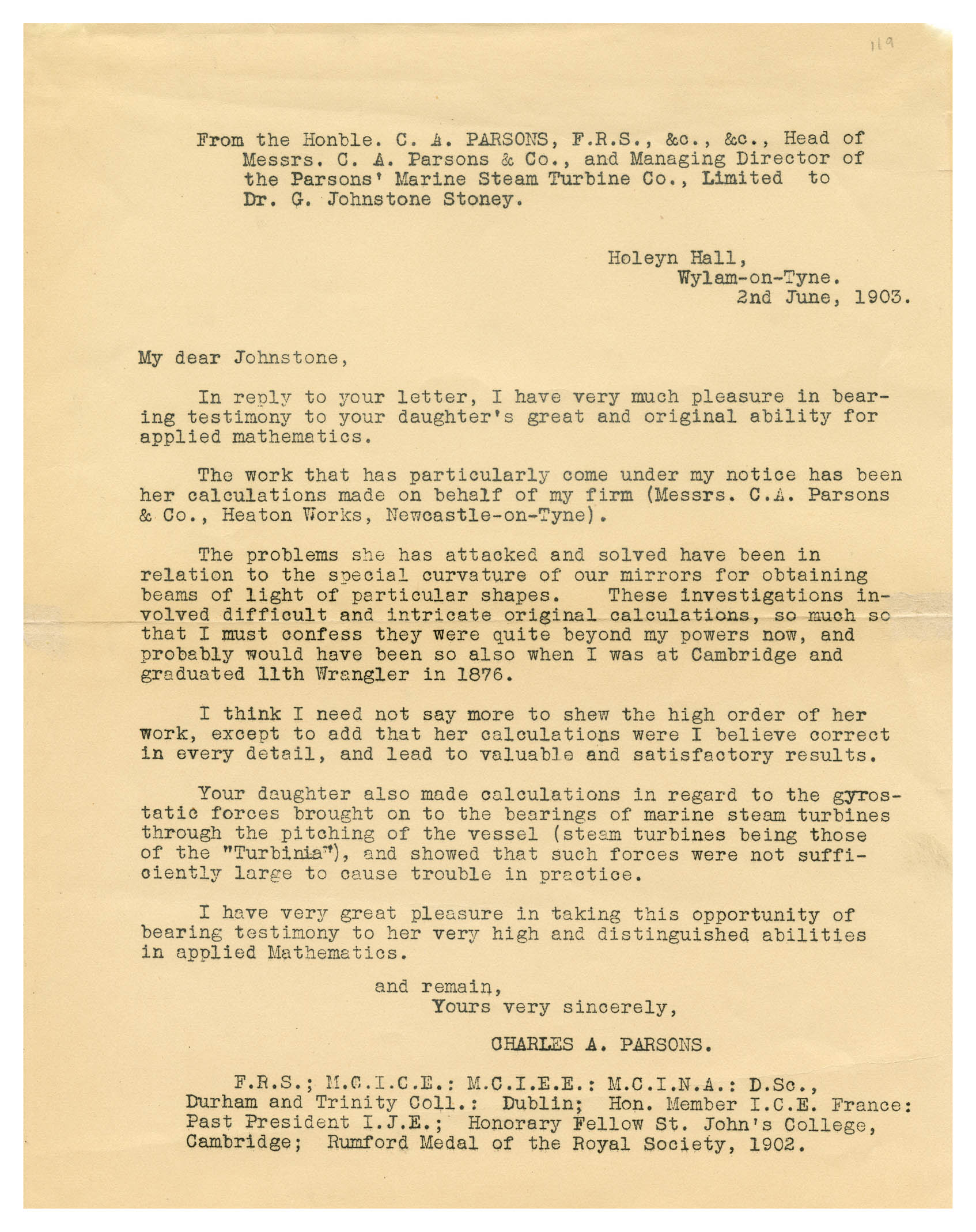
I’ve always found this letter fascinating.  If anyone fancies doing some further research on this letter, do let us know what your results are!

This letter of reference is an intriguing insight into the mathematics behind the construction of Newcastle’s famous ‘Turbinia’ steamship, which can still be seen in the Discovery Museum in Newcastle upon Tyne.  Who is this (female) mathematician, who seems to get little mention in the history of the Turbinia?  Perhaps as a sign of the times, this letter, which appears to be a reference, is addressed to her father and does not refer personally to her by name at all.  Dr G Johnstone Stoney had three daughters (who led fascinating lives in their own right in the fields of science and medicine), I would love to know which one came to Newcastle and made such an important contribution to this part of North East history.

GB186/MSA/2/22

GB186/MSA/2/22

The Turbina was an experimental vessel built by Charles Parsons to demonstrate the benefits of his revolutionary new design of steam turbines.  Built by the firm of Brown and Hood, based at Wallsend on Tyne it started to undergo speed trials in 1896 and the results were pretty spectacular.  By December an average speed of 29.6 knots had been reached over the measured mile whilst, with further improved propellers, 32.76 knots was achieved by April of the following year.  Eventually, maximum speeds of over 34 knots were recorded.  At the time it was easily the fastest ship in the world.

Obviously with a great eye for publicity, Parsons caused quite a stir when the Turbina appeared at Queen Victoria’s Diamond Jubilee Naval Review at Spithead, apparently racing between the two lines of navy ships and steaming up and down in front of the crowd.  Popular legend had her appearance as unannounced; it would seem that Parsons did have permission, although perhaps the organisers did not expect such a dramatic entry!

If you are interested in coming into the reading room to see this letter …
# This item is held within the Manuscript Album (Ref Code GB186/MSA).
# You can place your order by linking to our request form. The reference code and title will be ‘GB186/MSA/2/22 Letter from Charles Algernon Parsons to George Johnstone Stoney concerning mathematical work undertaken by one of Stoney’s daughters.’

To see the ship (and its turbines!) and much more …
The Discovery Museum is close to Newcastle upon Tyne rail station and has many gems https://discoverymuseum.org.uk/

Thanks to the Discovery Museum for providing the backstory of the Turbina, http://www.webcitation.org/5xujimKGb

‘The Scenery of our Native North- The Collieries’: The Art and Legacy of Thomas Hair – February 2016

‘The characteristic appearance of no district in the world is more strikingly marked than is that of the North of England, the peculiar features of which are its collieries and their necessary adjuncts. The face of the country is thickly studded with the engine -houses and coal-heaps attached to respective pits… The fields and roads are crossed are crossed and intersected in every direction by the “waggon-ways” connecting the pits with their respective places of shipment… The margins of our noble rivers are fringed with the staiths and machinery, often constructed on a gigantic scale, necessary for effecting for effecting the shipment of the jetty treasure… The sea itself is blackened with our fleets of colliers, bearing the precious source of warmth and comfort to distant districts and countries, and thus diffusing wealth and happiness around…’.

Part of the opening remarks of M. Ross’ ‘Preliminary Essay on Coal and the Coal Trade’, in T.H. Hair’s A Series of Views of the Collieries in the Counties of Northumberland and Durham (1844). The quote from the title comes from the same.

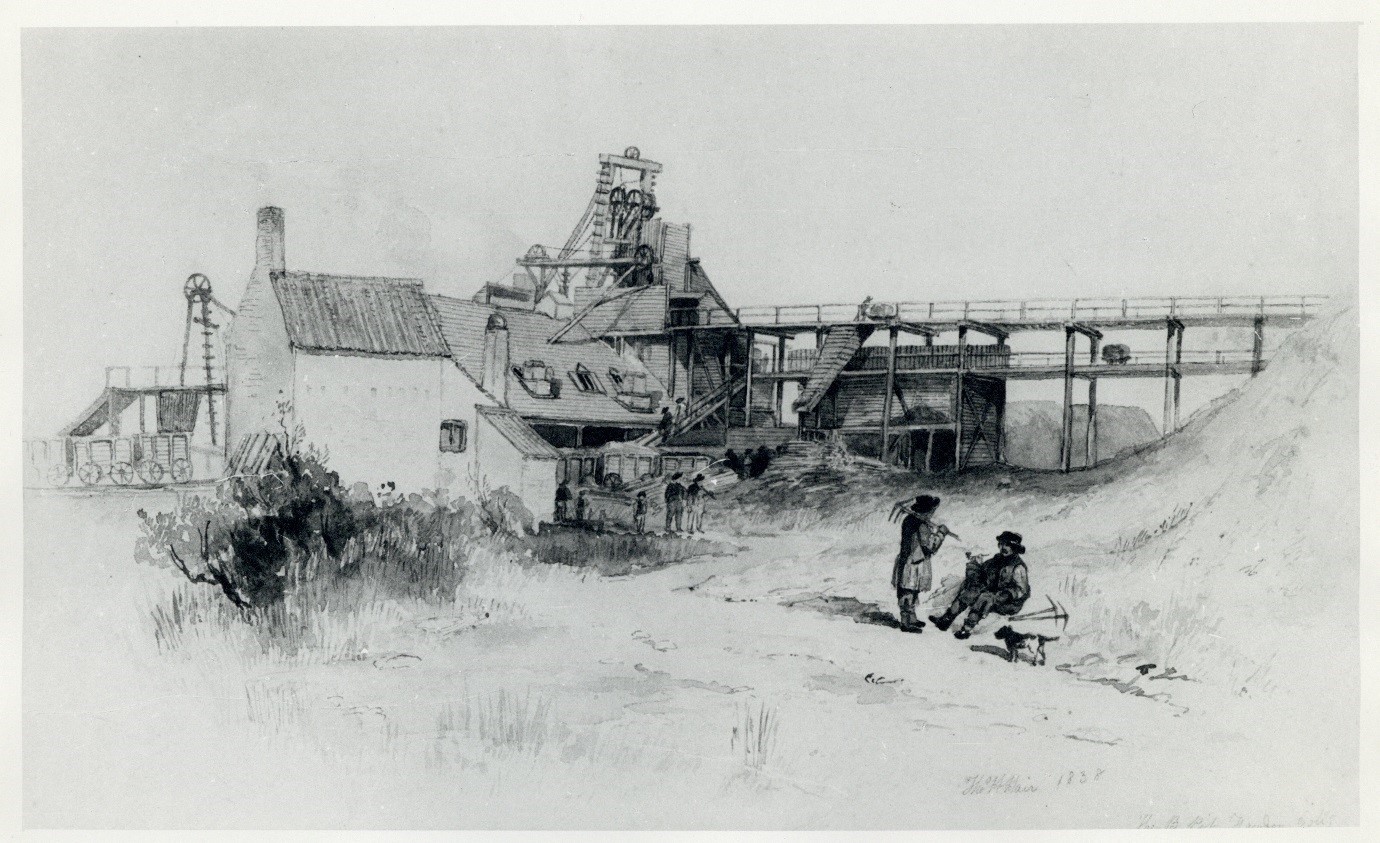
Old Pit, Burdon Main, by Thomas Hair. Date unknown.

Old Pit, Burdon Main, by Thomas Hair. Date unknown.

The art of Thomas Hair provides a valuable and unique visual record of the region’s mining history. Although the landscape remains scarred by the industry, and other physical remnants of the pits have survived, much more has been lost due to the process of industrialisation and the passage of time. Hair’s work affords us a contemporary view of the pits that shaped our communities and the lives of those dependant on them.

Little is known about Hair’s life. He was born in Newcastle upon Tyne around 1810, and his working life began when he trained with local engraver and lithographer Mark Lambert. Hair moved to London at some time in the late 1830s, and exhibited his work at the Suffolk Street Gallery from 1838, and several times at the Royal Academy during the 1840s. Although based in London, Hair maintained a strong affinity with the North East and continued to produce work inspired by the region during his time in the capital.

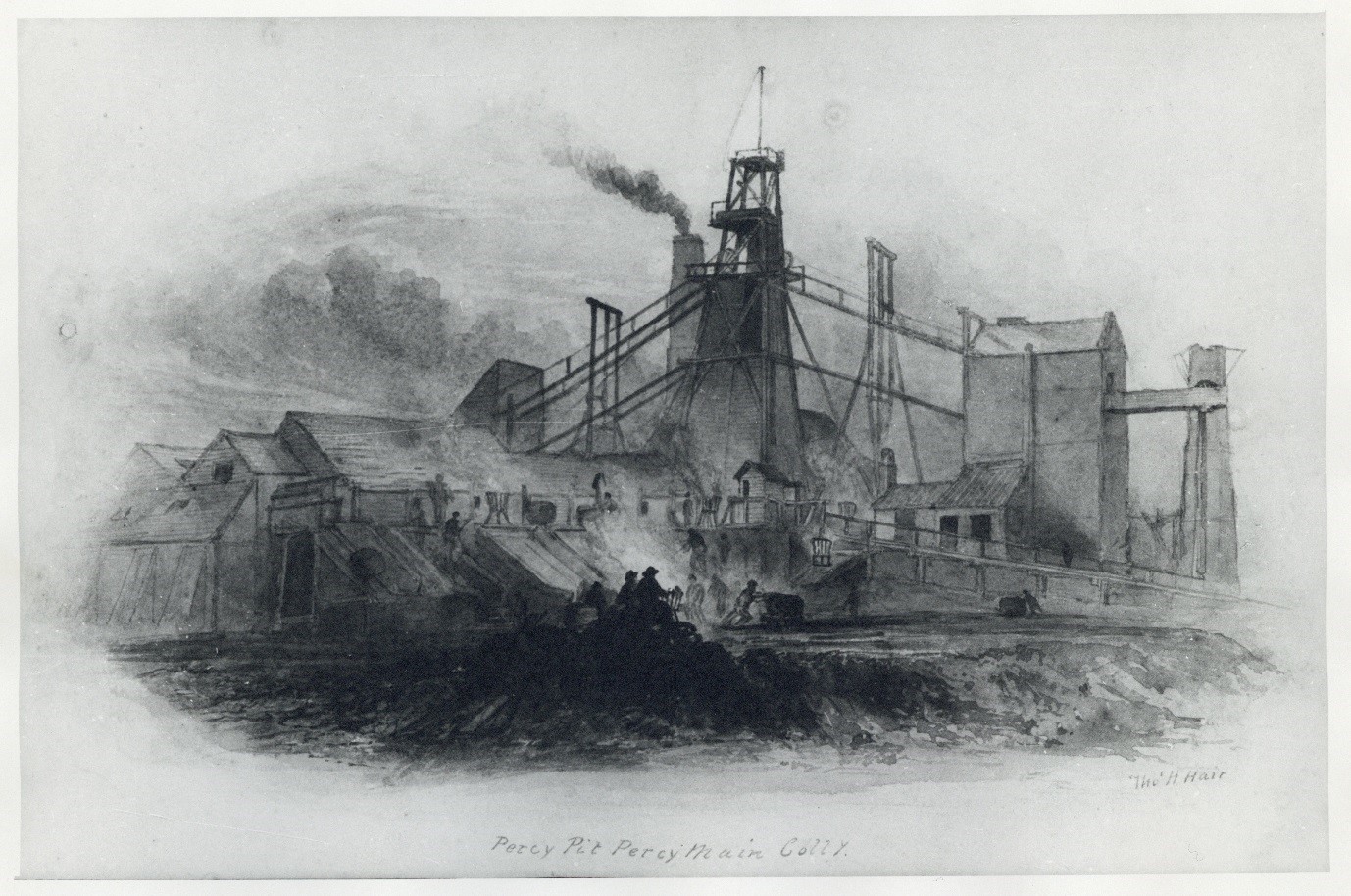
Percy Pit, Percy Main Colliery, by Thomas Hair. Date unknown.

Percy Pit, Percy Main Colliery, by Thomas Hair. Date unknown.

Hair travelled the ‘Great Northern Coalfield’ of Durham and Northumberland during the early nineteenth century, sketching and painting many of the different scenes of mining life. The paintings were then taken back to his studio, where they could be turned into etched engravings, either by Hair himself or another engraver he was associated with. Much of his work relating to the coalfield was published in Sketches of the Coal Mines in Northumberland and Durham; A Series of Views of the Collieries in the Counties of Northumberland and Durham, in 1844. Frank Atkinson, who wrote the ‘Preface’ to the 1969 edition of Hair’s Sketches and Views, has commented on the technical accuracy of Hair’s depictions, as well as his ability to pick up the small details that capture the essence of the scene.

The B Pit, Fawdon Colliery, 1848, by Thomas Hair.

The B Pit, Fawdon Colliery, 1848, by Thomas Hair.

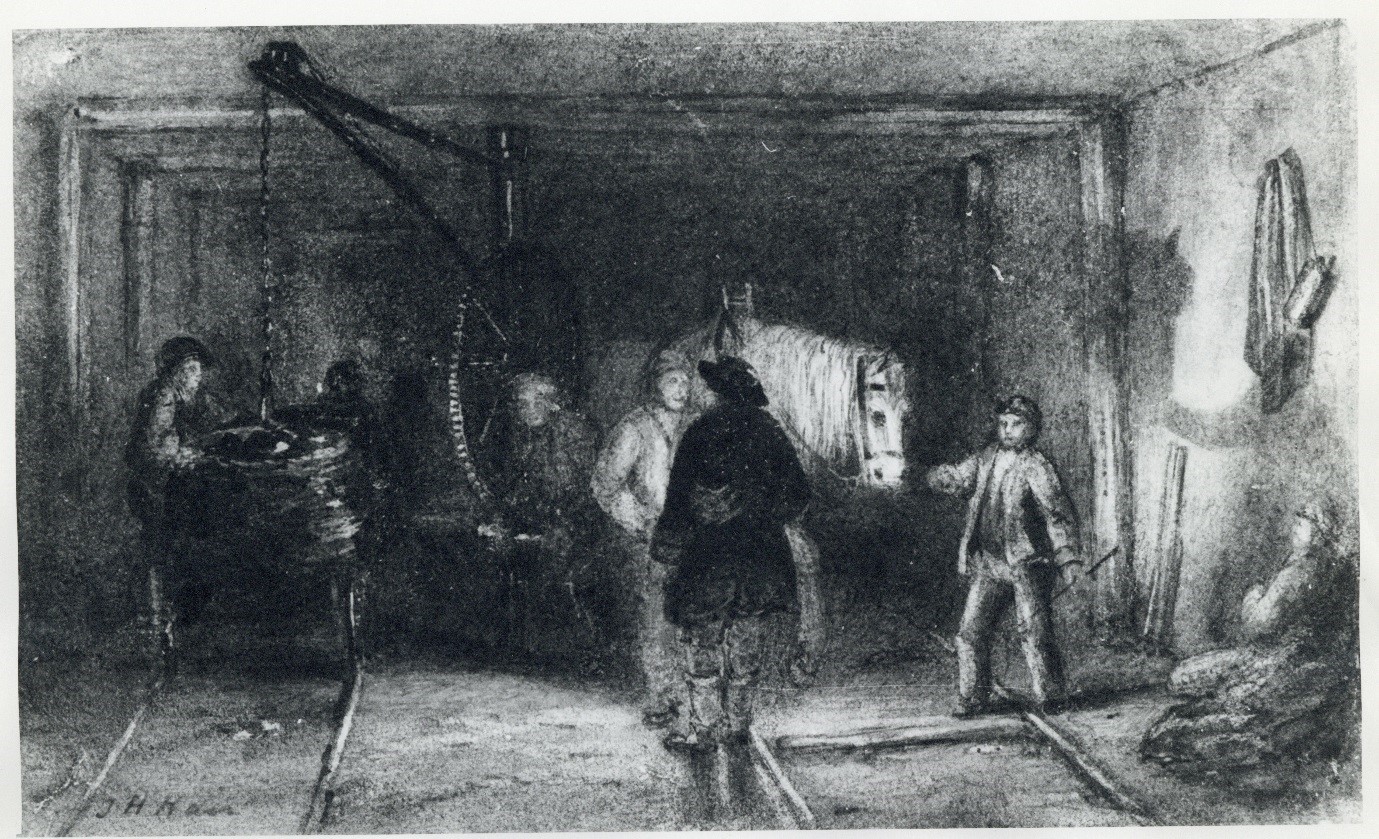
If a criticism can be made of Hair’s work, it is that it does not reflect the struggles and ‘everyday life’ of the miners and their communities. As Hair scholar Douglas Glendinning has noted, although miners are often pictured outside in Hair’s panoramic views of the pits, few of his depictions show the hazardous working conditions and danger involved in coal mining. However, Glendinning emphasises that many other artists also ignored the grim reality of the Industrial Revolution in order for their art to sell. Hair should therefore not be judged on this, and his work appreciated for the scenes it does portray.

Crane for Loading the Rollies, by Thomas Hair. Date unknown. This is one of the few illustrations by Hair that shows the subterranean conditions of the pit.

Crane for Loading the Rollies, by Thomas Hair. Date unknown. This is one of the few illustrations by Hair that shows the subterranean conditions of the pit.

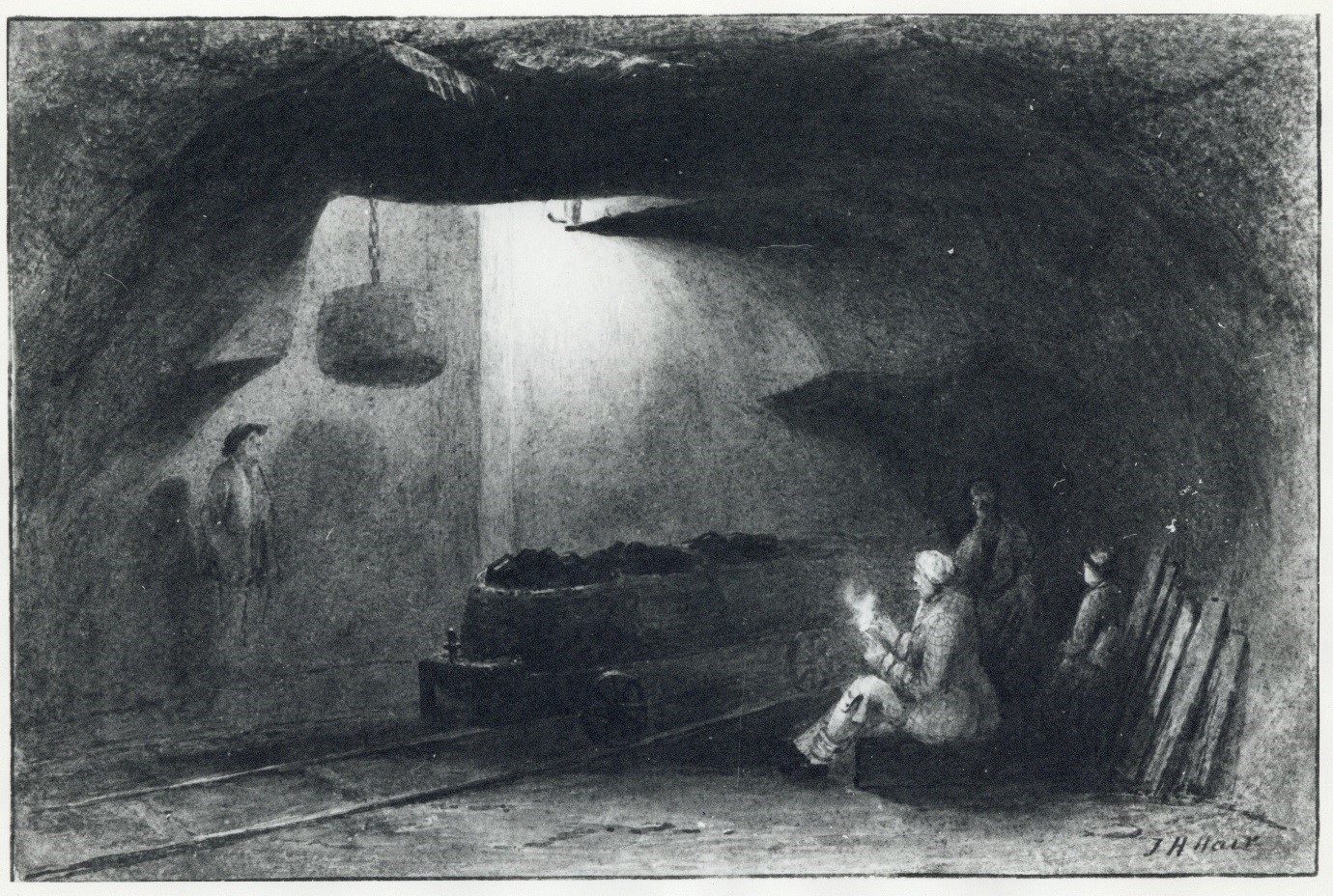
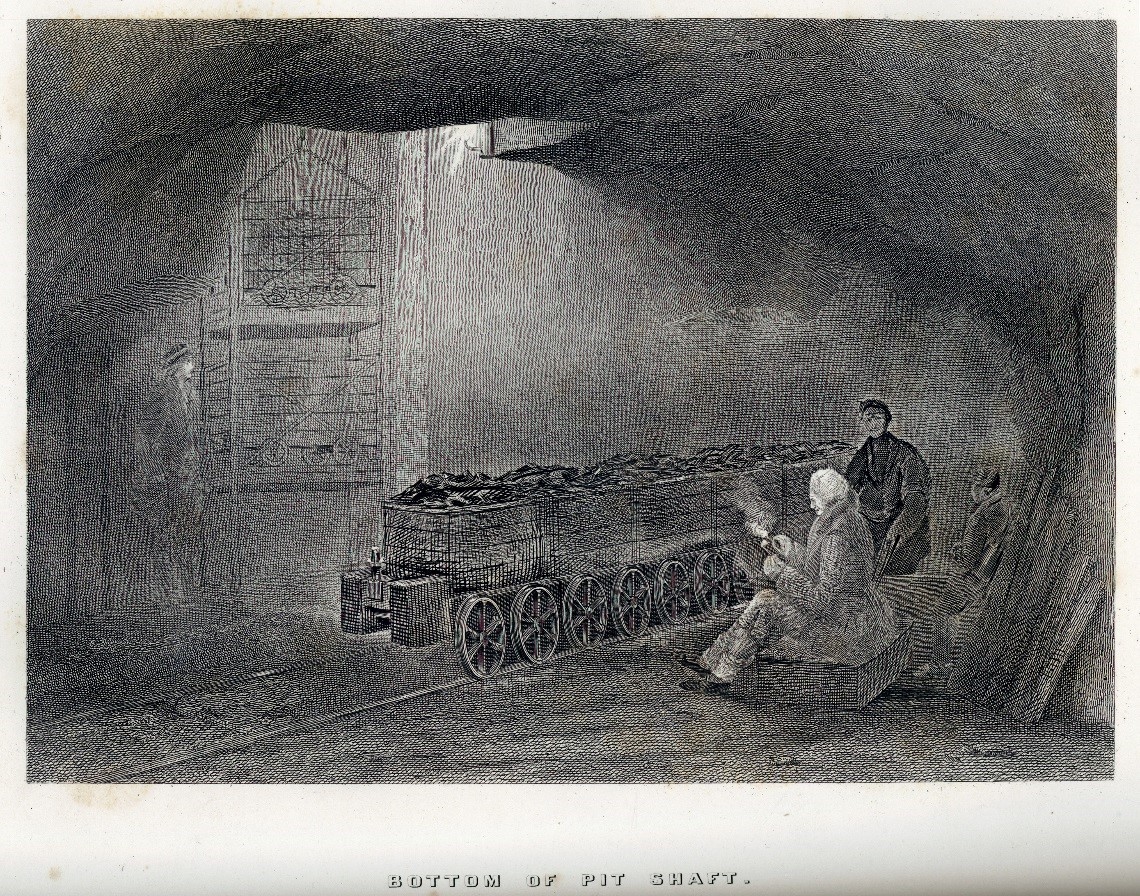
Although Hair had already published his artwork in Scenes and Views, his illustrations were pirated by William Fordyce, who had produced his own survey on the region’s mining industry. Fordyce’s Coal and Iron, published in 1860, used Hair’s work extensively with no credit given to the artist. Some of the illustrations were also altered to make them accurately reflect technological advances in the industry since Hair’s time. This is most obviously seen in Fordyce’s Bottom of Pit Shaft, which is a clearly altered version of Hair’s Bottom of the Shaft, Walbottle Colliery.

Bottom of the Shaft, Walbottle Colliery, 1844, by Thomas Hair.

Bottom of the Shaft, Walbottle Colliery, 1844, by Thomas Hair.

Bottom of Pit Shaft, from Fordyce’s Coal and Iron, 1860. Note the addition of a cage on the left hand side, which replaced the corves in Hair’s original. Most prominent is the removal of the rollies and their replacement with the wheeled tubs carrying coal.

Bottom of Pit Shaft, from Fordyce’s Coal and Iron, 1860. Note the addition of a cage on the left hand side, which replaced the corves in Hair’s original. Most prominent is the removal of the rollies and their replacement with the wheeled tubs carrying coal.

Hair died in Newcastle on 11 August 1875, and was buried in an unmarked grave in All Saints Cemetery. Although we know little about the artist himself, his art gives us an invaluable insight into the ‘The Scenery of our Native North’.

The Hair Prints- Special Collections. The prints have been digitised and can be viewed on our Collections Captured portal.

The above images have been digitised from the Hair Prints and are currently uncatalogued. Please contact lib-specenq@ncl.ac.uk for further details.


Further Reading 

T.H. Hair and M. Ross, Sketches of the Coal Mines in Northumberland and Durham (1839)- Special Collections Rare Books (RB 622.09428 HAI )

T.H. Hair and M. Ross (with an introduction by Frank Atkinson), Sketches of the Coal Mines in Northumberland and Durham; A Series of Views of the Collieries in the Counties of Northumberland and Durham (1969)- Special Collections Edwin Clarke Local (Clarke 1999)

William Fordyce, Coal and Iron (1860)- Special Collections Robert White (W622.33 FOR Folio)

Douglas Glendinning, The Art of Mining; Thomas Hair’s Watercolours of the Great Northern Coalfield (Newcastle: Tyne Bridge Publishing, 2000)- Robinson Library 709.42HAI (Gle)

Making the Archive Public #3 – Women’s Work: Oral Histories of the Women’s Institute

This is #3 of the ‘Making the Archive Public‘ series, where we are showcasing examples from this project, using the rich archive and rare book collections on offer to researchers in the North East.

Women’s Work: Oral Histories of the Women’s Institute

Visit: http://winortheast.omeka.net/

This website was created by Jess Kadow and Shelby Derbyshire as part of the Making the Archives Public: Digital Skills, Research and Public Engagement project at Newcastle University.

The Women’s Work project is a collaboration organised between Newcastle University, the Northumberland Federation of Women’s Institutes and The Northumberland Archives. The project consisted of recording and archiving the oral histories of the North-Eastern WI community, particularly its oldest members, as a means of preserving the tradition and heritage of the Women’s Institute.

The diversity of each woman’s experience with the WI, the changes they have witnessed, the friendships they have made and the activities they have participated in have given this project a great level of depth. This exhibition hopes to showcase its best elements.


Making the Archive Public #2 – The Execution of James Maben

This is #2 of the ‘Making the Archive Public’ series, where we are showcasing examples from this project, using the rich archive and rare book collections on offer to researchers in the North East.

The Execution of James Maben

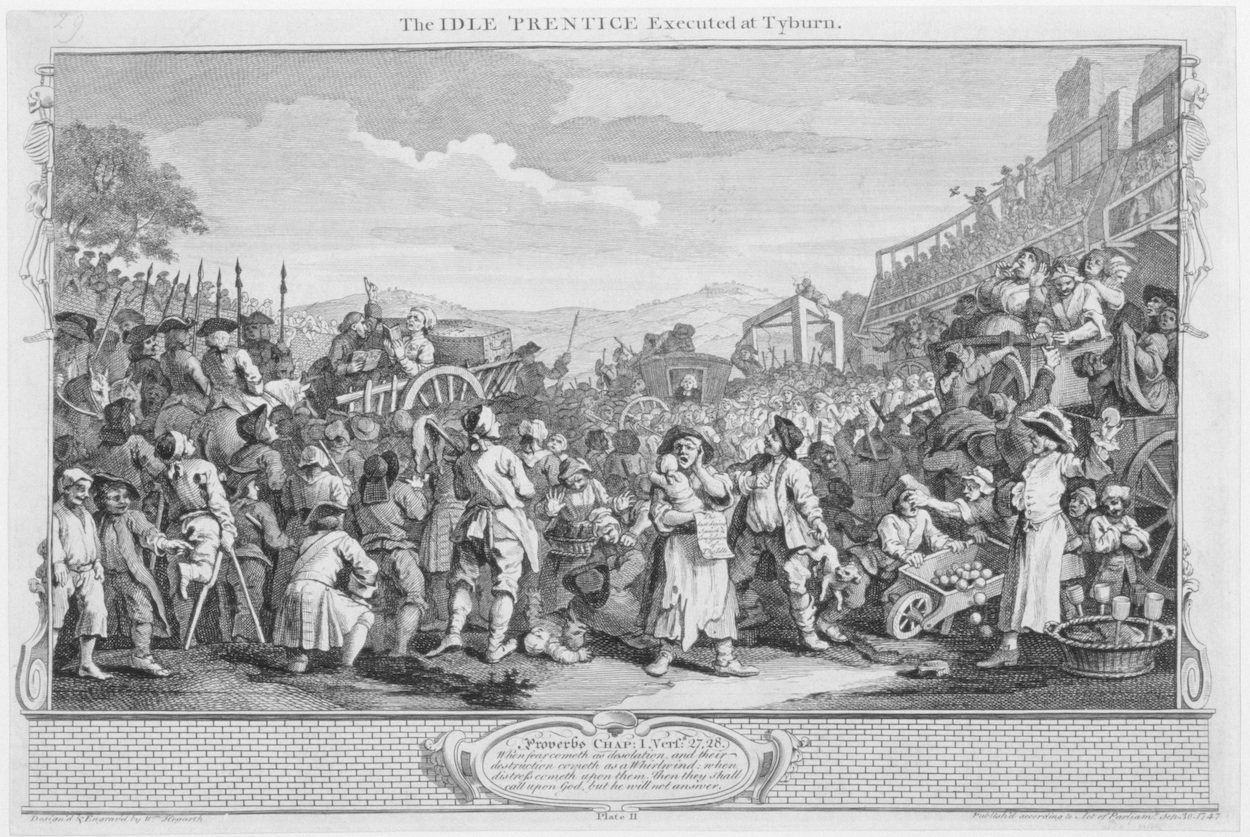
An eighteenth-century execution: Industry and Idleness, Plate XI, 'The Idle 'Prentice Executed at Tyburn', William Hogarth (1747).

An eighteenth-century execution: Industry and Idleness, Plate XI, ‘The Idle ‘Prentice Executed at Tyburn’, William Hogarth (1747).

Visit: http://executionofjamesmaben.omeka.net/about

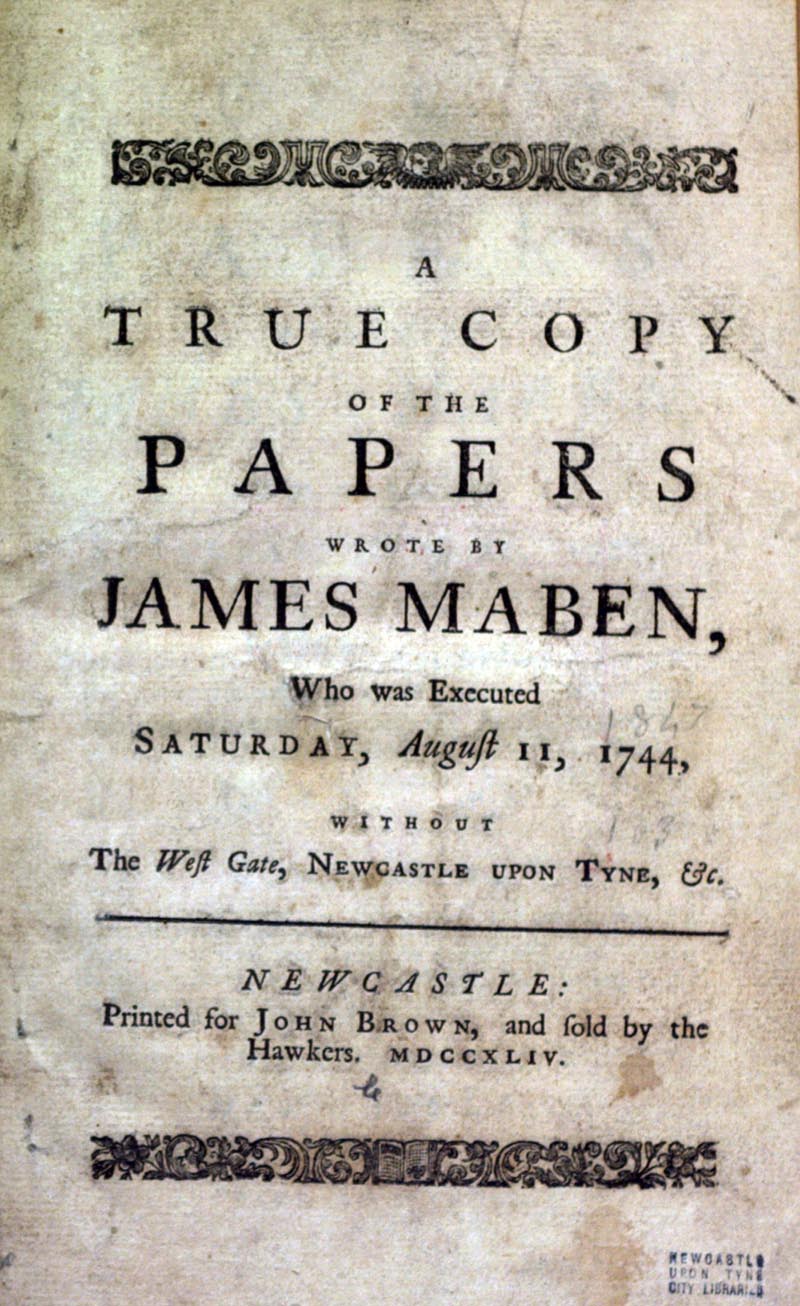
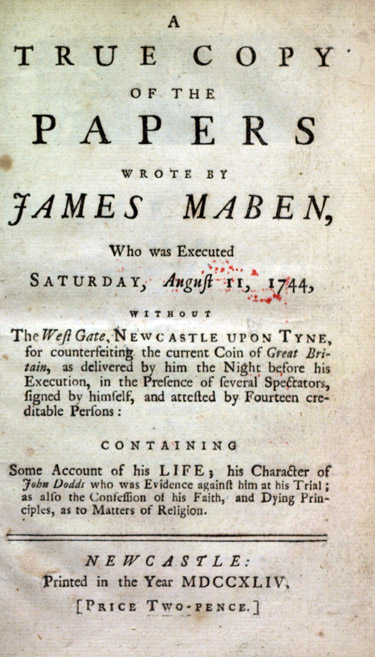
This project, by Robyn Orr, uses a digitised version of the eighteenth-century pamphlet, A True copy of the papers written by James Maben, held in the Newcastle City Library Special Collections. The themes that are discussed are Newcastle in the Eighteenth Century, Coins and Counterfeiting, and Prisons and Executions.

The pamphlet demonstrates that a single piece of archival material can be used to create a wider narrative (the front page and page 2 from the digitised pamphlet is shown below).

2nd page

Front page

Front page

Page 2


The Military Service Act, 1916 – January 2016

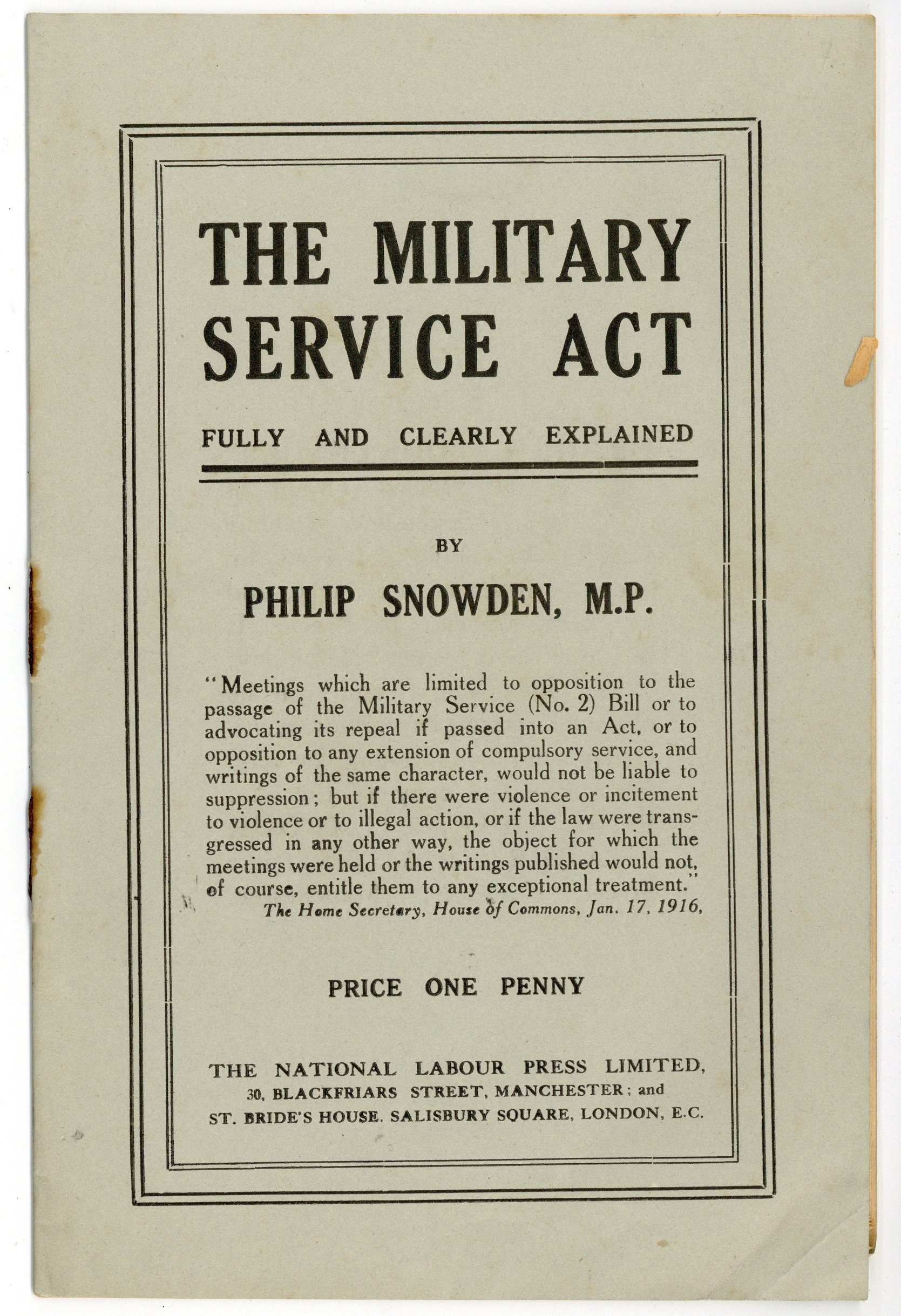
The Military Service Act Fully and Clearly Explained, by Philip Snowden (MP), 1916 (20th Century Collection, 343.0122 SNO)

The Military Service Act Fully and Clearly Explained, by Philip Snowden (MP), 1916 (20th Century Collection, 343.0122 SNO)

January 2016 marks the centenary of the enactment of the Military Service Act, which introduced conscription for the first time in Britain during World War I. The Act was passed by parliament on 28th January 1916 and came into operation when passed by Royal Proclamation on 10th February 1916. The Act imposed compulsory military conscription on all single men aged between 18 and 41, who were not eligible for exemption.

Unlike other European countries, Britain relied on volunteers to fight during times of war and when Great Britain declared war on Germany on 5th August 1914, this was no different. Many believed hostilities would be over by Christmas. However, it soon became clear that war would not be won in a matter of months. With this realisation, attention rapidly turned to maintaining the war effort and numerous attempts were introduced to encourage voluntary enlisting.

At the outbreak of war, patriotism was high and volunteers rushed to recruiting stations in order to support King and country. A drive to recruit more men was led by Lord Horatio Kitchener (a British military leader who became Secretary of State of War when World War I was declared), for men to voluntarily join up to the army. He is famously depicted in the army recruitment poster, ‘Your Country Needs You’, which was used in a poster campaign to encourage voluntary enlisting. Numbers did increase, however, as the war went on this voluntary system soon proved insufficient as the number of casualties grew. In October 1915, Lord Derby (appointed Director-General of Recruiting by the Prime Minister, Herbert Henry Asquith) introduced the Derby Scheme in order to raise numbers. Under the scheme men aged between 18 and 40 were informed that they could voluntarily enlist or attest with an obligation to be called upon if required. Despite these attempt, by 1916 the British government believed that compulsory active service was the only way to increase the war effort and in turn win the war.

This month’s Treasure is a pamphlet entitled The Military Service Act Fully and Clearly Explained, by Philip Snowden (seen in the image above). The pamphlet was a circular available for the public to buy for one penny in 1916, which clarifies who the Act applies to, persons outside the Act, claiming exemption and outlines the Tribunal procedures (seen in the image below).

Pages 2-3 of The Military Service Act Fully and Clearly Explained, outlining Penalties for Disertion of Aiding Disertion, To Whom the Act Applies and Persons who are Outside the Act, by Philip Snowden (MP), 1916 (20th Century Collection, 343.0122 SNO)

Pages 2-3 of The Military Service Act Fully and Clearly Explained, outlining Penalties for Desertion of Aiding Desertion, To Whom the Act Applies and Persons who are Outside the Act, by Philip Snowden (MP), 1916 (20th Century Collection, 343.0122 SNO)

The pamphlet also details the six Grounds of Exemption; men who are better employed in their usual work (such as in food supply or the export trade), work that is more suited elsewhere for the war effort (such as in agriculture or engine drivers), youths being educated or trained, financial and domestic obligations, ill-health or infirmity and the Conscientious Objection. Conscientious Objection is noted to be ‘perhaps the most important of all, and is likely to prove the most difficult in administration’. The Act made limited allowance for men who objected to serve. Conscription was seen as a controversial issue but those who objected to combatant service were known as Conscientious Objectors. They claimed the right to refuse military service on the grounds of freedom, conscience, disability and/or political and religious views and could attest by means of a Tribunal system.

Detailed in the pamphlet on the Tribunal of Conscientious Objectors:

‘Men who apply on this ground should be able to feel that they are being judged by a Tribunal that will deal fairly with their cases.

 …If the certificate is granted as a certificate of exemption from “combatant duties” only, then the individual would be liable to serve in certain branches of the Army, as in the Royal Army Medical Corps for instance’.

Page 1 from News Sheet, No. 8, c. 1917 (20th Century Collection, 343.0122 CEN)

Page 1 from News Sheet, No. 8, c. 1917 (20th Century Collection, 343.0122 CEN)

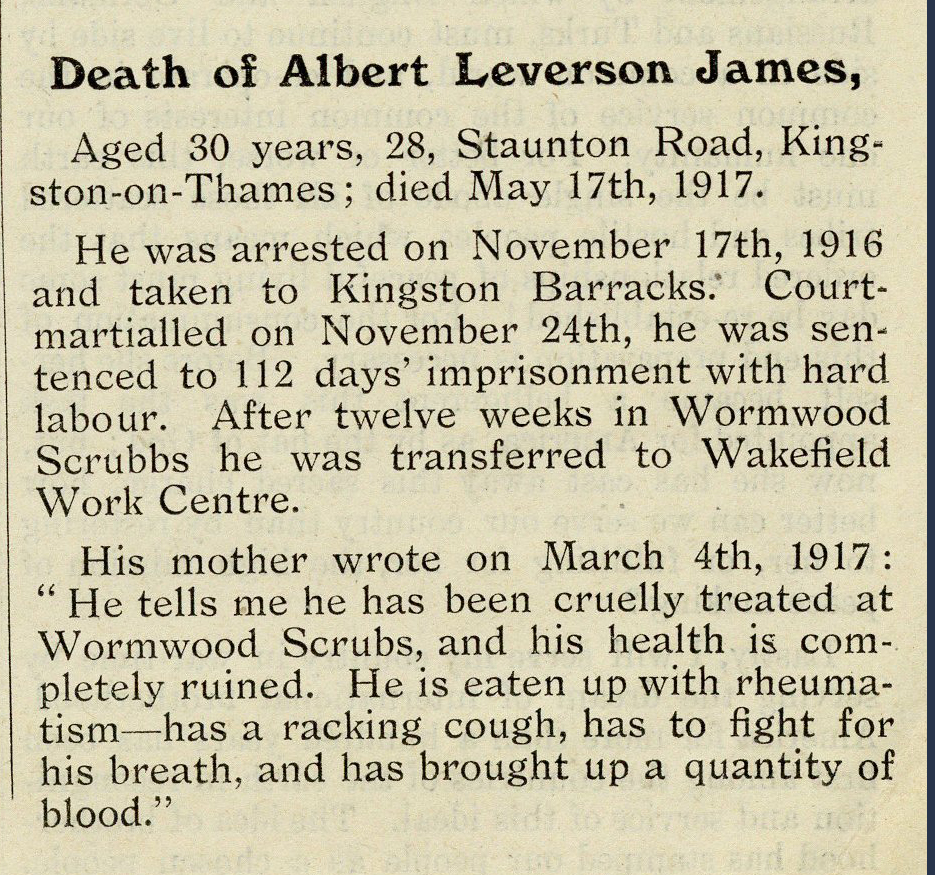
Those who objected to provide their service towards any part of the war effort, whether that be ‘economic, commercial, or other activities’, were sent to prison where the conditions and treatment were harsh. A News Sheet (seen in the image above) issued by The Central News Bureau, c. 1917, includes text on the death of the Conscientious Objector, Albert Leverson James (aged 30 from Kingston-on-Thames). The text explains that Albert was arrested on November 17th 1916, where he later attended a Tribunal and was sent to complete 112 days imprisonment with hard labour. His mother describes his health whilst at Wormwood Scrubs, as ‘…completely ruined. He has to fight for his breath, and has brought up a quantity of blood’ (seen in the image below). After 12 weeks he was transferred to Wakefield Work Centre, where he broke down with haemorrhage double pneumonia and later died on 4th March 1917.

Parliament raised Albert’s death, which was used as an example of the Government’s disregard and mistreatment of men who refused to kill. Albert is commemorated on the Conscientious Objectors’ plaque (1 Peace Passage, London, N7 0BT) along with 69 other Conscientious Objectors who died during World War I.

Death of Albert Leverson James, extract from No. 8. News Sheet, issued by The Central News Bureau, c. 1917 (20th Century Collection, 343.0122 CEN )

Death of Albert Leverson James, extract from No. 8. News Sheet, issued by The Central News Bureau, c. 1917 (20th Century Collection, 343.0122 CEN )

Making the Archive Public #1 – William Corbett’s Bookshop

Making the Archives Public was a UTLSEC Innovation Fund (University Teaching, Learning and Student Experience Committee) project in 2014/15. Devised by Dr Ruth Connolly and Dr Stacy Gillis from the School of English with further expertise and access provided by our own Special Collections, Queen’s University Belfast, and local heritage partners, it incorporated traditional curation and digitisation with web based visualisations. As an introduction to some of the concepts behind Digital Humanities, these online exhibitions served to widen the understanding and availability of physical documented heritage to the public.

In this blog series, we will be showcasing examples from this project, using the rich archive and rare book collections on offer to researchers in the North East. 

Here is the #1 in this ‘Making the Archive Public‘ series:

William Corbett’s Bookshop

William Corbett's Bookshop

Visit: http://corbettsbookshop.omeka.net/

This site, created by Claire Boreham, allows users to browse the shelves of a seventeenth-century bookshop.

William Corbett was a bookseller in Newcastle-upon-Tyne in the seventeenth century. When he died in 1626, an inventory of his shop was made, listing over a thousand books, mentioning around two hundred of them by name. This is an incredible insight into what books the Newcastle public were buying and reading in the early years of printing, such as Bibles and theological books (an example is shown in the image below).

William Corbett’s will and the inventory of his house and shop are held in Durham University Special Collections and the exhibition also includes rare and unique material from Newcastle University Special Collections, Newcastle City Library, and Queen’s University Belfast Special Collections.

1a

Christopher Barker, “The Bible, that is, the Holy Scriptures, contained in the Old and New Testament,” William Corbett’s Bookshop

150th Anniversary of the birth of Rudyard Kipling – December 2015

Rudyard Kipling (1865-1936)

Lithograph portrait of Rudyard Kipling by William Nicholson, 1899 (Pollard Collection)

Lithograph portrait of Rudyard Kipling by William Nicholson, 1899 (Pollard Collection)

150 years ago, on 30th December 1865, Alice and John Lockwood Kipling welcomed their son, Joseph Rudyard, into the world. Rudyard Kipling would go on to become something of a celebrity, with notoriety as a ’poet of empire’. Despite this reputation and his friendships with the likes of Cecil Rhodes and King George V, Kipling declined a knighthood, the Poet Laureateship and the Order of Merit; although he did accept other awards including the Nobel Prize for Literature (1907) and an honorary degree from the University of Durham (1907). After a perforated ulcer took his life on 18th January 1936, he was given a Westminster Abbey funeral – Prime Minister Stanley Baldwin was among his pallbearers. He lies in Poets’ Corner.

Kipling’s early years were spent in India – first in Bombay (now called Mumbai) and later in Lahore and Allahabad. (An 11-year interlude in England from the age of five was an unhappy period.) He found work as a journalist and editor, first with the Civil and Military Gazette and then with its sister paper, the Pioneer. Throughout this period, however, he was writing and publishing short stories and poems and his writing reflected the culture, language, sights, sounds and smells of India that he had fallen in love with as a child and was experiencing on adolescent insomnia-fuelled nocturnal walks. His writing was critically well-received and was popular in England.

Hoping to leverage some of his fame, Kipling returned to the UK where he met agent and publisher, Wolcott Balestier. This proved to be a life-changing encounter: Kipling married Balestier’s sister, Caroline (Carrie) in 1892, settled in her native America and had three children with her – Josephine, Elsie and John.  Kipling liked to be around children and flourished as a writer of juvenile fiction, enchanting boys and girls with works such as The Jungle Book (1894) and penning parental advice, in verse, to his son in the poem ‘If’ (1895).

‘Rikki Tikki Tavi the mongoose and cobra’ by Charles Maurice Detmold for Rudyard Kipling’s The Jungle Book, 1902 (Pollard Collection)

‘Rikki Tikki Tavi the mongoose and cobra’ by Charles Maurice Detmold for Rudyard Kipling’s The Jungle Book, 1902 (Pollard Collection)

A publically sensationalised quarrel with brother-in-law, Beatty, and the death from pneumonia of Josephine drove Kipling into retreat in England. Again, he focussed on his writing, publishing Just So Stories (1902) in tribute to Josephine. [Newcastle University Special Collections holds the 1955 reprint]

As Kipling withdrew from public view, Europe prepared for war against Germany. Kipling supported the war, perceiving it to be a battle between civilisation and barbarism. He served as a war correspondent from the trenches in France and was keen for his son, John, to see active service, pulling strings to get him enlisted with the Irish Guards. John was killed at the Battle of Loos (September 1915) – he was 18 years old and his body has never been undisputedly identified. Kipling, distraught, turned his attention away from children’s stories and towards involvement with the Imperial (now Commonwealth) War Graves Commission: he helped to create graveyards, advising on the language to be used for the memorial inscriptions; wrote a regimental history of the Irish Guards; and influenced the wording of the letter which would be sent, on the King’s command, from Lord Derby (Secretary of State for War) to mourning relatives. By this time, Kipling’s literary prominence was waning as the world tried to come to terms with the aftermath of the First World War and Kipling with his own grief.

In 2011 the Friends of University Library purchased a significant collection of Kipling’s work in first and early editions; as well as material relating to Kipling, such as ephemera and cuttings which had been brought together by Mr Eric Pollard. The Pollard Collection is accessible via the Library’s online catalogue and the Special Collections team invite as wide an audience as possible to use it. Kipling’s work has been appraised and reappraised over the years and the Pollard Collection demonstrates the breadth of his work.

A Special Collections exhibition will draw upon the collection to remember Kipling in February 2016 – the year that marks the 80th anniversary of his death.

Kipling’s signature, from a letter to Lord Derby, 8th December 1917 (Manuscript Album)

Kipling’s signature, from a letter to Lord Derby, 8th December 1917 (Manuscript Album)