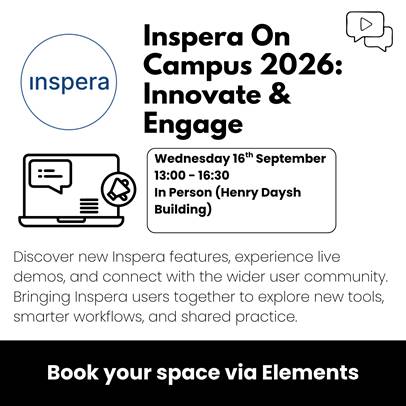
Inspera users (and those interested in the system) are invited to the Inspera On Campus 2026: Innovate & Engage event on Wednesday 16th September, 13:00-16:30. This event will take place in person in the Henry Daysh Building.
This year’s event has two key focusses:
Sharing applicable updates to the system with our users that will be available from the new academic year.
Opportunity for users to take part in Inspera-led discussion sessions with other Inspera users across our University.
If you’d like to join us, please sign up to attend the event using the Elements booking form. This will enable you to keep up to date with communications about the event and assist with our planning. The full agenda will be released in later this month with details of the new features we are adopting.
Following on from our last blog all about our new Digital Drawing Tool, we’ve complied some best practice about how to create accessible question and enable students to use this tool effectively.
Hints and Tips following Universal Design for Learning (UDL) principles.
1. Accessible question design aims to remove irrelevant barriers, do consider the language and instructional text being used. Avoiding instructions which could be ambiguous will greatly help your student’s clarity within their exam. Even if student choice is applied as to whether they use the drawing tool; short, clear instructions would be best practice
Unclear example: ‘access the drawing tool to supplement your answer if you’d like to illustrate a diagram’
Clear example: ‘You may draw a diagram using the drawing tool’
Don’t: use idioms or references which are culturally specific
Do: use short sentence structure
2. Consider students using assistive technology and over-allocate time for drawing. Drawing using the Digital Drawing Tool can generally take longer than text entry, has the exam duration been designed to incorporate sufficient time for use of the tool?
3. Ensure colour use is not a marked requirement. Although within the Digital Drawing Tool interaction, students can draw using the different tools, colours, and shapes; using colour alone could impact students who are colour-blind. Consider contrast options or labelling to ensure colour information is accessible information to all.
Alternate options: have you considered arrangements should your student(s) not be able to use the new Digital Drawing Tool? You could:
4. Provide an alternative response option
Clear example: ‘If you are unable to use the drawing tool, you may provide a written entry of your answer in the text box below’
Further questions? If you have any questions about your Inspera exam, please contact the Digital Exams Team via Digital.Exams@newcastle.ac.uk
Got a quick digital exams question? Why not join our Teams Community about all things Inspera!
We’re currently within the Semester 1 Exam period for 2025-26. For anyone marking using Inspera we’ve collated some handy tips which you may find helpful.
Hints and Tips
To access your exam(s) to mark, click the link within the assignment point in Canvas. You must be a teacher or teaching assistant on the Canvas module.
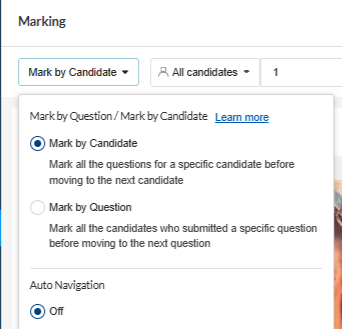
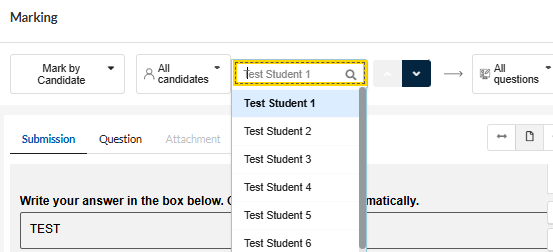
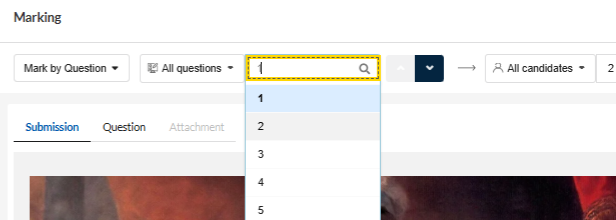
If you need to search for a specific student, within the Inspera ‘Grading Overview’ section, use the search bar – you can search for a student ID.
To download raw marks from Inspera, as an Excel file. Click the ‘Options’ button at the top right of the Grade screen and navigate to ‘Downloads’. Select ‘Marks and Explanations as Excel file’.
Inspera Exams are always set up initially within the Canvas assignment as out of 100 points. You can edit the points on the Canvas assignment after the exam if needing to display raw marks (edit the Canvas assignment)
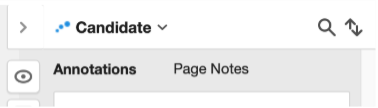
For manually marked questions, Markers can add Annotations to student submissions.
Within the student’s submitted text, click the left mouse button to select the text you want to annotate. Click Annotate.
Once marking is complete within Inspera, don’t forget to Confirm Marks, this will complete the grading step and push the completed marks from inspera to Canvas Gradebook.
It is now possible to port Inspera digital exam grades from Canvas Gradebook into NESS. For instructions on how to do this please see NESS Guidance.
Video demonstrations: There are a range of marking videos available which provide on-screen demonstrations of grading tasks. See Video guides for Markers.
The January Exam period (for 2026) is taking place from Tuesday 6 January 2026 to Tuesday 20 January 2026 (including Saturday 10 January and Saturday 17 January). Inspera Digital Exams will be running throughout this. This blog aims to share communications Module Teams are asked to share with their students ahead of their Inspera exams, along with information around support with marking once your Inspera digital exam is over.
Communications for Students
Module Teams are encouraged to share communications with their students if sitting an Inspera digital exam. Note: Students must know their own University log in details (username and password). It may not be possible to reset forgotten log ins on the day of the exam. Please remind students of this. Below is some draft text that you can use in an email and/or Canvas announcement.
[Title] Preparing for your [MODCODE] digital exam: make sure you know your log in details
To sit your upcoming Inspera digital exam you will need to know your University login details (username and password).
Please check that you know your login details before the day of the exam and that you can successfully sign into a campus Cluster PC. If you do not know your login details on the day of the exam it may not be possible to reset them before the exam starts.
Your username begins with a letter (usually c) followed by the middle 7 numbers from your student number, which you can find on your smartcard. E.g. if your smartcard shows your student number is 212345678, your username is c1234567.
To help you prepare for your assessment, you can try out our demo exams via Canvas. There is a locked down demo and an open book demo. Both demo exams reflect the same demo content. The locked down demo allows students to experience the in-person Inspera exam security, therefore this particular demo should only be taken within a Campus PC cluster (as the required software will be installed).
There is also a student page on the Academic Skills Kit about Inspera which students may wish to look at ahead of your exams.
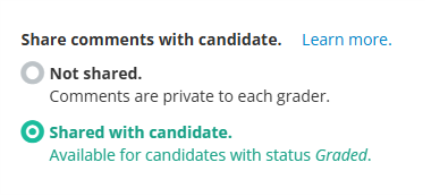
Inspera’s feedback release aims for transparency for all exam questions, however this had caused limitation for Module Teams wishing to releasing Essay comments as feedback, without revealing correct answers to automated marking. A new workaround is now available.
When marking an Inspera exam which includes Essay feedback comments that you wish to be visible to your individual students, comments must be saved as visible to candidate in Grade i.e.
Module teams, for the new academic year, can allow their students to take practice Inspera exams repeatedly using Multiple Attempts with manually marked questions. Use with automarked content has been available during the latter half of 24-25.
Important note: Multiple Attempts is a feature which supports formative digital exams. There is no option to lock down an exam using Multiple Attempts.
Setting up Multiple Attempts with manually marked questions
Important note: Multiple Attempts as a feature cannot be used with templates. Please ensure when setting up, your template is left blank i.e.
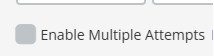
Within the Deliver Tab, you will need to edit the exam settings and click ‘Enable Multiple Attempts’. (Once activated, the greyed box will turn green and include a white tick symbol).
You will be prompted to ‘choose method for attempt creation’ for manually marked tests, select ‘I want to specify attempt time windows’. This means the individual setting up the test would have flexibility to schedule attempts. This is recommended as the workflow for manually marked questions as there must be marker input prior to feedback release.
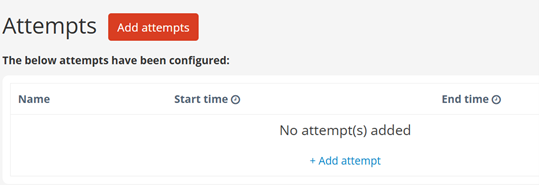
Once selected, you can ‘add attempts’:
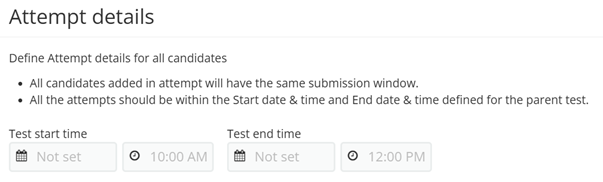
Each attempt will enable a different start/end time which you input:
Click ‘create attempt’ to save and ‘add’ to create another.
Important note: All attempts must be within the Start date & time and End date & time defined for the parent test.
You will then be prompted to ‘choose how attempts are available’ for manually marked tests, select ‘Grader control’. This means Graders can release students’ next attempts once marked.
5, Under ‘Setting final result’, choose the most appropriate option for your exam which will be applicable as part of your student feedback. Options are:
Highest: The highest score achieved among all attempts will be the final result.
Average: The average score obtained across all attempts will be calculated and used as the final result.
Latest: The most recent score from the student’s attempts will be the final result.
The Digital Exams team will be releasing this new feature prior to Academic Year 25-26 teaching starts. We’ll also be updating our Multiple Attempts dedicated website.
Any questions please contact digital.exams@ncl.ac.uk
As seen on our dedicated content creation features website, within your Inspera Question Sets using sections, you are able to apply Stimulus to questions.
Stimulus can be helpful when authoring exam content, as information that is relevant to question(s) within a section can be displayed alongside the question itself. Stimulus examples include:
case studies
background information
key concepts that students should refer too
To further capture student attention to a particular part of a stimulus, you can highlight text in a section Stimulus. The highlighted text becomes visible to students as outlined per individual questions in the section.
If a Stimulus is used for multiple questions, as students moves through the questions; you could highlight different parts of the Stimulus text in line with what is relevant for the selected question.
Using highlighting:
Add a Stimulus (using the document option) to your Section
While editing the Stimulus, select the text that you want highlighted and click on the highlight brush (at the top right of the toolbar)
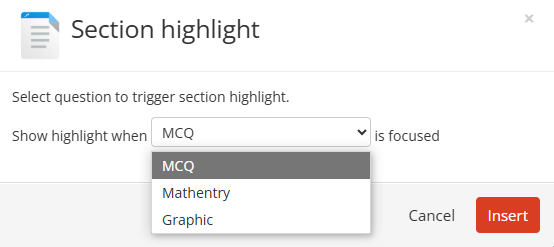
Select the question this highlight refers too:
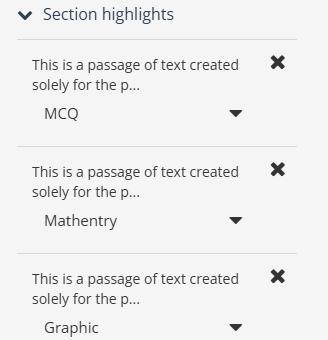
In this example, the MCQ question is selected
Click insert
Repeat for all questions as required
Review all highlights using ‘Section highlights’
Save
Important note: for highlighting to be achieved, the Stimulus must be created as a Document.
You can check out some of our hints and tips for marking Inspera Digital Exams or our dedicated website.
To access your exam(s) to mark, click the link within the assignment point in Canvas. You must be a teacher or teaching assistant on the Canvas module, and this will attach you to the exam in Inspera.
If you need to search for a specific student, within the Inspera ‘Grading Overview’ section, use the search bar – you can search for a student ID.
To download raw marks from Inspera, as an Excel file. Click the ‘Options’ button at the top right of the Grade screen and navigate to ‘Downloads’. Select ‘Marks and Explanations as Excel file’.
Digital Exams are always set up initially with the Canvas assignment associated with your Inspera exam as out of 100 points. (If you’d like students to see raw marks, please edit the Canvas assignment points area to match that of your total Inspera marks).
For manually marked questions, Markers can add Annotations to student submissions. (Within students submitted text, click and hold the left mouse button to select the text you want to annotate. Click Annotate).
Once marking is complete in Inspera, don’t forget to Confirm Marks, this will complete the grading step and push the completed marks from inspera to Canvas Gradebook.
Video demonstrations: There are a range of marking videos available on the Inspera website which provide on-screen demonstrations of grading tasks. See Video guides for Markers.
Feedback Release: If you would like to release feedback to your students on your auto or manually marked Inspera questions, check out our dedicated feedback release webpage.
Further questions? If you have any questions about marking an Inspera exam, please contact the Digital Exams Team via Digital.Exams@newcastle.ac.uk
Internal Inspera Teams Community (Digital Exams using Inspera Assessment @ Newcastle)
The Digital Exams Team have set up a Newcastle University community via a new Teams group. This new community will:
Enable colleagues who use Inspera for their Digital Exams, to ask general questions in a dedicated area
Create a space for colleagues to share ideas and best practice and/or learn from others experience.
Build a supportive community network of like-minded colleagues.
Enable the Digital Exams Team to share updates about Inspera such as feature developments, improvements and Roadmaps.
The Digital Exams Team will monitor this community to ensure members are on track for enhancing their Inspera digital exam and provide support queries relevant across all disciplines.
Multiple Attempts is a feature which supports formative auto-marked Inspera digital exams. Module teams can now allow their students to take practice auto-marked Inspera exams repeatedly, either by having students submit as many times as they wish, or by setting a defined number of retakes. Please be aware there is no option to lock down an exam using Multiple Attempts.
Multiple Attempts can help students to learn rapidly and understand topics by allowing them to practice until answers are correct. This can also allow for a dynamic and effective learning experience.
Students can:
Improve their understanding of the topic by practicing multiple times
Increase their confidence by identifying and correcting mistakes
Prepare more effectively for exams by identifying improvement areas
Multiple Attempts can currently only be used with Inspera digital exams which are using automatically marked questions. The feature can also be used with pre-defined feedback. Pre-defined feedback is recommended if using multiple attempts, as this allows students to improve their understanding of the exam content.
Setting up Multiple Attempts
Within the Deliver Tab on Inspera, you will need to edit the exam settings and click ‘Enable Multiple Attempts’.
You will then be prompted to set a maximum number of attempts. If wishing students to have an unlimited number of attempts, click ‘Unlimited Attempts’.
Under ‘Setting final result’, choose the most appropriate option for your exam which will be applicable as part of your student feedback. Options are:
Highest: The highest score achieved among all attempts will be the final result.
Average: The average score obtained across all attempts will be calculated and used as the final result.
Latest: The most recent score from the student’s attempts will be the final result.
Student feedback when using Multiple Attempts
When using Multiple Attempts, feedback should be set to be released to students immediately after each test attempt. Feedback which is immediate enables students to see full details of their attempt instantly and work on this for the next attempt.
If a student accidentally deletes text in an essay question, there is an option to restore it using Snapshots. This Snapshot functionality is available for students during their live Inspera exams.
Snapshot is accessed via the test editor/option panel available to students on any essay question:
The icon to retrieve Snapshots which are available is a backwards arrow around a clock face: .
Once selected, students can retrieve previous versions of their work. A new snapshot is taken every 15 minutes and is saved in the browser memory. Snapshot use is available after 15 minutes of beginning work on an essay question. Navigating away from the question, and then returning to it would not disrupt the Snapshot. Snapshots are activated per question, so using this option could not revert any other question answers to an earlier instance.
Important note: As browser-based memory is used for this feature, exiting the Inspera exam or refreshing the browser will disable Snapshots. (Note: refresh is only available in non-locked down exams).
How does it work for students?
When students click the Snapshot button, a message like the one below will appear. The student will be advised to select a snapshot and then click continue. This will enable them to retrieve prior instances of their work. Students can click the icon and select a different snapshot if their first selection is not what they were searching for.
Next steps
For academic year 2024-25, Instructions will be available to exam invigilators, these can be shared with students if needed in their exam.
Instructions are also available for students to familiarise themselves with ahead of their exams via the ‘Instructions in Inspera’ tab on the Student Inspera ASK website