
Conversations about assessment, active learning, partnership and artificial intelligence filled the room on 6 June as more than 67 colleagues came together to launch the new Leading Edge Curriculum (LEC) Communities of Practice.
Continue reading “LEC Communities of Practice Launch”Introducing the My Progress system for Academic Advising
As part of the University’s new approach to Academic Advising, a new system called My Progress will be introduced from September 2026.
My Progress is being developed to support students, Academic Advisers and Directors of Academic Advising. The system will bring together relevant information, tools and records in one place to support more informed and meaningful advising conversations. It will help colleagues access key student information, support advising interactions, record meetings, and enable students to reflect on their progress, skills and future goals.
The introduction of My Progress also provides an opportunity to simplify the digital tools used to support Academic Advising. Rather than asking students and colleagues to move between separate systems for engagement information, reflection activity and advising records, My Progress will provide a more joined-up space designed around the needs of the new Academic Advising Framework.
As part of this change, the University’s learning analytics system, NULA, will be decommissioned for colleagues and students. Relevant engagement data will be available through My Progress to help support informed advising conversations. Bringing this information into My Progress will help advisers consider engagement alongside other relevant student information, supporting a more holistic view of the student and their current context.
NU Reflect will also be decommissioned for UG and PGT students. Reflection functionality will be available through My Progress, allowing students to write reflections and reflect against the new Skills and Attributes Framework. This means reflective activity will sit alongside other areas that support advising, including student goals, skills development and advising conversations. Colleagues and PGR students will retain access to NU Reflect for uses that are outside the scope of Academic Advising.
Overall, My Progress is intended to provide a clearer and more consistent digital space for Academic Advising. It will support students and advisers to prepare for conversations, review relevant information, identify next steps, and make better use of reflection, skills and engagement information as part of the advising process.
Further information about My Progress is available on the Learning and Teaching site. Resources, FAQs and step-by-step guides will continue to be added as the system develops and functionality is confirmed. Student-facing resources will also be made available online. Training webinars will run from September 2026 to support colleagues in using My Progress as part of Academic Advising.
We recognise that colleagues may have questions about what this means for existing processes. If you have any questions, please contact ltds@newcastle.ac.uk.
LEC101 Pre-design menu
During March and April our LEC Education Fellows have been working on a series of in-school workshops designed to unpack a particular aspect of LEC. We’ve brought these together into a “LEC 101” series and were pleased to offer these to schools via their DoEs who attended the LEC Focussed joint FEC on 30 April.
Continue reading “LEC101 Pre-design menu”Book Review: Making Active Learning Happen for All – Practical Ideas for Developing and Sustaining Active Learning
This is an comprehensive 511 page resource edited by Sarah Wilson-Medhurst and Janet Horrocks drawing on contributions from the Active Learning Network and its members. As a bonus, the book is helpfully published under a Creative Commons license (CC-BY-NC-SA)
The book Making Active Learning Happen for All is laid out in 7 sections
- So Why is Embedding and Sustaining Active learning a Problem, and What Can We Do About it?
- Approaches to Embedding and Sustaining Active Learning Across the Institution
- Shifting Staff Mindsets
- Promoting Staff Self-Regulation and Adaptation
- Shifting Student Mindsets
- Promoting Student Self-Regulation and Adaptation
- Designing and Implementing Sustainable and Inclusive Active Learning Experiences
After the first introductory section, the remaining sections comprise short articles, opinion pieces and case studies from a range of perspectives. It’s really easy to navigate and a rich resource that is worth dipping into.
Section 2, Embedding Active Learning Across the Institution starts with systems level perspective on the challenges of implementing Active Learning – grouping challenges into those relating to mindset; purpose and goals; structure; and elements and resource. From here the chapter then explores how a number of institutions have supported the adoption of active learning. We read of the satellite Active Learning Network in Anglia Ruskin University providing a space where staff can share ideas, reflect on experience and build collective expertise. Manchester Metropolitan University has an Innovation Scholar Scheme where educators are fractionally seconded to MMUs Centre for Learning Enhancement and Educational Development Unit. The Case Study from Herriot Watt had lots of practical tips – how they have encouraged the use of active learning in their curriculum framework through consistent messaging, use of examples, tips on low preparation activities, through training sessions and a storyboard toolkit.
Section 5 unpicks some of the essential underpinnings for Active Learning, I particularly appreciated the examples offered by Sophia Zevgoli in “Active Learning and Culture in Sync: Making it work for an Inclusive Classroom” – her chapter focusses on normalising mistakes and removing cultural barriers. Section 6 speaks to the development of capabilities and attributes that enable students to “navigate the active learning terrain” – the need for deliberate scaffolding, the role of critical team coaching and mature perspectives on the role of GenAI.
Section 7 features a number of detailed active learning case studies. Some of my favourites are below:
- Gamified Peer Review: Making Feedback Fun – students rate quality of feedback received from their peers awarding gold silver or bronze to the reviewers and a dynamic reviewer leaderboard.
- Applying Educational Games to Teaching and Learning of Sustainable Development: A Multinational Case Study – using a board game to enable students to explore the Sustainable Development Goals
- Active Learning as a Tool for Student-Led Seminars – students present on film sequences and their peers capture key points
- Partnering with Students to Create Educational Science Games: Insights from Higher Education in South Asia – how designing games created a space for postgraduate science education students to develop a deeper understanding of pedagogy.
- Active Learning as Interdisciplinary and Collaborative Learning: Building Student Capacity for the Complex Challenges of the 21st Century – supporting second year students to address challenges in interdisciplinary groups
- Using Problem-Based Collaborative Active Learning as a Scaffold for Developing Professional Competencies – Group based PBL Consultancy Capstone for Masters students.
- Making Multidisciplinarity Work: An Active Learning Approach – Play-Doh modelling used on a PGCert Research Masters to communicate disciplinary attributes, knowledge creation and connections in a multidisciplinary environment.
- Transition to Active Learning: Introducing Widening Participation Students to Active Learning – interspersing micro lectures and activities in a Summer School programme.
Active Learning at Newcastle University
This is a timely publication, given that our Leading Edge Curriculum places active learning as our core pedagogical principle. The case study ideas above can act as useful inspiration, but it is worth noting that we also have fabulous home-grown examples of active learning see: Active Learning – Case Studies of Teaching Practice. These are linked from our Active Learning page on the Teaching and Learning Site.
The “Embedding Active Learning ”case studies in Section 2 come from diverse institutional settings each with differing starting points, structures and approaches to redesign. As we transform programmes, the Curriculum Transformation Team will be supporting programme teams to design active learning into modules. Alongside this our LEC Fellow led Communities of Practice will be celebrating and sharing practice as well as developing resources and development.
Get involved
If you would like to champion active pedagogies or contribute to resources you can come to The Communities of Practice Launch event, co-hosted with Newcastle Educators. It’s on Thursday 7 May, to sign up and find out more see the post in the Newcastle Educators Team.
We would also love to hear about your own use of Active Learning. You can contribute an Active Learning Case Study via our form on Case Studies of Teaching Practice or by getting in touch with us ltds@newcastle.ac.uk
Leading Edge Curriculum Resources
To support curriculum transformation LTDS colleagues have redeveloped a number of new resources.
A new LEC landing page on the Learning and Teaching Site
Our University Learning and Teaching site is provides guidance on learning and teaching, digital technologies and professional development. We have taken the “effective practice” branch and reorganised it around the eight sections of LEC.
You can see the new site here: Leading Edge Curriculum | Learning and Teaching @ Newcastle | Newcastle University
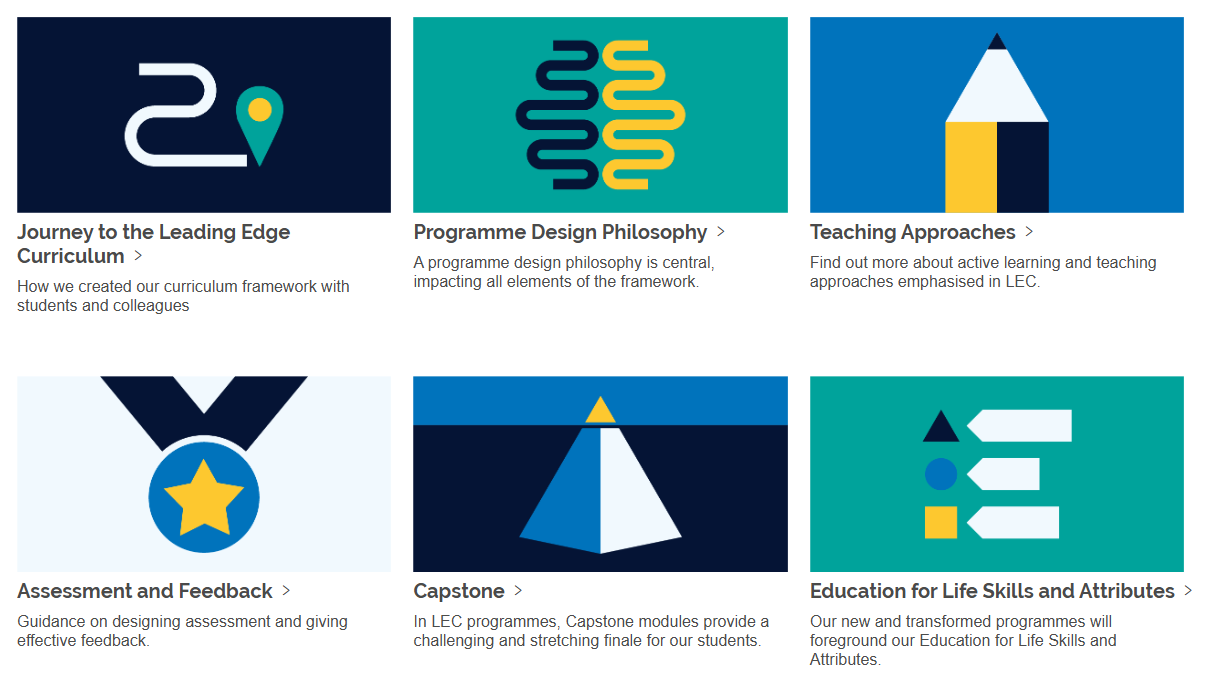
New pages include:
- Active Learning | Learning and Teaching @ Newcastle | Newcastle University
- Psychological Safety
- Inclusive Assessment – a toolkit co-developed with Student Health and Wellbeing Colleagues
The site has prominent links to the Enabling Policy for the LEC (EPGS) and to the Education Strategy SharePoint site where you can find out more about the LEC Implementation support and progress.
LEC Orientation Canvas Course
On the Workshops and Training pages we have published a link to a short self-paced Canvas course designed for colleagues to work through before curriculum transformation.
The LEC Orientation Course outlines the benefits that our Leading Edge Curriculum Framework will bring, introduces key LEC requirements, and directs you to key resources that will be useful to explore before a supported design period supported by the Curriculum Transformation Team.
The orientation acts as a starting point for a more detailed study of the LEC Framework and supporting policy.
You can self enrol using this link: https://ncl.instructure.com/enroll/7NW9GC
We are continuing to develop these resources
Colleagues are working on new resources we will be adding in examples from the Curriculum Transformation pilot, guidance from the Encounters workstream and LEC Fellows, as well as case studies illustrating LEC parameters.
Do get in touch (ltds@newcastle.ac.uk) if you have feedback or have examples of practice you would like to share.