Sound

In session 3 of our 3P event on Friday 27th we had a look at sound recording and sound file use.  audacityHere are a few resources we used for this part of the session:

ULTSEC Innovation Fund 2015/16 – Deadlines Approaching

The University’s Innovation Fund awards are designed to encourage the development of new or innovative approaches to learning and teaching and to enable their dissemination across the University.

The Innovation Fund is a fantastic opportunity to propose and deliver projects with real benefit to learning, teaching, and the student experience.

Past projects have also offered stepping stones to other internal and external learning and teaching opportunities and funding (eg: evidence for the reward and recognition of teaching; HEA schemes).

Whilst Innovation Fund projects can offer opportunities to undertake educational research, it is essential that the primary focus of projects is on improving the student learning experience.

Responsive project proposal submission deadlines

Spring: Thursday 24 March 2016, 5pm

Summer: Friday 20 May 2016, 5pm

Strategic project proposal submission deadlines

Semester 1: Friday 15 January 2016, 5pm

Semester 2: Friday 20 May 2016, 5pm

More information is available on the LTDS website.

Workshops for prospective applicants to the Innovation Fund are available giving an overview of the purpose of the fund, and the responsive and strategic strands of funding.

Presentations will be made by winning Innovation Fund project teams.

Guidance will be available from the Careers Service about employing students as part of an Innovation Fund project.

Introduction to the application process, key dates, and where to find further information will also be included:

Monday 7th December 2015 – 10.00-11.00

Wednesday 24th February 2016 – 14.00-15.00

To book your place, please register here.

For more information about the Innovation Fund contact innovfund@ncl.ac.uk.

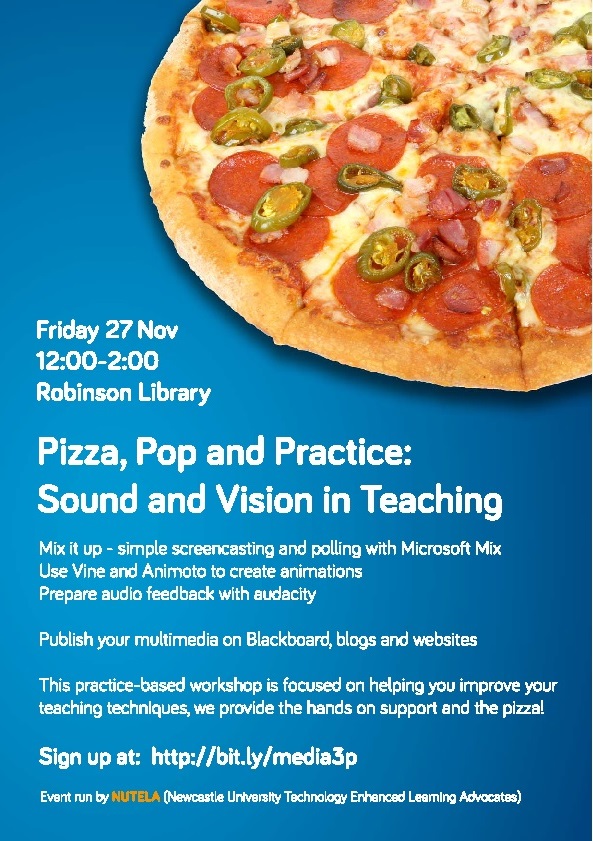
PIZZA POP AND PRACTICE: SOUND AND VISION IN TEACHING

NUTELA 3PS 111115NUTELA will hold it’s first Pizza, Pop and Practice workshop of this academic year in the Tees Cluster at the Robinson Library on Friday 27th November 2015.

The workshop, entitled Sound and Vision in Teaching, will showcase techniques to use video and sound editing software to create short film sequences and audio recordings for teaching.

As well as vast quantities of FREE PIZZA and POP over lunchtime, the event will offer a series of short workshops to show participants how to use Microsoft Mix to put together or mix up words and images, Vine and Animoto to make short animations and Audacity to record short sound clips.

See Animoto in action and learn more about the event:

https://animoto.com/play/YcUFoKFhQkZG2Z8817siog

Participants must register for catering purposes.

We look forward to seeing you there!


Inserting an Office Mix into a Blackboard Module

Follow these steps to use an Office Mix Placement inside a module in Blackboard:

  1. Go to the module you’d like to use.
  2. In the Tools menu, select Office Mix.
  3. In the Link Name box, type a name.
  4. Configure any additional settings you’d like.
  5. Click Submit.
  6. When you return to the Module, click the item that you just added.
  7. When the item appears, use one of these methods to select a mix:
    • By URL: A simple way to select a mix is to visit the Office Mix website, watch a mix, and copy/paste the URL in the dialog. This method makes it easy to include mixes that have been created by other people.
    • My Mixes: Select a mix from your My Mixes page. In order to prevent students from having to sign in to view a mix, only those mixes with permissions set to Unlisted or Public are shown. You can find our how to set these preferences here
  8. After you have selected a mix, click Yes to confirm that this is the mix you’d like to use.

NUTELA Peer Recognition Awards – Winners Announced!

NUTELA is pleased to announce the winners of its 2015 Peer Recognition Awards.

The awards are designed to recognise University staff who go above and beyond the call of duty to help their colleagues, schools and units to adopt forms of TEL (technology-enhanced learning).

This year’s winners Gigi Herbert (Development Officer within the Curriculum Development team at the Careers Service) and Graham Patterson (Computing Technician with Sage Faculty IT) have both been integral to helping other staff to adopt innovative technologies in their teaching.

NUTELA Peer Recognition Award winner Gigi Herbert [Right] with Salome Bolton, who nominated her.
Gigi was responsible for helping Careers Service staff to adopt technologies such as Grademark and Turnitin in their year-long Career Development Modules.

She was nominated by her colleague Salome Bolton. Salome said: ‘Gigi has been fundamental in developing the team of six to help manage the complexities around student assessment and enhancing learning through the innovative use of technology.

‘[She] helped each team member work through these issues and address any problems using individual support and training.

‘[We] have received very positive feedback from students informally and via our student-staff committee about the additional benefits of being able to access their feedback online via this system.’

Graham has worked tirelessly helping staff in the School of Civil Engineering (CEG) to use mobile technologies in their teaching.

For this a tablet devices (Android based) were issued to each all incoming students in CEG from 2012.

Henny Mills (Senior Teaching Associate, CEG), who nominated Graham said: ‘Graham has been central to the introduction and management of the PEARL project and without him, the use of tablet devices within the teaching environment of CEG would not have been such a success.

‘When I was not able to deliver the tablet inductions sessions due to other teaching commitment, Graham run the sessions for up to 100 students, which is well beyond the scope of an IT Technician.

‘The use of these devices has revolutionized teaching delivery in CEG and improved student experiences. This would not have been possible without Graham’s support and enthusiasm for technology-enhanced learning.’

Graham Patterson
Graham Patterson Peer Recognition Award Winner


Graham added: ‘Using these mobile devices is great because it encourages interaction between lecturers and students and means that lecturers can poll immediate feedback during classes.’

NUTELA Chair, Laura Delgaty, who helped to choose the winners, said: ‘We had some great entrants this year and it was tough deciding on the winners.

‘I think everyone at Newcastle can be really proud of how staff are working together to support each other in using these innovative new methods in their teaching.

‘We are excited this year to offer these awards. The focus was on recognizing colleagues that have gone out of their way to help others at the University learn about or use technology.

‘We asked for peer nominations focusing on how these individuals contributed to the advancement of others using technology and how this related to NUs LTSE.’

Do you have an extra-special colleague who has helped you with incorporated TEL into your teaching practice? Do you want to recognise someone who has provided excellent support or advice on TEL to your school, unit or faculty? Watch out for details of next year’s competition on the NUTELA blog or email: nutelaops@newcastle.ac.uk for more information.

Social Media in Teaching – 3P workshop on 23 April 2015

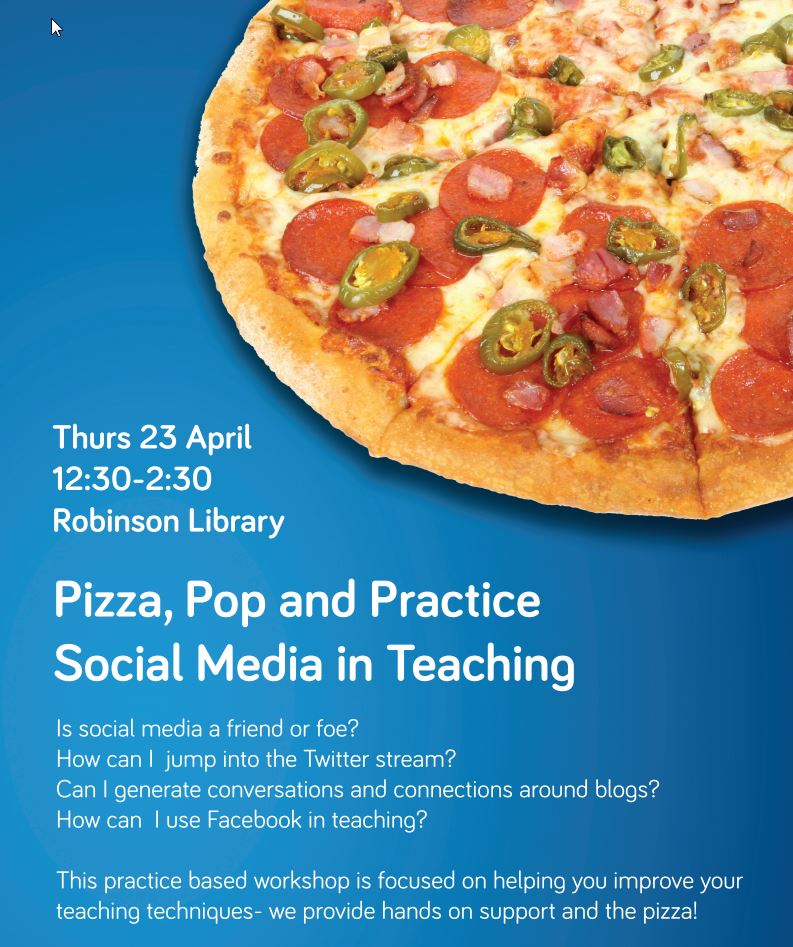
2015-04-23 15_43_09-mooc-images.ncl.ac.uk_blog_nutela-poster-23-April.pdfOur fourth Pizza Pop and Practice event will be on the topic of “Social Media in Teaching”

Is social media friend or foe?

  • How can I jump into the Twitter stream?
  • Can I generate conversations and connections around blogs?
  • How can I use Facebook in teaching?


This workshop is focused on helping you improve your teaching practice – we provide the hands-on support and the pizza!

Print off a poster for the workshop

Hashtag #social3p

Workshop materials

Twitter

Blogs

Facebook


Peer recognition award – deadline extented to 30th April (5pm)

celebration-medal
Has someone helped you? Has another member of University staff gone out of their way to help you use technology? Would you like her/him to be recognised? If so, let us know!

NUTELA is offering two peer recognition awards this year. We are looking for nominations of staff members who have contributed to peer support or the mentoring of others learning about and/or working with technology.

It might be someone who has helped you understand the purpose of a specific learning technology, or someone who has been instrumental in progressing Technology Enhanced Learning (TEL) initiatives in your unit. You are welcome to nominate any member of staff at Newcastle University.

The nomination process is simple. In 500 words or less, just answer these two questions and send your response to nutelaops@ncl.ac.uk.

  1. How has this staff member contributed to your learning, working or development with TEL?
  2. How has this contributed to the Learning, Teaching and Student Experience Strategy

The deadline is April 30, 2015. NUTELA will review the applications and make a decision. All nominees will be told they have been nominated, and will be invited to present their work at the year-end NUTELA conference in June, 2015. The award will be presented by Suzanne Cholerton, Pro-Vice-Chancellor (Learning and Teaching) and the winners will be invited to the Vice-Chancellor’s Celebrating Success event.

Laura Delgaty
Chair
NUTELA
l.e.delgaty@ncl.ac.uk

Pizza Pop and Practice – Learning and teaching off campus – 20th Feb 2015


Home working

  Office (at home)  Fabio Bruna CC BY 2.0.

This Practice based workshop was the third of four focused on helping you improve your teaching practice with hands on support. We covered:

Handout – Lync and Adobe Connect for meetings and teaching remotely (pdf)

Other relevant resources in response to questions on the day:


Why should you join us in The Enterprise Shed?

As we watch signup figures rise day by day for out third free online course with FutureLearn, The Enterprise Shed: Making Ideas Happen, Katie Wray, Lead Educator, for the course explores why we should all be joining her in The Enterprise Shed…

SS3Firstly, let me unpack ‘enterprise’. For me, enterprise is about making creativity, problem solving and ideas practical. This makes it relevant across all areas of education, not just business. Where enterprise is applied to creating a new venture, it is commonly known as ‘entrepreneurship’. We are increasingly aware of entrepreneurship, through the steady creation of new businesses (particularly in austere times), but also through the media. From this awareness we can each draw our own conclusions about what an entrepreneur is? The Enterprise Shed challenges a variety of definitions of an entrepreneur and looks at enterprise and entrepreneurship at a grassroots level. On the course you will be introduced to a whole bunch of entrepreneurial individuals and teams, not all of whom refer to themselves as ‘an entrepreneur’.

So if you can be ‘entrepreneurial’ (behave like an entrepreneur) without actually being an entrepreneur (starting a new business venture), who is ‘entrepreneurial’ and what can you do with your ‘entrepreneurialness’*? We are committed to exploring this with you throughout the course, and to supporting each participant to draw their own conclusions about how they can make change in their own context. Our other commitment is to exploring your ideas, to collecting insights into what a solution looks like, and to help you to turn that idea into something tangible.

This course is about you; it is about your role, through your ideas, in making change. There are 3 main reasons why you should commit 3 hours per week, for 4 weeks to The Enterprise Shed:

  1. You will develop confidence in yourself as a ‘doer’. You will do this through analysing the behaviours of other entrepreneurial people that you will be introduced to on the course, and drawing conclusions about the way that they ‘do’ and what you might ‘do’ when approaching your own challenges, problems and projects.
  2. You will discover ideas that address problems you want to play a role in changing. You will do this through identifying problems, sharing them with others, creating and collaborating on ideas generation, and developing solutions together with peers on the course.
  3. You will have the opportunity to meet people and build networks. WE will do this by forming virtual and physical networks around the globe, which can outlive the end of the course. You will meet people that share your passions and drivers to make change in your world, find out where you can go for help, and collaborate to achieve impact.

entshed_course_image_FLThe Enterprise Shed is not just a course, but a place where you can go to think, and critically, to do. Join us from 30th March 2015 in The Enterprise Shed and make your ideas happen.

Rebecca Fisher, Entrepreneurial Development Officer in our Careers Service, who is helping Katie develop the course wrote recently about what that experience is like over at the Rise Up blog.
Learning and Teaching Conference 2014

Learning and Teaching Conference 2014, 18th-19th June 2014

Group Work

Our annual Learning and Teaching Conference was on 18th-19th June 2014.  The conference theme was ‘Learning, Teaching and the Student Experience’.

The main purpose of the Conference, hosted by Suzanne Cholerton (PVC Learning and Teaching), is working with staff to enhance the student learning experience. All staff at Newcastle University were invited to take part in the Conference, students presented on their own as along side staff.

Most sessions were 20 minutes long, scheduled in themed 2 hour blocks of 4 to 6 sessions. There were refreshment breaks between blocks, and discussion time within blocks.

If you attended the conference this year please complete the feedback form if you have not already done so.

Colleagues were welcome to tweet about the Conference using the hashtag #ncllt. Please find links to the tweets below;

Day 1: https://storify.com/lyd_ncllt/day-1-newcastle-university-learning-and-teaching-c

Day 2: https://storify.com/lyd_ncllt/day-2-newcastle-university-learning-and-teaching-c

June 18th – Robert Boyle Lecture Theatre, Armstrong Building

9:00-11:00

Keynote


Growth

Suzanne Cholerton

Introduction by Suzanne Cholerton

Raising the Bar  – implications for Learning, Teaching and the Student Experience The session will set Newcastle University’s Raising the Bar initiative in the context of the broader, strategic HE environment, with particular emphasis on our ambitions to grow and the implications for learning, teaching and the student experience.


Bev Robinson (workshop)

The Learning process- how do we create the right environment?

 Focusing on the Raising the Bar initiative, this workshop aims to generate 10 key principles to develop suitable learning spaces. We will explore innovative practices and how the academic and student community can work with ESS and ISS to help design the type of spaces required.

Presentation

Spaces session doc

11:00-13:00

Transitions into, during and beyond university study

Laura Heels (Transition Officer, School of Computing Science), with Lindsay Marshall and Marie Devlin

It’s the transition that is troublesome.

This presentation introduces  our new Transition Officer and outlines the activities and processes she has implemented to help first year Computing Science students with their academic and pastoral issues.Presentation


Ann Musk, Jen Stewart, Laura Fletcher

Building Bridges: Successful Transition and Innovative Practice.

A workshop to explore the transitional challenges faced by current and prospective students and the innovations, which can empower students whilst supporting retention and achievement. Presentation


Sandra Salin and Damien Hall

Better French Living Through Independent Learning.

The main objectives of this project funded by the Innovation Fund are:

  • to collaborate with NU students in the development of online resources which will be specifically designed to help other students prepare for a placement in a francophone country.
  • to pilot an initiative that will integrate French Linguistics into French Language learning and teaching. Presentation


Dawn Jones

Helping students to succeed.

The presentation will address the challenges students face and the strategies used to try to enable students to understand what it is we require in order for them to succeed. Presentation

Lunch/Posters


History Room, Students’ Union

Sue Thorpe- Poster

Iain Keenan- Poster

Alison Clapp- Poster

14:00-16:00

Students’ professional development & career planning

Phil Ansell

Enhancing the Employability of Stage 2 Maths & Stats students through the School of Maths & Stats Careers Management Skills Award.

The School of Maths & Stats Careers Management Skills Award is for Stage 2 students who have taken part in non-compulsory (but timetabled) events and activities. We will describe the development of the award, what we have learned, what was successful and what we will change in the future. Presentation


Bryan Burford

Two approaches to developing medical student preparedness.

Graduating medical students must be ready to be core members of the healthcare workforce. Two recent projects looked at the contributions of clinical placements and simulated practice to developing preparedness.Presentation

Tom Hill and Jessica Strudwick

Enhancing skills in analysis and resolution of complex issues of relevance to Food and Human Nutrition.

This presentation will discuss the experiences gained from attending a major international symposium on “Dietary Guidelines: Scientific substantiation and public health impact” which took place at The Royal Society of Medicine earlier in the year.


Gigi Herbert & Salome Bolton

To Boldly Go: roundtable reflections on engaging students with (personal) enterprise.

Roundtable presenters will discuss key areas of practice in cultivating enterprising skills and behaviours and reflect on some of the tensions and contradictions involved in the context of assessed modules.

Twilight session HERB.1 Red & Blue Zone PC 104 Herschel Building
16:00-17:30

App Swap

Graeme Boxwell and Marc Bennett

Learning and Teaching App Swap Event

Is your mobile device improving your learning and teaching? Would you like it to? If the answer to either of these questions is yes, then this is the event for you.

We will be demonstrating some L & T apps, and would also like you to show your favourites at this interactive app swap. Bring your device and learn what apps are out there to support your teaching. The apps demonstrated will be usable on Apple or Android devices.

Day 2 of Learning & Teaching Conference

June 19th – History Room, Students’ Union


9:00-11:00

Students as partners

Glenn Hurst

NPCEC: Postgraduate Innovation in Research and Professional Development.

The Northern Postgraduate Chemical Engineering Conference (NPCEC) received national attention in Summer 2013 for being the first event to serve as a platform for postgraduates to present their research in a prestigious yet supportive environment. This presentation outlines the positive impact and skills developed this conference had from the point of view of presenters, audience and organisers; all of whom were postgraduates. Presentation


Colin Bryson

Creating partnership opportunities in the curriculum

In Combined Honours we have co-designed modules with students that enable them to really take ownership – through projects they choose – many of which enhance the student experience more broadly.Presentation


Aimee Cook

Herbal Magic: Cross campus collaboration, outreach and the student experience:

Hear more about Herbal Magic, an outreach project involving the Library, AFRD and Newcastle students. Student involvement helped turn this successful project into an unusual example of collaboration, with real impact and benefits for all involved. Presentation


Dr Gill Vance

Student Involvement in Medical Education Research.

This presentation shares a number of strategies that we use to involve medical students in medical education research. These include optional rotations in medical education research and a research advisory group, comprising students from all years of the MBBS programme.Presentation

11:00-13:00

Innovative approaches to learning & teaching

Mark Backhouse, Michael Fitzpatrick, Jocelyn Selwyn-Gotha, Ayat Bashir (Stage 4 MBBS), Rachael Allen (Professional Artist, Gateshead), Iain D Keenan (School of Medical Sciences Education Development) (Presentation)

Transdiscipline student partner approaches for evidence-based development and evaluation of a novel cyclical ORDER (observe-reflect-draw-edit-repeat) artistic learning technique in anatomy education.

Medical and artist partners have developed ORDER to increase the variety of anatomy learning methods. Our data from a mixed-method evaluation shows ORDER can enhance student learning, engagement and experience. Presentation

Innovative Approaches to Learning & Teaching

Patrick Rosenkranz, Amy Fielden, Efstathia Tzemou

Teaching psychological research methods through a pragmatic and programmatic approach.

In this talk we will present our experience and evaluation of the first delivery of a revised research methods module in psychology.  We will focus on the students’ perception and explore how the module can support the development of psychological literacy.Presentation


Venda Pollock

Creative Difference: Feedback and Assessment in Fine Art.

This presentation investigates the Open Studios feedback and assessment model in Fine Art, looking at the role of feedback within the learning environment of the studio. Presentation


Brian Lunn

Improving feedback for students: Less effort for a greater return

The greatest potential benefit from assessment is from constructive feedback. We have developed a system that  automatically generates meaningful feedback without requiring significant time investment by academic staff. Presentation.


Rebecca Wassall and Divya Vedapuri

Time to listen – embedding patient feedback in student assessment (phase 1 pilot)

Patient experience is fundamental to providing high quality care. The outcomes of this pilot provide learning opportunities for student dentists, teaching staff and the NWE placement student. Presentation


Lunch Martin Luther King Room, Students Union
14:00-16:00

Technology-enhanced learning

Feng Hao

Enhancing teaching and learning with electronic voting

I will present a smart phone based Verifiable Classroom Voting system (https://evoting.ncl.ac.uk), which was developed at the School of Computing Science, trialled in real classroom teaching with positive student feedback and is being made available to all schools in Newcastle University. Presentation Blog


James Gerrard and Emma Gooch

Getting the Romans online: e-learning, student engagement and contextual knowledge in the humanities.Getting the Romans online

This presentation explores a recent initiative by Archaeology to augment student learning through the provision of additional Blackboard based resources, which allow undergraduates to develop their contextual knowledge base. Presentation.


Antony Mullen

An Evaluation of ePortfolio for Personal Tutoring.

This presentation shares the findings of the investigation into ePortfolio’s efficacy as a personal tutoring tool, covering tutors’ views and best practice. Presentation


Chris Thomson

Title: Teaching and Training Online – learning from the Netskills experience

Abstract: Jisc Netskills, based in Computer Sciences, has been successfully running full day online workshops for several years now. This presentation describes how Netskills runs a typical online workshop in a way that ensures an engaging and interactive experience and details some of the lessons we have learnt in a way that can help anyone considering using tools like Adobe Connect or Blackboard Collaborate for their own teaching practice. Presentation


Twilight session HERB.1 Red & Blue Zone PC 104 Herschel Building
16:00-17:30

MOOCs (Massive Open Online Courses)

Mike Cameron and Nuala Davis

What can we learn from MOOCs?

What are the lessons learnt so far from developing ‘Massive Open Online Courses’ for the FutureLearn social learning platform? How can we apply these lessons to distance and campus based education?