
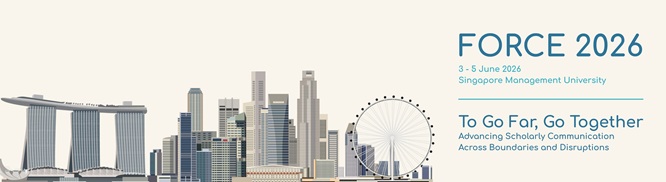
I recently joined around 200 librarians, developers, funders, publishers, and academics at Singapore Management University for FORCE2026, an international conference focused on the future of scholarly communication. The conference theme of “To Go Far, Go Together: Advancing Scholarly Communication Across Boundaries and Disruptions” emphasised the need for global cooperation in the face of increasing technological – and political – disruption.
The tone was set in an excellent opening keynote by SMU President Lily Kong, in which she challenged us to rethink how scholarly contributions are valued for their wider impact in academia and in society. She warned that the use of publication-based proxies for research quality and impact may be relatively easy, but used in isolation they can have a negative impact on research culture. She argued that institutions should recognise a much broader range of contributions, including methodological innovation and influence on policy, education, industry, and communities. However, she was also clear about the scale of the challenge in recognising that “reforming research assessment has proven far more difficult than simply articulating better principles” and that “No university can reform research culture alone” – i.e. we need work across boundaries.
Disruption from AI was the theme of the day 2 keynote by Ian Mulvany, Chief Technology Officer of BMJ Group. He described AI as a ‘jagged frontier’ in which while it may already exceed human capability in some domains that doesn’t mean it will in all. Scientific discovery is currently still mostly a human endeavour, but we are already seeing radical shifts in behaviour of academics with AI impacting on all aspects of scholarly workflows that we need to adapt to when considering how knowledge is created, communicated and trusted. He used the memorable metaphor of ‘dark factories’ in manufacturing to contemplate a future where autonomous AI generates a research question, designs experiments to test it, and writes up the results, all with minimal human involvement. Asking what this would mean for the traditional roles of researcher, publisher and librarian?
In the closing keynote from Professor Ginny Barbour, Co-Chair of the Declaration on Research Assessment (DORA) discussed the state of publishing and “…how we got into such trouble and how we get out of it?” She reflected on ‘disturbed times’ with shifting attitudes towards openness and academia, and how AI risks breaking established scholarly processes, reinforcing biases, and undermining research integrity. However, she also presented ways in which institutions and individuals might help rebuild a better system by championing openness and integrity, by telling uncomfortable truths despite pressure not to, and by educating our communities against emerging threats. She concluded with a positive message about the necessity of disruption based on a gift card that offered the wisdom “If the seas were always calm, we would never build a better boat.”
Beyond the keynotes there was an excellent range of sessions on topics including FAIR data, open access publishing, open research infrastructure, and of course, AI. Across all these sessions I found it refreshing to hear so many different perspectives from around the world and to recognise that we share many of the same challenges with scholarly communication. So my strongest takeaway from FORCE2026 was that addressing these challenges will, as the conference theme suggested, depend on our ability to work across disciplinary, institutional, and national boundaries.
If you’d like to find out more about the conference you can view recordings of the keynotes and slides from other sessions at: https://ink.library.smu.edu.sg/force2026/
(P.S. While away I also managed to run an open research workshop for our colleagues at Newcastle University in Singapore, but that’s for another post…)
