Mary Trevelyan: From Child to Mother on Digital Showcase

The second instalment of digitized Trevelyan family albums is now available on our Digital Showcase. We’re happy to say that a further three albums have now gone live, along with contextual information which allows you to search for individuals, places, or learn more about the images.

This group includes the first (although not the earliest) volume in the collection – Volume 1. Begun in 1894, when Mary Katharine Trevelyan [Molly] was 13 or 14 years old, it gives a valuable insight into her life before her marriage to Charles Philips Trevelyan. Born into the Bell family, wealthy industrialists in Middlesbrough, Molly’s father Sir Hugh Bell had joined the family firm, becoming director of the Bell Brothers’ steelworks in the town. Her mother, Florence Bell nee Olliffe was an author and playwright. Her family’s is perhaps most famously known for her half-sister Gertrude Bell, the archaeologist and diplomat.
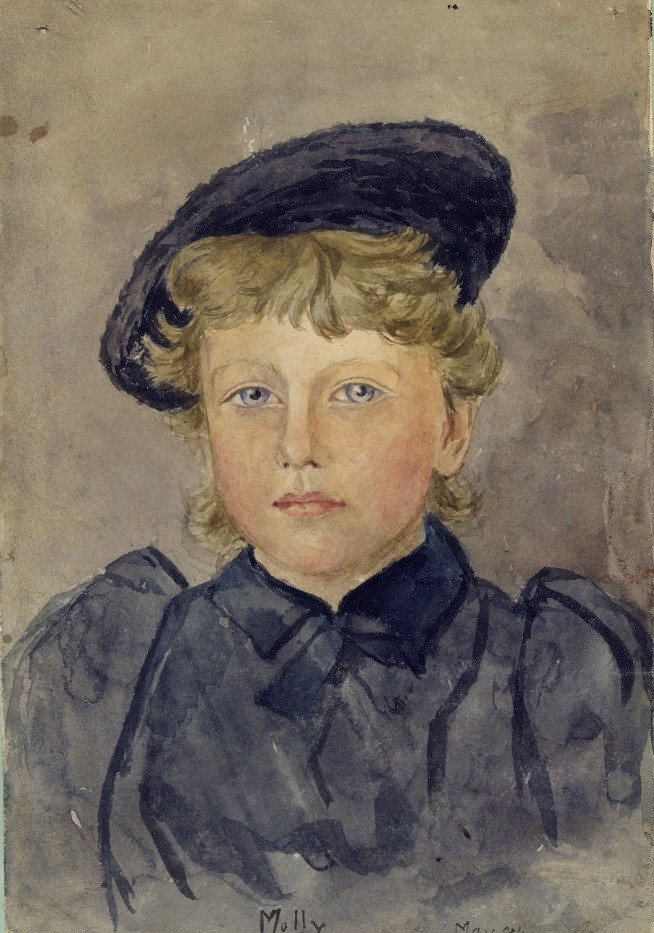
Picture of Molly by Lilian Bell, 1894 (CPT/PA/1)

Picture of Molly by Lilian Bell, 1894 (CPT/PA/1)

In the seven years covered by the album we see Molly and her extended family relaxing at properties in Red Car, Mount Grace and Sloane Street, London. There are also souvenirs from time spent in Germany in 1900, including concert programmes from Weimar and Berlin. The final few pages give an inkling of the following volumes’ content, as pictures from a visit to Wallington feature, with photographs of the impressive great hall and the exterior, as well as picnics with her future husband Charles on the estate which they would eventually manage together.
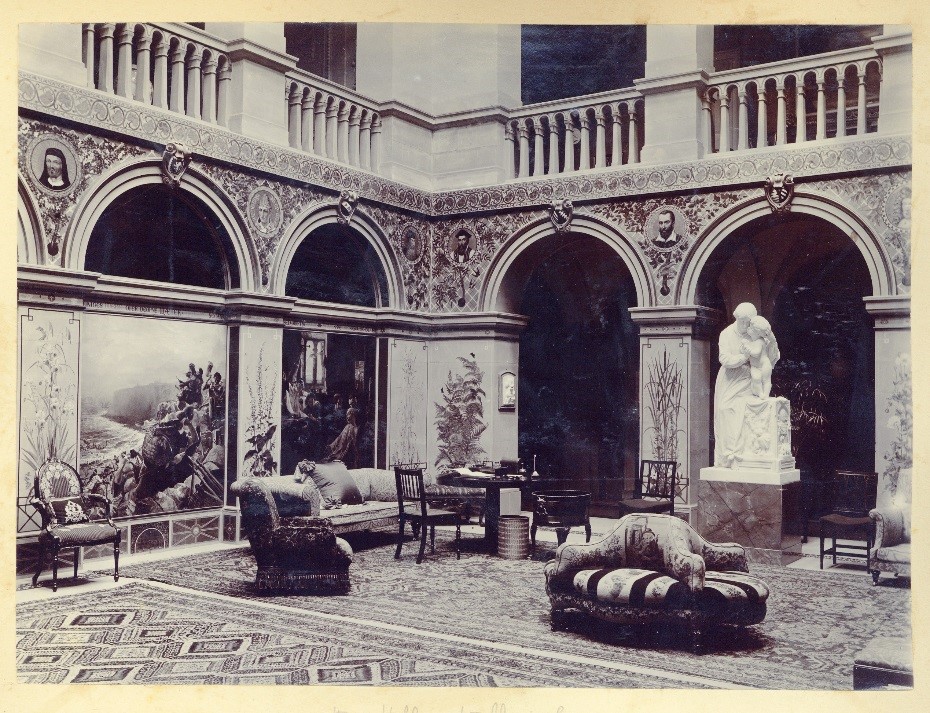
Great Hall at Wallington, 1903 (CPT/PA/1)

Great Hall at Wallington, 1903 (CPT/PA/1)

Volume 3, which also appears in this group, shows the early years of Molly and Charles’ married life together (1904-1906). At this point, their lives were split between Cambo House on the Wallington Estate, and Great College Street, Westminster, this album begins with many photographs of the couples’ friends, visits to family at Stocks House (the childhood home of Charles’ sister in law Janet Trevelyan nee Ward), Welcombe (a second home of Charles’ parents George Otto and Lady Caroline Trevelyan) and Rounton Grange (the Bell family home, recently inherited by Molly’s parents). Their love of animals is evident in the frequent photographs of cats and dogs, which appear alongside newspaper cuttings discussing Charles’ career as Liberal Member of Parliament for the Elland constituency in Yorkshire. The album ends with the birth of their eldest child (and first of seven), Pauline Trevelyan (later, Pauline Dower).
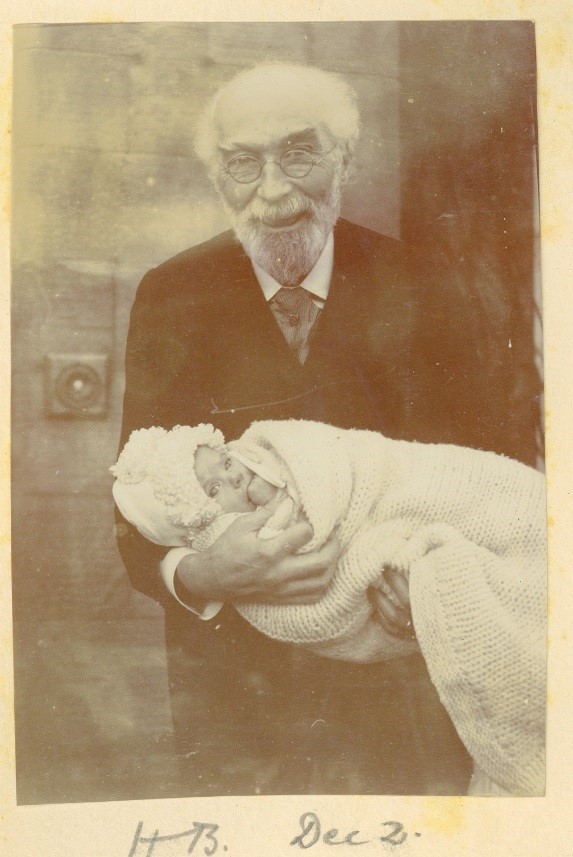
Sir Hugh Bell and Pauline Trevelyan, 1905, CPT/PA/3

Volume 5 continues on from volume three (handwritten notes added later by Pauline state that ‘there never was a vol. 4 a mistake in the binding!’). This album includes the arrival of their next two children, George Lowthian [Geordie] and Katharine [Kitty]. This album includes many photographs of their three eldest children playing together when young, as well as photographs and souvenirs of Charles and Molly’s trip to Italy. Marriage is very much a key feature of this album, and many invitations to weddings of their friends and family are included, as well as photographs and souvenirs from the wedding of Molly’s sister Elsa to Admiral Sir Herbert William Richmond (the parents of Lady Bridget Plowden].
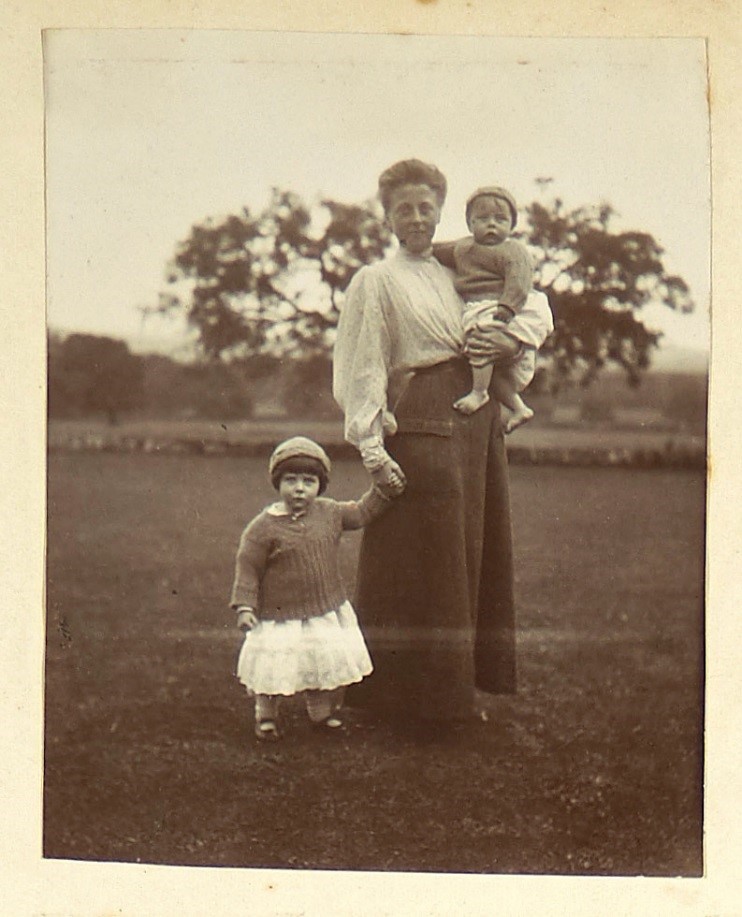
Molly with Pauline and George Trevelyan, 1907, CPT/PA/4

The content of these albums shows the shifting focus of Molly’s world as she transitions from a teenager in an industrialist family to being the wife of a politician and heir to a landed estate and the mother of three young children. Consistent to all the albums though, is the importance of family. The scrapbook style combination of private photographs, souvenirs and publications, gives an intriguing insight into both the private and public worlds of the Trevelyan and Bell families. One which will hopefully be further understood once the ongoing cataloguing of the family correspondence is complete.
Kathleen Ainslie’s Mischievous Dutch Peg Dolls – February 2017

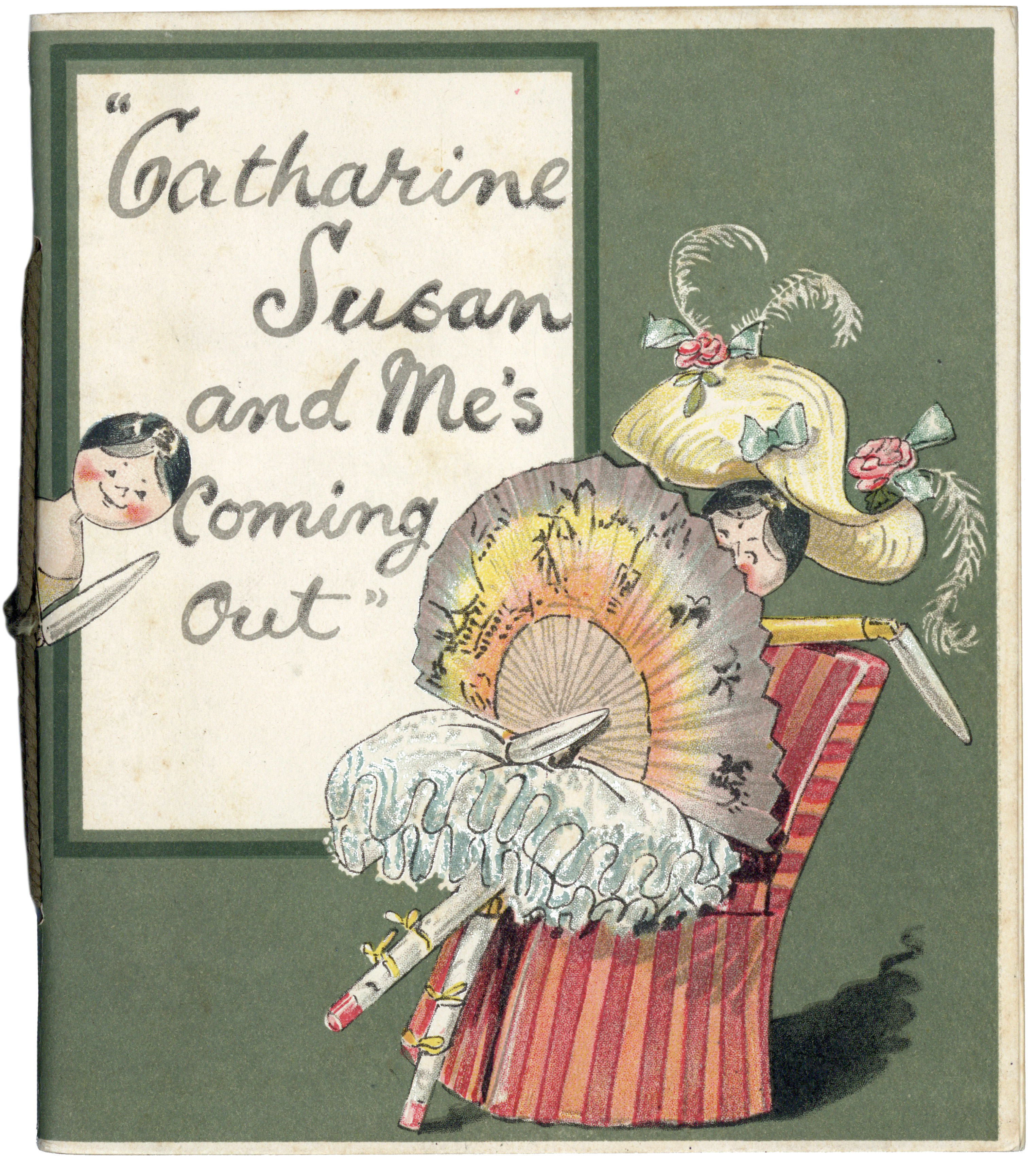
Front cover from ‘Catherine Susan and Me’s Coming Out’ by Kathleen Ainslie (Rare Books 823.912 AIN)

Front cover from ‘Catherine Susan and Me’s Coming Out’ by Kathleen Ainslie (Rare Books 823.912 AIN)

Kathleen Ainslie was an illustrator, active in the years 1900-1911. She is best-known for her series of children’s books based on jointed Dutch peg dolls which were popular during the 19th and early-20th centuries (Florence Kate Upton’s The Adventures of Two Dutch Dolls and a Golliwogg had been published in 1895.)

The first of two books that we have recently added to our Rare Books Collection is Catherine Susan and Me’s coming out, published in London by Castell Brothers Ltd. and in New York by Frederick A. Stokes, c.1906 (COPAC lists just one copy, at Cambridge University).

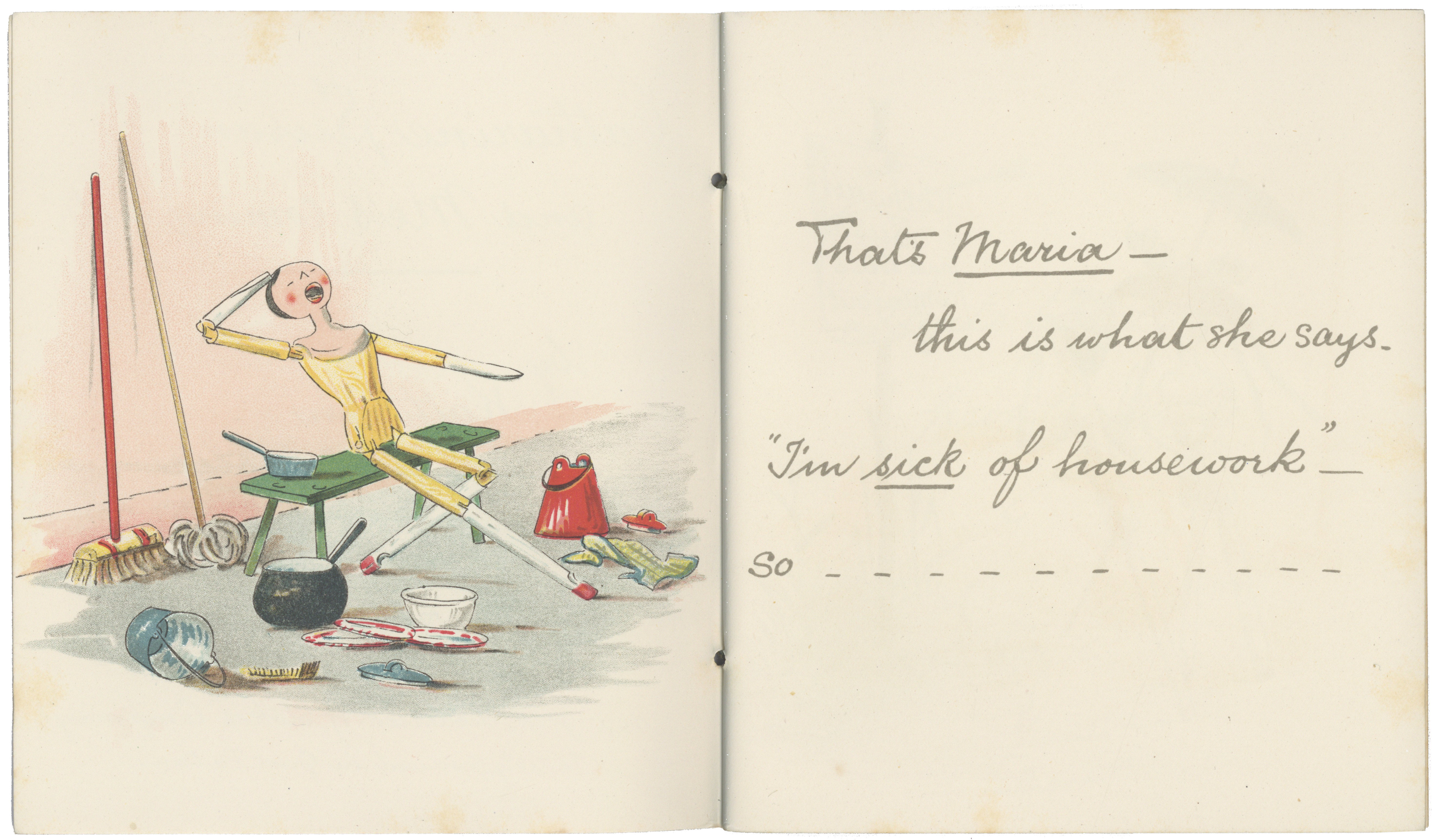
Catherine Susan and Maria are weary of household chores so they issue a public notice to announce that they are ‘coming out’. Their coming out is both in the sense of venturing out on a trip to London and of being presented to society.

Pages 1-2 from ‘Catherine Susan and Me’s Coming Out’ by Kathleen Ainslie (Rare Books 823.912 AIN)

Pages 1-2 from ‘Catherine Susan and Me’s Coming Out’ by Kathleen Ainslie (Rare Books 823.912 AIN)

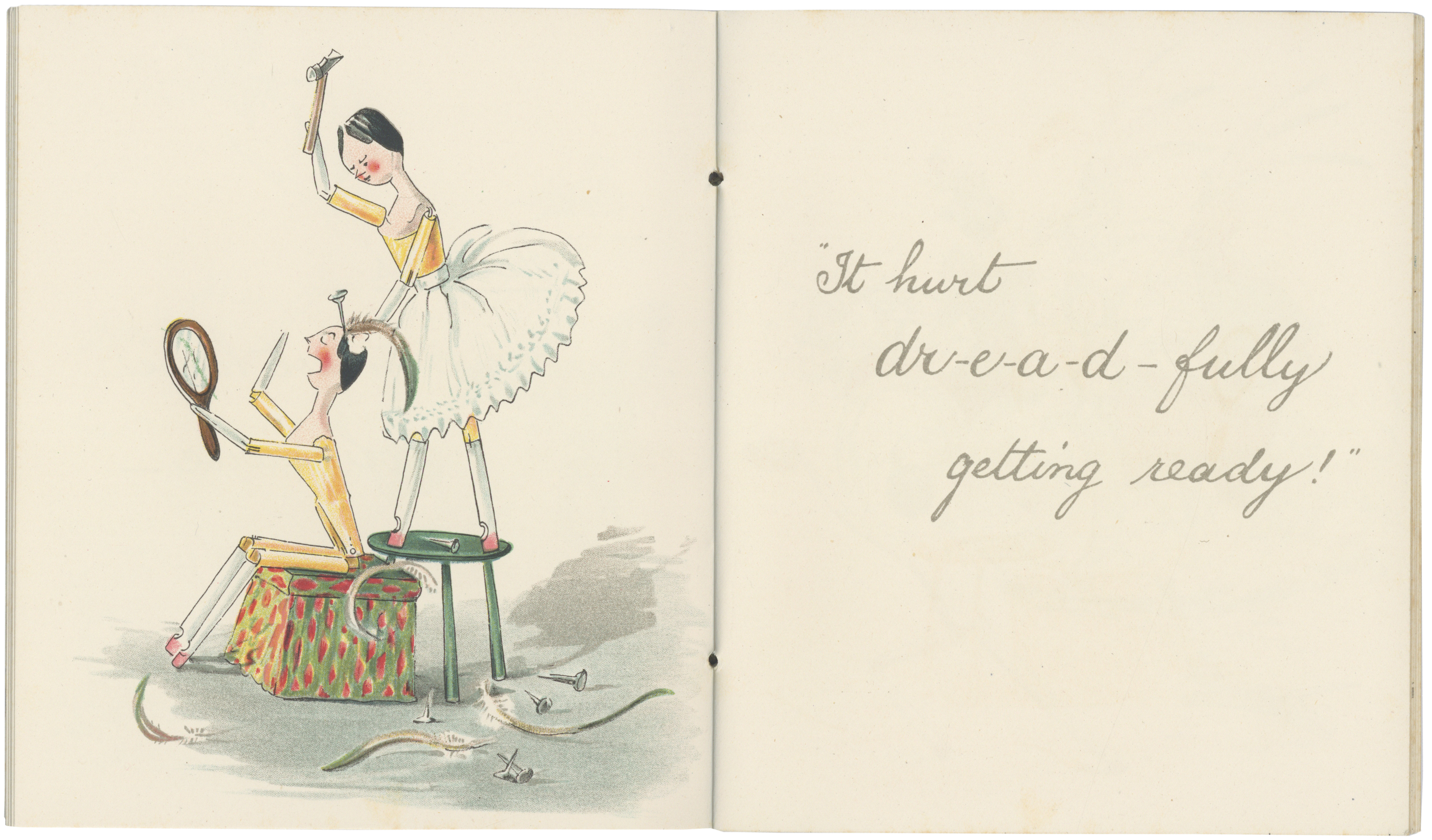
Of course, such a momentous occasion requires clothes and the dolls have nothing appropriate to wear. Dutch peg dolls were sold undressed and children made clothes for them from scraps of cloth. Towards the end of the 19th Century, the female silhouette changed rapidly and, certainly in the early 20th Century, styles, designs and fabrics from other cultures had become more influential in fashion. In the haberdashery store, the dolls argue about whether to wear muslin or white satin, both of which were considered stylish at the time. In the 1880s and 1890s, small hats ornamented with birds, feathers and artificial flowers were fashionable. The mischievous dolls chase hens and then secure the feathers to their heads with hammer and nails!

Pages 11-12 from ‘Catherine Susan and Me’s Coming Out’ by Kathleen Ainslie (Rare Books 823.912 AIN)

Pages 11-12 from ‘Catherine Susan and Me’s Coming Out’ by Kathleen Ainslie (Rare Books 823.912 AIN)

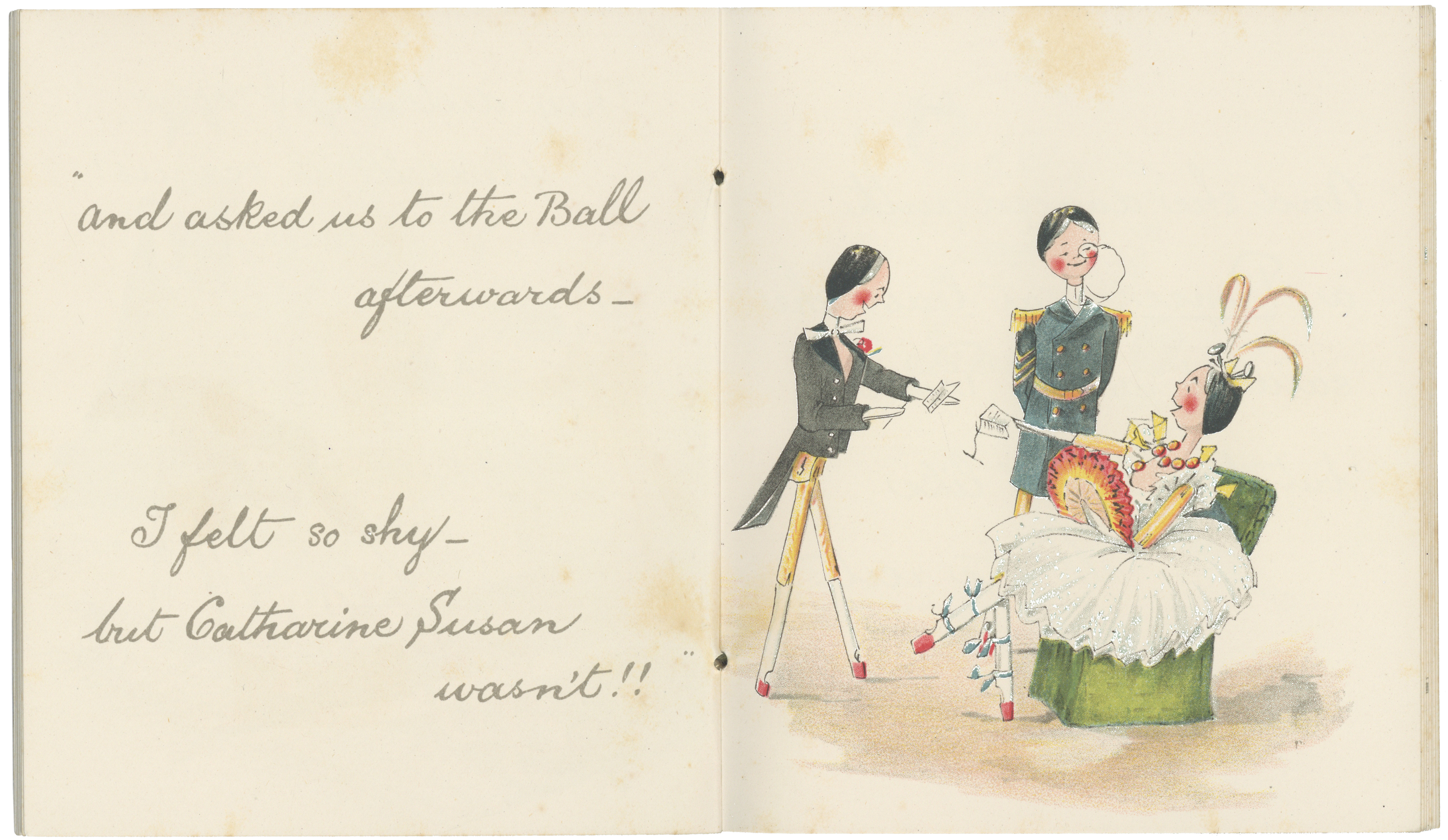
Catherine Susan and Maria squeeze into car and find a warm welcome in London. They are invited to attend a ball – in the 19th and early 20th centuries, numerous balls were held for members of ‘high society’. Debutante balls were occasions at which young women ‘came out’. Fans were essential: not just part of the outfit but a form of non-verbal communication conveying rejection (a closed fan), interest (an open fan) or excitement (a fluttering fan). Catherine Susan isn’t shy and sits with her fan open and, later, dances with a gentleman she tells everyone was a prince.

Pages 17-18 from ‘Catherine Susan and Me’s Coming Out’ by Kathleen Ainslie (Rare Books 823.912 AIN)

Pages 17-18 from ‘Catherine Susan and Me’s Coming Out’ by Kathleen Ainslie (Rare Books 823.912 AIN)

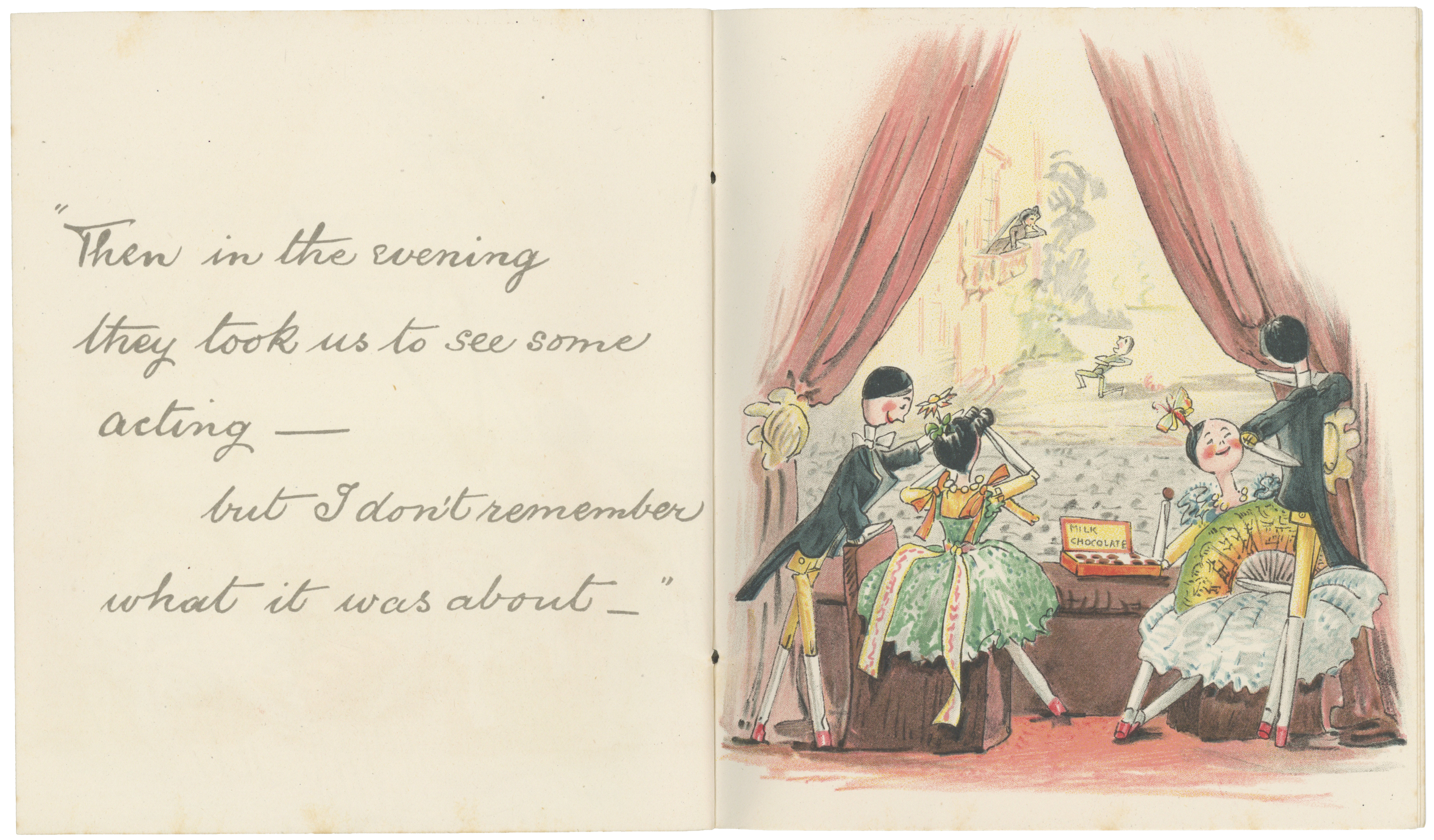
The dolls go to a polo match. Polo had been imported to England in the 1860s, from India, and its popularity grew in the late 19th and early 20th centuries. Although the dolls exclaim at how fast the horses gallop, British polo was slower and more methodical than the polo played in Manipur. They also try their hands at punting. Punting boats were first built for pleasure in England in the 1860s. Pleasure punting probably started on the River Thames but became increasingly popular in the early 1900s. In the evening, they go to the theatre – although Maria doesn’t remember what they saw, from the balcony scene, it looks as though it might have been Romeo and Juliet. Victorian productions of Shakespeare’s plays often prioritised ‘authentic’ costumes and scenery and to be a bona fide actor/actress, like Henry Irving (1838-1905) or Ellen Terry (1847-1928), was to be a great Shakespearean actor.

Pages 27-28 from ‘Catherine Susan and Me’s Coming Out’ by Kathleen Ainslie (Rare Books 823.912 AIN)

Pages 27-28 from ‘Catherine Susan and Me’s Coming Out’ by Kathleen Ainslie (Rare Books 823.912 AIN)

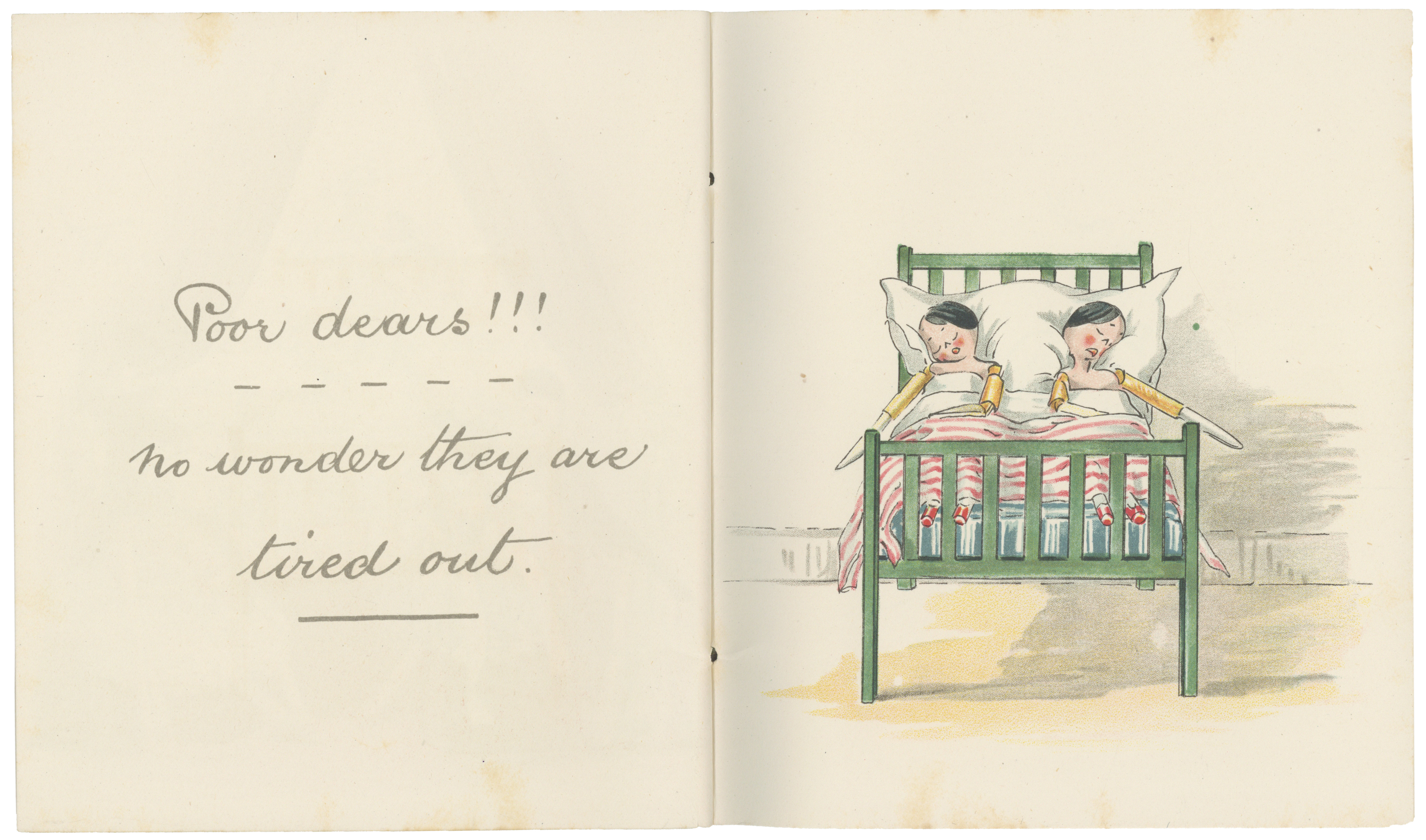
By the end of the book, the dolls are both exhausted.

Pages 29-30 from ‘Catherine Susan and Me’s Coming Out’ by Kathleen Ainslie (Rare Books 823.912 AIN)

Pages 29-30 from ‘Catherine Susan and Me’s Coming Out’ by Kathleen Ainslie (Rare Books 823.912 AIN)

The second book by Kathleen Ainslie that we have added to our Rare Books Collection is What I did, published c.1905 (COPAC lists copies held at the British Library, Manchester University and Oxford University.) Inside the front cover, someone has written in pencil “I hope you will like reading this book. It is very amusing”. This time, the protagonist is a naughty Dutch doll schoolboy and the book recounts his boarding school escapades: fagging (i.e. slaving) for an older boy called Tomkins; swimming; playing cricket; cavorting in the dormitory; and smoking.

Pages 25-26 from ‘What I Did’ by Cathleen Ainslie (Rare Books 823.912 AIN)

Pages 25-26 from ‘What I Did’ by Cathleen Ainslie (Rare Books 823.912 AIN)

We do not currently have any more of Kathleen Ainslie’s Dutch peg doll books but in other stories, Catherine Susan and her companion, Maria, celebrate holidays, take on odd jobs and even agitate for women’s suffrage (Votes for Catherine Susan and Me, 1910). Ainslie wrote about 25 books (the first being Me and Catherine Susan in 1903), as well as illustrating a series of six calendars (1906-1911). They all feature the same brand of humorous chromolithographed illustrations.

Mary Elizabeth Coleridge’s Handwritten Poetry Collection – December 2016

miscmss56-note

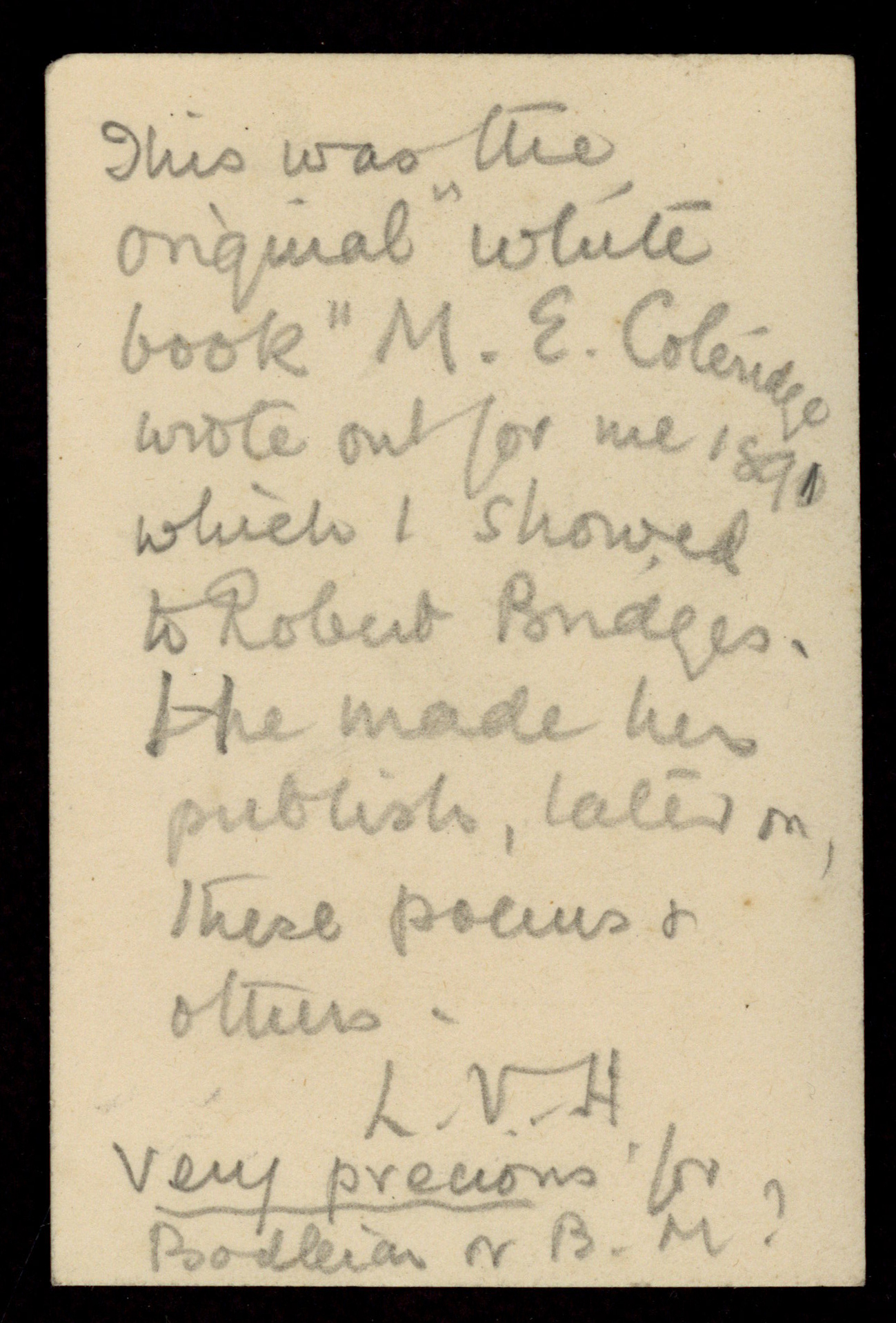
Note written by Lucy Violet Holdsworth to accompany Mary Coleridge’s handwritten collection of poems, later to be published as ‘Fancy’s Following’. (Miscellaneous Manuscripts 56)


Mary Elizabeth Coleridge was born on 23 September 1861, and she grew up surrounded by literary and artistic talent. She was the great-grand-niece of Romantic poet Samuel Taylor Coleridge and her family friends included Alfred, Lord Tennyson, Anthony Trollope, John Ruskin, and Robert Browning. During her lifetime, she became best known for her essays, reviews and her five published novels. These included ‘The King with Two Faces’ which she received the substantial sum of £900 for in 1897.

However, posthumously it is her poetry which has taken centre stage. Our first Treasure of the Month for 2017 is a fair copy of Mary Coleridge’s first poetry collection, ‘Fancy’s Following’, which was handwritten by the poet for her friend, Lucy Violet Holdsworth.

miscmss56-spread2

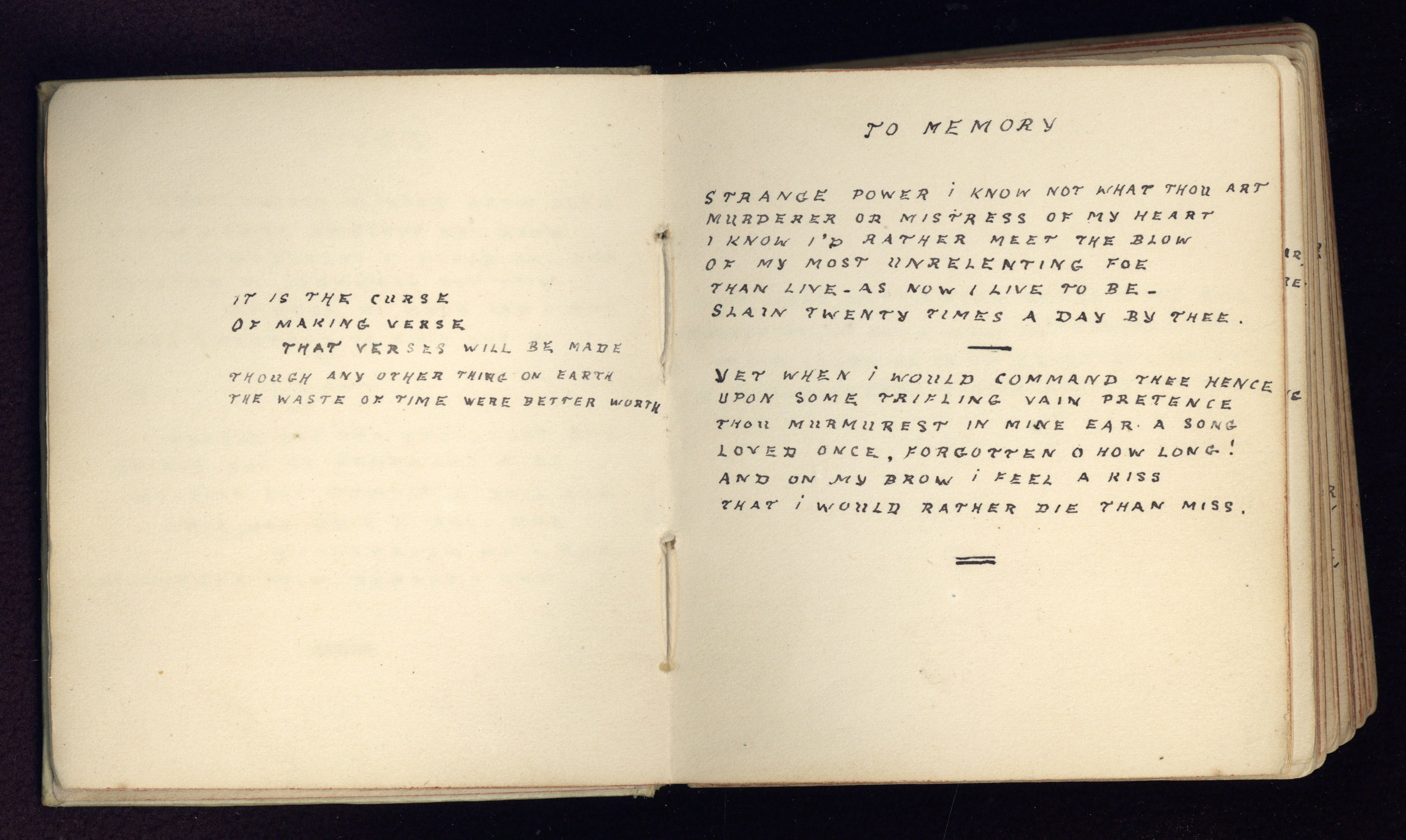
Page taken from Mary Coleridge’s handwritten collection of poems, later to be published as ‘Fancy’s Following’. (Miscellaneous Manuscripts. 56)


miscmss56-spread1

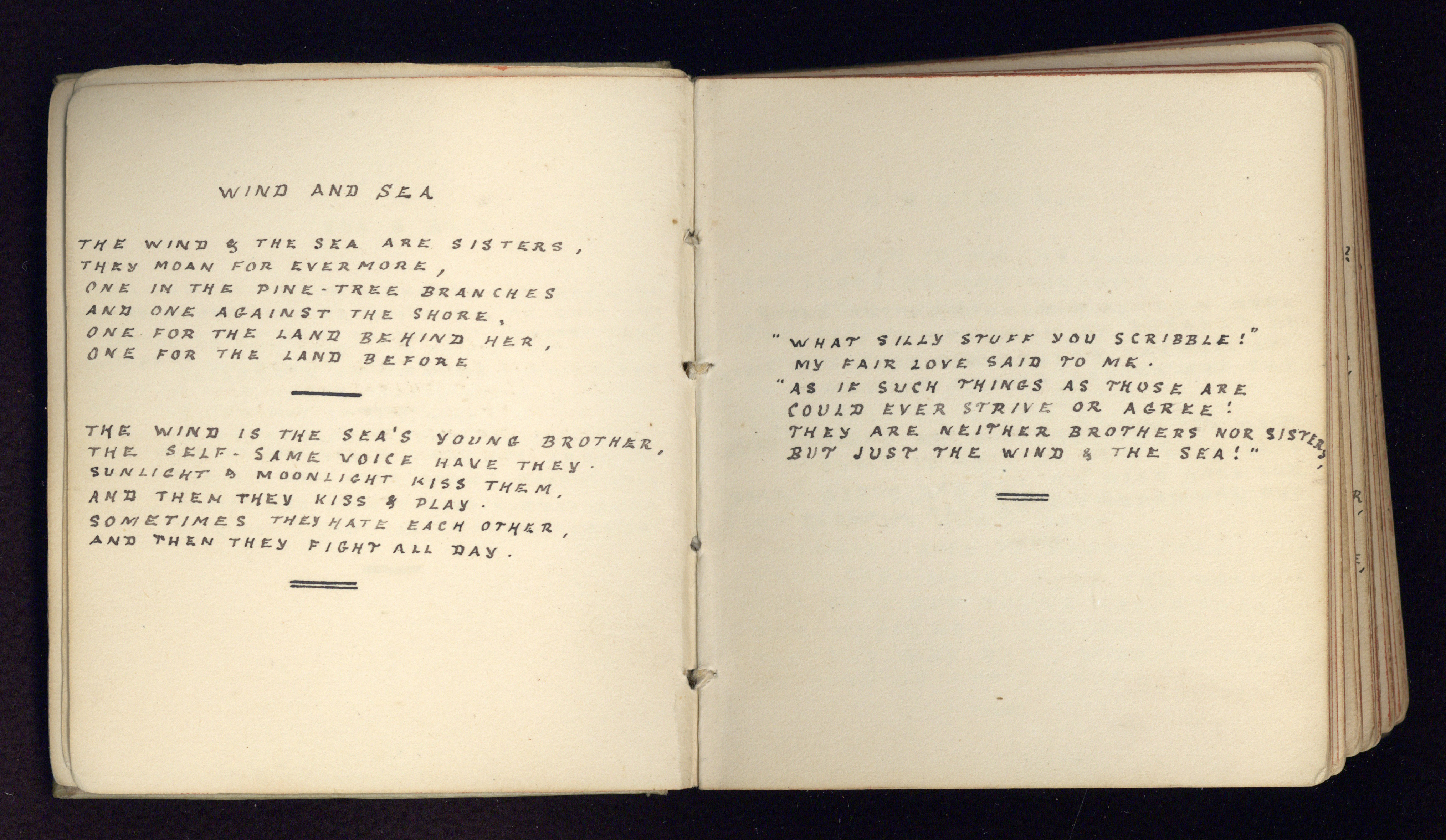
Page taken from Mary Coleridge’s handwritten collection of poems, later to be published as ‘Fancy’s Following’. (Miscellaneous Manuscripts. 56)

The copy was made before it was later issued privately by Daniel Press in 1896, and in fact, it was this small white book which led to the publication. Holdsworth’s cousin, Monica Bridges (nee. Waterhouse) was married to the Robert Seymour Bridges, Britain’s poet laureate from 1913 – 1930. Holdsworth planned for the book to be left out for Bridges to take notice and when he did, he asked to meet Mary to encourage her to publish her work. Coleridge agreed, but with the stipulation that it was published under the pseudonym ‘Anodos’ in order not to disgrace her family name by acknowledging she was the author. It wasn’t until four months after her death in 1907 that a book of two hundred and thirty-seven of her poems was finally published under her real name, and by that time, it proved so popular that it was reprinted four times in just six months.

op-119-no-3-2

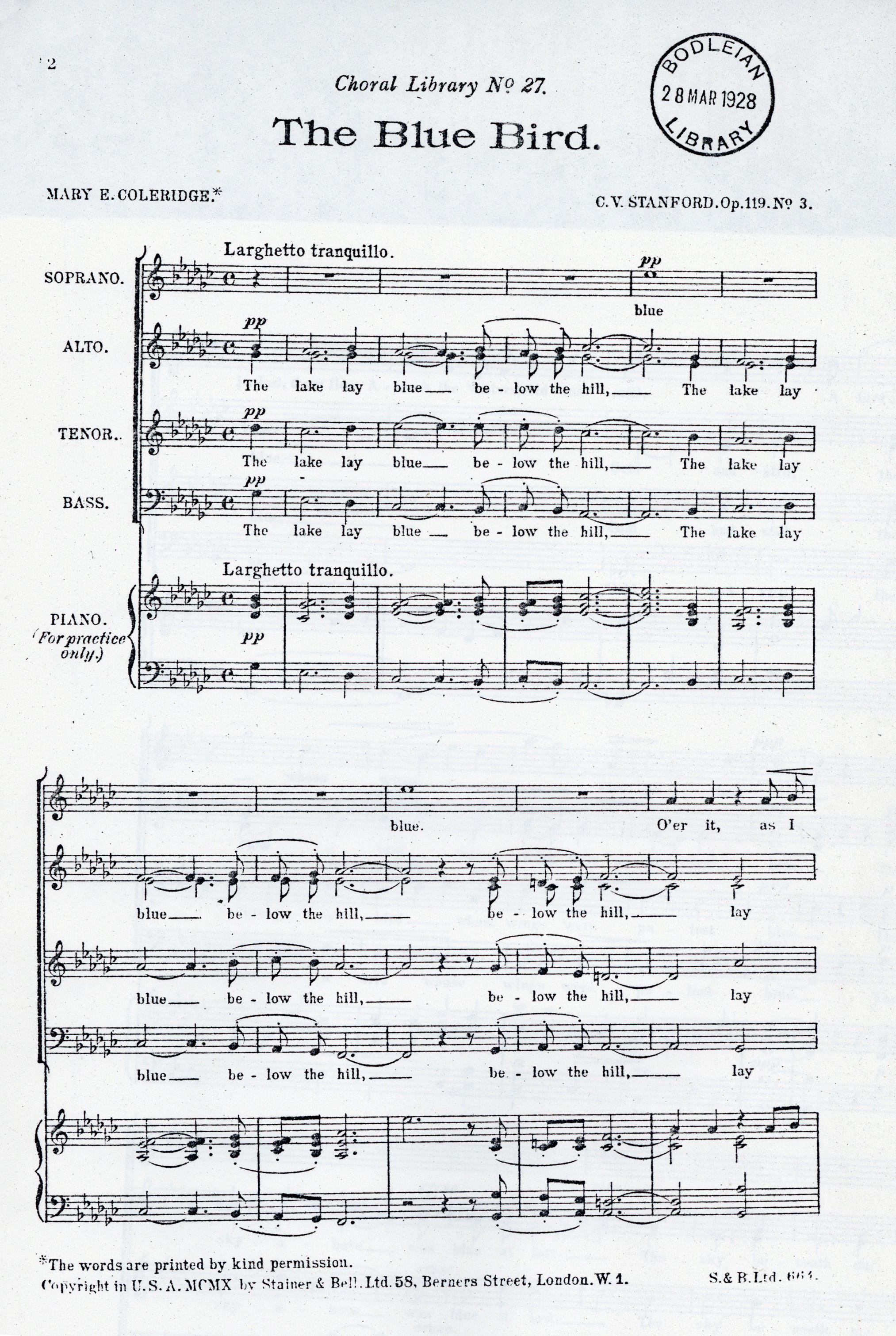
The score for ‘The Blue Bird’, a poem by Mary Coleridge set to Music by Charles Villiers Stanford. (Stanford Collection, Op.119.3.)


‘A Blue Bird’, which appeared in ‘Fancy’s Following’, was one of eight of Mary Coleridge’s poems which was set to music by Charles Villiers Stanford. The score can be found in our Stanford (Charles Villiers) Collection, and you can listen to a performance of it below.

Suffragette banners on the march!

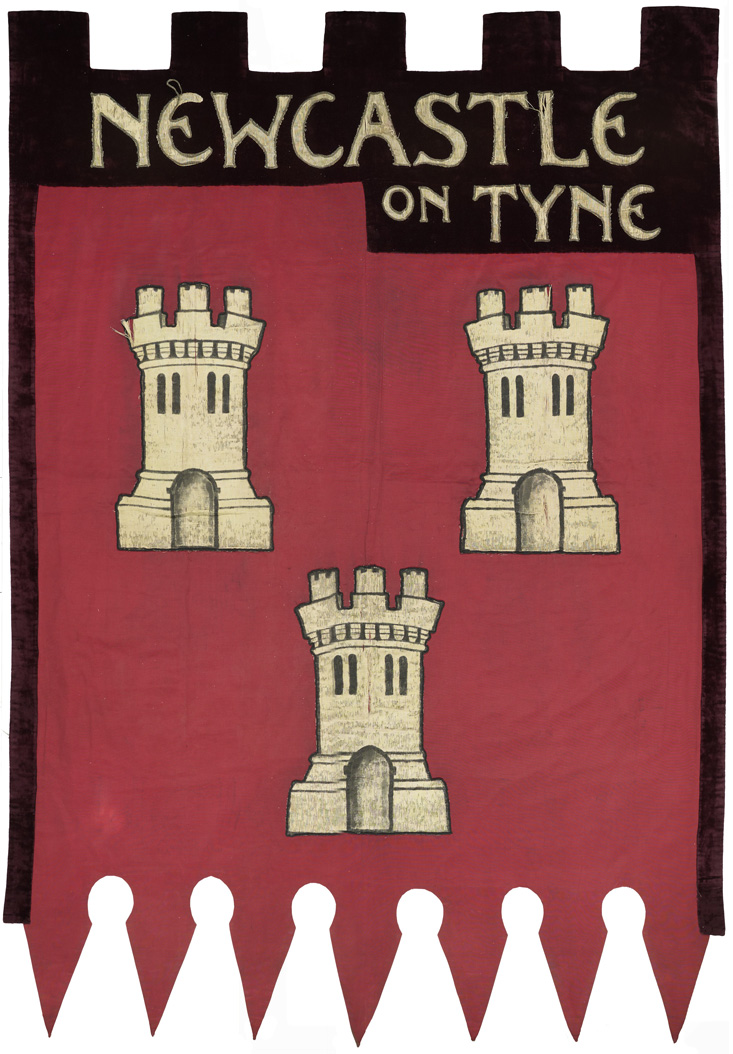
We recently came across a piece of historic film on the British Film Institute website, showing a Suffragette march through Newcastle in 1909. Clearly on view near the beginning of the film is the banner of the Newcastle Women’s Suffrage Society. A second banner can be seen later in the film.

View the video from the British Film Institute here.

One of these banners may be the one made by Newcastle’s first female GP and suffragist Dr. Ethel Williams in about 1905. These banners were carried on national demonstrations, not only in Newcastle, but also in London.

Ethel William’s suffragette banner (Item reference: GB 186 EWL/3/5) is part of our Ethel Williams Archive, which you can find more information on here.

banner300dpi

14th December – 17th Century Cake Bread Recipe

#ChristmasCountdown

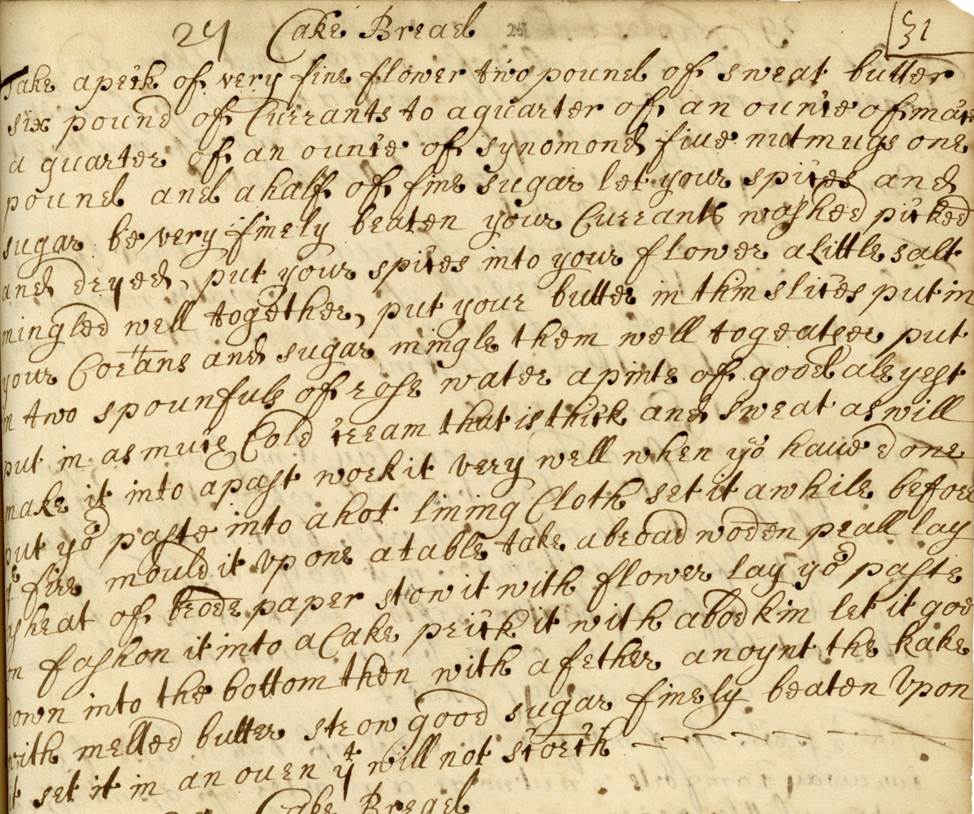
Cake Bread recipe

Cake Bread recipe from Jane Lorraine’s recipe book (Miscellaneous Manuscripts 5)

Image and transcription (below) are taken from a page of Jane Lorraine’s recipe book. The recipe book contains lots of different recipe and was written in the 17th century by a woman called Jane Lorraine.

Jane Lorraine lived in Northumberland. She is likely to have been the wife of Nicholas Loraine and probably a member of the Fenwick family (John James Fenwick in 1882 opened the shop Fenwicks which exists on a larger scale down Northumberland Street, Newcastle today).

The recipe book is a collaboration between many different people. We can see that many different people contributed their recipes to it as there are mentions of different individuals within it (a total of 67 people), in addition to six different handwriting being identified within the text. Jane Lorraine put together the recipes by different individuals into one big recipe book.

27. Cake Bread
Take a peck of very fine flower two pound of sweat butter
six pound of currants to a quarter of an ounce of mace
a quarter of an ounce of synomond five nutmugs one
pound and a half of fine sugar let your spices and
sugar be very finely beaten your currants washed picked
and dryed put your spices into your flower a little salt
mingled well together, put your butter in thin slices put in
your Corants and sugar mingle them well togeather put
in two spounfuls of rose water a pinte of good ale yest
put in as much Cold cream that is thick and sweat as will
make it into a past work it very well when you have done
put your paste into a hot lining Cloth set it a while before
the fire mould it upon a table take a broad wooden peall lay
a sheat of broade paper strow it with flower lay your paste
on fashon it into a Cake prick it with a bodkin let it goe
down into the bottom then with a fether anoynt the kake
with melted butter strow good sugar finely beaten upon
it set it in an oven that will not scorch

This recipe book is part of Miscellaneous Manscripts

2nd December – 1892 Kate Greenaway Almanack

#ChristmasCountdown

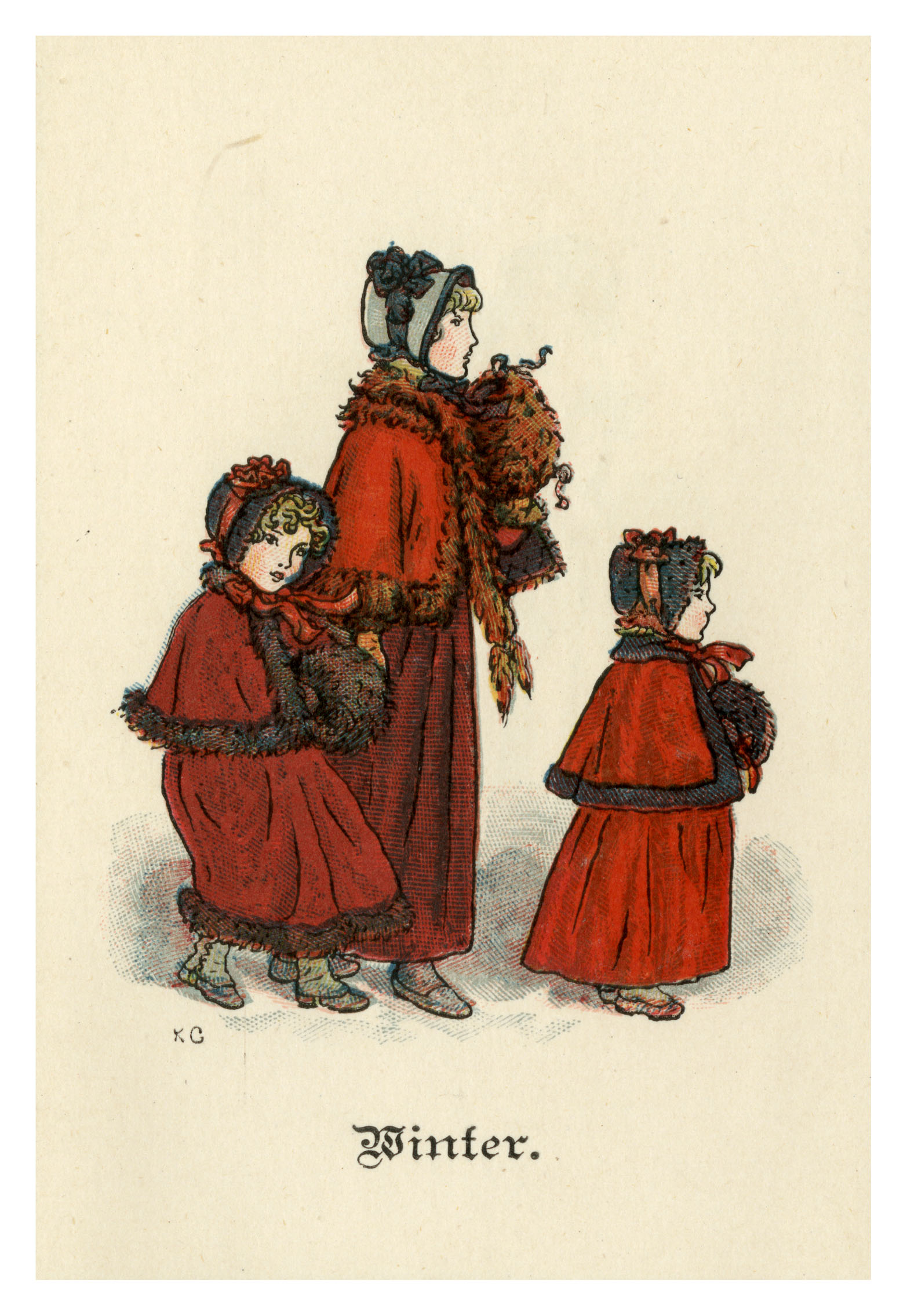
'Winter' illustration

‘Winter’ illustration from Kate Greenaway’s 1892 Almanack (030 GRE)

Beautiful Winter illustration taken from Kate Greenaway’s Almanack for 1892 – Engraved by Edmund Evans – Published by G. Routledge & Sons

Catherine Greenaway (1846 – 1901), known as Kate Greenaway, was an English children’s book illustrator and writer. Her most popular books are Under the Window (1879)Kate Greenaway’s Birthday Book for Children (1880), Mother Goose; or, The Old Nursery Rhymes (1881), and A Painting Book (1884).

Her almanacs ran from 1883 up until 1897, with no 1896 issue being published. Each almanacks included a Jan-Dec calendar, beautifully drawn illustrations and short poems. Her almanacs were sold throughout America, England, Germany and France and were produced with different variations and in different languages.

Kate Greenaway’s Almanacks are from the 19th Century Collection. Find her 1892 almanack and others here.

Shakespeare at the old Theatre Royal – May 2016

Shakespeare performed by Children

May 2016 marks the 400th anniversary of Shakespeare’s death. Newcastle has played host to the bard’s plays ever since – in more recent times, the Royal Shakespeare Company performed almost annually at the Theatre Royal by the Royal Shakespeare Company from 1977. Unfortunately, they will not be returning in 2016.

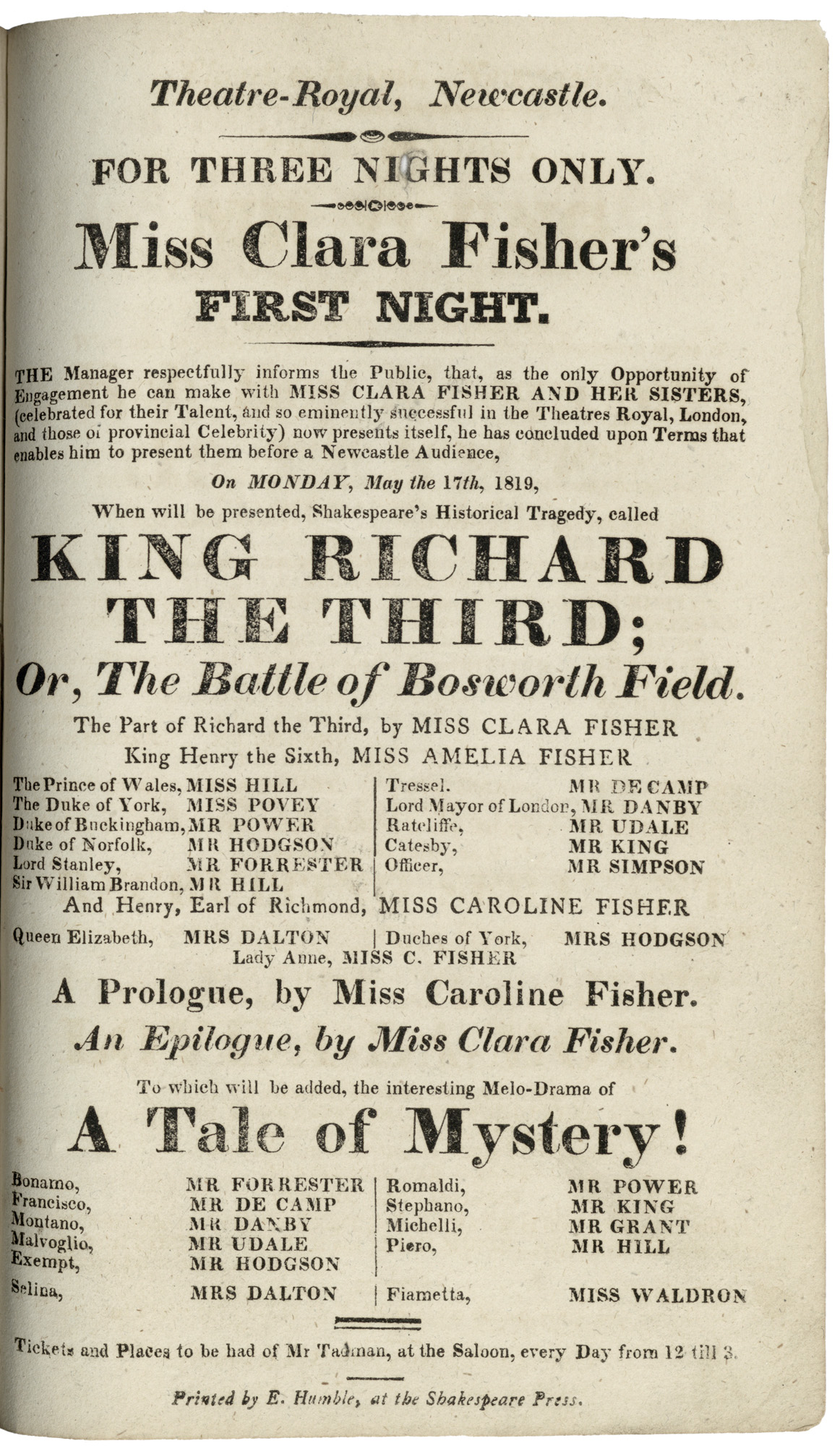
Our Theatre Royal Playbills (RB 792 (4282) – NEW) feature many notices for performances of Shakespeare at the old Theatre Royal on Mosley Street between 1770 and 1820, including this one by a Georgian/Victorian theatre sensation and her two sisters.

King Richard The Third playbilll (RB 792 (4282)–NEW).

King Richard The Third playbilll (RB 792 (4282)–NEW).

Clara Fisher (b.14 July 1811, London, died 12 November 1898, Jersey, U.S.) was an Anglo-American actress who inspired an enormous following in the United States. She made her stage debut in 1817, at the age of six, in a children’s adaptation of David Garrick’s Lilliput at the Drury Lane Theatre in London. Her performance in that and in excerpts from Richard III captivated the audience. She then began a 10-year period of touring up and down Great Britain, winning popular acclaim in a variety of child’s and adult’s roles.

By the time she and her sisters Amelia and Caroline started their three-night engagement at the Newcastle Theatre Royal on 17 May 1819, Clara would have been only seven years old. On the opening night, she played the leading role in  ‘Shakespeare’s Historical Tragedy, called KING RICHARD THE THIRD; Or, The Battle of Bosworth Field. Clara was known for her ‘breeches parts’ (men’s roles), including Hamlet on at least one occasion. At the Theatre Royal, her sister Amelia was Henry VI, and Henry, Earl of Richmond, was played by Caroline Fisher.

On the second night, she played Shylock in The Merchant of Venice, and then, on a lighter note, performed ‘A COMIC SONG. (IN CHARACTER)’.

The third, and supposedly final, night was Shakespeare-free.

Such was the success of the Fisher girls’ engagement that they were held over for an extra performance on Friday 21 May, 1819, performing ‘some of the best scenes from the most popular Plays . . .’. This included acts four and five of King Richard the Third, with the sisters reprising their ‘breeches parts’ of the previous Monday.

Fisher went to the United States in 1827 and made her debut in New York City that same year. She was a sensation – her name was given to babies, racehorses, stagecoaches, and steamboats – and she was regarded as America’s leading stage actress. Her last performance was in Baltimore, Maryland, in 1889.

This performance, and about 240 others, is promoted by notices in one volume of our Theatre Royal Playbills collection, a bound collection of ‘posters’ for the ‘old’ Newcastle Theatre Royal in Mosley Street. The bills were printed in 1819 and 1820, and are typical of the early nineteenth century –  i.e. very small compared to the modern-day concept of ‘posters’ –  and utilising revolutionary display typefaces which had begun to be manufactured in about 1810 for advertising.

Fittingly, the bill was printed by Edward Humble, at the Shakespeare Press. Humble was a respected local printer, and a proprietor of the County Durham Advertiser.

If you are interested in coming into the reading room to see playbill and others from the collection…

# This item is held within a volume of our Theatre Royal Playbills (Ref Code RB792(4282) NEW.

# You can place your order by linking to our request form. The reference code and title will be RB 792 (4282) – NEW – Theatre Royal Playbills.’

The Turbina Steamship and a mystery in the archives … – March 2016

I’ve always found this letter fascinating.  If anyone fancies doing some further research on this letter, do let us know what your results are!

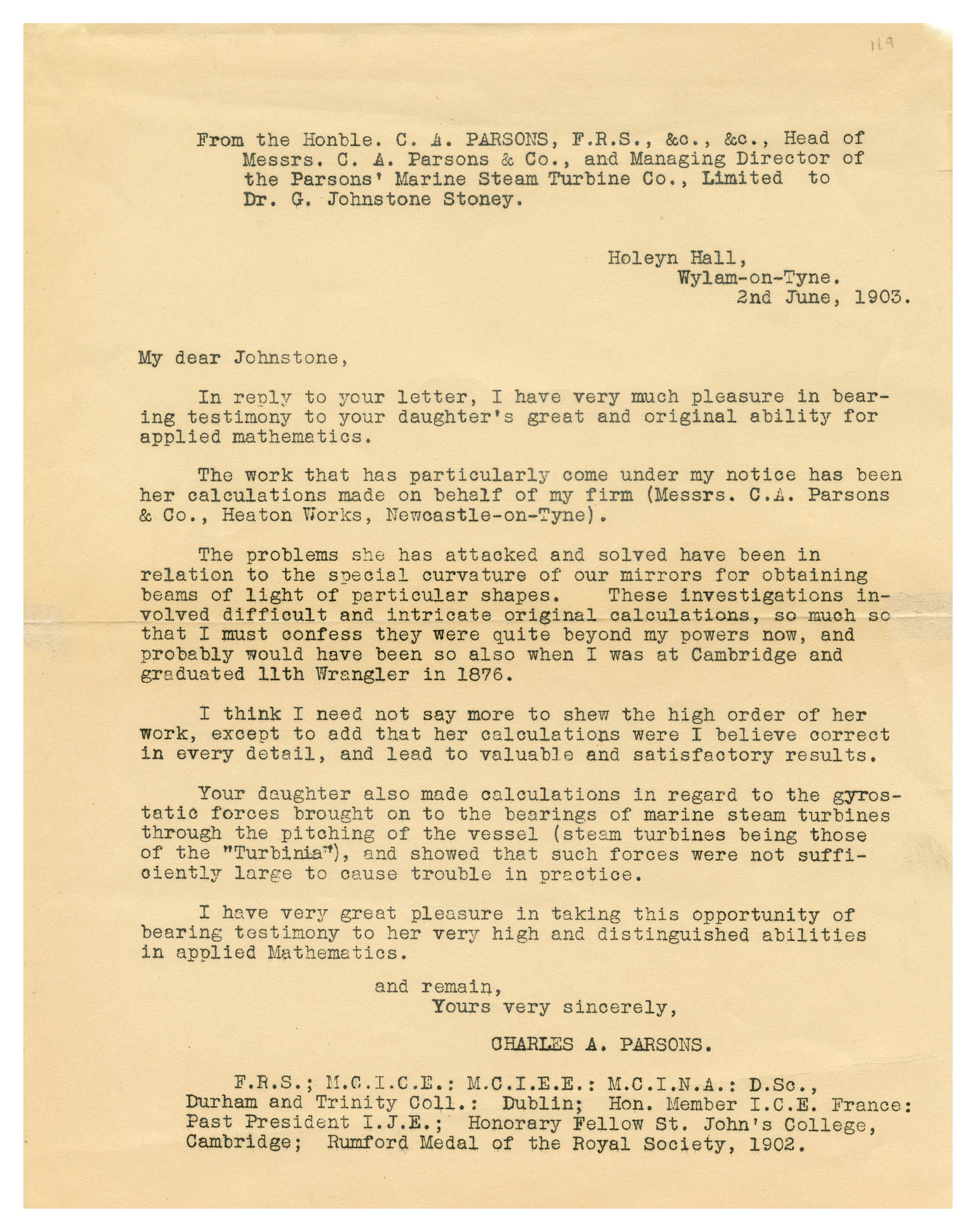
This letter of reference is an intriguing insight into the mathematics behind the construction of Newcastle’s famous ‘Turbinia’ steamship, which can still be seen in the Discovery Museum in Newcastle upon Tyne.  Who is this (female) mathematician, who seems to get little mention in the history of the Turbinia?  Perhaps as a sign of the times, this letter, which appears to be a reference, is addressed to her father and does not refer personally to her by name at all.  Dr G Johnstone Stoney had three daughters (who led fascinating lives in their own right in the fields of science and medicine), I would love to know which one came to Newcastle and made such an important contribution to this part of North East history.

GB186/MSA/2/22

GB186/MSA/2/22

The Turbina was an experimental vessel built by Charles Parsons to demonstrate the benefits of his revolutionary new design of steam turbines.  Built by the firm of Brown and Hood, based at Wallsend on Tyne it started to undergo speed trials in 1896 and the results were pretty spectacular.  By December an average speed of 29.6 knots had been reached over the measured mile whilst, with further improved propellers, 32.76 knots was achieved by April of the following year.  Eventually, maximum speeds of over 34 knots were recorded.  At the time it was easily the fastest ship in the world.

Obviously with a great eye for publicity, Parsons caused quite a stir when the Turbina appeared at Queen Victoria’s Diamond Jubilee Naval Review at Spithead, apparently racing between the two lines of navy ships and steaming up and down in front of the crowd.  Popular legend had her appearance as unannounced; it would seem that Parsons did have permission, although perhaps the organisers did not expect such a dramatic entry!

If you are interested in coming into the reading room to see this letter …
# This item is held within the Manuscript Album (Ref Code GB186/MSA).
# You can place your order by linking to our request form. The reference code and title will be ‘GB186/MSA/2/22 Letter from Charles Algernon Parsons to George Johnstone Stoney concerning mathematical work undertaken by one of Stoney’s daughters.’

To see the ship (and its turbines!) and much more …
The Discovery Museum is close to Newcastle upon Tyne rail station and has many gems https://discoverymuseum.org.uk/

Thanks to the Discovery Museum for providing the backstory of the Turbina, http://www.webcitation.org/5xujimKGb

Making the Archive Public #3 – Women’s Work: Oral Histories of the Women’s Institute

This is #3 of the ‘Making the Archive Public‘ series, where we are showcasing examples from this project, using the rich archive and rare book collections on offer to researchers in the North East.

Women’s Work: Oral Histories of the Women’s Institute

Visit: http://winortheast.omeka.net/

This website was created by Jess Kadow and Shelby Derbyshire as part of the Making the Archives Public: Digital Skills, Research and Public Engagement project at Newcastle University.

The Women’s Work project is a collaboration organised between Newcastle University, the Northumberland Federation of Women’s Institutes and The Northumberland Archives. The project consisted of recording and archiving the oral histories of the North-Eastern WI community, particularly its oldest members, as a means of preserving the tradition and heritage of the Women’s Institute.

The diversity of each woman’s experience with the WI, the changes they have witnessed, the friendships they have made and the activities they have participated in have given this project a great level of depth. This exhibition hopes to showcase its best elements.