Sophia Leggett is an MLitt English Literature student at Newcastle University, specialising in Contemporary Children’s Literature. Throughout the year, she has also been working in the Special Collections department at the Robinson Library, helping to catalogue newly acquired rare books.
As she reaches the end of her time with us, we have asked Sophia to take a look at one of the hidden gems within our archive collection and tell you (and us!) a little bit more …
Taking inspiration from the three letters in the Manuscript Album collection written either to or by the great author, playwright and diarist Fanny Burney, Sophia looks a little deeper into the life and correspondence of this fascinating writer.
The Letters of Fanny Burney, held by Newcastle University, and available to consult in the Special Collections Reading Room, Robinson Library.
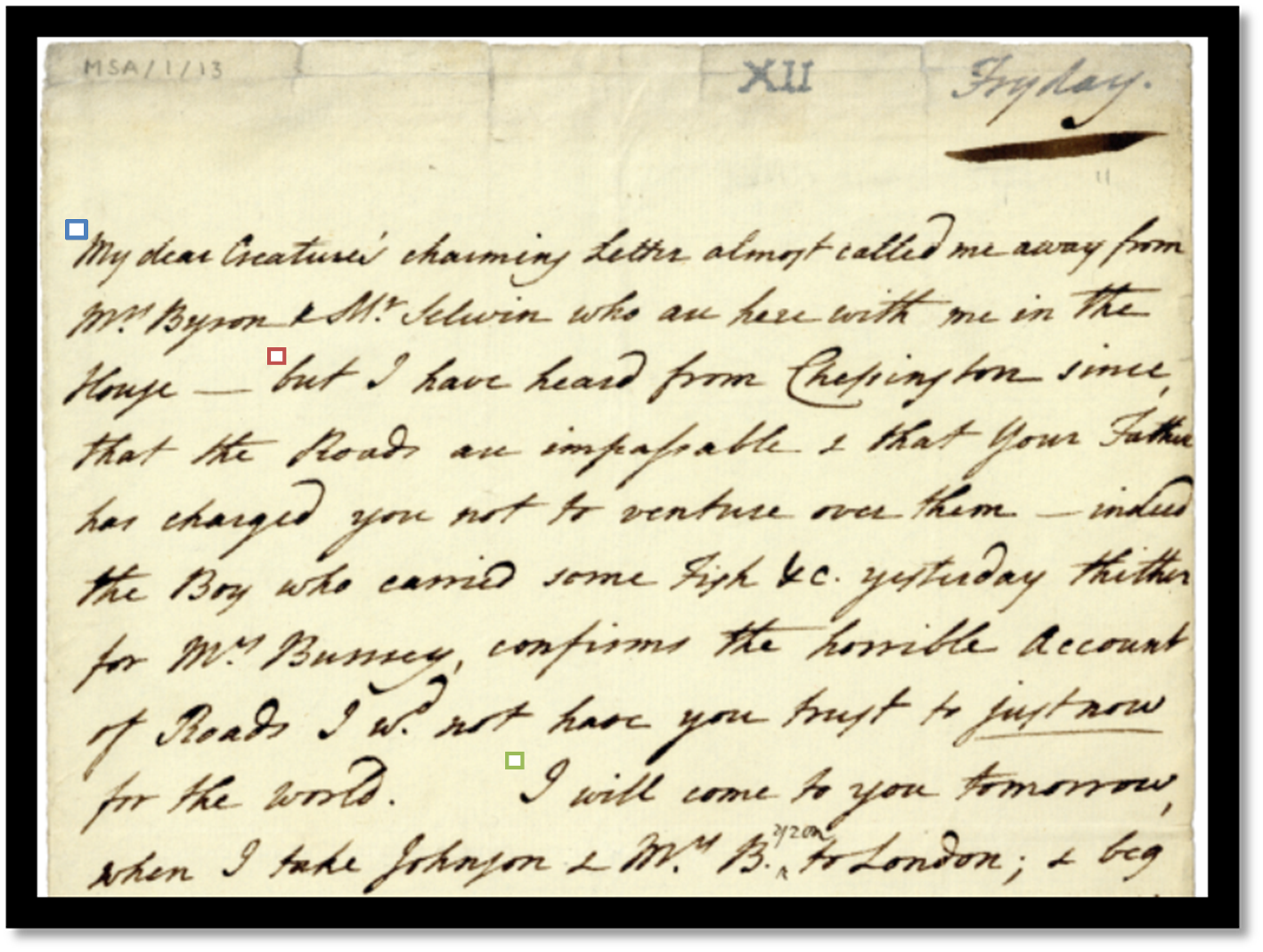
Reference ID: GB186-MSA-1-13 Letter From Hester Lynch Thrale To Fanny Burney
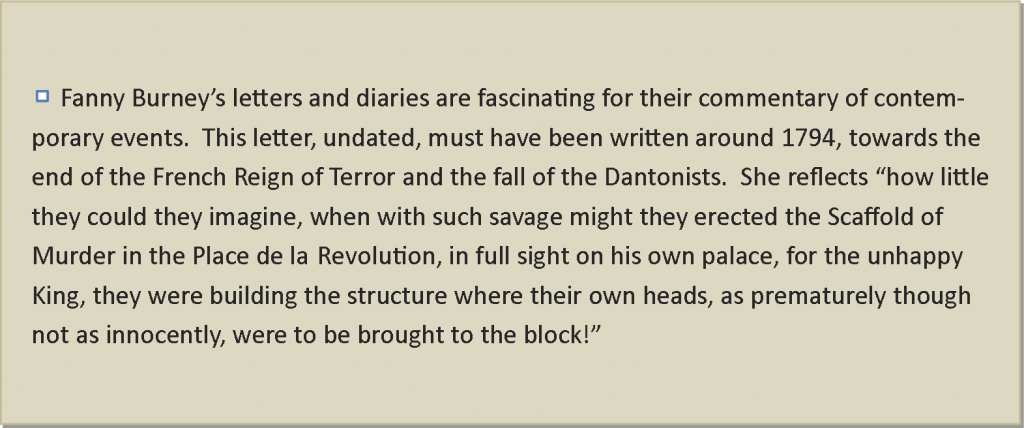
Reference ID: GB186-MSA-1-15 Letter From Fanny Burney To Dr Burney
Frances Burney (1752-1840) was arguably the most successful female novelist of the eighteenth century; her first novel Evelina (1778) was a publishing sensation and follow-up novels Cecilia (1782) and Camilla (1796) were considered among the best fiction of the time and were much admired by her contemporary Jane Austen. Further than this, Burney was also a keen playwright, and also wrote many letters and journals to her family and friends. Burney composed many of these letters and journals with a keen awareness of their future historical significance, giving a fascinating insight into many aspects of eighteenth century life including family, politics, court, war and pathology. Living to the incredible age of 87, Burney lived a long and fascinating life.
Family Life
Frances (‘Fanny’) Burney was born the third of six children to Charles and Esther Sleepe Burney. Her father, a musicologist, came from humble beginnings but increased his social standing through hard work and study. Her mother died when she was ten years old, and her father was remarried 5 years later to Elizabeth Allen, bringing three step-siblings into the family, and later two half-siblings. Her large family were a talented group of musicians, writers, scholars, geographers and artists. The whole family shared a habit of vividly ‘journalising’ experiences for each other, and between them left behind more than 10,000 items of correspondence. Burney’s family clearly nurtured her artistic talent, even though she did not learn to read until she was 8 and never received formal schooling. Burney was also nurtured by her father’s circle of friends, particularly as she acted as her father’s secretary as he worked on a history of music. Charles’ circle included the lexicographer Samuel Johnson, the poet Christopher Smart, the painter Joshua Reynolds, the actor David Garrick and a brewer Henry Thrale and his wife, Hester, a diarist.
Thrale Relationship
One of the letters held by Newcastle University is a letter from Hester Thrale, a friend of the family. Thrale seems to have had a very interesting relationship with the Burney family. She was allegedly strangely judgemental of them, torn between her love and admiration of the Burneys and contempt for their humble origins, referring to them as ‘a very low race of mortals’. Burney’s first novel, Evelina altered this relationship. It was initially published anonymously, but knowledge of her authorship soon broke out and Thrale saw the advantage of an acquaintance to Burney and demanded an introduction, inviting Burney to social gatherings and gaining her access to literary circles. Upon Thrale’s scandalous remarriage to musician Piozzi in 1784, Burney, in outrage, ceased correspondence with her, though they later had a partial reconciliation in 1815 in Bath.
MSA-1-13 Letter From Hester Lynch Thrale To Fanny Burney – Part 1
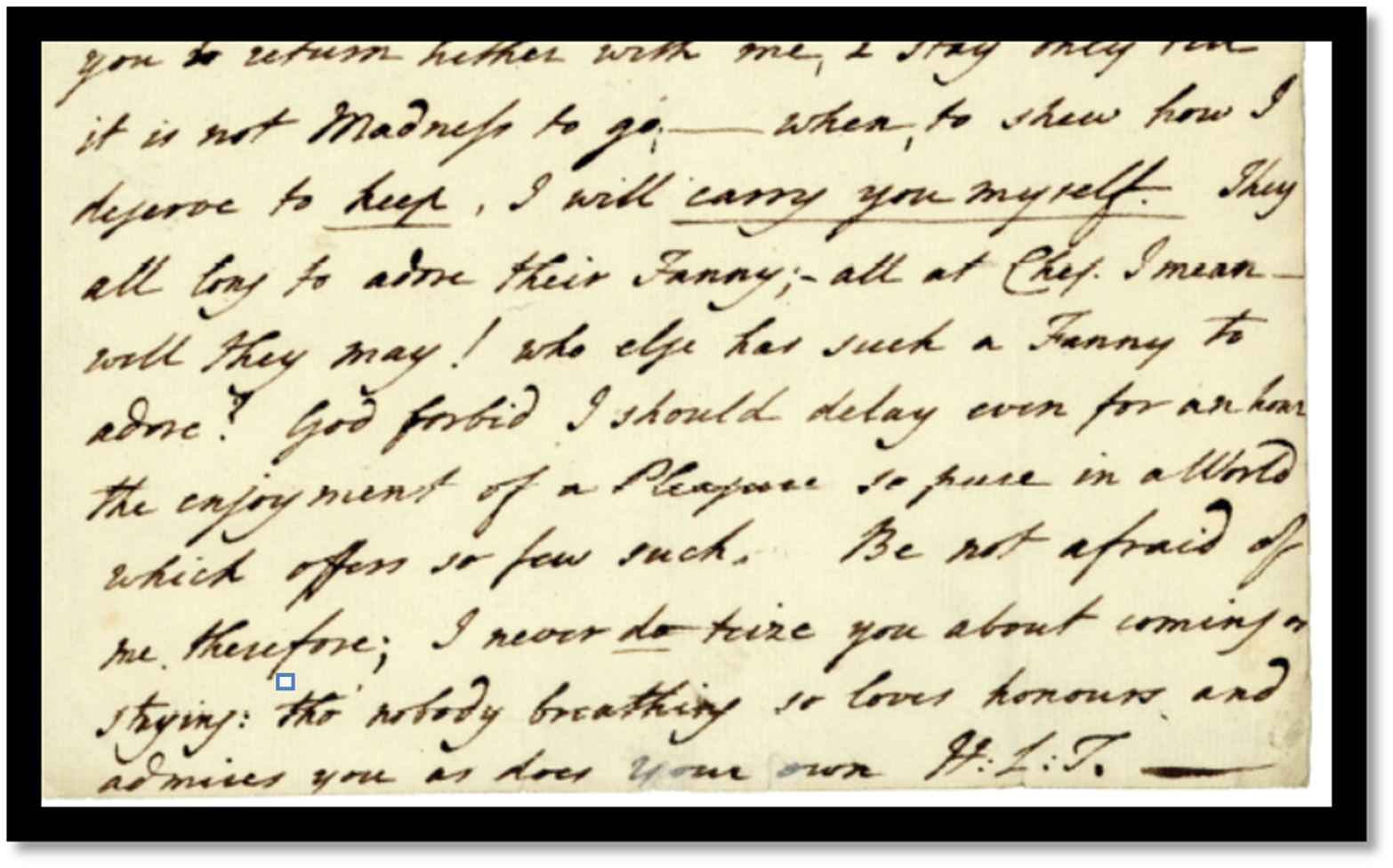
MSA-1-13 Letter From Hester Lynch Thrale To Fanny Burney – Part 2
Court Life
At 35, Burney was reluctantly appointed Keeper of the Robes to Queen Charlotte at the Court of George III, after the Queen wished for a new dresser who could supply her with intelligent conversation. This was meant to be a position for life, but Burney hated it and managed to leave after five years due to ill health. Despite this, Burney left on good terms with the Royal Family, and proceeded to stay in touch. She left with a pension of £100 – half of her £200 salary. Whilst at court, Burney vividly documented Court lifestyle, providing an intriguing insight into court lifestyle as well as King George III’s ‘madness’.
France
Following the French Revolution, in 1793 at the age of 41, Burney met Alexandre d’Arblay, an exiled French General, and soon after married him following a secret courtship. Due to poor relations with France following the Revolution, this was frowned upon particularly by Burney’s father, who tried to dissuade her from an imprudent match, though Burney clearly ignored him. D’Arblay was not allowed to work in England due to his nationality, and so Burney became the breadwinner of the family with her royal pension and her writing.
In 1802 Burney and her son joined D’Arblay in France, where he had returned to claim what was left of his estate and joined the French Royalist Guard. The family were then trapped in France by the breakdown of the Peace Amiens and the outbreak of war between France and England. In 1815, Burney fled from France to Belgium, and upon discovering that her husband was ill and wounded at Tréves (more than a hundred miles away from her), Burney set out to find him and take him back to England, documenting her travels through a war-torn country.
During her time in France, Burney’s journals and letters provide a fascinating insight into French society, politics and war. She also provides an intriguing pathological account of then-modern medicine. In 1811 at her home in Paris, she underwent a mastectomy for breast cancer without anaesthetic, writing a very detailed and graphic account of this operation.
MSA-1-15 Letter From Fanny Burney To Dr Charles Burney
The Manuscript Album is a collection of letters, purchased or given to Newcastle University Library over the last century. Although collected with no particular subject focus, each letter was chosen for its historical significance, and the album includes letters by Horatio Nelson, A.E. Houseman, Isambard Kingdom Brunel, Garibaldi, and Mary Shelly to name but a few, as well as by people of local significance like Thomas Bewick, Richard Grainger, and George Stephenson. The Manuscript Album contains three letters which were written either to or by the great author, playwright and diarist Fanny Burney.
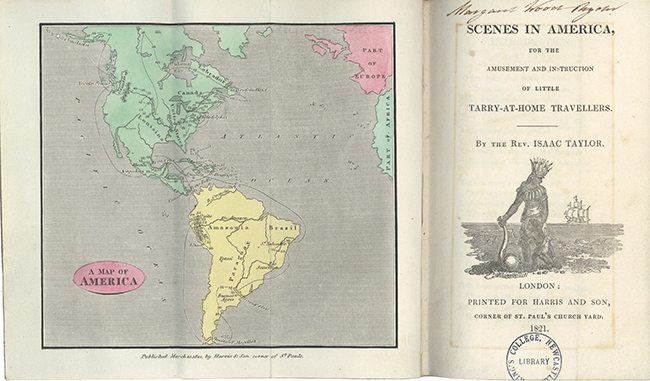
A map of America and frontispiece from Scenes in America, for the Amusement and Instruction of Little Tarry-at-Home Travellers(Rare Books, RB375 9 TAY)
‘ONCE again your friend a hearing
Claims from you, my little miss;
With a volume neat appearing,
Full of pictures, see, ‘tis this.
Long ago he gave a promise
O’er America to roam;
Travelling far and wide, tho’ from his
House ne’er moving, still at home.
Yet o’er many a volume poring,
Such as you could hardly read;
Distant realms and climes exploring,
Your enquiring minds to feed.
He has travelled thro’ and thro’ them,
Often wearied with his toil,
That at ease you here might view them,
Gath’ring knowledge all the while….’
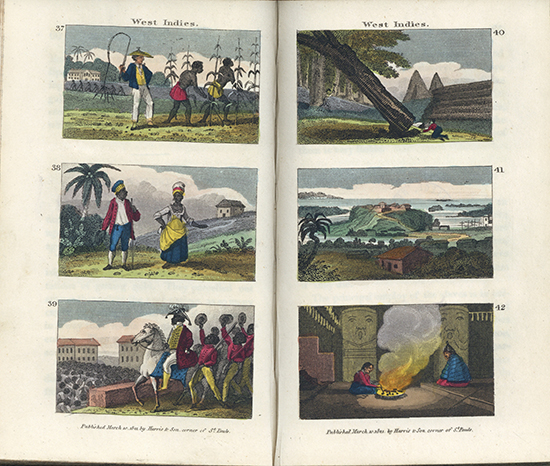
These verses open Isaac Taylor’s Scenes in America, for the Amusement and Instruction of Little Tarry-at-Home Travellers (1821). Scenes in America was part of the wider Scenes series, ‘a series of armchair traveller books for children’.Other titles included Scenes in Europe (1818) and Scenes in Africa (1820), as well as several other titles.
The books in the Scenes series follow a standard pattern: ‘three small, coloured engravings appear on each page of illustrations, and they are linked by captions to the scenes which they represent. As for the text, it is rather light in tone, mixing prose and verse with the instruction which was its putative purpose’.
Isaac Taylor was a man of many talents. He was a talented engraver and artist, a popular Church pastor, an ardent educationalist, and a successful children’s writer. Taylor’s educationalist outlook was both a major part of his life and his literary work. As deacon of an Independent congregation in Lavenham, Suffolk, Taylor had founded a Sunday School, where his ‘successive workrooms doubled as schoolrooms for his own children and later for those of neighbours too, Taylor giving instruction from his engraving stool as he worked’. When the family moved to Colchester, ‘he began a series of monthly lectures for young people, delivered free of charge in the parlour of his own house; these proved extremely popular and the programme continued for several years’.
Taylor’s belief in education and the stimulation of young minds can be seen as a driving force in his production of the Scenes series. However, Taylor’s moral and educational instruction could also take on a more overt form. Taylor was an ardent opponent of slavery and the slave trade. Scenes in Africa had spoken out against slavery, and Scenes in America reinforced those sentiments. Taylor was keen to explain to his young readers that, although they may have won a victory by abolishing the slave trade in the British Empire, they had not yet won the war against slavery:
‘Although the slave trade is happily put an end to, so that no more can be brought over; yet there are many thousand negroes who are still slaves. It has made no difference to them, except that their masters are not so oppressive to them, as they cannot easily replace them if they die’. P.61
The moral decay slavery caused in those who took part in it was evident the ‘masters’ who only cared for their profit. This moral dimension was of course part of Taylor’s moral education of his readers. But he also mentioned the physical brutality and callousness of slavers: ‘To every party there is an overseer, who stalks among them with a long whip, ready to lash any who do not work fast enough to please him’. The images this passage conjured would no doubt have made an impact on his young audience.
As J.R Oldfield has suggested, ‘most children’s books published between 1750 and 1850 were unashamedly moralistic and concerned, above all, with inculcating a compassionate humanitarianism’. Taylor’s abolitionist message in his books certainly fits this wider trend, but it also within the more specific trend of attempting to create an anti-slavery consensus ‘through the education of young and impressionable minds’.
Yet Scenes in America was far more than a moral instruction book. It was meant to evoke a sense of wonder in the reader, of this faraway world and the flora and fauna it contained. There were strange animals found there, like the ‘dreadful serpent’ the rattlesnake, the ‘passionate’ hummingbird, and, ‘glowing with celestial light’, the firefly. He showed the reader societies of people with different customs and ways of life. Taylor devotes sections to several difficult indigenous groups, and the engravings provide tantalising glimpses of these exotic lands to stimulate the minds of child readers (the accuracy of these descriptions and engravings, is of course, another matter). No doubt some of these are sensationalised or included for dramatic effect, such as the section ‘Sacrificing a Child on its Mother’s Grave’. Yet there are also sections on ‘Hunting the Buffalo on the Ice’, ‘Indian Sagacity’, and ‘the Pipe of Peace’. For those interested in studying European perceptions of indigenous Americans, Taylor’s work provides an example of an attempt to show the cultural diversity of Native American societies, while at the same time never quite seeing them as worthy or as equal as his own.
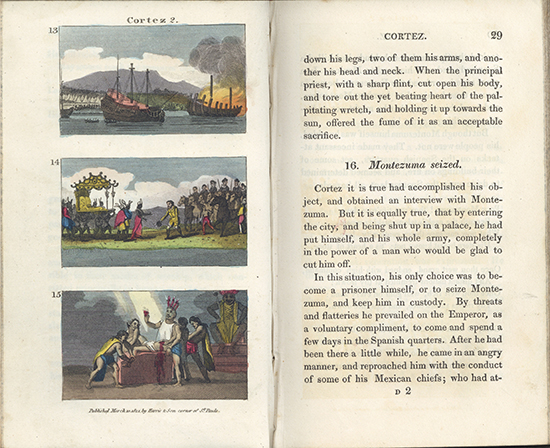
Pages 28 and 29 from Scenes in America, for the Amusement and Instruction of Little Tarry-at-Home Travellers(Rare Books, RB375 9 TAY)
Scenes in America was also an abridged history of European involvement in the New World. The narratives of the Spanish conquistadors of course provided an exciting tale for his readers, from Columbus’ contact to the conquests of Hernan Cortes and Francisco Pizarro. Indeed, the history of what we would call Latin America takes up approximately half of the book, so Scenes is in no way a glorified account of English and British settlement. But North American history was also discussed, with sections ranging in content from religious emigration to the New World, to the American War of Independence, with sections on Canada and, as we have seen, the West Indies.
Pages 68 and 69 from Scenes in America, for the Amusement and Instruction of Little Tarry-at-Home Travellers(Rare Books, RB375 9 TAY)
It wasn’t just the grander narratives of history that Taylor included. He discussed the daily lives of the ordinary settlers and tried to portray a sense of their daily lives, with sections such as ‘New Settlers First Log House’, and ‘Cultivating Tobacco’.
The fruits of Taylor’s educational mission can be seen in the literary and artistic abilities of his own children. Indeed, the family have been labelled as ‘amongst the most famous and prolific children’s authors and illustrators of the early nineteenth century’.
Ann and Jane Taylor were successful children’s poets, with Jane in particular achieving prominence. Her works include the still famous classic (and often anonymised) Twinkle Twinkle Little Star). Jane was also well regarded as an essayist and literary critic. We hold several of Jane’s works here in Special Collections, including Original Poems for Infant Minds and The Memoirs, Correspondence, and Poetical Remains of Jane Taylor, edited by her brother Isaac.
Isaac himself was known as a writer on theology, philosophy, and history. He was also a talented artist and engraver (indeed, he collaborated with his father to produce the illustrations for Scenes in America). We hold a number of his works here in Special Collections. These include The Natural History of Enthusiasm, the work that made his name, and Home Education, a work clearly influenced by his own experiences.
Jefferys Taylor, the youngest child, also gained prominence as a children’s writer, producing numerous works of varied character over a number of years. Like his father’s writings, Jefferys’ works ‘were overtly educational in purpose’, but their message was delivered through fictional or adventurous settings. Like his siblings, he also engraved some of the illustrations for his own books.
One of the verses in the conclusion contains a pearl of Taylor’s wisdom that is perhaps even more relevant today than then, and that we would all do well to remember:
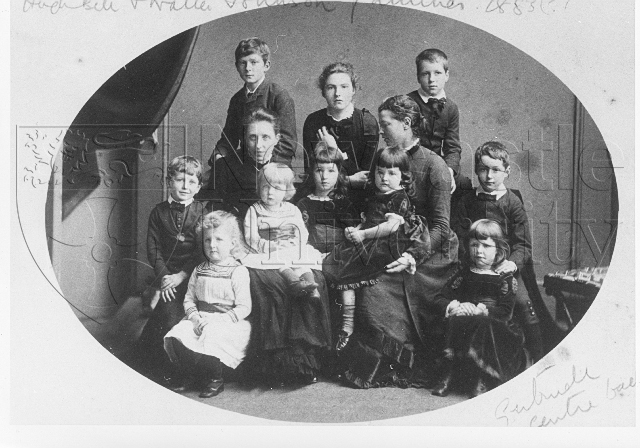
Gertrude Margaret Lowthian Bell was born on 14 July 1868 at Washington New Hall in County Durham, the daughter of Sir Hugh Bell and Mary Shield, and the granddaughter of eminent industrialist, Sir Isaac Lowthian Bell. Elected Lord Mayor of Newcastle in 1875, Sir Isaac owned several iron, steel and aluminium works and factories throughout the country, and was also the director of the North Eastern Railway and the Forth Bridge Company. His success meant that the Bells were, at the time of Gertrude’s birth, the sixth richest family in England. In 1870, Hugh, Mary and Gertrude left Washington Hall to set up their own home at Red Barns in Redcar. Gertrude’s younger brother Maurice was born here in 1871, but the family’s happiness was short-lived, as Gertrude’s mother Mary died shortly after his birth. In 1876, Sir Hugh married the Parisian Florence Oliffe, to whom Gertrude would gradually become very close.
For a young woman in the late nineteenth century, Gertrude’s education was extremely privileged. From the ages of fifteen to seventeen, she attended the exclusive Queen’s College School for girls in London’s Harley Street, established in 1848, and the first institution in Britain to offer the opportunity for girls to gain academic qualifications. In 1886, shortly before turning eighteen, Gertrude became one of the first women to be admitted to Oxford Universityand, just two years later in June 1888, she became the first woman to gain a first class honours in Modern History from Oxford.
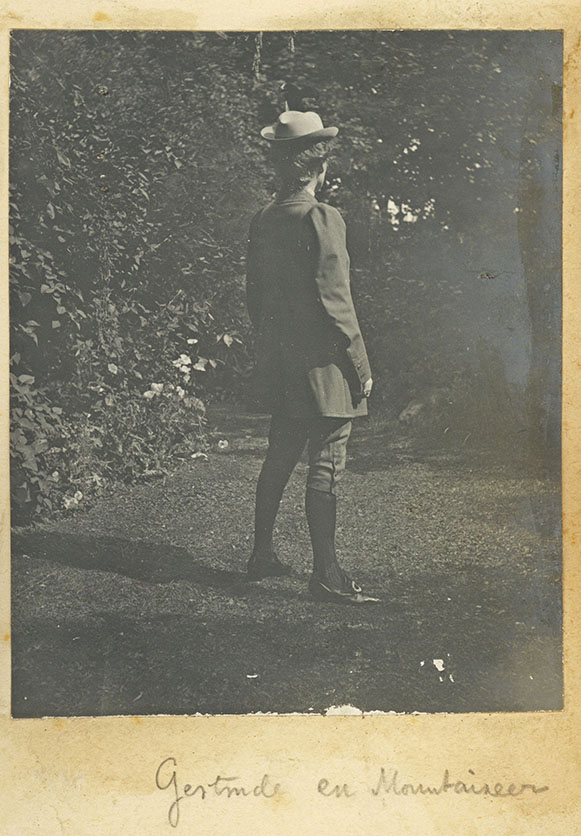
Photograph of Gertrude Bell dressed in mountaineering clothing titled ‘Gertrude en Mountaineer. [Trevelyan (Charles Philips) Archive, CPT/PA/1]
In May 1892, Gertrude embarked on her first major voyage to Persia (now Iran), beginning a lifetime of travel that encompassed two round-the-world trips (1897–8 and 1902–3), and numerous journeys to the Middle East, which continued until her death in Baghdad (1926). She was enchanted by the Persian surroundings and people, writing in a letter to her cousin Horace Marshall, ‘Isn’t it all charmingly like the Arabian Nights! but that is the charm of it all and it has none of it changed.’ In December 1897, Gertrude set off with her brother Maurice on the first of two round the world journeys, and from 1902–3 she undertook her second round the world trip with her half-brother Hugo. During this period (1899–1904), Gertrude also became a keen mountaineer, climbing regularly in the Alps, and summiting the Meije, Mont Blanc, and the Matterhorn. In 1901, Gertrude became the first person to summit seven of the nine peaks of the Engelhörner range in Switzerland, and in recognition of her achievement one of the peaks, Gertrudespitze, was named after her.
Archaeology, Photography and Cartography
Archaeological Work
Gertrude’s interest in archaeology was initially sparked on a holiday in Greece (1899), during which she first met David Hogarth – an established archaeologist, and a key figure in Gertrude’s later experiences during the First World War. Her fascination with archaeology grew during her journey to Jerusalem (1900), but was cemented with her journey through the Syrian desert to Asia Minor (1904-5), during which she explored the Binbirkilise, a region in the modern Karaman province in Turkey that is known for its multiple Byzantine church ruins.
Gertrude’s account of her travels from Syria through to Asia Minor was published as the popular travelogue The Desert and the Sown (1907) . She returned to the same region with archaeologist Sir William Ramsay (April 1907), to continue work on inscriptions in the ancient churches that she had first discovered towards the end of her previous visit. Gertrude and Sir William Ramsay published their findings in the co-authored book The Thousand and One Churches (1909). She returned to the East again in 1909 without Ramsay, to explore the Roman and Byzantine fortresses and churches along the banks of the Euphrates in Mesopotamia. Her primary objective of this trip was to reach and explore the large castle of Ukhaidir, which lay on the west bank of the river some 120 miles south-west of Baghdad at Ukhaidir, and of which there was no detailed historical or archaeological record in existence. Once she reached the palace, in March 1909, she spent the limited time she had (four days) sketching the huge structure.
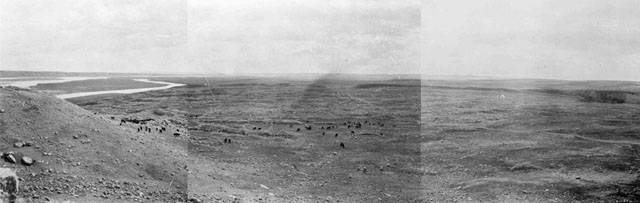
During these journeys, Gertrude became a skilled photographer, documenting her travels and archaeological explorations through her images as well as through her writing. She became a member of the Royal Photographic Society, which enabled her to develop her films professionally. Gertrude carried two cameras with her at all times, and took panoramic shots of entire horizons by combining multiple photographs (see image on left).
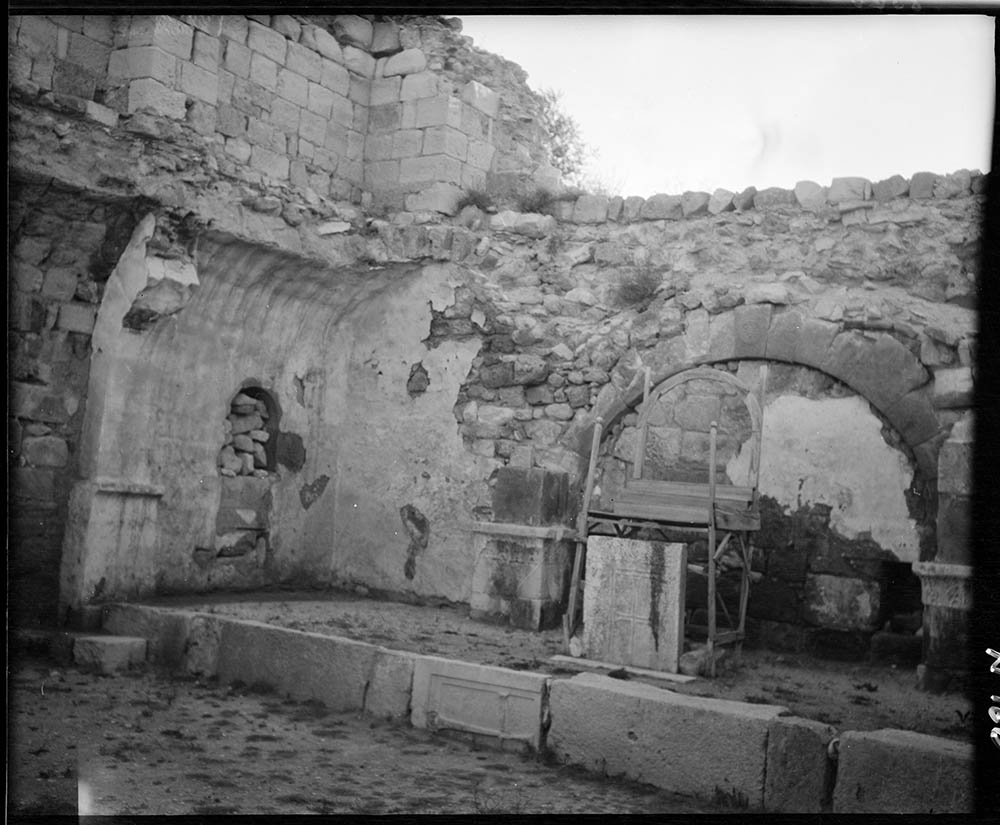
The photographs she took during her excavations of various ancient sites, such as image shown the left left, are invaluable to archaeological knowledge and research, particularly because many of the sites have since been looted or vandalised.
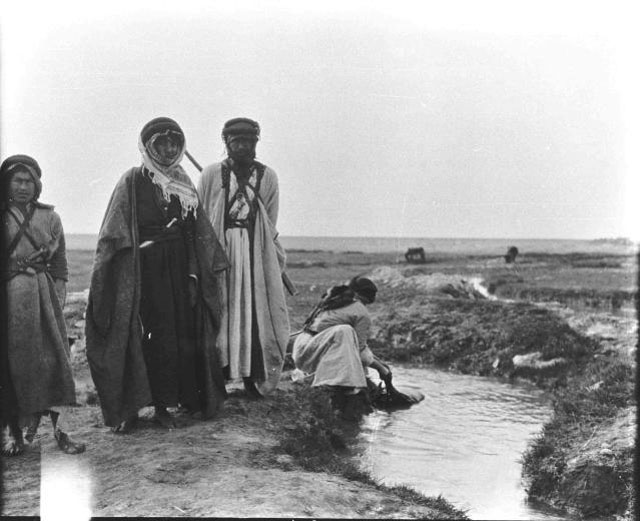
Also significant and fascinating are her photographs of the local people she encountered on her travels, for example (see image on left).
Cartography
As well as archaeological work and excavation, Bell was also interested in mapping the uncharted regions through which she travelled. To aid her in this, she undertook a course in survey methods and map projection at the Royal Geographical Society (1907), and returned to the East to travel a route that curved round the Druze mountains from Damascus to Hail, mapping and surveying the area as she went (1913). Bell’s journey of 1913 has since been highly praised, not least by David Hogarth, former President of the Royal Geographical Society, who, in April 1927, stated to the society that this particular journey of Bell’s ‘was a pioneer venture which not only put on the map a line of wells, before unplaced or unknown, but also cast much new light on the history of the Syrian desert frontiers under Roman, Palnyrene, and Ummayed domination.’
He also gives some hint of the importance of Bell’s work to wartime efforts and military strategies, arguing that:
‘Her information proved of great value during the war, when Hail had ranged itself with our enemy and was menacing our Euphratean flank. Miss Bell became, from 1915 onwards, the interpreter of all reports received from Central Arabia.’
Charles Doughty-Wylie
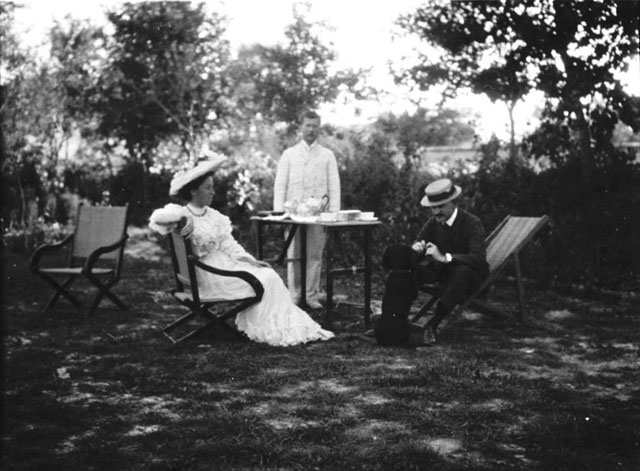
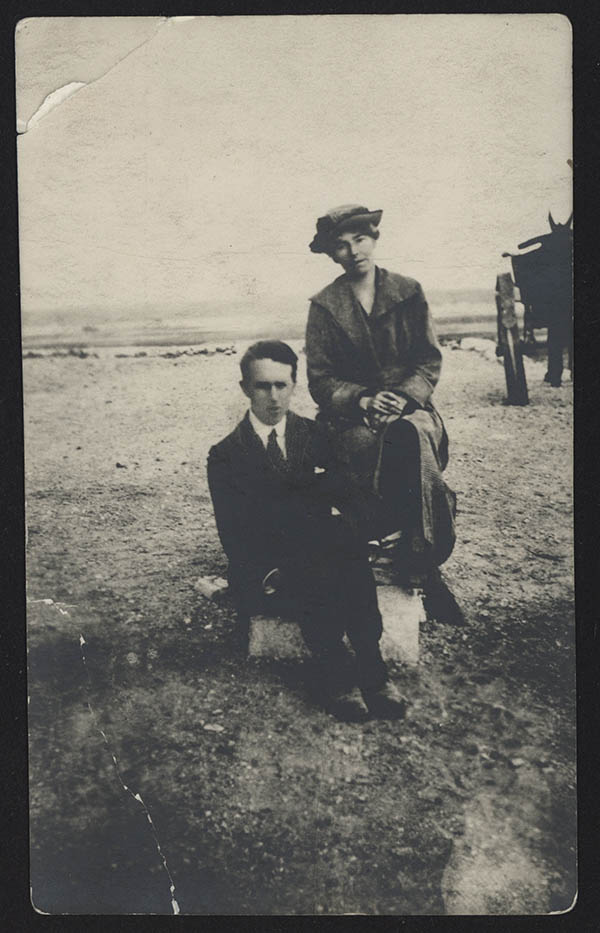
Konya (Iconium): The Doughty-Wylie’s with servant and dog in Consulate [Bell (Gertrude) Archive, I/246]
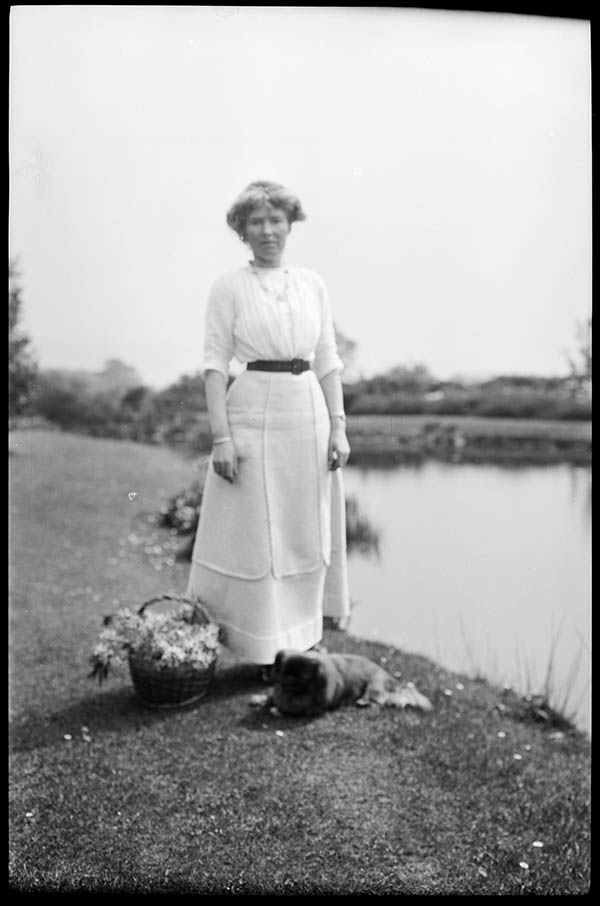
During her 1907 archaeological trip to Turkey with Sir William Ramsay to revisit the Binbirkilise, Gertrude met Charles Doughty-Wylie, who would soon become the love of her life. Major Charles Doughty-Wylie of the Royal Welch Fusiliers– known as Dick to his friends – had served in the Boer War, the East Africa campaign of 1903, and in Tientsin during the Chinese rebellion. By the time he met Gertrude, he was the British military consul at Konya in Turkey (see image above), and had married his wife, Lilian, just three years beforehand. Gertrude was invited to stay with the Doughty-Wylie’s at their house in Konya on the final leg of her trip, from where she wrote to her mother, ‘it’s a great alleviation to be staying with the Wylies – they are dears, both of them. I’ve had a very pleasant restful two days. It’s pretty hot but one sits out in their big garden under the trees.’ (see image show below).
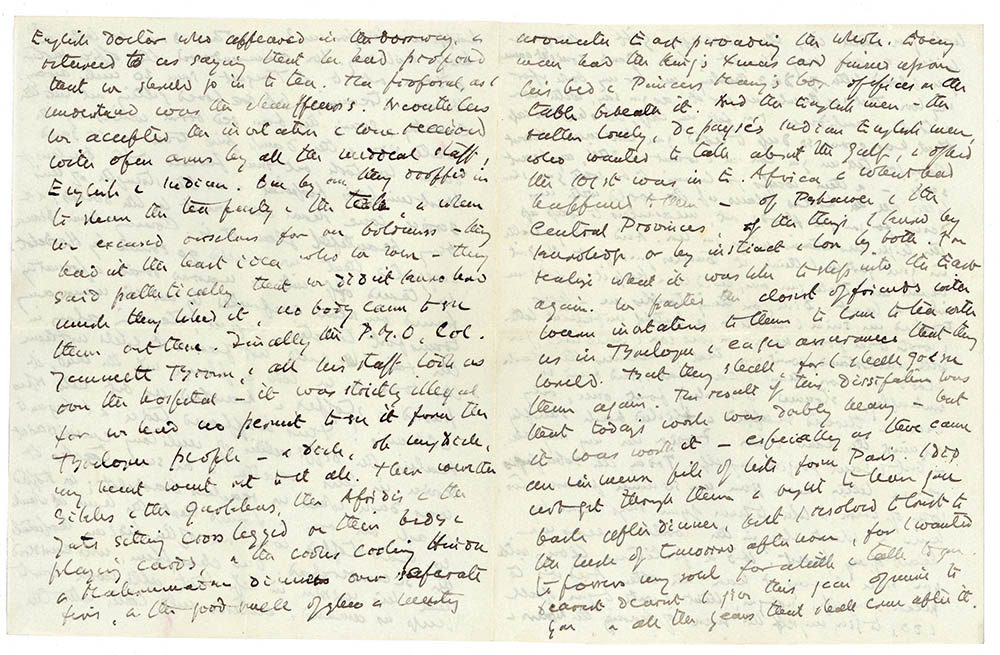
After meeting in 1907, Gertrude and Dick kept in touch, having discovered in each other a mutual love of the culture and history of the Middle East. In the spring of 1912, the two met in London when Dick arrived, without his wife, to take up the position of director-in-chief of the Red Cross relief organisation. During this brief period, Gertrude welcomed Dick into her circle of friends, and regularly took him to the theatre, to music halls, and to dinner. After this, the correspondence between the two intensified both in frequency and in passion. When Gertrude went travelling, she sent Dick full diaries of her journeys, such as the one of her journey to Ha’il. The depth of emotion in Gertrude’s letters to Dick in comparison to those she sent to her family becomes most evident during the First World War. Where she sent her family relatively short, largely factual missives designed, apparently, not to worry them, to Dick she poured out her heart and her fears concerning the conflict. For example, in a letter to her father written on 30 December 1914, when Gertrude was working in the Red Cross Office for the Missing and Wounded in Boulogne, she wrote of ‘the immense sacrifice we had to make to retake the trenches the Indian troops had lost’ (see image below).
In contrast, the language she uses in her letter of the same day to Dick is full of emotion, signifying the closeness between them:
‘When our men have to relieve them, they must go into trenches which offer them no shelter, nor pay in lieu of their neglect. Its not worth it. Oh my dear, my dear, the horror of it all, & then the shining courage, this devotion – yes, I know the more I talk of it, the more you long to be brave’ (image below).
Gertrude was willing to let only Dick see the pain and sadness she so often felt, and the deep depression that the war triggered within her. Though their affair remained unconsummated, the strength of their love for each other is overwhelmingly evident in their letters, and their relationship is focal point of Werner Herzog’s recent biopic of Gertrude, Queen of the Desert (2015), starring Nicole Kidman as Gertrude, and Damian Lewis as Dick.
Doughty-Wylie’s Death at Gallipoli
Newspaper cutting from the Daily Chronicle, 26th April 1915 titled ‘Hero’s Death after Victory Won’. [Bell (Gertrude) Archive, Item 39]
On 26 April 1915, the second day of the Gallipoli campaign, Charles Doughty-Wylie was shot and killed instantly by a sniper during a successful attack organised and led by him and another officer, Captain Garth Walford (who was also killed)
Unaware of his fate, Gertrude continued to write to Dick, only learning of his death when she visited London (June 1915). The letters to her parents during this period are sparse, but their brevity signals her heartbreak, in particular the short note sent on 11 June 1915, days after she had learned of Dick’s death:
‘Dearest Mother. Thank you and Father for your letters. I haven’t anything to say that’s worth, or at any rate worthy of saying, and therefore I don’t write. Your affectionate daughter Gertrude’.
Envelope that Gertrude Bell’s letter were returned to her upon Charles Doughty’Wylie’s death. [Bell (Gertrude) Archive, Item 19]
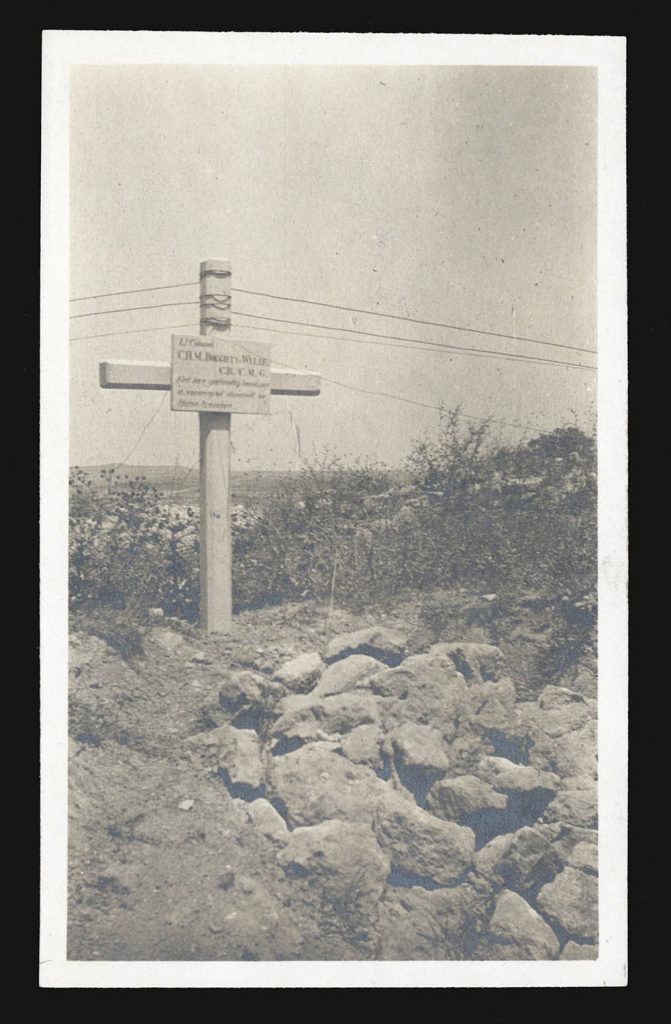
The image above is to show the envelope that was returned to Gertrude Bell containing her letters to Dick following his death. Dick was buried where he fell at Gallipoli, and towards the end of 1915, a mysterious, veiled female visitor was seen visiting his grave (image shown below), thought to have been the only woman who landed during the Gallipoli campaign. Who this woman was has never been confirmed – possibly it was Dick’s wife, but, equally possible, it was Gertrude.
Photograph of Charles Doughty-Wylie’s grave, buried where he fell at Gallipoli [Bell (Gertrude) Archive, Item 19]
Red Cross in London and Boulougne
Hospital Work at the Outbreak of the First World War
In November 1914, following
the outbreak of the First World War, Gertrude began work in a hospital at the
house of Lord Onslow in Clandon Park, Surrey, which was filled primarily with
wounded Belgian troops. However, much to her dismay, Gertrude’s role was purely
administrative, and involved none of the nursing she longed to do. In a letter
to her mother on 15 November, she complained:
However, a mere two days later, Gertrude was sent for by the Red Cross to work in their Boulogne office, helping to trace missing and wounded soldiers, and by 25 November, she was already hard at work in Boulogne.
The Boulogne Red Cross
Office
Upon her arrival at the Red Cross Office for Missing and Wounded in Boulogne, Gertrude was faced with a chaotic and ineffectual system for recording the missing and wounded. She took it upon herself to reorganise the entire office, and to put in place new indexing systems, writing to her mother that (8th January 1915),
Gertrude felt strongly that the Red Cross should be as sensitive as possible when informing families of the loss of their sons, fathers and brothers, and explained this to her mother (12th January 1915):
In March 1915, Gertrude agreed to move to the headquarters of the London Red Cross in London, to continue her work recording missing and wounded soldiers, and informing their families. Determined to do the job well, Gertrude found herself once more frustrated with the lack of adequate facilities, and most of all with the lack of space, writing to her mother that (20th August 1915):
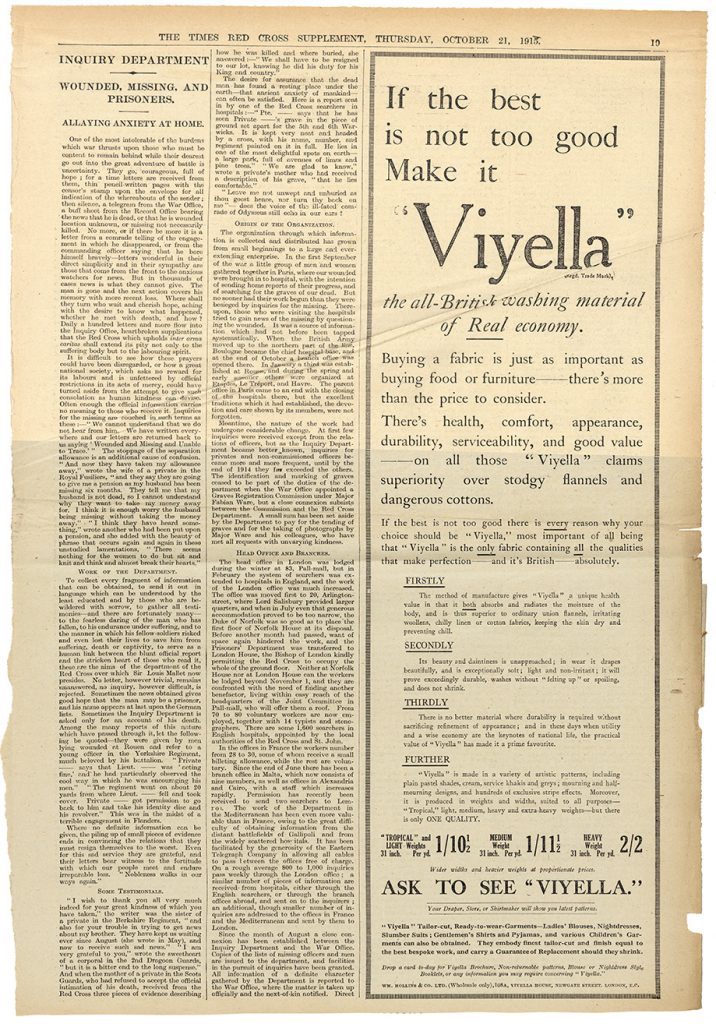
In October 1915, Gertrude wrote about the vital work of the Red Cross Inquiry Department for The Times (see Item G). By November 1915, however, after less than four months at the British Red Cross Headquarters in London, Gertrude was called to Cairo by the Foreign Office.
Article in the Times Red Cross Supplement, Inquiry Department: Wounded, Missing and Prisoners—Allaying Anxiety at Home, 21st October 1915 [Bell (Gertrude) Archive, Item 22]
In November 1915, David Hogarth, who had known Gertrude since 1899, enlisted her to come and work at the newly established Arab Bureau in Cairo, a British intelligence organisation dealing with Middle Eastern affairs. T.E. Lawrence – better known today as Lawrence of Arabia – also worked for the Bureau alongside Gertrude, and the two became close friends (see image to the left). Gertrude was employed by the Bureau in Cairo to interpret reports from Central Arabia, as well as to document ‘Arab tribes, their numbers and lineage. It’s a vague and difficult subject which would take a lifetime to do properly’. On New Year’s Day (1916), Gertrude wrote to her mother from Cairo reflecting on the past year of war:
When Gertrude arrived in Basra in March 1916, she stayed in the home of Sir Percy and Lady Cox until she could find a place of her own. Letters she wrote to her mother talk of her frustration at the impermanent, transient nature of her work. Nevertheless, Gertrude gave her full attention to the number of tasks at hand, which included classifying tribal material, a process in which her own prior knowledge from her travels. Gertrude also had strong views on the political situation in the Middle East, and was frustrated with what she perceived to be Britain’s mishandling of it:
Gertrude was appointed to the paid position of Official Correspondent to Cairo (June 1916), and also head of the Iraq branch of the Arab Bureau as an officer of the Indian Expeditionary Force D. She became increasingly influential, providing the Intelligence Department with summaries of recent Arabian history, and writing memoranda about British-Arabian relations, such as, ‘The Nomad Tribes of Arabia’ (pages 16 and 17 are shown below).
Page 16 from ‘The Nomad Tribes of Arabia’ [Bell (Gertrude) Archive]
Page 17 from ‘The Nomad Tribes of Arabia’ [Bell (Gertrude) Archive]
In January 1917, Gertrude was appointed Oriental Secretary by Sir Percy Cox, and continued as head of the Arab Bureau (Iraq). Gertrude left Basra for Baghdad (April 1917), following the British occupation of Baghdad (11 March 1917).
Gertrude was passionate about the future of Iraq, and wanted to ensure that the best was done for both the country and its people. On 30 October 1918, eleven days before the ceasefire of the First World War, the Turkish government signed the Armistice of Mudros with the Allied Forces. Gertrude’s work intensified in the months following the end of the war. She was heavily involved in decision making regarding Iraq, and while she felt strongly that the British administration needed to act in the best interests of the Iraqi population, she also had her own very clear ideas about what those best interests were. She was, for example, frustrated with calls for an Arab Amir to lead the country instead of Sir Percy Cox as British leader. For Gertrude, the only viable option was British rule in the Middle East:
The consequences of such views held by Gertrude and her colleagues, and the extent of British involvement in reshaping the Middle East following the First World War, continue to be powerfully felt today.
Bell’s Role in the Formation of Iraq
In the years following the end of the First World War, the British Government’s attentions turned to determining the lines along which the borders of the new Iraq would be drawn, and Gertrude was heavily involved in the decision making process.
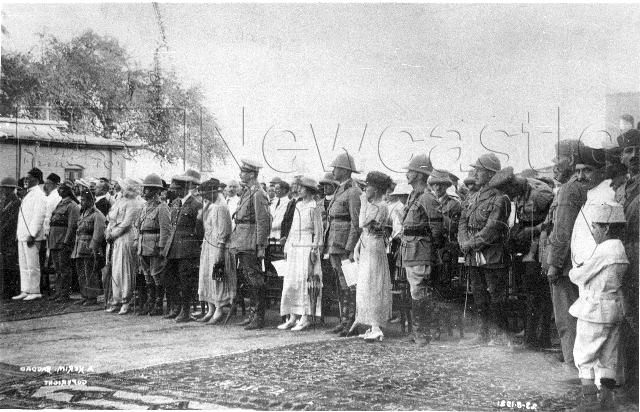
Crowd at the coronation of King Faisal [Bell (Gertrude) Archive, Pers/B/17/O/Robinson]
She attended the Paris Peace Conference as the representative of the Arab Bureau (1919), and later attended the ten-day Cairo Conference (March 1921), which was organised by Winston Churchill with the objective to work towards an independent Arab Government. To that end, Bell was instrumental in the selection of Prince Faisal as the new King of Mesopotamia (crowned July 1921 – see image to the left). While she became a close friend to King Faisal, and worked closely with him for the rest of her life, she found the process of nominating and publicising a potential king strenuous, writing to her father shortly after Faisal’s coronation that ‘you may rely upon one thing – I’ll never engage in creating kings again, it is too great a strain’.
Perhaps most famously, however, Bell was central in drawing the borders of Iraq during this period. In a letter to her father (December 1921), she writes, ‘I had a well spent morning at the office making out the Southern desert frontier of the Iraq […] One way and another, I think I’ve been succeeded in compiling a frontier’. After the coronation of King Faisal, the drawing of these borders, and the establishment of the new Iraqi Government, Bell refocused her efforts back into archaeology and historical research, and was appointed the Honorary Director of Antiquities for Iraq (October 1922). Bell initiated the Iraq Museum (October 1923), the first room of which opened in June 1926, just one month short of Bell’s death from an overdose of sleeping pills (12 July 1926). Four years after her death, a commemorative bronze plaque was unveiled by King Faisal, and a bust of Bell was erected to identify the Gertrude Bell principle wing of the Iraq Museum.
Find out More
Transcripts of most of Gertrude Bell’s letters and all of her diaries, together with digital copies of her extensive photograph albums, are available to browse at the dedicated Gertrude Bell website.
The 8th June 2013 marks the 100th anniversary of the death of the suffragette Emily Davison. A militant suffragette, whose family originated from Longhorsley in Northumberland, Emily infamously ran in front of the King’s horse at the Epsom Derby on 4th June 1913. She was seriously injured and died of her injuries in hospital four days later. It has long been speculated whether Emily was actually trying to kill herself in order to draw attention to the suffragette cause. Analysis of newsreel from the day now suggests that she may have been simply trying to attach a suffragette banner to the horse.
This is Ethel Williams’ suffragist banner. Ethel was the first woman to found a general medical practice in Newcastle upon Tyne in 1906. She was also reportedly the first woman to drive a car in the North of England that same year. She attended the London School of Medicine for Women and graduated in 1891, but had to gain her hospital experience abroad in Paris and Vienna due to male prejudice against women training in British hospitals. Such obstacles and her belief in the need to supplement medical care with social reform led to her active involvement in the suffrage movement.
Ethel was an active member of the National Union of Woman’s Suffrage Societies (also known as the NUWSS or the Suffragists). Unlike the Suffragettes, the Suffragists aimed to achieve women’s suffrage using lawful and peaceful methods. Ethel took part in the ‘Mud March’ of 1907 in London, the first large procession organised by the NUWSS, so-called due to the terrible weather conditions on the day. Despite this, over 3,000 women from all walks of life took part. There is a good chance that she may have used this banner during the march as women from across the country brought banners to show which area they represented. Red and white were the official colours of the NUWSS and both colours can been seen in the banner. She was also often seen in suffrage processions along Northumberland Street in Newcastle. During World War One she formed the Women’s International League for Peace and Freedom.
She co-founded the Northern Women’s Hospital in 1917 and, when she retired in 1924, she left her practice to another female doctor, Dr Mona MacNaughton. By this time there were 14 female doctors practicing in Newcastle. Ethel died in 1948 and Ethel Williams’ Halls of Residence were opened in her memory in 1950 at Newcastle University.
This Treasure of the month was provided by Owen Brittan one of this year’s Robinson Bequest Students.
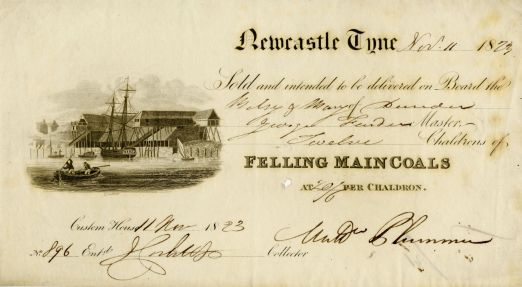
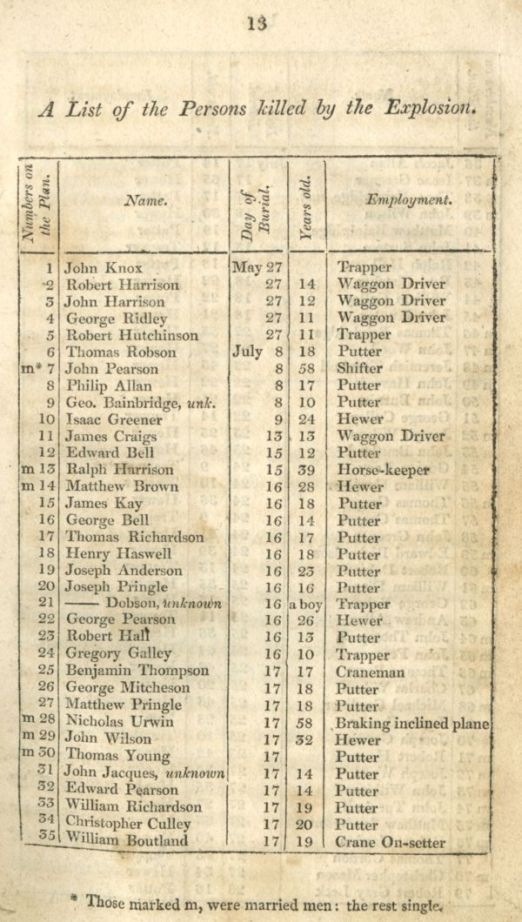
This May marks the 200th anniversary of the accident of the Felling Colliery which claimed the lives of 92 workers when an explosion ripped through the two pits. It was one of the worst ever known disasters in the history of coal fields with a survival rate of only 24 percent of the workforce who were an average age of 22.
Page showing the list of person killed by the Felliery Colliery explosion, from The funeral sermon of the Felling Colliery sufferers : to which are prefixed, a description and plan of that colliery : an account of the late accident there : of the fund raised for the widows and suggestions for founding a collier’s hospital, by Hodgson, John. Newcastle [England] : Walker, 1813. (Clarke (Edwing) Local, Clarke 1833)
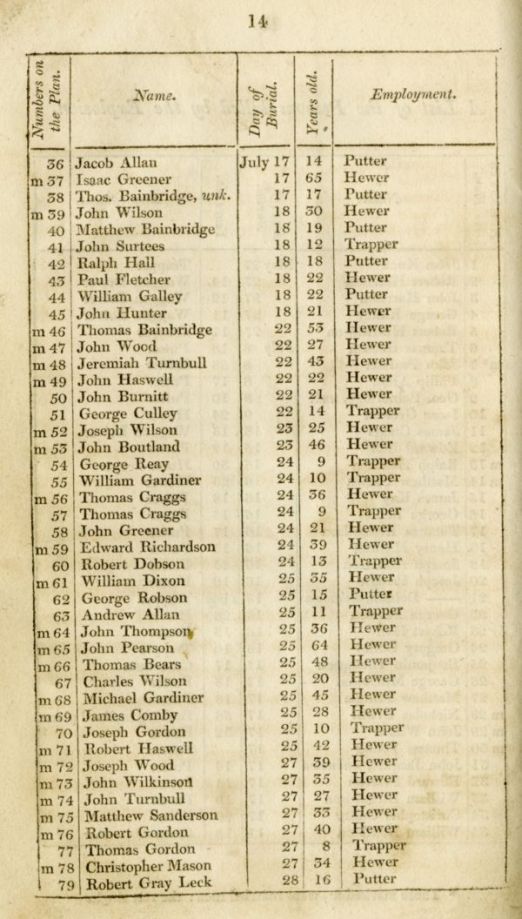
The tragedy took place years before any sort of regulation on child labour as evidenced by the large amount of children who died in the explosion. Of the 92 left dead, 11 of them were 10 years of age or younger. The story of the accident comes to us through the publication of Reverend John Hodgson’s funeral sermon on behalf of the fallen miners.
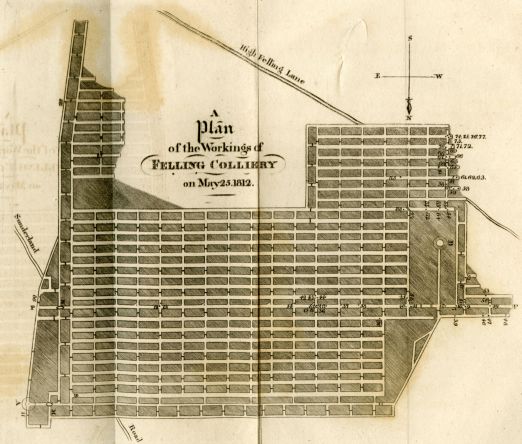
In October of 1810 Messrs. John and William Brandling, Henderson, and Grace each acquired a fourth share of the Felling colliery located in the parish of Jarrow, about a mile and a half east of Gateshead. The colliery consisted of two shafts, the John Pit and William Pit, which were both over 200 yards deep. Two shifts of men were constantly employed, except on Sundays. From its opening in October 1810 to 25 May 1812, the date of the explosion, the mine had had only one accident, which resulted in slight burns to two or three workmen, while excavating over 25 acres of coal.
Page showing the list of person killed by the Felliery Colliery explosion, from The funeral sermon of the Felling Colliery sufferers : to which are prefixed, a description and plan of that colliery : an account of the late accident there : of the fund raised for the widows and suggestions for founding a collier’s hospital, by Hodgson, John. Newcastle [England] : Walker, 1813. (Clarke (Edwing) Local, Clarke 1833)
It was not until July 8, after diverting a current of water into the pits for over a month to make the air breathable, that any further rescue attempts could be made but by then very few people had any hope of finding anyone alive. Over the course of the next 44 days bodies were recovered and identified. Most were too scorched or putrid to be identified by physical features so friends and family had to identify them by belongings found on their person.
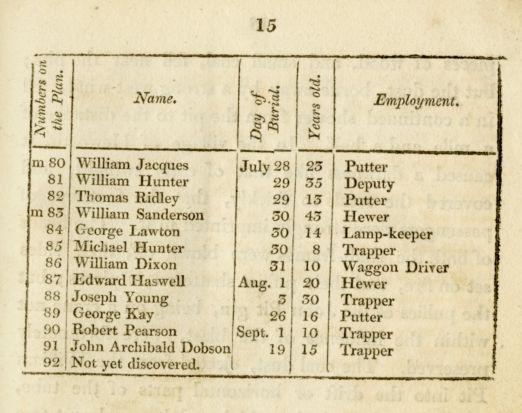
Page Page showing the list of person killed by the Felliery Colliery explosion from, The funeral sermon of the Felling Colliery sufferers : to which are prefixed, a description and plan of that colliery : an account of the late accident there : of the fund raised for the widows and suggestions for founding a collier’s hospital, by Hodgson, John. Newcastle [England] : Walker, 1813. (Clarke (Edwing) Local, Clarke 1833)
At 9:00 A.M. on 19 September the last body was recovered and by 11:00 AM the colliery was back to work as normal. The body of the 92nd victim has never been found.
All but four of these victims were buried together in the Heworth Chapel Yard in a single trench with brick partitions between every four coffins. In response to this tragedy several benevolent and prominent Newcastle citizens began taking up subscriptions for the families of the deceased. Additionally, this mining accident prompted safety improvements throughout the coal community. In correspondence to the inadequacy of lamps in a noxious environment new safety lamps were invented. The Society for the Prevention of Accidents in Coal Mines was also created shortly thereafter.
Plan of the workings of Felling Colliery from History of Felling on Tyne a file of ephemera (Clarke General Collection)
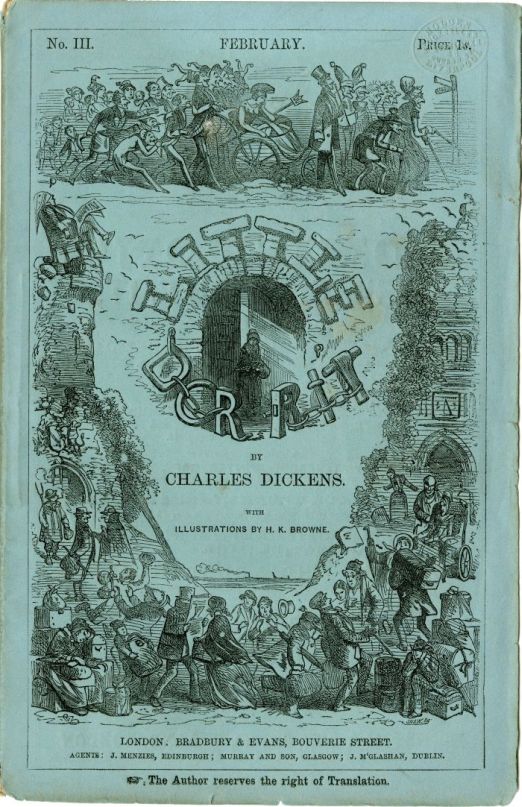
Front cover of Little Dorit, no.III (Rare Books, RB823.83 DIC)
7th February 2012 marks the 200th anniversary of the birth of Charles Dickens, regarded by many as the consummate Victorian author.
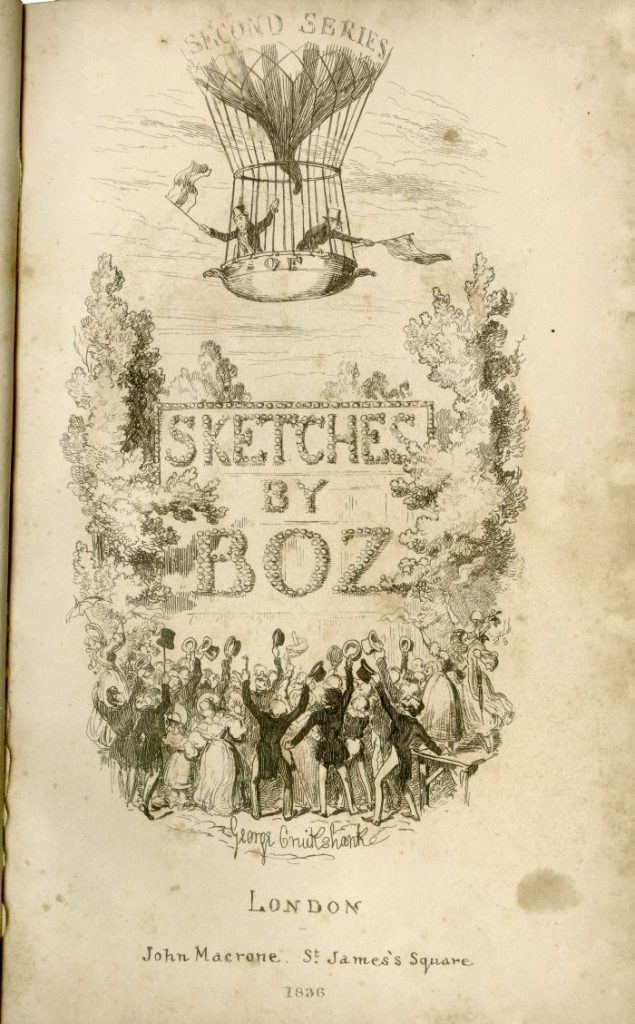
He began his career in journalism, writing for the journals The Mirror of Parliament, The True Sun and later, The Morning Chronicle. The contacts he made in the press industry enabled him to publish Sketches by Boz (1836): a collection of short portrayals of London characters and scenes which were illustrated by George Cruikshank and had previously been serialised in popular newspapers and periodicals.
John Macrone first published Sketches as a two-volume set in February 1836 and followed it with a second complete series in one volume in August that same year. It is a work of both non-fiction and fiction.
Title page from Sketches by Boz (1936) (19th Century Collections, 19th C. Coll. 823.83 DIC)
Dickens’ family had been sent to Marshalsea prison when his father fell into debt. Dickens had been sent to work in a blacking factory.
The social ills of the Nineteenth Century such as child labour, the Poor Law and the poor treatment of London’s waif-children are recurrent themes in his novels.
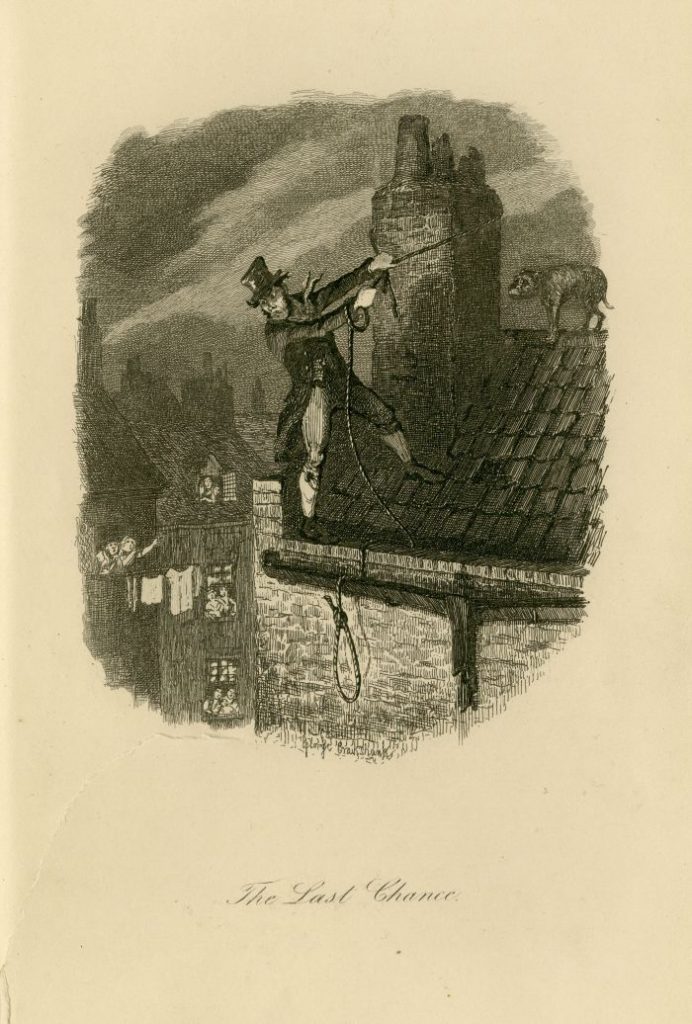
In The Adventures of Oliver Twist, 1837-39 (19th Century Collection, 19th C. Coll. 823.83 DIC) workhouse conditions, the recruitment of children as criminals, the social effects of industrialisation, London slums and the hypocrisies of the middle-class come under particular scrutiny.
Illustration of ‘The Last Chance’ from The Adventures of Oliver Twist(19th Century Collection, 19th C. Coll. 823.83 DIC)
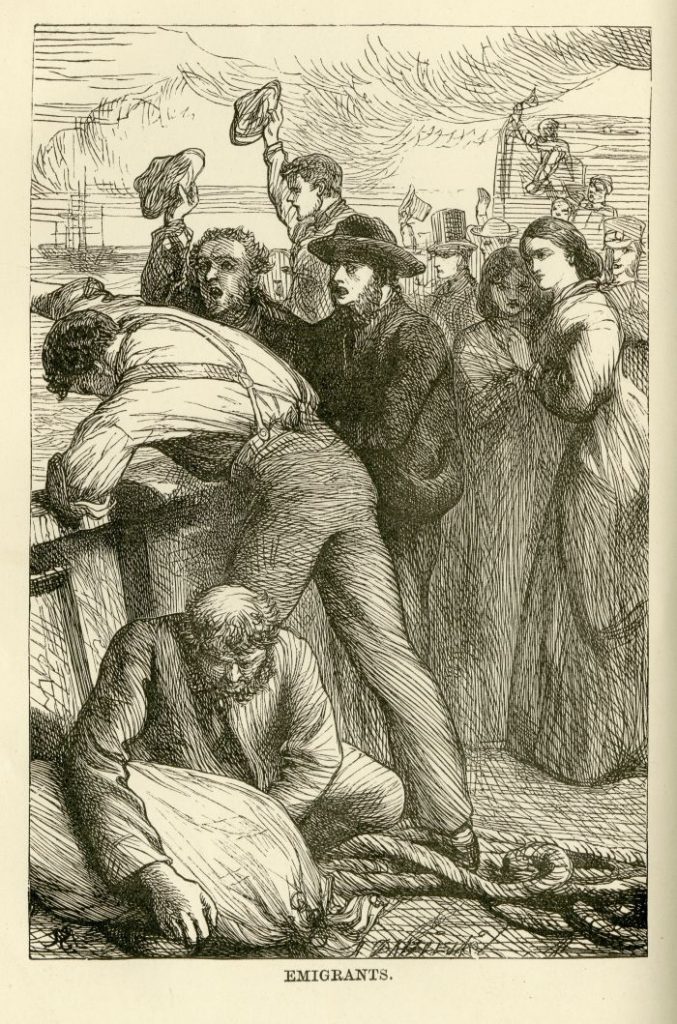
Dickens first visited America in 1842, his impressions of which are described in American Notes. He was already popular in the U.S. and was mobbed on arrival. Here his interest in social reform continued and his itinerary included visits to prisons, factories and hospitals. He was also saw first-hand the effects of slavery and was a vehement campaigner for its abolition. The trip was both a success and a disappointment: he wearied of the attention he attracted, failed to persuade Americanc of the need for an international copyright agreement, and was unimpressed by the level of information put out by the press. The success of the British reading tour and the prospect of large profits motivated him to visit America again in 1867 but by this time his health was failing and he did not travel far.
Image of ‘Emigrant’ from the Illustration London News (19th Century Collection, 19th C. Coll. 030 ILL)
Many nineteenth-century authors established themselves through writing serialised fiction. That is, the issuing of instalments in newspapers, like the Illustrated London News, and popular magazines, like The Strand, or, as ‘part serials’ i.e. discrete monthly parts. Serialisation impacted upon the novel form: the more an author wrote the more handsomely they were paid but there was also a need to engage readers with every instalment and authors like Dickens adapted plots according to reader responses. Serialisation made book-buying affordable for the middle-class because it spread the cost of purchasing a novel over an average of eighteen to twenty months, with each instalment selling at an average of 1 shilling – a little over £2.00 in today’s spending worth. Typically, when the final instalment had been acquired, the parts were stripped of their paper wrappers and advertisements, trimmed and bound in leather or fine cloth. Thus it is rare to find novels as part serials today. The copy of Little Dorrit (see image at the beginning of this post), 1855-57 (Rare Books, RB823.83 DIC) which is held in the Rare Books collection is a good example of a book in parts. The parts are stab stitched, with paper wrappers intact, marked with the price and some of the parts bear the inscription of a former owner and the stamp of Holden bookseller, Church St., Liverpool. It offers an opportunity to experience the text as the contemporary readers would have experienced it, with a greater number of illustrations (by H.K. Browne) and the cliffhangers at the end of each part.
Dickens’ final novel, The Mystery of Edwin Drood, 1870 (Rare Books, RB823.83 DIC) remains unfinished. There are no clues regarding an intended ending in the notes which Dickens left although he sent a summary of the story to his friend John Forster. He died from a stroke, having completed a full day’s work on the novel. The sixth instalment was the last to be published.
Extract from The Mystery of Edwin Drood, 1870 (Rare Books, RB823.83 DIC)
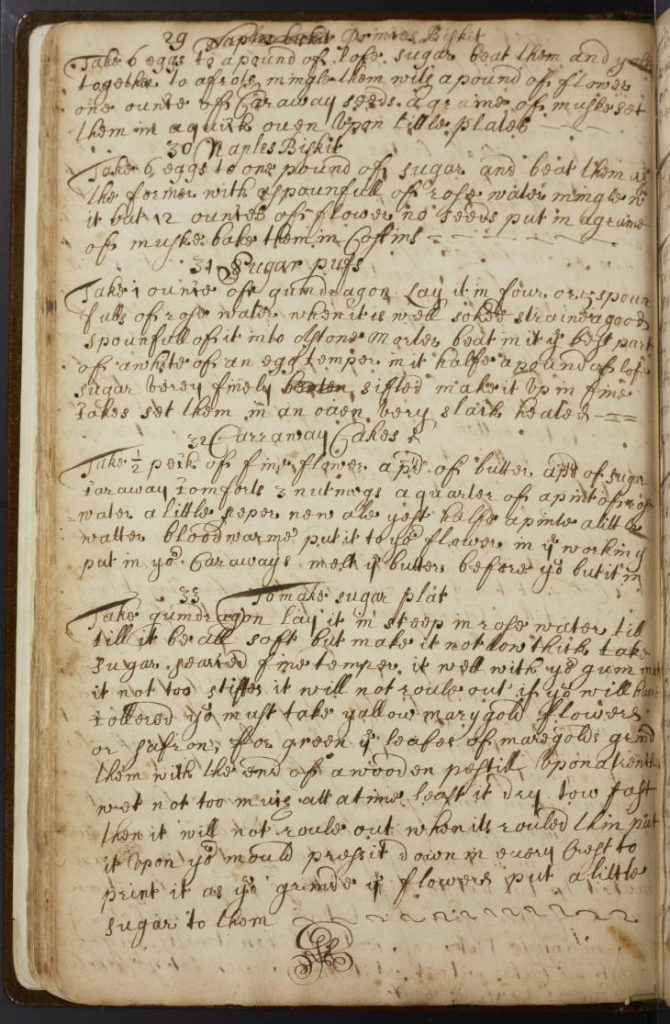
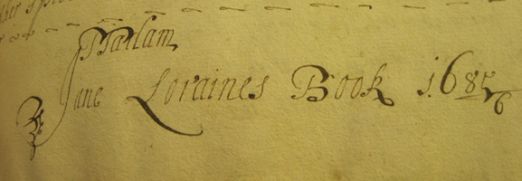
Page 32 from Jane Lorraine’s Recipe Book on how to make ‘Carraway Cakes’, ‘Sugar Plait’ and other recipes (Miscellaneous Manuscripts, Misc. MSS. 5)
This additional treasure of the month has been provided by Catherine Alexander, a student in the School of English Literature, Language and Linguistics, who has recently completed a summer research project based around a seventeenth-century recipe book, held in Special Collections.
This is a seventeenth century cook book manuscript, written by Jane Loraine, who lived in Northumberland. She is likely to have been the wife of Nicholas Loraine, son of Ambrose Loraine of Hartburn, and probably a member of the Fenwick family. The cook book is firmly rooted in Northumberland, and there are extensive records of the Loraine family in Kirkharle. Reference to individuals also demonstrates a local community; in this recipe Mrs Charleton’s surname locates her in Charlton, near Bellingham in North Tynedale. There are 67 recipes attributed to 41 individuals in this cook book, only 13 of whom are men.
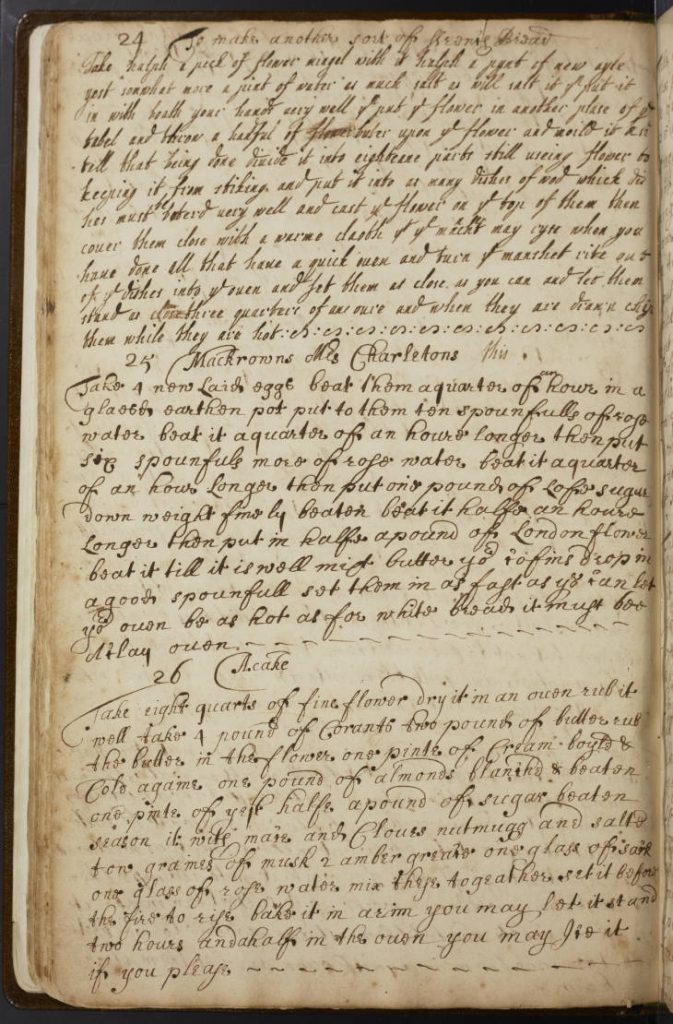
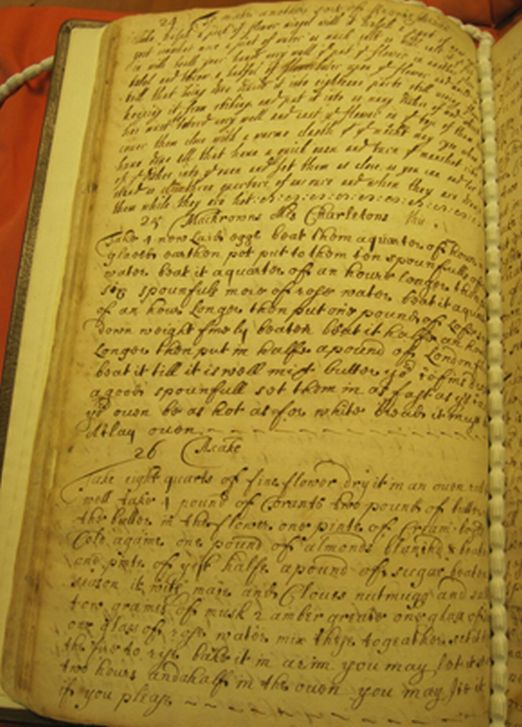
Recipe: To maike mackrowns page 31 fol. 24V
25 Mackrowns Mrs Charletons this Take 4 new Laid eggs beat them a quarter of an houre in a glased earthen pot put to them ten spoun fulls of rose water beat it a quarter of an houre longer then put six spounfuls more of rose water beat it a quarter or an hour Longer then put one pound of lose sugar down weight finely beaten beat it halfe an houre Longer then put in halfe a pound of London flower beat it till it is well mixt butter your cofins deep in a good spounfull set them in as fast as you can let your oven be as hot as for white bread it must be A clay oven
The manuscript, in folio format, is 78 pages long and contains 665 recipes. The page numbering, added later, shows missing pages.
The annotation beside the recipe title: ‘this‘, shows use of the book and the selection process for the contents page.
Page 31 from Jane Lorraine’s Recipe Book on how to make ‘Macrowns’ (Miscellaneous Manuscripts, Misc. MSS. 5)
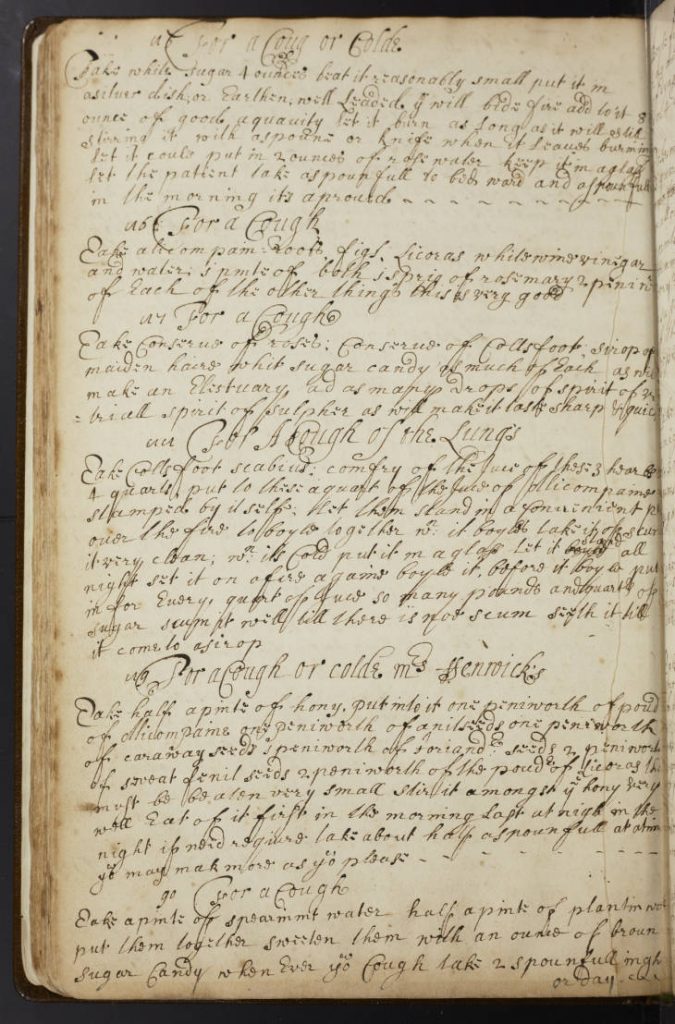
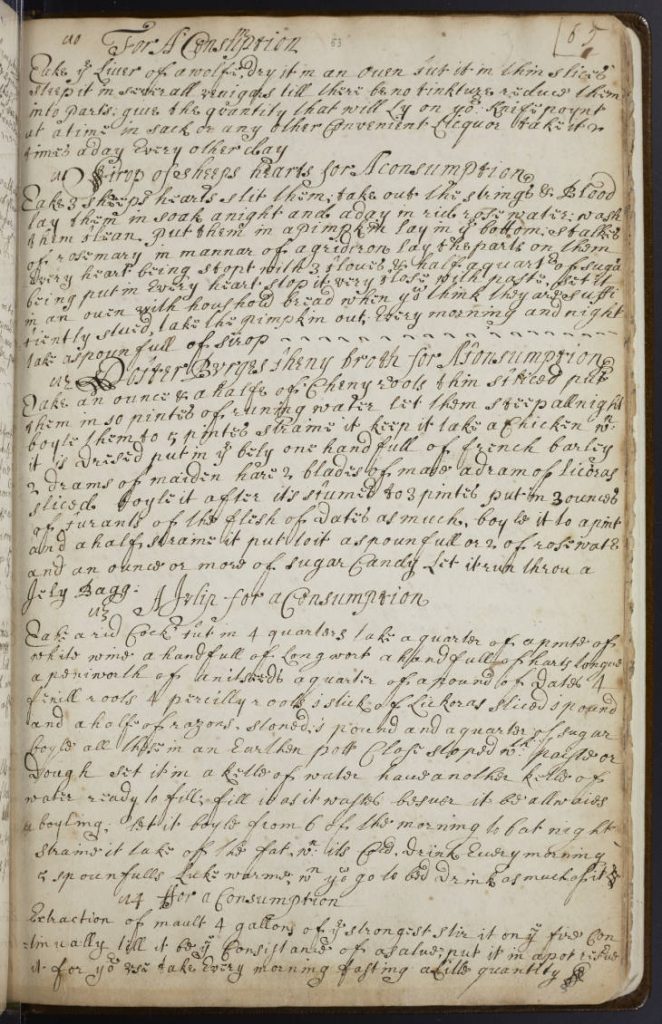
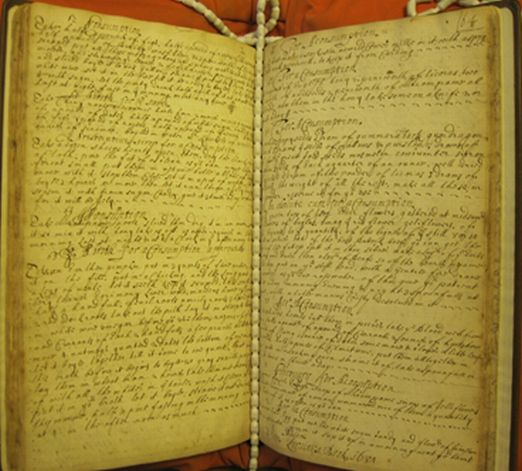
This manuscript is typical in its medical emphasis and over half of the recipes are medical, while only a quarter are culinary. These food recipes focus on cakes, creams and preserves, while the medical receipts cover a range of illnesses, focusing on common concerns such as consumption, and women’s health, particularly childbirth. There are also some recipes for beauty treatments and perfumes. Nine percent of the recipes represent the overlap between food and health, in the waters and wines which function as drinks as well as preventative medicines and cures.
Page 66 from Jane Lorraine’s Recipe Book showing multiple recipes for a common cold or cough (Miscellaneous Manuscripts, Misc. MSS. 5)
This hybridity has an impact on the domestic roles of women, as they commanded authority on medical as well as culinary issues.
Many parallels and similarities can be seen with other cook book manuscripts and printed texts at this time, and this manuscript is part of a widespread communication of ideas and advice. This genre was popular in the seventeenth century and gave women a literary voice.
Page 65 from Jane Lorraine’s Recipe Book showing multiple recipes for a consumption (Miscellaneous Manuscripts, Misc. MSS. 5)
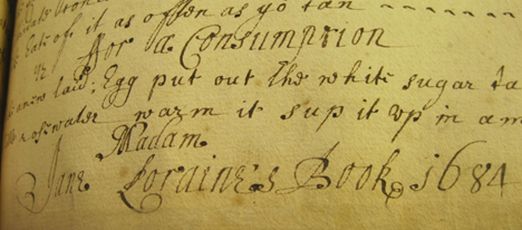
Collaboration is also typical within the recipe book format, and this can be seen through reference to individuals as well as in the six different handwritings identifiable in the text. The secretary hand which dominates 70% of the text can be associated with Jane Loraine, through the 13 signatures given. Many of these are dated between 1684-6.
This additional treasure of the month has been provided by Catherine Alexander, a student in the School of English Literature, Language and Linguistics, who has recently completed a summer research project based around a seventeenth-century recipe book, held in Special Collections.
Extract from Jane Loraine’s Recipe Book(Miscellaneous Manuscripts, Misc. MSS. 5)
This is a seventeenth century cook book manuscript, written by Jane Loraine, who lived in Northumberland. She is likely to have been the wife of Nicholas Loraine, son of Ambrose Loraine of Hartburn, and probably a member of the Fenwick family. The cook book is firmly rooted in Northumberland, and there are extensive records of the Loraine family in Kirkharle. Reference to individuals also demonstrates a local community; in this recipe Mrs Charleton’s surname locates her in Charlton, near Bellingham in North Tynedale. There are 67 recipes attributed to 41 individuals in this cook book, only 13 of whom are men.
To maike mackrowns page 31 fol. 24V
25 Mackrowns Mrs Charletons this Take 4 new Laid eggs beat them a quarter of an houre in a glased earthen pot put to them ten spoun fulls of rose water beat it a quarter of an houre longer then put six spounfuls more of rose water beat it a quarter or an hour Longer then put one pound of lose sugar down weight finely beaten beat it halfe an houre Longer then put in halfe a pound of London flower beat it till it is well mixt butter your cofins deep in a good spounfull set them in as fast as you can let your oven be as hot as for white bread it must be A clay oven
The manuscript, in folio format, is 78 pages long and contains 665 recipes. The page numbering, added later, shows missing pages.
The annotation beside the recipe title: ‘this‘, shows use of the book and the selection process for the contents page.
Page 31 from Jane Loraine’s Recipe Book, showing the recipe on how ‘to maike mackrowns’ (Miscellaneous Manuscripts, Misc. MSS. 5)
This manuscript is typical in its medical emphasis and over half of the recipes are medical, while only a quarter are culinary. These food recipes focus on cakes, creams and preserves, while the medical receipts cover a range of illnesses, focusing on common concerns such as consumption, and women’s health, particularly childbirth. There are also some recipes for beauty treatments and perfumes. Nine percent of the recipes represent the overlap between food and health, in the waters and wines which function as drinks as well as preventative medicines and cures.
This hybridity has an impact on the domestic roles of women, as they commanded authority on medical as well as culinary issues.
Many parallels and similarities can be seen with other cook book manuscripts and printed texts at this time, and this manuscript is part of a widespread communication of ideas and advice. This genre was popular in the seventeenth century and gave women a literary voice.
Collaboration is also typical within the recipe book format, and this can be seen through reference to individuals as well as in the six different handwritings identifiable in the text. The secretary hand which dominates 70% of the text can be associated with Jane Loraine, through the 13 signatures given. Many of these are dated between 1684-6.
Further information about this manuscript can be found on the Turning Pages software in the School of English.
Extract from Jane Loraine’s Recipe Book(Miscellaneous Manuscripts, Misc. MSS. 5)
[Mary, Queen of Scots] In the Royal Palace of St. James’s an Antient Painting. 1580. Delineated and sculpted by G. Vertue (1735) (Clarke (Edwin) General Collection)
This month marks the 450th anniversary of Mary, Queen of Scots’ return to Scotland aged nineteen, following the death of her husband, King François II of France. Mary was born in 1542 and became Queen of Scotland six days later following the death of her father, King James V, after his defeat at the battle of Solway Moss. King Henry VIII was determined to marry the infant Queen to his son, Edward, thus finally uniting the crowns of Scotland and England. This was unpopular with the Scottish nobles who instead made a deal with the French to marry Mary to the Dauphin. This was ratified by the Treaty of Haddington in 1548 and Mary was sent to live in France – a safe distance from the attempts by English troops to kidnap her.
After Francois’ death Mary decided to return to Scotland to rule the country of her birth. Her mother, Mary of Guise, had ruled as regent until her death in 1560 and now the nobles had seized power under her half-brother, Lord James Stewart. They welcomed Mary’s return. Scotland was now a Protestant, and turbulent, country and, as a Catholic, Mary had to compromise over religion during her reign.
Mary was determined to have her claim to the English throne recognised and hoped that she would be named by Queen Elizabeth as her heir. They made plans to meet in summer 1562 but Elizabeth pulled out at the last minute. Mary was upset and annoyed that she had listened to Elizabeth’s opinions about who she should marry. Elizabeth had suggested her own favourite, Robert Dudley, 1st Earl of Leicester, as she thought this would allow her to manipulate Mary’s decisions. In the end, Mary married her English Catholic first cousin, Henry Stuart, Lord Darnley at Holyrood Palace on 29th July 1565. She married without consulting Elizabeth who was furious as both Mary and Darnley were claimants to the English throne and any children would inherit both parents’ claims and thus be next in line for the crown.
At first Mary was infatuated with Darnley but before long he became arrogant, demanding more power and to be crowned King. He was also jealous of Mary’s friendship with her private secretary, David Rizzio, and he entered into a secret plot with the nobles to get rid of him. They were jealous of Rizzio’s position as Mary’s favourite and of his influence over her. On 9th March 1566, a group of the lords, accompanied by Darnley, murdered Rizzio in front of the pregnant Mary at Holyrood Palace in Edinburgh. Mary was kept prisoner but she managed to lure Darnley back to her side and they escaped. However, she could now no longer trust him.
In June, their son James was born. Those nobles who were loyal to Mary met to discuss the problem of Darnley and swore a bond vowing to get rid of him. Darnley knew the tide had turned against him and, fearing for his safety, fled to his father in Glasgow. Here he was taken ill, with what is now believed to have been syphilis. Mary encouraged her husband to come back to Edinburgh and arranged for him to recuperate in a house at the former abbey of Kirk o’ Field, within the city walls. In February 1567 an explosion occurred in the house in the middle of the night, and Darnley was found dead in the garden. He appeared to have been strangled. He and a servant were found in their bedclothes with a variety of objects including a chair, a dagger and a rope, leading historians to suggest that they were aware the house was going to explode and were trying to escape. It is possible that they were apprehended whilst fleeing and were strangled to death.
One of the nobles, James Hepburn, 4th Earl of Bothwell, was quickly accused of having supplied the gunpowder for the explosion and he was believed by many to be responsible for Darnley’s death. It was Mary’s and Bothwell’s actions in the wake of Darnley’s murder that convinced everyone of their guilt. Such was the evidence against Bothwell that Mary had to arrange a staged trial before Parliament, during which he was acquitted. Bothwell then managed to convince the nobles to sign the Ainslie Tavern Bond, in which they agreed to support him in his attempt to marry the Queen. By now the Scots were beginning to become suspicious of Mary.
In April 1567, Mary visited her son at Stirling, for what would be the last time. On her way back to Edinburgh she was abducted by Bothwell and his men and taken to Dunbar Castle, where she was allegedly raped by Bothwell. They returned to Edinburgh and at Holyrood they were married. Mary believed the marriage had the support of her nobles because of the Ainslie Tavern Bond. But they soon turned against the newlyweds and raised an army against them. Mary and Bothwell confronted them at Carberry Hill on 15th June. Although no fighting took place, Mary agreed to go with the Lords on condition that they let Bothwell go. However, they imprisoned her in a castle on an island in the middle of Loch Leven and forced her to abdicate the throne in favour of her son, James. Her brother James was to act as regent.
In May 1568, Mary escaped and managed to raise a small army. After her army’s defeat at the Battle of Langside, she fled by boat across the Solway Firth into England. She appealed to her cousin, Queen Elizabeth, to help restore her to her throne but Elizabeth, fearful of Mary’s presence in her country, instead imprisoned her for nineteen years. Following years of plots and escape attempts, Elizabeth eventually had Mary executed at Fotheringhay Castle in 1587. Upon Queen Elizabeth’s death, Mary and Darnley’s son ascended to the English throne as King James I, finally uniting the Scottish and English crowns.
Historians have examined the evidence and debated whether Mary and Bothwell plotted Darnley’s death, without reaching any definitive conclusion. Bothwell was almost certainly involved in Darnley’s death, but so were most of the nobles – after all they had signed a bond vowing to get rid of him. It is likely that they pointed the finger of blame at Bothwell in order to save their own lives. That Mary so unquestioningly took his side and then quickly married him has been taken as evidence of her guilt. However, as much as she hated Darnley at this point, as a ruling Queen, it is unlikely that she would have plotted his death. In the aftermath of his murder she would have been fearful for her own life and may have seen Bothwell as a protector. After he allegedly raped her, she would have had no choice but to marry him or forgo her honour. Almost as soon as she was in England, she promised to divorce him and marry someone of Elizabeth’s choosing in return for her freedom. It is unlikely she would have been so quick to cast her husband aside if he had been worth committing murder and jeopardising the throne for, just months earlier.
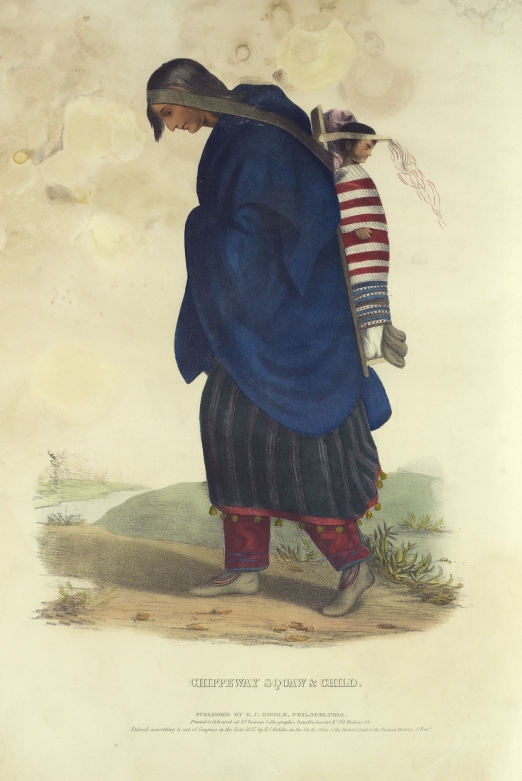
Illustration of ‘Chippeway Squaw & Child’ from M’Kenney, T.L. History of the Indian tribes of North America, with biographical sketches and anecdotes of the principal chiefs. Embellished with one hundred and twenty portraits from the Indian Gallery in the Department of War, at Washington (Philadelphia: Edward C. Biddle, 1837) (19th Century Collection, 19th C. Coll 970.1 MAC Elephant folio)
Thomas Loraine McKenney (1785-1859) served as Superintendent of Indian Trade (1816-1822) and as Superintendent of Indian Affairs in the newly-formed Bureau of Indian Affairs (1824-1830). The 1820s were a time when the Eastern Native American tribes faced a government policy which forced them to abandon traditional lands and move westwards. McKenney thought that the Native Americans would benefit from complying with the U.S. Government and was an advocate of U.S. President Thomas Jefferson’s American Indian ‘civilization program’. Jefferson believed that it was the environments in which Native American tribes lived which rendered them ‘savage’ and that removal west, into European-style towns, would see them progress to become ‘full Americans’. Nevertheless, Jefferson and McKenney shared the opinion that Native Americans were intellectual and moral equals to white men and defended Native American cultures.
McKenney was instrumental in bringing Native American delegations to Washington D.C. where they negotiated re-settlement terms and treaties. Keen to capture something of a vanishing way of life, he commissioned Charles Bird King to paint the portraits of Native American leaders and those paintings were housed in the War Department’s museum.
Later, Henry Inman was asked by McKenney to reproduce the paintings for publication in a three-volume portfolio: History of the Indian Tribes of North America. The portfolio took more than twelve years to complete, featured hand-coloured lithography and was expensive to both produce and purchase. The gallery of original portraits was transferred to the Smithsonian Institution in 1858 but was destroyed by fire on 24th January, 1865.
Whilst the portfolio features the portraits of several well-known Native American leaders, a small number of female subjects are included in the study. Selected images are accompanied here with extracts from the text.
Chippeway squaw and child
Extract;
“The life of the Indian woman, under the most favourable circumstances, is one of continual labour and unmitigated hardship. Trained to servitude from infancy, and condemned to the performance of the most menial offices, they are the servants rather than the companions of man. Upon them, therefore, fall with peculiar severity, all those vicissitudes and accidents of savage life which impose hardships and privations beyond those that ordinarily attend the state of barbarism”
“The woman who, during the season of plenty, was worn down with the labour of following the hunter to the chase, carrying the game and dressing the food, now [during periods when resources are scarce] becomes the purveyor of the family, roaming the forest in search of berries, burrowing in the earth for roots, or ensnaring the lesser animals. While engaged in these various duties, she discharges also those of the mother, and travels over the icy plains with her infant at her back.
Iroquois and Sioux tribes, by the late Eighteenth Century they controlled Ontario, Manitoba, Saskatchewan, Michigan, Minnesota, North Dakota, Illinois, Indiana and Ohio but lost most of their land when white settlers forced them onto reservations in the Nineteenth Century. Despite the name Hiawatha deriving from the Iroquois, Henry Wadsworth Longfellow’s epic poem, The song of Hiawatha (1855), contains place names and stories originating from the Chippeway”.
“Women (and children) were expected to perform such tasks as foraging for food and firewood, selecting plants to be used as thatch, farming, preparing feasts, making dyes and needlework (the moccasins worn by both sexes were often dyed red, yellow, blue and green and the winter months were passed adding quill work and moose hair designs)”.
(vol. 1)
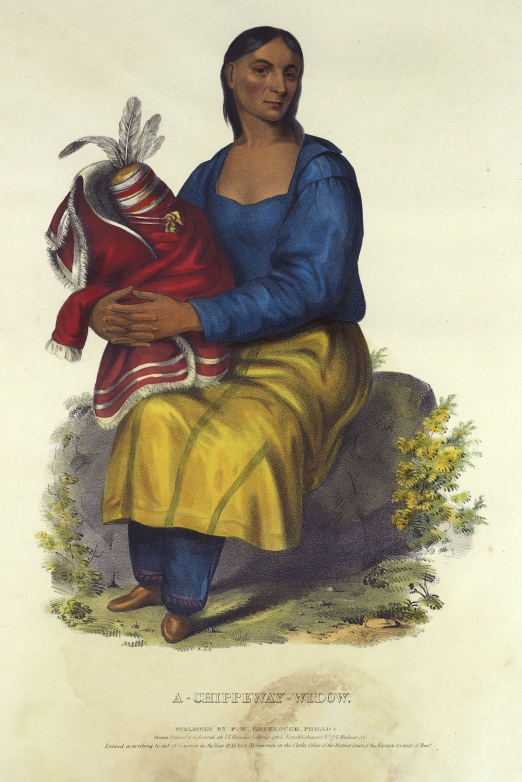
The Chippeway widow
The portrait of a Chippeway widow is a representation rather than the portrait of a known individual.
Illustration of ‘A Chippeway Widow’ from M’Kenney, T.L. History of the Indian tribes of North America, with biographical sketches and anecdotes of the principal chiefs. Embellished with one hundred and twenty portraits from the Indian Gallery in the Department of War, at Washington (Philadelphia: Edward C. Biddle, 1837) (19th Century Collection, 19th C. Coll 970.1 MAC Elephant folio)
Extract;
“A Chippeway widow, on the death of her husband, selects from his scanty wardrobe, a complete suit of his best clothes, which she makes up into a bundle. This is placed near her while at work, and is carried wherever she goes. She calls it her husband, treats it with the respect which would be due to a living lord and master, and would be considered as disgracing herself and treating his memory with disrespect, if she was to part with it even for a moment . . . . The Chippeway widow carries her “husband” during the season of mourning, which is one year, and during that time cannot marry without gross impropriety. If she does not marry at the close of the year, she usually continues to carry the badge of her widowhood until she is relieved of it by the nearest relatives of her deceased husband, who may at any time, whenthey conceive she has mourned long enough, call upon her, and take away the bundle, after which she is at liberty to contract a second marriage“.
(vol. 2)
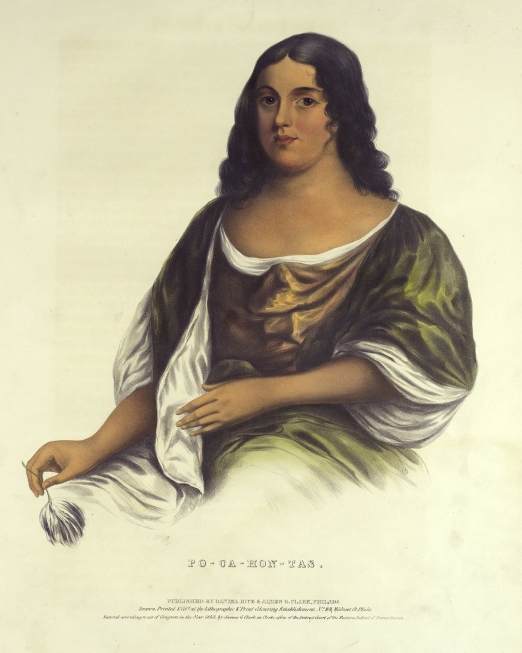
Pocahontas
Illustration of ‘Pocahontas’ from M’Kenney, T.L. History of the Indian tribes of North America, with biographical sketches and anecdotes of the principal chiefs. Embellished with one hundred and twenty portraits from the Indian Gallery in the Department of War, at Washington (Philadelphia: Edward C. Biddle, 1837) (19th Century Collection, 19th C. Coll 970.1 MAC Elephant folio)
Pocahontas (c.1595-1617) was the daughter of a Native American chief in Virginia. When English settler, Captain John Smith, described his capture by a Native American hunting party, he retrospectively credited Pocahontas as having saved him. The omission of her from his earliest accounts has made historians question the veracity of the tale but it has been established that she at least befriended Smith and visited the Jamestown colony, bringing food when it was most needed and playing with the children.Fiction romanticises the relationship between Pocahontas and Smith but there is no evidence that they were lovers. Captured by the English in 1613, she was taught about Christianity and baptised as Rebecca.
“Though born and reared in savage life, [Pocahontas] was a creature of exquisite loveliness and refinement. The gracefulness of her person, the gentleness of her nature – her benevolence, her courage, her noble self-devotion in the discharge of duty, elevate this lovely woman to an equality with the most illustrious and most attractive of her sex; and yet those winning graces and noble qualities were not the most remarkable features of her character, which was even more distinguished by the wonderful tact, and the delicate sense of propriety, which marked all the scenes of her brief, but eventful history.”
 Court Life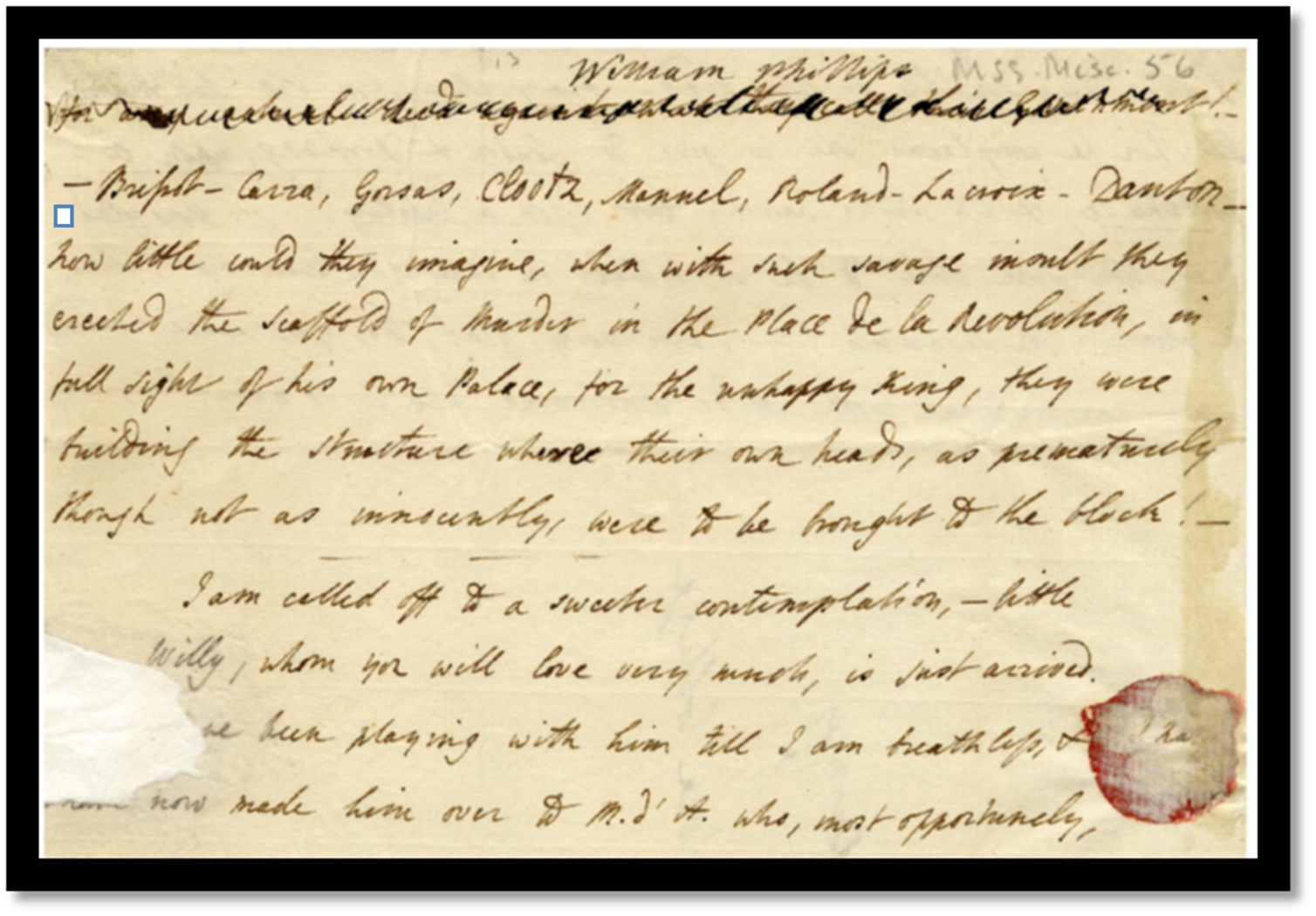








![[Mary, Queen of Scots] In the Royal Palace of St. James's an Antient Painting. 1580. Delineated and sculpted by G. Vertue (1735)](https://blogs.ncl.ac.uk/speccoll/files/2020/03/mary.jpg)