Going abroad may be a week’s holiday, or to some it’s going global or for longer, but have you ever thought about studying abroad as part of your Newcastle University degree? You could study abroad for a few weeks or up to an entire year, and it could change your perspective forever.
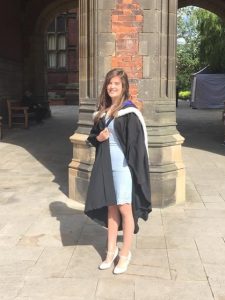
‘I can honestly say it was the best time of my life’– Eleanor (semester at Monash University, Melbourne)
Did you know you can study language modules for free at Newcastle?
By Ruth Harding, second year Biomedical Science student
I had a difficult time at home before I started at Newcastle university and I found that I was struggling to cope at points during my first year.
These are my top 5 tips to help improve your mental health while at university based on my personal experiences:
1. Access support
There is plenty of support available at uni, the first thing to do when you feel you are experiencing difficulties is to access the support that is available to you as soon as you possibly can.
I found the transition from sixth form to university to be a challenge especially when I was battling poor mental health at the same time. The university support I found to be the most helpful was my personal tutor and the student services team (student wellbeing). There is also an online CBT programme available to all Newcastle students here. There are also useful links and tips on the Ncl wellbeing app.
Family and friends form an important support network while at uni – me, Hannah and Cornelius.
As well as university support I encourage you to build a wider network, I do not think I would have got through the year without the support of my friends, and family.
By Charlotte Ripley – Food and Human Nutrition Student
A trip to Italy?! Yes please!
In June, I attended a Food and Health Summer School in Italy, mixing with students from the University of Padova and the University of Sydney.
The focus was on the effects of different food components on overall health and well-being, with topics ranging from the effect of soil on the micronutrient content of foods to the worldwide issue of obesity – so the week was specifically aimed at those with a medical or food science background. Thankfully, everything was taught in English, as even Duolingo wouldn’t have prepared me for terms such as ‘squalene’, ‘fetotoxic’ or ‘teratogenicity’.
Though the week was primarily lecture based, we visited 2 different food producers (Grandi Molini Italiani – one of Europe’s largest flour mills – and Prosciuttificio Attilio Fontana Montagnana – a family-run prosciutto factory) and got to see some of Padova’s biggest attractions (Orto Botanica, Palazzo Bo and the Museum of History and Medicine). We even had our very own gala dinner to celebrate the end of the summer school – luckily, the lectures didn’t quite put me off the free wine on the tables.
Prata Della Valle – just a 5-minute walk from my hotel.
Moving to uni can be lots of change for anybody. When you’re also living with a disability or a medical condition, getting through each day, let alone being able to study can be a challenge.
I’ve just finished my first year studying biochemistry and living and learning with physical disability has often been hard! I thought I’d share a few things that have helped, and so here are my practical top tips for starting university for those living with disability/long term medical condition.
Me on my scooter outside the med school
Get a Support Plan
A Student Support Plan (SSP) looks at all aspects of learning and possible adaptations that you may need, you get these from Student Wellbeing. Meet up with your disability advisor as soon as possible, the sooner you get this in place the sooner adaptions can be made. They will be aware of things you can utilise that perhaps you didn’t realise- for me that included creating a Personal Evacuation Plan (PEP) for when there were fire alarms! Continue reading “My top tips for starting university when living with disability or long-term medical condition”
With a flight ticket in my hand, I can still remember being so nervous and so excited at the same time before starting a new chapter of my life – university.
My big flight to the UK from Lithuania
“How did you handle that?” you may ask. Here’re my answers and top tips you.
It’s nearly the start of the new academic year and the School is buzzing as we prepare to welcome our new Stage 1 students – and of course to welcome back our existing students!
Dr Debbie Bevitt, our Head of School
We have an exciting year ahead, including a new name for the school and two major building developments which will provide much needed additional study space and specialist facilities for our students.
There’s an awesome placement / graduate role / further study position that you really want….
How do you succeed in getting it?
Answering those important questions
You will be asked questions, either in applications or interviews, to determine if you are the right fit for the role and how you would react in workplace situations.
Even if you’re unsure about doing a placement, investigate and prepare now – you can decide later not to do one but you do not want to regret not trying.
Kristi did her placement at GSK
“ I wasn’t sure I wanted to do a placement until I went for interviews and saw the facilities, from which point I was sold!”Kristi’s GSK placement profile
“I didn’t want to do a placement but having spoken to Dr Lawry I decided to put my CV in for one. I’m so glad I did as my placement has been brilliant!” Ellie – Fujifilm Diosynth placement Continue reading “How to find a year-placement”
I look at the screen and smile. After an intensive six-hour lab session involving lots of careful pipetting, I’m ecstatic that the experiment I’ve spent weeks on has succeeded at last.
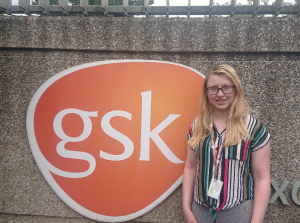
At the moment, I’m based in a biology research unit at GlaxoSmithKline (GSK), one of the biggest pharmaceutical companies on the planet. I’ve been on placement here for over nine months; I still can’t quite believe it some days.