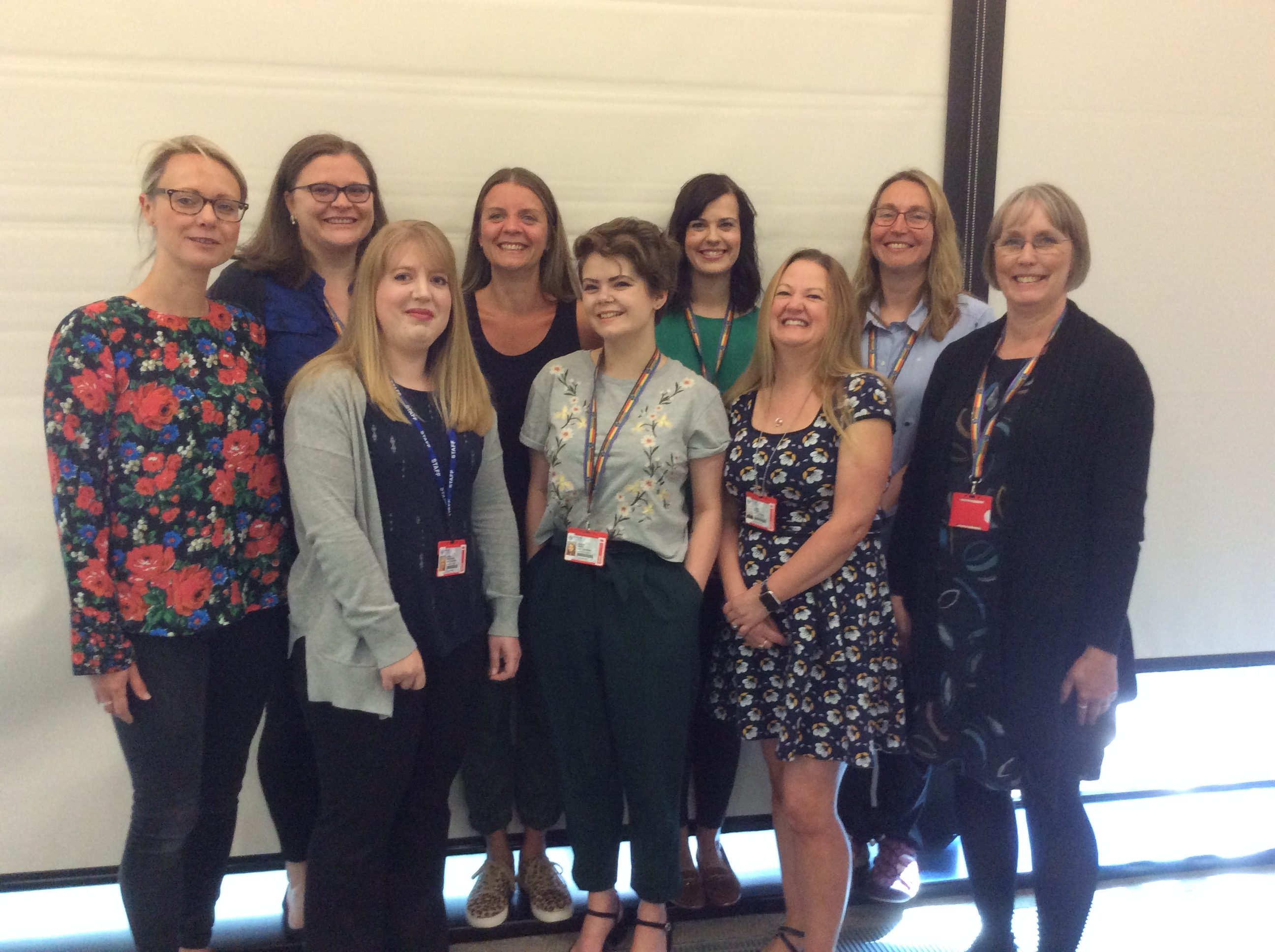
Dr Chloe Duckworth from the School of History, Classics and Archaeology has used engaging, bespoke online resources and a range of practical group activities to create a relaxed learning environment for her students.
Find out more from Chloe in the video below as she describes how she considers accessibility issues and ensures an inclusive approach to teaching.
If you are interested in reading more about Chloe’s case study or other case studies of effective practice take a look at the case studies website.
Professor Suzanne Cholerton, Pro-Vice-Chancellor, Education, introduces this brand new series of Education Strategy focussed events, showcasing ‘The Art of the Possible’.
This first week focusses on Technology Enhanced Learning given our commitment in the Education Strategy to an educational experience supported and enhanced by technology.
Find out more from Professor Cholerton in the video below.
All events and activities will be delivered in a light, fun and adventurous way and we are looking forward to engaging with colleagues from across the University. Take a look at the programme and find out how to register.
If you are interested in future ‘The Art of the Possible’ events and other learning and teaching news, events and case studies sign up to the learning and teaching newsletter.
Alistair McNaught, Subject Specialist, Accessibility and Inclusion
A long time coming…
Disability legislation has required organisations to make “reasonable adjustments” for disabled people since 1995. Unfortunately, the legislation did not define what a reasonable adjustment might look like. For the next 23 years, equalities legislation tried to improve the lived experience of disabled people, but without clarity about what was ‘reasonable’ it often failed. Many disabled students drop out of University courses not because the intellectual challenge is too hard, but because negotiating the basic resources is a daily uphill struggle.
The new public sector web accessibility legislation changes everything. For the first time ever it makes a concrete link between a failure to make a reasonable adjustment and a failure to meet the “accessibility requirement” for websites, VLEs and VLE content. The accessibility requirement for digital content is well established – so it’s very easy to tell if resources fail the ‘reasonable adjustment’ test.
Competence more than compliance
This does not mean not every teaching professional now has to become an accessibility professional, any more than an academic referencing a paper is expected to be an information professional. What it does mean is that professional communicators are expected to communicate using conventions and practices that minimise barriers. With a significant proportion of teaching staff having self-taught IT skills it’s little surprise that we don’t always know the best way to make our resources accessible. But the relevant skills are learned very quickly. They also benefit considerably more students than the 10% with visible or invisible disabilities.
Accessibility for everyone
For too many years, accessibility has “belonged to” the disability support team. This is as unrealistic as hygiene in a restaurant belonging to the chef, with nobody else having awareness of training. Higher education institutions have complex digital ecosystems and accessibility needs to be a ‘hygiene factor’ that threads through the organisation’s policy and practice. The encouraging thing is that the vast majority of accessibility is a combination of good design, good practice, good resources, good pedagogy and good procurement policies. What is there not to like?
Find out more
In the Education Strategy Series: The Art of the Possible, Alistair McNaught will work with different groups of staff in the University to try to do what accessibility should do for everyone: enlighten, empower, support and inspire. Bring your own experience, skill and ambition – the catalysts for culture change.
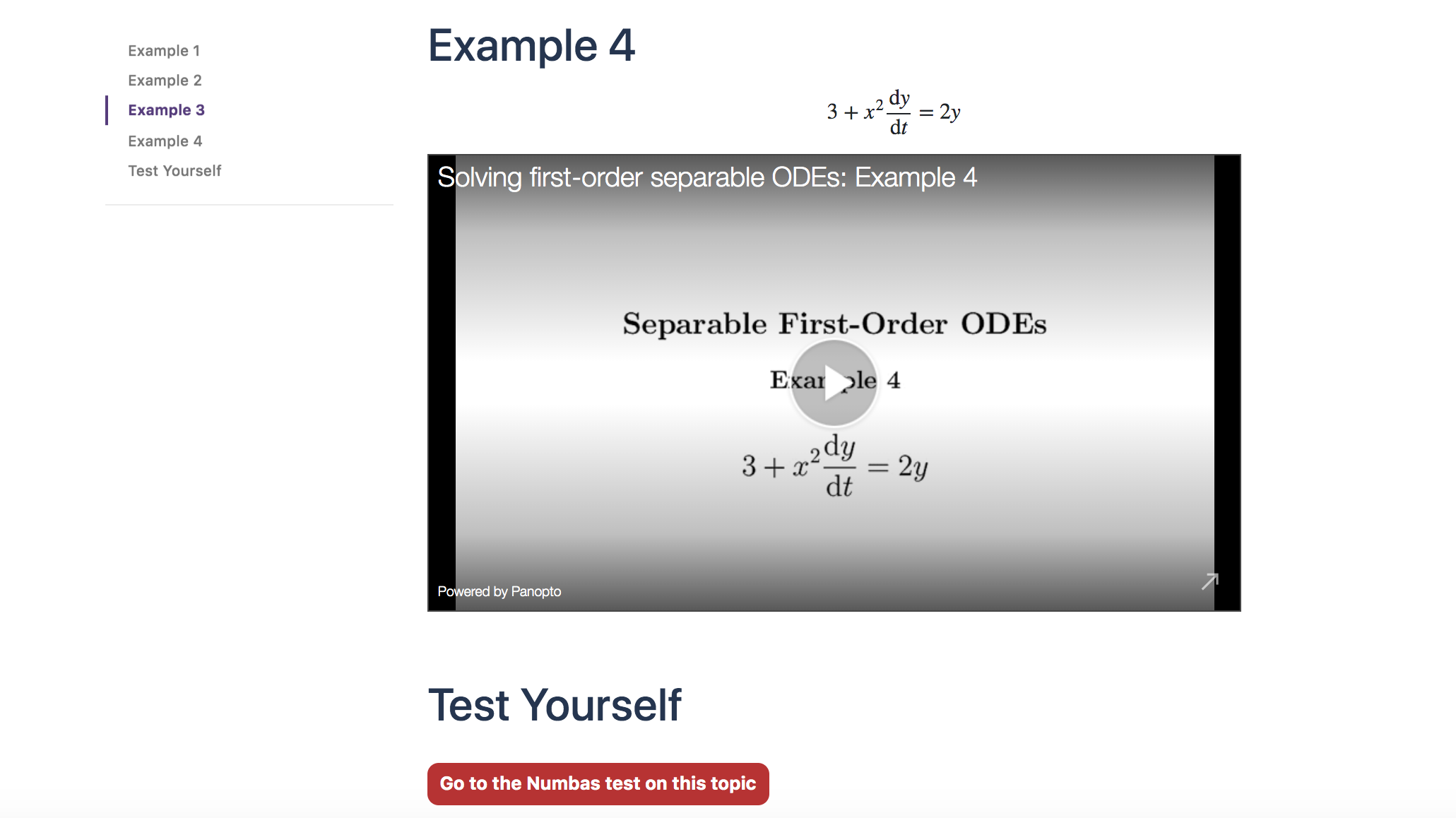
Whilst I’m normally on this blog talking about Numbas, this post is dedicated to something else that I take a keen interest in: lecture capture. It describes a pilot project that was funded by the NUTELA group to deploy short, re-purposed ReCap videos in a large engineering module. These were made available to students in addition to the full length ReCap lecture capture, and sat alongside formative tests associated with the content.
A disclaimer, before I go any further… this is a dump of my current thoughts on the topic, and it will save the next person who asks me about ReCap/short videos from suffering me talking at them for an hour! As a result, it’s part project report, opinion piece and tutorial! Despite lacking any focus whatsoever, I hope that you find something interesting…
Motivation
I have been interested for some time in the use of lecture capture. I originally wasn’t a fan, mainly citing a hatred of hearing my own voice! I have managed to get over that though, and spend a lot of time in computer clusters, where I see first-hand the benefits of ReCap for students. I am particularly fond of telling the story of asking a student which ‘psych-up’ music he was listening to on his headphones before a big class test… he was listening to me giving a lecture!
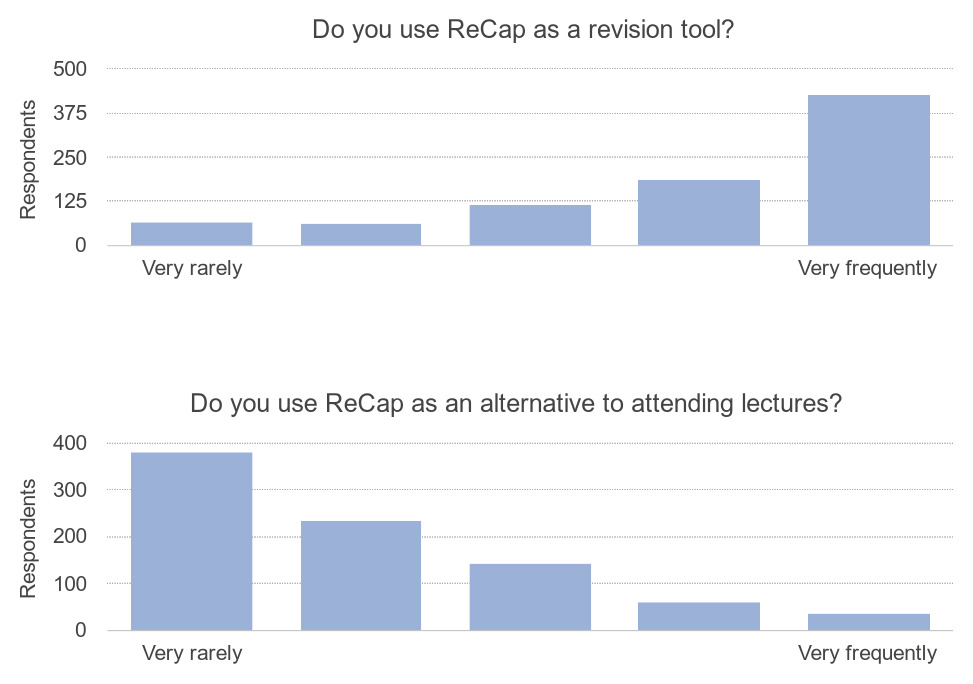
Whilst the opportunity to catch up on lectures is clearly very beneficial – in particular, as the associated report mentions, for students with disabilities and those competing in elite sport (and I’ll also throw in those with families or caring responsibilities) – it does not appear to be the primary use of ReCap. This aligns completely with what I see in our computer clusters, which is predominantly students using the resource to prepare for class tests and exams.
Let me reiterate that I’m a big fan of the ReCap provision, before going on to make the following two observations:
1) Our current set up of teaching resources is often very siloed within the VLE. Typically a module might have a separate Blackboard folder for each of lecture notes, additional resources, formative assessments, whatever else… and certainly the default is a separate folder of ReCap videos. But if students are revising a topic for an exam, putting practicalities aside, it seems to make sense for the video content on a topic to sit side-by-side with the other course material.
This was just one of the motivations for our course material tool “Coursebuilder” (which will be the topic of my next blog post here as it happens), to have a stronger integration between different course resources. And it is surprisingly easy (after discovering the method as part of this project) to embed videos next to your lecture notes in Blackboard itself. See the Process for creating videos section below.
2) Slightly more pertinent to this post, our ReCap videos are presented to students as a separate video for each teaching session. Again from a practicality perspective, this seems like the only sensible thing to do, but from the student perspective, is this box-set of lectures the best way for the “series” to be divided, if it is being used for revision? Often topics are split over multiple lectures, or multiple topics are covered in one lecture. In maths, the subject of this project, lectures often contain distinct sections of theory and application/exercises. The student might only be interested in one of those when they come to revise.
A note on the indexing of ReCap videos for mathematics… You may have noticed that ReCap videos containing PowerPoint automatically generate a list of contents. Panopto basically identifies section headings in the presentation. In mathematics, it is rare to see a PowerPoint presentation, they are usually delivered using the visualiser or whiteboard, or as a LaTeX document. Content information can be added, but only manually after the fact.
The Project
Last Spring, colleagues in engineering maths, David Swailes and John Appleby, approached me to discuss short videos in the ENG1001 Engineering Mathematics module. David had heard of the work of Professor Chris Howls at the University of Southampton, who had successfully used short personal capture videos to enhance a calculus course. We discussed several possible formats for short videos, including something on the lines of what Chris had done, but the nature of the ENG1001 module lent itself to a slightly different and straightforward approach: to re-use a previous year’s ReCap collection. This is because almost precisely the same module content has been delivered (very successfully) over a number of years; last year’s ReCap videos would be almost identical to this year’s.
The Art of the Possible: Showcasing Technology Enhanced Learning at Newcastle University
Professor Suzanne Cholerton invites you to engage with a brand new series of Education Strategy focussed events, showcasing ‘The Art of the Possible’. Over the next year we will be running theme weeks of activities, with each theme week focussing on one of the four key themes in the Education Strategy:
Adopting and developing approaches to education that actively engage students in their learning.
A research-intensive environment that adds value to the education of all students at all stages.
Developing students as the whole person by supporting and preparing them to shape the societies in which they will live and the professions they choose to enter.
An educational experience supported and enhanced by technology.
These theme weeks will showcase the wealth of innovation and effective practice already taking place across the University, as well as focusing on new developments within the University and across higher education.
The first theme week will take place 1-5 July 2019, focusing on Technology Enhanced Learning given our commitment in the Education Strategy to an educational experience supported and enhanced by technology.
There will be a range of face to face and virtual events and activities including online case studies and videos to look out for, taster workshops, guest speakers and lightning talks. All delivered in a light, fun and adventurous way but with a clear link to the Technology Enhanced Learning Roadmap and the Graduate Framework.
We will explore the practical aspects of accessibility, inclusion and creating a variety of online content, and we will hear about effective practice taking place within schools and services, from across the University. We are also pleased to welcome Alistair McNaught, Subject Specialist in Accessibility and Inclusion, Jisc on Thursday 4 July.
Find out more about each event below:
Monday 1 July
A video introduction from Professor Suzanne Cholerton will launch this exciting programme which will run each year for the next four years.
Tuesday 2 July, 10:00-11:00
Lightning talks
Join colleagues to explore approaches to creating accessible videos, alternative models of assessment, diversifying online exams, creating accessible and flexible teaching resources and using tablets in teaching.
Thursday 4 July, 10:00-11:00
Small changes, big impacts. How technology tweaks support inclusion: NUTELA 4Bs event
Alistair McNaught, Subject Specialist, Accessibility and Inclusion
This is a practical session with a mix of presentation and activities. We explore the power of pedagogical practice in making content more meaningful. We consider the ‘accessibility profiles’ of different media and formats and identify the small practices that make big differences. We end the session by looking at a series of ‘good practice screenshots’ across the sector and reflecting on your own practice and priorities.
Friday 5 July, 15:00-16:00
Accessibility in practice
We all invest time creating documents and presentations to support teaching and learning. How can we make sure these can be used by our diverse student population? Find out more in this interactive workshop.
We will be promoting a variety of Case Studies over the course of the week so keep an eye on this blog to find out more about teaching ideas from colleagues across the University.
Find out more
Sign up to the Learning and Teaching Newsletter for more information about The Art of the Possible and other Learning and Teaching news.
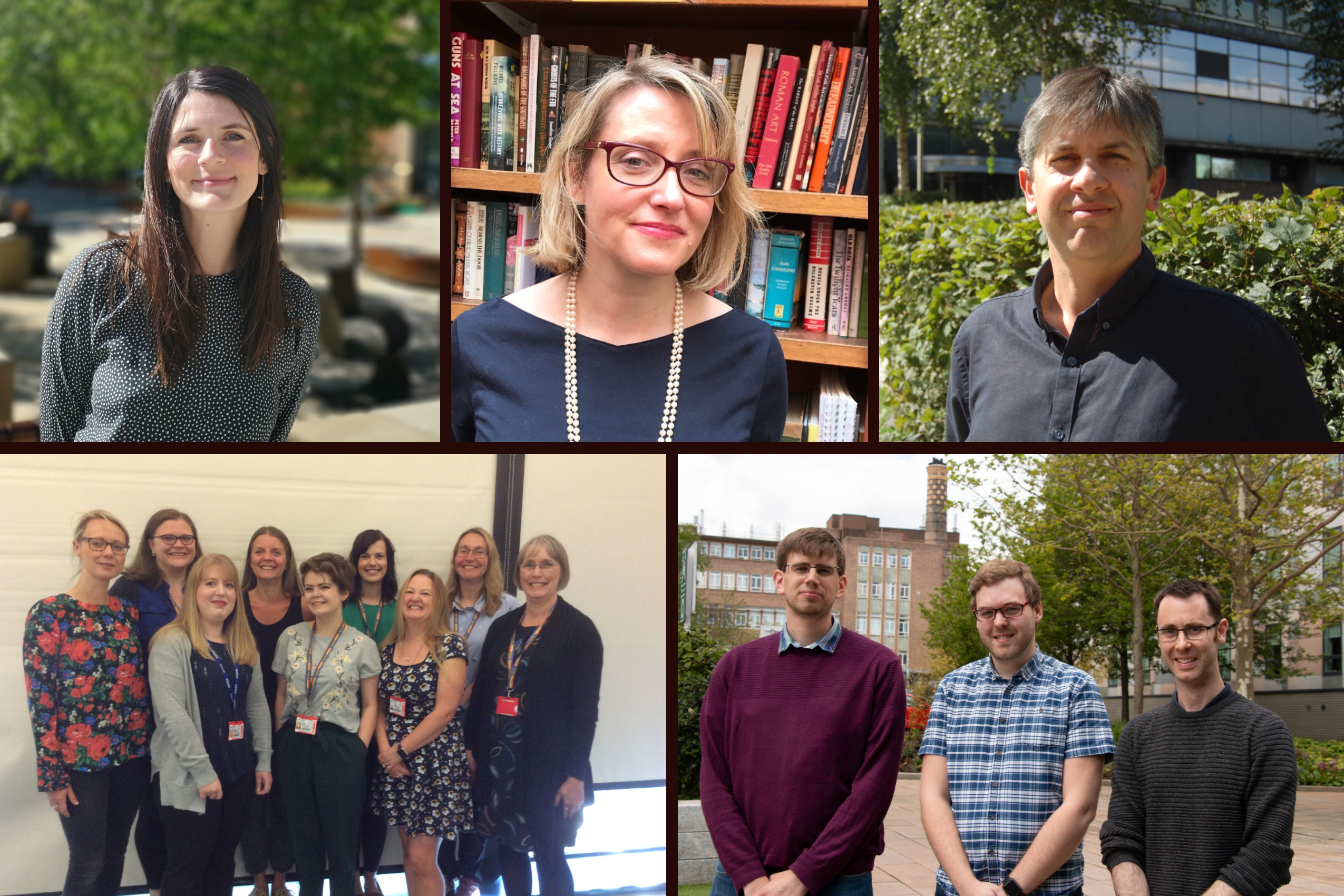
Congratulations to this year’s Vice-Chancellor’s Education Excellence Award winners who have demonstrated an exceptional commitment to enhancing our students’ educational experience.
The winning submissions evidenced impact and influence in a number of areas including, approaches to assessment, student representation, addressing gender imbalance in subject areas, student retention and success at a national and international level.
All submissions were considered by a panel chaired by Professor Suzanne Cholerton, Pro-Vice-Chancellor, Education. The high quality of the submissions was noted by the panel.
Professor Cholerton said, “The Vice-Chancellors Education Excellence Award is an opportunity to celebrate the outstanding work from individuals and teams enhancing our student educational experience. Five awards have been made this year out of a very competitive field of nominations. The panel were extremely impressed with the scale of impact, breadth of activity, and the creative approaches to education and educational support taken by all the awardees. ”
2019 Award Winners
Individual Awards
Dr Phil Ansell, School of Mathematics, Statistics and Physics
Dr Kirsten MacLeod, School of English Language, Literature and Linguistics
Dr Luisa Wakeling, School of Dental Sciences
Team Awards
E-Learning Unit, School of Mathematics, Statistics and Physics
Specialist Learning Team, Student Health and Wellbeing Service
Find out more about each of the award winners and what the award means to them below.
Dr Phil Ansell, School of Mathematics, Statistics and Physics
‘I am really pleased to receive the Vice Chancellor’s Education Excellence Award in recognition of the impact that some of my work has had on learning and teaching at Newcastle University. It is of particular pride that projects spanning the entire student journey, from outreach and recruitment to enhancing careers and employability were highlighted as exemplars of good practice by the panel. I look forward to working with students and staff in the future to ensure that we continue to deliver an outstanding and inclusive educational experience for all.’
Dr Kirsten MacLeod, School of English Literature, Language and Linguistics
‘It is an honour to receive the Vice Chancellor’s Education Excellence Award in recognition of my aim to foster and promote innovative teaching and assessment practices. I am indebted to and inspired by many creative, committed, and risk-taking colleagues in the School of English Literature, Language and Linguistics, and grateful for the wonderful support offered by a Faculty and University so committed to positive change.’
Dr Luisa Wakeling, School of Dental Sciences
‘Enhancing relevance and value in all activities that students undertake is of great importance to help them flourish beyond the University and achieve their professional goals. I have the privilege to work with amazing students who engage with the University, beyond their curriculum, in representing and enhancing the experience of their peers. The skills they develop through Academic Student Representation will be highly relevant in any workplace. I am thrilled to receive this distinguished award that recognises my work in supporting our students with opportunities to acknowledge and evidence their fantastic extracurricular work for their future.’
E-Learning Unit, School of Mathematics, Statistics and Physics
‘We are absolutely delighted to receive the Vice Chancellor’s Education Excellence Award, in recognition of our team’s contribution to supporting student learning in the School of Mathematics, Statistics & Physics and beyond. A solid foundation in mathematics is vital to so many subjects areas, and this award will help us in continuing to build new relationships with colleagues across the University who are involved in the learning, teaching and assessment of mathematical subjects.’
Specialist Learning Team, Student Health and Wellbeing Service
‘It is recognition of the significant support we provide to underpin the learning experience for students with Autism Spectrum Disorders/Aspergers, and confirms our approach to offer holistic programmes of support fits with University’s vision to provide all students with an inclusive student experience.’
All winners will receive their awards at a congregations ceremony in July and will also be recognised at a University Celebrating Success event. The will also receive funding to support future educational activities.
Next year’s Vice-Chancellor’s Education Excellence Awards will open in February 2020 and full details about the application process will be published on the LTDS website.
If you have any questions about the award, please contact LTDS@ncl.ac.uk
Alison Clapp, Lecturer, Faculty of Medical Sciences Graduate School
Thanks to NUTELA funding my travel, and the FMS Graduate School funding my attendance, I spent two days in Bristol University last summer listening to what other universities (and Newcastle too!) are doing to enhance their students’ learning. Overall it emphasised the practicalities with many presentations on enhancing feedback, technology enhanced learning and student wellbeing. Here is a flavour of the conference:
There was much about student mental health which, in my role with older, part-time, distance students, is not something I have paid much attention to. We should be considering this…. the government is going to make it mandatory for undergraduates (‘UK Step-Change Framework’) and we do need to show we are thinking about it for postgraduates including our online students. We are not meant to be qualified counsellors, but we do need to flag up problems and communicate with students about them including suggestions for getting professional help. The keynote speaker, Fabienne Vailes, will be at the Three Rivers Conference in September. Continue reading “NUTELA Small Grants Fund: Enhancing student learning through innovative scholarship conference, Bristol 2018”
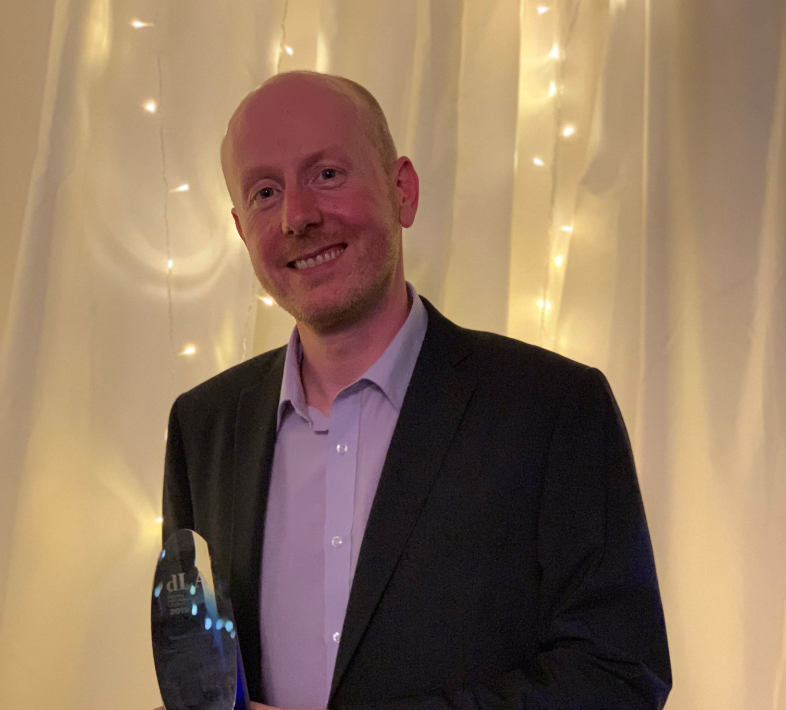
Congratulations to Terry Charlton who won a LILAC Digital Award for Information Literacy 2019.
Terry won the award for his fantastic work in the University Library Liaison team developing Newcastle University Library’s Online Learning Resources.
What did the project involve?
The project started with in depth consultation with students. This highlighted a preference for rich media and short, focused videos that could be viewed on a range of devices when students needed them.
After listening to student views a number of videos were produced to cover information literacy skills areas such as literature reviews, finding information and evaluating information. Attention was paid to the style of these videos which included background illustrations and animations. Other team members were the friendly face of the videos, which involved a bit of green screen acting. Take a look at one of the videos below:
The second phase of the project included the development of a new search planner tool which is a step by step approach to planning a literature search. This results in a personalised search strategy and can be shared with others, for example supervisors or the library liaison team.
Project successes
Over 9000 views of the videos in the first 6 months
94% of survey respondents rated the videos as ‘very good’ or ‘outstanding’
Greater student understanding of information literacy issues
Using a flipped classroom approach enabled lectures to focus on areas where students demonstrate less understanding
A fivefold increase in visits to dissertation pages
The resources are accessible, responsive, device independent and mobile friendly.
Find out more
Terry has recently moved to work in the Learning and Teaching Development Service and if you want to find out more you can contact him at terry.charlton@ncl.ac.uk
Delegate registration is open for the Researching, Advancing & Inspiring Student Engagement (RAISE) Conference.
Student participation is particularly welcomed (students pay a very low fee). This year there is a two day format but this is followed by a Development Day on the 6th with workshops and SIGS at the same venue.
The conference aims to offer a forum and platform showcasing practice and research about, student engagement (SE) and working in partnership. Staff in all roles, all students, and others interested in university and college higher education are welcome.
There are over 100 presentations and keynotes from Cathy Bovill, Brice MacFarlane and Colin Bryson.
There is still capacity for posters (those accepted will benefit from the presenter discount).
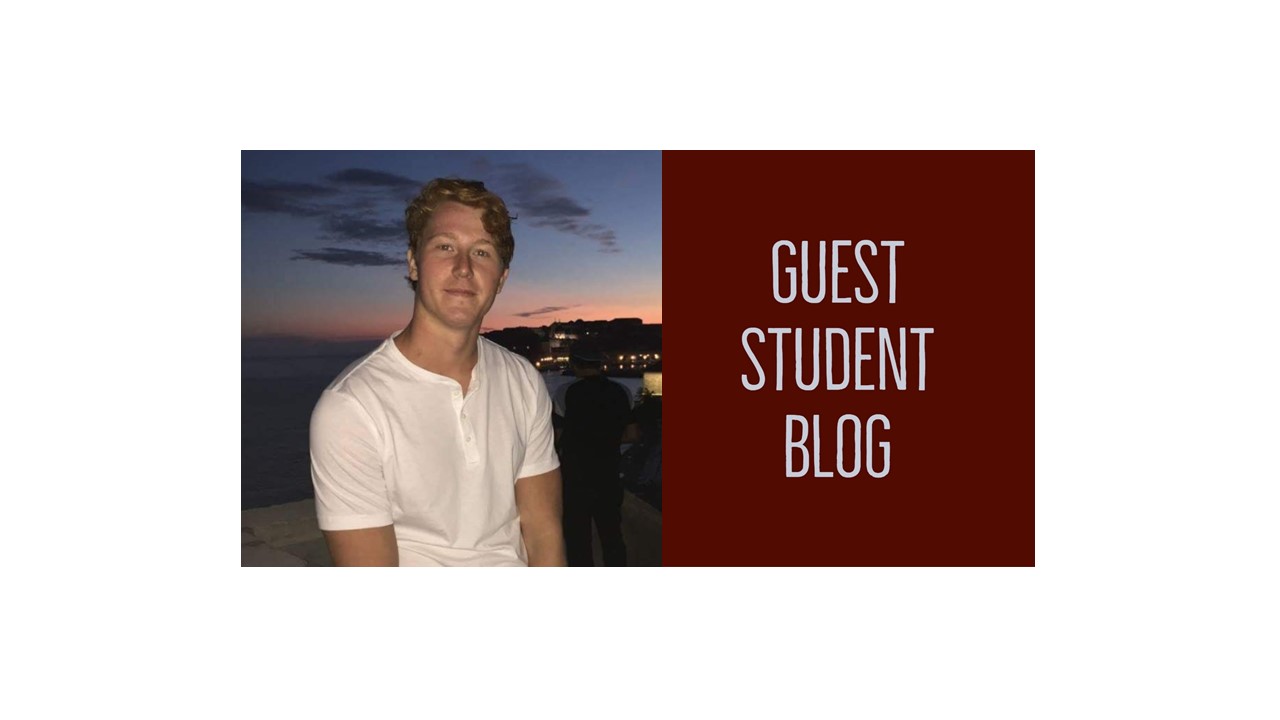
Ján Dixon, from the School of Medical Education was one of the 12 students who successfully applied for funding to attend the conference. Ján presented his research to fellow undergraduate students on the day. Read more from Jan below.
I applied for BCUR19 and was lucky enough to receive a scholarship from Newcastle University to attend. I submitted an abstract to BCUR because of the impact of presenting to such a large and diverse audience. The opportunity to present to an audience outside of the research field allows for an excellent shared learning experience; encouraging the presenter to distil the essence of their work and the audience to explore topics outside of their subject.