REF 2029 Open Access Policy – updates for 2026

The REF (Research Excellence Framework) 2029 Open Access (OA) policy details the requirements for making eligible research outputs open access during the REF 2029 assessment period between 2021 and 2028.

The OA policy applies to journal articles and conference proceedings with an ISSN that are published after 1 January 2021. It does not apply to any other research outputs, such as chapters, books, data, etc, although REF encourages researchers to move beyond the minimum requirements and apply open practices where possible to all outputs.

For inclusion in the REF OA submission, a version of the published article must be made open access, i.e. deposited, made accessible and discoverable, within the expected timeframes. The guidance for outputs published after 1 January 2026 has been updated, and the table below summarisies the key details.

 REF 2021 Open Access Policy guidanceREF 2029 Open Access Policy guidance
Published between1 January 2021 to 31 December 20251 January 2026 to 31 December 2028
Depositthe author accepted manuscript (AAM) must be deposited in a repository within 90 days of acceptancethe author accepted manuscript (AAM) or version of record (VoR) must be deposited in a repository or suitable platform within 90 days of publication
Accessiblewithin 30 days of publication or of an embargo period once published or at end of embargo period
Licenceminimum requirement CC BY-NC-NDCC BY, but CC BY-NC or CC BY-ND or equivalent permitted
Permitted embargo period12 months for papers submitted to Panels A & B 24 months for papers submitted to Panels C & D6 months for papers submitted to Panels A & B 12 months for papers submitted to Panels C & D
ExceptionsSpecific exceptions are definied in the REF 2021 exceptions sectionSpecific exceptions are definied in the REF 2029 exceptions section

Outputs made immediately open access on publication, provided they meet the deposit, access and licence criteria, will meet REF OA requirements. Note, there is no expectation that additional open access publication costs are required to meet REF 2029 OA policy requirements.

We advise that Newcastle University authors continue to deposit their AAM in our institutional repository as soon as possible after acceptance. Following deposit, the open access team will review uploaded manuscripts and contact authors to discuss any issues in meeting the open access requirements for REF. In line with the University Research Publications & Copyright Policy, for any articles published after August 2023, the AAM will be made available open access in the University’s repository under a CC BY licence, on the article publication date, unless an embargo is required (see above for permitted embargo periods).

Detailed instructions of the policy requirements and how to make your paper REF eligible are available on our Open Access for REF page. Some exceptions to the policy are permitted for outputs that do not meet the OA requirements, details of how to apply for these are also shown on that page.

For more information or to arrange a discussion, please contact openaccess@ncl.ac.uk.


*The author accepted manuscript (AAM) is the version after peer review and containing all academically necessary changes, but before publisher copy-editing, proofing and typesetting of the peer-reviewed accepted manuscript.

UKRN Open Research Survey

The UK Reproducibility Network (UKRN) has published the findings of its 2025 Open Research Programme (ORP) Survey, providing detailed insights into the prevalence open research practices such as data sharing, preregistration, open code, and open access publications, alongside attitudes and perceived barriers to open research adoption from across UK higher education, including Newcastle University.

This post presents a summary of findings from the aggregated national survey and reflections on our institutional results at Newcastle University.

Aggregated report

The UKRN survey report presents data from 1408 respondents across 19 partner institutions and is available at: https://doi.org/10.5281/zenodo.18711621

Key findings include:

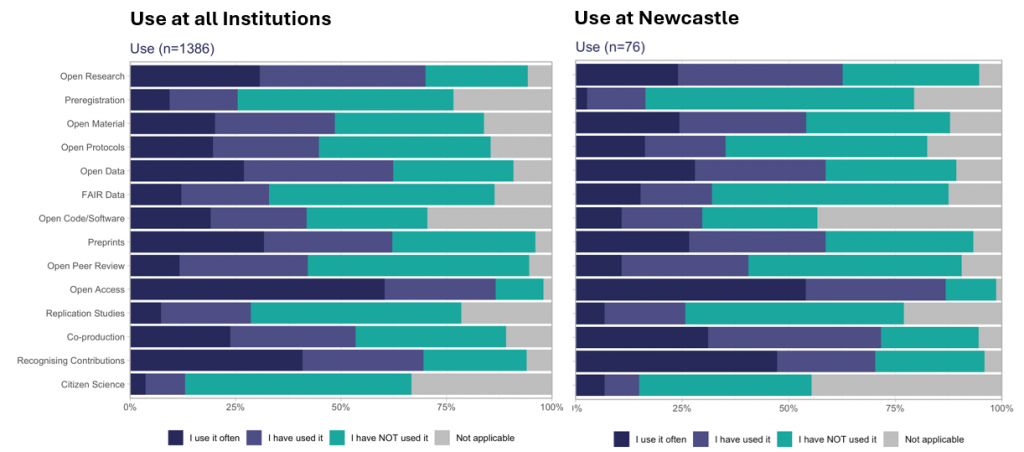
  • Awareness and Use: Awareness of OR practices is high overall, but uptake varies. Open access is near-universal (99% awareness, 86% use), while preregistration and citizen science awareness/use are lower (55%/25% and 66%/13%, respectively). Awareness of FAIR data is the lowest of any OR practice at 51%. Disparities between awareness and use are greatest for replication studies, citizen science, and open code/software, suggesting persistent barriers.
  • Disciplinary and Career Differences: Quantitative and mixed-methods researchers report higher engagement than qualitative researchers, and uptake is generally greater in scientific disciplines than in arts and humanities. Senior researchers show higher awareness and use, though junior and mid-career researchers express strong motivation to engage more.
  • Attitudes: Most respondents view OR as useful (80%), but only 42% feel their institution provides adequate training. Only 18% of respondents engaged with OR in hiring and promotion of staff.
  • Facilitators: Practical enablers—guidance, infrastructure, time allocation—are prioritised over cultural drivers.

Results from Newcastle

Our survey was conducted between May and July 2025. We invited responses from a random sample of 10% of research colleagues and PGRs, stratified for representation across disciplines and career levels. It was sent to 503 recipients and 77 responses were received (15% response rate). Respondents represented 19 disciplines, with 31.2% primarily using quantitative research methods, 22.1% qualitative and 41.6% both. 36.4% declared their career stage as ‘junior’, 28.6% as ‘mid’ and 32.5% as ‘senior’.

Our results showed similar trends to those in the overall survey. Awareness of OR practices was relatively high overall. It was generally higher among those using quantitative methods compared to those using only qualitative methods, with the exception being co-production. Awareness was also generally higher in health and biological sciences and physical sciences disciplines than in arts and humanities and social sciences.

Use of open research practices largely mirrored awareness. Open access publication is used almost universally. Co-production, recognising contributions, preprints and open data are also widely used. Preregistration, replication studies and citizen science are less commonly used. Sharing of code/software is perhaps lower than expected given its broad potential applicability and relatively high levels of awareness.

Attitudes to open research were broadly positive with most respondents stating they feel it is useful and that they wished to engage more with open practices. However, we still have some work to ensure appropriate training, support and recognition across methodologies and disciplines before open research can become normalised.

We will use these findings to further improve our open research training and support and to target new interventions where they are needed to achieve that.

If you’d like to find out more you can download a PDF of our full institutional report.

What’s happening in Library Research Services: March 2026

Members of the Library Research Services (LRS) team continue to be on hand to support you with any Open Research, Research Data and Open Access training and queries you might have. Get in touch at lrs@ncl.ac.uk.

Open Research events happening at Newcastle University in March:

Open Research events happening elsewhere in March:

Check out the library calendar for further courses and dates in 2026.

What’s happening in Library Research Services: February 2026

Members of the Library Research Services (LRS) team continue to be on hand to support you with any Open Research, Research Data and Open Access training and queries you might have. Get in touch at lrs@ncl.ac.uk.

Open Research events happening at Newcastle University in February:

Open Research events happening elsewhere in February and beyond:

Check out the library calendar for further courses and dates in 2026.

Upcoming research data management training

If you are involved in research, even to a small extent, you may benefit from attending training offered by the Library Research Services team.

On the 12th February 2026, between 11:00 and 13:00, there will be an online, practical training workshop for research data management. Attended by over 60 researchers in the last year, ‘Introduction to Writing a Data Management Plan’ is suitable for colleagues new to research (in various roles) and for those of you who may wish to refresh their memory and renew their day-to-day data practices.

Suitable for all disciplines, this session encourages you to think about what underpins, helps others understand, or validates your research claims and publications. It will include a live demonstration of DMPonline, a web-based tool designed to help you write, or update, your data management plan and you will have the opportunity to start outlining your own plan. We will provide considerations for the individual sections of a data management plan (DMP):

  • Outlining and detailing your data.
  • Data collection methods, consistency and quality assurance.
  • Metadata and documentation. How will you ensure your continuous understanding of your own work. How will others be able to make sense of it?
  • Ethical and legal considerations.
  • Short-term, active project storage.
  • Long-term storage, sharing and preservation. This will include information about the university’s repository, finding alternative repositories and staying compliant with funder requirements.

These training sessions are run a few times each academic year and we try to provide a mix of in-person and online training. For more information about the support we provide, please visit our website.

Coincidentally, this training session will take place during everyone’s favourite celebration, Love Data Week. So, what better time is there to think about your research data?

Sign up to the training.

You can also explore other Library Research Services training sessions.

Outdoor Singing in Modern Britain – Latest UKRI funded open access book

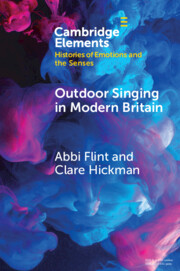
Book cover for Cambridge Elements: Histories of Emotions and the Senses. Outdoor Singing in Modern Britain. Abbi Flint and Clare Hickman

Outdoor Singing in Modern Britain – A Sensory and Emotional History by Abbi Flint and Clare Hickman, Reader in Environmental and Medical History at Newcastle University, has been published open access in the Cambridge University Press series Elements in Histories of Emotions and the Senses.

The work brings together historical sources and contemporary experiences to explore the interplay between singing, sociality, body, and meaning in the English landscape over the past century. It explores the connections between air and song and between singing and movement, through the context of the early twentieth century open-air recreation movement. This is supplemented by recent literature on singing and wellbeing, and the experiences of a contemporary walking choir captured via interviews in the field. The authors argue that outdoor singing has been part of co-constructed soundscapes of the modern English leisure landscape, and ask what this meant for those who participated in collective open-air singing and rambling. They explore how open-air singing connected with conceptions of the countryside, with a sense of fellow-feeling, and how this might have both reified and challenged normative ways of being in landscapes.


This is the fifth book published at Newcastle University as a result of the UKRI open access policy for long-form publications, with open access costs covered by UKRI funding.

Of the experience, Clare Hickman (co-author) had the following comment:

[T]he process was very straightforward and quick, and it is good to know that non-traditional monographs are included in the UKRI policy.

For further details of the previous books published through this funding scheme, follow the links to the published works and related blog posts:

The UKRI open access policy aims to ensure that findings from research funded by the public through UKRI can be freely accessed, used and built upon. The policy applies to peer-reviewed research articles and long-form outputs, namely book chapters, monographs and edited collections.

Full details of the UKRI open access policy and how Library Research Services can support making outputs open access can be found on our UKRI Policy for long-form publications page.

If you have any questions or concerns about the policy, and how this might affect any current or future publications, please contact openaccess@ncl.ac.uk.

Embracing the Complexity – how do we get to 100% OA?

In September 2025, I was given the opportunity to attend the OASPA Conference, held at the Irish College Leuven, Belgium. The conference promised a range of perspectives on the current open access (OA) landscape and how to move forward towards a goal of 100% OA. The sessions involved a lot of passionate discussion, considering the differing attitudes and priorities of stakeholders, from commercial publishers to non-profit publishers and open platforms, librarians and academics, and policy makers, and how ideas vary around the world.

In this post I reflect on how such topics as funding, policies and equity in OA can be addressed, and what that might mean for the work we do at Newcastle.

Themes

The core questions around OA of why, what for, for who and how ran through all the sessions, and with that some key areas emerged:

  • Power and responsibility

The conference opened with a panel discussion looking at ‘Who owns open knowledge?’. The discussion was focused on the idea that, following the Universal Declaration of Human Rights, article 27, access to knowledge is a human right, but not everyone has access to or benefits from the knowledge that is produced. 

With international contributors, we heard of the different priorities involved and how that shifts the power and who sets policies and rules around OA. With changes to priorities, there can be risks and costs involved, and not everyone is in a position to embrace those risks. This may be due to paywalls, censorship and gatekeeping of information, as well as global inequity and lack of infrastructure.

  • Transitioning to 100% OA

The session entitled ‘Complexity and impacts of transitioning from hybrid to 100% open access’ brought together commercial and not-for-profit publishers to discuss Read & Publish (R&P) deals, often called transitional agreements, to consider if they are suitable for the current OA landscape. While they work for some journals and publishers, there was a consensus that they don’t work for all. Article processing charge (APC) based models require someone to pay for the publication, and globally there’s an increase in publishing, but there is not an increase of money in the system. There’s also a lack of trust, as seen by fully open access publisher in the session ‘Views from fully open access journals using APCs’ as people question the costs and charges involved and look for transparency in the process.

Publishers are trailing different models, such as subscribe to open (S2O) and diamond initiatives, and also looking beyond the article, to where value can be added throughout the research. One session considering scaling inclusive OA models, including representatives from non-profit scholar led initiatives. There are established platforms, such as Open Journals Collective, who are working with communities to build awareness, as well as platforms, such as BioOne, acting as aggregator for society publishers and offering mixed models, to present scalable alternatives to APC models.

Trust continues to be an issue, e.g. from high APCs and predatory publishing. New models can be considered risky, and a lot of work in diamond and scholar led publishing can be undervalued. In order to grow and develop, diamond models may need to think in a commercial way, with sales and marketing and development etc, so they can compete with big publishers and the expectations from libraries and the research community.

  • Equity, Inclusion and global voices

Throughout all the sessions, the globalisation of research outputs was highlighted. There were informative talks from representatives across the globe, including China, Japan, Canada, India, Australia, USA, and the Netherlands, focused on their various OA policies and publishing practices. Through these we heard of the differing priorities, depending on, for example, government involvement, availability of funds to pay APCs or build infrastructures, and how these affect the attitudes of researchers. Periods of political uncertainty also bring challenges, e.g. in the USA currently, and this adds to the confusion and trust issues around making work open and that it will remain accessible.

Publishers have seen an increase in research outputs, including from countries that don’t have or haven’t developed OA policies and infrastructure, and with this brings challenges of global diversity and economy. The increase in publishing is not matched with an increase of money in the system, in part leading to the question of if all the outputs need to be published in journals, and if this the best way to disseminate the information.

In some fields, there continues to be uncertainty with self-archiving / green open access, despite evidence of benefits, and so authors continue to choose to publish gold open access, perhaps out of perceived publishing safety or lack of awareness of their options.

  • Incentives

One session was directed toward ‘Depressurising Publishing’ and researcher incentives and integrity on the journey to 100% OA. The idea of ‘publish or perish’ was reviewed, with research assessment typically based on journal outputs, driving an increase in publishing output and adding pressure into the system. Many academics also expect to peer-review work, but may not have sufficient time, guidance or reward for doing so. Following this, another panel session looked at the role funders and their mandates have on OA. Through the global perspectives of the panel, we heard how funder mandates provide a strong incentive to get people to deposit OA, as change is often brought about by external influence, but there is a lack of personal incentive, and this often results in complying for the sake of complying.

The Keynote speaker from the Wellcome Trust gave the example of how their policy has changed and adapted over time, with different publishing models and external factors. They addressed the need to embrace multiplicity and diversity in the system, and how they’re trying to do this while maintaining their primary focus on improving the dissemination of information relating to health.

Therefore, there is a need to look away from mass production with ‘quantity over quality’ but to cultivating the knowledge, providing context, attribution, history and understanding. With that, we need to ensure that those certifying the knowledge are the most appropriate, leading to a call for being transparent and using community driven frameworks of responsible openness, such as DORA and CoARA, and considering CRediT and FAIR principles. These are practices we support at Newcastle.

  • Libraries Role

The final session considered the role of ‘The library at the heart of the open access transition’. This looked at the day-to-day challenges faced by libraries when navigating the OA and scholarly communication landscape for the benefit of researchers, while managing the funds available.

It was noted that because of different priorities, there can be a lack of collaboration and clarity. Libraries are entrusted with funds to support scholarly communication, but budgets are being reduced, and services rationalised. Academics are often focused on the short term, e.g. with career progression, and Publishers are traditionally looking at knowledge as something to sell. For things to change, libraries may need to have a louder voice, as it is not just about managing APCs and funding, it’s about understanding what researchers want and how the library can best serve and advocate for that.

Conclusions

The open access landscape has changed and developed over the years, and there is still work to be done, both institutionally and globally so that everyone can benefit from OA content. Conferences such as this from OASPA allow people to have open discussions, bring awareness, share experiences and provide opportunities for future collaboration. From the discussions and themes presented, we can see that there are challenges ahead to reduce the burden for researcher, while helping them to take ownership of their work, as well as a need for greater transparency across all areas.

I will be reviewing the training offered around OA to share the discussions and case studies heard at the conference. We will continue to evaluate the agreements offered by publishers to ensure that they’re offering the best deals for colleagues at Newcastle, and we are investigating and looking to investing in non-APC models, where they align with our core values.

What’s happening in Library Research Services: Autumn 2025

Members of the Library Research Services (LRS) team continue to be on hand to support you with any Open Research, Research Data and Open Access training and queries you might have. Get in touch at lrs@ncl.ac.uk.

Coming up in the following months:

September
October
November

Check out the library calendar for further courses and dates in 2025/2026.

Photo by Jeremy Thomas on Unsplash

Open Access Support Sessions in 2025/26

Are you looking for advice and information on open access or managing publications? Come to one of our monthly drop-in sessions and meet members of the Library Research Services team, who will be happy to answer questions on:

Whether you’re a seasoned researcher, student or simply keen to explore the possibilities within open access, this session offers a welcoming space to ask questions, gain insights and delve deeper into the realm of open access.

These are informal sessions, however, registration is required for you to receive the online teams link. 

All are welcome!

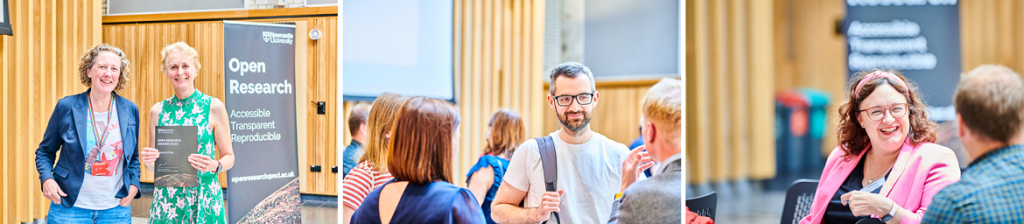
Open Research Awards 2025

We’re delighted to announce that the Newcastle University Open Research Awards for 2025 are now open.

The Open Research Awards recognise colleagues and students who have used open practices to make research more accessible, transparent or reproducible, and demonstrate an understanding of the aims of open research.

The awards are open to all students and colleagues working in any research-related role, at any stage, within any area of the University. We encourage applications from researchers in any discipline, including those where open research is not yet the norm, and who may use qualitative, quantitative or creative practice methodologies. 

The winners will be announced at a celebration event and presented with a bespoke award created by the University’s glass blowing workshop, as well as a certificate and letter of commendation to recognise their contribution to building a more open research culture.

Important Dates (2025)

  • Submission closes: Nov 7th (17:00)
  • Panel shortlisting:  Nov 17th
  • Celebration event: Nov 24th (12:00-14:00)