

Rights Retention: Where We Are In 2026

Since its introduction in 2022, the Newcastle University Research Publication and Copyright Policy, also known as our Rights Retention Policy (RRP), has enabled our authors to make their research journal articles and conference proceedings openly available, at no cost, with no embargo, under an open licence. The RRP ensures researchers can retain the rights to their work whilst meeting funder and REF open access policy requirements via dissemination in a repository while publishing in a journal of their choice. 

Under the RRP, Newcastle University authors grant the University a non‑exclusive, irrevocable, worldwide licence to make their Author Accepted Manuscripts (AAMs) available under a Creative Commons Attribution (CC BY) licence. Authors self-archive their manuscripts, which are then made publicly available in the university repository on the date of first online publication. 

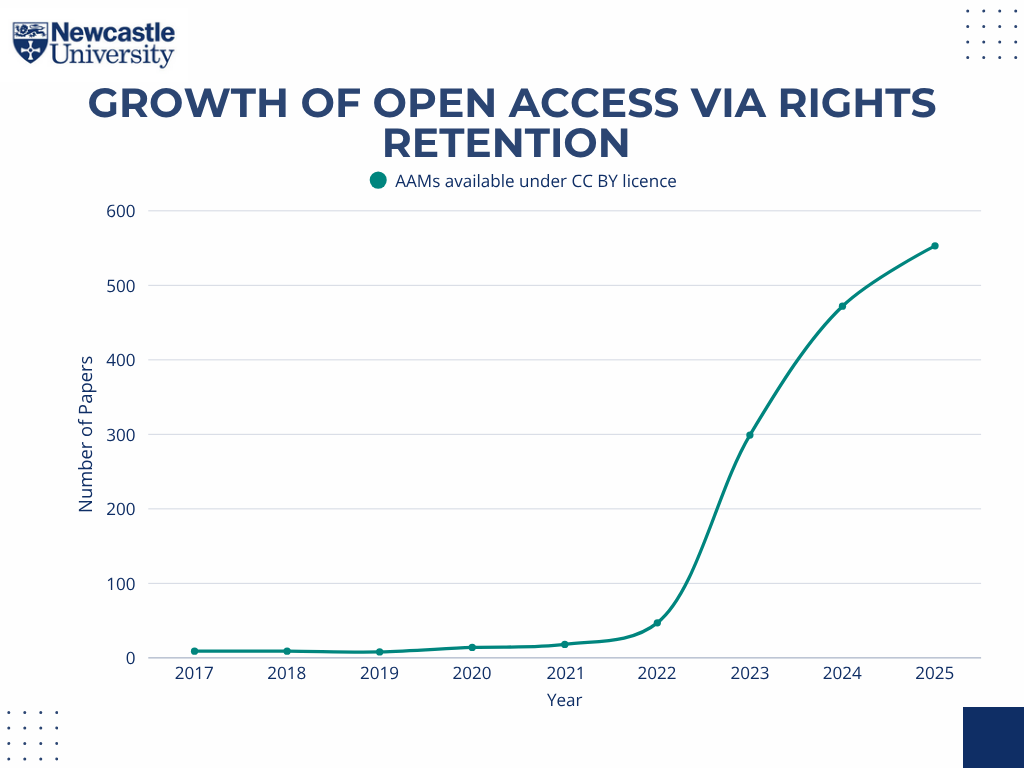
Through consistent monthly reporting, we are able to demonstrate the growth in the number of research outputs made openly accessible in our repository via the RRP, since the launch in 2022. This allows us to track how Rights Retention has supported an increased volume of article deposits over the past four years.  The chart below highlights this progression, illustrating both the scale and the steady upward trajectory of openly available research articles produced through research connected to the University. Since the policy’s implementation, to date, we have been able to make 1,369 AAMs available under a CC BY licence. These numbers reflect the dedication of our research community, the effectiveness of our open‑access workflows, and the value of authors retaining the rights to share their work openly.  
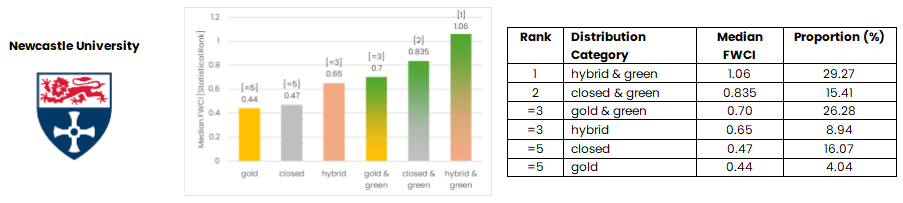
Research carried out by University of Liverpool explored the field weighted citation impact (FWCI) of journal articles, from 2021-2024, across the N8 Research Partnership, for different open access categories, including the impact of having a ‘green’ version of the paper available in a repository. 

Across all eight N8 institutions, green (AAM) and hybrid/subscription open access papers consistently came out on top as the most highly cited. Articles that were published and had a green version available had more citations that those without a green version. 
Credit: University of Liverpool 

The analysis brings together data from several sources: Web of Science to identify corresponding authors, OpenAlex to check for repository versions, and Scopus to measure median FWCI. 

The growing adoption of RRPs across the UK is helping to shift the landscape of scholarly publishing. Newcastle University’s position within the N8 Research Partnership has played an important role in our transition, with the N8 institutions simultaneously launching their individual RRP, and as other UK universities launch their own policies the momentum continues to grow. The sector’s collective stance contributes to our ability to assist authors with restrictions they may face when they choose to share their own work openly. While there is more work required to achieve open access to all content, positive change is happening as more of our research is made openly and freely accessible.  

Our ongoing collaboration with the N8 is now focused on supporting the N8 statement on sustainable scholarly publishing, to develop the scholarly publication routes available to researchers, including enhanced self-archiving options through institutional repositories. 

We remain committed to supporting all Newcastle University authors in understanding the advantages of depositing and sharing their AAMs, as they navigate this evolving publishing landscape. If you’re new to Rights Retention, unsure about depositing your manuscript, or simply want to learn more, please contact us at openaccess@ncl.ac.uk. We also host monthly drop‑in sessions, offering a friendly and informal space for researchers to ask questions, explore open access routes, and discover how Library Research Services can support at every stage of the publication process. 

Open Access Support Sessions 2024/25

Our Open Access Support Sessions are continuing between January to July 2025.

Are you looking for advice and information on open access or managing publications? Come to one of our monthly drop-in sessions and meet members of the Library Research Services team, who will be happy to answer questions on:

  • Publishing open access
  • Understanding research funder policy requirements
  • Copyright and licencing issues relating to your publications
  • Uploading your publications to MyImpact

Whether you’re a seasoned researcher, student or simply keen to explore the possibilities within open access, these sessions offer a welcoming space to ask questions, gain insights and delve deeper into the realm of open access.

Each session is informal, and will focus on a specific area and how this relates to open access:

23 January Publisher Agreements 13.00-13.45

18 February  Licences and Copyright for Open Access Publications 13.00-13.45

20 March Rights Retention and ePrints 13.00-13.45

29 April Data in Publications 13.00-13.45

6 June Funders and Open Access 13.00-13.45

10 July Library Research Services 13.00-13.45

Please note registration is required for you to receive the online zoom link. 

All are welcome!

Rights Retention

Newcastle University has introduced a new Research Publications and Copyright policy which came into effect on 1st August 2022. The policy is designed to ensure that Newcastle authors are in a position to follow good open research practice and comply with changing funder requirements around open access to research outputs. It does this by recommending that authors make their work open access via use of a Rights Retention Statement (RRS) and self-archiving into the institutional repository. Authors retain their own copyright throughout this process.

The University is working with our colleagues in the N8 Research Partnership to align our approach and all eight institutions will be formally launching their new policies from 1st January 2023. Many other Higher Education Institutions beyond the N8 are launching, or have launched, similar policies.

Funders such as UKRI and Wellcome have new open access policies which aim to ensure that the results of publicly funded research are immediately available and not subject to paywalls or embargo periods. These policies have the potential to bring authors into conflict with publishers, some of whom currently prefer to retain more restrictive publication options. Rights Retention policies developed because they offered a way of resolving the growing tension between research funder policies and publisher models.

Background

Traditional publication models require authors to grant publishers an exclusive right to publish their work, or to transfer copyright to the publishers. Reuse of the published work is subsequently controlled by the publishers while authors retain limited rights about when, where, how and with whom their output can be shared. Access to published research output is in effect paywalled, with access controlled by the publisher.

For some time, major research funders have been unhappy about these restrictions on access to publicly funded research and have adopted increasingly robust open access policies to challenge this position.

Since 2018, many major research funders, including UKRI and the Wellcome Trust, have signed up to CoAlition S whose stated ambition is to ensure that publications resulting from public grants must be published in compliant Open Access journals or platforms. The strapline for Plan S, (the CoAlition’s action plan) is clear and unambiguous:  “making full and immediate open access a reality.” 

Wellcome implemented a new open access policy in January 2021, and as of 1st April 2022 UKRI has followed suit. Both funders now require immediate open access to journal articles and conference proceedings resulting from research which they have funded. The policy for the next REF is also expected to be aligned with these requirements.

What does this mean in practice?

The new UKRI policy has extended the existing requirement for immediately-upon-publication open access to include author accepted manuscripts whereas previously an embargo period between first online publication and AAM availability was permitted. Funders will no longer pay fees for Gold Open Access to hybrid journals that lack a transitional agreement.

A further change in the new UKRI policy is that AAMs made available through repositories must be licenced with a creative commons attribution licence, preferably CC-BY: a licence that permits a broad range of usage.

Therefore, the challenge for authors and institutions is when the funder’s requirement for open access publication (immediately, without fees) conflicts with that of the publisher (after embargo, with fees) – whose policy do we comply with? And how do we manage the risks associated with non-compliance?

Rights Retention Policies at UK HEIs

In an attempt to resolve this conflict between funder and publisher policies, several research-intensive universities have started implementing their own rights retention policies, thereby ensuring their researchers are funder-compliant and the associated research outputs are disseminated as widely as possible, whilst retaining the freedom to publish in the journal of choice. The University of Edinburgh have pioneered this with their Research Publications & Copyright Policy 2021.

As mentioned earlier, Newcastle University’s policy came into effect on 1st August 2022, but along with the other N8 institutions will formally launch its new policy on 1st January 2023.

What will this mean for authors?

In practical terms, to comply with the proposed policy on Research Publications and Copyright authors will need to add a Rights Retention Statement (RRS) to the acknowledgements of submitted manuscripts, inform their co-authors about this policy at the earliest opportunity, and upload their Author’s Accepted Manuscript (AAM) into MyImpact. Providing the RRS is included in the AAM this will be made open access upon publication under a CC BY licence.

The Research Services team in the University Library is developing and delivering a programme of resources and training events to support colleagues in transitioning to the new policy between now and the formal launch in January. More detailed guidance on complying with the policy, including FAQs can be accessed on the Library Research Services web pages, and there will be more blog posts reporting on the uptake of the new policy over the coming months.

Photo credit: Chris Bishop via the Newcastle University Photo Library.