

Rights Retention: Where We Are In 2026

Since its introduction in 2022, the Newcastle University Research Publication and Copyright Policy, also known as our Rights Retention Policy (RRP), has enabled our authors to make their research journal articles and conference proceedings openly available, at no cost, with no embargo, under an open licence. The RRP ensures researchers can retain the rights to their work whilst meeting funder and REF open access policy requirements via dissemination in a repository while publishing in a journal of their choice. 

Under the RRP, Newcastle University authors grant the University a non‑exclusive, irrevocable, worldwide licence to make their Author Accepted Manuscripts (AAMs) available under a Creative Commons Attribution (CC BY) licence. Authors self-archive their manuscripts, which are then made publicly available in the university repository on the date of first online publication. 

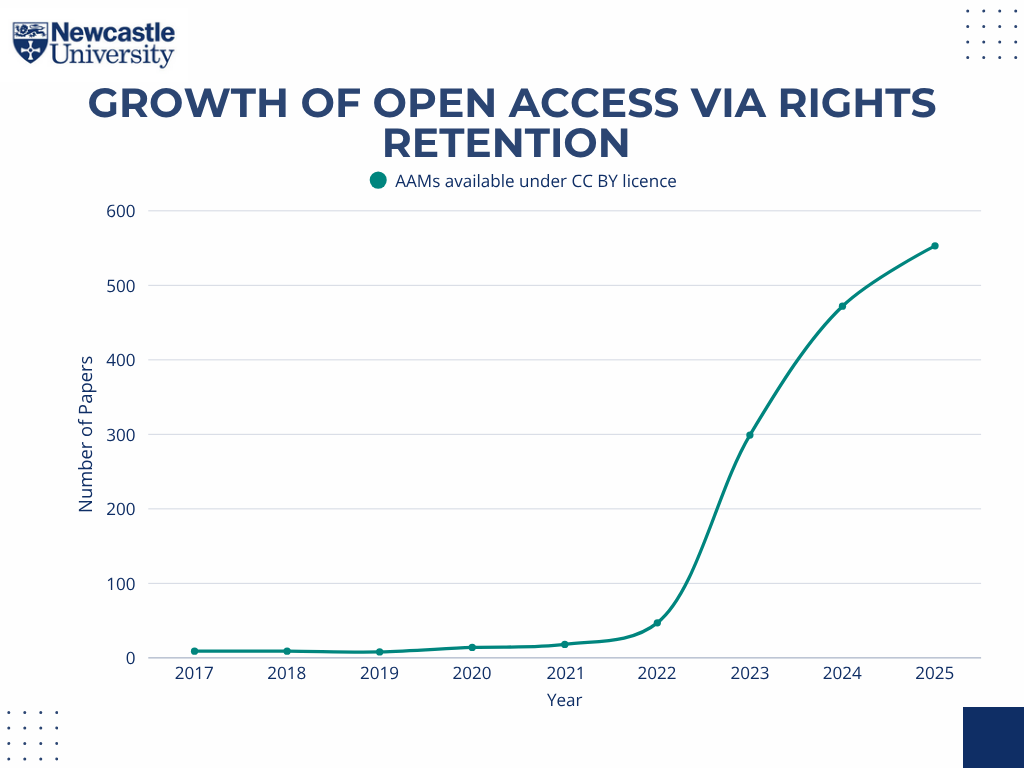
Through consistent monthly reporting, we are able to demonstrate the growth in the number of research outputs made openly accessible in our repository via the RRP, since the launch in 2022. This allows us to track how Rights Retention has supported an increased volume of article deposits over the past four years.  The chart below highlights this progression, illustrating both the scale and the steady upward trajectory of openly available research articles produced through research connected to the University. Since the policy’s implementation, to date, we have been able to make 1,369 AAMs available under a CC BY licence. These numbers reflect the dedication of our research community, the effectiveness of our open‑access workflows, and the value of authors retaining the rights to share their work openly.  
Research carried out by University of Liverpool explored the field weighted citation impact (FWCI) of journal articles, from 2021-2024, across the N8 Research Partnership, for different open access categories, including the impact of having a ‘green’ version of the paper available in a repository. 

Across all eight N8 institutions, green (AAM) and hybrid/subscription open access papers consistently came out on top as the most highly cited. Articles that were published and had a green version available had more citations that those without a green version. 
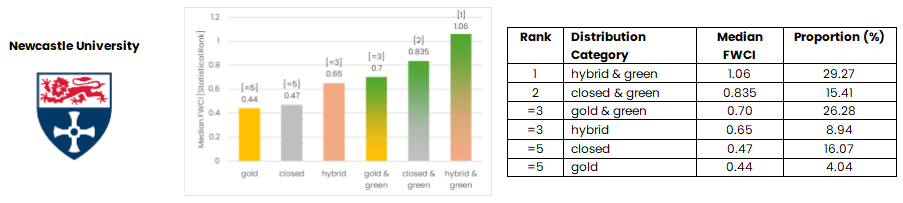
Credit: University of Liverpool 

The analysis brings together data from several sources: Web of Science to identify corresponding authors, OpenAlex to check for repository versions, and Scopus to measure median FWCI. 

The growing adoption of RRPs across the UK is helping to shift the landscape of scholarly publishing. Newcastle University’s position within the N8 Research Partnership has played an important role in our transition, with the N8 institutions simultaneously launching their individual RRP, and as other UK universities launch their own policies the momentum continues to grow. The sector’s collective stance contributes to our ability to assist authors with restrictions they may face when they choose to share their own work openly. While there is more work required to achieve open access to all content, positive change is happening as more of our research is made openly and freely accessible.  

Our ongoing collaboration with the N8 is now focused on supporting the N8 statement on sustainable scholarly publishing, to develop the scholarly publication routes available to researchers, including enhanced self-archiving options through institutional repositories. 

We remain committed to supporting all Newcastle University authors in understanding the advantages of depositing and sharing their AAMs, as they navigate this evolving publishing landscape. If you’re new to Rights Retention, unsure about depositing your manuscript, or simply want to learn more, please contact us at openaccess@ncl.ac.uk. We also host monthly drop‑in sessions, offering a friendly and informal space for researchers to ask questions, explore open access routes, and discover how Library Research Services can support at every stage of the publication process. 

Library Research Services Pop-Up Events

Library Research Services is excited to announce a series of informal Pop-up Sessions across campus in November and December. These sessions are designed to showcase the wide range of services we offer. We warmly invite academics and researchers to join us with any questions they may have about open access publishing, data management, or any specific open research queries. Below, you will find a full list of our locations and dates.

  • Tuesday, 5th November, 12pm-2pm: Medical School Foyer
  • Tuesday, 12th November, 12pm-2pm: Henry Daysh Café Space
  • Wednesday, 11th December, 12pm-2pm: The Atrium, Urban Sciences Building

Don’t worry if you miss us this time—you’ll have the opportunity to speak to us again in the new year. You can also contact us anytime at lrs@ncl.ac.uk

Supporting the UKRI 2022 Open Access policy

Friday 1st April sees the start of UKRI’s new Open Access policy. From this date, eligible UKRI-funded research papers must be made open access without embargo, under a CC BY licence (or, CC BY-ND by exception) and include a data access statement. A major change to the policy is that Gold open access in subscription/hybrid journals will be restricted to titles included in Newcastle University’s Transformative Agreements or journal titles that have committed to transition to open access (aka Transformative Journals).

Why has the open access policy changed?

UKRI is committed to championing open research as part of its strategy of advancing research culture change and to support the ambition set out in the government’s R&D People and Culture Strategy.

Open research improves research efficiency, quality and integrity through collaborative, transparent and reproducible research practices. UKRI’s priorities include open access to research publications and making research data as open as possible but as secure as necessary.
UKRI is building on the UK’s longstanding global leadership in open research with our new open access policy, which was developed through extensive consultation with the sector. The policy delivers on the ambition in the government’s R&D Roadmap, for publicly funded research to be accessible to all, and will boost the global impact of UK research by increasing opportunities for findings to be shared and used across all disciplines and sectors.

UKRI (2022) UKRI Strategy 2022–2027: Transforming tomorrow together. Available at: https://www.ukri.org/about-us/what-we-do/our-strategy-2022-to-2027/ (Accessed: 29 March 2022).

Where can I publish?

  • Fully open access journals and proceedings. Check the Directory of Open Access Journals (funds are available, apply here).
  • Subscription/hybrid journals that are in one of Newcastle University’s transformative agreements.
  • Transformative Journals. Subscription/hybrid journals that commit to transitioning to a fully open access journals (funds are available, apply here).
  • Subscription journals and proceedings that allow you to make your final accepted manuscript open access immediately on publication under a CC BY licence (e.g. Science).

If your journal does not meet any of the criteria above you may want to consider submitting elsewhere. Alternatively include a ‘rights retention statement’ in your submitted manuscript that allows you to make the author accepted manuscript open access in our repository. Contact the Open Access Team if you would like to know more about this alternative route to compliance.

Where can I get further advice and guidance?

Newcastle University’s Open Access team

  • You can find up to date information on our Open Access webpages
  • Open Access colleagues have presented policy briefings at a various meetings and events across the university and to all faculties. If you would like to request a briefing for your school or research group then please contact the Open Access team to request this.
  • Contact the Open Access team direct with your questions.

UKRI

UKRI have contacted grant holders directly explaining the policy changes and have published the following guidance:

Jisc

Find out how Jisc are supporting the research community to implement the UKRI open access policy – https://www.jisc.ac.uk/rd/projects/implementing-the-new-ukri-open-access-policy.