Approximately 35 years after Akyaaba Addai-Sebo – a Ghanaian-born activist – established Britain’s first-ever ‘Black History Month’, the UK continues to celebrate the achievements and contributions of Black people every October. This annual celebration aims to promote a better understanding of Black history, with events taking place all the way from London to Aberdeen this year.
To coincide with this important month, Newcastle Robinson Library has collaborated with Seven Stories to host a city-wide exhibition on Black Britain and children’s literature. Embodying the message, ‘Listen to This Story: From History to Our Story’, the exhibition features some of the most interesting picture books, nursery rhymes and illustrations, told from the material within Newcastle University’s Special Collections and Archives. The exhibition is running from 20th October 2022 – January 2023, on Level 2, Special Collections and Archives exhibition space, Philip Robinson Library – free and open to all.
Analysing these archived children’s works has enabled us to look back over centuries of British literary history, allowing us to present a unique insight into how race relations have changed within the UK. Many of the books show how, historically, literature for young people has played a prominent role in transferring problematic ideas about race and power. Indeed, it becomes clear that texts even for the very youngest of readers, such as ABC books and nursery rhymes, have depicted non-white people in derogatory and stereotypical ways.
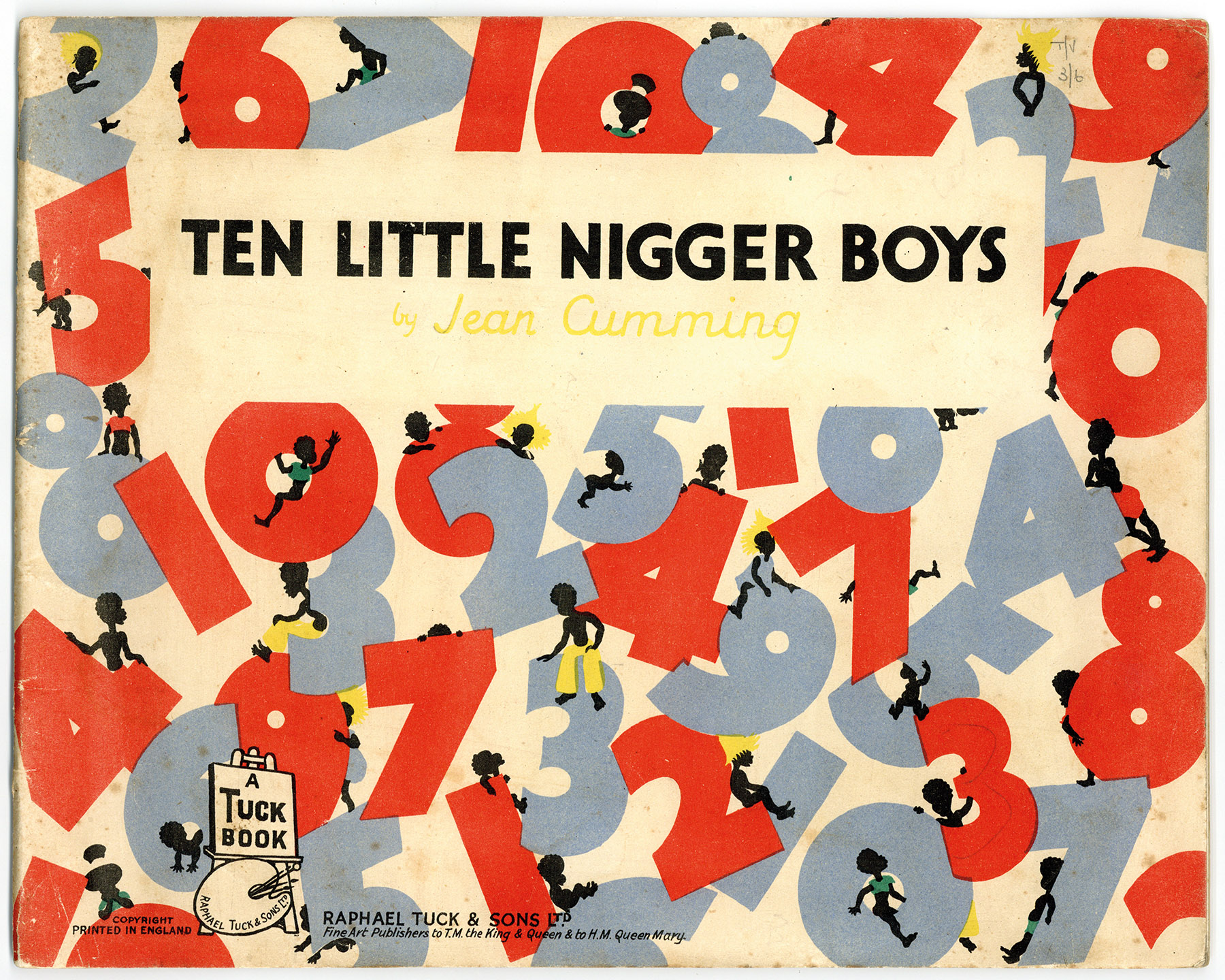
Front cover of Ten Little Niggger Boys by Jean Cumming [on loan from Karen Sands O’Connor’s Collection.
In a similar way, we can see that young people’s texts also presented people of colour as being white children’s ‘play-things’, such as toys, dolls, and gnomes. Presenting Black people like this was historically used to justify white oppression as it effectively demonstrated people of colour as needing parental care and governance.
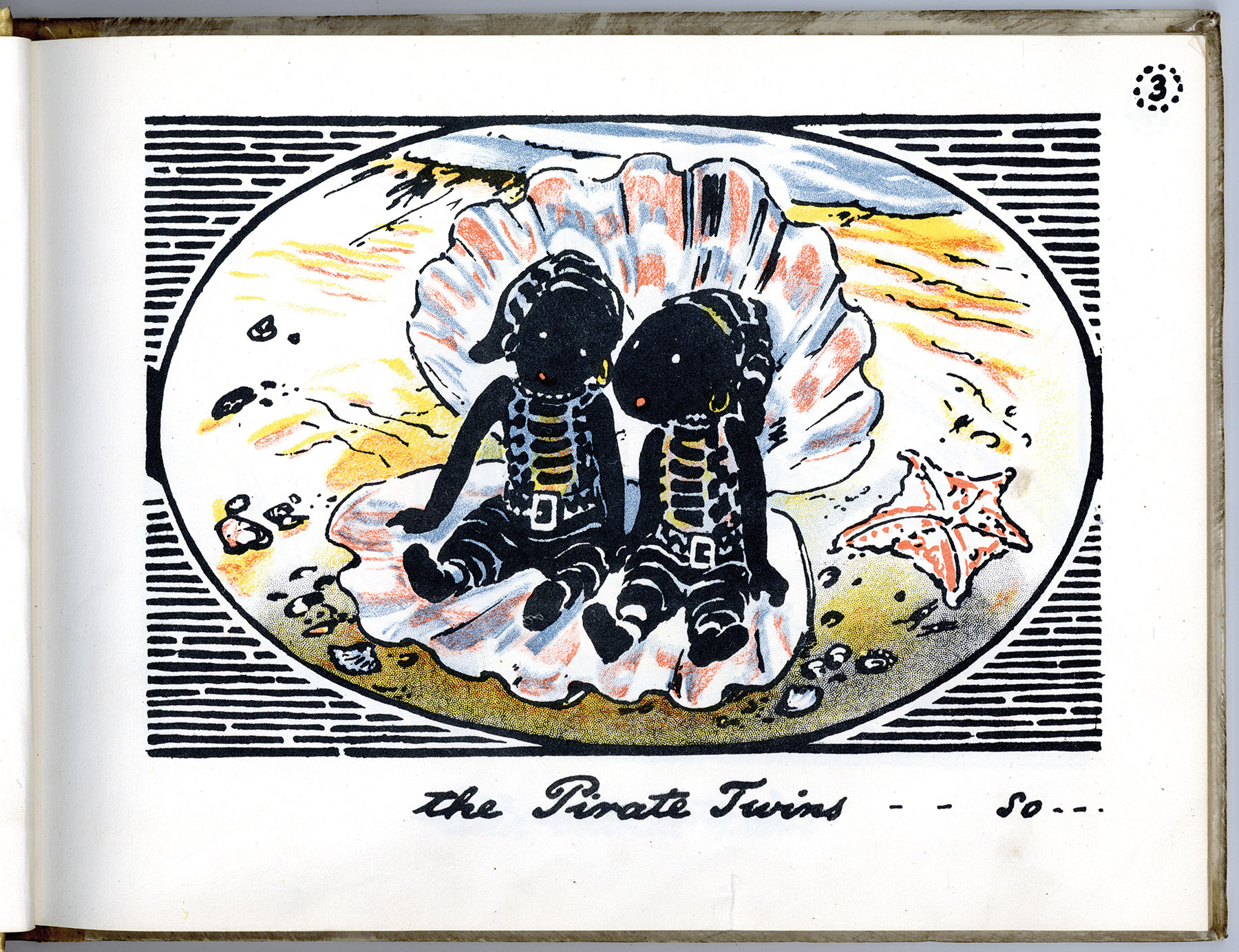
An example of this can be seen in William Nicholson’s The Pirate Twins (1929). In which, Nicholson presents two childlike pirates; miniature Black people who are cared for (and controlled) by a young white girl called Mary.
Illustration from The Pirate Twins, by Nicholson, William (1929) [Butler (Joan) Collection, 823.912 NIC]
These dehumanising caricatures became so normalised in British society that they could be found not only in children’s books but on postcards, perfume bottles, games, and jam jar stickers (to name but a few examples). They worked to elevate Eurocentric, white standards and devalue Black individuals, cultures, features and histories.
As a way to counteract and resist these harmful depictions, many authors, publicists and illustrators worked hard to create humanising stories which normalised and celebrated Black people.
It is clear, then, that a lot of progress has been made in the world of children’s literature.
However, with only 15% of published children’s books featuring a character of colour in 2020, we still have a long way to go to ensure that everybody is represented equally!
Written by exhibition placement student, Ella Fothergill.
We have sought to ensure that the content of this blog post complies with UK copyright law. Please note however, that we have been unable to ascertain the rights holders of some of the images used. If you are concerned that there may have been a breach of your intellectual property rights, please contact us with the details of the image(s) concerned at libraryhelp@ncl.ac.uk and we will have the specified image(s) taken down from the blog post.
Our Gertrude Bell website (link:http://gertrudebell.ncl.ac.uk/) features transcripts of thousands of Bell’s letters and diary entries, alongside over 7,500 of her photographs. Thanks to a generous donation from the Harry and Alice Stillman Family Foundation we have been able to digitise and catalogue the letters Bell wrote to her family, her diaries and photographs to modern day archival standards and this process has allowed us to uncover details beyond what has previously been recorded in the transcriptions.
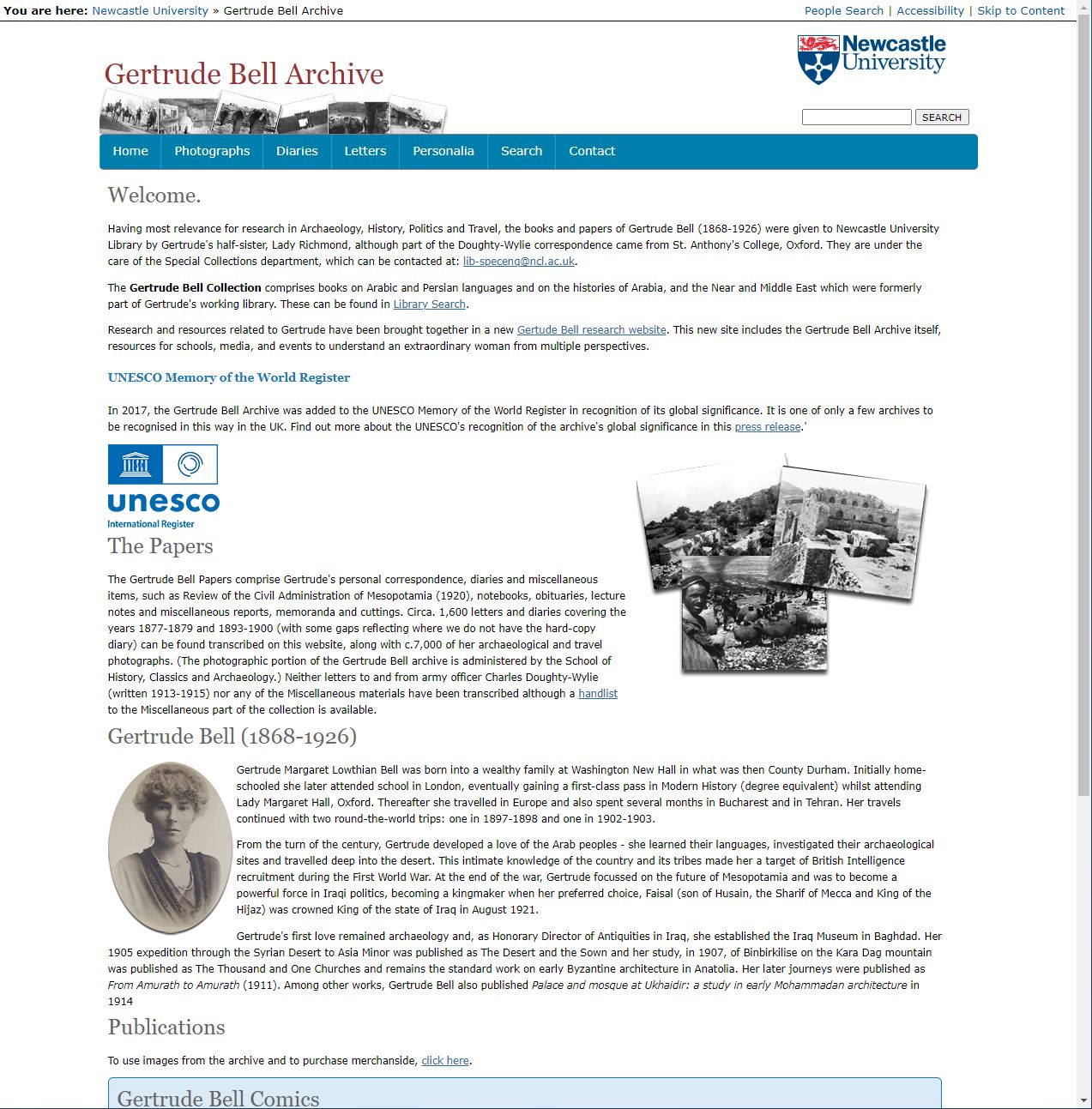
The homepage of the current Gertrude Bell website
Original transcripts of Bell’s letters and diaries were created in the 1990s and published online in the early 2000s. While these provide an excellent resource for exploring their content, cataloguing and digitisation has revealed new details and insight into how Bell communicated with her family, how those letters reached home, and the early 20th Century world she lived in.
When travelling in the Middle East, as she did on several prolonged trips in the 1900s and 1910s, Bell often used her letters to chronicle her journey. She regularly continued writing the same letter for several days, adding a new section each day and posting it when passing through a town. The original transcripts of Bell’s letters treat each day’s addition as a separate page on the website, however cataloguing and digitisation has revealed how often Bell wrote the same letter over multiple days, and sometimes, how rarely she passed civilization and an opportunity to post a letter.
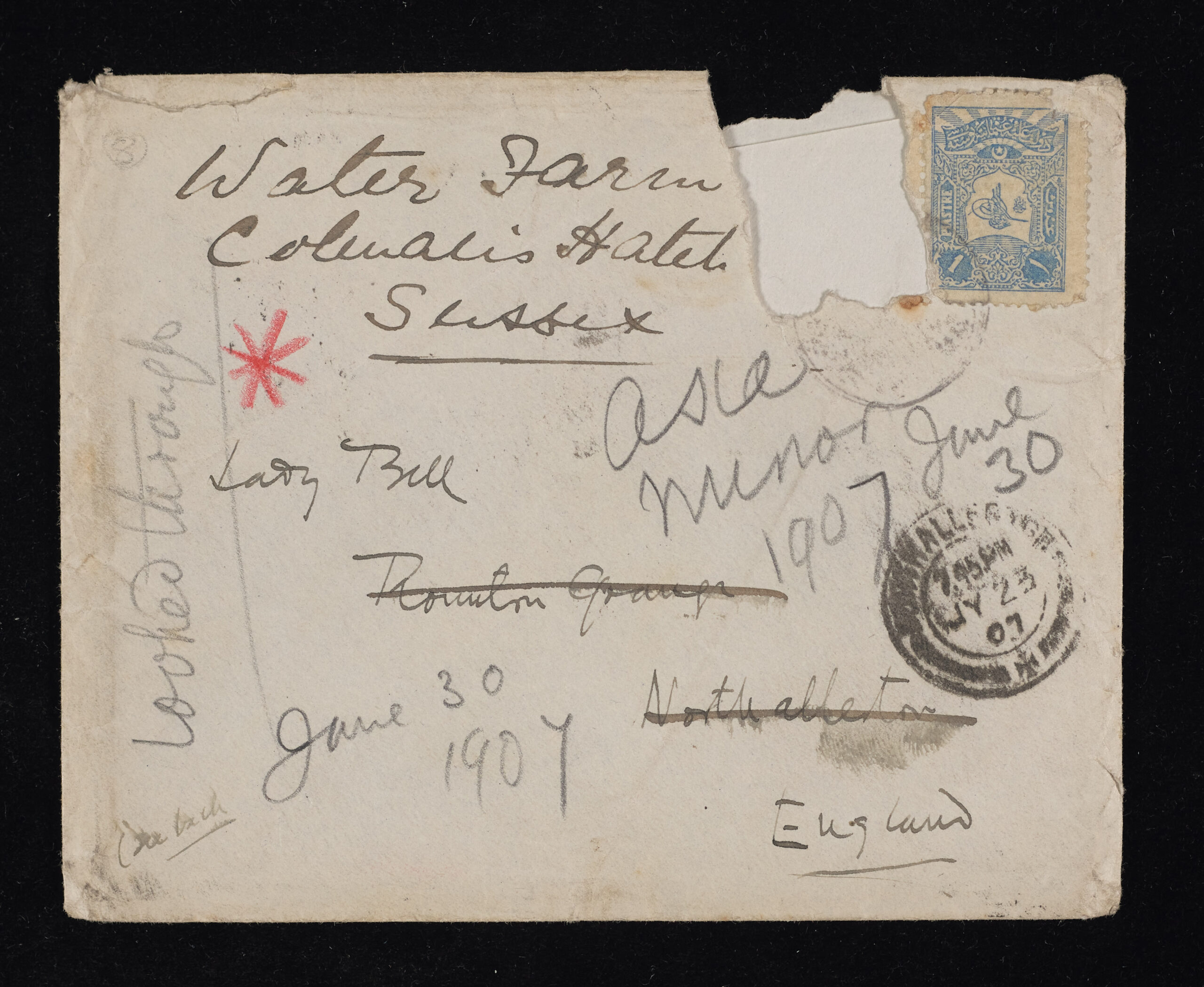
Envelope of a letter posted by Gertrude Bell to her step-mother from Turkey in July 1907, including stamp, postmark, a changed address and later annotations.
The envelopes Bell’s letters were posted in also provide clues about their journey after they were posted home. Her father, a wealthy industrialist, and her step-mother lived between their family home at Rounton Grange in North Yorkshire and Sloane Street in London. Bell would choose one or the other address to post the letter to and if the letters arrived at the address the intended parent was not at they would be forwarded on by crossing out the address and adding the correct one. This was not unlikely when postage from the Arabian Desert to Rounton could take several months! Indeed, the envelopes or letters themselves often contain hand written dates telling us when a letter was received by her family, providing an insight into the speed and efficiency of inter-continental postage of the day.
As records of their journey back to Britain the envelopes also have stamps affixed, postmarks, and during the First World War had stickers applied to signify that they’d been passed by a censor. The stamps provide a small insight into the countries Bell was posting her letters from and their changing political landscapes. This is particularly the case for the time that Gertrude lived and worked in what is now Iraq, during and after the First World War, where the changing face of the British occupation is reflected in the stamps on the envelopes of Gertrude’s letters home.
The front and reverse of an envelope from a letter written by Gertrude Bell to her step-mother in November 1916. The envelope has had a red stamp on its front and label on its rear indicated it has been opened by a censor. A pencil note also shows that this letter was not to be included in the later published work of Bell’s letters.
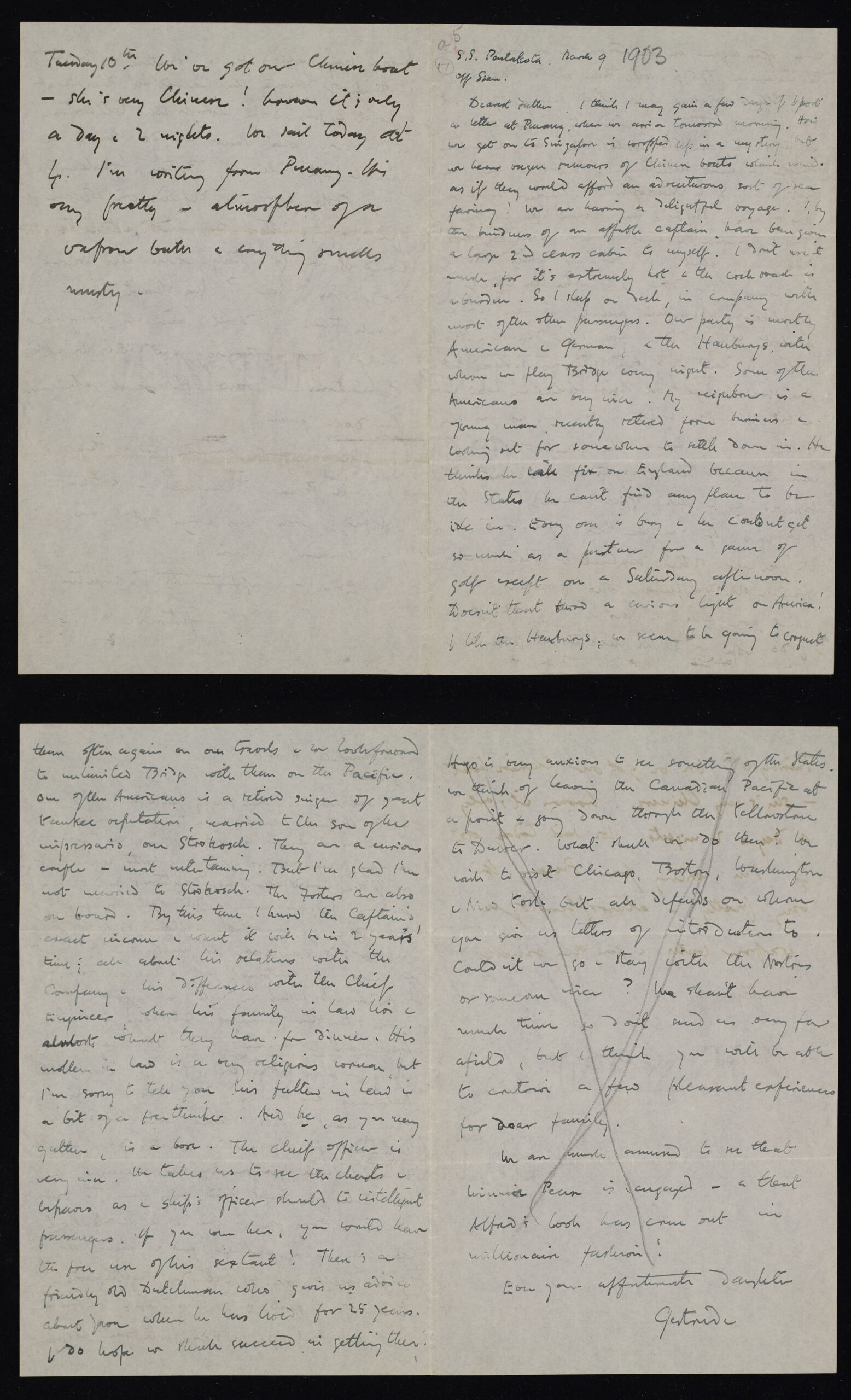
The letters also reveal clues as to how they’ve been used and managed in the time since Gertrude’s death in 1926. Following her death, Gertrude’s step-mother compiled and published two books containing text from many of Gertrude’s letters. The process of deciding what was and what wasn’t included is seen by the crossing out in pencil of sections of letter, or marking on the envelope that a letter was not to be copied. These are often sections where Gertrude talks about family matters or where Gertrude offered her (typically forthright) opinions of the people she met and worked with. Sometimes brief instructions were scribbled on the letters or envelopes themselves, particularly if a letter was not to be copied.
Letter written by Gertrude Bell to her father in March 1903. The letter includes a section which has later been crossed out in pencil and a postscript which Gertrude added after signing the letter.
Thus, the process of cataloguing and digitising Gertrude Bell’s rich archive of letters allows us to explore facets of Bell’s life and her letters that are not immediately obvious from their content alone. Marks which help us understand how she lived and communicated with her family, how the political and cultural landscape of the lands that Bell lived in changed, and how Bell’s family managed her letters can all be explored through the newly digitised and catalogued archive.
Thanks to project funding from the Harry and Alice Stillman Family Foundation a brand new Gertrude Bell website in early 2023. This will make the digitised images, transcripts and a new archival catalogue available alongside each other, providing a step-change in access to this internationally important archive.
July 2022 marks the 50th anniversary of the UK’s first Pride march, held in London on 1st July 1972. The first Pride saw around 2,000 participants marching together. Over the past 50 years that number has grown considerably, with the 2019 London Pride seeing 1.5 million people taking part to celebrate LGBTQ+ rights.
The official theme for this year’s march was #AllOurPride, uniting the collective past, present, and future of Pride for all members of the LGBTQ+ community. After a two-year hiatus due to the Covid-19 pandemic, this year’s London Pride Parade took place on Saturday 2nd July, beginning at Hyde Park, where the first Pride march in 1972 ended.
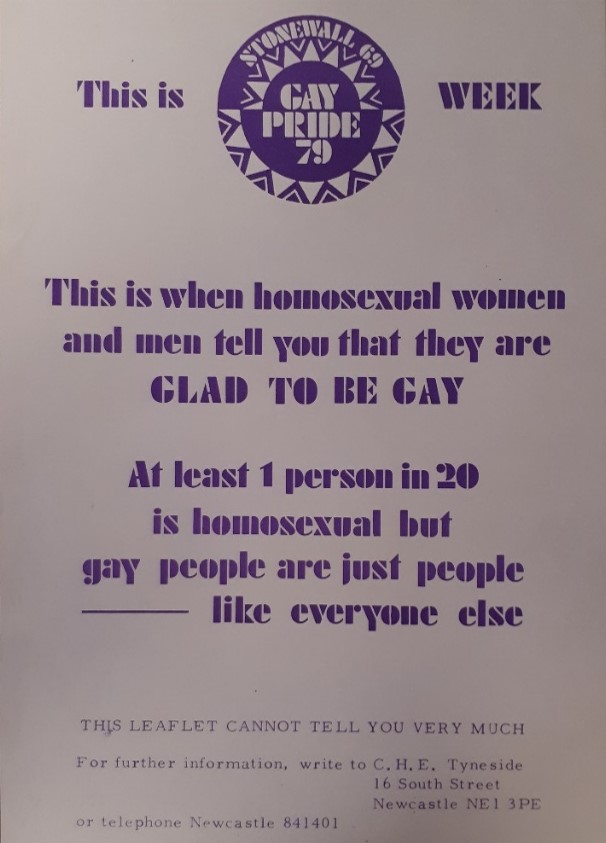
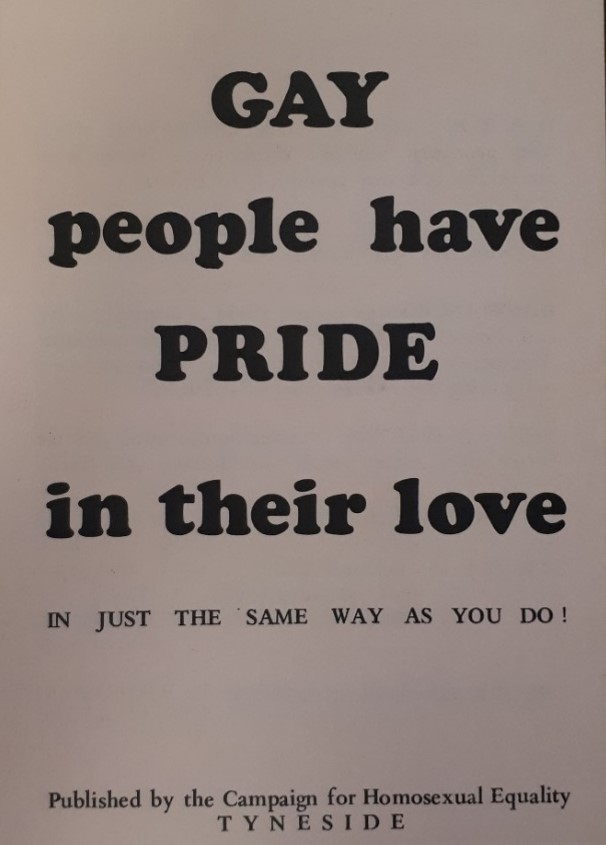
2022 also marks the 50th anniversary of the Tyneside Campaign for Homosexual Equality, a branch of the Campaign for Homosexual Equality (CHE) which was established in Lancashire in 1964 and grew to have local groups throughout the country. The archive for the Tyneside CHE contains documents relating to the group’s many campaigns for equal rights. For example, the archive covers the fight for the age of consent for same-sex couples to match that of heterosexual couples, and campaigns against Margaret Thatcher’s 1988 Section 28 legislation banning local authorities from ‘promoting homosexuality’ by discussing LGBTQ+ issues in schools. As well as campaigning, CHE also provided a social and support network for gay men and lesbians.
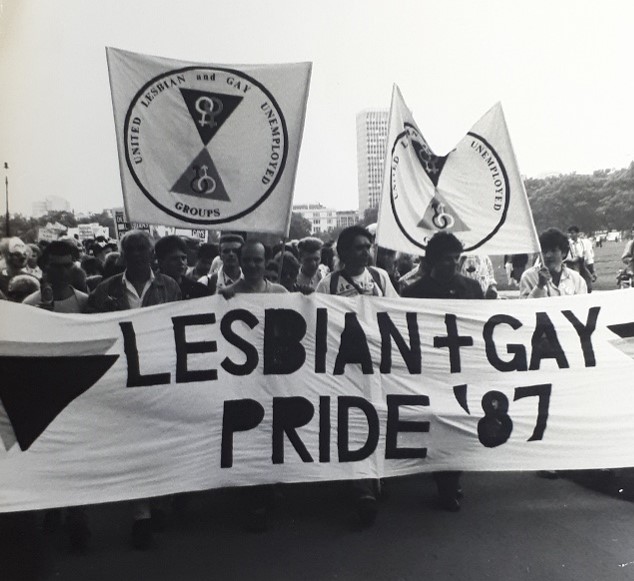
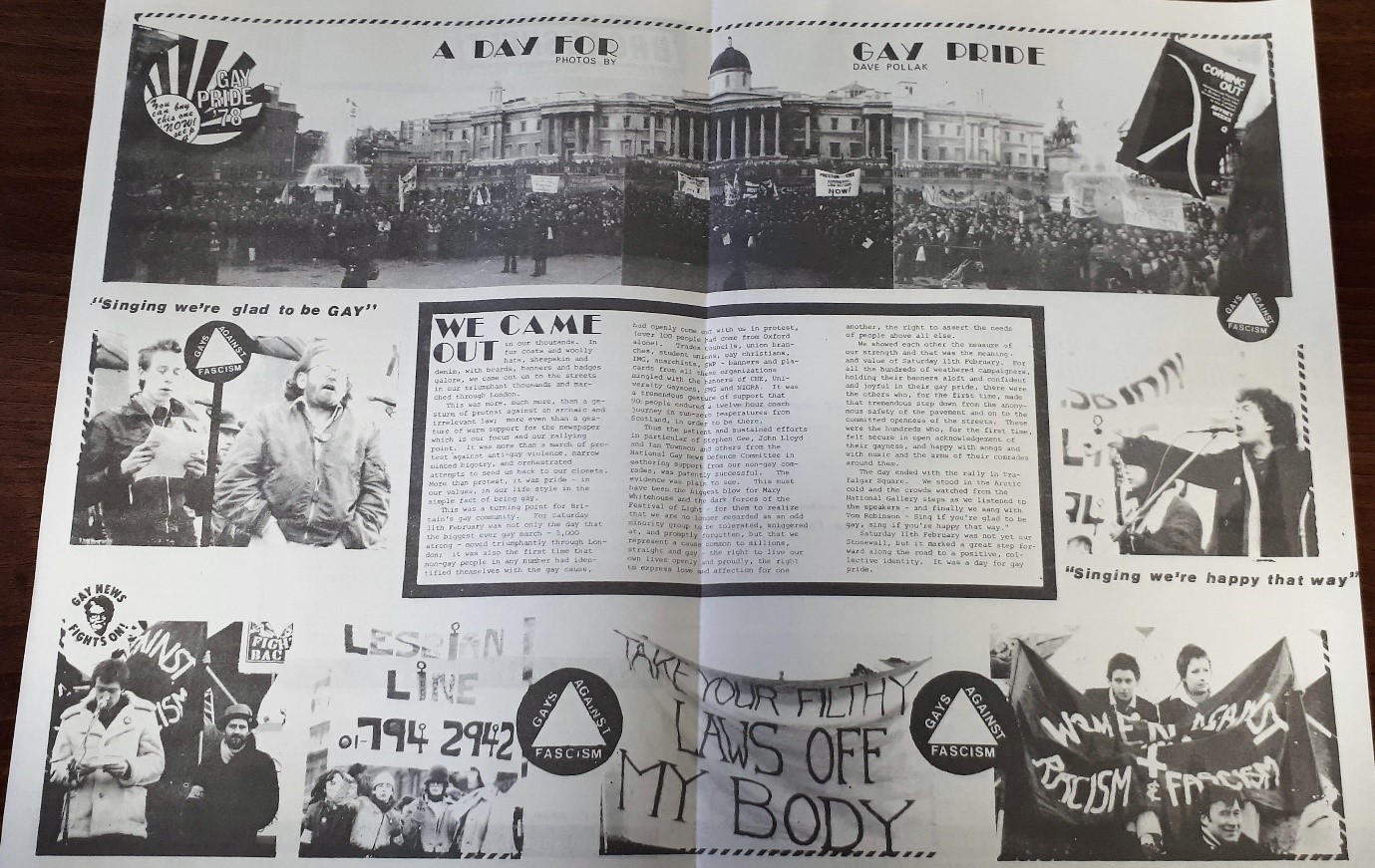
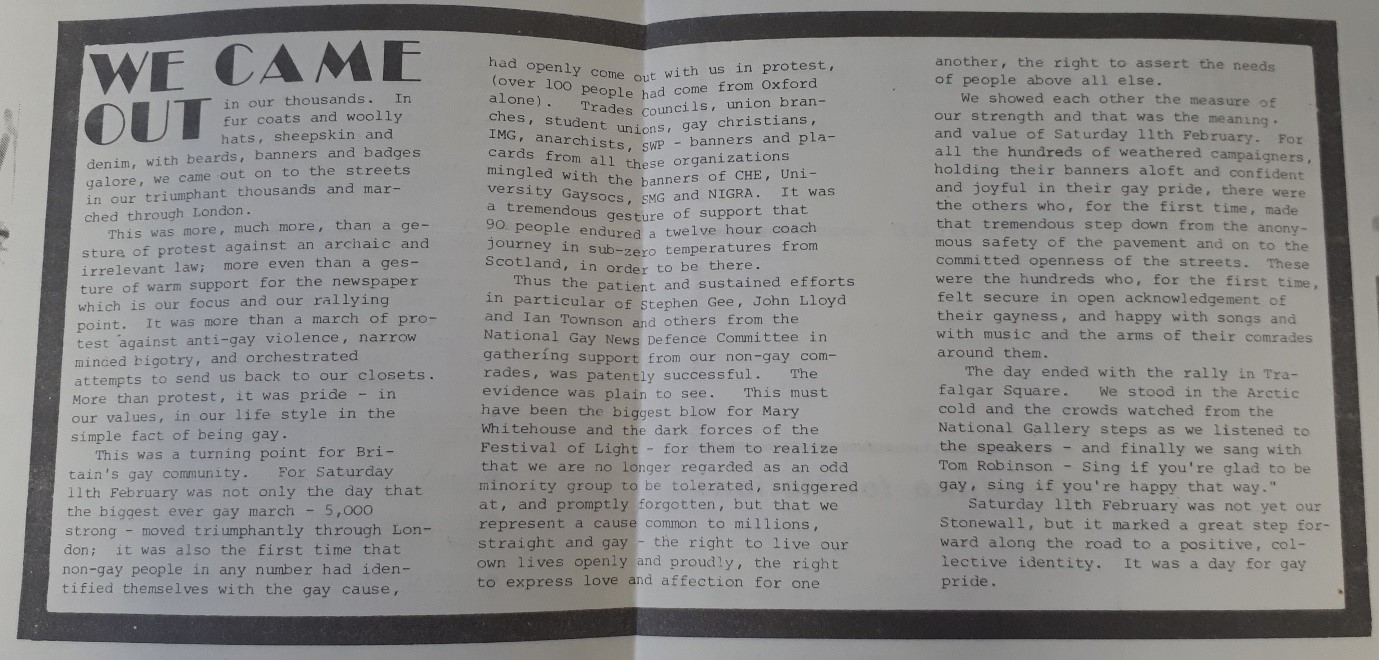
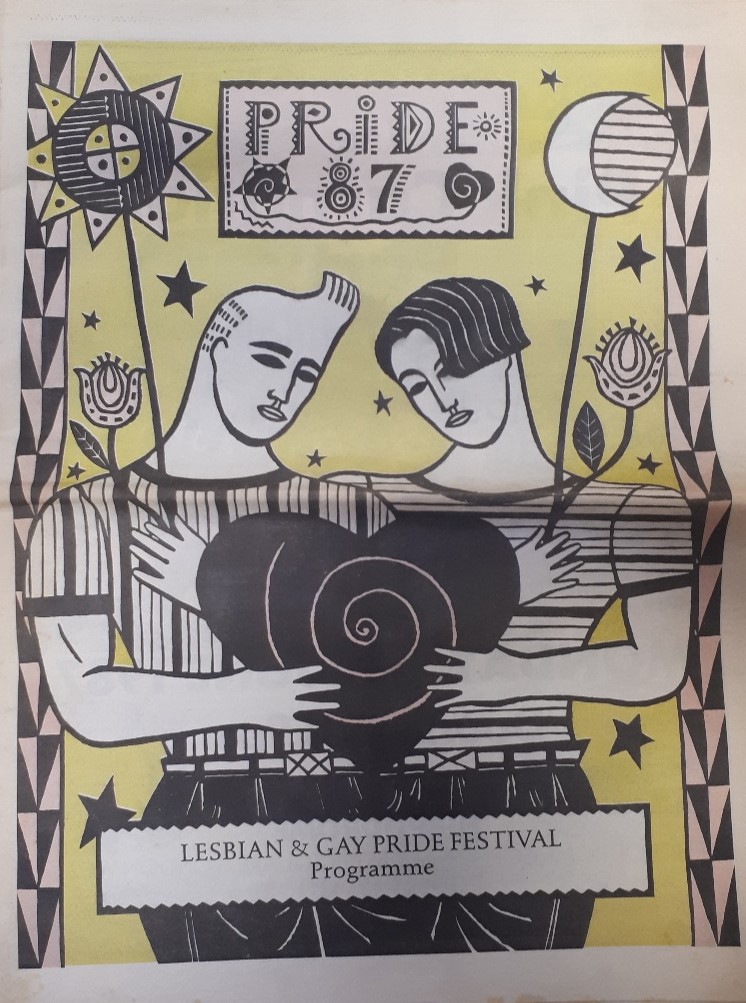
Within the Tyneside CHE archive, it is possible to look back at Pride marches across the past five decades. The first Pride march in 1972 took place 5 years after the Sexual Offences Act 1967 which decriminalised sex between gay men over the age of 21 in England and Wales. At the time of the first Pride, however, the LGBTQ+ community still faced much discrimination – for example gay marriage was not legal, and gay and bisexual people were banned from joining the armed forces.
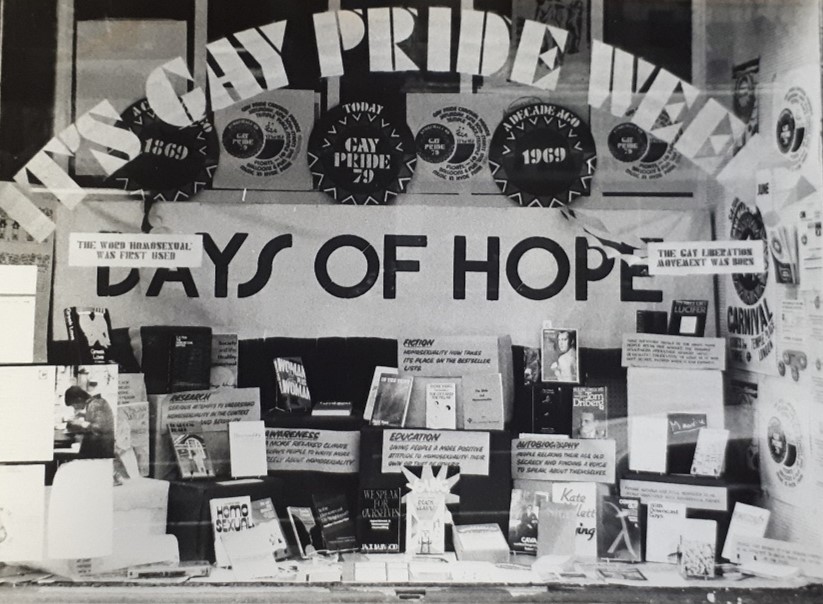
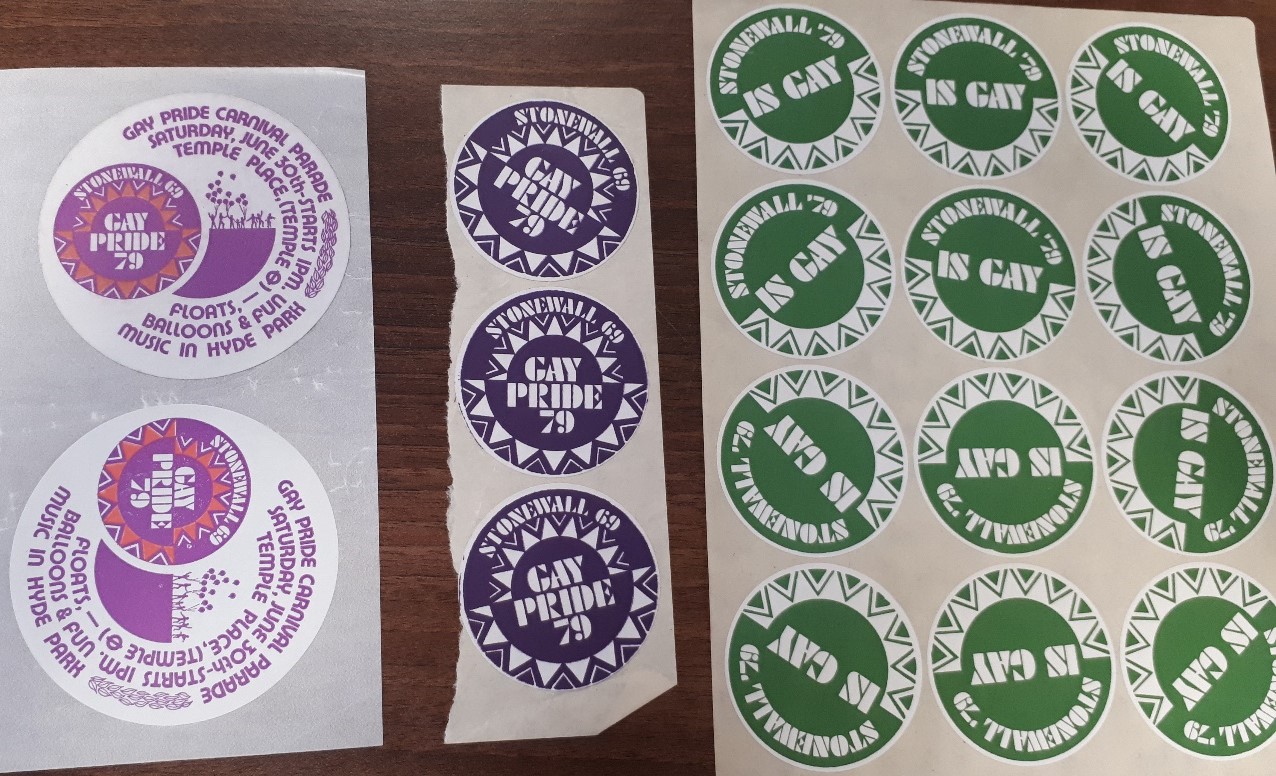
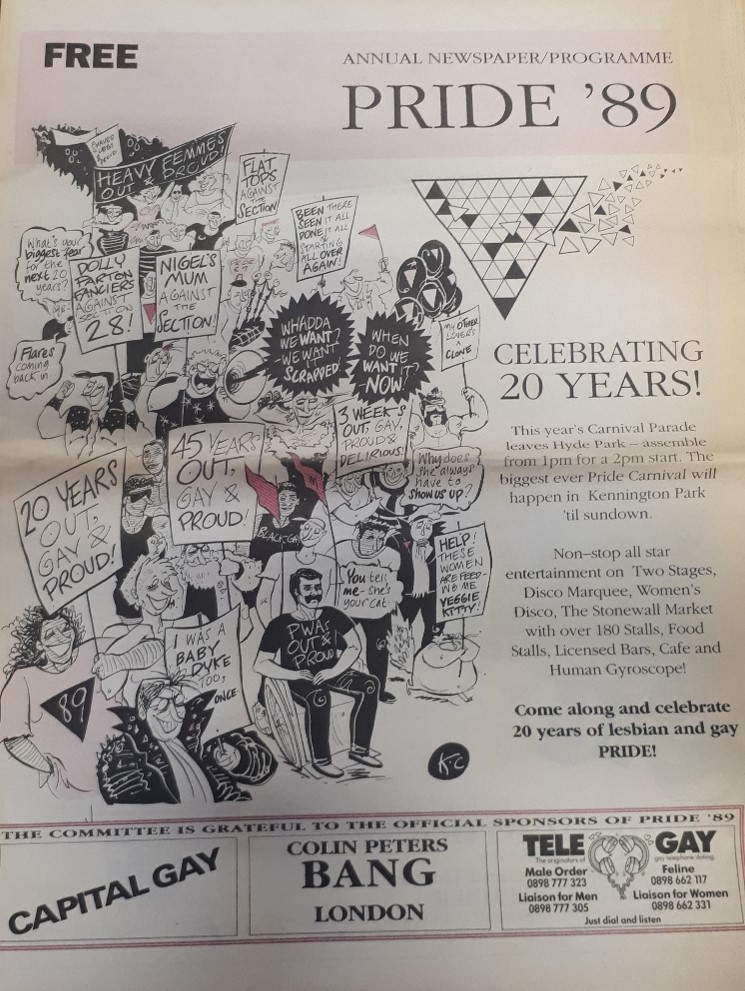
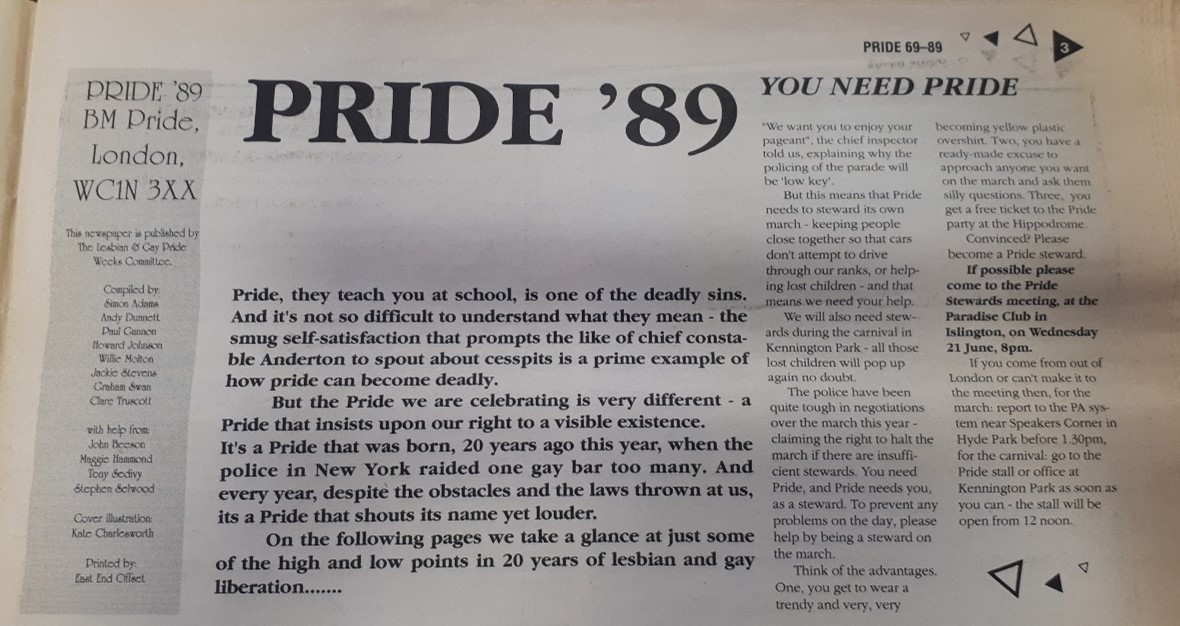
The Pride movement was influenced by the 1969 Stonewall riots in New York. The riots were a response to a violent police raid at the Stonewall Inn gay bar and were a catalyst for LGBTQ+ equality movements worldwide. The significance of Stonewall is reflected in the Tyneside CHE archive, as the marches of 1979 and 1989 commemorate the 10th and 20th anniversaries of this watershed moment in the LGBTQ+ liberation movement.
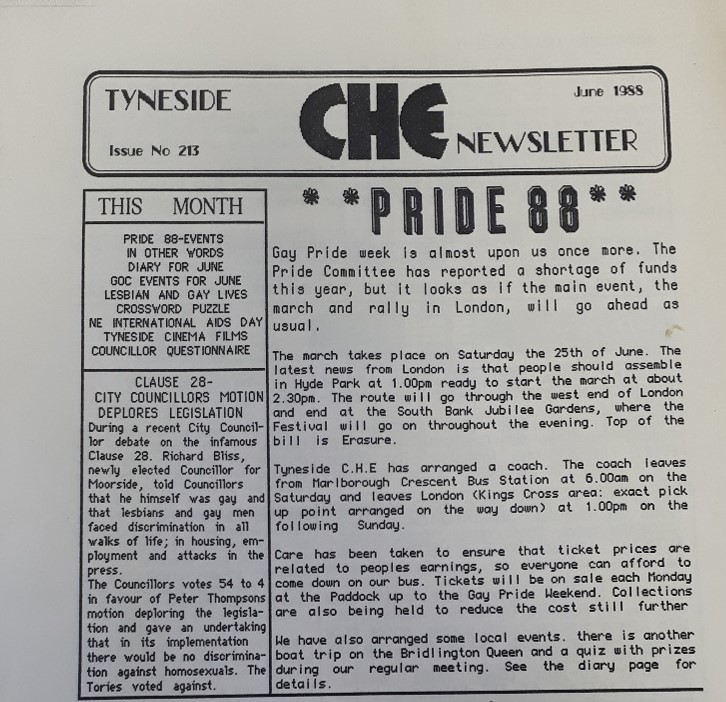
Throughout the years, Tyneside CHE organised annual trips to the London Pride marches. A coach was arranged, and ticket prices were ‘related to people’s earnings, so everyone can afford to come down on our bus’. Pricing tickets in this way promoted inclusivity and ensured LGBTQ+ people from across the socio-economic spectrum could participate in Pride.
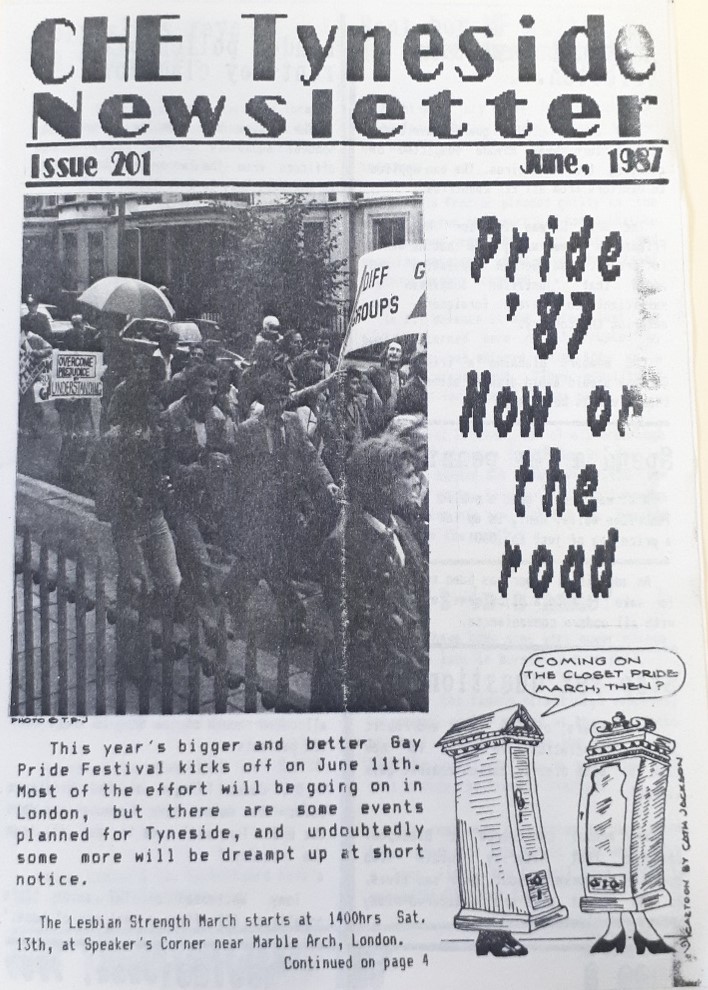
The London march was not the only way to celebrate Pride, however, with the CHE Tyneside newsletter from 1987 outlining that some events were planned in Tyneside itself.
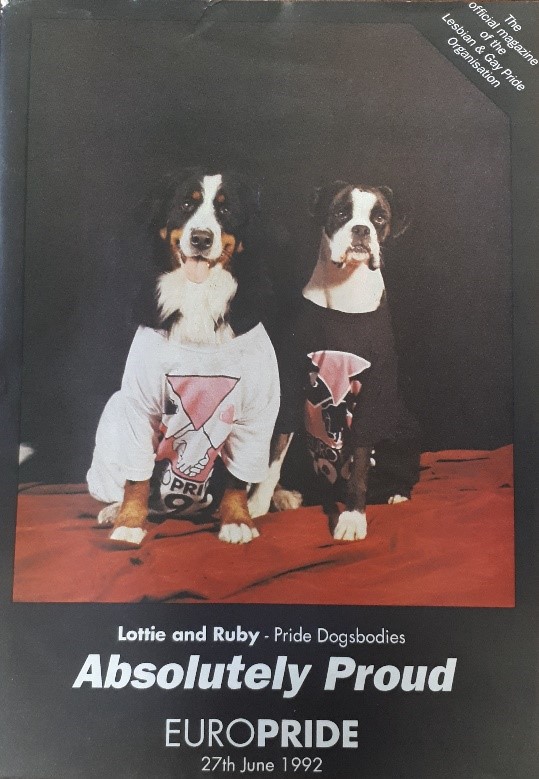
The Tyneside CHE archive also contains paraphernalia from Pride festivals across Europe, including from the very first EuroPride. EuroPride is a pan-European festival hosted by a different European city each year. The first EuroPride took place in London in 1992 and was attended by over 100,000 people. Not only does 2022 mark 50 years since the first Pride, but it also marks the 30 year anniversary of EuroPride.
Looking through the Tyneside CHE archive it is clear that a lot of progress has been made since the first Pride march 50 years ago. However, with 1 in 5 LGBTQ+ people in Britain experiencing a hate crime, and with conversion therapy still being legal in the UK, there is still a long way to go to achieving true equality.
CHE materials are used by kind permission of the Campaign for Homosexual Equality.
We have sought to ensure that the content of this blog post complies with UK copyright law. Please note however, that we have been unable to ascertain the rights holders of some of the images used. If you are concerned that there may have been a breach of your intellectual property rights, please contact us with the details of the image(s) concerned at libraryhelp@ncl.ac.uk and we will have the specified image(s) taken down from the blog post.
Frederick Douglass, photograph by an unidentified artist, c.1850, National Portrait Gallery, Smithsonian Institution, https://npg.si.edu/object/npg_NPG.80.21
Frederick Douglass’story as a black American started in the same way as many others of his era, born into slavery. Thanks to his determination and good luck he was able to escape the lifelong toil that many of his fellow black Americans endured, educate himself and then tell his story highlighting the plight of fighting for the rights of black Americans. The story of his life includes a journey to the UK, and Newcastle, where he would meet a local family that had a lasting impact on his ability to live a free life in America.
Frederick Douglass was born into slavery in 1818 on a plantation in Talbot, Maryland. His father was white, and possibly the ‘owner’ of his mother. He was removed from his mother as a young child, and only had limited contact with her prior to her death, while Douglass was still a child. After being a slave for a number of years he escaped from his owner in Baltimore on the 3rd of September 1838 and travelled to New York. Once there he set about educating himself and eventually telling his story through an autobiography.
In 1845 ‘The Narrative of the Life of Frederick Douglass, an American Slave: written by himself’ was published. This detailed his early life, escape from slavery, and new life as a free man. Across the Atlantic and during the early years of Douglass’ life, the Whig government in Britain (led by Earl Grey II who hailed from Northumberland) passed the Slavery Abolition Act in 1833. This act would make owning a slave in much of the British Empire illegal by 1840.
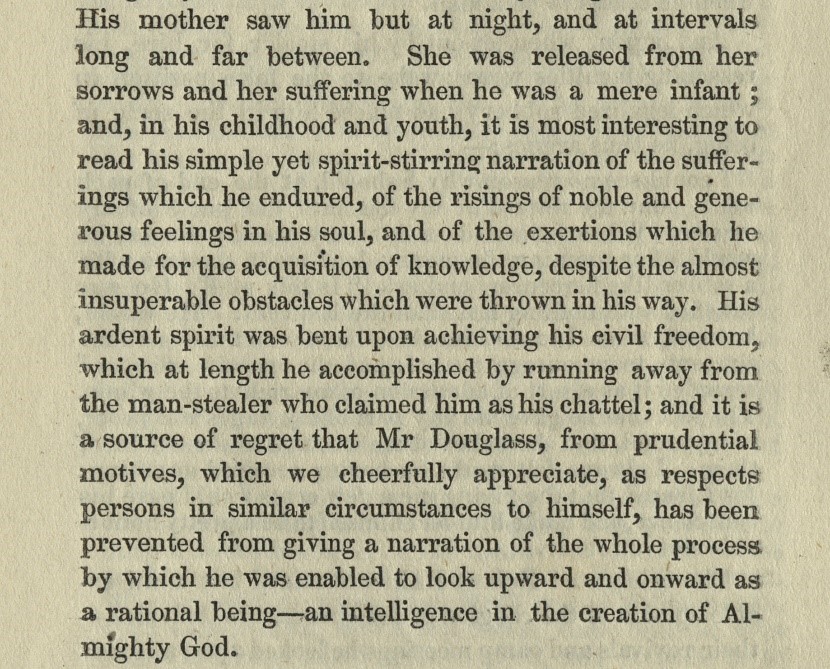
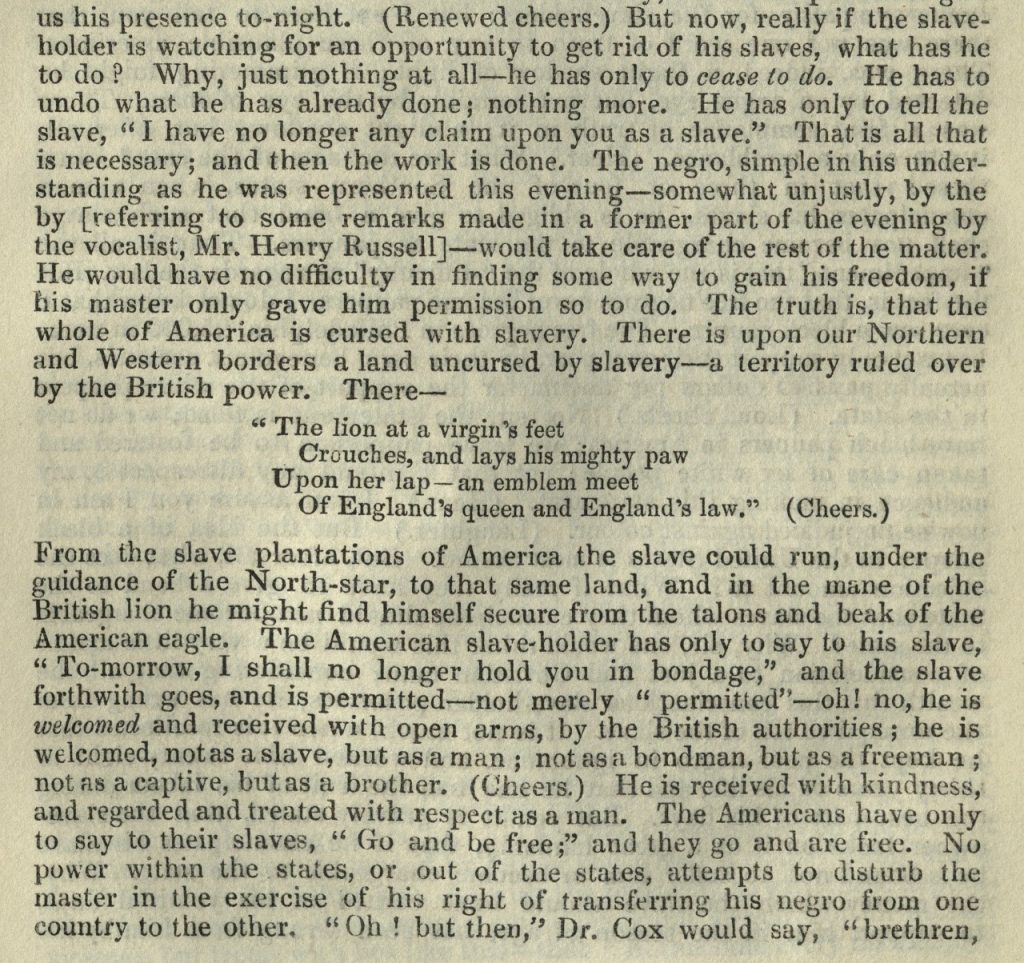
In August 1845 Frederick Douglass sailed across the Atlantic to Great Britain to promote his cause. A review of his book was published in July 1846 in the Newcastle Guardian. The review highlights in critical terms, the American ‘institution of slavery’ and introduces his story and selected quotes from his work.
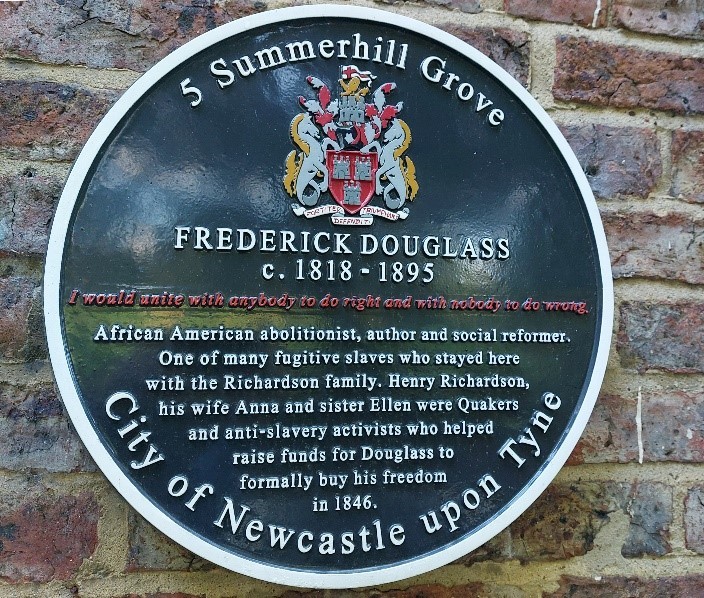
Excerpt from pg5 of Review of the Narrative of the life of Frederick Douglass, written by himself, 19thCentury Collection 942.8 REV The full review can be found at https://cdm21051.contentdm.oclc.org/digital/collection/p21051coll23/id/96/rec/15Plaque at 5 Summerhill Grove, Newcastle upon Tyne commemorating Frederick Douglass and the anti-slavery activists with whom he stayed whilst in Newcastle
During his 19 month stay in Britain he toured the country giving public lectures detailing his life, slavery in America and promoting abolition. This included a short stay in Newcastle, at the home of Henry and Anna Richardson and their sister-in-law Ellen. They were Quakers who lived in a house on Summerhill Grove near the city centre. His stay, and the impact the family had on Douglass’ life is commemorated by a plaque on the house. He made such an impact on the Richardson’s that they set about raising £150 and instructed a lawyer in America to formerly buy Douglass’ freedom from his former enslaver in late 1846.
Near the end of his tour of Britain Douglass was invited to give a farewell speech at the London Tavern on the 30th of March 1847 by the Council of the Anti-Slavery League. They later published a transcript of the speech he gave, a copy of which forms part of Special Collection’s Cowen Tracts Collection, collected by Joseph Cowen, a 19th Century reformist MP from Newcastle. You can read more about the life of Joseph Cowen here.
In his speech at the London Tavern Frederick Douglass covers a number of topics. He covers the American constitution, the slave keeping system and references the abolition of slavery in Canada which had been enacted by Earl Grey’s government.
Caption: Excerpt from Farewell Speech of Mr Frederick Douglass previously to Embarking on Board the Cambria, upon his Return to America March 30, 1847, pg14, Cowen Tracts, Vol.17, No.12, https://collectionscaptured.ncl.ac.uk/digital/collection/p21051coll85/id/58/rec/1
He went on to talk about the purchase of his freedom by the Richardson’s saying:
… As to the kind friends who have made the purchase of my freedom, I am deeply grateful to them. I would never have solicited them to have done so, or have asked them for money for such a purpose. I never could have suggested to them the propriety of such an act. It was done from the prompting or suggestion of their own hearts, entirely independent of myself…. (Cowen Tracts, Vol.17, No.12, pg16)
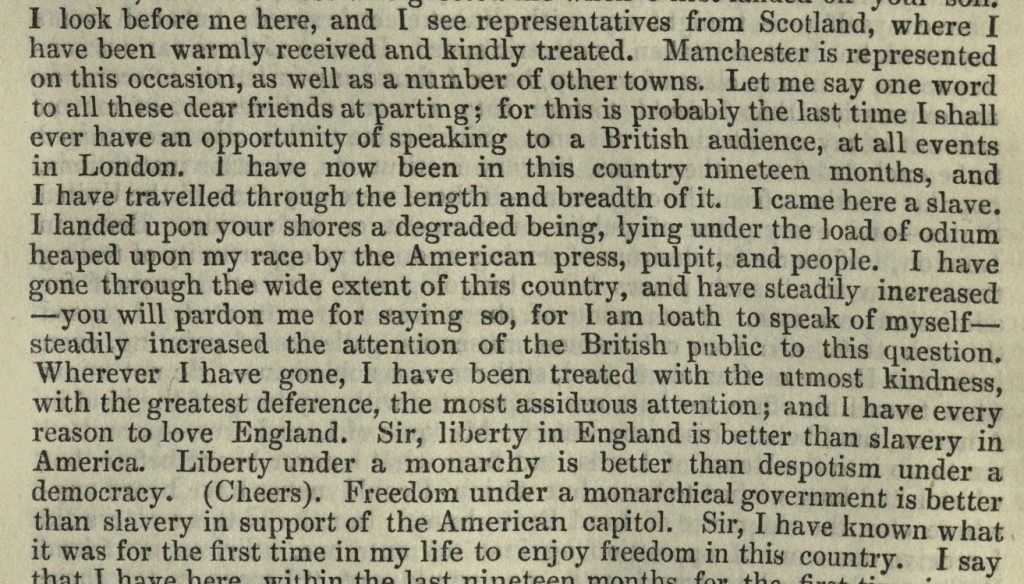
Later in his speech he went on to recount his feelings and experience of the 19 months he spent in Britain, contrasting it with the conditions he encountered in Boston before he boarded the Cambria and travelled across the Atlantic:
… I say that I have here, within the last nineteen months, for the first time in my life, known what it was to enjoy liberty. I remember, just before leaving Boston for this country, that I was even refused permission to ride in an omnibus. Yes, on account of the colour of my skin, I was kicked from a public conveyance just a few days before I left the “cradle of liberty”. (Cowen Tracts, Vol.17, No.12, pg19)
Caption: Caption: Excerpt from Farewell Speech of Mr Frederick Douglass previously to Embarking on Board the Cambria, upon his Return to America March 30, 1847, pg19, Cowen Tracts, Vol.17, No.12, https://collectionscaptured.ncl.ac.uk/digital/collection/p21051coll85/id/58/rec/1
He also recounts his experience of being refused entry to churches in Boston and not being permitted to “even to go into a menagerie or theatre, if I wished to have gone there” (Pg 19) and that “I was not granted any of these common and ordinary privileges of free men.” (pg 20).
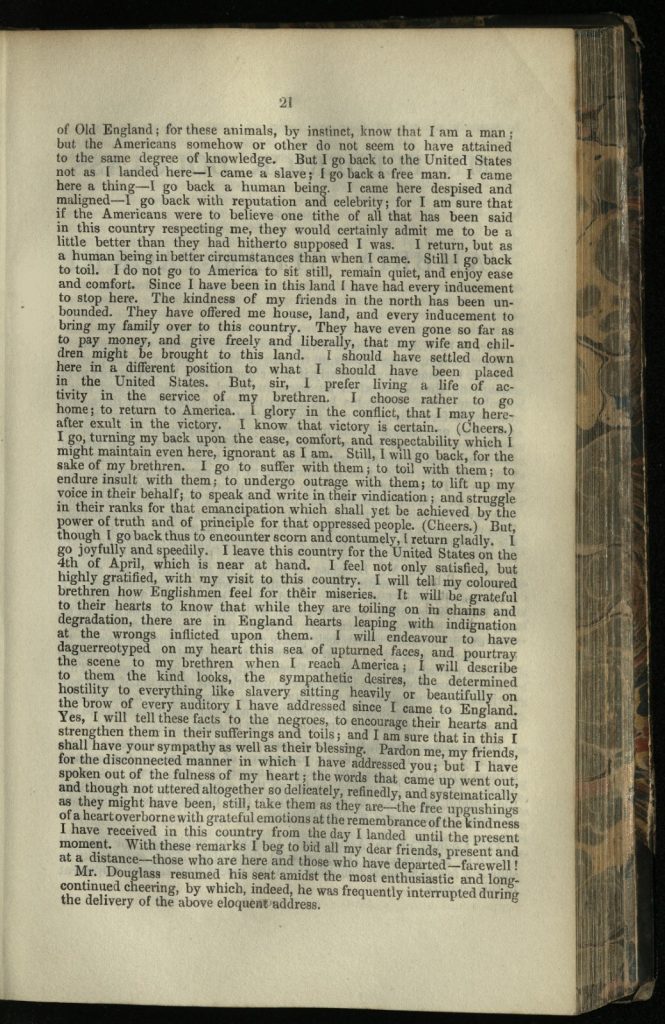
He concluded his speech by explaining his hopes and plans for his return to America saying:
…I go, turning my back upon the ease, comfort, and respectability which I might maintain even here, ignorant as I am. Still, I will go back, for the sake of my brethren. I go to suffer with them; to toil with them; to endure insult with them; to undergo outrage with them; to lift up my voice in their behalf; to speak and write in their vindication; and struggle in their ranks for that emancipation which shall yet be achieved by the power of truth and of principle for the oppressed people… (Cowen Tracts, Vol.17, No.12, pg21)
The speech he gave at the London Tavern gives us a valuable insight in Frederick Douglass’ own words of his experiences of slavery, how he valued the time he spent in Britain and the people that met and supported him while here. It also demonstrates that though he was now free himself he saw his future in helping his enslaved brethren, using his platform to promote their cause and work towards their emancipation, even if that meant experiencing the racial prejudices of 19th Century America.
On the 4th of April Frederick Douglass embarked the Cambria to travel across the Atlantic back to the United States. On boarding he was informed that the birth he had booked was occupied and that he would not be allowed to mix with the other passengers on account of his colour. After returning to America he would go on to spend the next 50 years working and campaigning for the rights of black Americans and women. He died in Washington DC, aged 77 in February 1895. Newcastle University’s Frederick Douglass Building, close to where he stayed during his time in Newcastle, is named in his honour.
Excerpt from Farewell Speech of Mr Frederick Douglass previously to Embarking on Board the Cambria, upon his Return to America March 30, 1847, pg14, Cowen Tracts, Vol.17, No.12, https://collectionscaptured.ncl.ac.uk/digital/collection/p21051coll85/id/58/rec/1
“Writing was a political act and poetry was a cultural weapon…”
So stated the renowned Jamaican dub poet, recording-artist and activist Linton Kwesi Johnson (b. 24 August 1952). Based in the United Kingdom since 1963, in 2002 he became the second living poet, and the only black poet, to be published in the Penguin Modern Classics series.
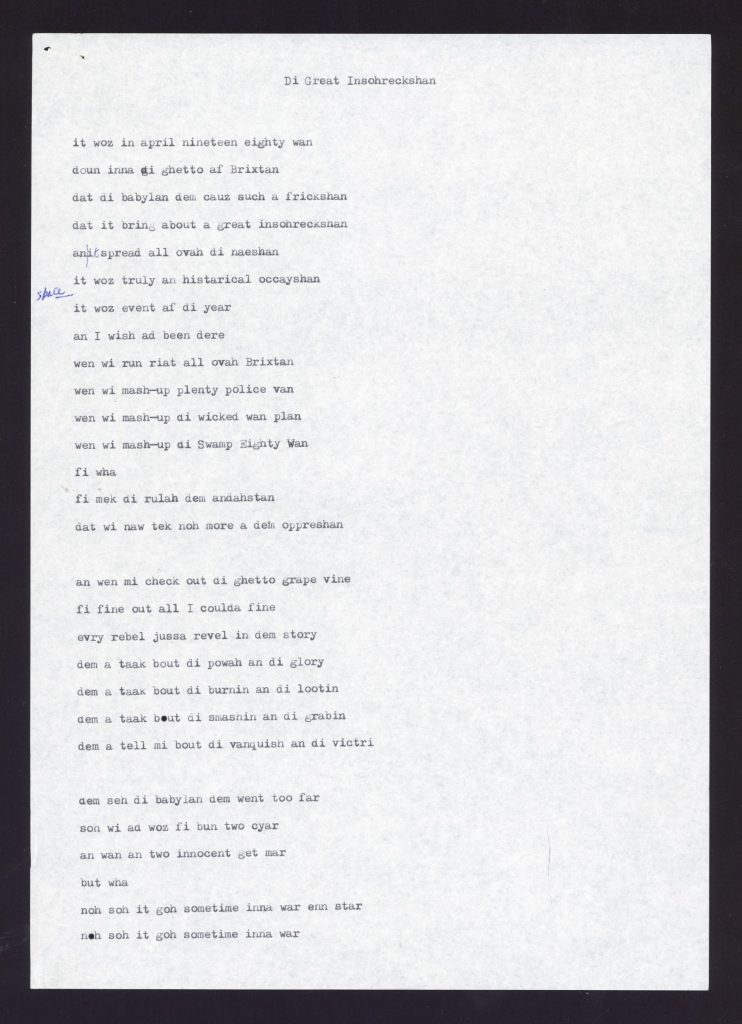
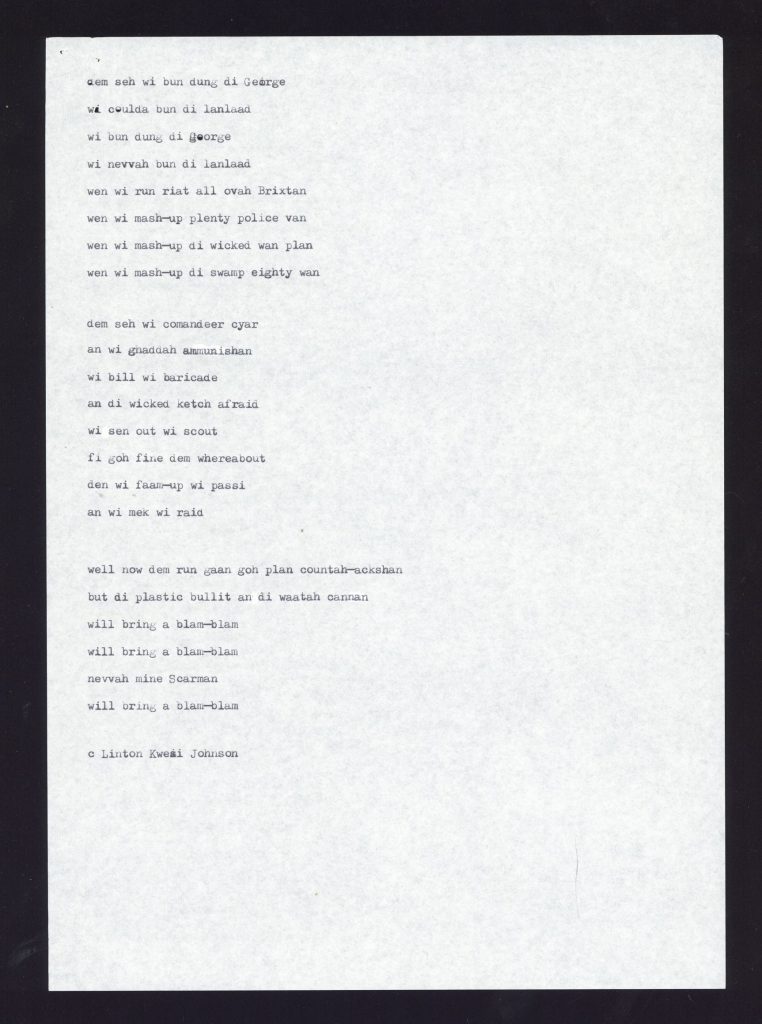
In the Bloodaxe Books Archive, Special Collections holds a set of proofs for Linton Kwesi Johnson’s 1991 poetry anthology Tings an Times which accompanied an album of the same name. Amongst the proofs resides this draft typescript of Johnson’s great dub poem Di Great Insohreckshan which he famously wrote as a response to the Brixton Uprising which took place 40 years ago this year, in April 1981. The poem first featured on his album Making History in 1983.
Typescript draft of Di Great Insohreckshan by Linton Kwesi Johnson prepared for his anthology Tings an Times published by Bloodaxe Books (Bloodaxe Books Archive, BXB-1-1-JOL-1-3-1&2)
Dub poetry, a term coined by Johnson himself, was a form of performance poetry of West Indian origin, written to be spoken out loud against a backdrop of reggae music.
The Brixton Uprising, also referred to as the Brixton Riots, took place 10-12 April 1981. It was the first large-scale racial confrontation between black British youth and white British police. The rioting was sparked by decades of injustices experienced by black people in the UK.
Next month will see the fortieth anniversary of the publication of the Scarman Report, commissioned by the UK government in response to the Brixton Uprising. Amongst other conclusions, the Report found there to be unquestionable evidence of the disproportionate and indiscriminate use of ‘stop and search’ powers by the police against young black people and placed the Brixton Uprising into the context of the racial disadvantage faced by them.
Linton Kwesi Johnson’s poetry is deeply political in its nature, dealing mainly with the experiences of being an African-Caribbean in Britain. Written and spoken in Jamaican Creole English, Di Great Insohreckshan railed against the injustice and oppression which brought about the tensions leading to the Brixton Uprising, giving full vent to black people’s anger and highlighting the government’s political failure.
When first performed, Di Great Insohreckshan grabbed and demanded the attention of those who heard it, with its intense, urgent, streetwise and intellectual delivery. Forty years on the poem is held to stand alongside TV and radio archive as a primary source in its own right, helping future generations understand the cultural and political upheaval that led to the Brixton Uprising of 1981.
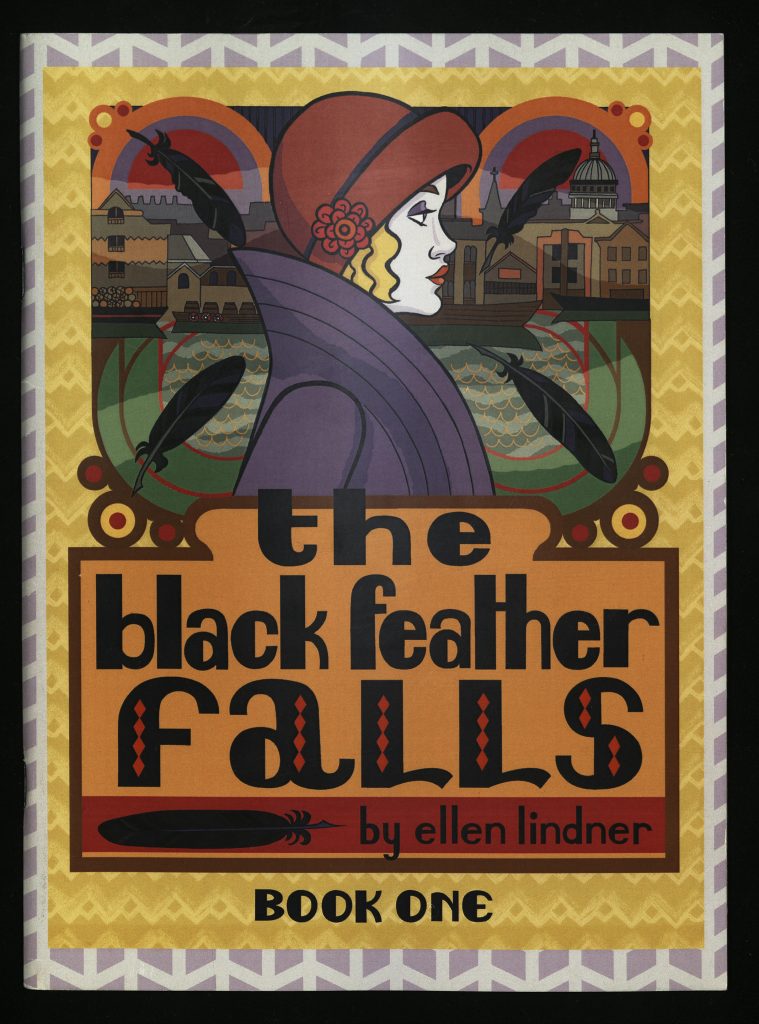
The front cover of comic book, Lindner, E. The Black Feather Falls, book one 2013, Wylie 741.5 LIN (used by permission of Soaring Penguin Press), Wylie (Terry) Comic Books, Newcastle University Special Collections, GB 186.
Ellen Lindner’s The Black Feather Falls is part of the recently-acquired collection of comic books that were formerly owned by Terry Wiley.
The Black Feather Falls was originally published in three volumes that were collected and published as a single-volume graphic novel under the same title in 2015. The series is set in the 1920s and features as its main character Tina Swift, a young American woman, who has recently moved to England and works in a dress shop in London. The street outside the shop becomes a murder scene where Tina discovers a black feather – a clue to the crime, but one that the police dismiss. Tina decides to solve the crime herself with the help of Miss McInteer, a stenographer at the local paper, which leads her back into the past, to events of the First World War. The series was nominated for the Ignatz award for Outstanding Series in 2014; the awards recognise outstanding achievements in cartooning and comics and are held annually in the United States.
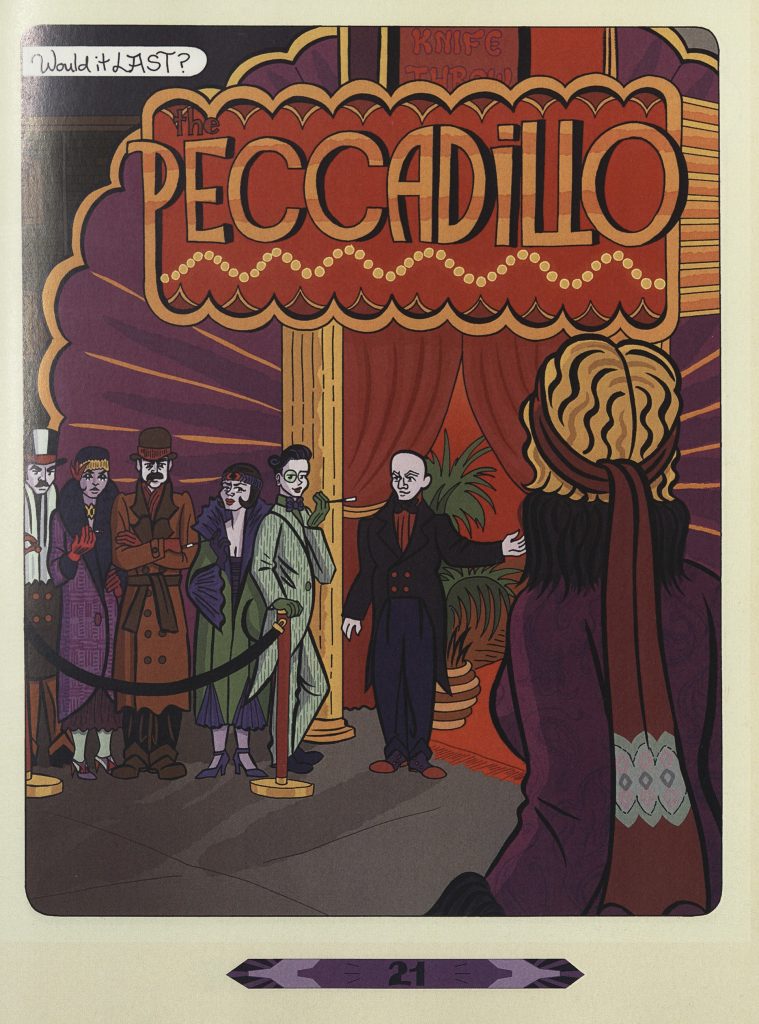
Page 21 of comic book, Lindner, E. The Black Feather Falls, book three 2014, Wylie 741.5 LIN (used by permission of Soaring Penguin Press), Wylie (Terry) Comic Books, Newcastle University Special Collections, GB 186.
This work is of particular significance for its blending of literary genres. The interwar mystery that comprises the action of the plot relates to the interwar ‘Golden Age’ of detective fiction that occurred both in Britain and the United States. Lindner’s choice of a main character that is both a professional woman, working to live independently, and amateur detective also relates to the growing number of women embarking on careers in this period. The artwork for this series demonstrates a use of limited colour palette and strong outlining to characters and scenes, showcasing Lindner’s distinctive style whilst detailing many aspects of the 1920s setting such as the clothing fashions and interior designs. The appearance of cosmetic items such as lipstick and compacts, along with ‘flapper’ style dresses of a looser fit and shorter hairstyles with cloche hats relate to the specific context of the 1920s that saw these changes in dress styles, accessories and millinery.
The Wylie (Terry) Comics are currently being catalogued. These three volumes are part of a collection that spans several decades of comics and graphic novels, and many artists, authors and cartoonists. These are not the only examples of the use of crime and mystery genres; there are also many volumes of Paul Grist’s Kane series about a detective working in a precinct of a fictional American city and works set in previous decades and fantasy worlds are also well represented. Special Collections and Archives also has many items relating to independent publishers, including the archives and collections of Iron Press, Bloodaxe Books and Flambard Press, and of illustrators including satirical prints, such as those in the James Gillray Collection, and children’s books.
The story of Dr Ruth Nicholson and the women of Royaumont Military Hospital
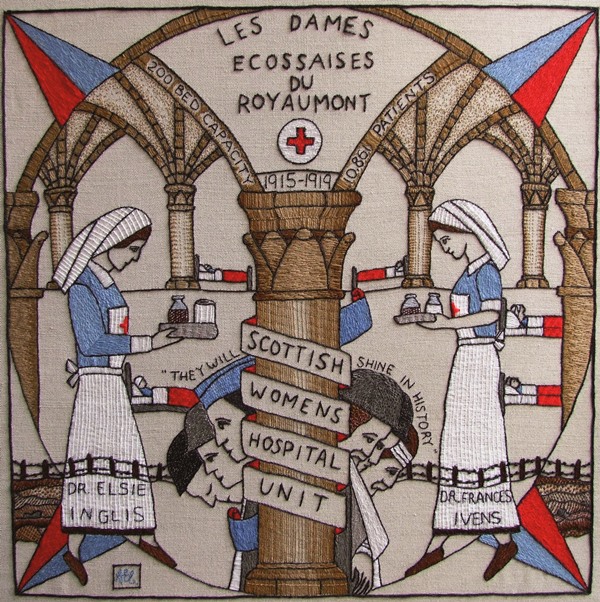
Panel on the Royaumont women in the Scottish Diaspora Tapestry, stitched by Andrea Cooley
This is an online version of the exhibition People don’t know about them…, which was on display in the Marjorie Robinson Library Rooms, Newcastle University, 28th October 2016 – 15th January 2017. The exhibition was the result of a collaborative oral history project based at Newcastle University Library, and part of the Universities at War programme.
Many thanks to the creators of the original exhibition, Sam Wagner and Rosemary Nicholson.
Three Women
Our story starts with Rosemary Nicholson, a local Newcastle woman who contacted the Universities at War project to tell us about her husband’s aunt Ruth – a Newcastle University medical graduate who had worked as a surgeon in a military hospital in France throughout the First World War, under the direction of the French Red Cross.
A female medical graduate?
A military hospital staffed entirely by women?
And why the French Red Cross?
The story caught the eye of Sam Wagner, an archaeology student in her final year of study at Newcastle University, who had joined the Universities at War project in 2015.
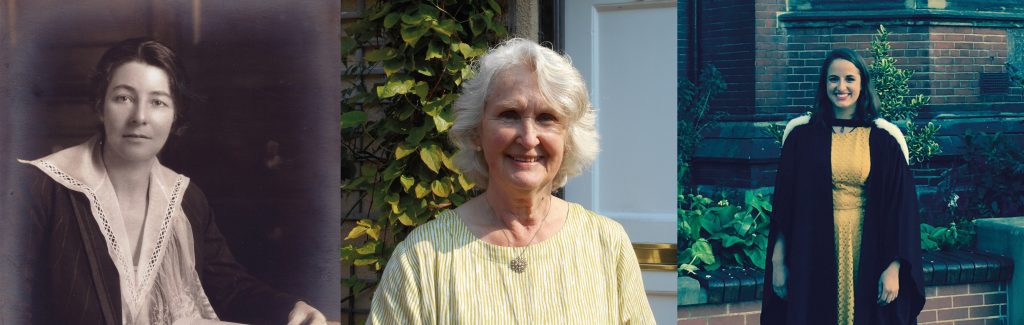
Ruth Nicholson, Rosemary Nicholson and Sam Wagner
Sam’s exhibition is the result of her own historical research and interviews with Rosemary – capturing her memories of family stories about Ruth, as told through Ruth’s sister, Alison, who was still alive when Rosemary married into the family.
It is the fascinating story of an amazing Newcastle woman, whose story had been almost forgotten – passed on by the women in her family who had never forgotten and who wanted her story to be told.
The College of Medicine – Newcastle upon Tyne
Ruth Nicholson completed her high school education at Newcastle upon Tyne High School and registered as a student at the College of Medicine in 1904. After graduating in 1911 she worked in a dispensary in Newcastle before going to Edinburgh where she became an assistant to Dr Elsie Inglis in the Bruntsfield Hospital. As Rosemary states, she then worked in Palestine before returning to England at the outbreak of the First World War.
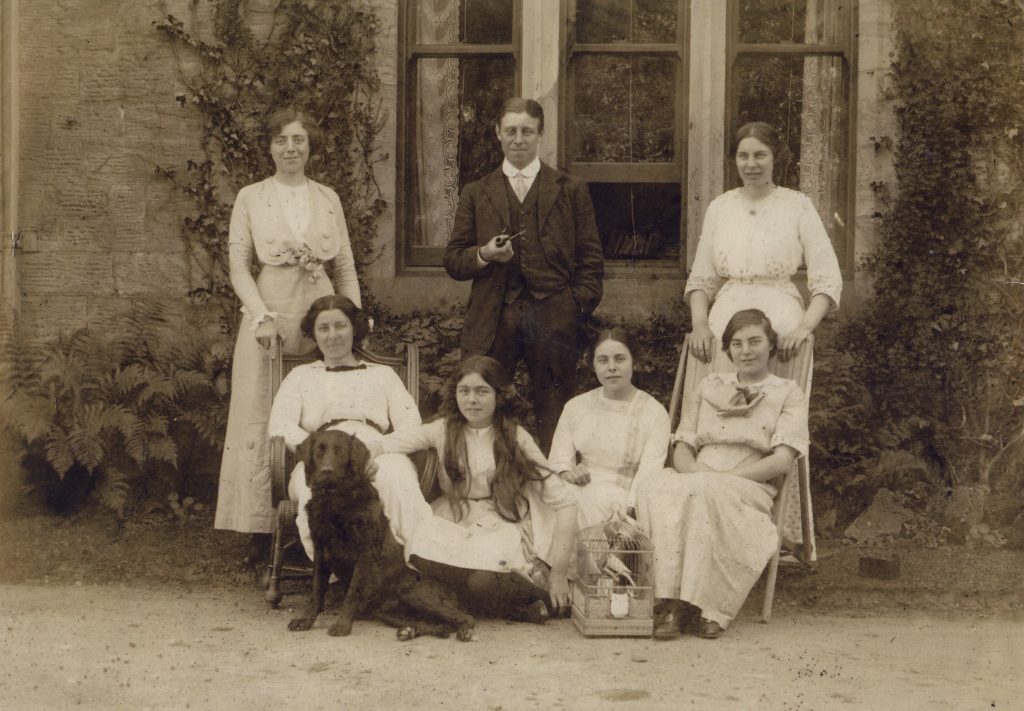
Ruth (seated far left) with her brother and five sisters
“There were seven of them all together, one brother and Ruth the eldest. This was taken at Newton Vicarage where they lived later on in their father’s life. Their father was a vicar.
Their mother was rather a remarkable woman I think for her time because she wanted all her children to get professional qualifications regardless of whether they were men or women … So Ruth qualified as a doctor in Newcastle, and then the youngest, Wyn, also qualified as a doctor. The only one who didn’t get special qualifications is Alison. She was always rather a joke in the family. She had a lover in Romania and that’s what distracted her!”
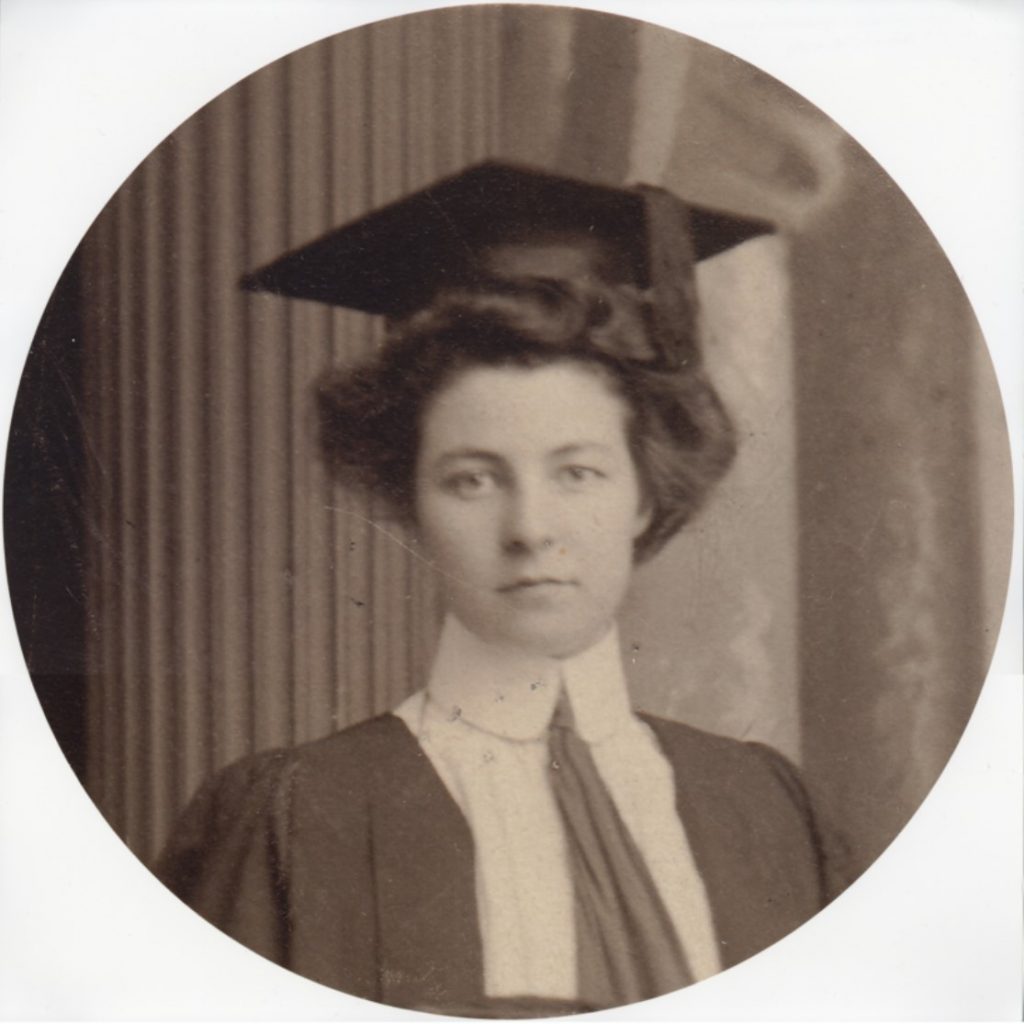
Ruth’s Graduation photograph, 1909.
“That picture’s Ruth in 1909 when she qualified … she qualified as the only woman in her year. And I think that she probably was quite a convinced suffragette. I don’t know whether she was a suffragette or a suffragist but you know Newcastle was a centre for a quite militant suffragette movement … Newcastle had some quite militant women!
It was quite difficult I think for women to get work as doctors in England. She went to work briefly in Edinburgh with a very distinguished woman doctor called Elsie Ingles and then she went to work out in Palestine in Gaza, which was before the First World War.”
The start of the First World War
“And then 1914, obviously the First World War is declared and she came back to England, and she’d been working as a surgeon. She offered her services to the War Office and the War Office accepted her and said yes and then she got her kit together and turned up at Victoria Station in London to join her group to go out to France to the military hospital out in France and the doctor in charge said “I’m not having a woman. I’m not taking her”.
So she was very, well according to the family, she was terribly terribly angry and upset. And she went back to Elsie Inglis in Edinburgh … she’d [Inglis] started a 100-bed hospital entirely with women, it was called the Scottish Women’s Hospital and she had also offered her 100-bed hospital to the War Office but the War Office said – I’ve forgotten what it is exactly they said – something like “Go home and sit down”.
She didn’t like that!”
Elsie Inglis, image kindly provided by the Imperial War Museum
Rosemary’s family stories appear to be entirely correct. Research by the National Archives confirms that Inglis was told by an official “My good lady, go home and sit still”. In her 1928 book, The Cause, Ray Strachey found evidence of accounts that suggested the commanding officers had told Inglis they “did not want to be troubled with hysterical women”.
The Hospital at Royaumont
“ So they offered the hospital to the French in London – the French Ambassador and he said “yes please” the French would like them, because apparently the French, this is again just through the family myth probably, the French were very aware of the deficiencies in their medical services and they were worried when the war was declared.
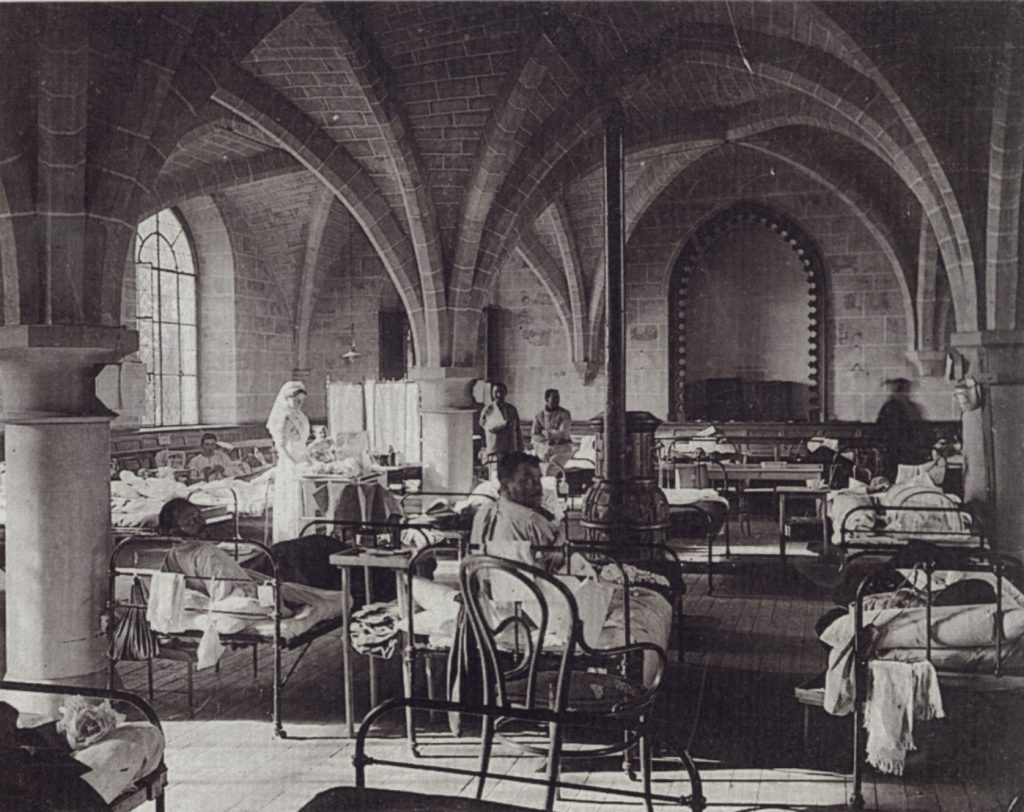
The president of the [French] Red Cross found them Royaumont, but Royaumont, the abbey hadn’t been inhabited for quite a long time; been used as stables and it had no, I don’t think it had electricity and it didn’t have any lifts, which they found really really difficult for dealing with stretchers and trolleys and things like that when they opened the abbey. The abbey was full of nuns, they were kind of helping out, but it was an empty shell of a building and it was in a terrible state. So, quite how they managed to get it open by 1915, I don’t know what they did.”
Royaumont Hospital, image kindly provided by the Imperial War Museum
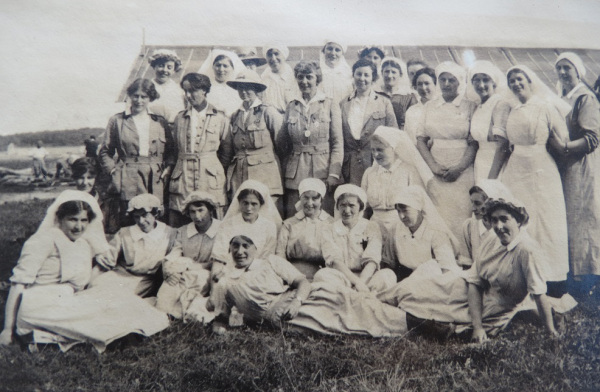
Royaumont was the largest continuously-operating voluntary hospital in France at the end of the First World War – over 10,000 patients were treated at Royaumont and its mortality rates were better than its army-run equivalents.
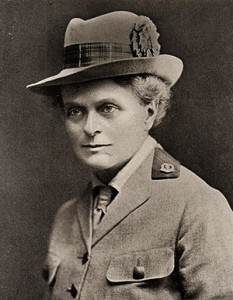
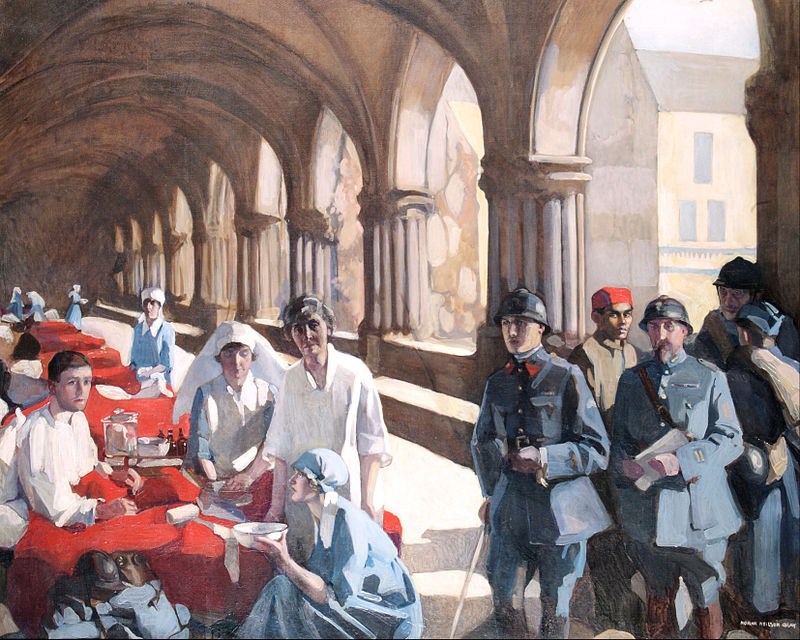
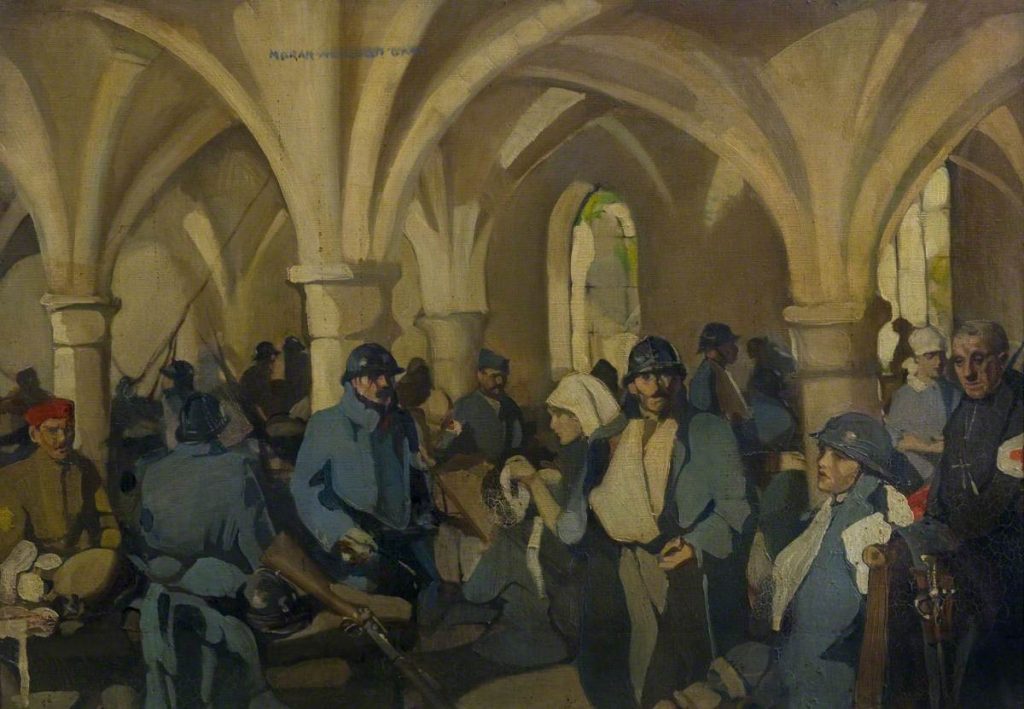
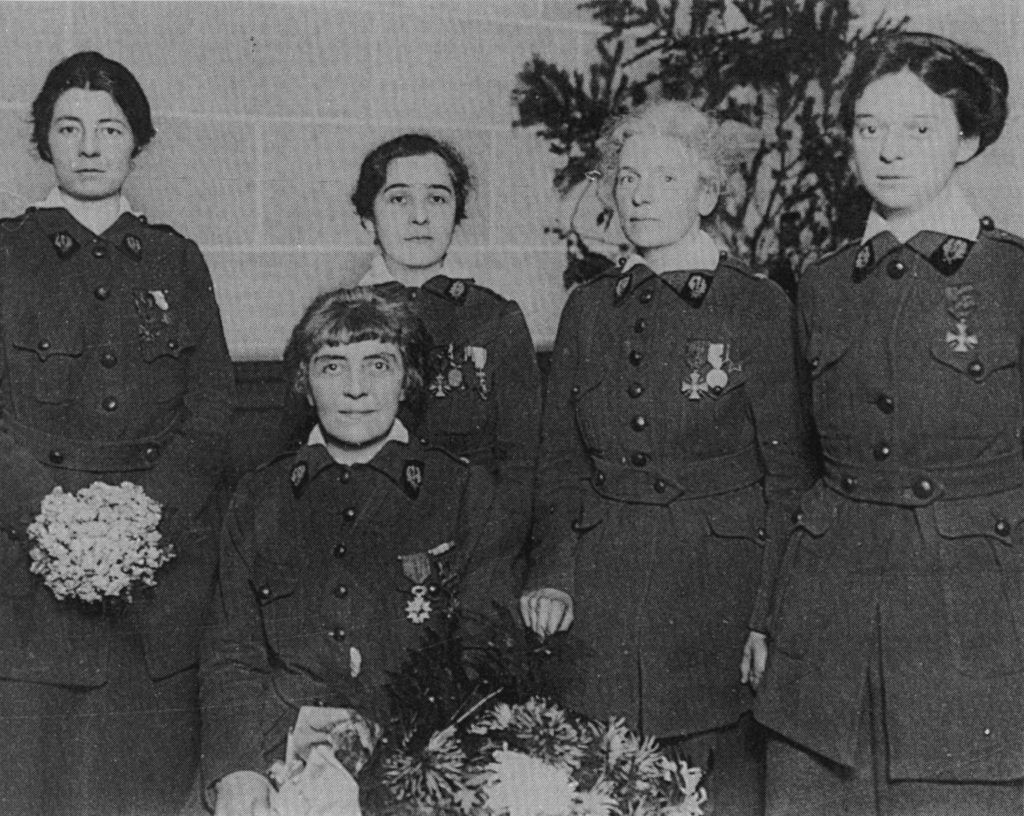
Frances Ivens at Royaumont, by Norah Neilson Gray, image kindly provided by the Imperial War Museum.Royaumont – by Norah Neilson Gray, image kindly provided by Helensburgh Public Library.
“ They started with 100 beds and by the end or at some stage, they had 600 beds. You probably know that, and some of the wards had 100 beds in them… I mean, I just don’t know how they coped, I don’t know how they did it…They were tough, I think, really tough.”
“ Unfortunately, I never met Ruth because she lived in Devon and she died in 1963, and my husband and I got married in 1962 and I never met her… but I knew Alison because she lived locally [Ruth’s sister Alison had also served in the Royaumont hospital, as an orderly, from September 1916 – March 1919]. I knew her quite well. And she used to talk about it all – they went on having Royaumont reunions right on until the sixties, the middle sixties, you know, which is a long time, you know… She talked about how traumatised people were, nightmares, they continued to have nightmares about it and things. And the doctors too, I think. I think it must have been awful. Really awful.”
“ I make it sound all gloom … but obviously in the First World War they had times of terrible crisis and awful fighting and then other lulls and really not much happening. And apparently, the nursing staff and the doctors, I supposed they were very used at home to providing their own entertainment and things and they would put on shows … Well Ruth, apparently had learnt how to do, while she’d been in Palestine, Dervish Dances, I think she called them her scarf dances! I think the patients liked them a lot!”
The Scottish Women’s Hospitals depended on an extensive network of fundraising, much coming from the National Union of Women’s Suffrage Societies (NUWSS) whose London units provided an x-ray van. Newnham and Girton colleges in Cambridge provided both money and volunteers, as did women in the USA and around the world.
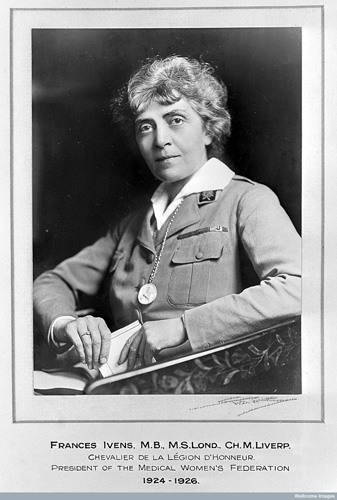
Frances Ivens was the first foreign-born woman to be awarded the Legion d’Honneur, France’s highest honour, and thirty of her Royaumont colleagues were awarded the Croix de Guerre.
Ruth (standing far left) and Frances Ivens (seated) receiving their Croix de Guerre medal.Frances Ivens, image kindly provided by the Imperial War Museum.
“ And then at the end of the war, these are some of the doctors who got French medals. They got the French Criox de Guerre. This is Frances Ivens … she was the first non-French person ever to get the Legion d’Honneur.”
“ There were two surgeons, Ruth of course, second in command of the hospital I think they called her, and the boss was called Frances Ivens. She was … the rather inspirational woman in charge … I think it’s incredible that quite a lot of the women who came out to be ambulance drivers actually brought their own cars, and had them slightly transformed I think! So, quite a lot of quite rich, I think, young women who could provide their own vehicles. ”
After the War
After the war Ruth specialised in obstetrics and gynaecology and became Gynaecological Surgeon and Clinical Lecturer at the University of Liverpool and was one of the earliest Fellows of the Royal College of Obstetrics and Gynaecology. She became the first woman President of the North of England Society of Obstetrics and Gynaecology and played a prominent part in the Medical Women’s Federation. Dr Ruth Nicholson died in Exeter on 18 July 1963.
Staff of Royaumont, Francis Ivens is Centre, with Ruth to her right.Ruth’s sister, Alison Nicholson, who went to the Royaumont Hospital in 1916 to serve as a nurse.
“ I felt she never got the credit she should have had, or the recognition she should have had, or Alison.
People don’t know about them, I mean I write to everybody. I heard the programme on Women’s Hour about the women’s hospital in London and I rang right in to them saying, you know, “What about Royaumont?!”
It was a matter of pride!”
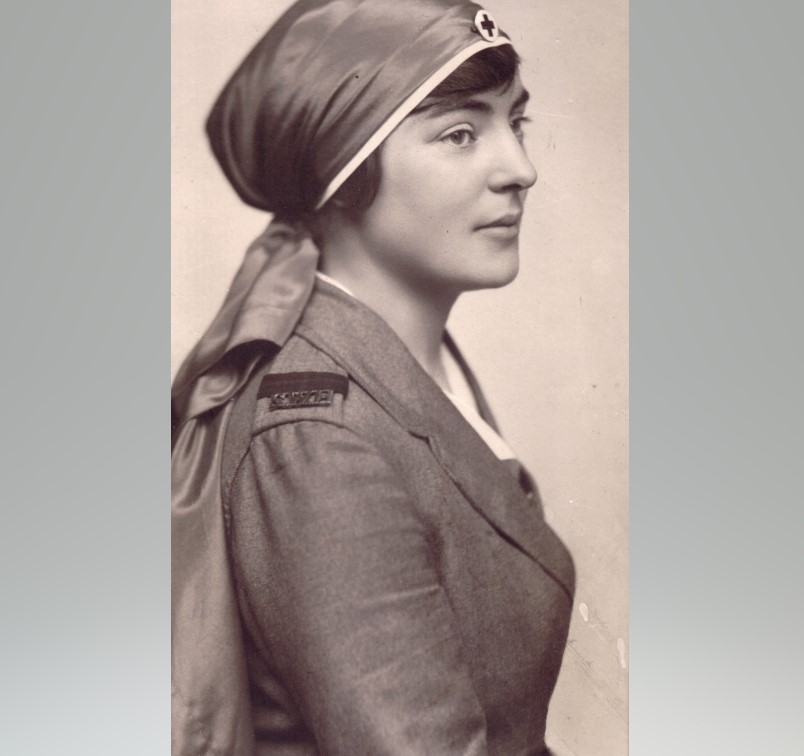
Ruth later in life, thought by her family to have been taken when she lived in Liverpool.
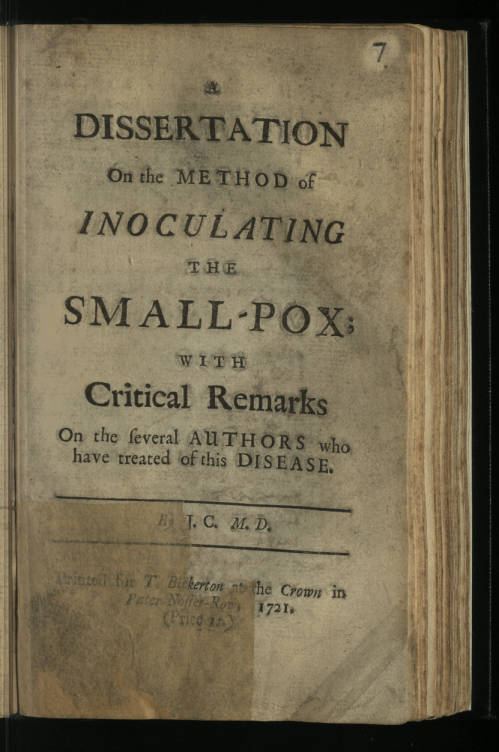
Title page to A Dissertation on the method of inoculating the small-pox … (1721) Medical Tracts v1(7), Medical Tracts, Newcastle University Special Collections, GB 186
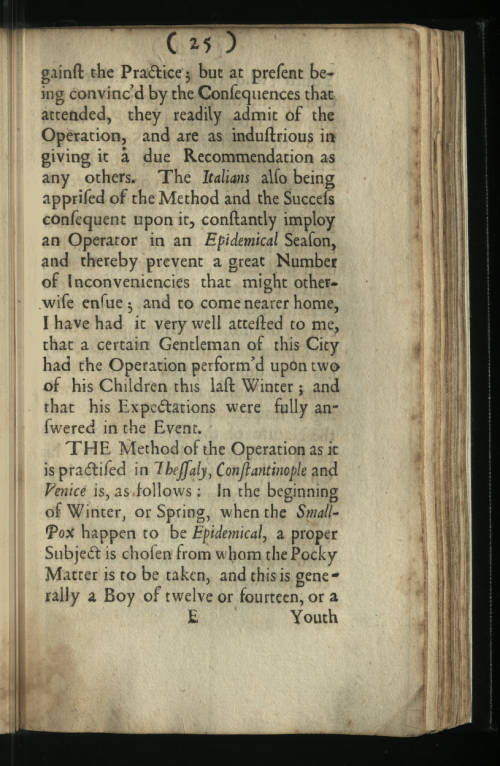
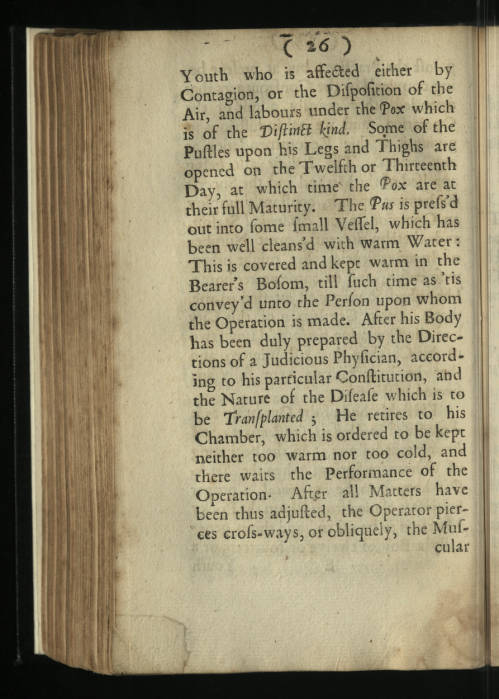
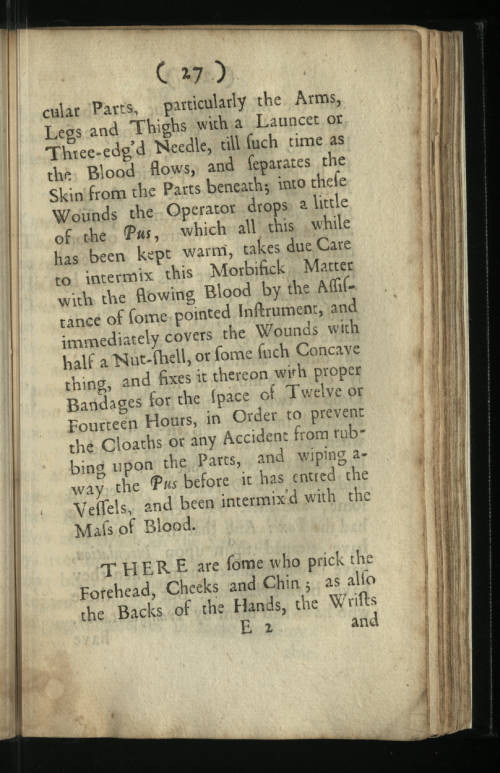
While we are all familiar with vaccination, its predecessor variolation is less well known. The goal is the same – to use a medical procedure to induce immunity to a disease. Before the invention of vaccination, variolation was the only preventative against smallpox available. This pamphlet, from our Medical Tracts Collection, is one of many English publications on the subject from 300 years ago in 1721. A translation of a Portuguese pamphlet by Jacob de Castro Sarmento, it outlines the variolation process ‘as it is practised in Thessaly, Constantinople and Venice’. The process is relatively simple – warm pus from someone suffering with smallpox is applied to a freshly made incision on the variolation patient. This triggers an immune response in the patient, which renders them less susceptible to future infection.
Description of the variolation procedure from A Dissertation on the method of inoculating the small-pox … (1721) Medical Tracts v1(7), Medical Tracts, Newcastle University Special Collections, GB 186
1721 was a key year in the history of variolation in England. While the practice had been taking place in Asia and Africa for some time, in the early 18th Century its adoption in England was cause of much debate. Since the 1710s the Royal Society of London had explored and discussed its use, but the high level of risk involved had prevented it from being introduced to English society. Arguments for and against the process continued to be published. Then in 1721, several events took place which contributed to its greater acceptance in England.
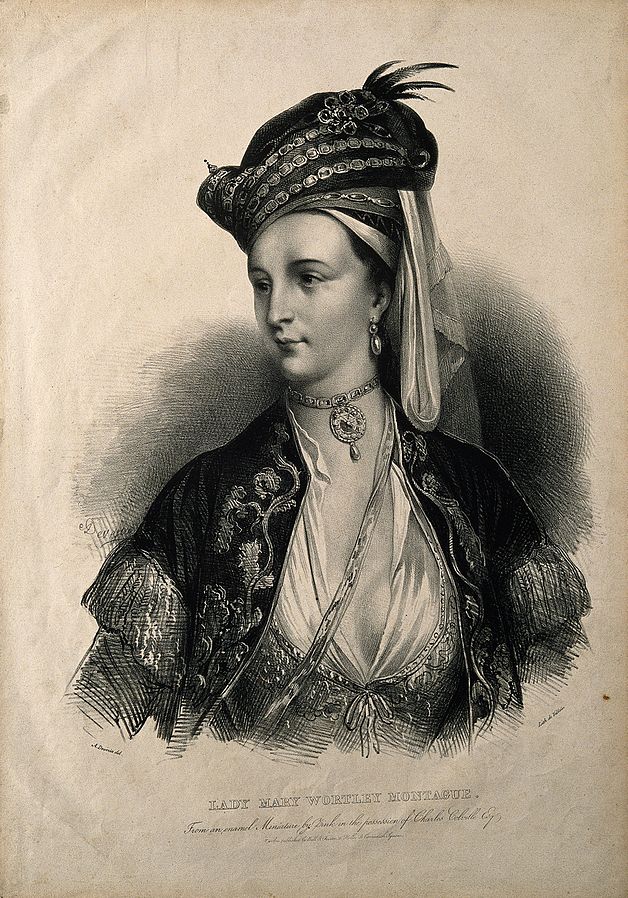
In April of that year, a smallpox epidemic led Lady Mary Wortley Montagu, an aristocrat and writer, to have her daughter Mary “engrafted”. Montagu had first encountered the procedure while in Turkey some years earlier. She had written about it to friends and had her son undergo the process whilst there. Back in England, Mary’s inoculation was observed by three members of the Royal College of Physicians, becoming the first documented inoculation in England. After the successful inoculation of her daughter, interest in variolation rose sharply amongst her aristocratic friends (which Montagu strongly encouraged. It came to the attention of Caroline of Ansbach, then Princess of Wales, who wished to inoculate her three children.
Lady Mary Wortley Montagu, Lithograph by A. Devéria after C. F. Zincke. Wellcome Library no. 6994i. Reproduced under Creative Commons.
It was felt that more evidence of the safety and effectiveness of the procedure was required before risking the health of the heirs to the British throne, and so in July, the royal physicians finalised arrangements to conduct variolation trials on inmates at Newgate prison in London. Seven inmates were offered the choice of participating in exchange for their sentence of transportation to the Americas being remitted. Those who accepted (which was all of them) underwent “engrafting” on the 9th of August 1721. The initial procedure was heavily attended by observers and the participants’ progress was discussed in newspapers and pamphlets.
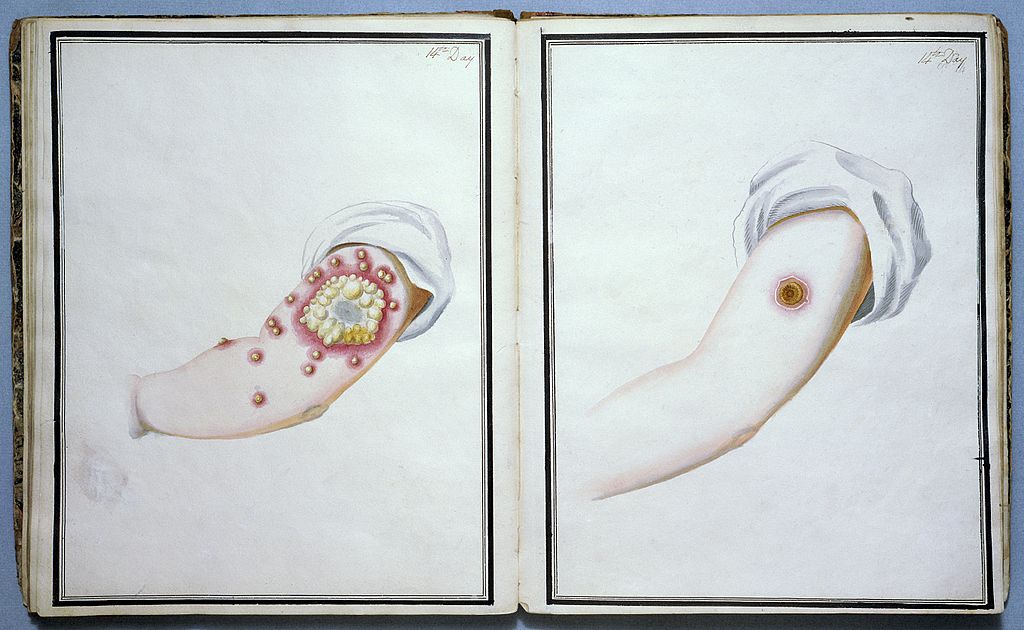
Watercolour drawings of the left arm showing smallpox inoculation (variolation) on verso and cowpox inoculation (vaccination) on recto. Wellcome Library number WMS 3115. Reproduced under Creative Commons.
The Newgate trial was deemed a success, with all the participants recovering well and displaying immunity. One of the participants, Elizabeth Harrison (originally sentenced to death for the theft of 62 guineas), was taken to a school which was suffering a smallpox outbreak to demonstrate her immunity. The royal children were eventually inoculated, but not until April 1722 after further trials on orphan children had taken place. While debate continued around the safety and effectiveness of variolation, these events contributed to its increased acceptance and by the 1740s, charitable inoculation hospitals were being established. It became common practice to use variolation to reduce the impact of smallpox outbreaks in rural areas. Variolation continued to be used in England until the invention and introduction of the safer vaccination process eventually led to the Vaccination Act of 1840. This entitled everyone in England to smallpox vaccination free of charge and banned the use of its riskier predecessor.
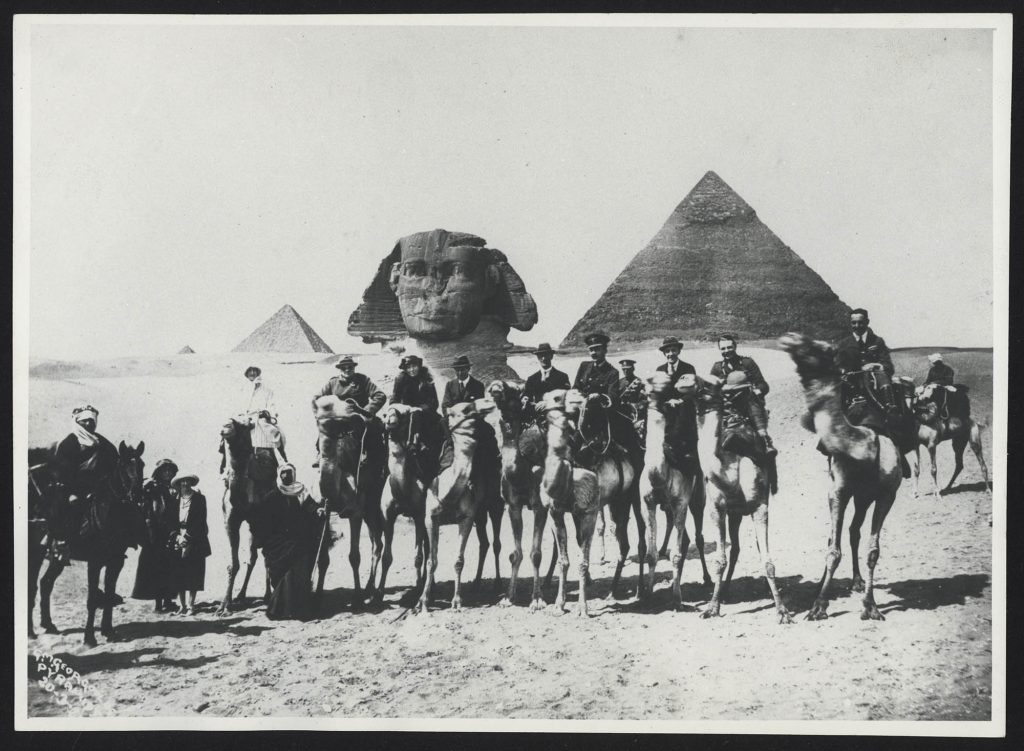
March 1921 marked a key milestone in the history of the Middle East and Iraq, and one in which Gertrude Bell played an important role. The key event was the Cairo Conference, where British officials met to discuss the political situation and agree on the future political makeup of the region.
Photograph of Gertrude Bell and group on camels involved in the Cairo Conference (1921) GB/PERS/F/002
The conference took place between the 12th and 30th of March in Cairo, Egypt. Key attendees included (Sir) Winston Churchill (at the time Secretary of State for the Colonies), T.E. Lawrence (Special Advisor to the Colonial Office), Sir Percy Cox (High Commissioner of Iraq) and Gertrude Bell herself who had previously been appointed as Oriental Secretary for the High Commissioner of Iraq. Gertrude Bell already had a working relationship with Percy Cox dating back several years to their time spent together in Basra and Baghdad during the First World War where she worked under him using knowledge gained over the preceding years of the local tribal populations and their politics to advise the British leadership.
We know a great deal of Gertrude’s thoughts, opinions and involvement in the conference and middle eastern politics thanks to the letters she wrote throughout her life to family members which were retained, and then passed to Newcastle University after her death in 1926. The university also holds several thousand photographs and diaries chronicling her time travelling and working overseas, often in a great deal of detail.
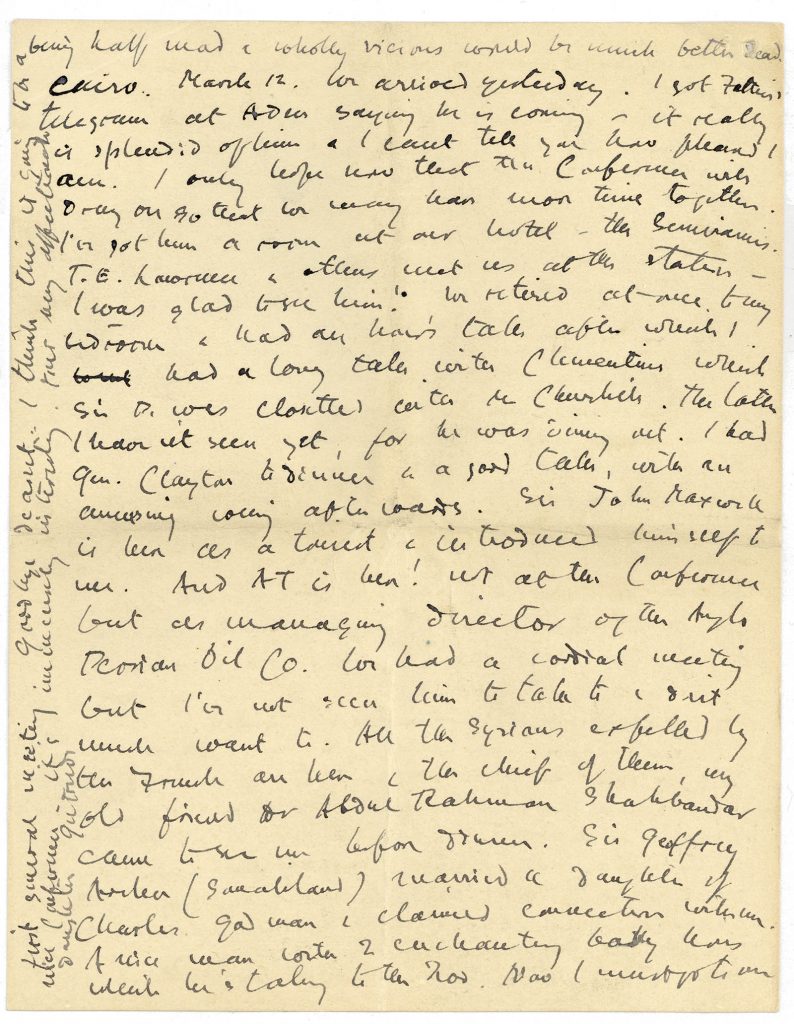
Gertrude’s letter of the 12th of March 1921 includes detail of her arrival in Cairo and the Semiramis hotel, and her first evening spent reacquainting with some of the other attendees at the conference:
T.E. Lawrence and others met us at the station – I was glad to see him! We retired at once to my bedroom and had an hour’s talk after which I had a long talk with Clementine while Sir P. [Sir Percy Cox] was closetted [sic] with Mr Churchill. The latter I haven’t seen yet, for he was dining out. I had Gen. Clayton to dinner and a good talk, with an amusing evening afterwards.
Part of a letter written by Gertrude Bell on the 12th March 1921. GB/LETT/1921/3/12
Busy with conference proceedings, and a visit from her father who had travelled to Cairo to see Gertrude, her next letters were written after the end of the conference whilst travelling back to Baghdad. In a letter to Lieutenant Colonel Frank Balfour Gertrude writes of the conference:
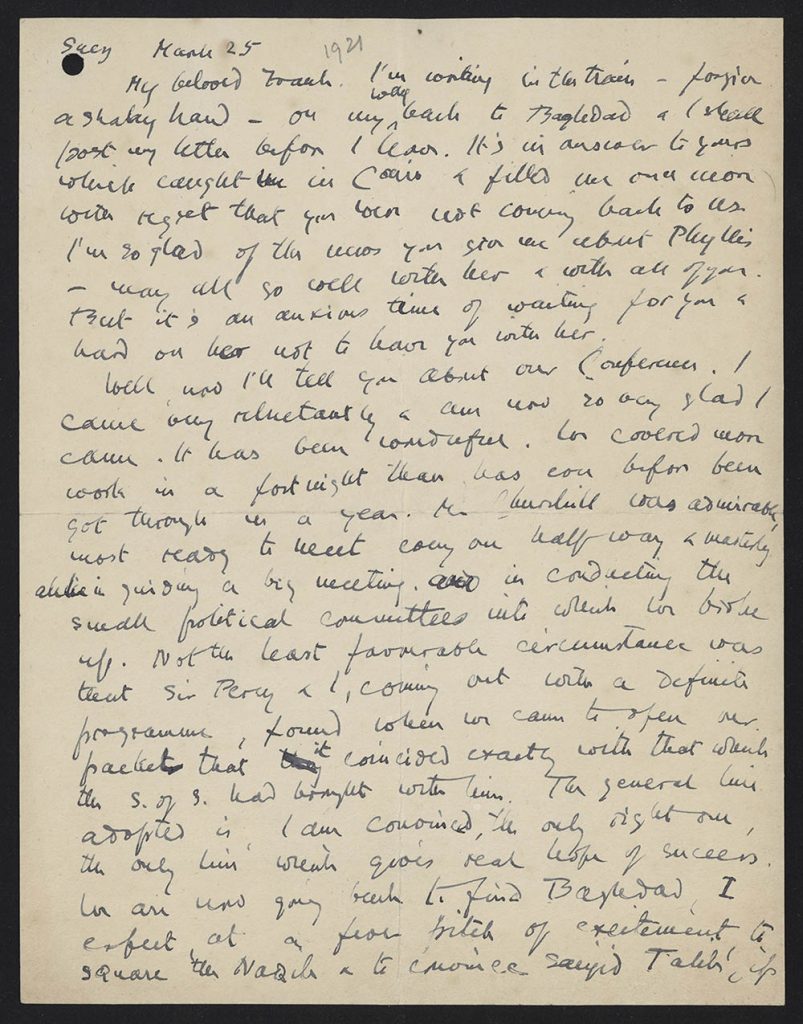
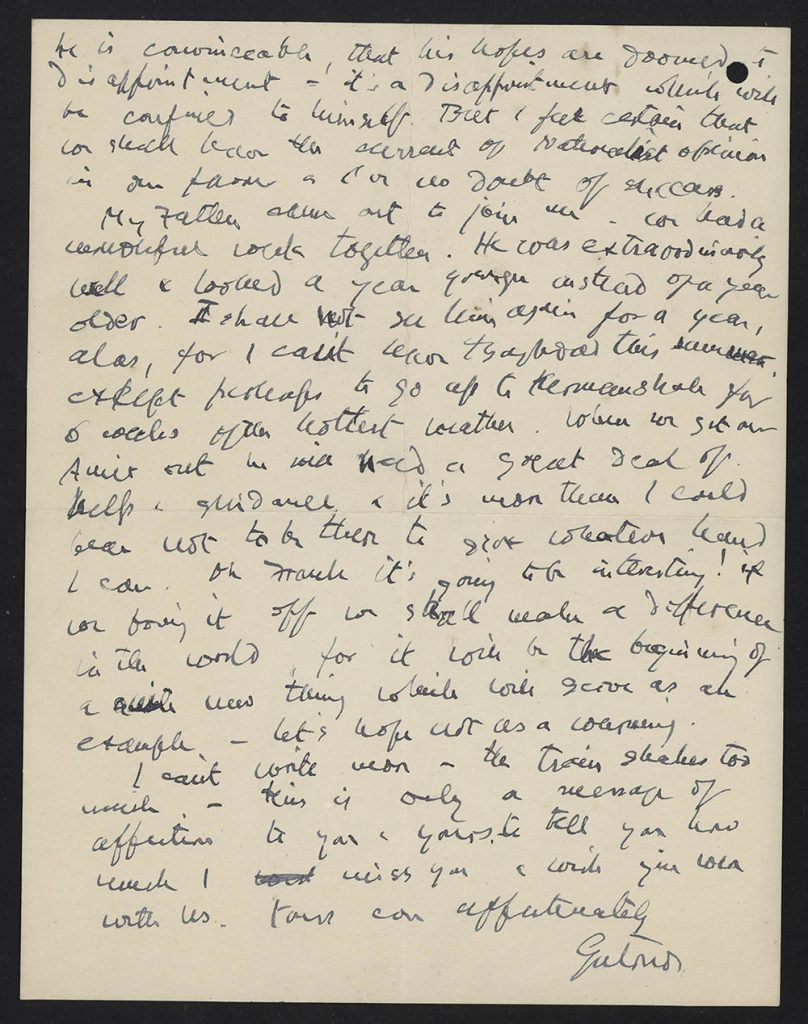
Mr Churchill was admirable, most ready to meet everyone half way and masterly alike in guiding a big meeting and in conducting the small political committees into which we broke up. Not the least favourable circumstance was that Sir Percy and I, coming out with a definite programme, found when we came to open our packets that it coincided exactly with that which the S. of S. had brought with him. The general line adopted is, I am convinced, the only right one, the only line which gives real hope of success. We are now going back to find Baghdad, I expect, at a fever pitch of excitement, to square the Naqib and to convince Saiyid Talib, if he is convinceable, that his hopes are doomed to disappointment – it’s a disappointment which will be confined to himself. But I feel certain that we shall have the current of Nationalist opinion in our favour and I’ve no doubt of success.
First page of a letter from Gertrude Bell to Frank Balfour, 25th March 1921. GB/LETT/1921/3/25
Second page of a letter from Gertrude Bell to Frank Balfour, 25th March 1921. GB/LETT/1921/3/25
As Gertrude suggests in her letter written on the 25th of March, the plan that was agreed for the future of Middle East and in particular the formation of the country of Iraq aligned closely with her own vision and ideas including the appointment of Faisal I bin Hussein bin Ali al-Hashemi as the first king of Iraq. Indeed a month later on the 17th of April, when back in Baghdad, Gertrude wrote to her father saying “I’m happy in helping to forward what I profoundly Bellieve [sic] to be the best thing for this country and the wish of the best of its people”. In the same letter she also described her role in the arrest and subsequent exile of Talib al-Naqib who had objected to the British plan for Iraq and threatened a rebellion.
While the extent to which her input influenced the eventual solution can be debated, that the solution she advocated closely reflected the outcome of the conference is reflected in her writing from the time of the conference and the preceding months and years.
Gertrude Bell achieved much as a woman in the early 20th Century, including exploits in mountaineering, travelling and recording middle eastern culture and archaeology, enabled greatly by her privileged upbringing which allowed her the time, finances and social connections to develop her interests. Despite her many remarkable achievements in spheres dominated by men, she was also a prominent anti-suffrage campaigner. This aspect of Gertrude Bell’s life has been explored through an online exhibition curated by a student studying an English Literature ‘Exhibiting Texts’ module and can be found here.
Transcripts of Gertrude Bell’s letters and diaries, and the digitised versions of Gertrude Bell’s collection of photographs can be found on our dedicated Gertrude Bell website by clicking here.
Other blog posts focussing Gertrude Bell and her archive include a post featuring a letter written in 1920 including her thoughts on the Middle Eastern political situation at the time, found here, and a longer post exploring Gertrude’s involvement in the the First World War, found here.
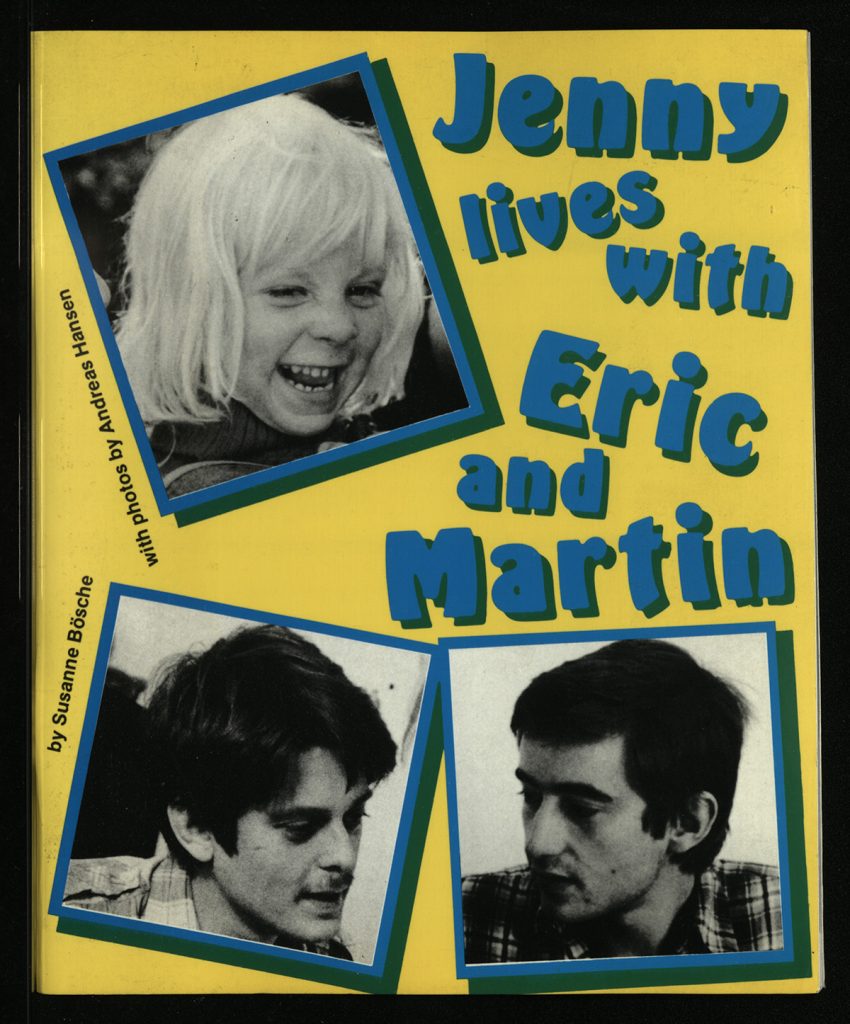
The book Jenny Lives with Eric and Martin was one of the first English-language children’s book to discuss male homosexuality and inadvertently played a significant role in one of the most difficult and controversial episodes in the history of the struggle for equality for LGBT people in the UK.
Written by Danish author Susanne Bösche and first published in Danish in 1981, the book was published in English in 1983 by Gay Men’s Press, intended to help reduce anti-gay prejudice and to be a resource to facilitate discussion with children about homosexuality.
Front cover of Jenny Lives With Eric and Martin (Gay Men’s Press, 1983). (Alderson (Brian) Collection, Alderson Collection BOS JEN)
Special Collections’ copy of Jenny Lives with Eric and Martin is held in the Alderson (Brian) Collection of children’s books, and demonstrates how a book may become politicised owing to its content and the context in which it is viewed, in this particular book’s case, having become a weapon in a war over the teaching of sexuality in schools.
The story describes a few days in the life of five-year-old Jenny, her father, Martin, and his partner Eric who lives with them. Jenny’s mother Karen lives nearby and often visits. It covers their various day-to-day activities, including going to the laundrette together; playing a game of lotto; preparing a surprise birthday party for Eric; and Eric and Martin having a minor argument and making up. There is also a conversation with a passer-by who expresses homophobic disgust when meeting the family in the street, the subject of a later discussion between Eric and Jenny.
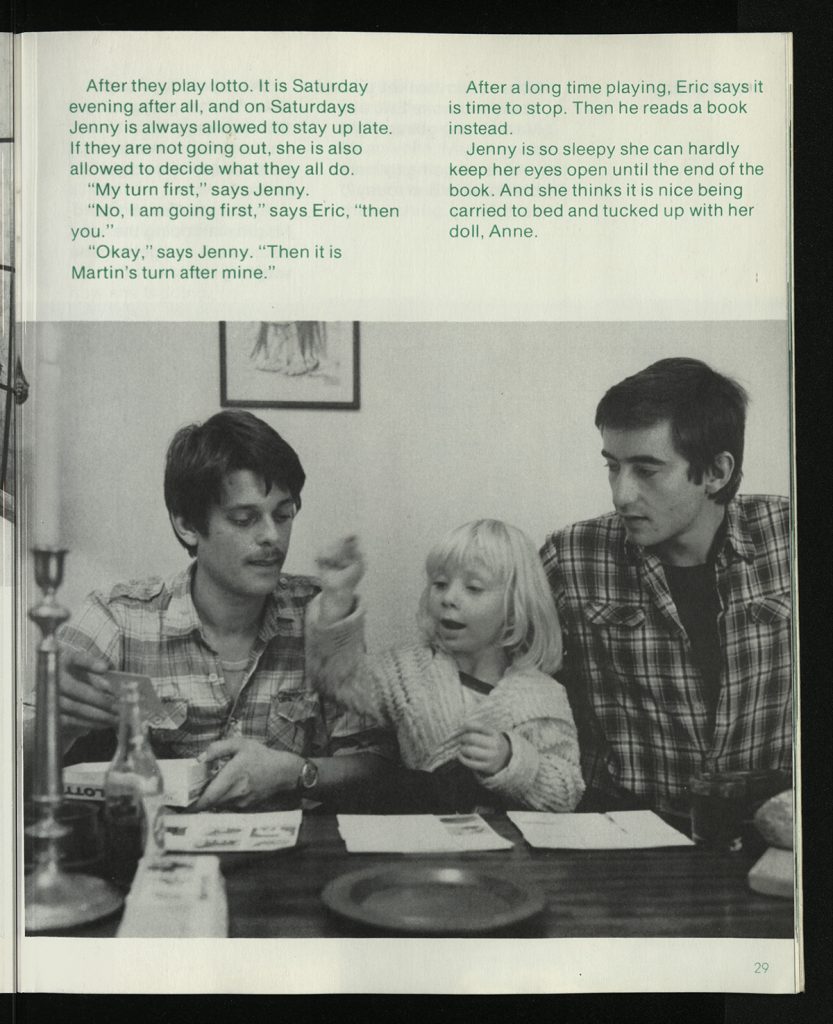
P.29 of Jenny Lives With Eric and Martin (Gay Men’s Press, 1983). (Alderson (Brian) Collection, Alderson Collection BOS JEN)
That the 1980s was a time of rising negative sentiments towards homosexuality in the UK is well-documented. In 1986 a copy of Jenny Lives With Eric and Martin was made available by the Inner London Education Authority in a teachers’ centre specifically for the use of teachers who wanted to know more about gay or lesbian parents. In response to this, various national newspapers inaccurately reported that the book was being made available in school libraries.
The ensuing controversy, including the condemnation of the book’s availability by the Secretary of State for Education, resulted in fear that the book was being used as “homosexual propaganda”, and made a major contribution towards the Conservative Government’s subsequent passing of the controversial Section 28 of the Local Government Act 1988, which forbade the promotion of homosexuality by local government and in schools in England, Wales and Scotland.
Attitudes towards sexuality and sexual minorities have shifted a great deal over the decades since the passing of Section 28, which was reviled by many far beyond the gay community itself. Now largely held to have been an unnecessary and unjust assault on civil rights, the legislation was repealed in 2003, and in 2009 the Conservative Prime Minister David Cameron apologised publicly for it.
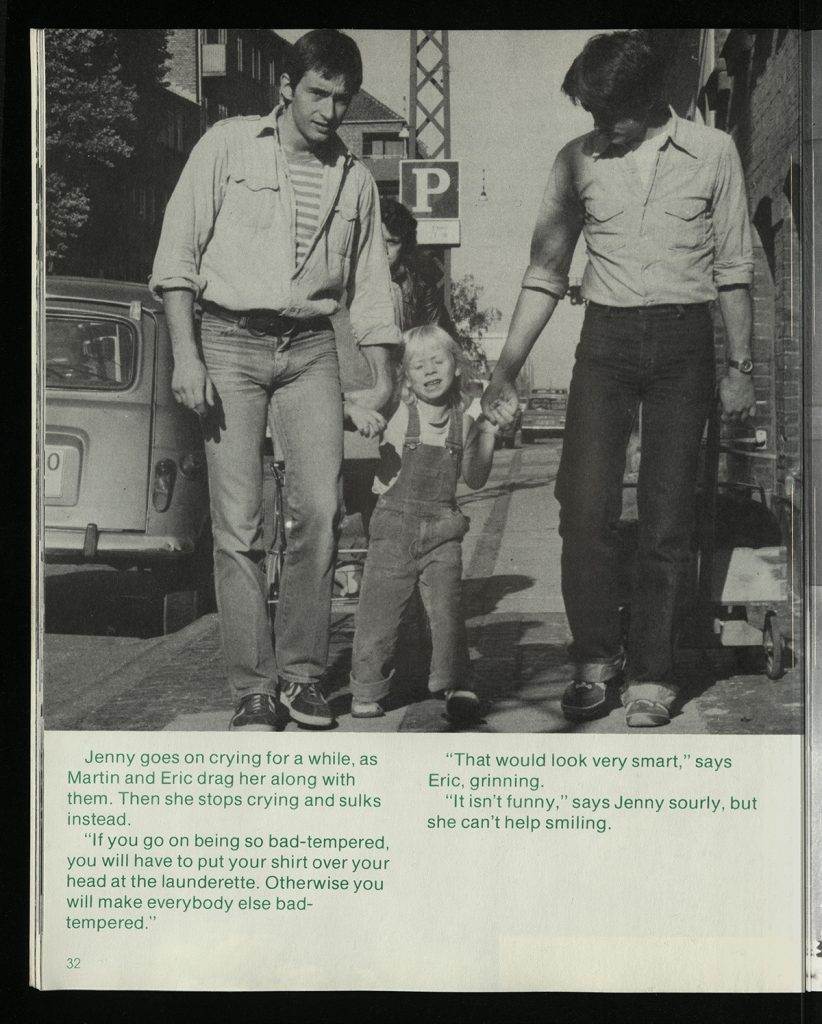
P.32 of Jenny Lives With Eric and Martin (Gay Men’s Press, 1983). (Alderson (Brian) Collection, Alderson Collection BOS JEN)
Bösche, Susanne. Jenny Lives with Eric and Martin (Gay Men’s Press, 1983)