Example H5P Hotspot item – click the + to try it out
Adding engaging and interactive content to your online course materials will get easier very soon. The University has bought an enterprise licence for H5P for use by colleagues for a year. Towards the end of August we’ll be making it available to all Canvas and MLE Teachers giving them the ability to make accessible interactive widgets, like the ones on this post. H5P isn’t just restricted to Canvas and MLE, it can be used on web sites too.
We’re particularly excited about H5P! Once it is turned on there will no longer be a need to be an HTML guru to do things like:
Add accordions
Add single question formative quiz questions
Generate branching scenarios
Create 360 degree virtual tours … and much more
H5P has been successfully used by our friends in other universities– it’s very well documented and each content type has its own tutorial.
We will be using the fully supported (H5P.com) version of H5P and, while we are plumbing this in, if you would like to have a peek at what is in store do check out H5Ps web pages for their documentation. We would recommend holding fire on creating accounts on H5P.org and wait instead until we have our Newcastle H5P site up and running. It won’t be long!
How you can help us?
We have H5P for a one-year pilot initially – so we will need feedback on how you are using it, how your students are finding it, and how you would like our H5P support to develop.
If you would like to get early access to H5P, receive updates, or help our evaluation please JOIN OUR H5P COMMUNITY by filling out this form.
Sample H5P Course Presentation – try moving between the slides and answering the questions
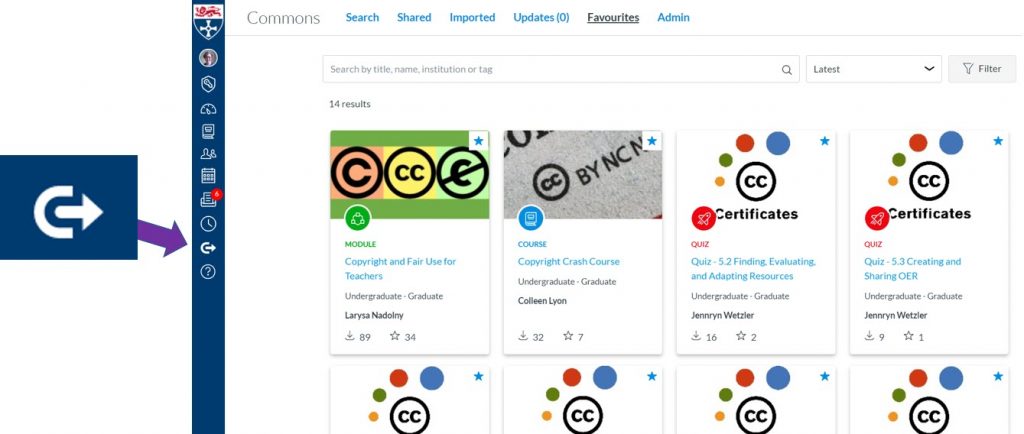
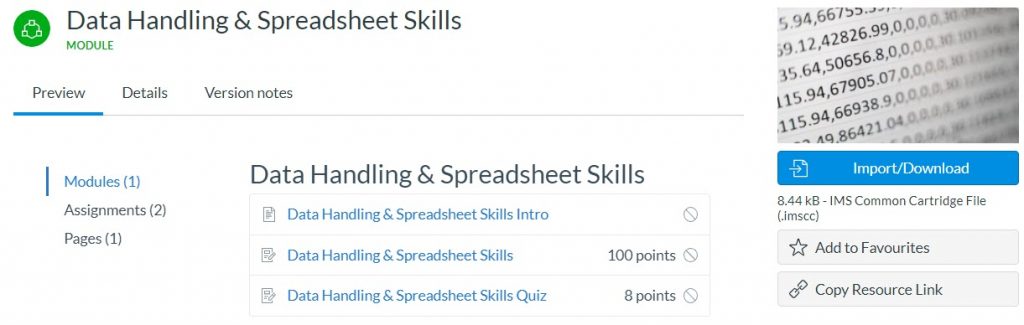
All colleagues who have a Teacher role in Canvas can access and contribute to a huge repository of content in Canvas Commons. You can use Commons to share content with the global Canvas community or choose to restrict its visibility to teachers at Newcastle University. You can also share content with yourself!
For the Art of the Possible we hosted workshops to explore Commons with Colleagues. Our participants got stuck in enthusiastically.
What we liked:
Commons is a great way to access generic content e.g. getting started with the library, or to share content across programmes. (Our induction project team are using Commons to share induction materials with schools this year.)
Even if you don’t want to use the content it’s helpful to see how others have approached teaching your subject – it can give ideas and inspiration
The ability to gather quiz questions to adapt
It could help improve consistency between modules / courses
Commons is a good way to hold content that needs to be included in all/some courses – assignment templates, school policies, supports consistency.
You can use Commons to hold content that is private to you – making it easy to add content into multiple courses.
It makes it easy share content across the institution – rather than importing/exporting or adding permissions
A way of sharing effective practice, building your reputation, and that of the University
Evidence your impact / influence for promotion
Building in consistency
When you don’t know who specifically will need to access the content
By sharing you are contributing to the educational community
To share knowledge and expertise
Some Cautions
Several participants commented on the huge amount of material in Commons, we saw how we could filter this by stage (UG/PG) or restrict our searches to content shared just with the Newcastle University. We saw how we could share permalinks to content elements in Commons to make finding resources easier.
Canvas Commons content isn’t policed so we had good discussions about the need to check content for accuracy, and also to look out for international differences (eg prescribing guidance, legal regulations etc…). We spoke about how different creative commons licenses could be added to support reuse and about how to give attribution to Commons Content shared with CC licenses.
2. Use Canvas modules to set a flow through your course
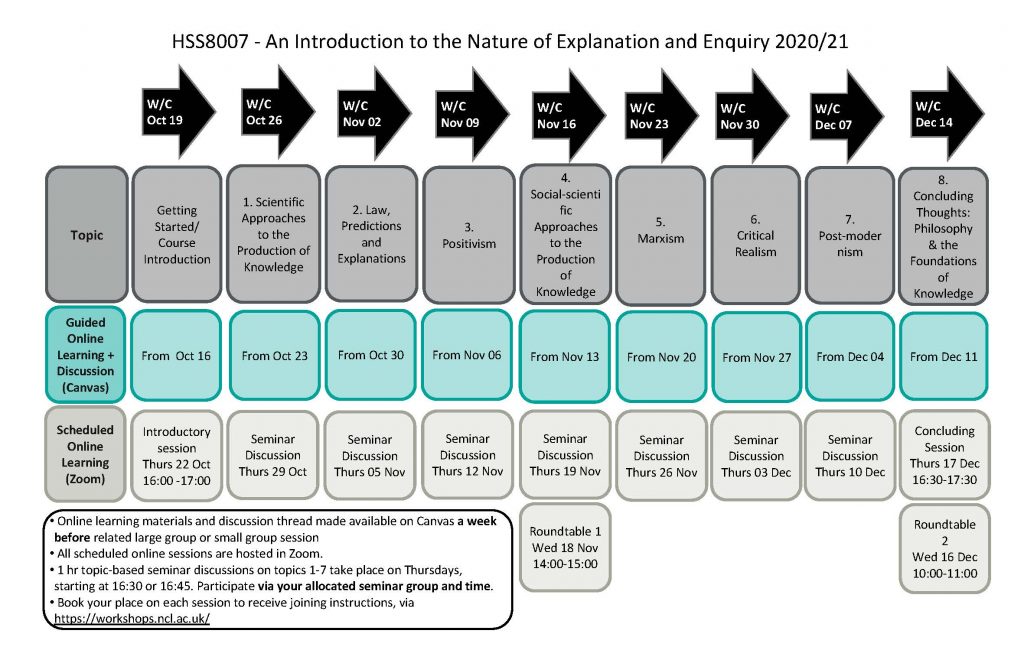
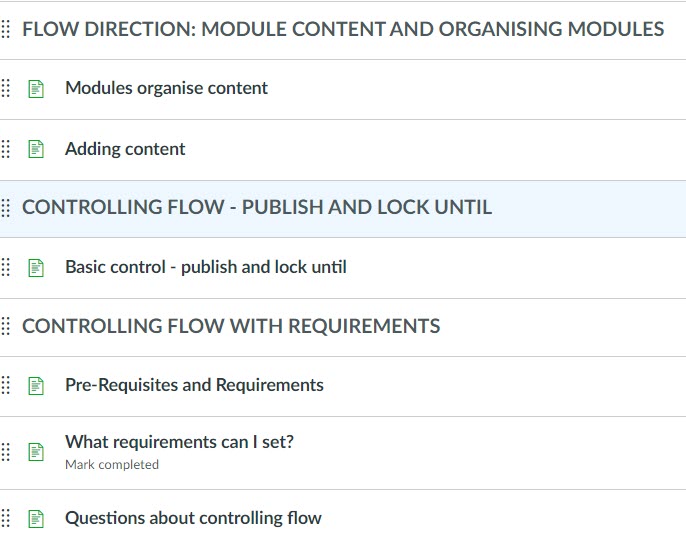
Use your Canvas modules to direct student’s activity week by week or topic by topic. Every Canvas course has a sample structure that you can adapt to match your teaching pattern. You can hide or lock materials that aren’t yet relevant and even set requirements so that student need to view or complete certain conditions before they can move on.
Without the normal structure of face to face time on campus it’s harder for many students to structure their time.
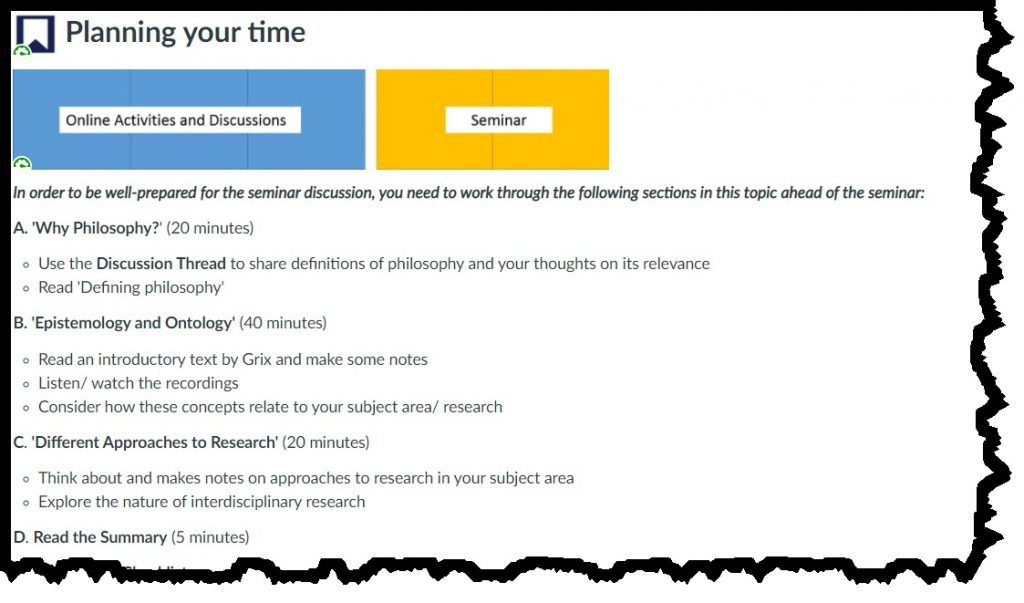
HSS8007 indicationg timings on activities
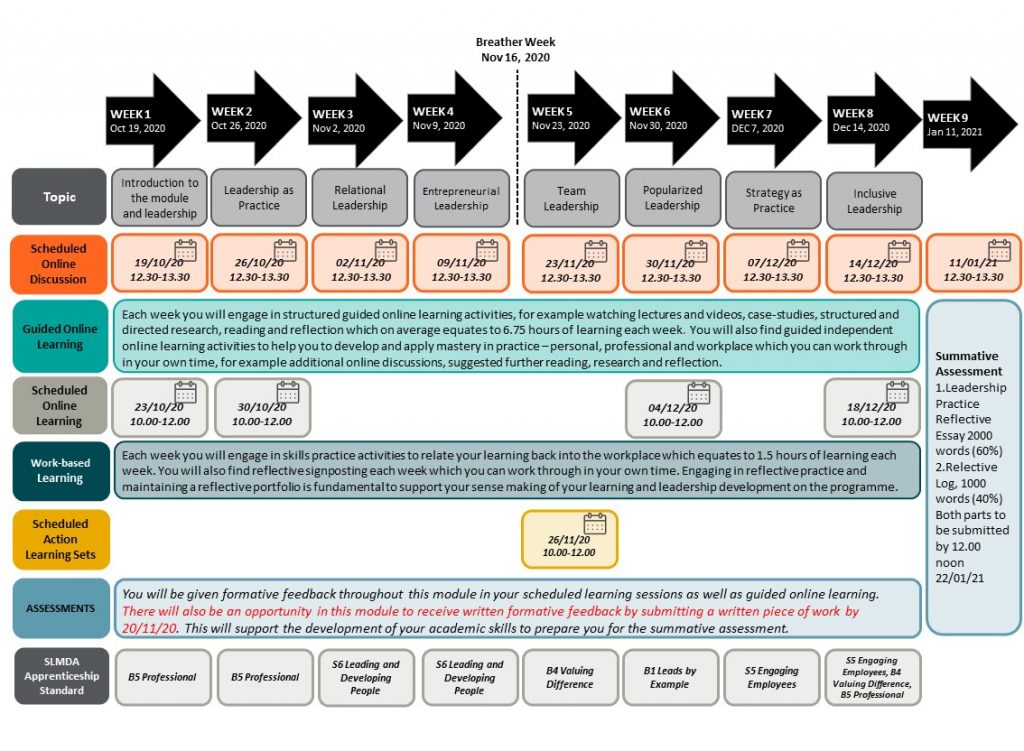
Add a weekly overview to give students an idea of your expectations for how much time to spend on the activities for a given week. This will help them plan their time, and make sure they give their attention to the things that you signpost as being most important.
From overwhelmed to ordered
It will take a bit of time to consider ordering, signposting, and setting a flow in your modules, but this need not be onerous and it’s one way you can help your students feel less overwhelmed in these strange times.
To help you to check that the Canvas course for your module is ready for your students, we have created a handy checklist which can be found on the Canvas section of the Digital Learning Website. You can also view our downloadable pdf version.
Remember, your Canvas course must be published for your students to be able to access it. This also applies to archive courses from 2017-18 to 2019-20.
If you need help with Canvas you can access the following channels of support:
Canvas 24/7 support for your ‘How do I?’ Canvas questions
In 2014 University Learning, Teaching and Student Experience Committee agreed a set of principles which stated that all appropriate assessments should be submitted through Turnitin.
Now we have moved to Canvas as the Virtual Learning Environment, this has opened up some new options for online submission. Alongside the Turnitin tool it is now possible to create Canvas assignments, which offer features like double blind marking, group submission and moderated marking, whilst still using the Turnitin similarity checker.
Given the new functionality now available, this is an appropriate time to revisit the principles. The updated Online Assignment Submission Principles were approved by University Education Committee in August 2020.
These principles are guidelines for how to get the most from submissions, advising that the Turnitin Similarity checks are carried out on Canvas and Turnitin assignments. If you allow students to submit multiple drafts they should not be allowed to see the similarity score, unless the assessment is focused on improving the students’ academic writing. Where appropriate the students’ work should be added to the Turnitin repository.
The principles recommend that Schools communicate to their students when their work is going to be put through the Turnitin similarity checker.
Canvas training webinars for October are now available to book online. We will be continuing to run online training webinars until Semester 2 next year. Sessions include:
We start 2020 with our new VLE, Canvas, and a rich array of digital learning tools that can be used to support teaching. There are so many possibilities and it could easily be overwhelming.
This is a short post to begin to answer one of the questions I heard last week “What tools should I invest in?”.
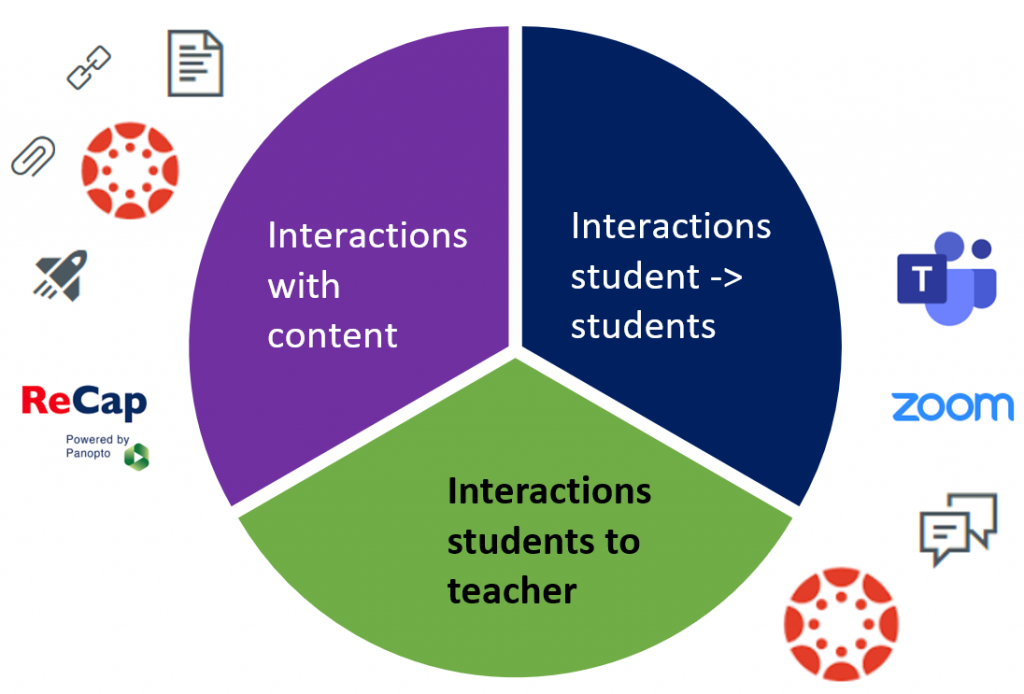
But, let’s back up a bit, before considering tools we need to think about what we want these tools to help us to achieve? Way back in 1998 Anderson and Garrison described three more common types of interaction involving students:
Student-content interactions
Student-teacher interactions
Student-student interactions
Let’s use this to come up with our list…
Student-content interactions
Your starting point here is Canvas itself. You can present information on pages, embed documents, link to resources on library reading list, include videos, audio and ReCap recordings.
Canvas support a wide range of question types: multiple choice, gap fill, short answer, matching, multiple answer. Quizzes can help students practice skills, check their learning and encourage them revisit material.
For short PowerPoint narrations the easiest place to start is the recording features that come as part of ReCap. We tend to think of ReCap as a lecture recording tool, but there is also a fabulous ReCap Personal Capture tool that you can use to record yourself, and publish in Canvas. There are several bonuses with using ReCap – you have the ability to do make simple edits, you can use automatic speech recognition to generate captions, and students have the ability pause, rewind and make notes on the recordings that you publish. ReCap personal capture comes in as tool #3 – you can install on your computer, or if you prefer you can use the new browser based recorder – Panopto Capture (beta).
Outside the limited amount of PiP time you are likely to be meeting your students online. For synchronous meetings there is increasingly little to choose from between Zoom and Teams – the only significant factor being that Zoom permits people to connect by phone – so supports those on lower bandwidth.
Now is a great time to become confident with the online meeting tool you are planning on using throughout your module. I’ll leave it to you if #4 for you is Teams or Zoom – it would be sensible to settle on one, for you and your students. Teams could be a strong contender if you plan to use this as a collaboration space over the module/stage, in which case do review the article on Building an online community using Teams.
Once you setting on your meeting tool, now is a great time to explore options for using whiteboards, polling, breakout rooms in these spaces and to begin to plan active online sessions.
For tool #5 I’d go with Canvas Discussions – these are easy to use, work really well in the Canvas Student and Teacher apps and are great for Q&A sessions, introductions, crowd-sourcing activities, and of course discussions!
Learning at university is a social! There are huge limitations on what we can do in person – but what can we do to help learning be as social as it can be? This isn’t so much about tools, but about the activities we design in: break out room discussions, group tasks, peer reviews, debates – things that might start in a timetabled session and then spill out.
For synchronous meetings and study sessions all our students have access to Zoom and Teams. We can model how to use these, build students’ confidence in these spaces and show them how they can collaborate in Microsoft 365 collaborative spaces (Word documents, OneNote…). I’ve already mentioned Teams and Zoom (#4), so for tool #6 I’ll pitch for Microsoft 365 with an emphasis on collaboration.
We are getting closer to the 31 July 2020 when all access to Blackboard ends for colleagues and students and we go fully live with Canvas.
There are 5 key steps which will help colleagues to prepare for the transition date and for course delivery next academic year:
More information about each of these steps, as well as links to support, can be found on the Canvas website.
Don’t forget Canvas 24/7 support is available to all colleagues and students for any of your ‘How do I’ Canvas questions direct from the Canvas Help Menu or via telephone on + 44 808 189 2336.
This post provides some further information on how the move to Canvas affects Numbas tests.
Will my Numbas tests roll over to Canvas automatically?
Numbas tests are attached to a particular course in a VLE, and therefore will not be moved across when we change from Blackboard to Canvas. Tests will need to be set up again for the new academic year, which is no bad thing as you will need to make some decisions about the set up in Canvas. See the section How do I create a Numbas test in Canvas? below.
Remember that Numbas tests are prepared on the Numbas Editor (the Public Editor is at numbas.mathcentre.ac.uk). This means that you can redeploy your existing test in Canvas.
How can I access scores from Numbas tests deployed in Blackboard?
If you require scores from Numbas tests deployed in Blackboard then you should access these before the close down of Blackboard on July 31st.
However, the Numbas LTI tool will continue to have a record of attempts. A request can be sent to numbas@ncl.ac.uk if you need access to data after the close down of Blackboard.
How do I create a Numbas test in Canvas?
Numbas can be deployed in Canvas in two ways:
as a module item, alongside other learning resources; or
as an assignment.
Numbas module item
Numbas assignment
Add Numbas content
✅
✅
Record student scores
✅
✅
Hide from calendar, to do list, etc
✅
Restrict by date
✅
Add scores to Gradebook
✅
Use as a pre-requisite
✅
The following videos demonstrate the set up of each. For full step-by-step instructions see the Canvas Orientation Course.
Adding a Numbas test as a module item
In the following video, I add a Numbas test as a module item in Canvas:
Adding a Numbas Assignment
In the following video I set up Numbas as an assignment in Canvas: