
AI, austerity, and authoritarianism: contemporary challenges in digital curation at the International Digital Curation Conference 2026

Art Pavilion in Zagreb

Earlier this year, I was very fortunate to have the opportunity to attend the 20th International Digital Curation Conference (IDCC) in Zagreb, Croatia. The IDCC “is an established annual event with a unique place in the digital curation community, reaching out to individuals, organisations and institutions across all disciplines and domains involved in curating data and providing an opportunity to get together with like-minded data practitioners to discuss policy and practice” (Digital Curation Centre, 2026).

It was particularly humbling and inspiring to see more than 200 colleagues from institutions across the world who proactively try to improve not only open research practice, but the support we give researchers in engaging with these practices. The theme for this year’s event was AI, austerity, and authoritarianism: contemporary challenges in digital curation. The posters and presentations are openly available in the IDCC26 Conference Materials Zenodo collection.

This year, the keynote talks were very inspiring. During the opening talk, Antica Čulina spoke passionately about open research practices such as preregistration, open data, open code and preprints. It was discussed whether they can be truly and sustainably achievable, while considering the infrastructure necessary, the culture supporting them and the incentives that would stimulate engagement.

The closing talk encouraged librarians and other people who curate knowledge to be resilient when facing difficult times, funding uncertainty and authoritarianism. Lynda Kellam and Mikala Narlock delivered a powerful talk about the Data Rescue Project, reminding us of our individual and collective responsibilities as curators or creators of knowledge. It was suggested that we may need to change the way we work. They advocated for “embracing redundancy” of files and that duplicating work and having more than two back-ups can sometimes prove beneficial.

Automation

Using new technologies to streamline processes

As you can probably imagine, many sessions discussed making the work of data curators, or researchers, more efficient through automation, either with innovative programs, or with AI. Regarding the use of AI, it was questioned whether existing open-source or commercial tools should be trusted. As an alternative, the use of in-house AI tools was also discussed. One such talk among many was Enhancing the Benefits of Machine-Actionable DMPs with Generative AI.

Who will automation help?

A matter for debate is whether using such tools would actually save us time, or simply change our process of ensuring that the output is sufficiently robust. Who would it even save time:

  • the person writing a data management plan, with the use of AI; or using AI to review their own plan before a submission?
  • or the person reviewing it?

Avoiding duplication

Researchers are busy people. A preregistration, ethical review and data management plan, often contain the same pieces of information that were used in a grant application. Are researchers expected to rewrite the same information? Interoperability of files and systems, and the capability to harvest relevant information for the right purpose, were recommended as improvements to current processes. Colleagues from the Eindhoven Institute of Technology described a tool that extracts structured metadata based on a user-defined schema, from research proposals, to populate data management plans.

Other tools

However, automation doesn’t always require AI. One informative talk delivered by a colleague from the UK Centre for Ecology & Hydrology (UKCEH), who host the Environmental Information Data Centre (EIDC), showcased a tool they designed to help check research data compliance with the FAIR principles. The File Check Assistanttests CSV data files for basic principles of re-usability, such as file structure and encoding, and helps guide users towards good practice”. This sounds particularly useful for large files as it can quickly identify if values are missing or are out of the defined range. While this tool was created to tackle issues with one specific type of file, it made me dream of tools that could help with a variety of other datasets: from missing metadata, to checking if interview transcripts are sufficiently desensitised.

Experts, communication and silos

The academic world is a large community, and each university is a community itself. Within a university there are many specialised sub-communities. They work independently from each other and develop their expertise in isolation. They are known as ‘silos’. Researcher silos are unique in their needs, and specialised in their solutions and protocols. Consequently, their research data practices will be unique from planning, to documenting, to sharing.

Similarly, professional services teams who support research are also siloed and focus on their individual areas of expertise. Among such teams, colleagues responsible for research data management offer general advice intended to be relevant to as many researchers as possible.

Colleagues from the Swedish University of Agricultural Sciences (SLU) advocated for better collaboration between academic and professional services silos. The SLU solution involved widening the use of their library’s online enquiry service, so that other university teams would also receive relevant queries through it. This facilitated smarter collaboration and knowledge sharing between support teams. Sharing knowledge and tailoring existing solutions to help others can be powerful tools in overcoming challenges and resource shortages with the aim of making our research outputs FAIR.

Data management plans (DMPs)

DMPs are always mentioned when two research data professionals are in the same room. This might sound cynical, or be perceived as a joke, but they are mentioned because they are a crucial part of the research process, they are time consuming and difficult to get right. It was eye-opening to see how differently they can be approached by different universities. Some of us strongly encourage their use. Others mandate them for all research projects. In some institutions, a small number of support staff, like me, review them on request. In other places, this responsibility is shared to supervisors in the case of postgraduate research projects.

An entirely different element is the choice of tools and mechanisms that we use to write and review DMPs, and I won’t refer to genAI tools this time. At Newcastle University, we use DMPonline, employing a generic template from the Digital Curation Centre, along with many funder-specific templates, each with detailed guidance. Some dynamic alternatives to DMPonline exist, giving users templates that tailor themselves based on previous answers. In theory, this should ensure that questions are as relevant as possible to researchers that might struggle with static templates. The alternatives discussed are Data Stewardship Wizard and FAIR Wizard. The former is an open-source tool, whereas the latter uses the former’s engine.

Another interesting approach employed templates provided in text documents. The documents are simple and are not overwhelming, as the guidance exists separately, on the website. Researchers are given the opportunity to request feedback for their DMPs by submitting a request form via the library’s online enquiry service. All the options above are interesting and have their merits. This made me reflect on whether one of them would be better at bringing together advice, support and guidance, while maintaining relevancy to as many experts as possible, in a variety of disciplines. What is the best way to incorporate definitions, encourage reflection and promote inclusion for colleagues who may not be familiar, or comfortable, with the language that has become standard in research data management circles?

Other takeaways and applications

Data access statements that use standardised language

Something close to my heart (or my day-to-day job) is the transparency of data access statements. It was emphasised by colleagues at the University of Bristol how important it is to have data access statements that use standardised language. It was suggested that we should use a taxonomy similar to CRediT. At a local level, I will continue to highlight the importance of data access statements, the need for enhanced clarity regarding the level of access to the data, persistent identifiers (such as DOIs) and additional information needed for accessing research data. Encouraging the research community to have clearly worded data availability statements in publication metadata will be a great step forward in enhancing data FAIRness and therefore, research transparency.

Key decision moments in the research data lifecycle

Another takeaway is João Aguiar Castro’s work, which aims to “enhance the usability, interpretability, and long-term value of DMPs” for all involved in research. João’s framework inspired me to assess the messages and guidance I provide in training and one-to-one consultation meetings regarding the level of detail required for a data management plan. While most of us already strive for this, using clearer language and digging deeper into researchers’ needs at different stages of their projects will most likely lead to more relevant conversations and useful DMPs.

Networking and community

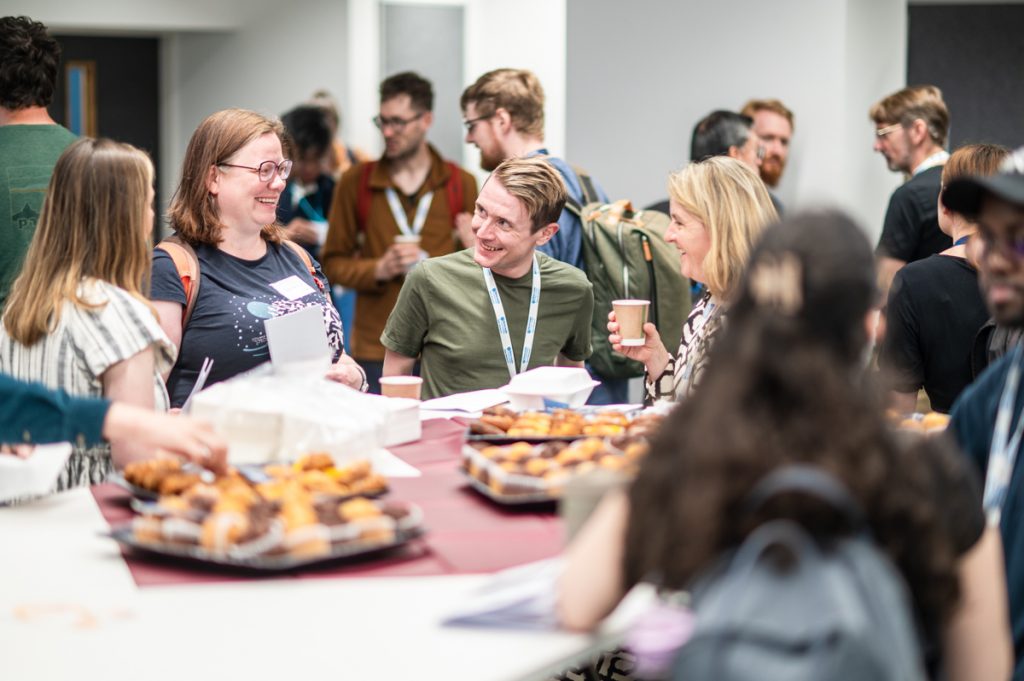
The IDCC was such a welcoming event. The attendees are all open to sharing knowledge and improving research transparency: it comes with the job description. The community is one that relies in cross-institution collaboration because at our respective institutions there are so few of us. And we are all continuously learning.

I am still working through my notes from the conference and I hope, in the near future, to arrange meetings with some of the colleagues I met. We are already exchanging ideas via LinkedIn or email, and some attendees have been sending me additional information that I had asked for.
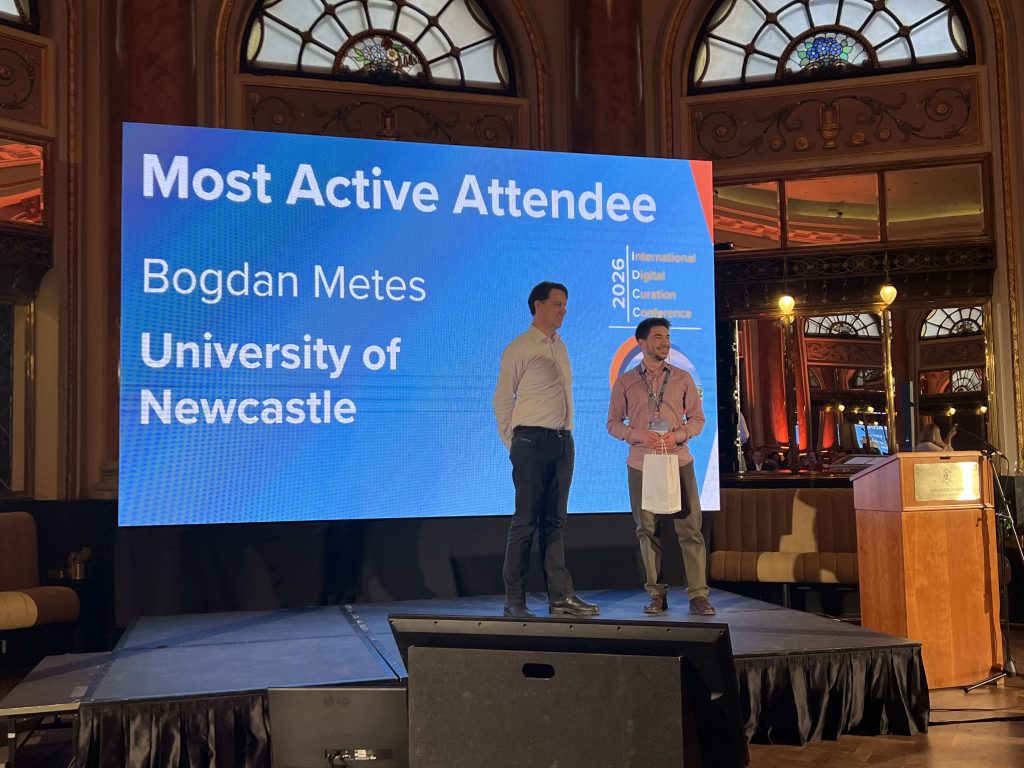
Me, receiving the award for the most active attendee, a very kind gesture from the organisers since I did not present a paper, or a poster, at this conference

Zagreb

Art Pavilion in Zagreb, with fountain

I was very lucky to spend some time as a tourist in Zagreb as well. My odd brain found an interesting link between the theme of the IDCC and Zagreb, a city full of museums, some of which rather serious, others rather whimsical. It felt serendipitous that this year’s event, focused on contemporary challenges in digital curation took place in a city that is so focused on remembering and preserving the knowledge of the past. One of the several museums I visited was truly memorable. The Museum of Lost Tales provided a unique look into the folklore and mythology of Croatia. Using allegory in the beginning, it showcased a fantastic creation myth that was sometimes similar to Norse mythology. For example, there is a world tree (Stablo svijeta), and a fierce and formidable warrior god of thunder (Perun), with red hair and beard.


Worlds connected through the World Tree
Deities of Croatian mythology around the World Tree
Saint Mark’s Church, Zagreb

What’s on in Library Research Services: April and May 2026

Members of the Library Research Services (LRS) team are here to support you with any Open Research, Research Data and Open Access training and queries you might have. Get in touch at lrs@ncl.ac.uk.

Open Research events happening at Newcastle University in April and May:

Open Research events happening elsewhere in April and May:


Check out the library calendar for further courses and dates in 2026.

What’s happening in Library Research Services: March 2026

Members of the Library Research Services (LRS) team continue to be on hand to support you with any Open Research, Research Data and Open Access training and queries you might have. Get in touch at lrs@ncl.ac.uk.

Open Research events happening at Newcastle University in March:

Open Research events happening elsewhere in March:

Check out the library calendar for further courses and dates in 2026.

What’s happening in Library Research Services: February 2026

Members of the Library Research Services (LRS) team continue to be on hand to support you with any Open Research, Research Data and Open Access training and queries you might have. Get in touch at lrs@ncl.ac.uk.

Open Research events happening at Newcastle University in February:

Open Research events happening elsewhere in February and beyond:

Check out the library calendar for further courses and dates in 2026.

Upcoming research data management training

If you are involved in research, even to a small extent, you may benefit from attending training offered by the Library Research Services team.

On the 12th February 2026, between 11:00 and 13:00, there will be an online, practical training workshop for research data management. Attended by over 60 researchers in the last year, ‘Introduction to Writing a Data Management Plan’ is suitable for colleagues new to research (in various roles) and for those of you who may wish to refresh their memory and renew their day-to-day data practices.

Suitable for all disciplines, this session encourages you to think about what underpins, helps others understand, or validates your research claims and publications. It will include a live demonstration of DMPonline, a web-based tool designed to help you write, or update, your data management plan and you will have the opportunity to start outlining your own plan. We will provide considerations for the individual sections of a data management plan (DMP):

  • Outlining and detailing your data.
  • Data collection methods, consistency and quality assurance.
  • Metadata and documentation. How will you ensure your continuous understanding of your own work. How will others be able to make sense of it?
  • Ethical and legal considerations.
  • Short-term, active project storage.
  • Long-term storage, sharing and preservation. This will include information about the university’s repository, finding alternative repositories and staying compliant with funder requirements.

These training sessions are run a few times each academic year and we try to provide a mix of in-person and online training. For more information about the support we provide, please visit our website.

Coincidentally, this training session will take place during everyone’s favourite celebration, Love Data Week. So, what better time is there to think about your research data?

Sign up to the training.

You can also explore other Library Research Services training sessions.

Open Access Help Drop-in Sessions 2026: Jan to June

Are you looking for advice and information on open access or managing publications? Come to one of our monthly drop-in sessions and meet members of the Library Research Services team, who will be happy to answer questions on:

Whether you’re a seasoned researcher, student or simply keen to explore the possibilities within open access, this session offers a welcoming space to ask questions, gain insights and delve deeper into the realm of open access.

These are informal sessions, however, registration is required for you to receive the online teams link. 

All are welcome!

What’s happening in Library Research Services: Autumn 2025

Members of the Library Research Services (LRS) team continue to be on hand to support you with any Open Research, Research Data and Open Access training and queries you might have. Get in touch at lrs@ncl.ac.uk.

Coming up in the following months:

September
October
November

Check out the library calendar for further courses and dates in 2025/2026.

Photo by Jeremy Thomas on Unsplash

Open Access Support Sessions in 2025/26

Are you looking for advice and information on open access or managing publications? Come to one of our monthly drop-in sessions and meet members of the Library Research Services team, who will be happy to answer questions on:

Whether you’re a seasoned researcher, student or simply keen to explore the possibilities within open access, this session offers a welcoming space to ask questions, gain insights and delve deeper into the realm of open access.

These are informal sessions, however, registration is required for you to receive the online teams link. 

All are welcome!

Open Research Awards 2025

We’re delighted to announce that the Newcastle University Open Research Awards for 2025 are now open.

The Open Research Awards recognise colleagues and students who have used open practices to make research more accessible, transparent or reproducible, and demonstrate an understanding of the aims of open research.

The awards are open to all students and colleagues working in any research-related role, at any stage, within any area of the University. We encourage applications from researchers in any discipline, including those where open research is not yet the norm, and who may use qualitative, quantitative or creative practice methodologies. 

The winners will be announced at a celebration event and presented with a bespoke award created by the University’s glass blowing workshop, as well as a certificate and letter of commendation to recognise their contribution to building a more open research culture.

Important Dates (2025)

  • Submission closes: Nov 7th (17:00)
  • Panel shortlisting:  Nov 17th
  • Celebration event: Nov 24th (12:00-14:00)

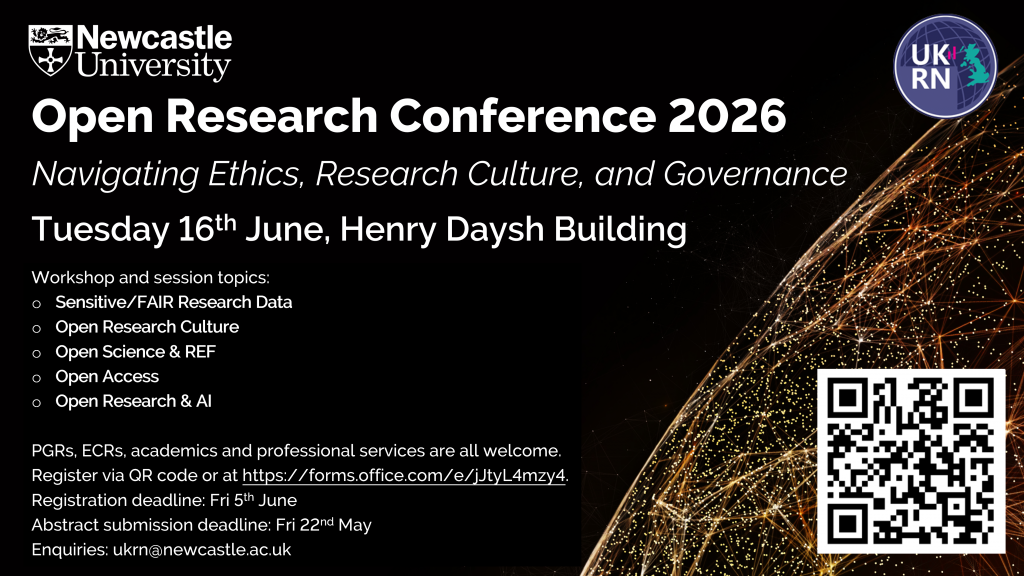
Newcastle University holds inaugural open research conference

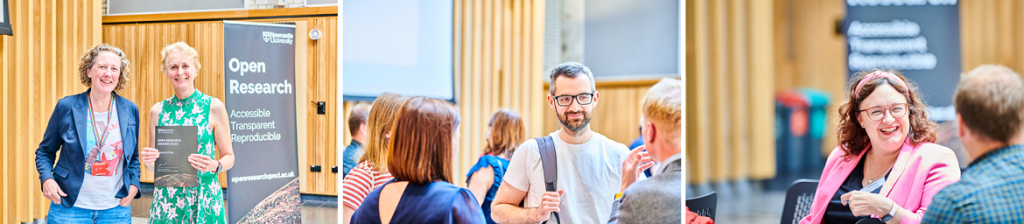
On Friday 13th June 2025 Newcastle University held its first ever open research conference, bringing together staff and postgraduate students to share successes and challenges in their open research journeys so far and learn what benefits working openly can bring. Attendees came from SAgE, HaSS, FMS and Professional Services indicating a growing multidisciplinary interest in open research practices. A welcoming address was given by Natasha Mauthner, Associate Dean for Good Research Practice and UKRN institutional lead.

The conference was aimed specifically at early career researchers (ECRs) and PGR students who were either practising open research or were keen to learn more about how to go about conducting open research, with the opportunity to share best practice and build upon open research techniques through a series of invited talks and hands-on workshops. Workshops were delivered by open research champions and the library open research team. Topics covered on the day included open, FAIR and sensitive data, trust in research methods and results, transparency and reproducibility, and research tools and software for openness. The day concluded with a hands-on exploration of open research through games and a productive and thought-provoking ‘open forum’ discussion of what open research means for non-quantitative disciplines including challenges, opportunities to expand how openness and transparency is considered over all disciplines within the university, and open research training needs.

Feedback on the day was positive, there was a buzz of discussion and attendees were able to make new connections, learn about new tools and discuss any shared challenges in making their research more open. The conference also acted as an opportunity to promote the work of the UK Reproducibility Network (UKRN) at Newcastle University and the monthly ReproducibiliTea journal club.

Details of the talks from invited speakers and workshops with resources can be found on the conference programme page and below, with links to the slides.

Short Talks

  • Open-Source Software Tools for Research – Ben Wooding, School of Computing, SAgE (download slides)
  • Demystifying Clinical Audit vs Research – Edmund Ong, Newcastle University Medicine Malaysia, FMS (download slides)
  • Applying FAIR Principles to Research Software – Frances Turner, Carol Booth, Research Software Engineering Team (download slides)
  • Open Access DNA-Encoded Library Screening : Accelerating Therapeutic Discovery Through Collaboration – Cameron Taylor, Mike Waring, Dan Gugan, School of Natural and Environmental Sciences, SAgE  (download slides)
  • Introduction to Open Hardware Principles – James Grimshaw, BioImaging Unit, FMS (download slides)
  • Open, FAIR, and Sensitive Data in the context of Electric Vehicle Charging – Shouai Wang, Sanchari Deb, Electrical and Electronic Engineering, SAgE (download slides)
  • Multi100: Estimating the Analytical Robustness of the Social Sciences + Lessons About Open Research – Harry Clelland, Eotvos Lorand University and Northumbria University (download slides)
  • Using Social Media Big Data and ChatGPT for Identifying Counter-urbanisation Hot Spots in China: A Case for Open and Ethical Research – Jian Chen, Centre for Rural Economy, SAgE
  • A Brief History of Research Software Engineering – Mark Turner, Research Software Engineering (download slides)
  • Generating trustworthy evidence: A painful story – Gavin Stewart, School of Natural and Environmental Sciences, SAgE (download slides)

Workshops

  • Workshop 1: A Very Short Introduction to Version Control with Git – Janetta Steyn, Research Software Engineering Team (Intro to Git & GitHub)
  • Workshop 2: Sharing sources and processes: a milestone for trust and research longevity – Bogdan Metes, Library Research Services (access slides)
  • Workshop 3: Making Your Literature Review Easier and More Transparent: Reference Managers and other Tools – Nayara Albrecht, Federal University for Latin American Integration, previously School of Geography, Politics and Sociology (download slides)
  • Workshop 4: DOI Generation and other tools for open publishing – Glyn Nelson, Bioimaging Facility, Faculty of Medical Sciences (download slides)

This guest post was written by Nicola Howe and Clement Lee, local network leads for UKRN Newcastle.