
Technical report about survival instincts in electronic systems


http://async.org.uk/tech-reports/NCL-EEE-MSD-TR-2013-181.pdf

I wrote this article as a chapter to Peter Cheung’s 60th birthday Festschrift.

Here is the abstract:

The writing of this paper has been inspired by the motivating ideas of
incorporating self-awareness into systems that have been studied by
Prof Cheung in connection to dealing with variability and ageing in
nano-scale electronics. We attempt here to exploit the opportunities for
making systems self-aware, and taking it further, see them in a
biological perspective of survival under harsh operating conditions.
Survivability is developed here in the context of the availability of
energy and power, where the notion of power-modulation will navigate
us towards the incorporation into system design of the mechanisms
analogous to instincts in human brain. These mechanisms are
considered here through a set of novel techniques for reference-free
sensing and elastic memory for data retention. This is only a beginning
in the exploration of system design for survival, and many other
developments such as design of self-aware communication fabric are
further on the way.
Making the most of energy

An article about my group’s research on energy-modulated computing has been published by International Innovation. 

http://async.org.uk/p41-43-Alex-Yakovlev.pdf

International Innovation is the leading global dissemination resource for the wider scientific, technology and research communities, dedicated to disseminating the latest science, research and technological innovations on a global level. More information and a complimentary subscription offer to the publication can be found at: www.researchmedia.eu

New hybrid electronics (caps and async switching logic) as a computing engine for many fractal (power law) processes in nature …

Image

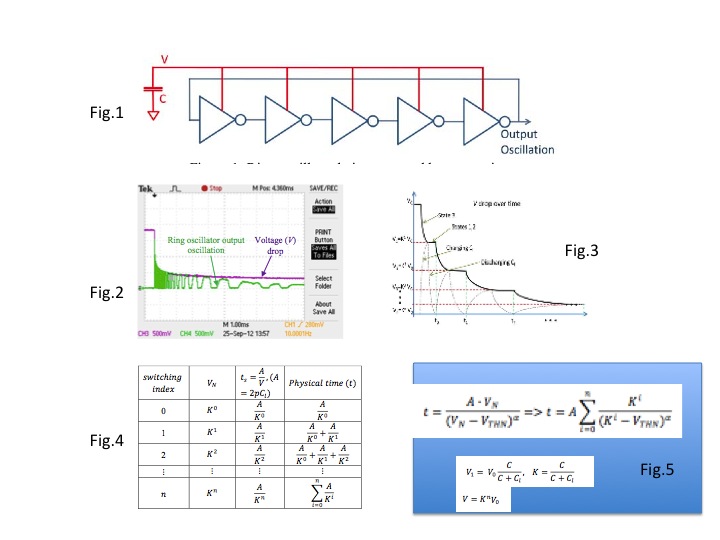
In the simple example of connecting a charged capacitor to a self-timed switching circuit, say a ring oscillator (Fig.1)

we have the process of discharging the cap shown in Fig. 2 (this is taken from the testing of the real silicon – 180nm CMOS). A simple mathematical analysis of this behaviour considers the discretisation, shown in Fig. 3 and 4, which is captured by the hyperbola function in Fig. 5 for V vs time (if we only look at the super-threshold region of the transistors in the inverters). Here K is a ratio of charge sharing between the main cap and a small parasitic cap that is charged at every step of the switching process in the ring chain. A is a constant determined by the inherent parameters of the transistors in the inverters in the oscillator.

One can generalise this analysis to considering a situation with a capacitive source of energy and an arbitrary asynchronous circuit being powered by such a cap. The math characetrisation of such systems will involve use of power laws. Indeed, a simple huperbola described by y=a/x is already a power law. Consider x and y both in log scale, this will be log(y)=log(a)-log(x), which is a straight descending slope lifted up to log(a).

My conjecture is that most of the processes in biology (such a development of biogradients from concentrations of nutrient molecules), economics (bank accounts being debited by its users) etc., they all fit similar patterns. So, isn’t the system of caps and async switching circuits an adequate computational paradigm (and a new type of computers!) for many processes in real life?


Asynchronous Static RAM demo video

It is now possible to see the video of our demo of the Self-timed SRAM, as it works (Write and Read) under a wide range of power supply conditions:

(1) stable levels of Vdd in the range from 1.2V down to 0.4V; and

(2) with a run-time varying supply from our Capacitor-Bank power supply (second box in the setup).


Showcase event of Holistic Project 11 Feb 2013 in London

We are preparing ourselves for a showcase event in London (Imperial College) next Monday 11th February 2013:

http://www.nmi.org.uk/events/event-details/277

This showcase marks the completion of a large EPSRC project jointly with Southampton, Imperial and Bristol.

 Newcastle will feature with two talks and two demos there.

Talks:

(1) Summary of Project Outputs (Theme B) –  Alex Yakovlev (Theme B Leader, Newcastle University) at 11:30

(2) Technical Seminar 4: Energy Modulated Computing- Prof Alex Yakovlev (Newcastle University) at 14:30

Demos (at 12:00)
(1) Self-Timed SRAM for Energy Harvesting Systems (Delong Shang and Abdullah Baz)

(2) Reference free Voltage Sensing (Reza Ramezani)

 The SRAM is our key demo, which will involve showing a number of technologies developed in our group, particularly:

– a fully self-timed SRAM, which operates under a wide range of supply voltages (Delong Shang and Abdullah Baz)

– a controllable power supply based on switched cap converters, to produce a wide range of Vdds that can be applied to the SRAM (Xuefu Zhang)