Using Trello to stay on track

trello_cardsThe LTDS Online Courses Team have been experimenting with a number of online tools to support team-working and in the process have become great fans of Trello.

A team in different places

Trello gives us a live representation of the project and current responsibilities. It is easy for us to add new people to the Trello Board as the project progresses irrespective of where they are.

To put on a course we bring together a team – academic colleagues, digital media, LTDS.  We are in different locations, and our academic leads can often be off campus.  An online tool works really well for us.
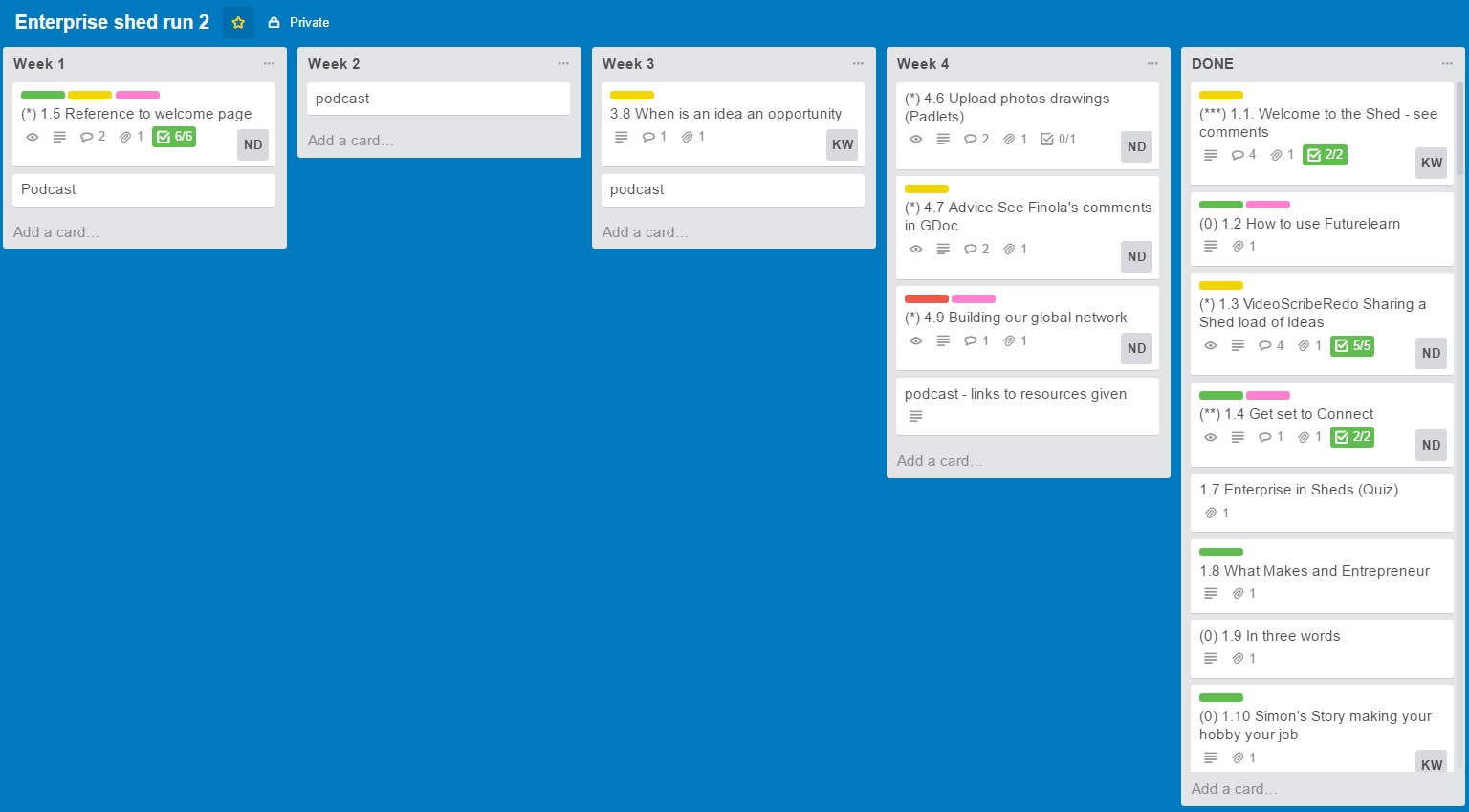
Trello screenshot

Enterprise Shed 2 Trello Board

Mocking up courses

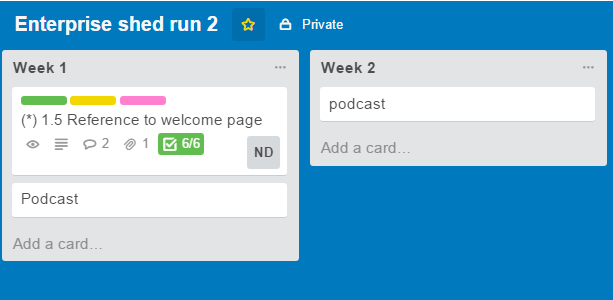
Trello comes into its own after we have done a good deal of planning (on Post-it notes and paper).  We create a Trello List for each Week and give each step a Trello card.

By mocking up the course in this way it makes it easy to check that we have variety of media/approaches and it enables us to experiment with different routes through the learner activities.

If we think the content could be ordered better, then Trello allows us to drag and drop elements.

We also tend to add extra Trello Lists to the board to share project documents and resources eg actions around Marketing. This gives us a a complete “dashboard” for the project.

Customising Trello – agreeing conventions

One of the best things about Trello is that it is so easy to customise  to meet your needs.  If you can agree conventions with your team before you start you will reap the rewards later.

Here are some examples of what we did:

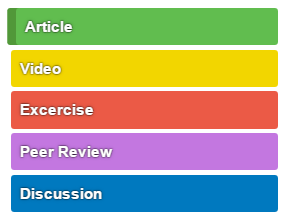
  • To help us see the mix of content in each week we defined labels that related to the activity type for each step, and applied these labels to the steps.
 trello_labels

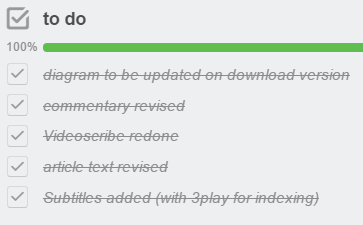
  • We added Trello checklist to steps to record work to be done and progress.
trello_todo

  • We dragged cards which were finished to the “done” list once work on the associated step was complete.
  • Borrowing from agile practitioners, we indicated the amount of work left on a card by adding a number of asterisks to the end of each card’s title. (*) trivial, through to (***) significant
  • We put links on each card so that we could go straight to the step on the course.  That way if you spotted your name on a card, had time to give you could click through and edit the course content in a couple of clicks.
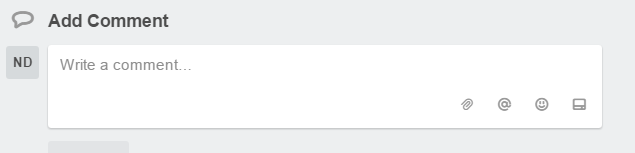
  • We added comments to Trello cards to remind ourselves of where we had got to, and to leave notes for other team members.
trellocomment

Other useful things

  • It is mobile friendly – Trello works really well on phones and tablets and has mobile apps available from the relevant appstores.
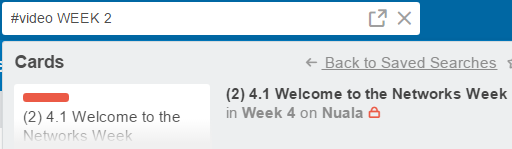
  • Trello has a good search function – eg “#video  WEEK 2” gives the status of steps in Week 2 that have been labelled as video.
trello_search

See the Trello.com for more details.
 

We believe in lifelong learning

This September sees an opportunity to take part in our Ageing Well: Falls course, the third time we have delivered the course on FutureLearn.

FALLS_300x250 Starts 5 Sept Box

Looking back at our previous two courses, it is a real pleasure to see how engaged and enthusiastic our learners were with the course materials.  Learners worked together as a community and participated in discussions, activities and quizzes, creating an active and supportive learning environment.

Should this be a surprise?  Well not really, we know that FutureLearn have been working hard to “pioneer the best social learning experiences for everyone” and our course shows that this still holds with an older audience.

In the UK, only 9% of people aged over 65 and 36% of those aged 55-64 used a computer on a daily basis when surveyed in 2006. But by August 2014, these figures had risen to 42% and 74% respectively. Of particular relevance to our Ageing Well: Falls course, is that when older people use the Internet, one of the main reasons is to seek health information. 1, 2

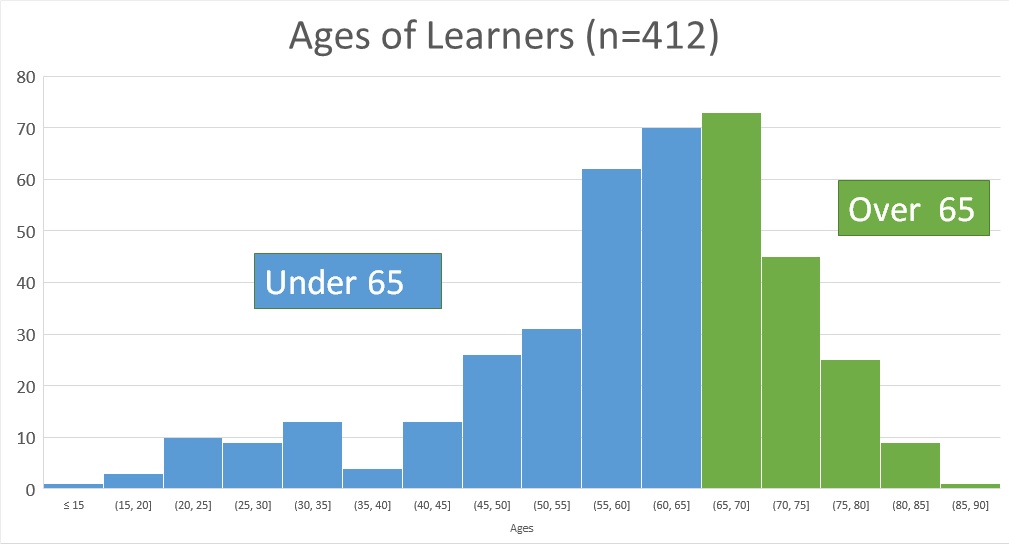
Data from our course also helps to show that older people engage with online learning. The graph below shows the age distribution of 412 people who volunteered their age during one of our activities.  The oldest learner completing this activity was 87, showing that you are never too old to learn!

fallsgraph

As before the course will be facilitated by Dr James Frith, and colleagues from the Newcastle Falls and Syncope service. You can sign up at www.futurelearn.com/courses/falls

  1. Office for National Statistics. Internet Access – Households and Individuals: Statistical Bulletin; 2014.
  2. Morrell RW, Mayhorn CB, Bennett J. A survey of World Wide Web use in middle-aged and older adults. Hum Factors 2000;42(2):175-82.


Maintaining meaningful connections

A recent study found that two-thirds of people living with dementia feel isolated.   Our free online course “Dementia Care: Staying Connected and Living Well”  starting on 23 May has been written to to help people stay connected and to communicate well.

In the first week of the course we explore dementia’s effect upon the person, on our personal relationships and on daily life.

Here is a sneak preview of one of the videos featuring Dr Lynne Corner:

The course has been written with family carers in mind.  In it we hear from carers and experts as we explore practical strategies that can improve communication.   Lynne draws on Newcastle University’s great expertise in ageing and dementia research and together with colleagues shares knowledge on dementia, language and practical strategies that can improve communication.

To find out more about the course and to sign up please visit https://www.futurelearn.com/courses/dementia-care/


Dementia Care

Dementia Care: Staying Connected and Living Well” is a course for carers, to help maintain connections,  manage stress and diffuse difficult situations.

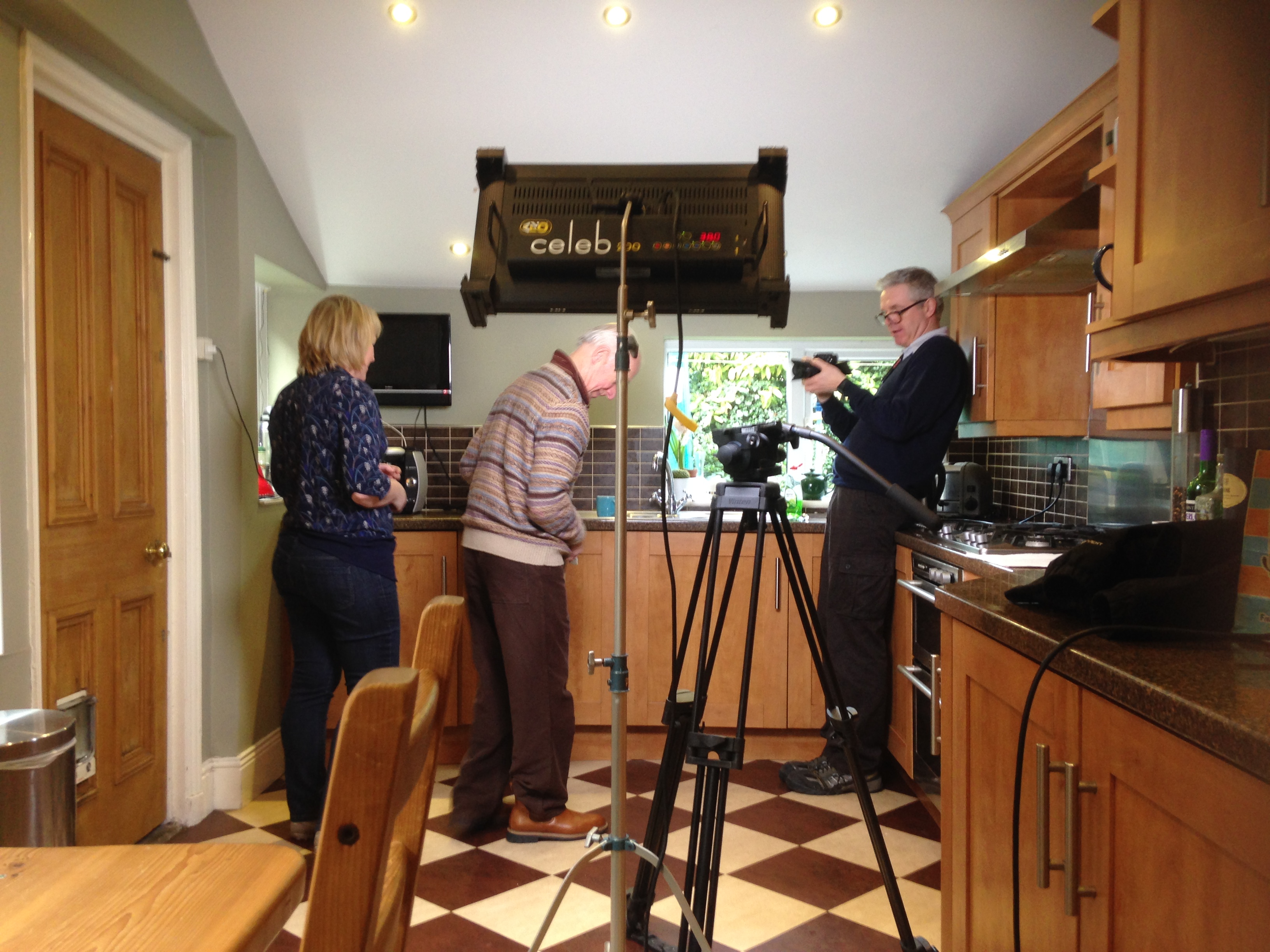
kitchen

We have been delighted to meet some of our learners who have signed up for the course and introduced themselves to us on our pre-course welcome page.  It is great to have these introductions in the back of our minds as we put the course together.

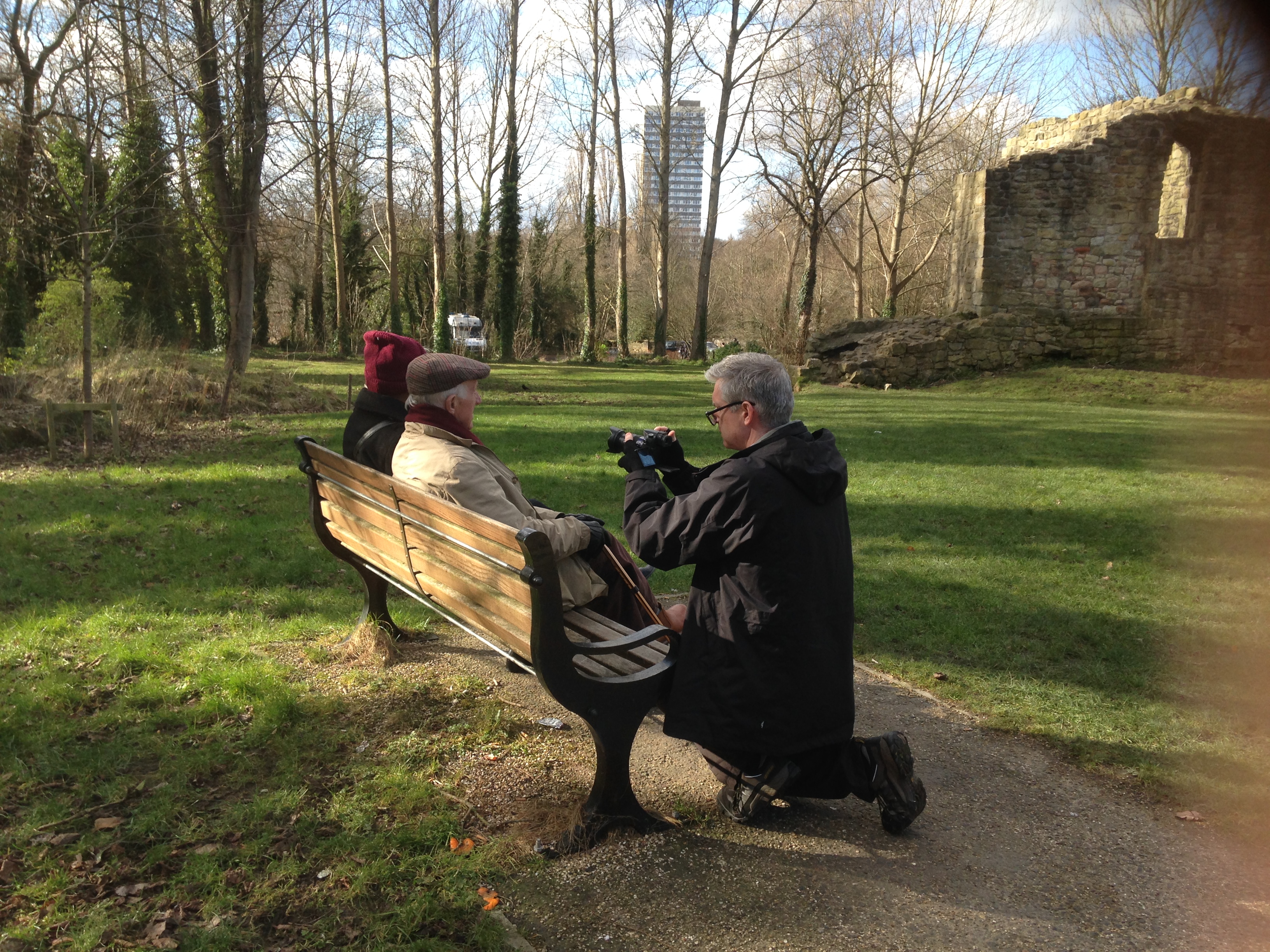
Today we’ve been capturing video footage around daily living to illustrate our articles, videos and discussions around the real challenges of caring for a person living with dementia.

park

You can sign up for the course here


Entrepreneurs Panel

During the first run of The Enterprise Shed: Making Ideas Happen we held an Entrepreneurs Panel.

Simon Laing and Roland Glancy are entrepreneurs, so they are well placed to talk about becoming an entrepreneur and the everyday life of an entrepreneur. The challenges can come well before you even start developing your idea. During the first run of this course, we invited Simon and Roland into the Shed and explored with them how their lives have changed since becoming entrepreneurs. You can view the recording here.

The full video is 39 mins long, so you can select 2 or 3 questions from the list below that interest you most. If you click on the links they will take you to Roland and Simon’s answers in the video.

Questions posed during the session

Why should you join us in The Enterprise Shed?

lightbulb

Katie Wray, Lead Educator for the course explores why we should all be joining her in The Enterprise Shed

“Firstly, let me unpack ‘enterprise’. For me, enterprise is about making creativity, problem solving and ideas practical. This makes it relevant across all areas of education, not just business. Where enterprise is applied to creating a new venture, it is commonly known as ‘entrepreneurship’. We are increasingly aware of entrepreneurship, through the steady creation of new businesses (particularly in austere times), but also through the media. From this awareness we can each draw our own conclusions about what an entrepreneur is? The Enterprise Shed challenges a variety of definitions of an entrepreneur and looks at enterprise and entrepreneurship at a grassroots level. On the course you will be introduced to a whole bunch of entrepreneurial individuals and teams, not all of whom refer to themselves as ‘an entrepreneur’.

So if you can be ‘entrepreneurial’ (behave like an entrepreneur) without actually being an entrepreneur (starting a new business venture), who is ‘entrepreneurial’ and what can you do with your ‘entrepreneurialness’*?  We are committed to exploring this with you throughout the course, and to supporting each participant to draw their own conclusions about how they can make change in their own context. Our other commitment is to exploring your ideas, to collecting insights into what a solution looks like, and to help you to turn that idea into something tangible.

This course is about you; it is about your role, through your ideas, in making change. There are 3 main reasons why you should commit 3 hours per week, for 4 weeks to The Enterprise Shed:

  1. You will develop confidence in yourself as a ‘doer’. You will do this through analysing the behaviours of other entrepreneurial people that you will be introduced to on the course, and drawing conclusions about the way that they ‘do’ and what you might ‘do’ when approaching your own challenges, problems and projects.
  2. You will discover ideas that address problems you want to play a role in changing. You will do this through identifying problems, sharing them with others, creating and collaborating on ideas generation, and developing solutions together with peers on the course.
  3. You will have the opportunity to meet people and build networks.WE will do this by forming virtual and physical networks around the globe, which can outlive the end of the course. You will meet people that share your passions and drivers to make change in your world, find out where you can go for help, and collaborate to achieve impact.

The Enterprise Shed is not just a course, but a place where you can go to think, and critically, to do.

Join us from 15th February 2016 in The Enterprise Shed and Make your ideas happen”.

*Actually, you can also be ‘intrapreneurial’ (behave like an entrepreneur as an employee in someone else’s business), but I’ve tried and keep it simple for this post.”

Katie Wray
Lecturer in Enterprise

New Year, New Ideas, Your Opportunity

Come and make your ideas happen in The Enterprise Shed! This free online course starts on 15 February and lasts 4 weeks, with a time commitment of around 3 hours a week. It is led by Katie Wray, Lecturer in Enterprise from here at Newcastle University.

Join Katie on this highly interactive journey exploring and developing your own entrepreneurial mindset with a community of like minded people from all over the world.

“we were all sparking off each other and I really felt I was learning and being encouraged”

“I am now more confident about my big idea and am excited to get started”

“So inspiring, and exposing me to much more than I anticipated.”

On the course, you’ll meet a whole bunch of thinkers and doers; those just starting out, makers, tinkerers and experienced entrepreneurs. Sharing your ideas with them and other learners will encourage you to have more confidence to think and do more to create change and solve problems in your own world.

You don’t need any specific skills or experience – just passion and a willingness to get involved.

Sign up at www.futurelearn.com/courses/enterprise-shed

You can download a flyer too to share with your friends, colleagues and family.

Visualisations?

To go alongside the summer 2015 run of our Hadrian’s Wall course we held a panel discussion on the theme of “Why do we employ Visualisations“.  Dr Rob Collins chaired the session and posed questions from learners on the course to our lead Educator, Professor Ian Haynes,  and to Bill Griffiths, Head of Programmes at Tyne and Wear Archives and Museums.

Transcript for this video

Here is a list of questions asked – the links jump to Ian and Bill’s responses.


Can anyone be an entrepreneur?

We had the chance to ask Sir Richard Branson a question at a ‘Mentor Me Branson’ event held at Newcastle University in March 2015.

Katie Wray asked the panel: ‘do you think any type of person can be entrepreneurial?’

After Jimmy Cregan and Sir Brian Souter answered here’s what Sir Richard Branson said:

https://www.youtube.com/watch?v=SlPd1i5cGHE&feature=youtu.be&t=21m36s

I’ll try to be a bit more controversial.  I think that if you have got an idea that can make other people’s lives better, but you think I’m not necessarily entrepreneurially bent, I would say just forget that thinking and just try it. And I do think that, most people, if they try it, they’ll learn about it, and they may not become a serial entrepreneur, which is not necessarily a good thing, they may just want to specialise in that one thing that they have got a passion for.   So I think most people ought to be able to become entrepreneurs, if they put their mind to it.

We love this answer and will be exploring the theme of “enterpreneurial mindsets” further in the early stages of our  Enterprise Shed: Making Ideas Happen course.

Katie Wray (Lecturer in Enterprise) is the lead educator for the four week course starting early in 2016.