Last month, Professor Alaa Alameri from Mustansiriyah University in Baghdad joined Professor Graham Smith in Newcastle to develop a new university module in oral history for Iraq. In this article, Alaa and Graham describe the collaborative process of integrating oral history teaching and resources into Iraqi Higher Education (HE).
We began our joint venture by creating a manual that Iraqi university lecturers could use to teach oral history. Oral History in Iraq: A Methodological and Practical Guide for Academic Research and University Training, is the first of its kind to be produced and published in Arabic. It offers a comprehensive introduction to the practices and theoretical frameworks of oral history, serving as the foundation for accrediting a dedicated module within Iraqi universities.
We approached this work by drawing on the international history of oral history and understanding that we could draw on that rich heritage. We understood that there are many ways of doing oral history, and that the field has developed through diverse trajectories across different regions worldwide. Over more than seventy years of international exchange and experimentation, oral history has evolved into a mature, dynamic intellectual discipline.
Globally, oral historians have assembled publicly accessible collections of millions of testimonies, housed in archives of various sizes and institutional contexts. The field now includes an expanding body of secondary analysis and a widely accepted conceptual framework that aids navigation through its complex landscape. Importantly, oral history remains an active domain of intellectual debate, continually re-evaluating its practices, boundaries, and definitions in ways that promote innovation and transformation.
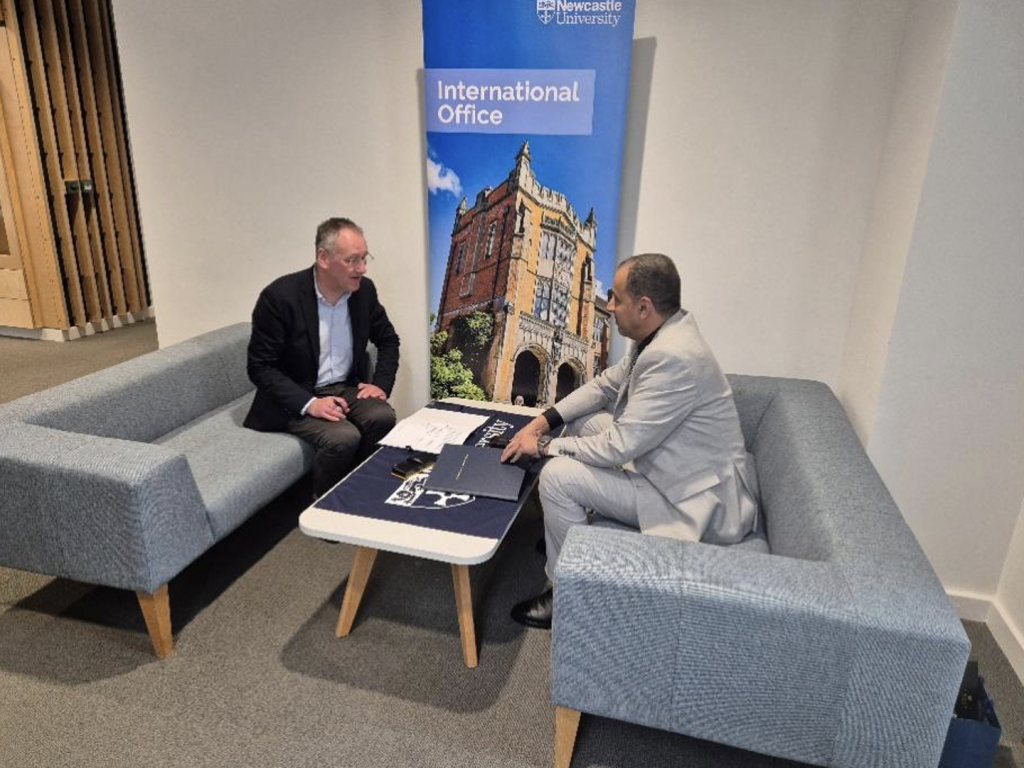
In February 2024, Mustansiriyah University and Newcastle University signed a memorandum of understanding that included a specific commitment to developing oral history teaching and research in Iraq. The collaboration was conceived as a means of drawing on Newcastle’s experience in the field. The guide described here represents an initial outcome of this collaboration—one that marks the first step in embedding oral history into Iraqi higher education and reflects a shared vision of building capacity through exchange, dialogue, and critical engagement.
Our guide proposes a methodological vision that restores the status of oral history as a rigorous academic practice—one capable of documenting memory and bridging the divide between educational institutions and society. It calls for the integration of oral history into higher education through a structured curriculum, training for researchers in oral methods, and the creation of oral archives that preserve Iraq’s diverse historical experiences before they disappear with the passing of generations. In this way, the guide aims to contribute to the reconstruction of national memory and to the advancement of epistemic justice in narrating Iraq’s recent past.
Beyond foundational theory, we also sought to demonstrate through the guide how memory and history interact in the interview and analytical process, especially in the context of contested histories. Alongside internationally recognised technical and procedural standards, we included reflections tailored to the Iraqi context.
For decades, Iraq has endured war, authoritarian regimes, international sanctions, terrorism, and the erosion of civil and institutional infrastructure. These prolonged crises have created critical gaps in the historical record and a profound void in archival and documentation systems. The absence of a comprehensive national initiative means that the lived experiences of individuals and communities—particularly those on the margins—have largely gone unrecorded.
Oral history projects undertaken by students will help forge strong connections between past and present. These projects are compelling when focused on women in rural areas, ethnic and religious minorities, and veterans of armed conflict.
We are exploring ways in which oral history might help fill the archival gaps left by decades of war and the destruction of civilian infrastructure, including libraries, universities, and public records. However, this approach assumes even greater significance in Iraq and the broader Arab world, where a lack of archival awareness and institutional engagement with individual, social and collective memory remains prevalent.
Many institutions have yet to develop an archival culture, leaving the preservation of history vulnerable even more to erosion and neglect. Additionally, methodological confusion and the uncritical repetition of classical approaches persist, with little genuine effort to contribute to the creation of new historical knowledge. In this context, oral history becomes not merely a research technique but an intellectual and methodological necessity; an urgent call to rebuild historical narratives from within and to meet the challenges of the present with living, dynamic tools that go beyond the set and static documents and printed volumes.
Although our collaboration is still in its early stages, we are already identifying ways in which Iraq can make meaningful contributions to the international development of oral history. Iraq’s multi-ethnic, multi-religious, and culturally rich landscape presents unique opportunities—and ethical responsibilities—for oral historians. An early pilot involving Arab al-Ahwār (Arab Marsh) communities in southern Iraq illustrated how indigenous oral history traditions can inform practice, while also surfacing critical questions of shared authority, ethical care, and community empowerment in contexts historically marked by state violence and exclusion.
This collaborative work is ongoing. But we are confident that it will help solidify oral history as a vital academic field in Iraq and open space for new and critical Iraqi voices to contribute to global conversations about history, memory, and justice.