Jack Mapanje – poet and prisoner of conscience – March 2019

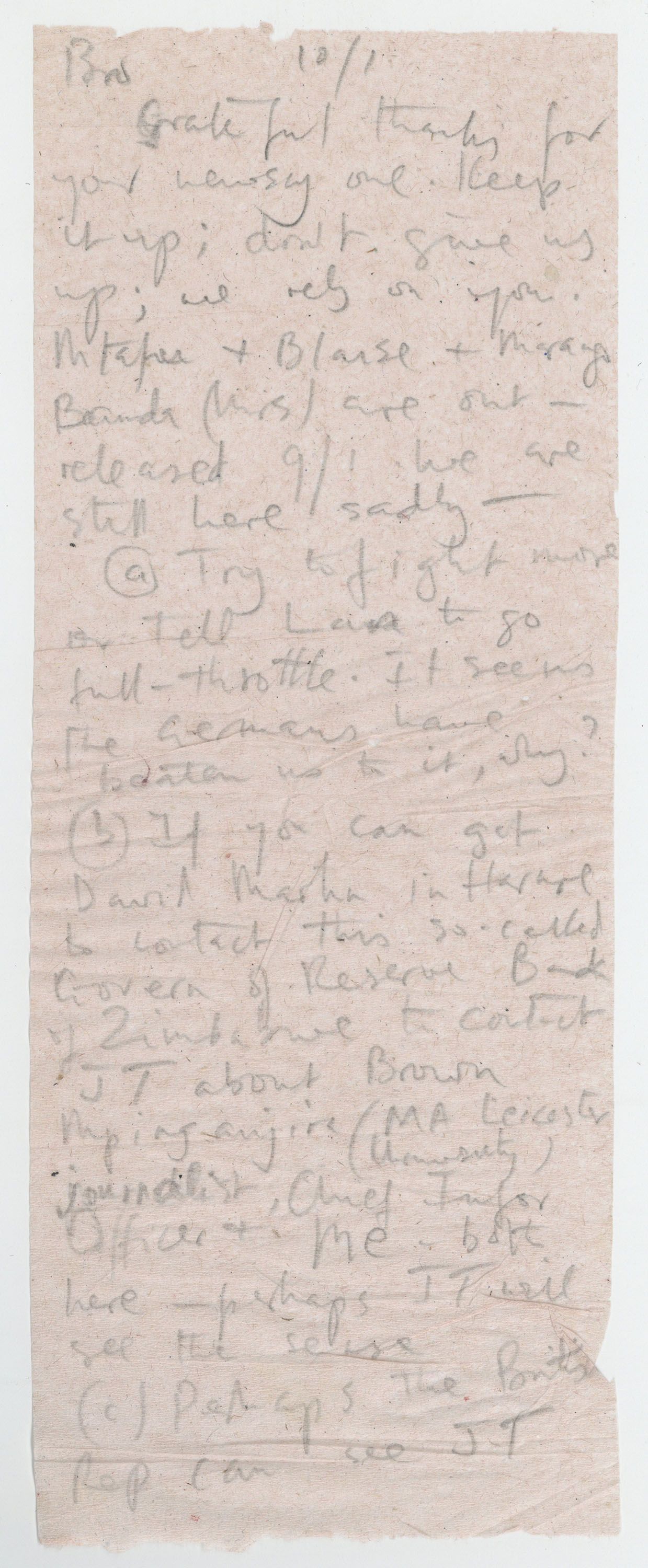
Extract from a letter written on toilet tissue paper by Jack Mapanje to David Kerr whilst a prisoner in Mikuyu Prison in Malawi

Extract from a letter written by Jack Mapanje to David Kerr whilst a prisoner in Mikuyu Prison in Malawi (Jack Mapanje Archive, MAP/6/3/43)

Within Special Collections and Archives we hold the papers of a number of contemporary poets. One of that number is Malawian poet Jack Mapanje. In 1987 he was imprisoned for 4 years for critical views of the Malawian government expressed in his first published collection of poems. Since then he has had several more works published alongside a career as an academic in Malawi and the UK. In the Mapanje (Jack) Archive we hold material relating to his poetic works, items relating to his academic career in both Malawi and the UK, and perhaps most interestingly, correspondence written during and after his time held as prisoner of conscience.

Jack Mapanje was born in 1944 in Malawi, where he was educated before he studied at universities in Malawi and the UK. He then went on to lecture in the Department of English at Chancellor College, University of Malawi. In 1983 he was awarded a PHD in linguistics after study at University College London, he then returned to work at the University of Malawi.

During this time Jack Mapanje witnessed at first hand the regime of Hastings Banda and began to write poetry, some of which reflected his despair at the political situation. His first collection, Of Chameleons and Gods, was published in the UK in 1981. In 1985 the Malawian government withdrew the book from circulation without reason, and in 1987 Mapanje was arrested and imprisoned without trial in Mikuyu Prison.

Whilst detained he wrote a series of letters to David Kerr, an English colleague and friend who also worked at the University of Malawi. Their content tells of the conditions inside the prison and Mapanje’s thoughts on the campaign to release him. The harshness of prison conditions meant that paper and letters had to be smuggled into and out of the prison. This included using clean toilet paper as a medium on which to write letters.

One letter written on toilet paper survives as part of our collection (MAP/6/3/43). This particular letter is dated the 10/1, in it he mentions prisoners released the previous day and discusses possible tactics and options open to his contacts fighting for his release.
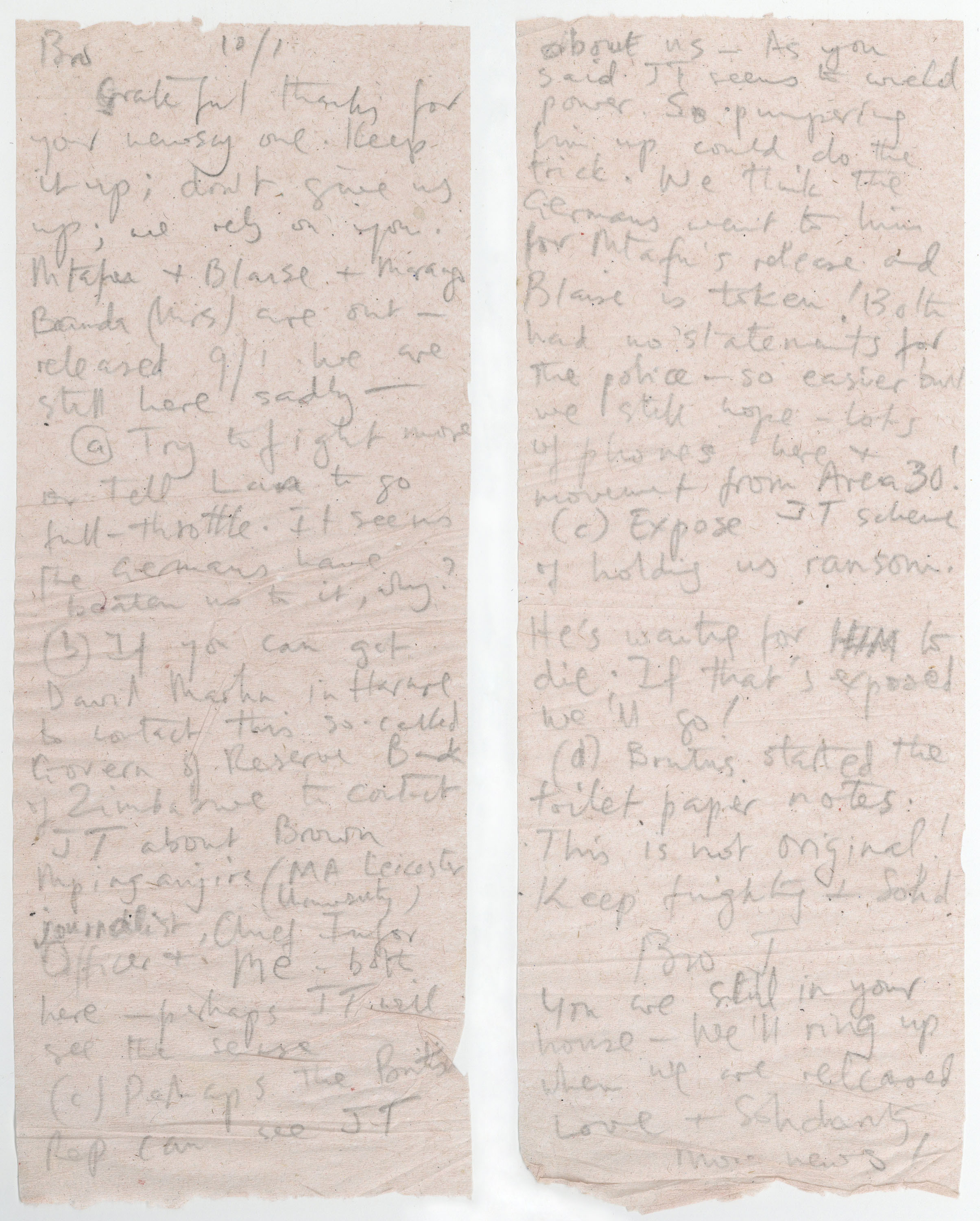
Letter written on toilet paper tissue by Jack Mapanje to David Kerr whilst a prisoner in Mikuyu Prison in Malawi

Extract from a letter written by Jack Mapanje to David Kerr whilst a prisoner in Mikuyu Prison in Malawi (Jack Mapanje Archive, MAP/6/3/43)

Whilst he was in prison his first collection, Of Chameleons and Gods won the Rotterdam Poetry International Award and the PEN/Barbara Goldsmith Freedom to Write Award. These helped to highlight his plight and political oppression in Malawi to an international audience. At the same time there was a campaign for his release coordinated by Amnesty International which involved several well-known writers and activists including Harold Pinter and Noam Chomsky.

He was eventually released in May 1991, after this he and his family moved to the UK. In the years since he has had a successful career as an academic with several universities and has carried on writing. The collection of poems he largely wrote whilst in Mikuyu Prison, ‘The Chattering Wagtails of Mikuyu Prison’, was published in 1993. More recent books include The ‘Last of the Sweet Bannanas: new and selected poems’ and ‘The Beasts of Nalunga’. He has edited other works and his memoir, ‘And Crocodiles are Hungry at Night’ was published in 2011.
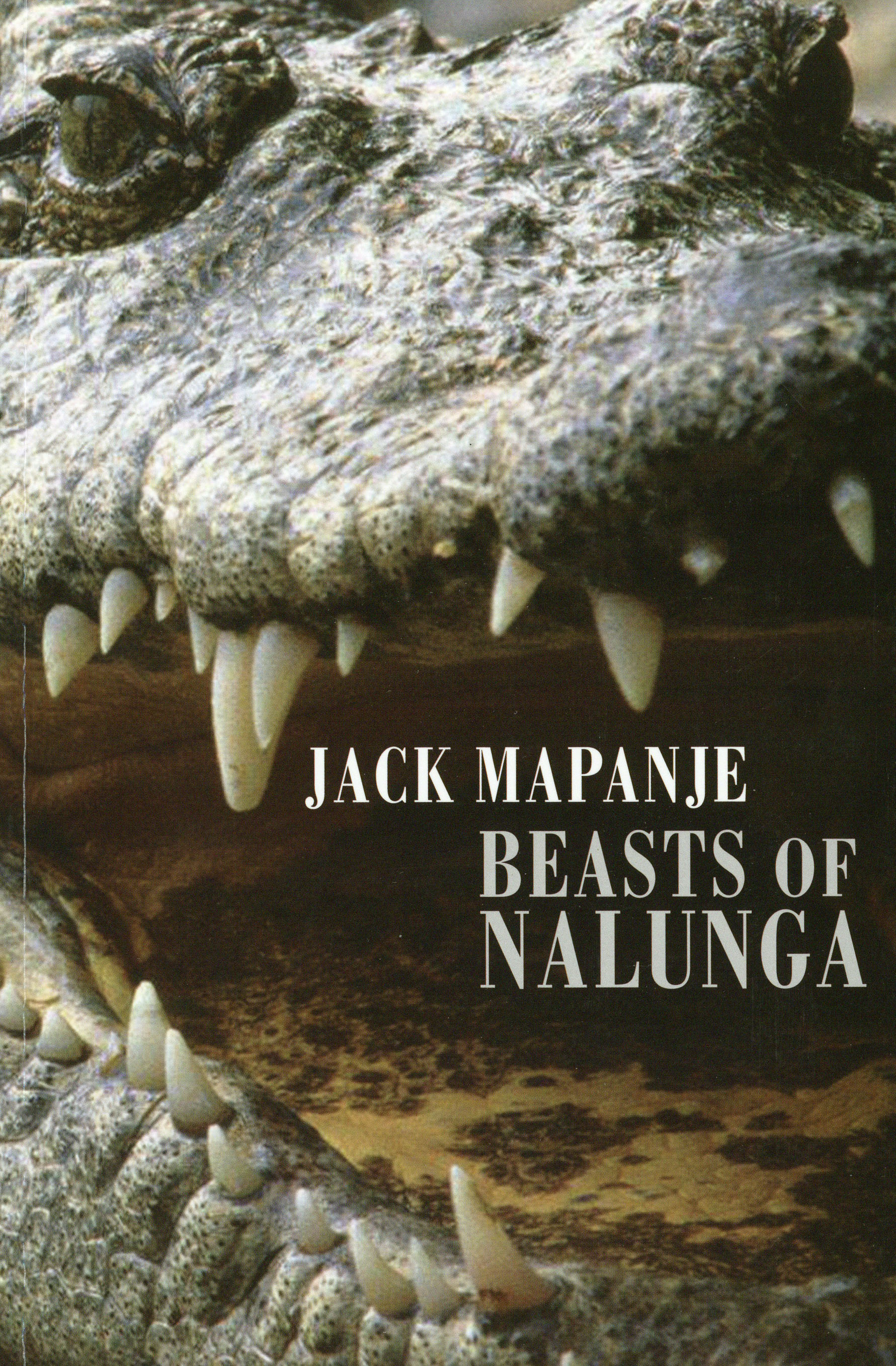
Front cover of ‘Beast of Nalunga’, showing the head of a crocodile with its mouth open

Front cover of ‘Beast of Nalunga’, published by Bloodaxe Books in 2007 (Bloodaxe Books Collection, Bloodaxe 821.94 MAP)

A catalogue of Jack Mapanje’s papers held at Newcastle University Library can be found here on our Archives Hub pages and a small selection of digitised images from the archive can be found on Collections Captured.

Aurelia Musso – The Exchange, Newcastle – December 2018

One of the very special images we have within our ‘Local Illustrations’ collection is this picture: Exchange by Aurelia Musso.  Unusually for the prints that remain of this artist, it is a picture of a civic building, the Exchange on Newcastle Quayside (now known as the Guild Hall).

‘Exchange’, by Aurelia Musso and dedicated to David Landell, c. 1783 1793 (Local Illustrations, ILL/11/165). The Exchange is located along the Newcastle Quayside, now known as Guild Hall.


Aurelia Musso was a prolific artist, and highly regarded within Newcastle society in the late 18th Century.  Born in Piedmont in Italy in 1758, she moved to Newcastle in 1783 with her husband, fellow artist Boniface Musso, and their two children.  The early history of the Musso family is fairly scant, but Aurelia (nee Grezzini) appears to have had family links in Newcastle, with various members of the Grezzini family involved in wood carving trades and the making of high quality toys in the City.

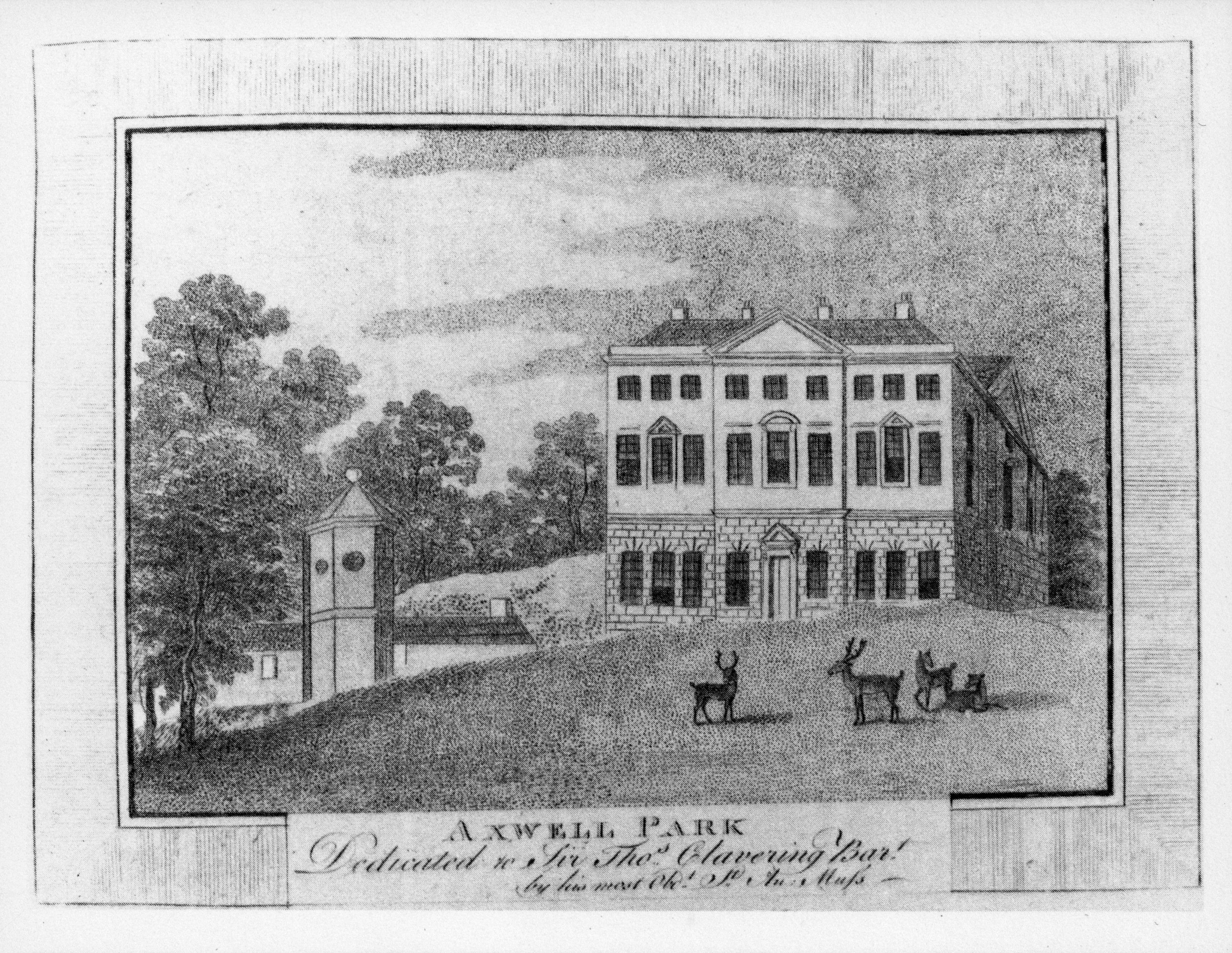
Axwell Park by Aurelia Musso, commissioned by the Clavering family of Gateshead. Original held at Newcastle City Library and kindly reproduced with their permission.

Jesmond Mill by Aurelai Musso, commissioned by the Brown family of Benton. Original held at Newcastle City Library and kindly reproduced with their permission.

Aurelia Musso specialised in prints and her work was highly valued among the wealthy and powerful in Newcastle.  She was commissioned by several prominent families, including the Clavering family of Axwell Park, (Gateshead), John Bigge of Carville Hall (Wallsend), William Lamb of Ryton Hall (County Durham) and Ralph Carr of Dunston Hall (Gateshead), and often Musso’s images remain the earliest prints of these family estates and houses.  She appears to have been very much a part of this elite circle and was certainly a very fashionable artist during this period.

The image of the Exchange was presumably created whilst Aurelia lived in Newcastle, and can therefore be dated to between 1783 – 1893.  Not very long afterwards, in 1809, the frontage of the building was radically altered to the designs of architects William Newton and David Stephenson.  Whilst the interior and rear of the building remained intact, the old steeple and staircase were entirely taken down, and the present front was erected, with the clock placed in the front, largely obliterating the original Italian architectural style seen in Musso’s print.  The print below, dating from 1829, shows the building with its new facade, which remains to this day.

‘Guild Hall or Exchange’ 1829, William Westall (artist) and Edward Finden (engraver), held by Victoria and Albert Museum, London.

The Musso family, although nowadays far less well know than during their lifetimes, play an important part in Newcastle’s history.  Aurelia’s husband Boniface was the tutor for a short time of architect John Dobson (link to profile), as well as the artist John Martin (link to profile).  John Martin moved to Newcastle initially in 1803 at the age of 14 to take up the post of apprentice to a coach-builder to learn heraldic painting.  Meeting the Musso family in 1804 however he was taken on by them, receiving classical art instruction.  After Aurelia’s death, Boniface moved with the family to London taking John Martin with him – although Martin proved to be a somewhat wayward apprentice and the apprenticeship was later terminated!

Aurelia died in 1793, only 35 years old, cause of death unknown.  She was buried on 17th September 1793 in St Andrew’s Churchyard, Newcastle.

Many thanks to Pat Halcro for her research for this piece.

Agatha Christie and Archaeology – September 2018

Agatha Christie is the world’s best-selling crime novelist; but did you know that she also worked in the field of archaeology alongside her second husband, the distinguished archaeologist Sir Max Mallowan? From the 21st Century Collection, this month’s treasure is Agatha Christie and Archaeology, edited by Charlotte Trümpler, which celebrates Christie’s relationship with archaeology, exploring what life was like working and travelling around archaeological digs in the Middle East in the 1930s to the 1950s, and detailing the extraordinary relationship between Christie’s books and the field of archaeology.

First published as part of a major exhibition at the British Museum in 2001-02 and translated from German, this book details Christie’s contribution to the excavations led by her husband at various sites in Syria and Iraq, including the ancient Assyrian city of Nimrud which has since been destroyed. With reflections from those who worked as part of the excavation teams, the book describes everyday life for Christie and her husband at the digs (including anecdotes of Christie piecing together pottery shards and cleaning ivory fragments using hand lotion and face cream).

Christie photographed many of the finds, some of which are now held in the British Museum. These are explored in the book, as well as details and stills from two films she made of the excavation sites that have never been shown publically. The book also provides photographs of Agatha and Max, in addition to examples of photographs taken by Christie of late-1930s Syria and of Iraq between 1948 and 1958. Demonstrating Christie’s unique perspective on archaeological digs in these areas, Agatha Christie and Archaeology also explores the differences between her attitude to the Orient, and those of previous European travellers in the Middle East, including Gertrude Bell whose extensive archive is held in Special Collections.

Many of Christie’s best-loved and most well-known novels featuring Hercule Poirot, such as Murder on the Orient Express (1934), Murder in Mesopotamia (1935), Death on the Nile (1937) and Appointment with Death (1937), take place in the Middle East and feature settings of archaeological sites; Agatha Christie and Archaeology uncovers some of the little-known connections between the fictional dramas and characters of the novels and their basis on real-life events and people, such as Christie’s own adventurous travels to excavation sites.

Why not visit Special Collections to take a look at some of the examples of Christie’s work held here? There are children’s versions of Death on the Nile and Crooked House in the Booktrust Collection, and the little-known Star Over Bethlehem and Other Stories – a collection of religious stories and poems generally thought to be aimed at children that Christie published under her married name – is held in the Brian Alderson Collection.

Edith Stoney – Unsung hero of the Turbinia story… – July 2018

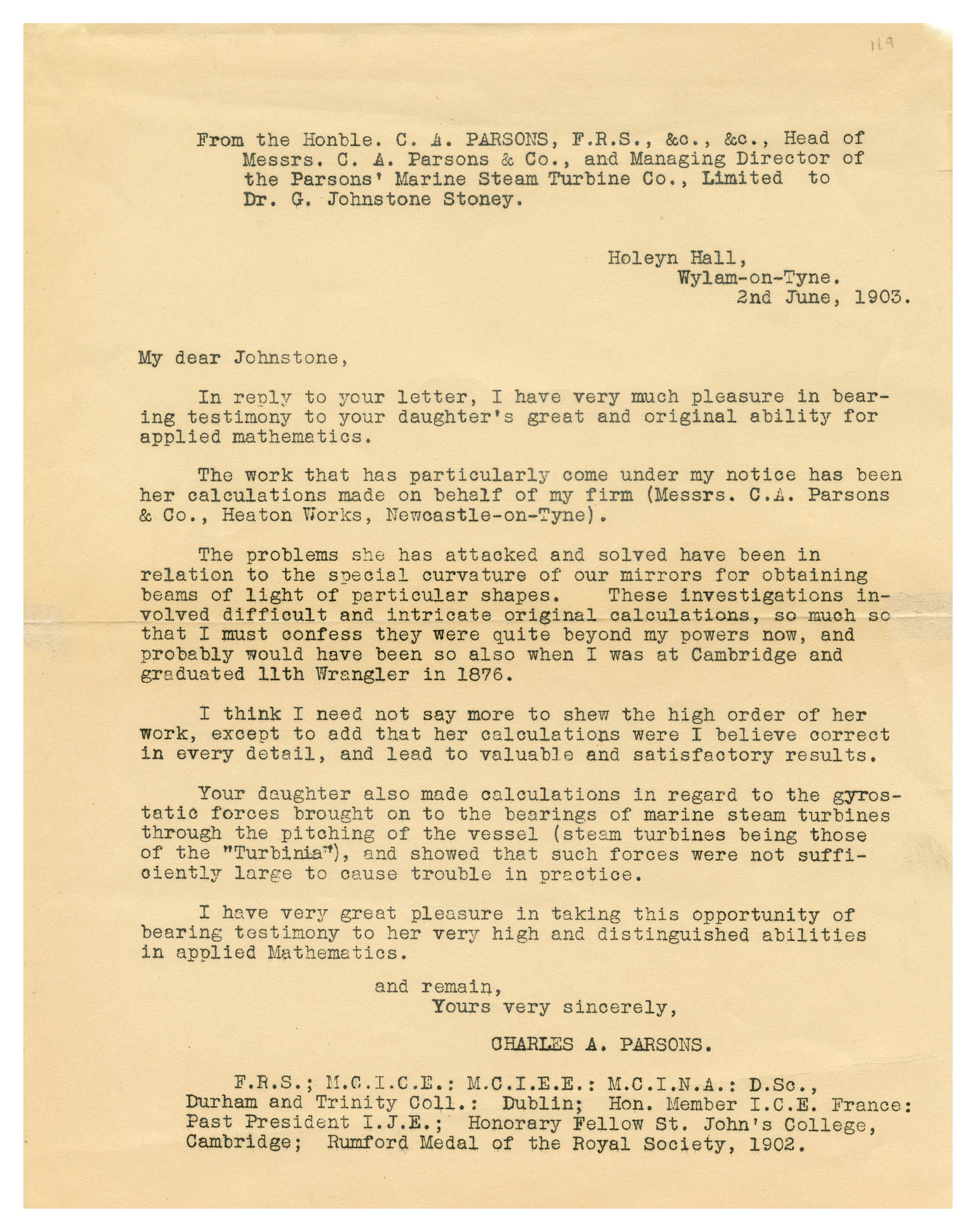
Letter from Charles Algernon Parsons to George Johnstone Stoney concerning mathematical work undertaken by on the the Stoney’s daughters (GB186/MSA/2/22)

Thank you to the Heaton History Group, whose research into the Stoney family of Heaton solved one of the mysteries in our archive!  A fascinating letter in our Manuscript Album (Letter from Charles Algernon Parsons to George Johnstone Stoney concerning mathematical work undertaken by one of Stoney’s daughters’, GB186/MSA/2/22) was obviously about one of the Stoney sisters, but we didn’t know which one.  Whilst we still can’t be 100% sure, the Heaton History Group have found evidence that one sister, Edith, worked for the Parsons firm whilst living in Heaton in Newcastle, and all evidence points to Edith as our mystery mathematical genius!

You can read the first installment in March 2016’s Treasure of the Month, ‘The Turbinia Steamship and a mystery in the archives…

The following is an extract from the Heaton History Group’s research piece.  A full version, which includes their research about all of the Stoney family, including Edith’s brother George who was also connected to the Turbina story, can be seen here.

The Turbinia

Most people in Newcastle have heard of Sir Charles Parsons, the eminent engineer whose invention of a multi-stage steam turbine revolutionised marine propulsion and electrical power generation, making him world famous in his lifetime and greatly respected still. Parsons’ Heaton factory was a huge local employer for many decades. It survives today as part of the global firm, Siemens.

But, of course, Charles Parsons did not make his huge strides in engineering alone. He was ably supported by a highly skilled workforce, including brilliant engineers and mathematicians, some of whom were much better known in their life times than they are today.

One that certainly deserves to be remembered is Edith Anne Stoney. Edith worked for Parsons only briefly but her contribution was crucial.  This is her story.

Family background

Dr George Johnstone Stoney (1826-1911), Edith’s father, was a prominent Irish physicist, who was born near Birr in County Offaly.  He worked as an astronomy assistant to Charles Parsons’ father, William, at nearby Birr Castle and he later taught Charles Parsons at Trinity College, Dublin. Stoney is best known for introducing the term ‘electron’ as the fundamental unit quantity of electricity. He and his wife, Margaret Sophia, had five children whom they home educated. Perhaps not surprisingly, the Stoney children went on to have illustrious careers. Robert Bindon became a doctor in Australia; Gertrude Rose was an artist;  George Gerald was an Engineer (who also worked on Turbina in his career); and Florence Ada (awarded the OBE in 1919), was the first female radiologist in the UK. But it is Edith Anne whose mathematical genius is shown in the fascinating letter we have here at Newcastle University Special Collections.

Edith Anne Stoney

Edith was born on 6 January 1869 and soon showed herself to be a talented mathematician. She won a scholarship to Newham College Cambridge where, in 1893, she achieved a first in the Part 1 Tripos examination. At that time, and for another 50 years afterwards, women were not awarded degrees at Cambridge so she did not officially graduate but she was later awarded both a BA and MA by Trinity College Dublin.

After graduation, Edith came to Newcastle to work for Charles Parsons. In a letter sent by Charles Parson to Edith’s father, George Johnstone Stoney, in 1903. Parsons pays tribute to:

your daughter’s great and original ability for applied mathematics… The problems she has attacked and solved have been in relation to the special curvature of our mirrors for obtaining beams of light of particular shapes. These investigations involved difficult and intricate original calculations, so much so that I must confess they were quite beyond my powers now and probably would have been also when I was at Cambridge… Your daughter also made calculations in regard to the gyrostatic forces brought onto the bearings of marine steam turbines…

It looks like the sort of reference someone might write for a perspective employer except that, a sign of the times, it doesn’t mention Edith by name and is addressed to her father.

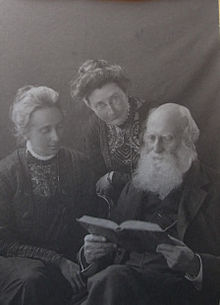
Stoney Edith,_Florence,_Johnstone_Stoney

Edith, Florence and George Johnstone Stoney. Image courtesy of Heaton History Group

After working in Heaton, Edith went on to teach mathematics at Cheltenham Ladies’ College and then lecture in physics at the London School of Medicine for Women in London. There she set up a laboratory and designed the physics course.

In 1901, she and her sister, Florence, opened a new x-ray service at London’s Royal Free Hospital and she became actively involved in the women’s suffrage movement as well becoming the first treasurer of the British Federation of University Women, a post she held from 1909-1915.

During WW1, both sisters offered their service to the French Red Cross to provide a state of the art radiological service to the troops in Europe. In the x-ray facilities at a new 250 bed hospital near Troyes in France, planned and operated by her, she used stereoscopy to localise bullets and shrapnel and pioneered the use of x-rays in the diagnosis of gas gangrene, saving many lives.

She was posted to Serbia, Macedonia, Greece and France again, serving in dangerous war zones for the duration of the war. The hospitals in which she worked were repeatedly shelled and evacuated but she continued to do what she considered to be her duty.  Her war service was recognised by several countries. Among her awards were the French Croix de Guerre and Serbia’s Order of St Sava, as well as British Victory Medals.

After the war, Edith returned to England, where she lectured at King’s College for Women. In her retirement, she resumed work with the British Federation for University Women and in 1936, in memory of her father and sister, she established the Johnstone and Florence Stoney Studentship, which is still administered by the British Federation of Women Graduates to support women to carry out research overseas in biological, geological, meteorological or radiological science.

Edith Anne Stoney died on 25 June 1938, aged 69. Her importance is shown by the obituaries which appeared in ‘The Times’, ‘The Lancet’ and ‘Nature’. She will be remembered for her pioneering work in medical physics, her wartime bravery and her support for women’s causes. Although her time in Newcastle was brief, she deserves also to be remembered for her contribution to the work in Heaton for which Charles Parsons is rightly lauded.

Thank you to Heaton History Group for this piece.

Link to related article: The-turbina-steamship-and-a-mystery-in-the-archives/

Dr. Martin Luther King Jr. Memorial Service – April 2018

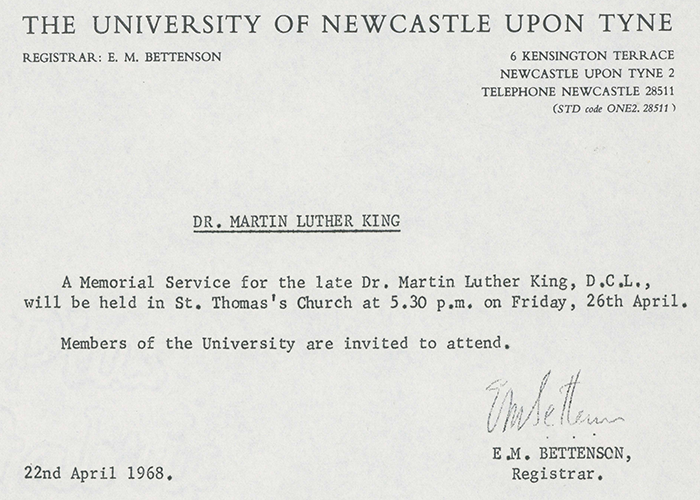
E.M. Bettenson, "Dr. Martin Luther King," announcement

E.M. Bettenson, “Dr. Martin Luther King,” announcement, 22 April, 1968 (University Archives, NUA/00-7621/3/21)

April 2018 marked the 50th anniversary of the assassination of the civil rights campaigner, Dr. Martin Luther King Jr. Shortly after 6pm on 4th April 1968, King was short dead in Memphis, Tennessee. He was just 39 years old. Following the news of King’s assassination, Newcastle University Registrar, Ernest Bettenson announced that the University “deeply deplored” the killing and “we are flying our flag at half-mast to show our deepest regret and sympathy for Dr. King’s family…” (‘City Students Pay Tribute to Dr. King,’ E-Chronicle, April 5, 1968, p.1).

The world was shocked and press quickly took to reporting the hunt for King’s killer. The press in Newcastle also joined the rest of the nation through extensive coverage of the murder, the riots that then ensued in the United States and the hunt for King’s killer. Two months after King’s assassination, on 8th June 1968, James Earl Ray was arrested in London, which later led to his trial and conviction.

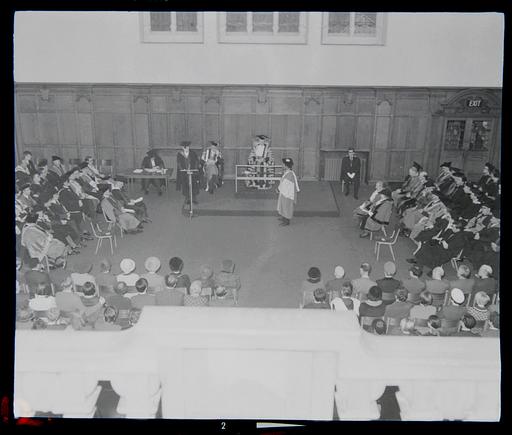
Just five months prior to his assassination, on 13th November 1967, King made a fleeting visit to Newcastle. Staying just seven hours in the City, to receive an Honorary Doctorate in Civil Law from the University (the only University to do so during his lifetime) and delivered a powerful, impromptu speech. King spoke about many challenges that still remain with us today. He linked the African American freedom struggle to developments in contemporary British race relations and issued a call for people to confront global challenges of war, poverty and racism. This would be his last public address outside the US before his assassination. You can read the full details of the day of King’s visit to Newcastle University in this digital exhibition.

Photograph of Dr. Martin Luther King Jr. receiving his Honorary Degree in King's Hall

Photograph of Dr. Martin Luther King Jr. receiving his Honorary Degree in King’s Hall –
just 5 months before his assassination (University Archives, NUA/052589-12)

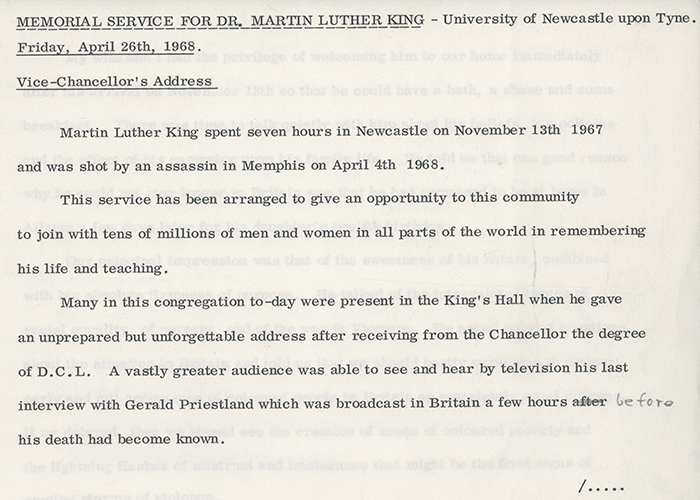
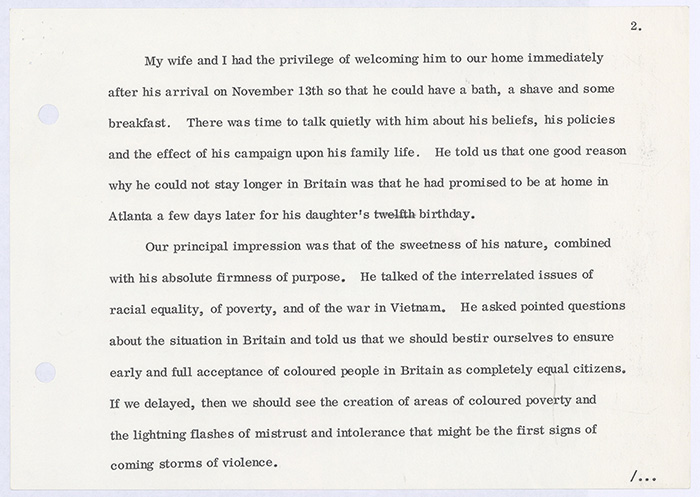
To remember Martin Luther King, Newcastle University organised a Memorial Service to honour King’s visit and curate his lasting legacy. On 26th April 1968, Vice Chancellor Charles Bosanquet delivered this Service and gave a moving eulogy for staff and students at St. Thomas’ Church, Haymarket in Newcastle. Bosanquet spoke of King’s visit to the University. He personally expressed the experience he had when King arrived, where they spoke about King’s beliefs and policies surrounding radical equality, poverty, the war in Vietnam and the situation in Britain. King told Bosanquet that “we should bestir ourselves to ensure early and full acceptance of coloured people in Britain as equal citizens”.

Charles Bosanquet, Page 1 from his Address at the Memorial Service for Dr. Martin Luther King

Charles Bosanquet, Page 2 from his Address at the Memorial Service for Dr. Martin Luther King

Charles Bosanquet, Pages 1 & 2 from his Address at the Memorial Service for Dr. Martin Luther King, 26 April, 1968 (University Archives, NUA/00-7621/3/4)

The University went on to remember his legacy through a series of events, including Martin Luther King Memorial Lectures, the first delivered on 12th October 1972, when Trevor Huddleston (Bishop of Stepney) spoke on ‘Race Relations in a Hungry World’, as well memorial conferences and the unveiling of Dr. Martin Luther King’s statue in the King’s Quad to celebrate the 50th anniversary of his visit to the University.

On 26th April 2018, St. Thomas’ Church is holding a Memorial Service to honour Dr. Martin Luther King, 50 years to the day that the 1968 Service took place.

Votes for Women: Newcastle’s own Radical Suffragist – February 2018

To mark the centenary this month of the 1918 Representation of the People Act which gave some womens the right to vote for the first time, our Treasure of the Month takes a closer look at Ethel Williams, Newcastle’s own radical suffragist.

Portrait photograph of Ethel Williams (Ethel Williams Archive, EWL/2/4)

Dr Ethel Mary Nucella Williams (1869 – 1948) was Newcastle’s first female doctor, and became the first woman to found a general medical practice in the city as well as co-founding the Northern Women’s Hospital.

Ethel was also a radical suffragist and pacifist. As a suffragist, she served as Secretary of the Newcastle Women’s Liberal Association and became president of the Newcastle and District Women’s Suffrage Society. As a pacifist, she was a founding member of the Women’s International League for Peace and Freedom.

Being a radical suffragist meant that Ethel believed in more peaceful means of campaigning and demonstration but took a broader view than many other suffragists, who tended to be drawn from the middle classes, recognising as she did that the movement needed the support of working class women, and that the issue of the franchise should draw women from all sections of society together with a common identity.

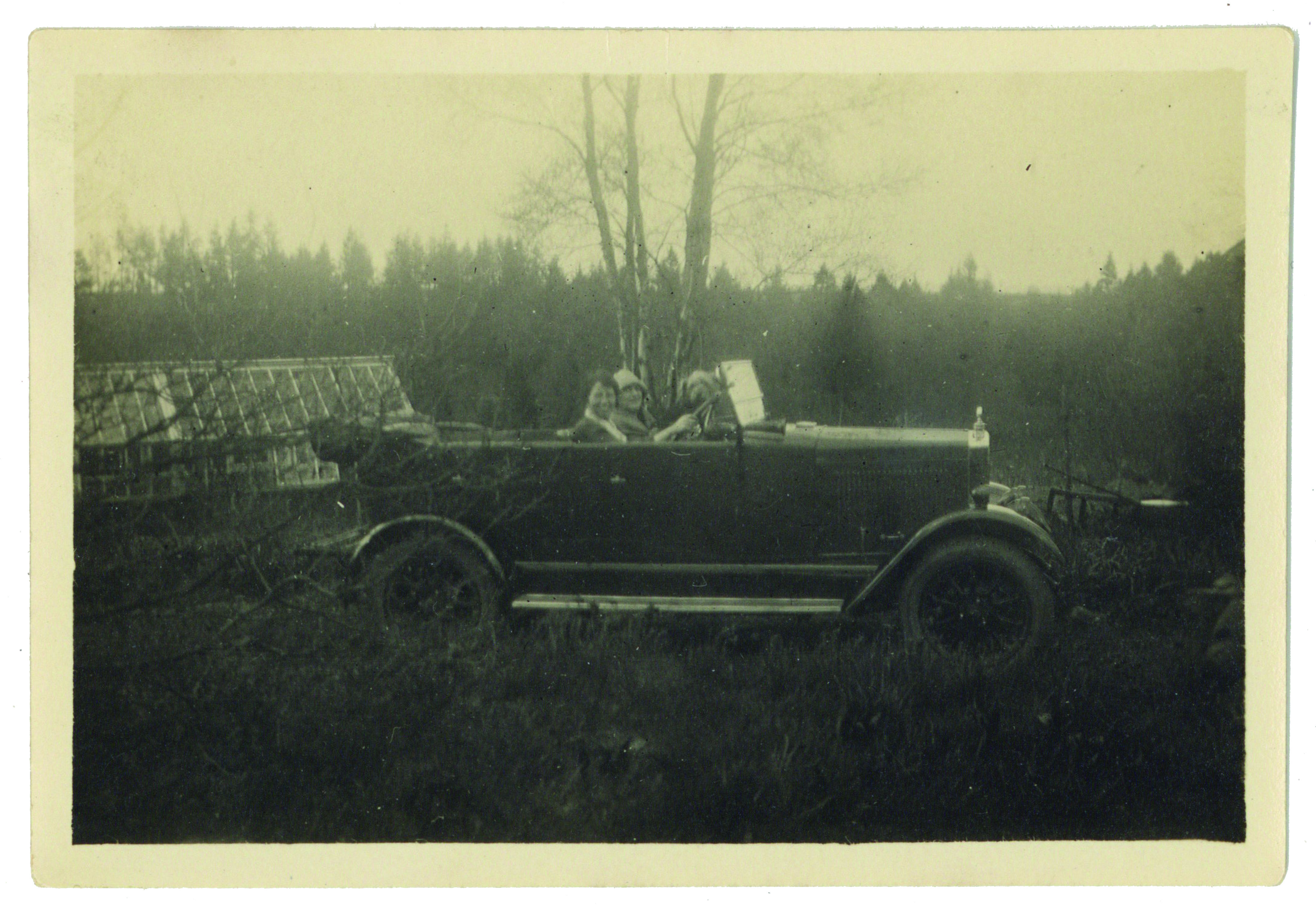
Ethel was one of the first women in the North East of England to own and drive a motor car. We see her here photographed with her car, which was crucial to enable her work in mobilising the women’s suffrage movement in the region.

Photograph of Ethel Williams in her car (Ethel Williams Archive)

Ethel took part in the ‘Mud March’ of 1907 in London, the first large procession organised by the National Union of Women’s Suffrage Societies Sand so-called due to the terrible weather conditions on the day. Despite the hardship, over 3,000 women from all walks of life took part.

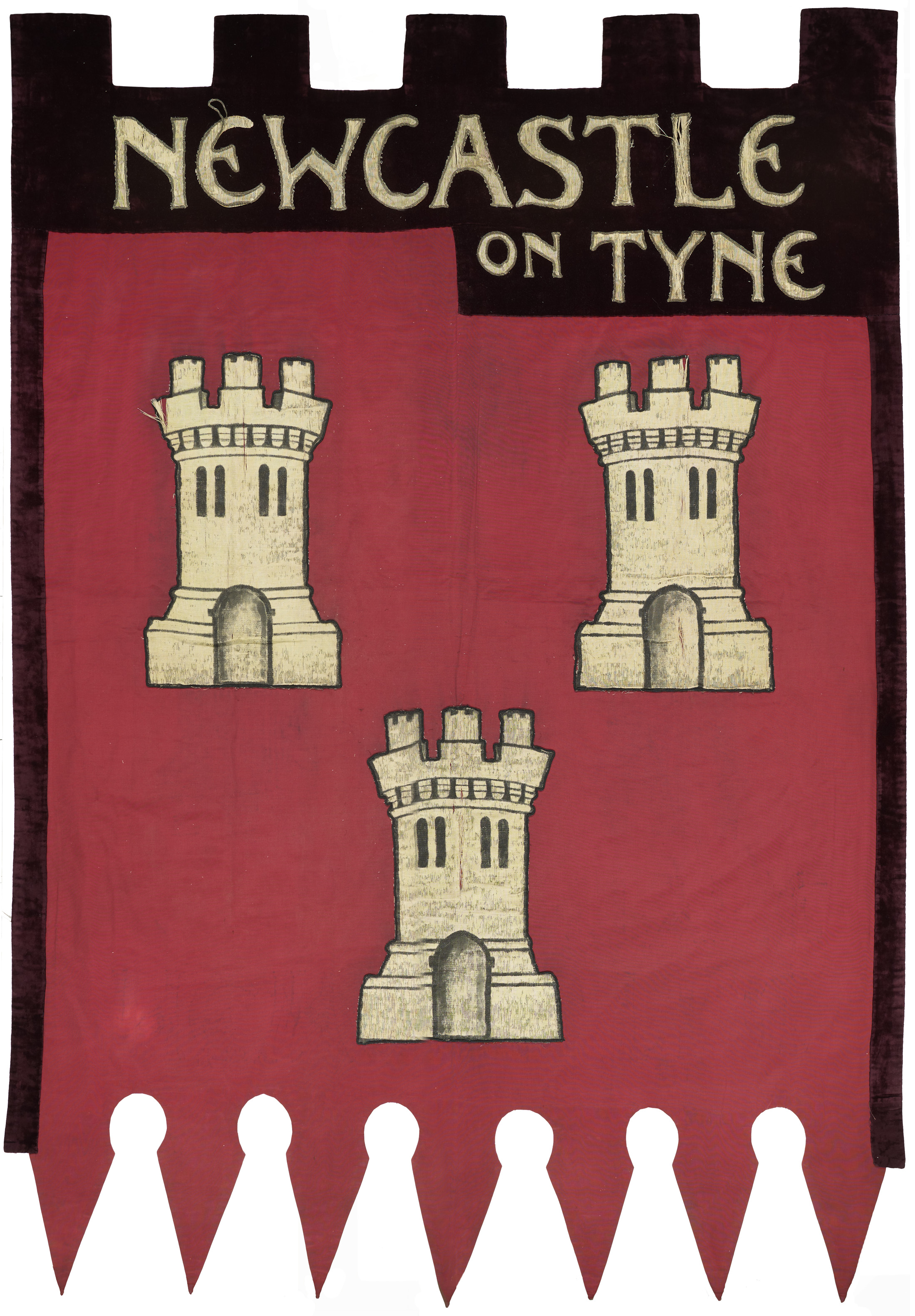
This Ethel Williams Archive in Newcastle University Library’s Special Collections includes letters from her contemporaries, a number of photographs of her throughout her life, and objects connected to her involvement with the campaign for women’s suffrage, including a suffragist banner and a ‘Winged Victory’ statuette bestowed on her in 1918 to commemorate the Representation of the People Act which momentously gave women householders and wives of male householders over thirty the right to vote for the very first time.

Ethel’s suffragist banner is currently undergoing conservation work at The People’s History Museum in Manchester; when it returns to Newcastle later this year, it will be fit to be enjoyed by all as we celebrate this significant centenary year of women achieving the vote.

Ethel Williams’ suffragist marching banner (Ethel Williams Archive, EWL/3/5)

Learn more about the Ethel Williams Archive in Special Collections here.

And read more about Ethel’s suffragist banner here

Happy Anniversary Frankenstein’s Monster! – January 2018

Quote

2018 marks the 200 anniversary of the publication of Mary Shelley’s Frankenstein.

Why not celebrate by starting the New Year by reading or re-reading this classic.  And for the faint-hearted our amazing Book Trust Collection on Level 1 of the Robinson Library has some great kids’ versions!

The circumstances of the novel’s genesis are well-known: Claire Clairmont, Lord Byron, John Polidori, P.B. Shelley, and Mary Godwin (as she was then) passed a stormy night in Geneva, June 1816, inventing ghost stories. Mary’s contribution, inspired by a dream, would be published two years later as Frankenstein; or, The Modern Prometheus and marked the birth of the science fiction genre. Victor Frankenstein raids graveyards to acquire the parts he needs to create life but his experiment goes horribly wrong and he rejects his nameless creation. Denied companionship, the monster endeavours to destroy his maker. The novel explores themes which would characterise much of Mary Shelley’s subsequent work, such as alienation and solitude; justice; the purpose of life; destiny; and social class as it relates to political power.

Critically acclaimed in her own day, Mary is perhaps remembered today as the wife of Percy Bysshe Shelley and the author of Frankenstein (1818), her most enduring novel.  More recent scholarship however has tried to shed a greater light on her later literary output.  Mary Shelley was the author of seven novels, a great number of short stories and two travelogues, both of which use the travelogue genre as a vehicle to explore and comment upon politics, war and culture.

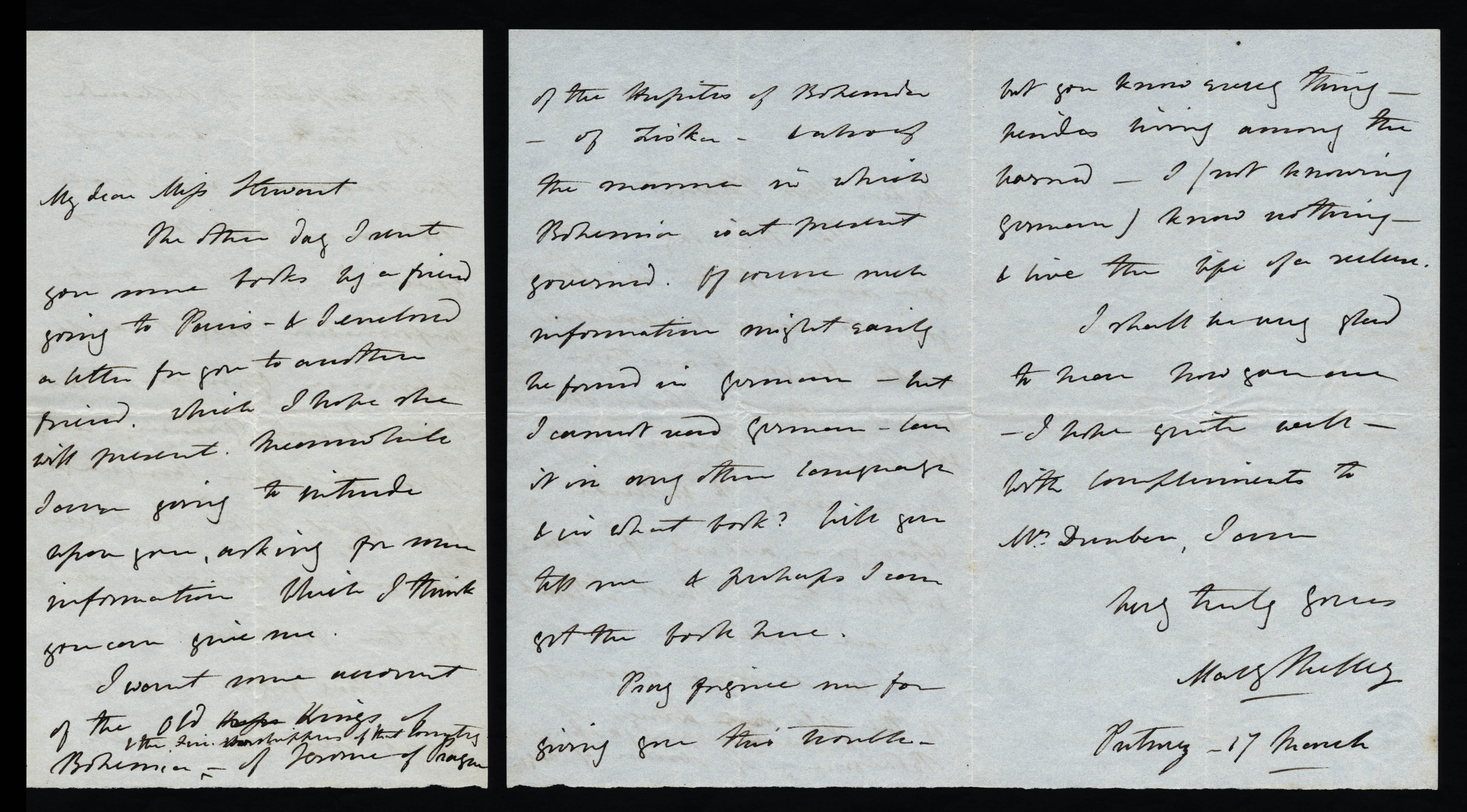
In one of two letters written by Mary Shelley which are held in the Manuscript Album here in Special Collections, she enquires about the history, religion and politics of Bohemia. This appears to be related to one of her last-known projects, which was a partial translation of a novel by German author, Ida Hahn-Hahn, called Cecil (1844). The letter was written in March 1844 which is also the same year that her final full-length book was published: Rambles in Germany and Italy, in 1840, 1842, and 1843.

The other day I sent you some books by a friend going to Paris – & I enclosed a letter for you to another friend which I hope she will present. Meanwhile I am going to intrude upon you, asking for some information which I think you can give me.

I want some account of the old Kings of Bohemia & the fire worshippers of that country – of Jerome of Prague of the Hussites of Bohemia – of Zizska – & also of the manner in which Bohemia is at present governed.

Pray forgive me for giving you this trouble – but you know every thing – . . . living among the learned – I (not knowing German) know nothing – & live the life of a recluse. I shall be very glad to hear how you are – I hope quite well – with compliments to Mr. Dunbar, I am very truly yours.

Shelley, M.

from a letter to Rose Stewart, 17th March 1844 (MSA/199, Manuscript Album, held at Special Collections, Newcastle University Library)

Mary Shelley [Letter] [MSA/1/99], Manuscript Album, Newcastle University Library.

Oh and did we mention that one of the versions of Frankenstein in the Book Trust Collection is a pop-up?  Go on, you know you want to!

Thank you to Melanie Wood, whose full research on Mary Shelley and the letters we hold in the Manuscript Album can be seen in the online version of the exhibition Very truly yours…

Andrew Wilson’s An Essay on the Autumnal Dysentery, 1777 – October 2017

For many of us, autumn is synonymous with falling leaves, darker nights, and wrapping up in warmer clothes. It’s a time when the clocks go back, and we can enjoy the last of the sunny days before winter sets in. However, in the Eighteenth Century, autumn was also synonymous with something altogether less pleasant: ‘autumnal dysentery’.

Dysentery was common in Newcastle and wider Tyneside during the Eighteenth Century, but reached epidemic levels during the autumns of 1758 and 1759. There were also significant outbreaks in 1783 and 1785.

Andrew Wilson (1718-1792) was a Scottish physician and medical writer, who studied medicine at the University of Edinburgh and graduated in 1749. He set up a practice in Newcastle a short time after and stayed in the city until 1775 or 1776, when he moved to London.

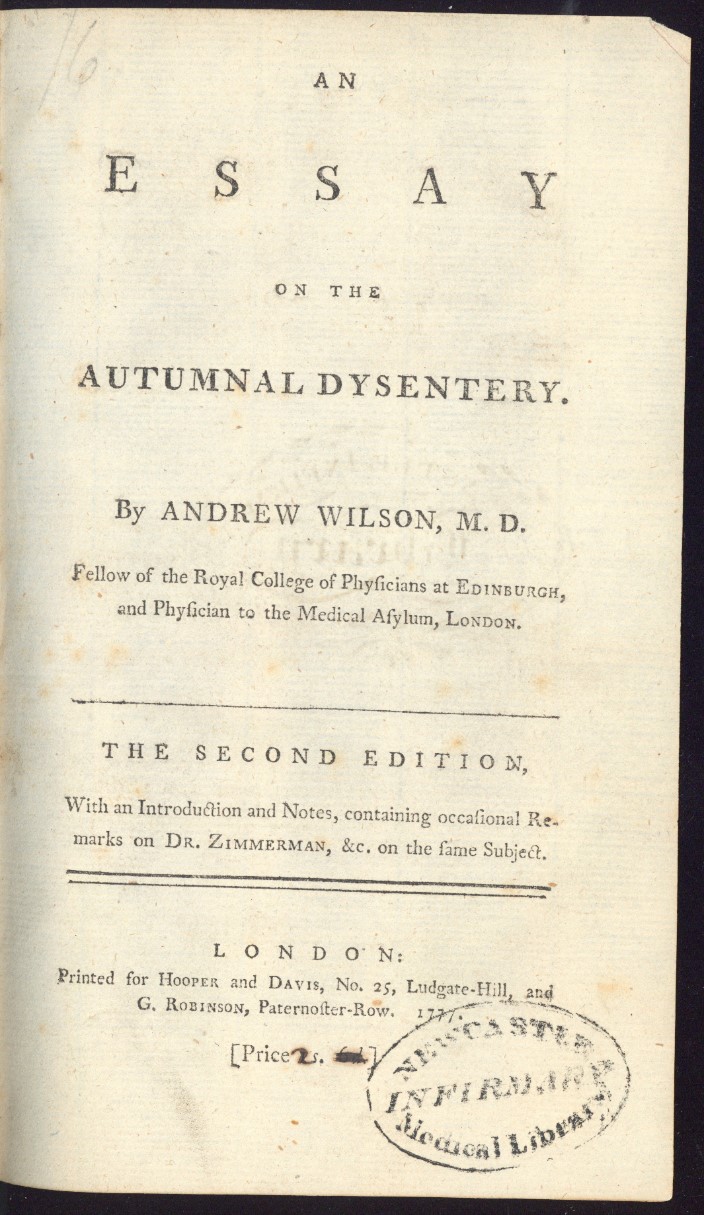
Wilson was in Newcastle during the 1758 outbreak, and ‘the conceptions that I then formed of the nature and genius of the Autumnal Bloody Flux, and of the true indications of cure to be adhered to in it’ (pp.1-2), he put into his Essay. The Essay was first published in 1760. The second edition that we have in Special Collections was published in 1777. Considering Wilson’s Edinburgh connections, it is unsurprising that he dedicated the tract to Dr John Rutherford, Professor of Medicine at Edinburgh, ‘my respected Master, my Patron, and my Friend’.

Title page from ‘An Essay on the Autumnal Dysentery’ (Medical Collection, Med Coll 616.935 WIL)

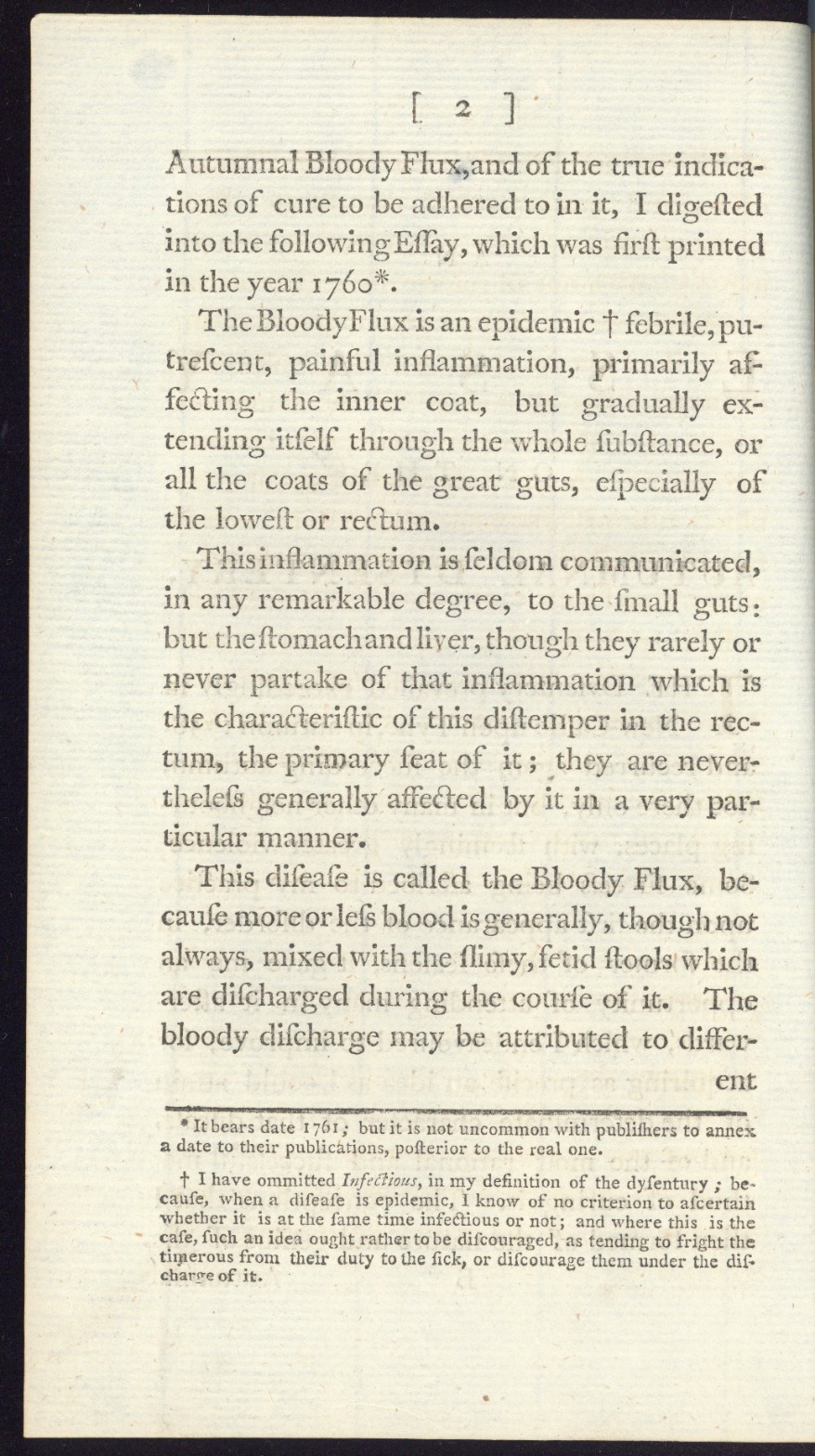
Wilson went into considerable detail discussing the causes, symptoms, and treatment of patients with dysentery. He offered a fairly gory description of the symptoms, which may not be suitable for those of squeamish dispositions…:

‘This disease is called the Bloody Flux, because more or less blood is generally, tho’ not always, mixed with the slimy fetid stools which are discharged during the course of it. The bloody discharge may be attributed to different causes, according to the degree, malignancy and continuance of the disease; such as, the vehemence of the inflammation, stretching the vessels opening into the cavity of the intestines, and straining red blood thro’ them, which does not naturally pass that length undissolved; the acrimony of the humours which are discharged into these guts during the inflammation, fretting and corroding the blood vessels…’ (pp2.3)

Page 2 from ‘An Essay on the Autumnal Dysentery’ describing the symptoms of the disease

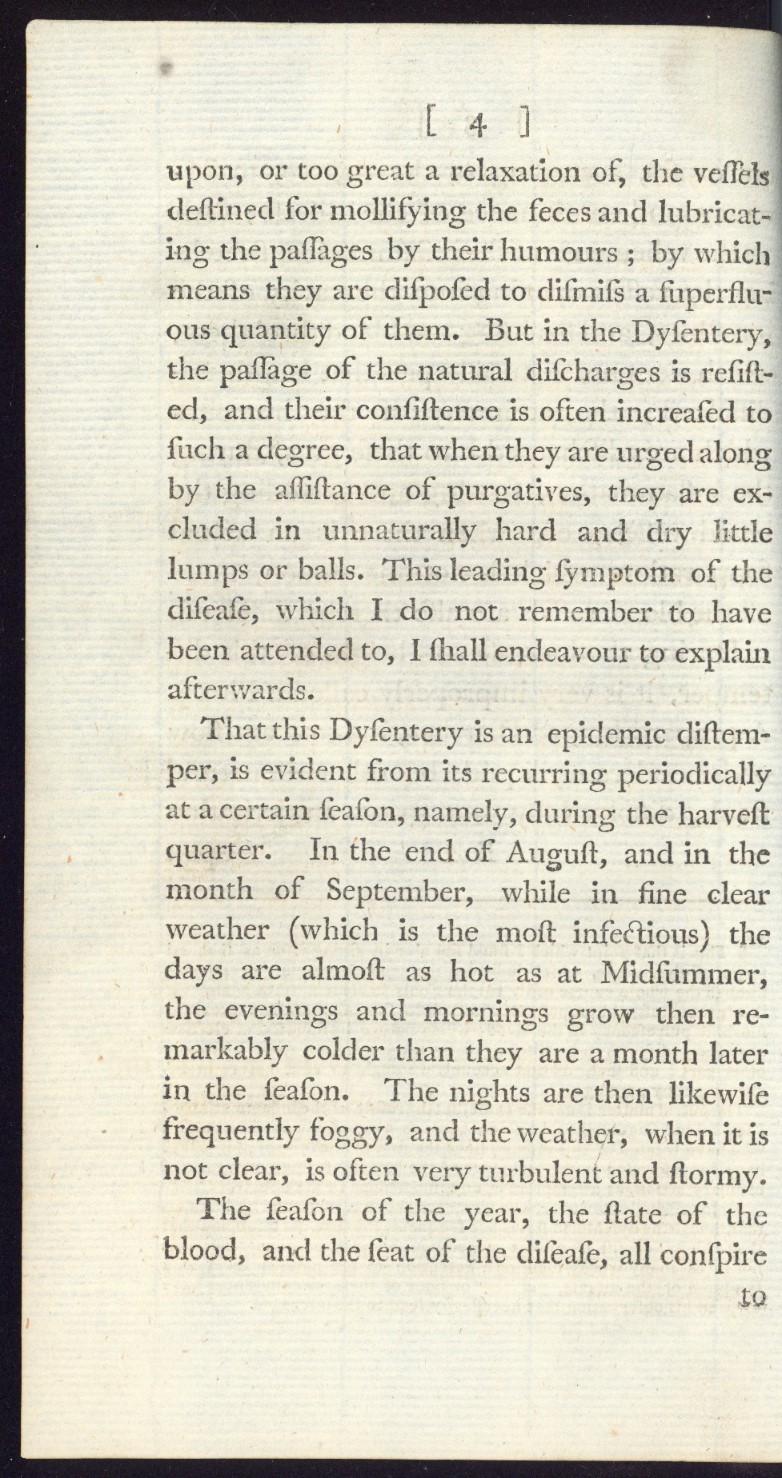
Page 4 from ‘An Essay on the Autumnal Dysentry’ describing the time of year that dysentery spread

Wilson also mentioned how ‘This disease, like all epidemics, is… more frequent in cities and towns than in the country; among the feeble than among the strong…’ He also claimed that dysentery was ‘more frequent among the poor and labourers, than among the wealthy, and those who live better and pay more attention to their health’. As for the reason for this, he suggested that ‘indigence, but much more especially negligence in the article of cooling after heats by labour, exercise etc., exposes the lower class of people prodigiously to this and many other diseases’. (p.28)

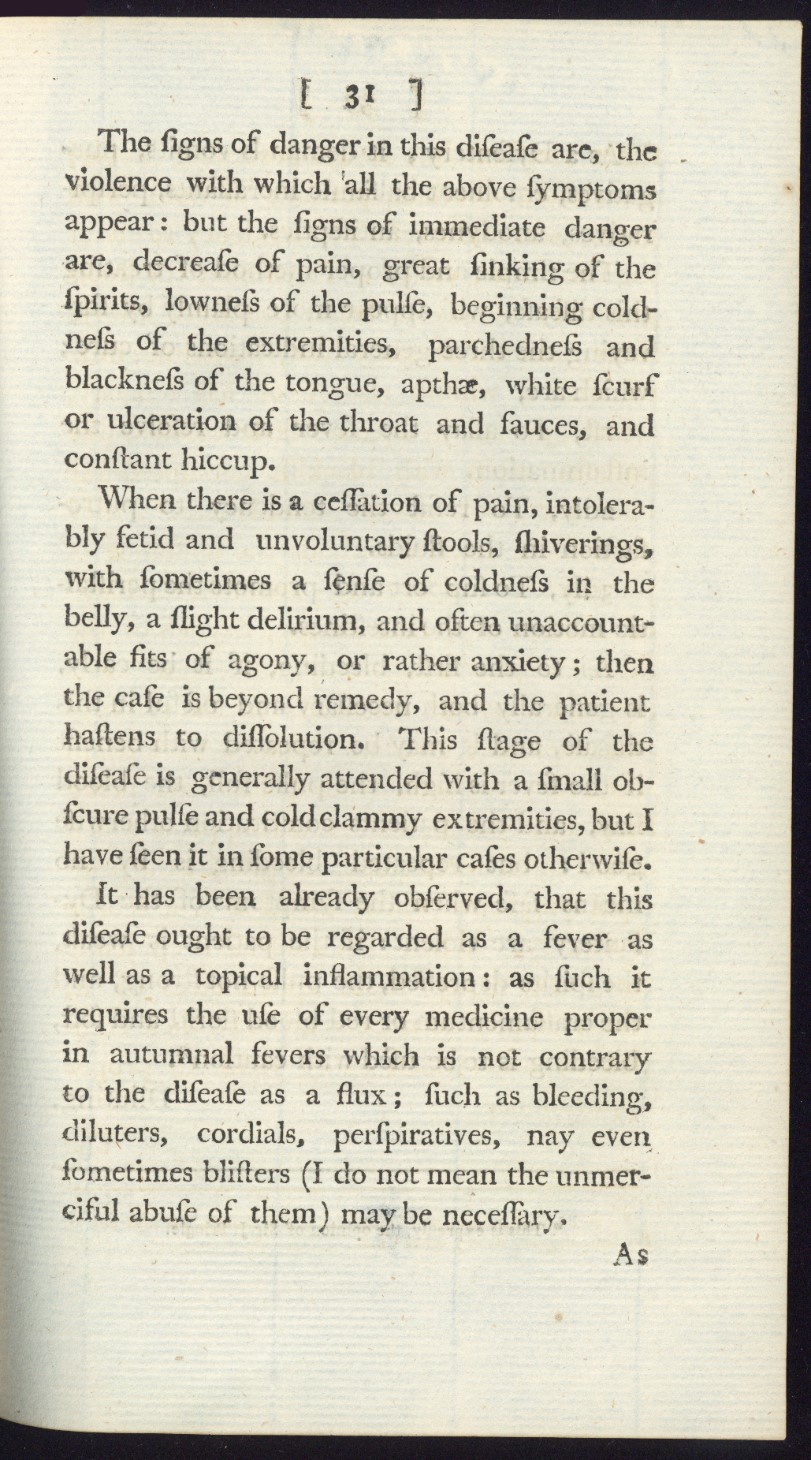
Page 31 from ‘An Essay on the Autumnal Dysentry’ describing the signs of danger when treating patients

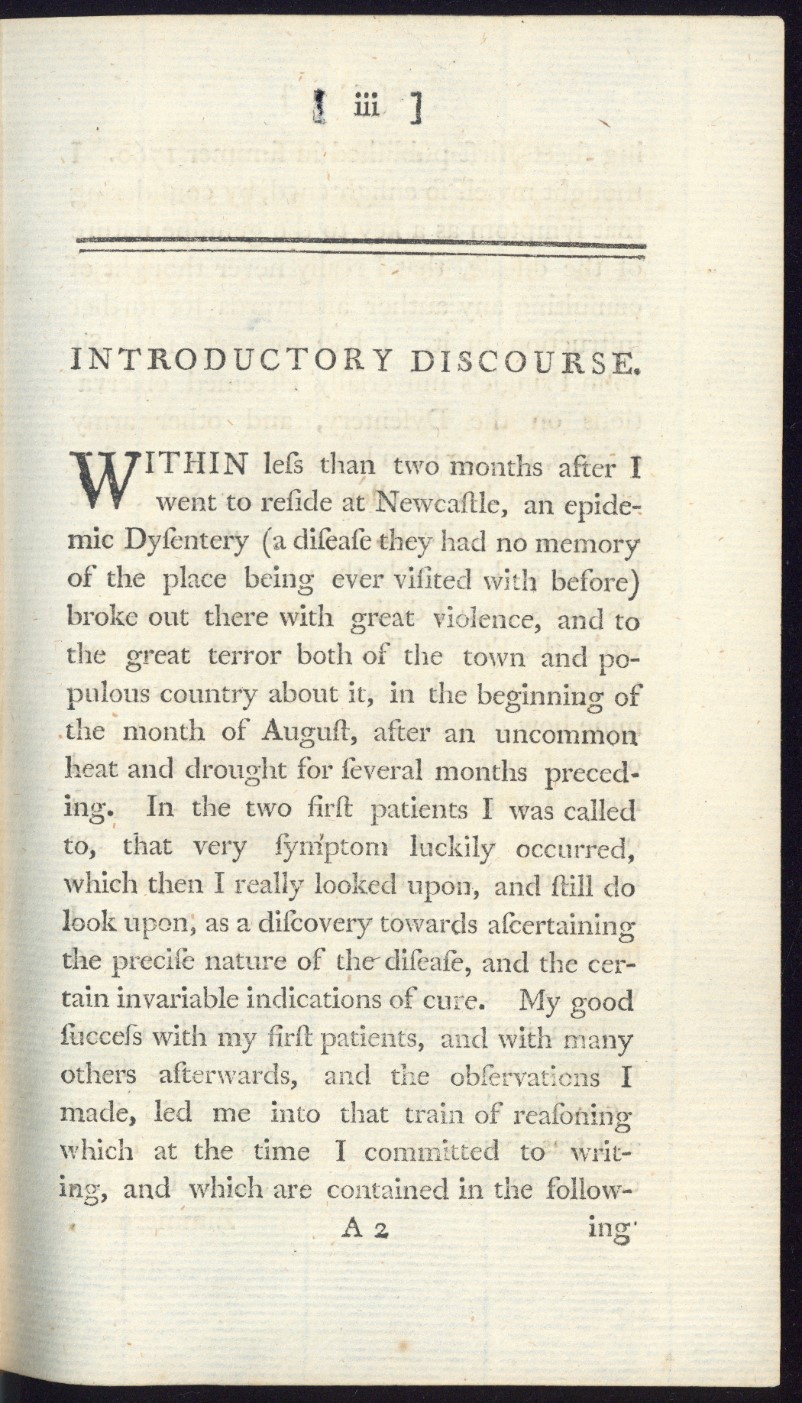
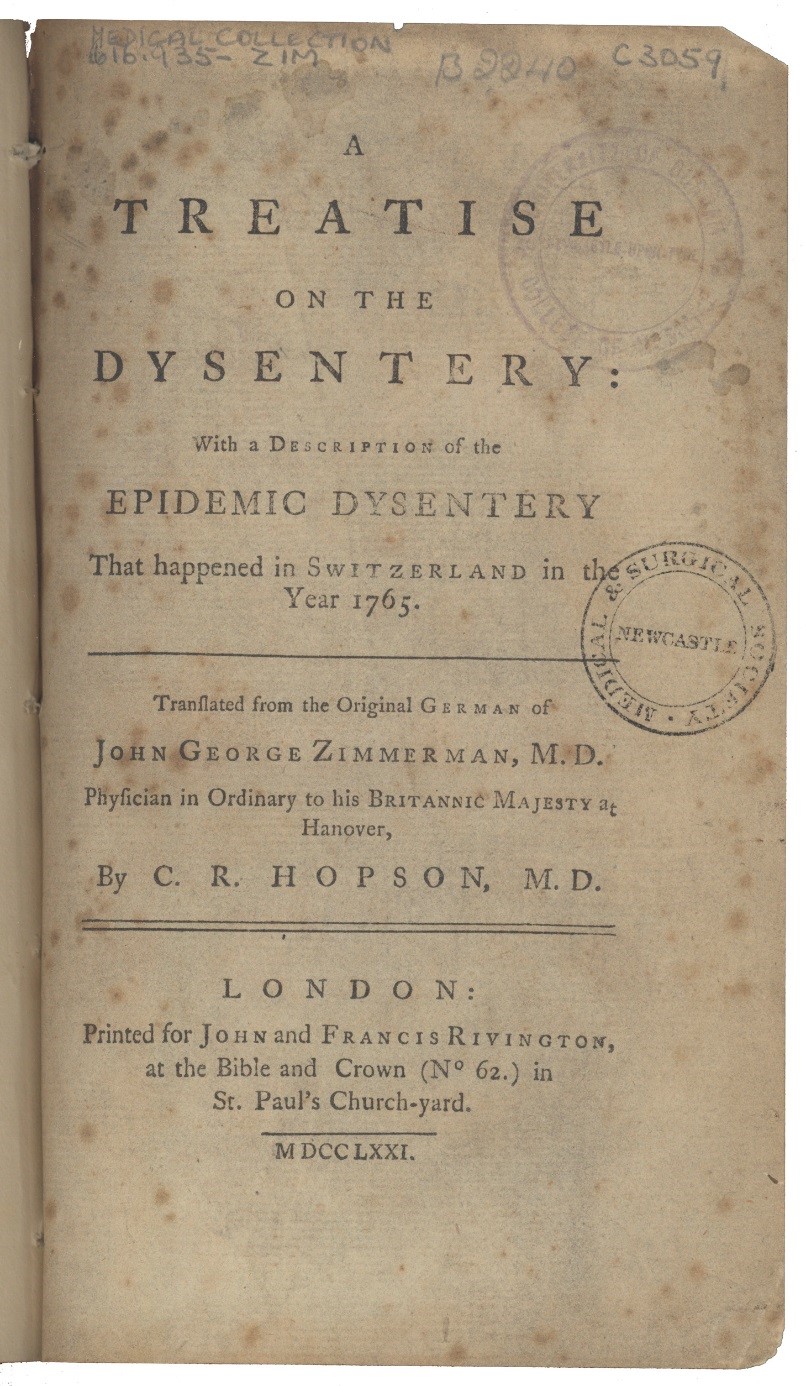
The second edition of the Essay, there is also the hint of medical controversy. In the ‘Introductory Discourse’ (which was new to the second edition), Wilson mentioned some of the recent publications on dysentery since his work was first published. Of particular interest to Wilson was a study by the Swiss physician Johann Georg Ritter von Zimmermann, titled A Treatise on the Dysentery. Zimmerman had been made Physician in Ordinary in Hanover to George III in 1768.

First iii of the ‘Introductory Discourse’

Zimmermann’s book was of such interest to Wilson because, in the course of reading it, he ‘discovered that he had made use of my Essay, and totally supressed his knowledge of it, while he was very profuse in his references to every other latter English writer on the subject’. Wilson argued that he ‘would be sorry to mention this circumstance upon presumptive evidence only, but he has extracted a pretty long case verbatim from my Essay, which was to be found nowhere else…’ Wilson found this ‘a very strange way… of extracting from a writer upon the very subject he was treating of, while he was, almost in every page, citing other authors who had written in English as I had done…’ However, drawing back from a full accusation of plagiarism (perhaps because of Zimmerman’s relationship with George III), Wilson left the question open, and stated: ‘I make no remarks upon it’. (p.V)

Title page from Zimmerman’s ‘A Treatise on the Dysentery’ (Medical Collection, Med Coll 616.935 ZIM)

Newcastle University’s Special Collections have both Wilson’s and Zimmerman’s books here in Special Collections. Reading them and deciding whether there has been any wrongdoing might be a nice way to spend a dark autumn day, but only if you’ve got the stomach for it.

———————————–

Item references

Andrew Wilson, An Essay on the Autumnal Dysentery (1777) (Medical Collection, Med Coll 616.935 WIL)

Johann Georg Ritter von Zimmermann, A Treatise on the Dysentery: with a description of the epidemic dysentery that happened in Switzerland in the year 1765 (1771) (Medical Collection, Med Coll 616.935 ZIM).

Inakanotsuki Animal Prints – August 2017

One of my favourite books on my own bookshelves is a contemporary reprint of part of the Hokusai Manga. The Manga comprises sketches by the artist Katsushika Hokusai, reproduced in three colour woodblock prints. Woodblock printing was a popular art form in Japan from the seventeenth century onwards. Having arrived in Japan from China centuries before, it gained popularity during the Genroku period (between 1688 and 1703), in part due to the increased wealth and disposable income of the merchant classes. The art form was known as Ukiyo-e, or ‘pictures of the floating world’, in reference to the urban culture of Edo (modern day Tokyo). The ‘floating world’ was the term used to describe the city’s red light district, with its kabuki theatres, brothels and tea houses.

Ukiyo-e’s original subjects were the people and places found within that world. In later years however, the genre moved away from these roots. The Meiji restoration and opening of the Suez Canal in 1868 caused a rapid influx of Westernization. All of Japanese culture felt the impact of these changes, and within the art world there was a shift towards works with a more Western focus including images of the natural world, muted colour palettes and techniques such as shading.

While searching our catalogue, I came across a listing within our 19th Century Collection of rare books for a publication titled Inakanotsuki, which had been tagged with ‘Ukiyo-e’. Intrigued, I decided to seek it out from our stores to see what it contained.

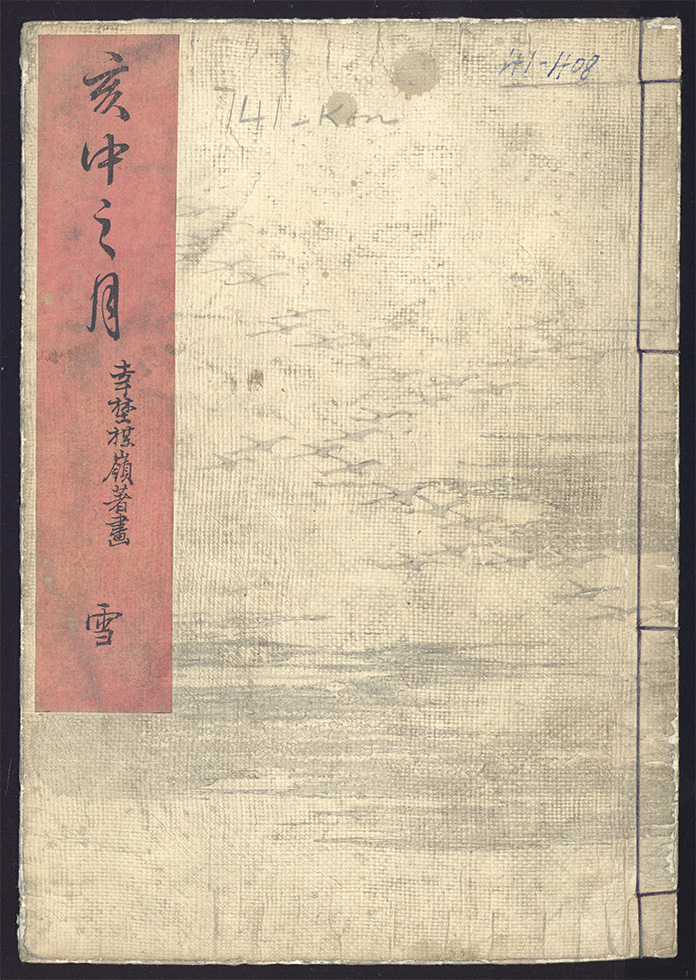
Front cover of ‘Inakanotsuki‘ by Kōno Bairei, 1889 (19th Century Collection, 741 KON)

Inakanotsuki is a small book with a stitched binding, known as fukuru-toji. What appears at first to be a plain, beige cover is itself a very subtle print showing flocks of birds. Inside the volume are multi-colour woodblock prints of various animals. It was published in 1889 – the year the Meiji Constitution was adopted in Japan. The artist is Kōno Bairei.

Kōno Bairei was born in 1844 in Kyoto. As a young man he trained in classical Japanese painting under the tutelage of respected and established artists. He founded the Kyoto Art Association, and was a co-founder of the Kyoto Prefectural Painting School. His involvement with Ukiyo-e consisted of designing prints for illustrated books, often depicting birds. While this example of Kōno’s work does feature birds, my personal favourites are his depictions of animals.

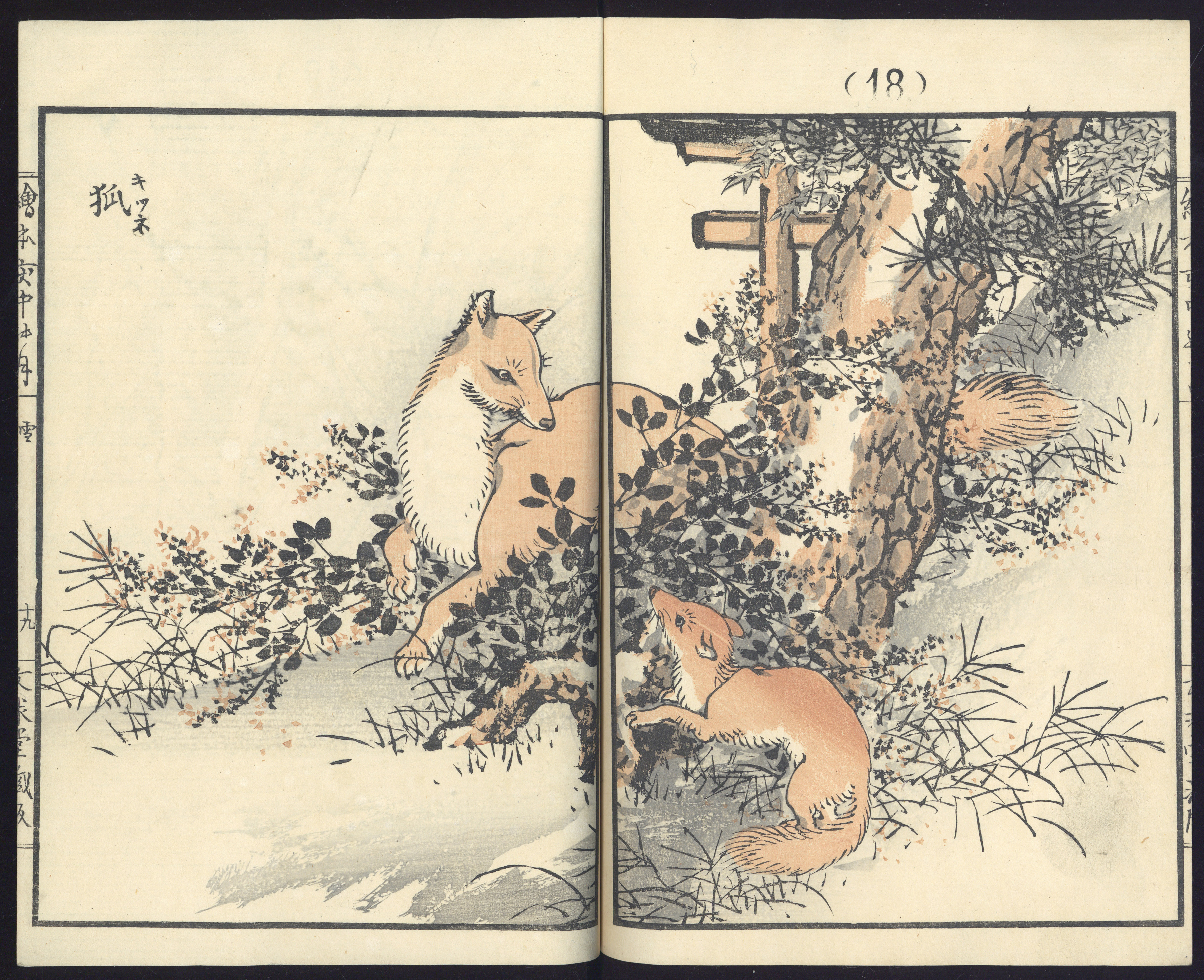
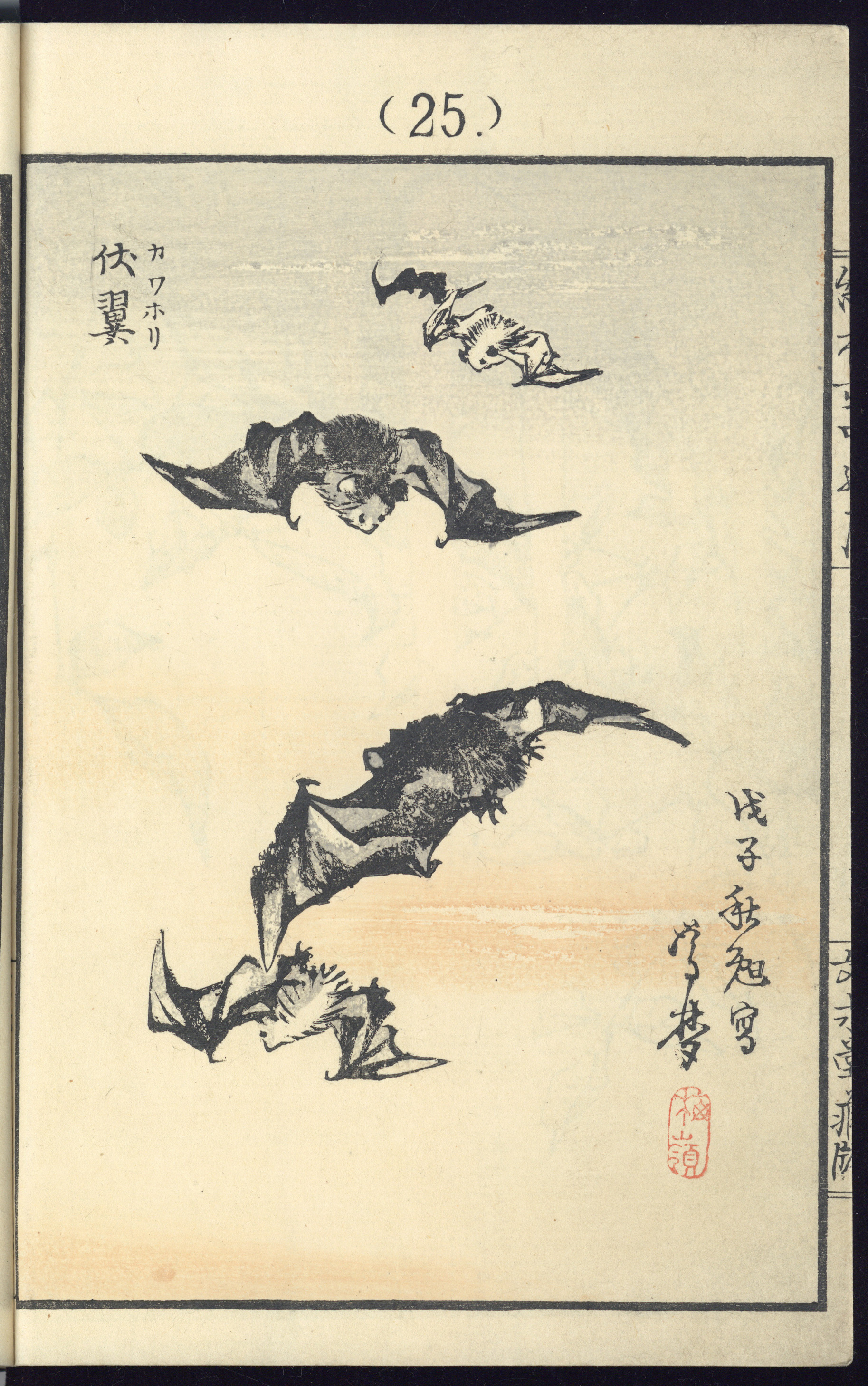
Ukiyo-e depictions of the natural world are also known as kacho-e, and an array of wildlife appear on the books’ pages, including bats, foxes and turtles. Japanese art is renowned for the symbolism vested in its images – not just in the animal subjects, but a whole range of aspects including the scenery, colours and composition.

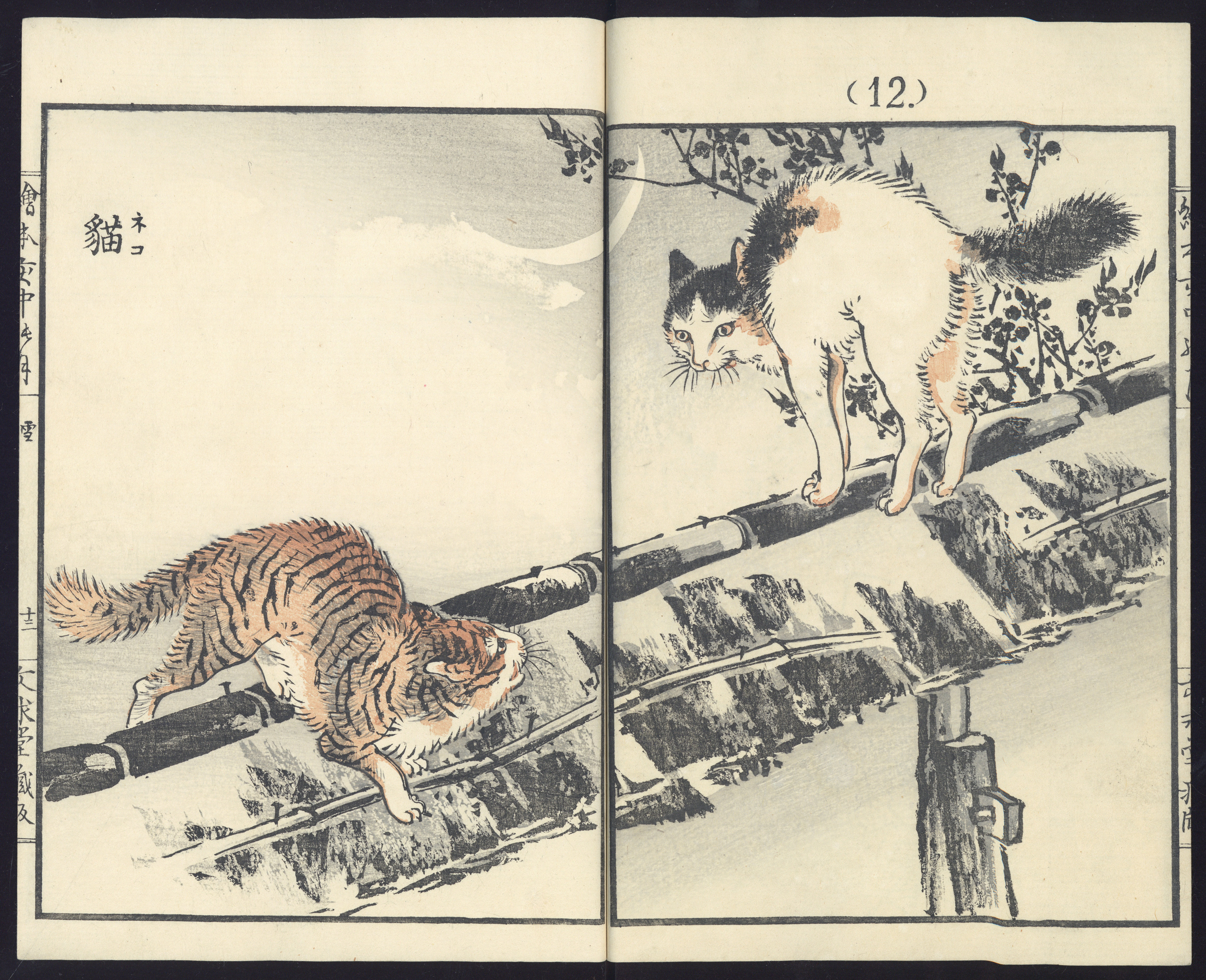
One of my favourite prints in the volume is a double page spread of cats fighting on a branch. It provides a nice excuse to share this treasure on International Cat Day (#internationalcatday).

Written by Alex Healey, Project Archivist

Three Weddings and an Election – new Trevelyan albums on Digital Showcase

Another instalment of digitized Trevelyan family albums is now available to view on our Digital Showcase. A further three albums are now live, each including contextual information allowing you to learn more about the people, places and events shown in the images.

The three newly launched albums are Volume 2 (1903-04), Volume 7 (1912-16) and Volume 10 (1921-23).

In the earliest of these volumes we see the announcement of Charles Philips Trevelyan and Mary Katharine [Molly] Trevelyan’s engagement, and their first year spent as man and wife. The photographs and newspaper cuttings contained in the album give an insight into the Trevelyan wedding, while also showing other society weddings from the period. This notably includes Charles’ brother, the renowned historian George Macaulay Trevelyan’s marriage to Molly’s friend Janet Penrose Ward, daughter of author Mrs Humphry Ward; and Molly’s cousin Florence Lascelles’ engagement and marriage to British Diplomat Cecil Spring Rice. We also see Charles’ growing political career, with the Land Values Bill and the 1904 election also appearing.

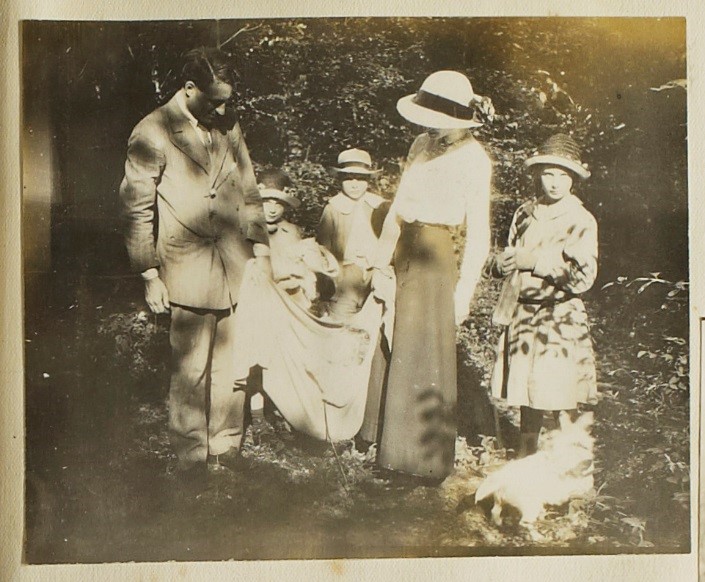
The volumes from the early 1910s through to the 1920s allow us to see the Trevelyan children grow from infants through all stages of childhood, into adults. The earlier stages of Volume 7 focus on Pauline (later Dower), George Lowthian and Katharine [Kitty] Trevelyan. We see the children enjoying dressing up, playing outdoors and arts and crafts. We are later introduced to Marjorie Trevelyan (later Lady Weaver) born in 1913, whose first steps are documented, as well as the arrival of twins Florence Patricia and Hugh Patrick Trevelyan born in 1915. This is a very brief glimpse into Hugh’s short life as he passed away a month after his first birthday.

Combined with the newspaper cuttings which appear, Volume 7 shows us two sides of Charles: the politician who conscientiously objected to the First World War, and the family man who led his son’s Boy Scouts group. We also see Molly’s political and community involvement through the inclusion of invitations and cuttings.

In the final volume of the instalment, we see the close ties between the Trevelyan’s, their extended family and their community. There are photographs and prizes from the Cambo Exhibition along with various plays and concerts. Pictures of Molly’s needlework are also including – the work is still exhibited at Wallington today.

This volume also tracks the 1922 election campaign, during which Charles successfully stood as the Labour candidate for Newcastle Central, a seat he would hold until 1931. We see Ramsay MacDonald become Prime Minister and follow the early stages of the new Labour government.

By Megan Wilson