Bubbles and echos: are you surrounding yourself with fake news?

Librarians have been warning people about ‘Fake News’ for many, many, many, many years – how to find and select reliable, authoritative, quality resources is at the heart of any good library teaching session.  In a way we librarians have to thank Mr Trump for making Fake News a popular term; he has made everyone aware that there are fake stories out there and that there has been for centuries (see our historical time-line of Fake News).

2019 is NU Library’s third year of promoting awareness of Fake News, and by looking at the large number of visits to our Fake News Guide over these three years (4,672 visits in total), and again thanks to Mr Trump, it’s not something that’s going away anytime soon.  So we Librarians will continue our quest of highlighting all information that is fake for the greater good.

Until I went to Librarian’s Fake News conference last year, I hadn’t heard of the terms ‘Filter Bubble’ and ‘Echo Chambers’ in relation to Fake News.  However, once explained hopefully it will make you more aware of what information/news stories you read via the likes of Google, Facebook and Twitter, and how they could potentially be fake.  So here is the low-down on what these terms mean and how you can avoid falling into their traps; we’ve also offered the alternative view that they’re a load of old nonsense so you can decide for yourselves…

What is a ‘Filter Bubble’?

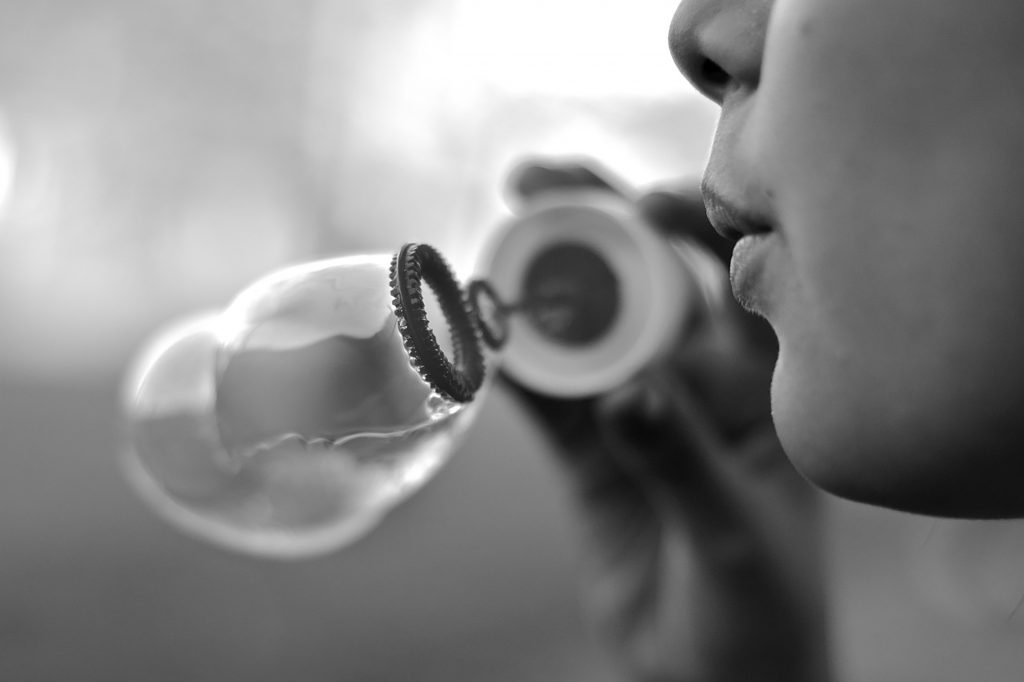
A Filter Bubble is when you are in a virtual bubble on social media – you only encounter information and opinions that agree with or reinforce your own beliefs.  Your ‘personalised’ online experience is the result of algorithms that work away in the background and dictate what you see/read online. Google, Facebook, Pinterest, Netflix, YouTube and many more all do this.

These Filter Bubbles in turn create Echo Chambers…

What are ‘Echo Chambers’?

When information within a closed system online is only giving you (‘echoing’) back your opinion and beliefs and establishing confirmation bias (only accepting information that confirm your own opinion and beliefs).

What are the dangers?

As much as I enjoy Facebook fuelling my love of funny dog videos by suggesting similar videos and articles, being aware of why and how Facebook is doing this helps when it comes to more serious topics such as the news, social issues and politics.

Regarding Fake News, confirmation bias is particularly worrying as you will start believing fake news stories that confirms your opinions and beliefs. I know I have done this, which is really scary to realise.

Watch this short TedTalks video from Eli Pariser on the dangers of Filter Bubbles:

You could argue that this type of ‘personalisation’ is editing the web – only showing you one half of the story.  So what can you do to pop the bubble?

What can you do to stop the bubbles and echoes?

There are a few simple things you can do to stop this and open yourselves up to a wider web:

  • Read news sites, websites and blogs that offer a wide range of perspectives, such as the BBC.
  • Use Incognito browsing, delete search histories and try and resist the temptation of logging into your accounts every time you go online.
  • Deleting or blocking browser cookies – these cookies hold the algorithms that determine what we see.
  • Turn off your curated feed in Facebook.
  • Click ‘Like’ on everything! – This will tell the AI that you are into everything – all politics, all news etc.
  • Don’t clink on links, especially politics and social issues – will stop fuelling the algorithms.
  • Tell everyone else to turn off their curated feed!

Is it all a myth?

Below are a few articles that claim Filter Bubbles and Echo Chambers are myths and that it’s not the technology at fault, but rather the user. I’ll let you decide:

Dubois, E. and Blank, G. (2018) The myth of the echo chamber. Available at: https://theconversation.com/the-myth-of-the-echo-chamber-92544. (Accessed: 27 March 2019).

Robson, D. (2018) The myth of the online echo chamber. Available at: http://www.bbc.com/future/story/20180416-the-myth-of-the-online-echo-chamber. (Accessed: 27 March 2019).

Schwab, P. (2017) Academic research debunks the myth of filter bubbles. Available at: https://www.intotheminds.com/blog/en/academic-research-debunks-the-myth-of-filter-bubbles/. (Accessed: 27 March 2019).

Don’t burst my bubble!

Or maybe you like being in your own little bubble? The safety and comfort in knowing what information you are going to be presented with – nothing that offends or upsets your online world. I know I will carry on being fed humorous dog videos.

There are some interesting thoughts and opinions on the Social Network Bubble – the pros and cons – on this Radio 4 programme:

BBC Radio 4 (2017) Bursting the social network bubble. Available at: https://www.bbc.co.uk/programmes/b083p4lw. (Accessed: 27 March 2019).

References:

BBC Radio 4 (2017) Fave ways to burst your social media bubble. Available at: https://www.bbc.co.uk/programmes/articles/3n9yf0D5WxRZJGclBMtFGwK/five-ways-to-burst-your-social-media-bubble. (Accessed: 27 March 2019).

Farnam Street (2017) How filter bubbles distort reality: everything you need to know. Available at: https://fs.blog/2017/07/filter-bubbles/. (Accessed: 27 March 2019).

Grimes, D. (2017) Echo chambers are dangerous – we must try to break free of our online bubbles. Available at: https://www.theguardian.com/science/blog/2017/dec/04/echo-chambers-are-dangerous-we-must-try-to-break-free-of-our-online-bubbles. (Accessed: 27 March 2019).

Everyday life and Mass Observation

Vintage documents

Mass Observation. Wow, sounds intriguing, doesn’t it? It should!

This resource offers revolutionary access to one of the most important archives for the study of Social History in the modern era. You can log in using your Newcastle University Campus ID and password to explore original manuscript and typescript papers created and collected by the Mass Observation organisation, as well as printed publications, diaries, photographs and interactive features dating from 1937 to 1972.

If you’re interested in learning more about the topics currently influencing our lives, it would do no harm to research the social history topics available within Mass Observation such as anti-Semitism, the economy, austerity, education, women at work, religion, mining, news, the Government, smoking, drinking, sexual behaviour, propaganda, unemployment and writing (to name just a few!).

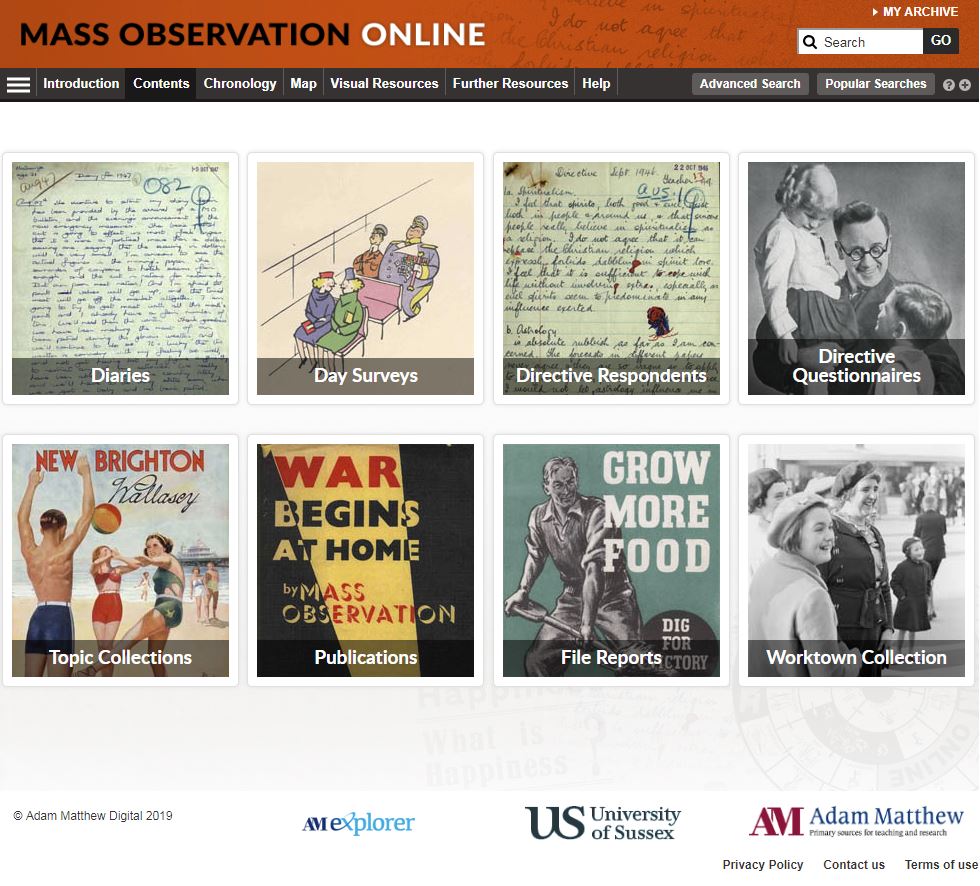
Mass Observation home page

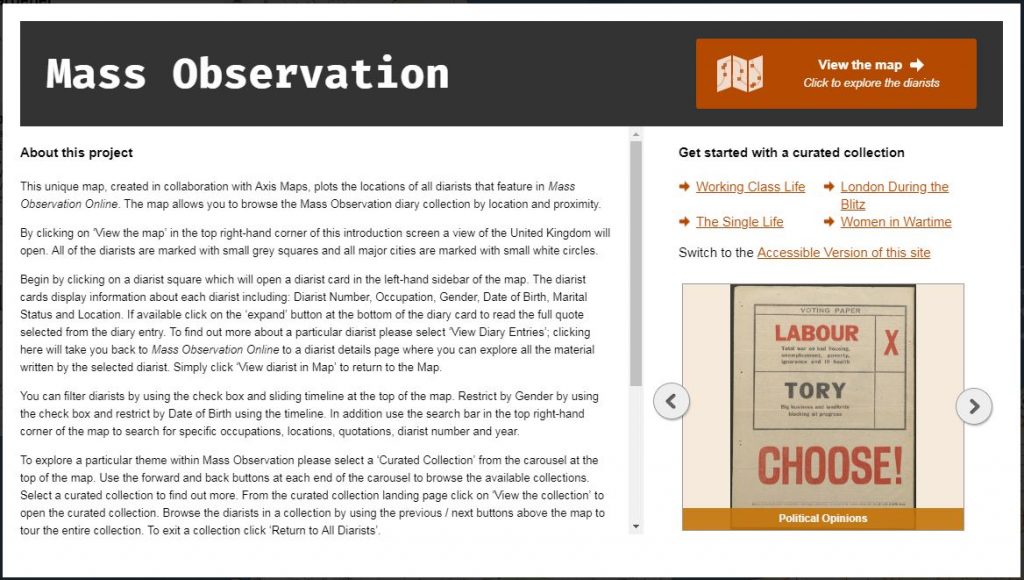
Mass Observation Diarist maps

If you want to know more about Mass Observation and to see some samples from the collection, then you could take a look at the Mass Observation Twitter feed, or there is a recorded webinar available for you to watch via YouTube in order to get the best out of the resource.

Top tips to get you started with revision

A person writing at a desk

Hoping to get some revision done during the Easter Vacation?

Here are some tips to get you started:

1. Have a look at our MCQ collection in the Quiet study area of the Walton Library. This collection has books with MCQs, EMQs, SBAs, OSCEs and other self  assessment and answer questions on many different subjects including;  anatomy, medicine, physiology, surgery and more. Look out for the green stickers on the spines of the books.

2. Check out the the Exams and Revision Section on the ASK (Academic Skills Kit) webpages for more help.

3. Remember to take regular breaks.

4. Stay well hydrated, eat properly and get some exercise.

5. Remember to check the date, time and place of your exam well in advance of  the day, make sure you know where you are going.

Have a good Easter Vacation. Happy revising and Good Luck in the exams when you get back.

Image by Shurriken from Pixabay

From all the staff in the Walton Library.

Medicine in Literature – some thing different for your Easter Reading

Medical Humanities or Narrative Medicine is a popular academic discipline that explores the crossroads between medicine and the arts.

Our Medicine in Literature collection captures the complexities of what it means to be human through a wide range of literary genres.

These resources range from fiction, non-fiction including medical history, ethics and memoir, graphic novels, poetry and prose or medicine as metaphor, to films. Representations of illness, dis-ease, healing and health are interwoven themes that give voice to a diversity of perspectives and personal experiences of the human condition.

If you’re interested in exploring your subject field from a different viewpoint or simply want a break from revision this Easter, dive right in! The physical stock is located in the Quiet Study area of the Walton Library or you can browse the collection from our Library Guide.

Please email any resource recommendations to lib-medlit@ncl.ac.uk.

See the Top 10 Medicine in Literature books borrowed from the collection this year.


Level Up Your Referencing: Cite Them Right

A person writing at a desk

You already know that referencing is important – it not only gives credit to the original creator of a work you have used but also helps to highlight your skills as a researcher; showing that you have read around your topic, found relevant information, applied it to your arguments and used it to develop your own ideas.

However, when it comes to referencing, all of those punctuation rules, different styles and the vast array of document formats can seem overwhelming. Happily, we’ve got a great resource to help you work out your references in three easy steps!

Cite Them Right:

‘Cite Them Right’ is a fantastic referencing guide that provides clear instructions and examples for how to reference a wide range of documents including books, journals, websites and audio-visual materials.  Available as both a physical textbook and an online tool, ‘Cite Them Right’ helps you to format your references correctly using Harvard, American Psychological Association (APA), Modern Humanities Research Association (MHRA), Modern Languages Association (MLA), Oxford Standard for the Citation of Legal Authorities (OSCOLA), Vancouver or Chicago referencing styles.

(Remember to always use the referencing style recommended by your school.)

Three steps to an accurate reference:
  1. Search for the type of document you want to reference on Cite Them Right online using the search box at the top right of the screen or by browsing the drop down menus at the top of the page.
  2. Select the referencing style you need from the drop down menu at the top of the page.  This defaults to Harvard (author-date).
  3. Follow the example references given, copying the format to create your own reference in the ‘You Try’ box.

Why not have a go and create a reference for this blog post!

If you need some more advice on how to reference, take a look at our video:


Resource in Focus Megatrends on Passport

Passport is a global market research database that gives us statistics, analysis and reports on global markets, economies and consumers. As well as being able to search for statistics and analysis using keywords, browse by country, industry and economy, Passport highlights what they call Megatrends which are the major issues influencing consumer behaviour in today’s market.

Megatrends for the UK right now include population changes, healthy and ethical living, and middle class retreat. You can access the full reports from the Passport homepage while they give useful summaries on their YouTube channel.

To access the Newcastle University subscription to Passport and our other market research resources, visit our Market Research resource guide.

Future proofing your employability

“What would you guess is the most common job?” Michael Lai, Outreach Lead at KGI, asked an audience of students at his Columbia Heights TEDTalk back in 2016. His audience members offer a few suggestions. “Engineer?” “Fast food workers?”  After several failed attempts, Michael puts them out of their misery,

“3.5 billion truck drivers in the United’s States” he tells them. “Experts predict that in the next 12-15 years, most of the cars on America’s highways will be self-driving… so what’s going to happen to the most common job?”

The future of the job market – and it’s inherent uncertainty – has been receiving a lot of attention in the international press in recent years, with Universities UK analysis predicting “65% of children entering primary schools today will work in jobs and functions that don’t currently exist.”  In previous generations, new graduates could expect to work with the same company for several years, steadily climbing the corporate ladder in a predictable, but reassuring linear way. In the 21st century however, the face of the job market is changing, and once you graduate, you may find yourself looking at a “portfolio career” over traditional career progression – something Facebook COO Sheryl Sandberg described as more akin to a career “jungle gym” than a career ladder.

But what does all this talk of truck-driving and emergent markets mean for you, the UK Graduate? Well, if the gig economy becomes the norm in the next 10 years, one of the key challenges for new graduates will be the perpetual need to upskill yourself, and market your own skill base to different employers. This puts the spotlight on what have traditionally been referred to as “soft” transferable skills that are required across many different roles and sectors – skills such as resilience, team-working and critical thinking. Here at the Library, we’d argue that information and digital literacy falls under this bracket (well of course we would, we’re librarians!). The ability to find and use information and make considered use of digital tools is an important capability in any graduate job. Don’t just take our word for it – we spoke to several students returning from placement who told us their information skills had helped them get ahead.

The good news though is that your degree programme offers you the chance to work on and demonstrate all of these skills. Employers will know that you may not have extensive work experience as a new graduate, but make sure you cherry-pick prime examples from your University work, part –time jobs and any voluntary experience to exemplify the skills employers are looking for (and remember, the Careers service can help you with interview preparation.) Make the most of the workshops and sessions open to during your time at University so you are in a great position to articulate these important skills. For more information on how the Library can help, check out our Employability Guide

References

  1. TEDx Talks (2016) Four Key Skills to Lead the Future. Available at: https://www.youtube.com/watch?v=djHTcES2ATg
  2. Universities UK (2018) Solving future skills challenges. 6th August 2018. Available at: https://www.universitiesuk.ac.uk/policy-and-analysis/reports/Documents/2018/solving-future-skills-challenges.pdf
  3. Sandberg, S as quoted by Lebowitz, S and Campbell, D (2019) “Goldman Sachs CEO David Solomon shares his number one piece of advice for millennials who want to get ahead in their careers.” Business insider, Jan 13th 2019. Available at:  https://www.businessinsider.com/career-advice-millennials-goldman-sachs-ceo-david-solomon-2019-1?r=US&IR=T